
AI can move fast. Much faster than the people who must live with its choices. That is why “human oversight” matters. It is the practical act of making sure a real person can watch, pause, correct, and improve an AI system before it harms users, customers, or your company. If you are building AI in robotics, health, finance, hiring, security, or any system that touches real life, oversight is not a “nice to have.” It is part of building a product people can trust—and investors can back.
At Tran.vc, we see this up close. Technical teams often build a strong model, ship it, and only later realize they cannot explain what it did, why it did it, or how to stop it when it goes wrong. That is when deals slow down. That is when pilots stall. That is when legal and safety questions turn into expensive delays. The good news is that oversight does not need to be heavy or slow. If you design it early, it becomes a simple set of controls and habits that protect your product and your roadmap.
And there is another reason to care: oversight connects to IP. When you build a new way to monitor, intervene, and guide AI safely, that can become protectable know-how. For deep tech founders, that is a real edge. It is not just “compliance.” It is product strength and a defensible moat. If you want help turning these ideas into a strong IP plan from day one, you can apply anytime here: https://www.tran.vc/apply-now-form/
What “human oversight” actually means in real systems
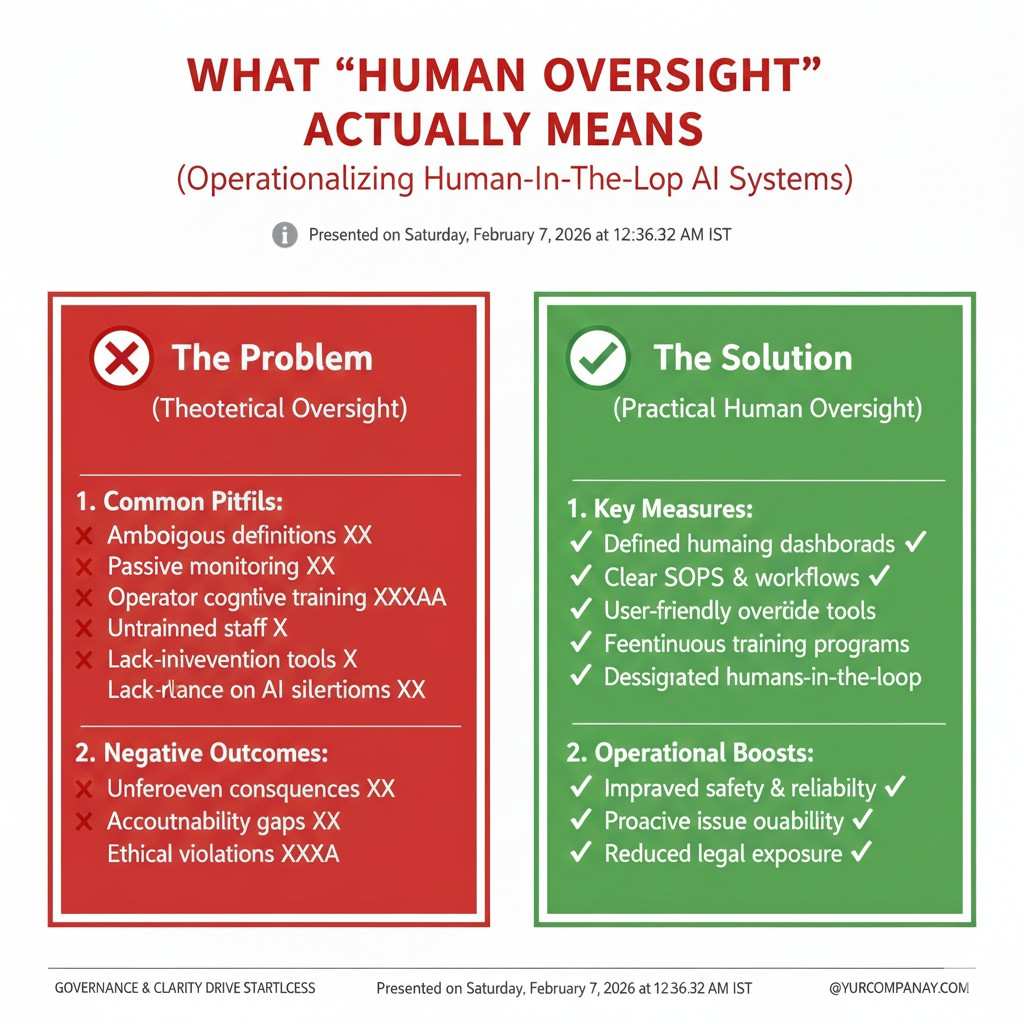
A lot of people hear “human oversight” and picture someone staring at a screen all day, ready to click “stop.” That is not how strong systems work. Human oversight is more like guardrails plus a clear plan for when the AI is allowed to act alone and when it must hand off to a person.
In practice, oversight means three things.
First, the AI must be easy to understand at the level that matters. Not in a research paper way. In a “what should I do next?” way. If a model flags a transaction as fraud, the human reviewer must see why it was flagged, what evidence the model used, and what the reviewer should check before deciding. If a robot arm slows down near a worker, the operator must know what sensor triggered it and what condition will clear the stop. If a customer support bot refuses a refund, a manager must be able to see the exact reason and reverse it.
Second, the AI must be easy to control. This is where many systems fail. Teams ship a model that can output answers, but they forget the control layer. Oversight demands clear control points: pause, rollback, override, rate-limit, or switch to a safer mode. If your AI can take actions, there must be a safe way to prevent actions when risk is high. If your AI can learn from new data, there must be a safe way to stop learning when the data is messy or hostile.
Third, oversight must be designed into the workflow, not bolted on later. The best systems do not add “a human review step” at the end. They design the entire process around what humans do best and what AI does best. Humans are good at judgment, context, and values. AI is good at speed, pattern finding, and consistency. Oversight is the bridge between those strengths.
If you are building a startup, this bridge needs to be thin, strong, and simple. It should not slow every request. Instead, it should focus attention on the few moments where mistakes are costly.
Where oversight breaks down (and why it keeps happening)
Oversight fails most often for one of four reasons.
One, the AI’s output is too polished. This sounds odd, but it is true. When AI writes with confidence, humans trust it too much. The person reviewing stops thinking. The model becomes the “boss” without anyone saying so. This is called automation bias. Your oversight plan must assume this will happen and must work even when people are tired, busy, or new.
Two, there is no clear line between “advice” and “action.” A model that “recommends” a loan decision can still be a loan decision if staff treat it that way. A model that “suggests” a medical note can still shape care. If your system touches high stakes outcomes, you need a clear rule: when is the human deciding, and when is the machine deciding? That rule must show up in the product, not just in a policy doc.
Three, the system does not record the right facts. When something goes wrong, the team cannot answer basic questions. What input did the model see? Which version of the model ran? What prompt or config was used? What did the model output? Who approved it? What happened next? If you cannot answer these fast, you cannot fix fast. Oversight without records is a feeling, not a system.
Four, your “human in the loop” is not real. Sometimes the “human reviewer” is a checkbox. Or it is a person who cannot override the system. Or it is someone who does not understand the task. That is not oversight. That is theater. Real oversight gives real power to the human role, plus training and clear choices.
If this sounds like a lot, it can be, but you can design it in a clean way. The trick is to match oversight to risk.
Risk-based oversight: stop treating every decision the same
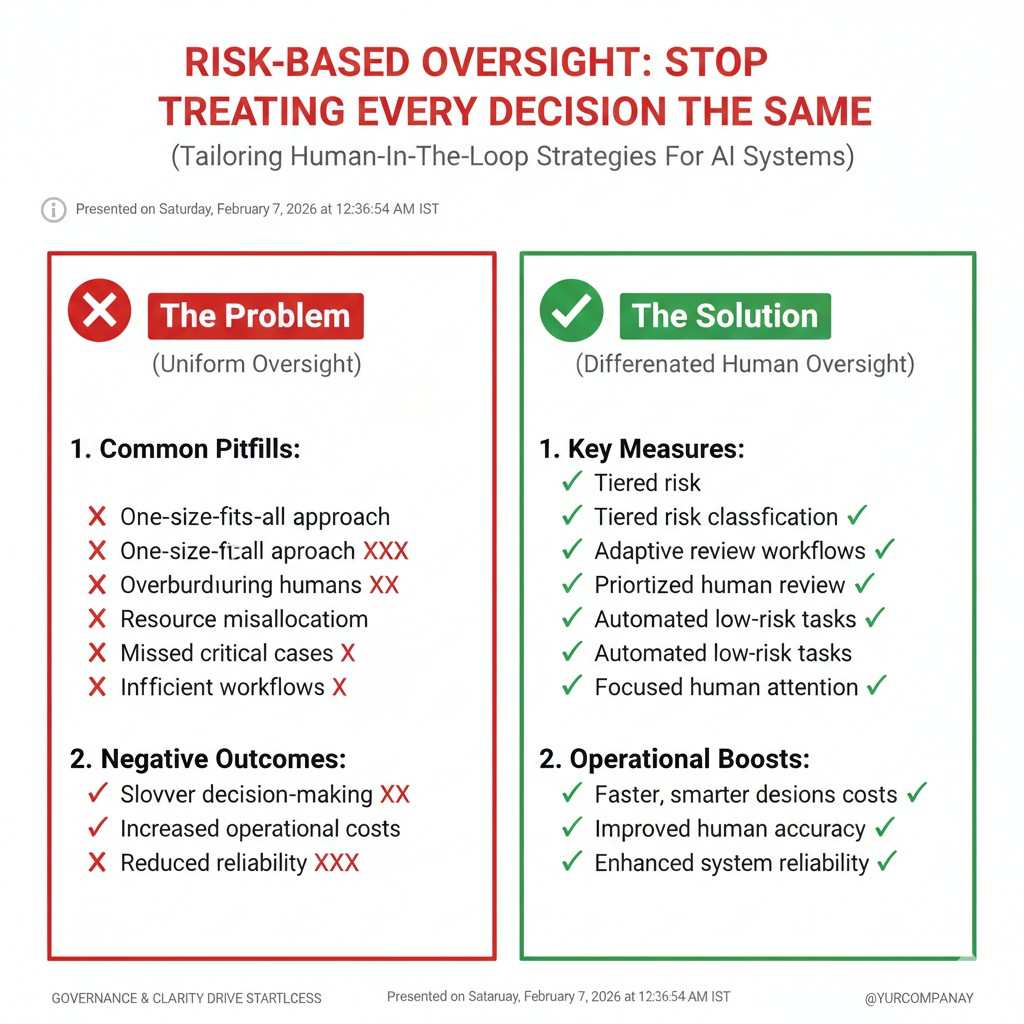
Not every AI output needs the same level of review. If your system suggests a subject line for an email, that is low risk. If your system controls a drone, that is high risk. The oversight you need should match the harm that could happen if the system is wrong.
A simple way to think about risk is to ask: “If the model is wrong, who gets hurt, and how hard is it to undo?” If the harm is small and easy to fix, you can allow more automation. If the harm is big, personal, or hard to undo, you must add stronger human control.
This is where founders can be practical. You do not need a big committee. You need a short risk map for your product. Break down your AI features into parts. Which parts only inform? Which parts decide? Which parts act in the real world? Then design oversight for each part.
For example, consider an AI system used in a warehouse robot. Route planning might be low to medium risk if the robot moves slowly and avoids people. But collision avoidance is high risk, because a mistake can hurt someone. So route planning can be mostly automated with light monitoring, while collision avoidance needs strict safety checks, clear stop rules, and logs for every event.
Or consider an AI that helps with hiring. Summarizing resumes might be lower risk if a recruiter still reads the original. But ranking candidates and rejecting people can be high risk because it can create unfair outcomes that are hard to detect. In that case, oversight should focus on the ranking and rejection steps: require reasons, require review for edge cases, and track outcomes over time.
The oversight principle is simple: the closer your AI gets to making a high-stakes call, the more human control it needs.
Three common oversight patterns (and how to choose)
Most real systems use one of these patterns, sometimes mixed.
The first is “human before action.” The AI produces an output, but a human must approve before anything happens. This fits high stakes actions like sending legal notices, closing accounts, changing medical orders, moving robots near humans, or pushing changes to production systems. The main risk here is speed. If humans approve too many things, they rush and stop paying attention. So this pattern works best when you keep the number of approvals small by only requiring review for high-risk cases.
The second is “human after action.” The AI acts, but humans review later. This can work when harm is limited and reversible, like routing support tickets, tagging content, or drafting internal notes. The key is that the review must lead to change. If humans review but nothing improves, the loop is broken. You must have a clear path from review to fixes, whether that is tuning prompts, updating filters, changing policies, or retraining models.
The third is “human on exception.” The AI acts in normal cases but stops and asks a person when confidence is low, when signals conflict, or when something unusual happens. This is often the best pattern for startups because it scales. It keeps humans focused on the hard cases. But it only works if your exception triggers are well designed, and if “asking a human” is a smooth part of the workflow.
Choosing a pattern is mostly about reversibility and speed. If you cannot undo harm, put a human before action. If you can undo harm but still need safety, use human on exception. If you can undo harm and the harm is minor, human after action may be fine—if you actually do the review and improvement work.
Designing oversight that people will actually use
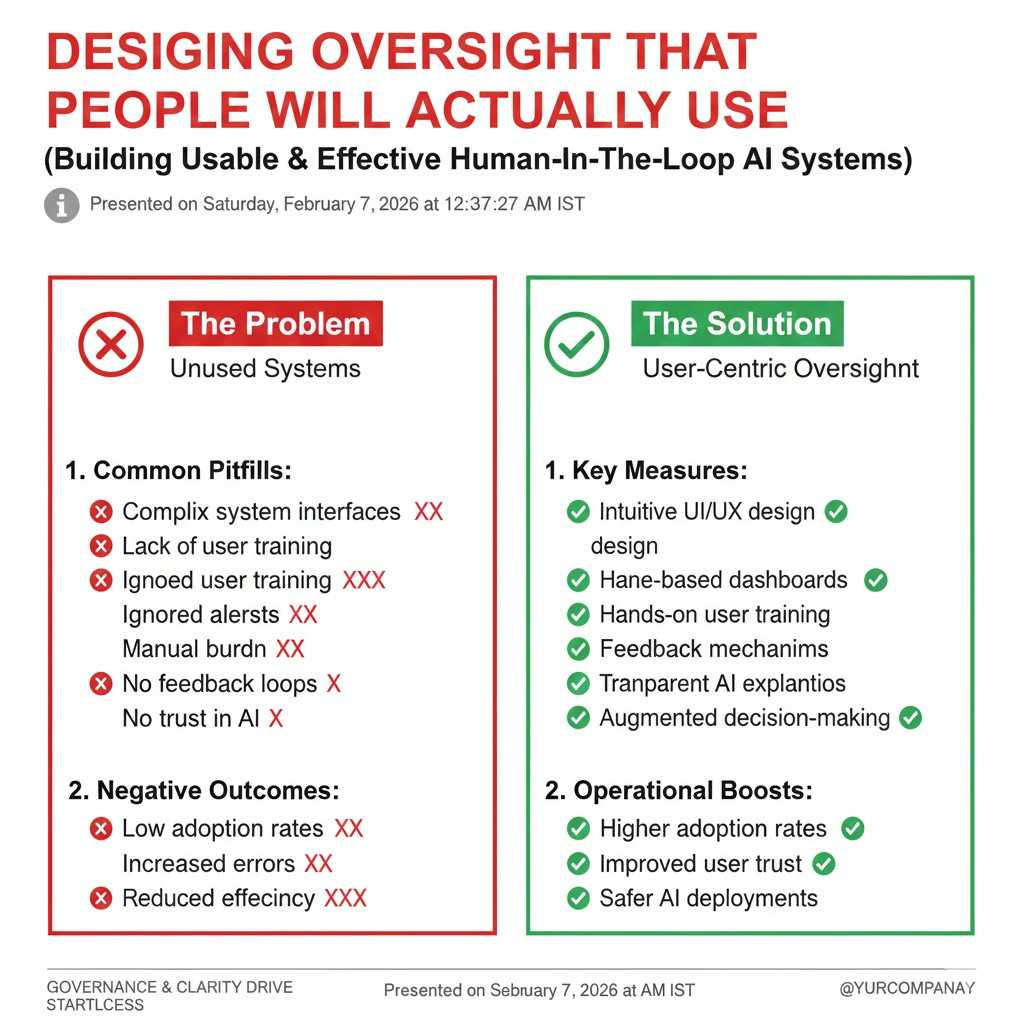
Here is the real test: will the person doing oversight use it on a busy day?
Most oversight plans fail because they assume perfect behavior. In real life, the reviewer is juggling ten things. They have two minutes. They might not be an expert. The interface must help them do the right thing quickly.
That starts with clarity. When the AI makes a recommendation, show the key facts that matter for the decision. Not a long explanation. Not a wall of numbers. Show what the model saw, what it is proposing, and what could go wrong. Then show what the reviewer can do: approve, edit, reject, escalate. Each option must be simple and clear.
Next, reduce “silent approvals.” If a human must approve, do not make the default path “approve and move on.” That creates rubber-stamping. Instead, design a small friction that forces thought. It could be a quick reason selection like “approved because: correct policy match,” or a short note field for high-risk cases. You do not want to slow every decision. You want to slow the decisions that matter.
Then, handle uncertainty honestly. Many AI systems show a confidence score. That is fine, but only if it means something. If your score is not well calibrated, it will mislead reviewers. A more useful approach is to show uncertainty as simple categories: “normal,” “needs review,” “unusual.” You can define these based on tests, drift signals, missing data, or model disagreement. The goal is not to be fancy. The goal is to guide attention.
Finally, make overrides safe. If a reviewer edits an output, that edit should not create a new risk. For example, if a support agent edits a bot reply, you still need checks for banned content, privacy leaks, or promises the company cannot keep. Oversight is not only about stopping AI mistakes. It is also about preventing human mistakes that happen when people are rushing.
By the way, building these oversight layers—controls, review flows, safe overrides, and event logs—often creates unique technical work that can be part of your IP story. If you want to protect that work early, Tran.vc can help you map it into a clear patent plan while you build. You can apply anytime here: https://www.tran.vc/apply-now-form/
The oversight checklist no one wants, but everyone needs
I will keep this tight and practical, not a long list. Think of this as a set of questions you must be able to answer.
Can a human stop the system quickly, without calling an engineer? That includes a pause switch, a safe mode, or a rollback. If the answer is “no,” you are not ready for real customers in high-risk settings.
Can a human see what the system did and why, in plain words? Not a full explanation of the math. A clear explanation of the reason for the action.
Can you trace each outcome back to the exact model version, rules, prompts, and data snapshot used at that time? If you cannot, you will struggle to debug and defend decisions.
Do you know what “good” looks like and are you measuring it? Oversight depends on monitoring. If you do not measure error types, user complaints, edge cases, and drift, your oversight is blind.
Can you improve the system based on oversight results, in a repeatable way? If every fix is an emergency patch, your product will never stabilize.
If these answers feel uncomfortable, that is normal. Many early teams move fast and postpone this work. The earlier you start, the cheaper it is.
Human Oversight Requirements for AI Systems
Why this topic matters right now
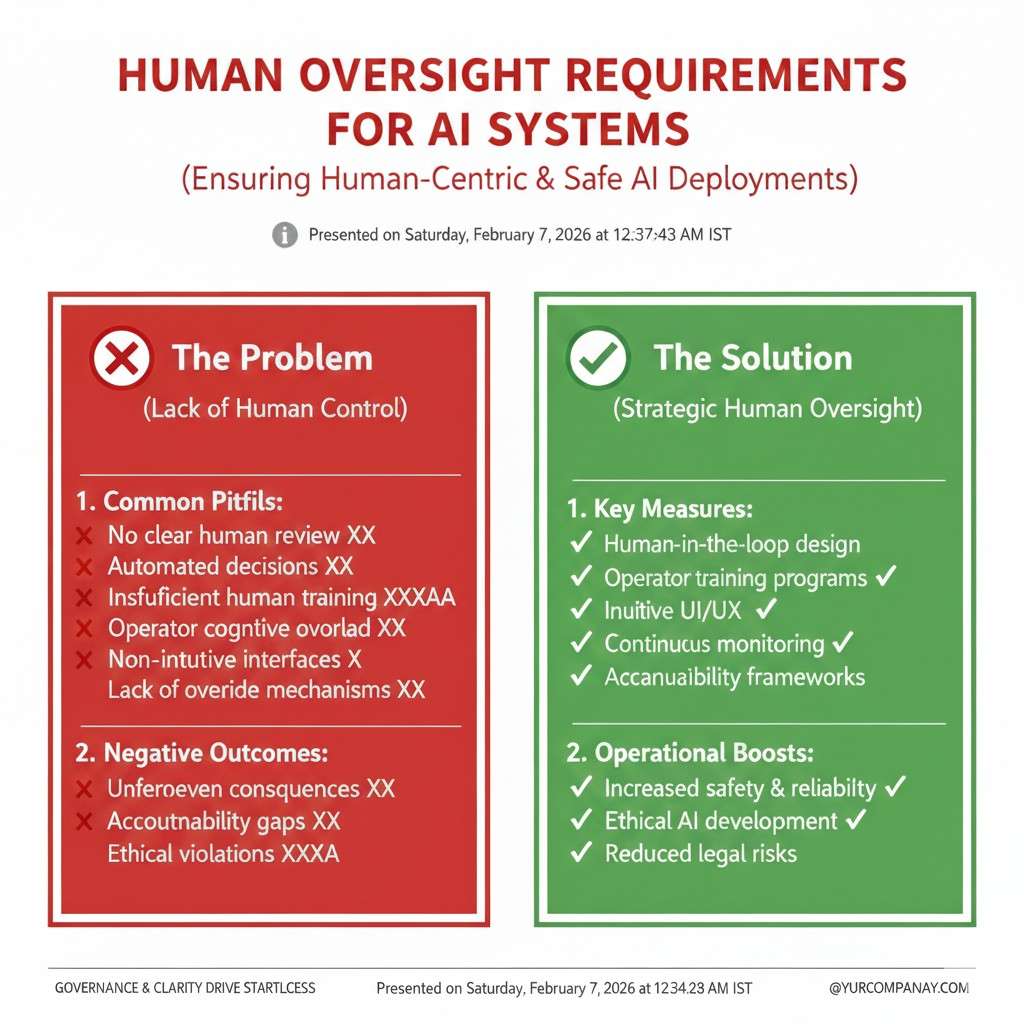
AI can move fast. Much faster than the people who must live with its choices. That is why “human oversight” matters. It is the practical act of making sure a real person can watch, pause, correct, and improve an AI system before it harms users, customers, or your company.
If you are building AI in robotics, health, finance, hiring, security, or any system that touches real life, oversight is not a “nice to have.” It is part of building a product people can trust, and investors can back. If you want help shaping this early, you can apply anytime at https://www.tran.vc/apply-now-form/
How founders get surprised by oversight
Most teams ship a strong model, get early traction, and only later realize they cannot explain what the system did, why it did it, or how to stop it when it goes wrong. That is when pilots stall. That is when legal questions appear. That is when enterprise buyers ask for controls you did not plan for.
The good news is that oversight does not need to be heavy. If you design it early, it becomes a simple set of controls and habits that protect your roadmap instead of slowing it.
Oversight is also part of your moat
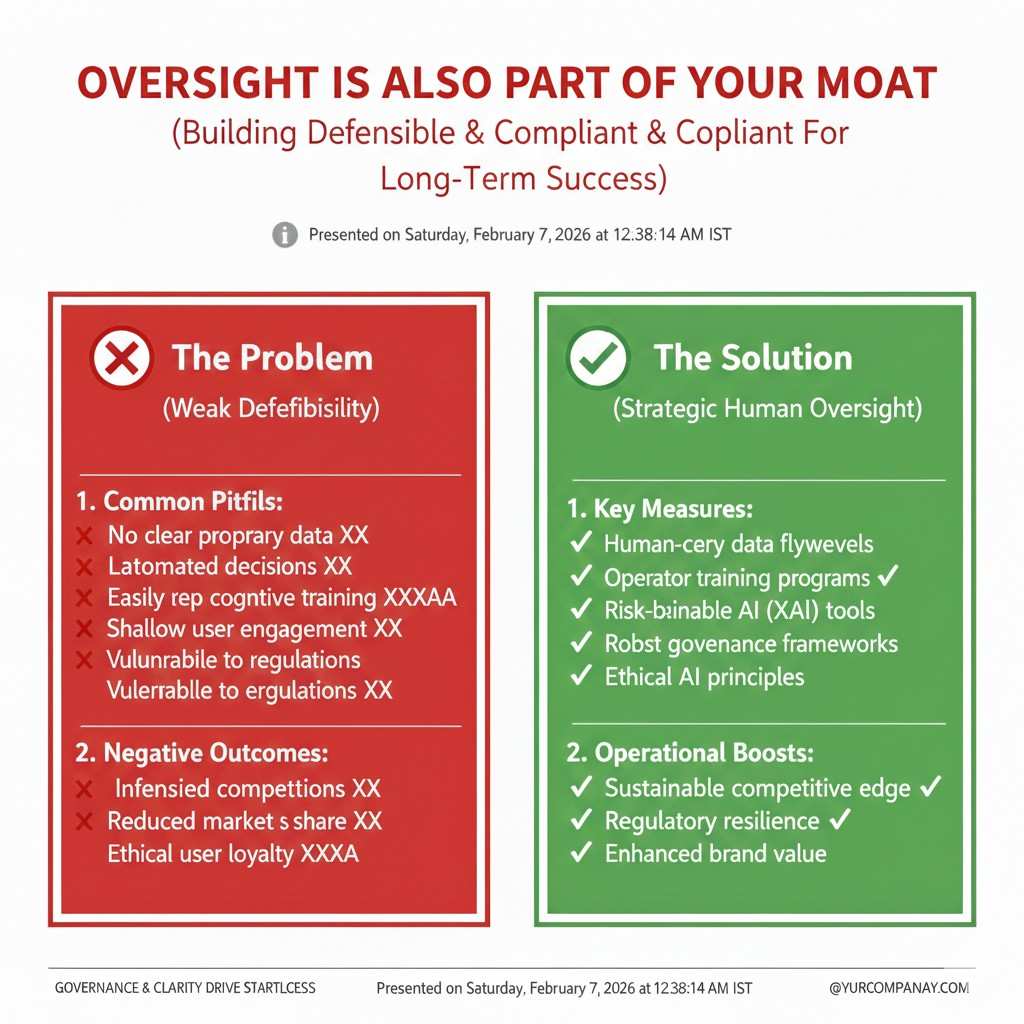
Oversight is not only a safety topic. It can also be part of your product edge. When you build a clear way to monitor, intervene, and guide AI safely, you are building hard-to-copy know-how.
For deep tech founders, this matters. A smart oversight layer can become protectable IP, especially when it connects to novel workflows, novel monitoring, and real-world constraints. Tran.vc helps teams turn this kind of work into an IP plan from day one. Apply anytime at https://www.tran.vc/apply-now-form/
What human oversight means in real AI systems
Oversight is not “someone watching a screen”
A lot of people hear “human oversight” and picture a person staring at a dashboard all day, ready to press stop. That is not how strong systems work. Good oversight is a design choice, not a job role.
In most products, oversight is a set of guardrails plus a clear plan for when the AI is allowed to act on its own and when it must hand off to a person. You decide this at the feature level, not as a vague policy.
The three things oversight must deliver
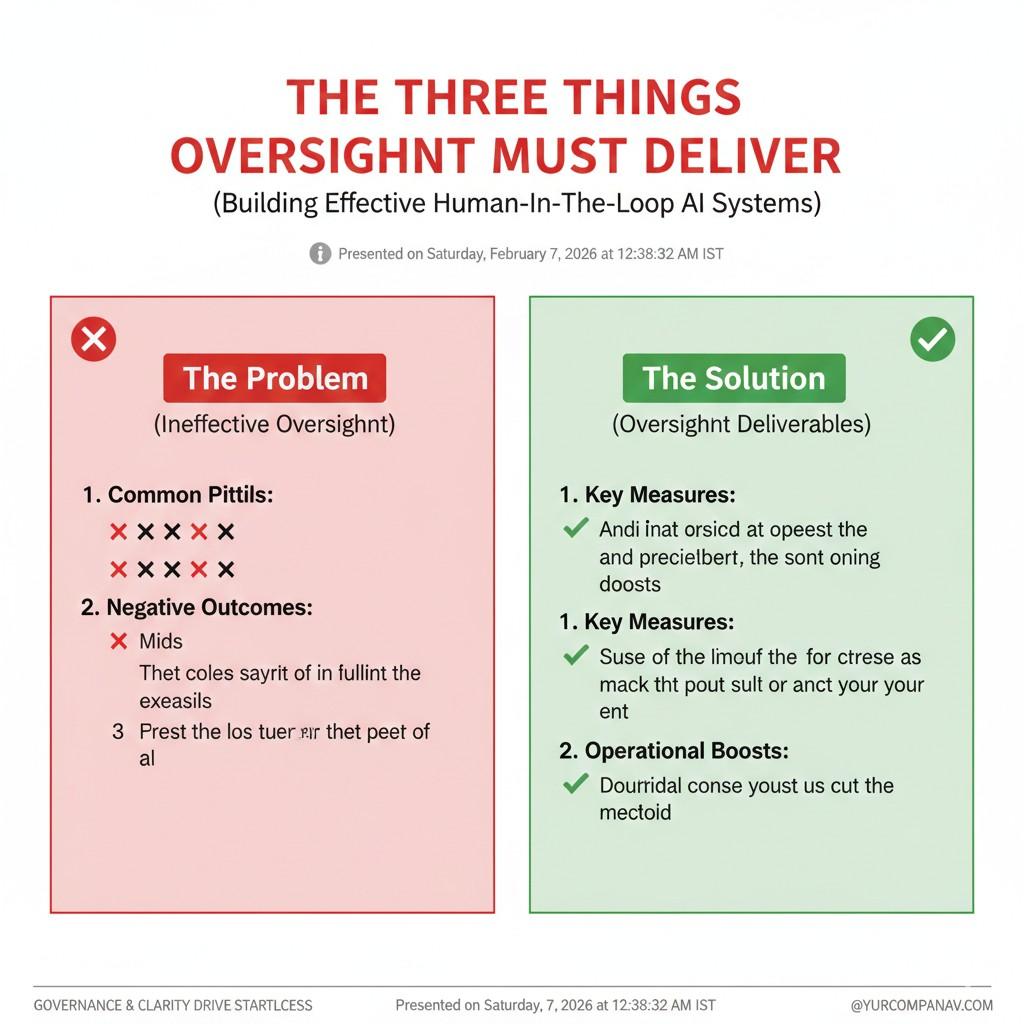
Oversight is real only when three things are true. First, the system must be easy to understand at the level that matters. Not in a research paper way. In a “what should I do next?” way that helps a reviewer decide in minutes, not hours.
Second, the system must be easy to control. A model that gives answers is not enough. Oversight demands control points such as pause, rollback, override, rate-limit, and safe mode. If you cannot slow the system down when risk rises, you do not have oversight.
Third, oversight must fit the workflow. If you bolt on a “human review step” after the product is built, you usually create pain. Review becomes a bottleneck, people rush, and quality drops. When oversight is designed into the flow, humans handle judgment and context, while the AI handles speed and consistency.
Where oversight shows up in day-to-day product work
In a real AI product, oversight appears in small product choices. It is the screen that shows a reviewer the right facts, not every fact. It is the button that lets them correct the output safely without breaking policy.
It is the logic that decides when the system must ask for help. It is also the record that logs what happened, so you can fix issues and explain outcomes later. These are not “extra” features. In many markets, they are the features that unlock real revenue.
Why oversight breaks down so often
The “confident answer” problem
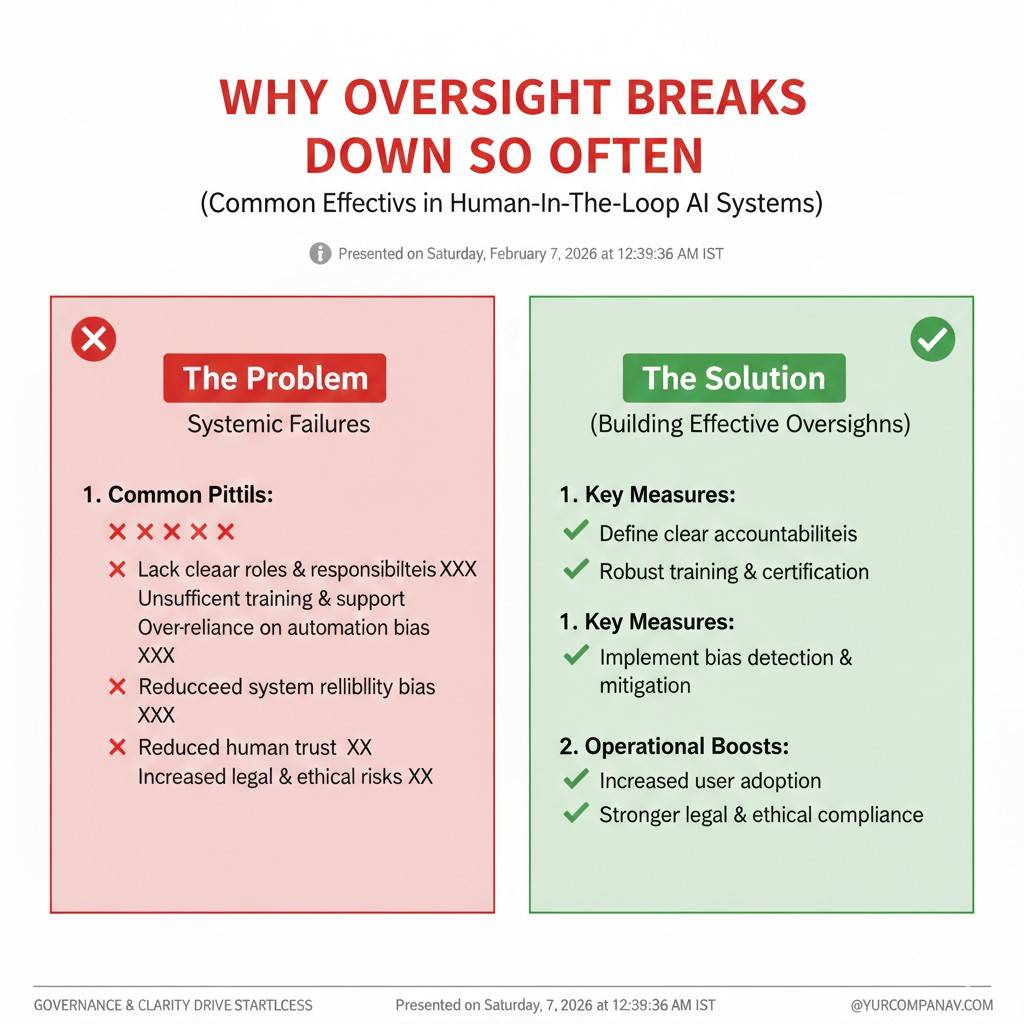
AI outputs can sound certain even when they are wrong. When text is smooth and confident, humans trust it more than they should. Over time, reviewers stop thinking, and the model becomes the default decision maker.
This is not a moral failure by users. It is normal human behavior. Oversight design must assume that people will over-trust automation, especially when they are busy or tired. Your product must help them stay careful without forcing them to become AI experts.
“Advice” becomes “action” without anyone noticing
Many teams say, “The AI only suggests.” But in practice, the staff treats the suggestion as the decision. A model that “recommends” who to interview can shape the final list, even if a human clicks the last button.
This matters because it changes risk. If the AI is shaping outcomes, your oversight must be strong enough for that reality. The system must make the handoff clear, so you can honestly say what humans decided and what the AI decided.
You cannot debug what you cannot trace
When something goes wrong, a serious buyer will ask basic questions. What input did the model see? Which version ran? What prompt, rules, and settings were used? Who approved the output? What happened next?
If you cannot answer quickly, you cannot fix quickly. You also cannot defend your product to customers, auditors, or partners. Oversight without clear records becomes guesswork, and guesswork becomes risk.
The “human in the loop” that is not real
Sometimes the “human reviewer” is a checkbox. Sometimes they cannot override the system. Sometimes they do not understand the task and do not have training. That is not oversight. It is theater.
Real oversight gives real power to the human role. It also gives clear choices and short guidance so the person can do the job well. If the reviewer is set up to fail, the whole system is set up to fail.
Matching oversight to risk
Why risk is the right starting point
Not every AI output needs the same level of review. If your system suggests a subject line for an email, the risk is low. If your system controls a robot near people, the risk is high. Oversight should match the harm that could happen if the system is wrong.
A simple way to judge risk is to ask two questions. If the model is wrong, who gets hurt? And how hard is it to undo? If harm is big or hard to undo, you need stronger control.
A practical way to map risk inside your product
Founders often think risk mapping needs a big process. It does not. You can do it feature by feature. Start by listing the moments where your AI influences a decision, not just where it produces text or numbers.
Then note which moments affect money, safety, rights, access, or a person’s future. Those are the moments where oversight must be clear. This approach keeps oversight focused. It also stops you from slowing down low-risk parts of the product.
Example: robotics and physical systems
In robotics, route planning can often be medium risk if the robot moves slowly and avoids people. But collision avoidance is high risk because a mistake can hurt someone in seconds. The oversight you need for those two features should not be the same.
Collision-related features often need strong safety checks, safe mode behavior, and logs for each event. They also need clear operator controls, so humans can stop or reroute the system fast. When you build this early, you reduce downtime and build trust with real customers.
Example: hiring and people decisions
In hiring, summarizing a resume can be lower risk if a recruiter still reads the original. But ranking candidates or rejecting people can be high risk because unfair patterns can hide inside the model and stay unnoticed for months.
Oversight should focus on the steps that shape outcomes. Reviewers should be able to see why someone was ranked the way they were, and they should be able to correct that safely. Over time, you also need outcome checks so you can spot bias drift, not just one-time errors.
Core oversight patterns you can design into products
Human review before action
In this pattern, the AI produces an output, but a human must approve it before anything happens. This fits high-stakes actions like closing accounts, sending legal notices, changing medical orders, or moving machines near people.
The risk here is speed and fatigue. If the reviewer must approve too many things, they start rubber-stamping. To avoid this, you should reserve this pattern for truly high-risk cases, and use smarter triggers for everything else.
Human review after action
In this pattern, the AI acts, and humans review later. This can work when harm is limited and easy to undo. For example, tagging content, routing support tickets, or drafting internal notes can be safe with a strong review loop.
The key is that the review must lead to changes. If humans review and nothing improves, you are only collecting complaints. Oversight becomes real when feedback becomes fixes in prompts, filters, policies, training data, or model choice.
Human review on exception
In this pattern, the AI runs in normal cases but asks a person for help when something looks risky or unusual. This is often the best pattern for startups because it scales. Humans focus on edge cases, where judgment matters most.
But exception review only works if your triggers are well designed. If you send too many cases to humans, you create a bottleneck. If you send too few, the system slips into unsafe behavior. The goal is a calm flow where humans handle the cases that truly need them.
Designing oversight people will actually use
Build for a busy reviewer, not a perfect one
Your oversight plan must work on a busy day. The reviewer may have two minutes, not twenty. They may be new. They may not know the full context. Your interface has to help them do the right thing quickly.
This starts by showing only the facts that matter. You do not need to dump raw model internals on the screen. You need clear signals that support a decision, and a simple way to confirm or correct.
Reduce “silent approvals” and rubber-stamping
If a human must approve, do not make the easiest path “approve and move on.” That creates weak oversight. Add a small moment of thought that forces attention on high-risk cases.
This does not mean long forms. It can be a short reason choice or a short note field in cases that matter. The goal is not to slow the team down. The goal is to prevent fast approvals when stakes are high.
Show uncertainty in a way that helps decisions
Many systems show a confidence score. That can help, but only if it is honest and stable. If the score is not well tuned, it gives false comfort. A clearer option is to show simple categories like “normal,” “needs review,” and “unusual.”
These categories can be based on missing data, drift signals, model disagreement, or policy rules. The job of uncertainty is not to look smart. The job is to point a human to the right cases at the right time.
Make overrides safe, not risky
When a human edits an AI output, the new output can still cause harm. For example, an agent might accidentally include private data, make a promise the company cannot keep, or share restricted details.
Oversight should include safety checks after edits as well. This is not about distrusting people. It is about building a system that protects everyone under pressure. Strong products assume mistakes can happen and reduce the blast radius.
Oversight connects to trust, sales, and IP
Why buyers ask about oversight early
Serious customers do not only ask, “How accurate is it?” They ask, “How do we control it?” They want to know how your system behaves on bad inputs, strange cases, and real-world pressure.
When you can explain your oversight design clearly, sales cycles get smoother. You also reduce late-stage surprises during security and risk reviews. Oversight is often the difference between a demo and a deployment.
Turning oversight work into protectable advantage
The control layer, the review logic, the exception triggers, and the monitoring flow can become hard-to-copy parts of your system. When these parts are novel and tied to real outcomes, they can support an IP strategy.
Tran.vc helps deep tech founders turn real product work like this into strong, defensible IP assets early, without giving up control too soon. If you want that support, apply anytime at https://www.tran.vc/apply-now-form/
A simple internal test for readiness
Ask yourself if a real human can stop the system quickly without calling an engineer. Ask if a reviewer can see what happened and why in plain words. Ask if you can trace each outcome back to model version, settings, and approvals.
If those answers are not clear yet, you are not behind. You are simply early. The best time to design oversight is before your first large customer forces it on you.