
If you build AI, you feel this pull every day.
On one side, you want the model that wins. The one that ships fast, hits the numbers, and makes users say, “Wow.” On the other side, you need answers. Clear reasons. Proof that the system is safe, fair, and steady when the real world gets messy.
This is the tension: explainability vs performance.
Many teams treat it like a trade. They think they must pick one. “Do we want the best score, or do we want something we can explain?” But in real products, you cannot live at either extreme for long. A model that is perfect on paper but cannot be trusted in the field will get shut down. And a model that is easy to explain but weak will lose deals and die in procurement.
The good news is you can balance both. Not by guessing. Not by adding a “shiny” explainability tool at the end. You balance both by making a few smart choices early, and by building the right habits while you build the model.
In this article, we will talk like builders. We will focus on what you can do this week, not vague ideas.
And if you are building a deep tech startup—robotics, AI, or hard science—this balance matters even more. It can decide if you close your first enterprise customer, pass a safety review, or raise your seed round with real leverage. This is also where Tran.vc helps: we back technical founders with up to $50,000 in in-kind patent and IP work so you can protect what matters while you build the product right. You can apply anytime here: https://www.tran.vc/apply-now-form/
What “Performance” Really Means in Real Products
Performance is not just a score

When people say “performance,” they often mean one thing: a leaderboard number. Accuracy. F1. AUC. Loss. Latency. Cost per call.
Those numbers matter, but they are only the start. In a real product, performance means the model helps the user finish a job, with fewer mistakes, in less time, and with less stress.
A model can have a great test score and still fail in the field. It may break when lighting changes, when data drifts, when users do strange things, or when the system meets rare edge cases.
So performance is not “How good is the model in a lab?” It is “How good is the whole system when it meets real life?”
Product performance includes the whole pipeline
If you build robotics, AI sensors, or automation, your model is never alone. It sits inside a chain: data capture, cleaning, feature build, model, post-processing, and then action.
The user does not care which part failed. They only see the result. If the output is wrong, they lose trust, even if the model itself was fine.
This is why high-performing teams track system performance, not only model performance. They ask, “Where do errors begin?” and “How do errors travel through the stack?”
That view becomes even more important as you scale, because small issues multiply across many users and devices.
Performance is always tied to a goal

Performance also depends on what you are trying to optimize.
If the goal is to catch fraud, you may accept more false alarms to stop real attacks. If the goal is medical support, you may need fewer false alarms to avoid panic and waste.
In robotics, you may prefer a slightly less accurate model if it is faster and helps the robot react in time.
So performance is not one number. It is a set of choices. You pick what “good” means, based on risk, cost, and user need.
What “Explainability” Actually Means
Explainability is not a fancy chart
Explainability is often shown as colorful plots and tool outputs. But explainability is not a tool. It is an ability.
It means you can answer the question, “Why did the model do that?” in a way that a real person can understand and accept.
That person may be a customer, a regulator, a safety lead, a clinician, a legal reviewer, or your own engineering team trying to debug a failure.
If the answer is too complex to act on, it is not useful. Explainability must lead to a decision, not just a report.
There are different “levels” of explanation
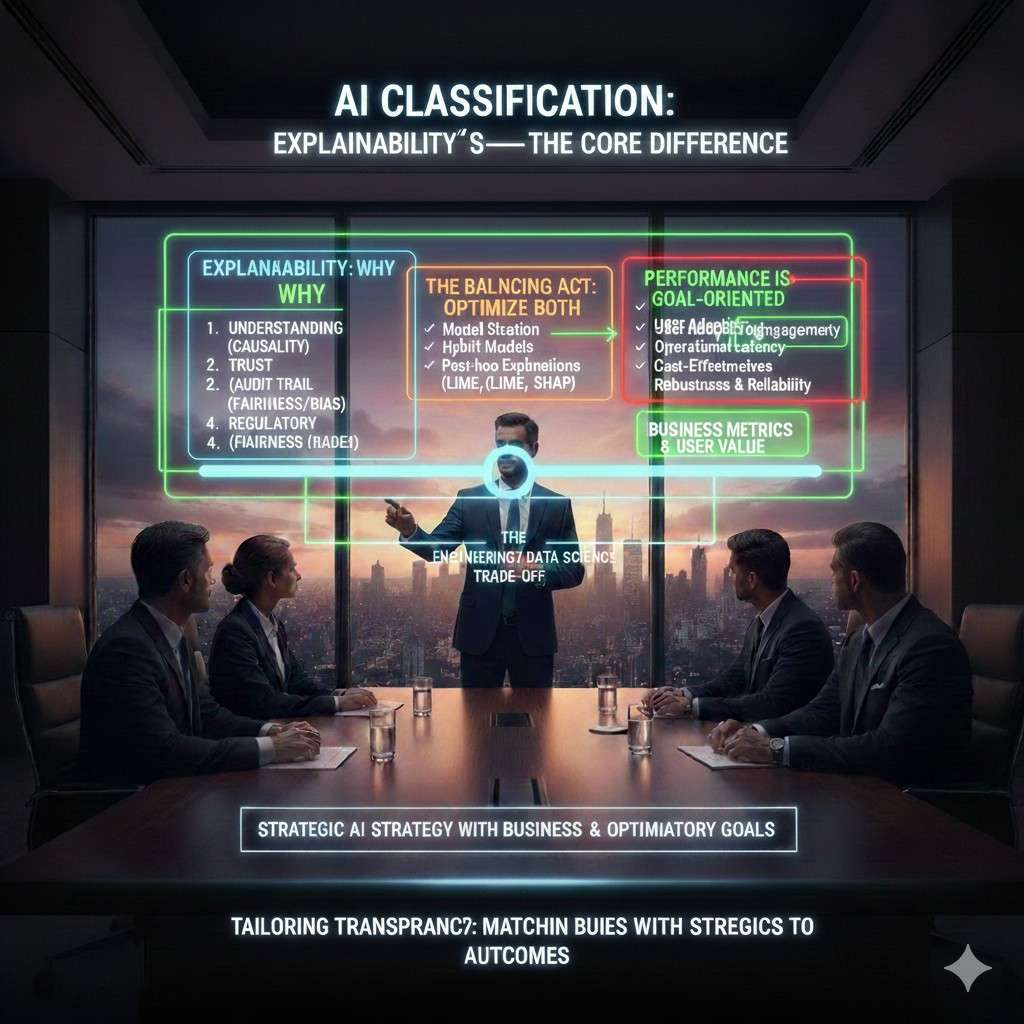
Not everyone needs the same depth.
A user may only need a simple reason, like “We flagged this because the invoice amount is far above your normal range.” That helps them decide what to do next.
An auditor may need to see which data sources were used, how the model was trained, and how drift is monitored. They need proof the system is controlled.
Your own ML team may need feature impact, counterfactual tests, and failure clusters to fix weaknesses. They need detail to improve the model.
So explainability is not one thing. It is a set of explanations designed for different people and different moments.
Explainability is also about predictability
Many teams miss this point. Explainability is not only “why.” It is also “when will it fail.”
A system is easier to trust when you know its limits.
If you can say, “This model is strong on these cases, weak on these cases, and here is how we detect the weak zone,” people feel safe using it.
That kind of clarity often matters more than a perfect explanation of every single prediction.
The Key Difference Between Explainability and Performance
Performance aims to win outcomes

Performance is about results. It focuses on whether the model meets the target in the real world.
It answers questions like: “Did we reduce costs?” “Did we increase throughput?” “Did we reduce defects?” “Did we prevent failures?”
It is tied to business value, user success, and system speed.
When performance is strong, the product works and customers want it.
Explainability aims to earn trust
Explainability is about confidence. It focuses on whether people can rely on the model when it matters.
It answers questions like: “Can we defend this decision?” “Can we audit it?” “Can we find the root cause when it fails?” “Can we show it is safe?”
It is tied to adoption, compliance, and long-term use.
When explainability is strong, the product is easier to sell, easier to keep, and harder to replace.
They pull in different directions for a reason

The reason they clash is simple.
The most powerful models are often complex. They learn deep patterns that humans do not naturally describe. That complexity can give you better outcomes, but it can hide the logic.
The most explainable models are often simpler. They are easier to describe, but they may miss subtle signals and reduce accuracy on hard cases.
This is not always true, but it is common. And if you act like the trade-off is fixed, you will limit yourself.
The real job is to decide where you need clarity, where you need raw power, and how to combine them without creating a fragile product.
Why This Balance Matters More for Startups
Enterprise buyers ask for both
Early-stage teams often think, “If we get great results, buyers will accept the black box.” That is rarely true in serious B2B.
In many industries, the buyer has to justify the purchase to a committee. They need clear reasons to sign a contract.
They also need a plan for risk. If they cannot explain what your system does, they will delay or reject the deal, even if your demo is strong.
So explainability becomes part of sales, not just engineering.
Your first big failure will happen in public

In a startup, you do not have the luxury of silent failures.
If a model harms a customer process, causes downtime, or makes a scary mistake, the story spreads fast inside that company. Trust is harder to rebuild than it is to earn.
Explainability helps you respond quickly. It lets you say, “Here is what happened, here is why, and here is how we fixed it.”
That speed can save a relationship.
IP and defensibility depend on how you frame the system
This is a part founders often overlook.
If you cannot explain what is unique about your approach, it is harder to protect. Patents and strong IP are built on clear technical claims, not vague magic.
When you design for explainability, you often end up with better system structure. You can point to novel steps, special data handling, safety gates, and control logic.
That structure can turn your work into defensible IP, which helps you raise and helps you avoid being copied.
Tran.vc is built for this moment. We invest up to $50,000 in in-kind patent and IP services so technical teams can protect their core work while building a system customers can trust. Apply anytime here: https://www.tran.vc/apply-now-form/
The Biggest Trap: Treating Explainability as a Final Add-On
The “bolt-on” approach usually fails

Many teams build a complex model, ship it, then later try to add explainability on top.
They grab a tool, generate feature importance plots, and hope this will satisfy buyers. But this often creates more problems than it solves.
If the system was not built with traceability in mind, you may not even know which data was used for a given decision. Or you may not be able to reproduce the result later.
When that happens, explainability turns into a story, not evidence.
Explainability must be part of the build
A better approach is to treat explainability like reliability.
You do not “add” reliability at the end. You design for it. You set up logs, tests, checks, and fallbacks from day one.
Explainability is similar. You decide what you need to explain, to whom, and at what moment. Then you build the system to collect the right signals and store the right facts.
This makes explanations cheaper, faster, and more credible.
The hidden benefit: you get better performance too
This may sound surprising, but it happens often.
When you force yourself to explain model behavior, you notice data leaks, broken labels, drift sources, and weak edge cases earlier.
That leads to a better dataset and a more stable model. The model may become slightly simpler, but the system becomes stronger where it matters.
In practice, teams that can explain their system often deliver better real-world performance over time.
A Practical Way to Think About the Balance
Decide where you need perfect clarity
You do not need full explainability for every single output.
You need it most where risk is high, where decisions are costly, or where users must act on the result quickly.
In a hiring tool, explanations must be strong because fairness and legal risk are high. In a movie recommender, the risk is lower, so simpler explanations may be fine.
In robotics, the highest risk is often the action step. If the model triggers motion, you need clear reasoning, safety bounds, and a way to override.
Decide where you need raw performance
There are also parts of the system where raw performance matters more than human-readable logic.
For example, a vision model detecting tiny defects may need deep patterns that are hard to describe. That is okay if you can control inputs, monitor drift, and gate actions.
The goal is not to force every part into a human story. The goal is to make the overall system safe and sellable.
Combine different models on purpose
One of the simplest patterns is to use more than one model.
You can use a strong black-box model to get high accuracy, and a simpler model or rule layer to provide guardrails and a clean explanation.
This is not cheating. It is good engineering. It is how many real systems work, even outside AI.
The key is to be honest about what each layer does, and to test how they interact under pressure.
Explainability vs Performance: How to Balance Both
How to Set the Right Target Before You Train Anything
Start with the decision, not the model
Most teams begin with the model because that is the fun part. But the balance you want is decided earlier, at the decision level.
Ask what the system will decide, and what happens after it decides. If the output triggers an action that costs money, moves a robot, blocks a payment, or flags a person, you are in a high-trust zone. In that zone, you must be able to explain and defend the output.
If the output is only a suggestion, like “try this setting” or “look at this part,” you can accept less explanation, as long as the user can verify quickly. The cost of a wrong suggestion is lower, so you can lean more into raw performance.
When you frame the problem around the decision, the trade-offs become clear. You stop arguing about model types and start designing the product.
Write your “explainability requirement” in plain words
A useful trick is to write a short statement that describes what a good explanation looks like for your product.
It should not be a technical sentence. It should be something any smart person on your team can read and agree with. For example, “For every high-risk alert, we must show the top reason, the key evidence, and the exact data window used.” Or, “For every robot stop event, we must store the sensor inputs, the model confidence, and the safety rule that triggered the stop.”
When you write it this way, it becomes a build requirement, not a vague goal. Your engineers can implement it. Your sales team can sell it. Your customer can trust it.
Choose your metrics in a way that reflects risk
Teams often pick a single metric, optimize it hard, then get surprised in production. This happens because one metric rarely captures the cost of errors.
In many B2B cases, false positives and false negatives are not equal. One may waste time, the other may cause harm. In robotics, a missed hazard can be far worse than a false stop. In finance, a missed fraud case can be worse than annoying a user.
If you want to balance performance and explainability, your metrics must reflect the real cost of mistakes. Otherwise, you will “win” training and lose customers.
Picking the Right Model Strategy Without Getting Stuck
Simple models can be stronger than you think
Many founders assume simple models are always weak. That is not true. If your data is clean and your features are strong, a simpler model can perform very well.
A well-designed linear model, a decision tree with sensible limits, or a gradient boosting model with careful tuning can be both strong and easier to explain.
The key is not to pick “simple” because it feels safe. The key is to test simple first as a baseline, then move to complex only when you can prove you need it.
This approach also protects you from over-building early, which is a common startup mistake.
Complex models are fine when you control the system
Deep nets, large transformers, and complex ensembles can deliver big gains. In some domains, you need them. Vision systems in messy environments often fall into this category.
The mistake is using complex models without putting a control layer around them. If your model is hard to interpret, then your system must be easier to monitor, easier to audit, and easier to constrain.
That means you need strong logging, drift checks, input validation, and clear fallbacks. It also means you should limit the model’s power to take irreversible actions without oversight.
Complex is not the problem. Uncontrolled complex is the problem.
A strong pattern: separate “detection” from “decision”
One of the most practical ways to balance both is to split the job into two parts.
First, a high-performance model detects or scores. It can be complex. Its job is to find signal.
Second, a simpler decision layer uses that score along with rules, thresholds, and context to decide what happens next. This layer is easier to explain because it is closer to business logic.
This split helps you in sales because you can show the buyer exactly how decisions are made, even if the scoring model is advanced. It also helps you in safety reviews because you can prove there are guardrails.
In robotics, this often looks like “perception” and “control.” Perception is a model, control is a policy with clear limits. When you keep that separation, trust is easier to earn.
Make failure modes part of the product
A model that never fails does not exist. What matters is how your system behaves when it is unsure.
A simple but strong move is to design “uncertainty behavior” into the product. When confidence is low, you can route to manual review, request more data, or choose a safe default action.
This is explainability in practice. You are saying, “We know when we do not know, and we handle it responsibly.”
In robotics, this is the difference between a safe demo and a dangerous field test. In enterprise AI, this is the difference between a pilot and a rollout.