
ISO 10218 sounds like a dry “robot rule book.” But if you build, buy, or deploy cobots, it touches your real life fast: where the robot can move, how close people can get, what guards you need, what tests you must pass, and what paperwork your team will be asked to show.
Here’s the practical way to think about it.
ISO 10218 is a core safety standard for industrial robots and robot systems. It helps set the baseline for how robots should be designed and how a full robot cell should be put together so people do not get hurt. Even if your robot is “collaborative,” you still do not get a free pass. A cobot is not “safe by default.” It is only safe in a certain task, in a certain setup, with the right limits, and with the right proof.
So, the goal of this guide is simple: help you connect the standard to the day-to-day decisions you actually make. Not theory. Not vague advice. Just what matters when you are trying to ship a cobot product, integrate one into a factory, or sell into a buyer who is going to ask, “Show me how you made this safe.”
One more thing before we begin: safety work and IP work are tied together more than most founders expect. The way you design your cobot for safe use—how it senses force, how it limits speed, how it detects people, how it enters a safe stop, how it logs events—often contains real invention. If you are building something meaningfully better than what already exists, you may have patent-worthy ideas hiding inside your safety design. Tran.vc invests up to $50,000 in in-kind patenting and IP services to help robotics and AI teams protect those kinds of advantages early, before a bigger competitor copies the approach. If you are building in this space, you can apply anytime at https://www.tran.vc/apply-now-form/.
Now, let’s set a clear frame: what ISO 10218 is, what it is not, and how it shows up when cobots enter the picture.
ISO 10218 is usually discussed as two parts. One part focuses on the robot itself. Think of the arm, the controller, the teach pendant, and built-in safety functions. The other part focuses on the robot system and integration. That means the full cell: end effector, tooling, fixtures, conveyors, sensors, fences, scanners, the workpiece, and the way people move around it. Most safety failures do not happen because the robot arm was “bad.” They happen because the system around it created a new hazard that nobody fully handled.
Cobots fit into this because many cobots are industrial robots, just designed with features that support closer work with people. They may have force limits, rounded edges, speed limiting, and safety-rated control features that allow certain types of collaboration. But ISO 10218 pushes you to treat the whole setup like a serious machine system, not like a smart appliance you can drop onto a table.
This is where teams get tripped up. A founder sees a cobot spec sheet that talks about “collaborative operation” and assumes that means “no guarding needed.” Then the robot goes into a real task: picking metal parts with sharp edges, using a gripper that can pinch, moving a heavy payload, or running near a human who is distracted. Suddenly, the robot is still gentle, but the task is not. A safe arm holding a dangerous tool can still hurt someone. A safe arm moving a heavy load can still crush a hand against a fixture. A safe arm running at higher speed to hit cycle time can still create impact energy that crosses safe levels.
ISO 10218, in plain words, forces you to stop guessing. It expects you to identify hazards, reduce risk with proven methods, validate the safety functions, and document what you did. If you want a mental model, think of it as a safety story you must be able to tell clearly:
What could go wrong?
What did we change so it cannot go wrong?
How do we know it really cannot go wrong?
What limits must the user follow for it to stay safe?
That is the heart of it.
Now, you may have also heard of ISO/TS 15066. People often bring it up when talking about cobots. The practical way to see the relationship is this: ISO 10218 is a foundational standard for industrial robot safety. ISO/TS 15066 is more focused on collaborative operation details, like guidance for contact limits and collaborative methods. In real projects, teams often use ISO 10218 as the base and then use the collaborative guidance to handle the close-human aspects in a more specific way. But the mistake is thinking you can skip the base. You cannot.
So what does ISO 10218 make you do, in real life, as a builder or integrator?
It pushes you toward a risk assessment process that is not optional. Risk assessment is not a one-time doc you create to satisfy a customer. It is a living part of design and deployment. When your cobot changes tools, changes payload, changes speed, changes layout, or changes the way a human interacts with it, the risks change.
A good risk assessment in cobot work is very grounded. You start by walking the full cycle like a person would experience it. You look at normal operation, teaching, maintenance, cleaning, jam clearing, tool changes, power cycling, network drops, and emergency stops. You do not only look at the “happy path.” Most injuries happen during “non-routine” moments when someone is tired, rushed, or trying to fix a fault.
Then you name hazards in plain language. Pinch points. Crush points. Sharp edges. Hot surfaces. Stored energy. Unexpected restart. Falling payload. Gripper release. Tool break. Slips and trips around the cell. And yes, even “the operator gets too close while looking away” is a real scenario to consider.
Next you reduce risk. And ISO-style safety work usually favors a certain order:
First, design it out if you can. If you can avoid a pinch point by changing geometry, do it. If you can use a safer end effector design, do it. If you can shape fixtures so hands do not enter danger zones, do it.
Second, add protective measures. This can be a safety-rated stop when someone enters a zone, speed reduction near people, a guard, a scanner, a light curtain, two-hand controls, interlocks, safe torque off, and so on.
Third, add information for use. Warnings, training, labels, manuals. This is important, but it is not the best layer. If you rely mainly on “tell the user to be careful,” you are building on the weakest base.
Cobots change the mix because collaboration sometimes means you accept certain contact, but you keep it within safe limits. That is where details matter: the robot’s speed, the payload, the shape of the tool, the stiffness of the mounting, the presence of sharp parts, the human body part that could be contacted, and how predictable the contact is.
Let’s make this concrete with a common example. A cobot does pick-and-place of small cartons. In a demo, it runs slow. People stand next to it. It looks safe. In production, the customer wants faster cycle time. The integrator increases speed and acceleration. Now the impact energy is higher. Also, cartons sometimes jam. The operator reaches in to clear a jam. If the robot is still moving, the operator could get hit. If the robot stops, but the end effector has suction and drops a load, something could fall. If the robot restarts after a quick fault reset, it could move while a hand is still inside the space.
The “cobot” label does not solve any of this. The safety design solves it. ISO 10218 is part of how you make sure you solved it and can prove you solved it.
This is also where procurement teams and factory safety teams live. When you try to sell a cobot system, you will meet someone whose job is to stop unsafe machines from entering the building. They will ask questions like:
- What is the collaborative method you are using here?
- What safety-rated functions are used to limit speed and separation?
- What happens on fault?
- How is restart controlled?
- What is your validation evidence?
- Where is your risk assessment?
- Who is responsible for what: robot maker, integrator, end user?
If you answer with marketing words, you will lose trust. If you answer with clear, simple, grounded details, you will win.
Now, a key practical point: ISO 10218 splits responsibility across roles. The robot manufacturer must provide certain safety capabilities and information. The integrator must build a safe system and choose protective measures. The end user must operate and maintain it properly. In real life, these lines blur, especially for startups. Many robotics startups are both the “robot maker” and the “integrator” because you deliver a full turnkey cell. That means you own more safety responsibility than you might think. And that is why building safety into your product from the start is not just “compliance.” It is business protection.
Because if you ship a system and it hurts someone, the cost is not only legal. It is lost deals, higher insurance, delays, and in some cases, the end of the company.
This is also why you should capture your safety design decisions early. Not only in a risk assessment doc, but in a clean engineering story. When you do this well, it becomes a sales asset. You can show buyers you know what you are doing. You can shorten security and safety reviews. You can move faster than competitors who wing it.
And again, for deep tech teams, it can also become an IP asset. If your company created a clever safety method—say, a better way to detect human proximity with fewer false stops, or a safer gripper logic that prevents drop events during safe stop transitions—that can be protectable. Tran.vc exists for this exact gap: you are building hard tech, you are moving fast, and you need real IP strategy and filings without giving up control early. You can apply anytime at https://www.tran.vc/apply-now-form/.
ISO 10218 and Cobot Safety: The Practical Overview
Why this standard shows up in real cobot projects
ISO 10218 sounds like paperwork until you are the person trying to install a cobot next to a human and sign off that it is safe. The moment a customer’s safety lead asks, “Show me your risk work,” this standard becomes very real. It is one of the main references people use to judge if your robot setup was built with care, not hope.
Even if your robot is marketed as “collaborative,” the job it does might still be risky. A safe arm can carry a sharp part, a hot part, or a heavy part. A safe arm can still trap a hand between the load and a fixture. ISO 10218 pushes you to look at the whole system, not only the arm.
What ISO 10218 is and what it is not
ISO 10218 is a safety standard for industrial robots and robot systems. In simple words, it sets a baseline for safe robot design and safe robot cell design. It does not “certify” your cobot by itself, and it does not replace local laws or site rules. It also does not promise safety in every task just because the robot is a cobot.
Think of ISO 10218 as a practical map. It guides how to find hazards, reduce risk, prove the safety features work, and document the limits the user must follow. If you follow it well, you reduce injuries and also reduce sales friction because buyers can see you did the work.
Where cobots fit, and why teams get confused
Cobots are often industrial robots with features meant to support closer work with people. Some can limit force and speed, some support safety-rated stops, and some can run in modes that allow shared workspaces. But none of that means “no safety work needed.” It only means you may have more options to make the setup safe without building a full cage.
The common mistake is reading the spec sheet and assuming collaboration is automatic. In real factories, tasks change, speeds increase, and humans behave in ways you cannot fully control. ISO 10218 is there to stop you from treating “collaborative” as a label, instead of a proven design outcome.
A quick note on IP and why safety design can be protectable
When you design cobot safety well, you often create new control logic, sensing methods, tool designs, or system layouts that competitors will try to copy. Those details can become real IP if they are new and useful. Many founders miss this because they think patents are only for the “core algorithm,” not for the safety method that makes the product sell.
Tran.vc invests up to $50,000 as in-kind patenting and IP services for robotics, AI, and other tech startups, so you can lock in defensible value early without giving up control too soon. If you are building in this space, apply anytime at https://www.tran.vc/apply-now-form/.
The two parts of ISO 10218 and why both matter for cobots
Part 1: The robot as a product
One part of ISO 10218 is about the robot itself. This covers the arm, controller, teach pendant, and built-in safety functions. If you build robots, this is where you prove that the robot has the right safety-rated capabilities and behaves in predictable ways under faults and stops.
If you do not build the robot but you sell a system, this still matters because you must understand what the robot can and cannot do safely. A cobot may support safe speed limiting, safe stop functions, and protective stop behavior, but you need to know how those features are meant to be used. If you treat every stop as “safe enough,” you can end up with gaps you did not expect.
Part 2: The integrated system in the real world
The second part of ISO 10218 is about integration. This is the full setup: end effector, tooling, fixtures, workpiece, sensors, safety PLC logic, and the human workflow around the cell. Most real hazards come from the system, not the bare robot.
A cobot arm could meet force limits, but the gripper can pinch. The arm could stop quickly, but the load can fall. The arm could slow near humans, but a sharp part can still cut skin even at low speed. Integration is where you solve these problems in a way that matches the actual job being done.
Why startups often “own” both roles
Many early robotics teams are both the manufacturer and the integrator because they ship a turnkey solution. That means you do not get to point to someone else when safety questions show up. Buyers will expect you to have a complete safety story, including the robot behavior and the system behavior.
This is also why you should build your safety approach into your product plan early. It is much cheaper to design a safe system from the start than to patch hazards after a pilot is running. Late fixes can force redesigns, re-testing, and delays that destroy momentum.
The practical safety outcome ISO 10218 pushes you toward
The “safety story” you must be able to tell
ISO 10218, in practice, is a discipline of clear answers. What could go wrong, how you reduced the risk, how you proved it works, and what limits the user must follow. If you cannot answer these cleanly, your system is not ready for a serious factory.
This is not about sounding smart. It is about being specific. If your answer is vague, a safety lead assumes you did not test. If your answer is clear, they assume you built this like a professional team.
Why “cobot” is not a safety pass
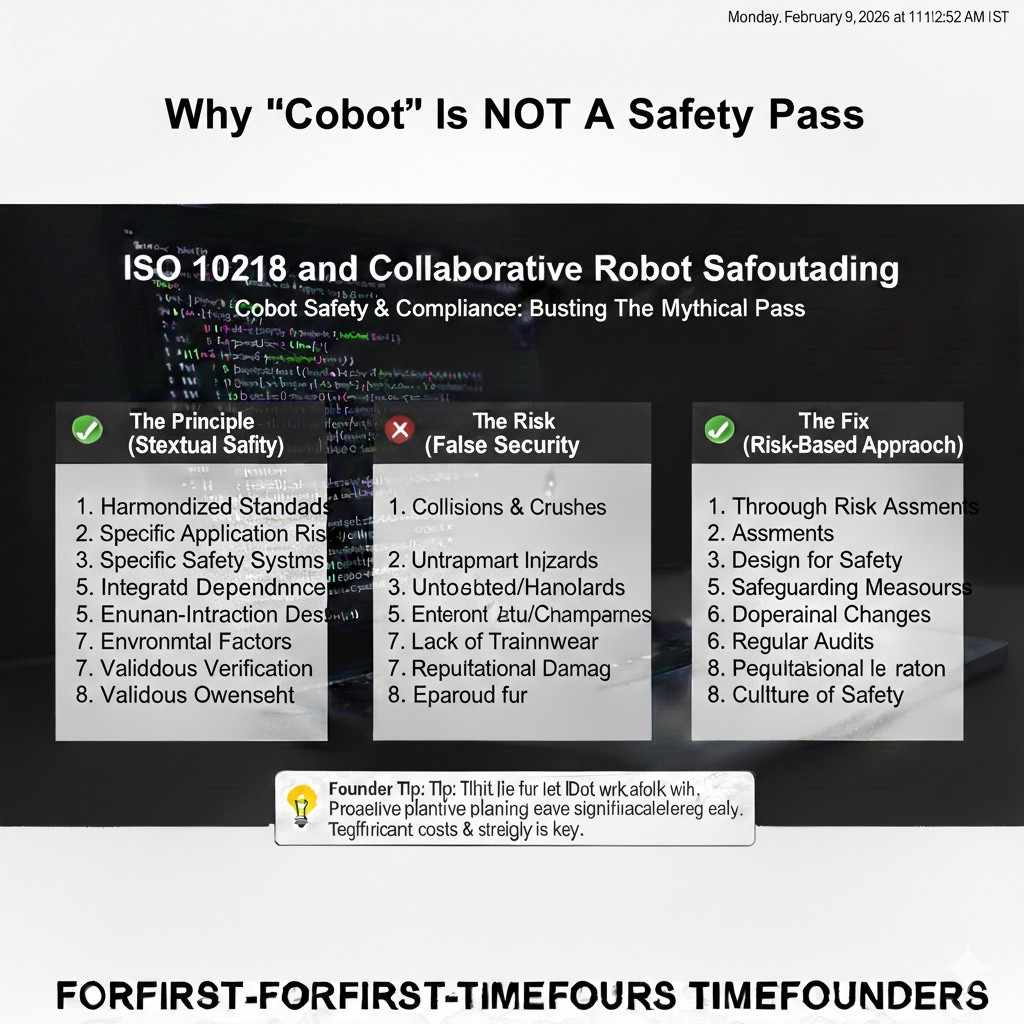
A cobot can still create harm if the task is risky. A heavy payload can crush. A fast motion can hit hard. A tool can cut. A fixture can trap fingers. ISO 10218 makes you treat the setup as a machine system with predictable failure modes, not a friendly helper.
This matters even more when customers push for speed. In demos, cobots run slow and look harmless. In production, cycle time becomes the priority, and speed changes the energy of contact. Safety must still hold after performance tuning, not only in the showroom.
Risk assessment in cobot projects: what “good” looks like
Start with the full life cycle, not only normal operation
A useful risk assessment does not stop at the main production loop. You must consider teaching, maintenance, cleaning, jam clearing, tool changes, shift change behaviors, and fault recovery. Many injuries happen during “non-routine” moments when people reach in, rush, or bypass steps to keep the line moving.
Walk through the job as if you are the operator. Ask what they touch, what they see, and where their body goes when something goes wrong. If your design assumes perfect attention, it is not ready for factory reality.
Name hazards in plain language
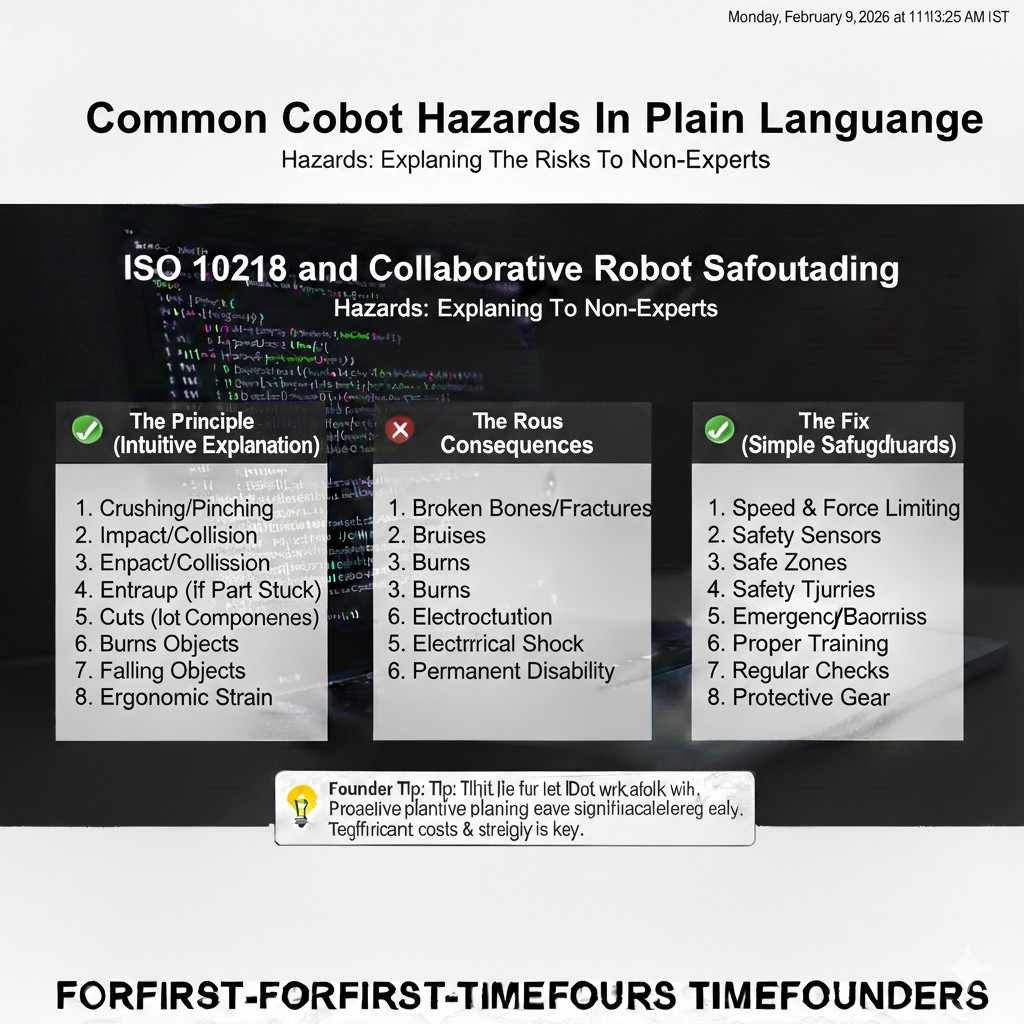
ISO-style hazard thinking is not about fancy terms. It is about seeing the physical truth. Pinch points, crush points, sharp edges, hot surfaces, unexpected restart, falling loads, and stored energy in pneumatic lines are all common. A cobot does not erase these hazards; it just changes how you manage them.
Be careful with “soft” hazards too. A person can slip near the cell and fall into the robot space. A person can be distracted by a screen or a supervisor and step closer than planned. Good safety design assumes humans are human.
Reduce risk in the right order
You get the strongest safety when you remove hazards by design first. If you can change geometry so hands cannot enter a dangerous gap, do that. If you can choose a tool that cannot pinch, do that. These choices are powerful because they reduce dependence on sensors, software, or training.
After design changes, you add protective measures. This can include safety-rated stops, speed limits, scanners, interlocks, guarding, and safe zones. Finally, you use warnings and training, but this should not be the main protection. If your safety depends mostly on “be careful,” the system will eventually fail in the field.
Collaboration modes: what changes when people are close
Collaborative work still needs defined limits
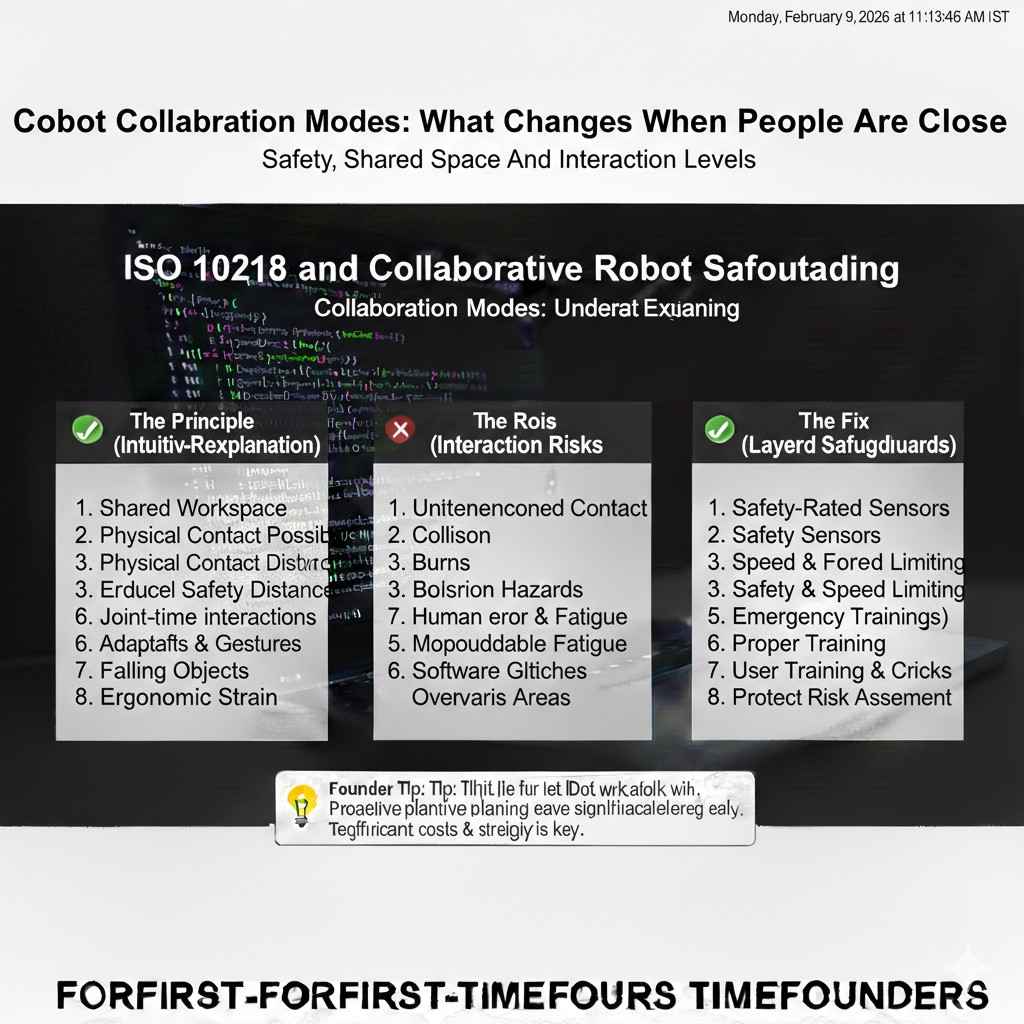
Collaboration means humans and robots share space in a controlled way. It does not mean free motion next to people at any speed. The safe outcome depends on speed, payload, tool shape, layout, and the human path through the work area.
A cobot may support safe speed limiting and safe stop behavior, but the integrator must set values that match the real task. If you set limits based on a demo, and later increase speed for production, you must revisit the risk work. Safety must track the real settings, not the original plan.
Tooling usually becomes the real danger
In many cobot cells, the end effector is the main risk source. Grippers pinch. Sharp tooling cuts. Vacuum cups can drop loads. Screws, blades, weld tips, or heated tools can cause harm even when the robot is gentle.
This is why ISO 10218 thinking always pulls you outward to the whole system. The arm is only one part. You need to treat the tool, the part, and the fixture as safety-critical components, not optional add-ons.
Contact is not always the biggest problem
Many teams focus only on “impact force” because cobots are known for force limiting. But trapping and crushing can be worse than impact. A hand can be pinned between the robot and a hard fixture. A finger can be pinched by a gripper. A wrist can be trapped against a table edge.
Good cobot safety design tries to prevent these trapping spaces or uses layout rules that keep hands out of those zones. When trapping cannot be fully designed out, you often need protective measures that stop motion before contact becomes a pinch.
Documentation and validation: what buyers expect to see
Proof matters more than promises
Factories do not buy safety claims. They buy evidence. They want to see that safety functions behave correctly, stop time is understood, and restart behavior is controlled. If your system relies on software logic, they will want to know if it is safety-rated and how you validated it.
This is where startups often struggle, not because they are careless, but because they do not plan for validation early. If you treat validation as a final step, you can end up redesigning large parts of the system late. If you plan for it from the start, you can build faster and with fewer surprises.
Clear ownership reduces delays
In cobot projects, confusion about roles slows everything down. Who owns the end effector safety? Who owns the scanner settings? Who owns training? ISO 10218 thinking encourages you to make this clear, because unclear ownership leads to gaps.
When you sell a turnkey system, buyers will expect you to own most of it. That can feel heavy, but it also gives you control. If you can show a clean safety package, you become easier to approve, easier to deploy across sites, and harder to replace.
Safety work can become a sales asset
When you do this right, your risk assessment and validation are not just internal docs. They become part of your go-to-market. You can shorten buyer reviews, reduce pilot friction, and build trust with plant leaders who have seen unsafe systems before.
If you are building new safety methods along the way, that is also a moment to think about patents. Tran.vc helps deep tech founders capture these advantages early with up to $50,000 in in-kind patenting and IP services. If you want help turning your safety engineering into defensible IP, apply anytime at https://www.tran.vc/apply-now-form/.