
Deep tech founders face a quiet, expensive choice early on.
Do you file patents and turn your invention into a public asset you can defend? Or do you keep it as a trade secret and rely on silence, speed, and tight controls?
This choice shows up sooner than most teams expect. Often it appears right after the first prototype works. Or right when a big customer asks for details. Or when a new hire joins and you realize your “secret sauce” is sitting in a shared drive with weak access rules.
Here is the uncomfortable truth: both patents and trade secrets can protect value, but they protect it in very different ways. And if you pick the wrong one for the wrong part of your tech, you can lose leverage with investors, lose your edge in the market, or lose control of your invention without noticing until it is too late.
At Tran.vc, we see this pattern a lot with AI, robotics, and other deep tech teams. You are building real technical advantage. You are also moving fast. The problem is that IP decisions do not wait for you to “have time later.” The moment you share, demo, publish, ship, or sell, you are already making IP choices.
This article is about making that choice on purpose.
I am going to keep it simple, direct, and practical. We will walk through what patents and trade secrets really do, how they fail, and how deep tech changes the math. You will learn how to decide what should be patented, what should be kept secret, and when to switch from one to the other. You will also learn how to avoid common mistakes that can kill patent rights or destroy trade secret protection without you realizing it.
And if you want Tran.vc to help you build an IP plan that fits your tech and your stage, you can apply any time here: https://www.tran.vc/apply-now-form/
Before we go deeper, let’s make sure we mean the same thing.
A patent is a legal right granted by a government. In plain words, it gives you the power to stop others from using an invention that fits the claims in your patent. You must describe the invention in a public document. In return, you get time-limited protection, usually around 20 years from filing for utility patents in many places, as long as fees are paid and the patent survives challenges.
A trade secret is different. It is not a registration. It is not a document you file. It is simply valuable information that you keep secret and take reasonable steps to protect. If someone steals it or breaks a duty of trust to get it, you can take legal action. But if they figure it out on their own, or reverse engineer it legally, you may have no protection.
So the trade is simple:
With patents, you tell the world and get a legal wall.
With trade secrets, you tell nobody and hope your wall is strong enough without ever being written into law.
That sounds like a clean choice. In real life, it is not.
Deep tech creates special pressure because your value often sits in places that are hard to “see” from the outside. That can make secrecy attractive. But deep tech also attracts smart competitors with labs, budgets, and patience. That can make patents feel safer. Meanwhile, AI adds another twist: many “advantages” are not stable for 20 years, but your investors still want proof that you can defend your position.
So you need a strategy that is not based on feelings. You need one that is based on how your tech can be copied, how it can be detected, and how your business will scale.
A helpful way to start is to ask one question:
If a strong competitor wanted to copy this, how would they do it?
If they can copy it just by looking at your product, testing it, and taking it apart, secrecy is weak. That is where patents often shine.
If they cannot copy it without your internal data, your internal process, or your internal know-how, secrecy may be strong. That is where trade secrets often win.
But even that is not enough, because deep tech teams rarely have only one “thing.” You have a mix:
- core algorithms
- model training data and labels
- robotics control loops
- sensor fusion methods
- firmware tricks
- manufacturing steps
- calibration flows
- test rigs
- customer insights
- pricing logic
- deployment playbooks
Some of these are patent-friendly. Some are not. Some are better as secrets. Some you should never keep secret because you need partners and customers to trust you.
The goal is not “patents or secrets.”
The goal is: patent the parts that need a legal shield, and keep secret the parts that stay hidden and can be protected by process.
If you do this well, you end up with a stack of protection layers. That makes you harder to copy, easier to fund, and more credible when you sell.
This is where early-stage teams often get stuck. They think:
“We are too early for patents.”
Or:
“Patents are expensive and slow.”
Or:
“Trade secrets are free.”
These ideas are common, but they are incomplete.
Patents can be staged. They can start small. They can be designed around milestones. And done right, they become fundraising tools, partner tools, and deal tools, not just lawsuit tools.
Trade secrets are not free. They cost real effort: access control, contracts, training, audit trails, clean room practices, and serious discipline. If you do none of that, you do not have a trade secret. You just have “stuff we have not told people yet.”
Many founders only learn this after a painful event: a key engineer leaves, a vendor reuses a process, a customer asks for the code, or a competitor releases something that looks too familiar.
So I want to set the tone early:
This is not about fear. It is about building leverage.
When you protect the right pieces, you can:
- sell with confidence without oversharing
- raise money without sounding like “trust me”
- hire faster without risking leaks
- partner with big companies without losing control
- increase valuation because you own something defensible
That is the “why.” Now we will build the “how.”
In the next section, we will break down patents and trade secrets in a very practical way: what they protect, how they break, and what deep tech founders should watch for. Then we will start mapping real examples for AI and robotics so you can see how to apply this to your own stack.
And if you want help mapping your exact system into a clear IP plan, Tran.vc does that as part of our in-kind IP investment. You can apply here whenever you are ready: https://www.tran.vc/apply-now-form/
Patents vs Trade Secrets: The Real Difference
What a patent really gives you
A patent is a legal right that can stop another company from using your invention, even if they built it on their own. That detail matters more than most founders realize. If a competitor independently creates the same method, a granted patent can still block them.
A patent is also a public document. You must explain the invention clearly enough that a skilled person could recreate it. In exchange for that openness, the government grants you a limited-time right to exclude others from practicing what you claimed.
For deep tech, this can turn “we figured it out” into a defensible asset. It is a way to convert engineering work into something that can be owned, valued, licensed, and enforced. That ownership often carries weight with investors and strategic partners because it is not just a promise, it is a filed position with a paper trail.
What a trade secret really gives you
A trade secret is protected by secrecy, not by registration. The law protects you when someone steals it, breaks a contract, or abuses trust to get it. But the law does not protect you if a competitor discovers it fairly. That includes independent discovery or legal reverse engineering.
This means trade secrets work best when your advantage stays inside your walls. If the key value is in internal steps, internal tuning, internal data, or internal know-how that never needs to be shared, secrecy can be strong and long-lasting.
Trade secrets can last forever in theory, but only if the secret stays a secret. In practice, secrecy is fragile. Every new employee, vendor, partner, and customer request increases risk. If you cannot prove you treated the information like a secret, it becomes very hard to claim it later.
Why deep tech makes this choice harder
Deep tech is rarely one single invention. It is usually a system of parts that work together, and each part has a different “copy risk.” Some parts are visible once the product ships. Other parts are hidden in training data, calibration routines, or manufacturing methods.
That is why a simple “patent everything” or “keep everything secret” approach fails. Your best plan is often mixed. You patent the pieces that will be exposed or that you must disclose to sell and scale. You keep secret the pieces that can stay internal and are hard to recreate without your environment.
The founders who win are the ones who design their IP like they design their product: by breaking it into components, understanding threats, and choosing the right protection method for each one.
When Patents Are the Better Choice
When your product can be copied by inspection
If a competitor can learn your key method by testing your product, patents become very attractive. This is common in robotics hardware, sensors, mechanical systems, and anything that can be taken apart and measured. If your advantage is visible, secrecy is weak because the market itself becomes your leak.
Even in software-heavy products, visibility still happens. An API can reveal behavior. A device can be probed. A deployed model can be attacked through repeated queries. If the outcome patterns reveal the method, your “secret” may not stay secret for long.
A patent creates a different kind of safety. Instead of relying on nobody figuring it out, you rely on the law that says, “Even if you figure it out, you still cannot use it without permission.”
When you need to share details to sell
Many deep tech companies must explain how things work to win deals. Enterprise buyers ask tough questions. They want reliability, safety, and compliance. They want to know what happens in edge cases. They may ask about architecture, data flows, or failure modes.
Trade secrets can collide with sales because secrecy can look like vagueness. You can try to share “just enough,” but the best buyers push. If you cannot answer, trust drops. If you answer too much, secrecy breaks.
Patents reduce this tension. You can disclose in controlled ways because the core idea is already filed. You still should not overshare everything, but you have a stronger base. You can say, “We have filed protection around this approach,” which often changes the tone of the conversation.
When investor diligence will require proof
In deep tech, many investors ask a simple question: “Why will this not be copied?” If your answer is only “we will move fast,” that can feel thin, especially in markets where big labs can catch up.
Patents are not the only way to show defensibility, but they are a clear signal that you treat your technical edge as an asset. They also create a structured story: what is novel, what is protected, and how the company plans to expand coverage over time.
This is one reason Tran.vc focuses on IP early. When patents are thoughtfully chosen, they support fundraising without forcing founders to raise too soon. They help you build leverage first, then raise from strength. If you want to explore this approach, you can apply here: https://www.tran.vc/apply-now-form/
When licensing could be part of the business
Some deep tech companies discover that the largest value is not only selling a product, but also licensing a method. This happens in medical devices, industrial robotics, edge AI, and core infrastructure tools.
Trade secrets are hard to license because licensing requires sharing. You can try to license “access” without disclosure, but that is not always workable. Patents are built for this. A patent lets you license rights without giving away operational details beyond what is already published.
If you expect partnerships, joint ventures, or OEM paths, patents often make negotiations cleaner. They turn “we have something special” into “here is what we own and what you can pay to use.”
When Trade Secrets Are the Better Choice
When the advantage lives in process, not the product
Trade secrets shine when your edge is in how you do something, not what the customer receives. Think about a manufacturing step that improves yield, or a calibration workflow that makes sensors more stable, or a data labeling approach that produces higher quality training data.
In these cases, even if a competitor buys your product, they still cannot see the internal process that created it. That makes reverse engineering difficult. If they cannot observe the cause, they struggle to reproduce the effect.
This is also common in AI. A model may be shipped, but the training pipeline, curated datasets, feature engineering habits, evaluation harnesses, and deployment controls can be where the true edge sits. Those are often better protected as secrets, especially if they change often.
When the invention is hard to describe without giving away too much
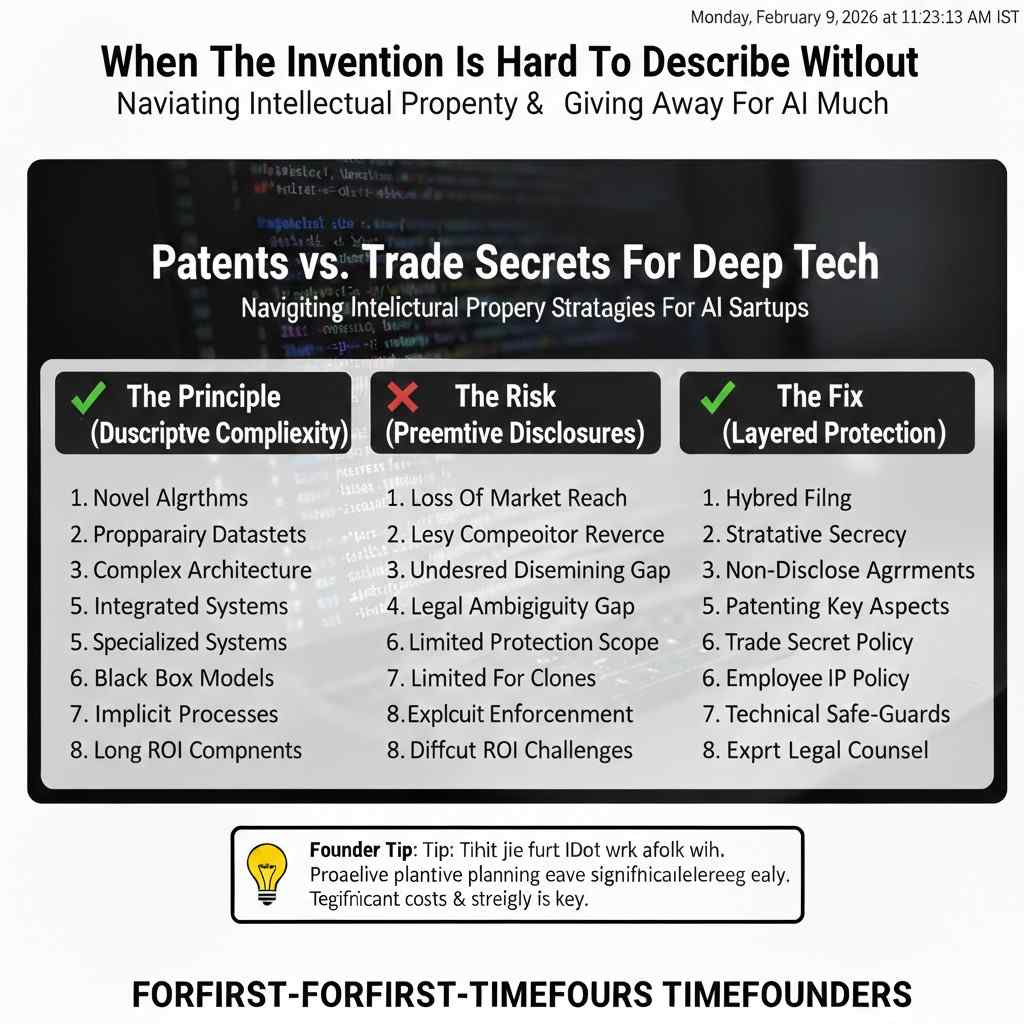
A patent requires disclosure. For some inventions, writing them down clearly enough to meet patent standards can reveal more than you want competitors to learn. If your edge relies on many small choices that work together, a patent may force you to explain the recipe.
Some teams feel safer keeping the full recipe inside the company. They may still patent selected parts, but keep the detailed “how we make it work in the real world” as a trade secret.
This is a common mixed strategy in robotics. A company may patent a control concept or a mechanism, but keep the tuning methods, test data, and field fixes as secrets because those are what make the system perform reliably outside the lab.
When speed matters more than long legal timelines
Patents can take time to grant. You can file early, but you may not have an issued patent for a while. If your market is moving fast and your tech changes every quarter, you may not want to lock in a detailed disclosure for something that will look different soon.
Trade secrets can move at the speed of the company. You can change the secret, improve it, and keep it protected as long as you control access. That flexibility can fit early-stage AI teams where iteration is constant.
The caution is that secrecy requires discipline. If your team is not ready to protect information with real controls, the “fast” option becomes the “leaky” option.
When detection is a problem for enforcement
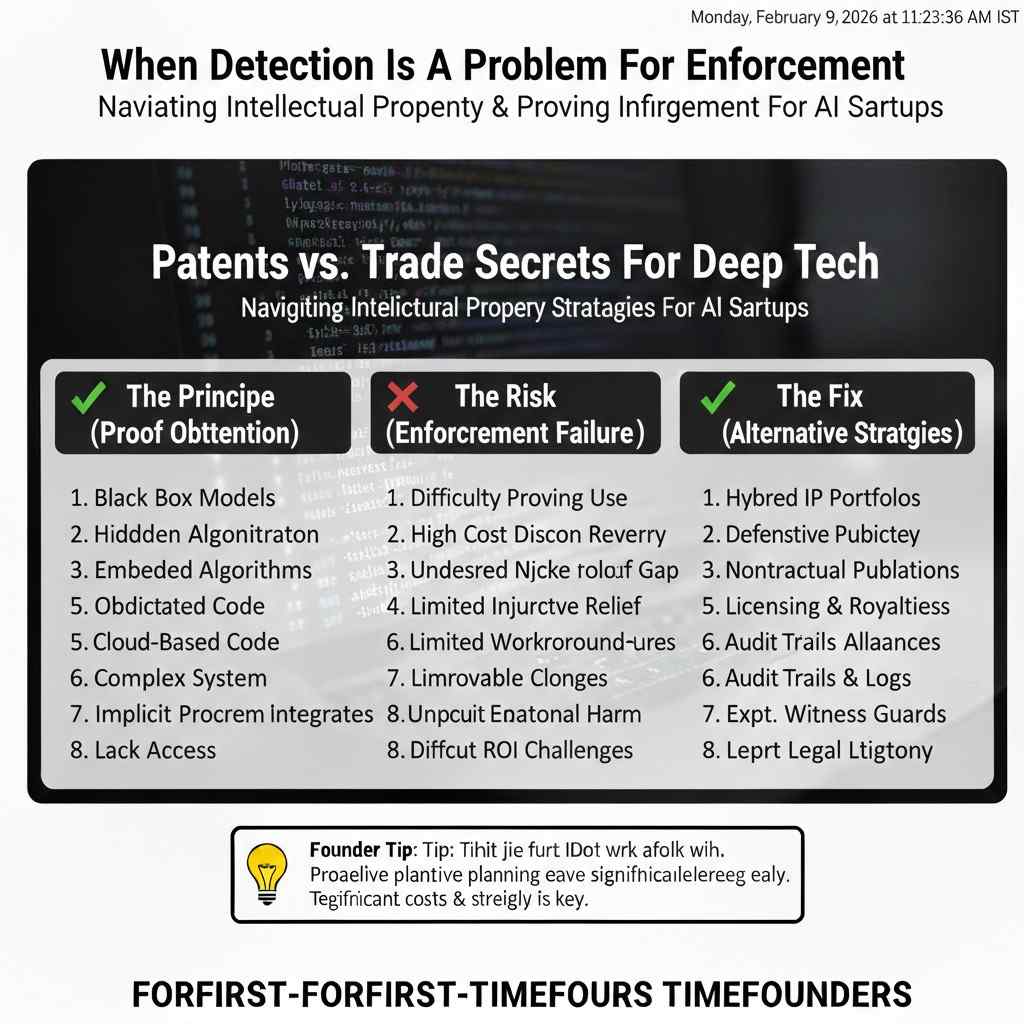
Even if you have a patent, you still have to detect infringement. In software and AI, it can be hard to prove another company is using your method if it runs on their servers and the outputs are similar but not identical.
If you cannot detect infringement, enforcement becomes expensive and uncertain. In some cases, a trade secret combined with strong internal controls can be more practical than a patent you cannot realistically police.
This does not mean “avoid patents in software.” It means you should be honest about what you can see, what you can prove, and what you can afford to enforce.
The Hidden Costs and Failure Modes
How patents fail in real startups
Patents fail when teams file too late, file the wrong thing, or disclose too early. If you present at a demo day, publish a blog post, share a preprint, or pitch too openly, you can hurt patent rights in many countries. Even where grace periods exist, relying on them is risky and messy.
Patents also fail when claims are too narrow. A narrow claim can be designed around. That is not always obvious when you read the patent, but it becomes obvious when competitors launch similar products that avoid the exact wording. Strong patent strategy is as much about claim design as it is about invention description.
Another failure is filing without a business plan. A patent should connect to how you will make money. If you file on side features, you may burn budget without building protection around the real value.
How trade secrets fail in real startups
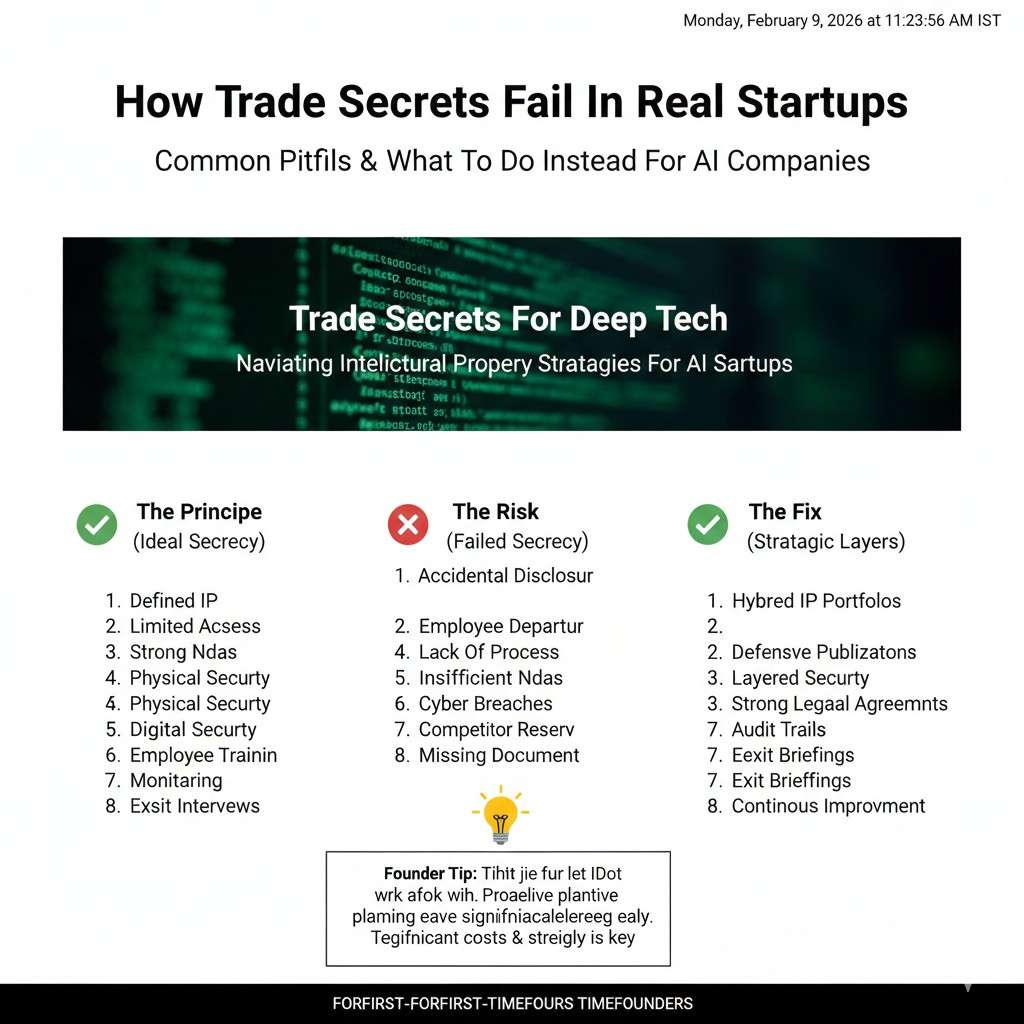
Trade secrets fail quietly. Often you do not notice until it is too late. The classic pattern is that information spreads slowly through normal business activity. A doc gets shared with a vendor. A contractor gets access to a repo. A pitch deck includes one slide too many.
Then an employee leaves. Or a partner becomes a competitor. Or a new company launches something that feels familiar. Now you are forced to prove the information was secret and that you treated it like a secret. If you cannot show reasonable protections, your claim becomes weak.
A trade secret also fails when customers require transparency. In regulated markets, you may need to disclose more than you expect. If your business model demands that you share details, your ability to keep secrets shrinks over time.
The deep tech twist: systems leak at the edges
Deep tech products touch the real world. They integrate hardware, firmware, cloud software, and human processes. That creates many “edges” where information can leak.
A prototype in a lab is easier to protect than a deployed fleet. A small team is easier to control than a company with vendors, pilots, and global customers. IP strategy should match your growth plan, not just your current size.
This is why early planning matters. You do not need to file everything today. But you do need to decide what must be protected before it becomes exposed by normal scaling.
A Practical Way to Decide: Copy, Detect, and Prove
Copy risk: how easy is it to reproduce your result
The first question is how a competitor could copy the result. If the path is simple, patents are stronger. If the path requires internal context you will not share, trade secrets can be enough.
In robotics, many mechanical and sensor innovations are easy to study once shipped. If your advantage is in the physical design, assume it will be examined. That pushes you toward patents for the core mechanical ideas.
In AI, copy risk depends on whether your advantage is in an observable model behavior or in hidden training assets. If the advantage is mostly in the data and pipeline, secrecy often plays well.
Detectability: can you realistically spot infringement
A patent is most useful when you can detect infringement without needing a competitor’s internal documents. If you cannot observe it, enforcement becomes harder. That does not make a patent useless, but it changes how you value it.
In hardware, detectability is often higher. Products can be analyzed and compared. In cloud software, detectability can be low because the method runs privately. If your method is invisible, consider whether the patent would be a strategic signal, a licensing asset, or mainly defensive protection.
Trade secrets shift the fight. Instead of proving someone used your idea, you focus on proving someone took your information improperly. That is a different legal path, and sometimes it fits better.
Prove-ability: can you show ownership and boundaries
With patents, boundaries are defined by claims. With trade secrets, boundaries are defined by what you kept secret and how you protected it.
If your team cannot clearly define what is secret, you risk a weak position. Many startups say “our secret is our model,” but they cannot articulate what about it is secret. Is it the architecture, the weights, the training data, the evaluation method, the deployment tricks, or the full pipeline?
If you cannot name it, you cannot protect it. A strong trade secret program starts with clarity. A strong patent program starts with selecting the inventions that truly matter.