
In the first 90 days of a deep tech startup, your product will change. Your team may change too. But one thing should not be left to chance: your intellectual property.
If you are building robotics, AI, chips, sensors, or any hard-to-copy system, you are not just shipping features. You are creating know-how. The kind that can become a moat—or leak out quietly through demos, GitHub commits, investor decks, pilot programs, and “quick” customer calls.
Most technical founders do not lose because their idea was bad. They lose because they built value and did not capture it. Someone else files first. A competitor copies the core method. A big company partners, learns, and then “builds it in-house.” Or a future investor asks a simple question—“What’s protected here?”—and the room goes quiet.
This is why an IP roadmap matters early. Not because you need paperwork. Because you need leverage. Real leverage is when you can explain, in plain words, what is unique, what is defendable, and what you own.
At Tran.vc, we see this pattern again and again: the founders who treat IP like a product roadmap—clear goals, clear timing, clear tradeoffs—move faster later. They raise with more confidence. They negotiate better deals. They sleep better when they launch.
So this guide is about the first 90 days. Not a full “patents 101” lecture. Not a legal maze. Just a practical way to think and act, week by week, so you do not wake up six months from now wishing you had started sooner.
In these first 90 days, your job is to do three things:
You must find the real invention inside your work.
You must protect it before you talk too much about it.
And you must build habits so your team keeps creating protectable work as you grow.
Done right, your IP roadmap becomes a simple system that supports every big move you will make next: hiring, partnerships, pilots, and fundraising.
If you want to build that system with experienced startup operators and patent attorneys—without giving up control early—you can apply anytime here: https://www.tran.vc/apply-now-form/
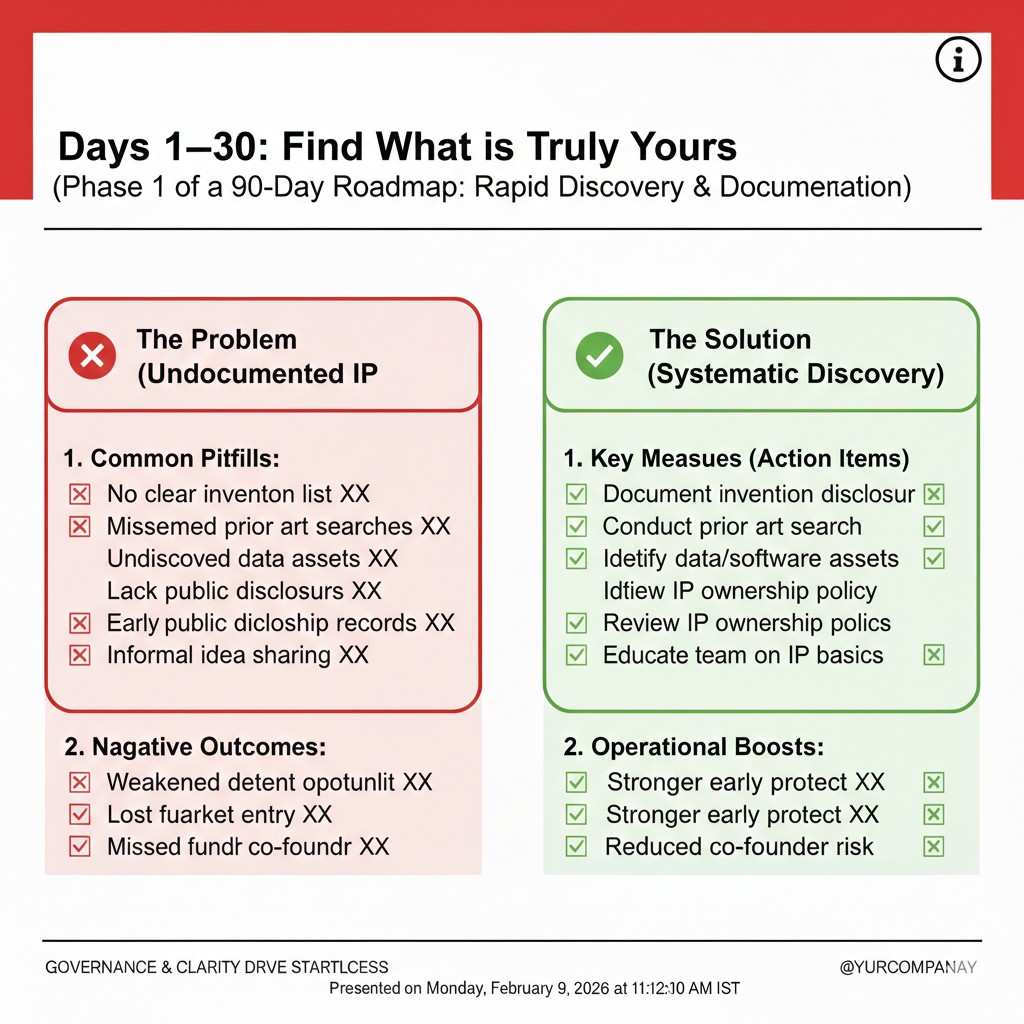
Days 1–30: Find what is truly yours
Start with the real risk most founders miss
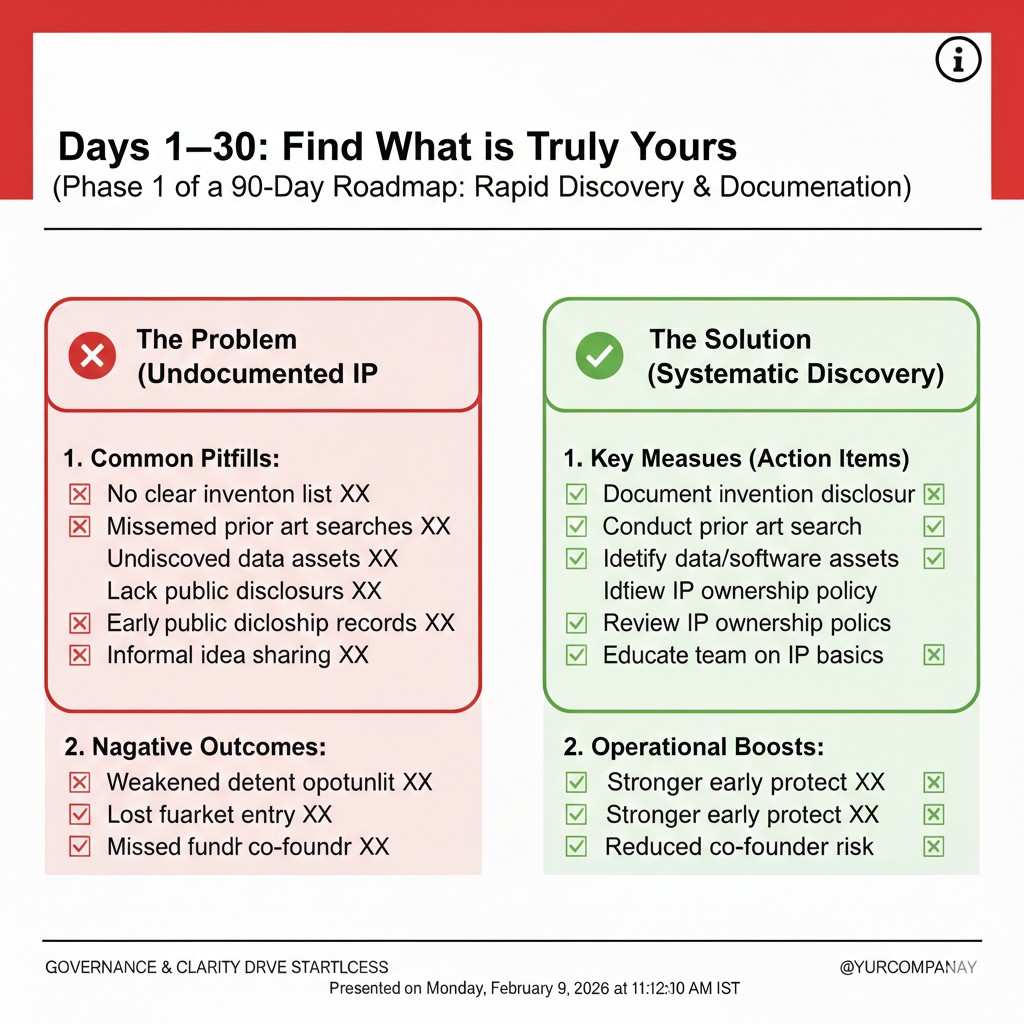
In the first month, your biggest IP risk is not “someone steals my idea.” It is that you slowly give away the parts that matter, without noticing.
It happens in normal startup life. You show a demo to a pilot customer. You put a helpful diagram in a deck. You explain your model pipeline on a podcast. You share a code snippet to recruit an engineer.
None of these things feel like “publishing.” But together, they can become a trail that makes it easier for others to copy you, and harder for you to file clean protection later.
The goal of Days 1–30 is simple: you will learn how to spot your real invention, and you will put basic guardrails around it, before your story spreads.
If you want Tran.vc to guide this work and invest up to $50,000 in in-kind patent and IP services, you can apply anytime here: https://www.tran.vc/apply-now-form/
Separate “the product” from “the invention”
Many founders mix these up. A product is what the user sees and pays for. The invention is the hidden method that makes the product work better than anything else.
In deep tech, the invention is often not the app, the dashboard, or the prompt. It is the core system behind it. It can be a control method, a training method, a data method, a sensor fusion method, a planning method, or a hardware layout.
If you only protect the surface, you protect what is easiest to replace. If you protect the core method, you protect the part that is hardest to rebuild without years of learning.
So in this first month, you will force yourself to answer one strong question: “If a smart team copied our UI and our features, what would they still not be able to copy?”
Make a simple “moat map” of your tech
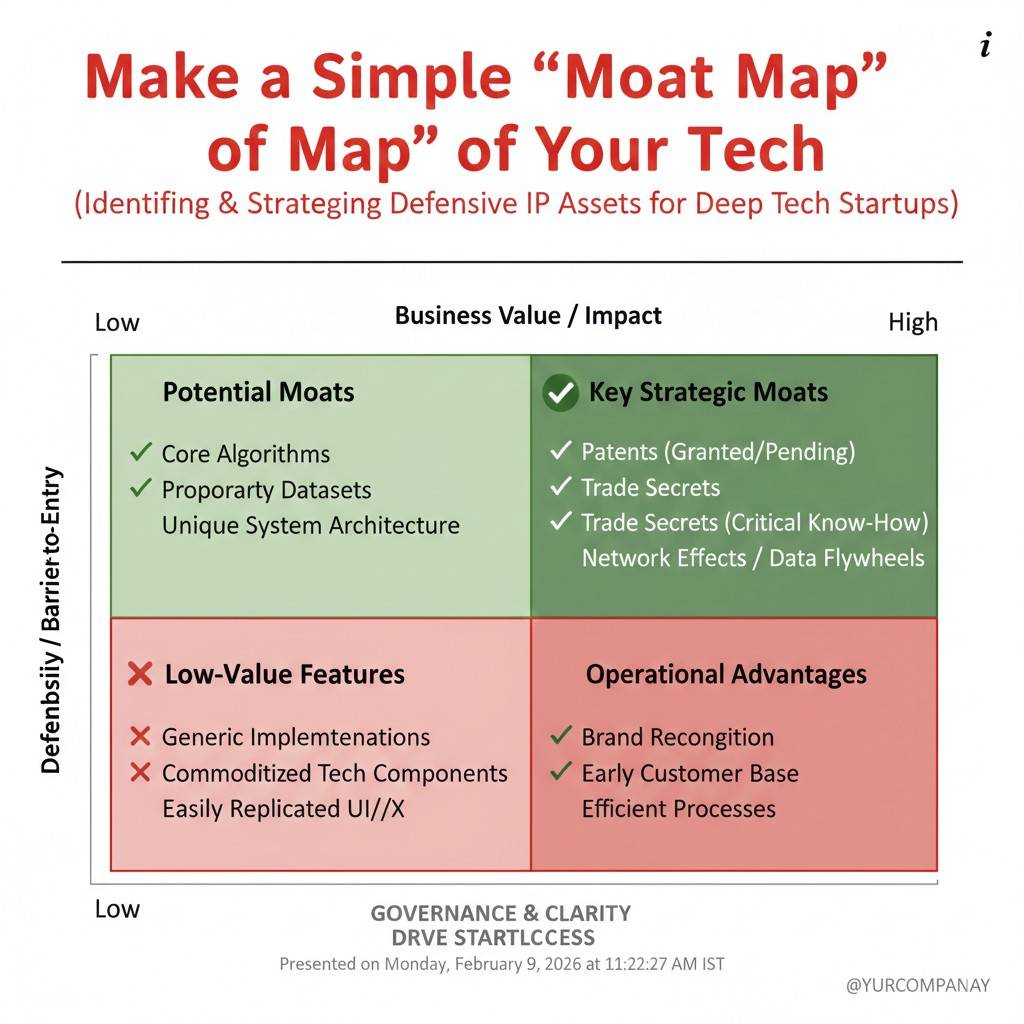
You do not need a big spreadsheet to start. You need a clear way to describe what is special.
Take your system and break it into parts in your mind. Think about inputs, processing, decisions, outputs, and feedback. Then ask where the hard work lives.
For a robotics company, the hard work may be in how the robot senses the world, how it plans motion, how it corrects mistakes, or how it stays safe.
For an AI company, the hard work may be in how you collect data, how you label it, how you train, how you fine-tune, how you evaluate, or how you run models cheaply at the edge.
Write this in plain language. Not “proprietary AI engine.” Instead, say what it does and why it is different. Use words a smart non-expert can understand.
This “moat map” becomes your first filter for what deserves protection.
Build an invention log that your team will actually use
Most teams fail here because they create a process that feels heavy. Engineers ignore it. Then, months later, no one can remember what changed and when.
Your invention log should be simple and fast. Each entry should capture what was done, why it matters, and what problem it solved.
A good entry answers: what is the new method, what makes it better, and what was tried before that did not work.
It also captures names and dates. This seems boring, but it saves you later when you need to show who invented what, and when it was created.
The key is habit. You want your team to log the “aha” moments while they are fresh, not six months later during a funding rush.
Decide what must stay secret for now
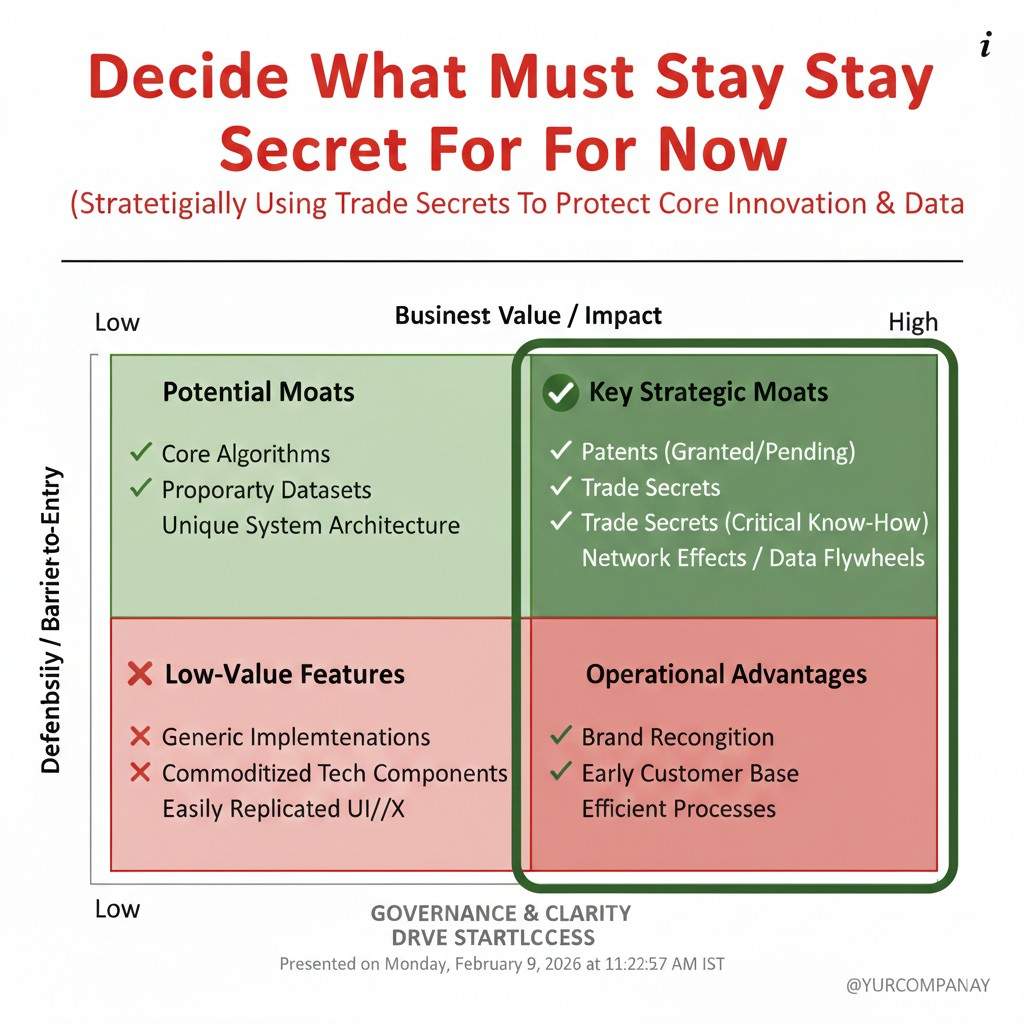
Not every valuable thing should be patented right away. Some parts may be better kept as a trade secret, at least for a period.
This is common when the value is in a process that is hard to reverse engineer. For example, a data cleaning pipeline, a labeling workflow, a calibration process, or a manufacturing trick that lives inside your team.
But trade secrets only work if you treat them like secrets. That means access control, clear internal rules, and careful sharing.
In the first 30 days, you should label your core pieces as “share carefully” even inside your company. Not to slow down work, but to stop casual leakage.
If you are not sure whether something should be patented or kept secret, this is exactly where experienced IP strategy helps. You can apply anytime here: https://www.tran.vc/apply-now-form/
Put basic sharing rules in place before you start pitching
Founders often do IP work after they start fundraising. That is backward. Once you start pitching, you will feel pressure to reveal details to sound credible.
So in the first month, you need a simple sharing rule for your team: what can be shown, what can be said, and what should never leave the room without review.
This does not mean you become paranoid. It means you become intentional. You can still tell a clear story. You just avoid giving away the “recipe.”
A useful approach is to talk about outcomes and performance, but not the exact steps that create them. You can share results, but keep the core method as a black box until protection is in motion.
Use NDAs the right way, not the lazy way
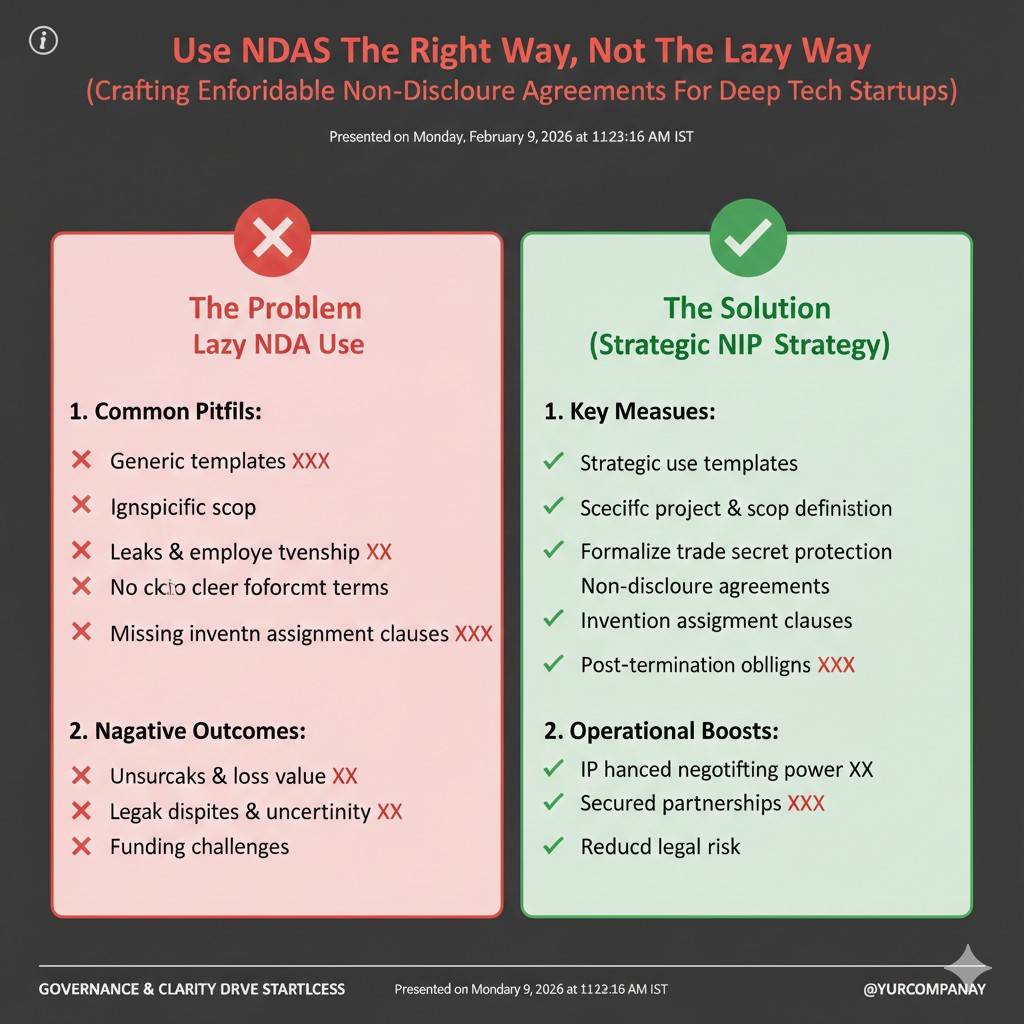
NDAs can help, but they are not magic. Many founders either avoid them completely or use them in situations where they do not matter.
In early startup life, NDAs are most useful when you are sharing real implementation details with a partner, contractor, or manufacturer.
For investor meetings, many investors will not sign. You should not depend on an NDA for fundraising. Instead, protect yourself by controlling what you reveal.
Your goal is to build a story that is strong without showing every detail. This is a skill, and it improves fast once you treat it as part of your roadmap.
Do a quick prior art scan to avoid false confidence
One painful mistake is filing on something that already exists. Another is assuming you cannot protect anything because “someone must have done this before.”
The truth is usually in the middle. Many inventions are improvements, not brand-new ideas. Those improvements can still be valuable and protectable.
A quick scan helps you see the landscape. It shows what others claim, what they do not claim, and where your work may fit.
In this first month, the point is not to become a patent search expert. The point is to remove blind spots and shape your strategy with real information.
Pick your first “priority inventions” with clear reasons
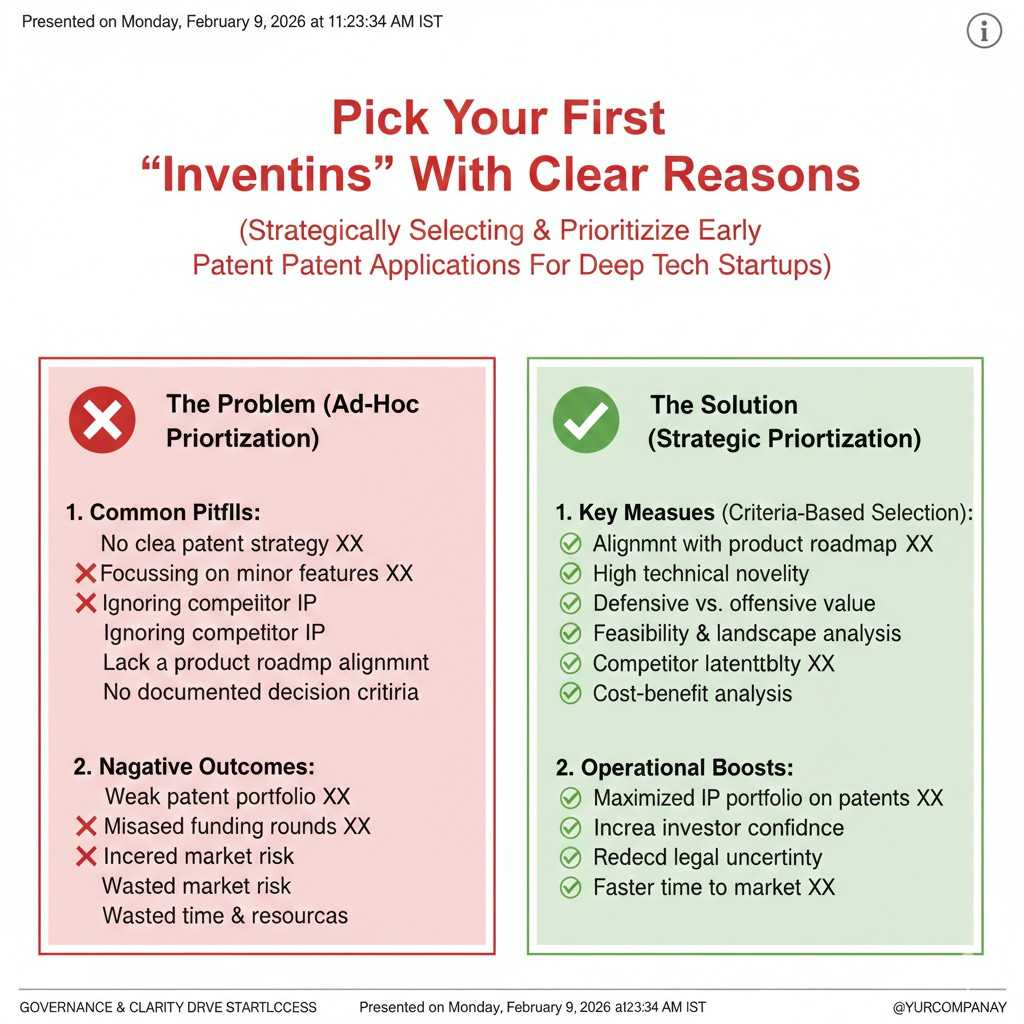
By the end of Day 30, you want a short set of core inventions you believe are worth protecting soon.
Each one should have a reason tied to business value. Maybe it blocks competitors. Maybe it makes pilots possible. Maybe it supports a pricing premium. Maybe it makes your system safer or cheaper at scale.
This is where founders get smarter. Instead of “let’s patent everything,” you start thinking, “What should be protected first because it changes our future options?”
A good IP roadmap is about timing and leverage, not volume.
Prepare your team for the next step: turning ideas into filings
Once you have your moat map, your invention log, and your priority list, you are ready for Days 31–60.
That next phase is about shaping claims, choosing what to file first, and building a plan that matches your product timeline.
You do not need to do it alone. Tran.vc exists for this exact moment—when your tech is real, but your resources are tight, and you want to move with discipline.
If you want help building an IP-backed foundation in your first 90 days, apply anytime here: https://www.tran.vc/apply-now-form/
Days 31–60: Turn your core ideas into a filing plan
Why this middle month decides your leverage later
By the second month, most deep tech teams have real progress. The model performs better. The robot fails less. The edge device runs faster.
This is also when the outside world starts pulling on you. Customers want deeper demos. Partners ask how it works. Investors ask what is defensible.
Days 31–60 is where you stop treating IP like a vague “we should do that” task. You turn it into a plan with clear targets and clear timing.
The goal is not to file a pile of documents. The goal is to protect the few things that create long-term leverage, and to do it before you talk too much.
If you want Tran.vc to guide this work and invest up to $50,000 in in-kind patent and IP services, you can apply anytime here: https://www.tran.vc/apply-now-form/
Convert your moat map into “claimable” building blocks
In a patent, the strongest protection usually does not come from describing the whole product. It comes from protecting the key steps that make your system work.
So you take each priority invention from Month 1 and break it into building blocks that can stand on their own.
For example, if your “secret sauce” is a robotics planning system, your building blocks might include how you represent the environment, how you score actions, how you handle uncertainty, and how you recover from bad sensor input.
If your advantage is an AI training method, your blocks might include how you select data, how you create labels, how you reduce noise, how you train in stages, and how you verify the model without expensive human review.
This step matters because it helps you avoid filing something too broad and fuzzy. You want a protection story that matches the real mechanics of your system.
Choose what to protect first using a simple filter
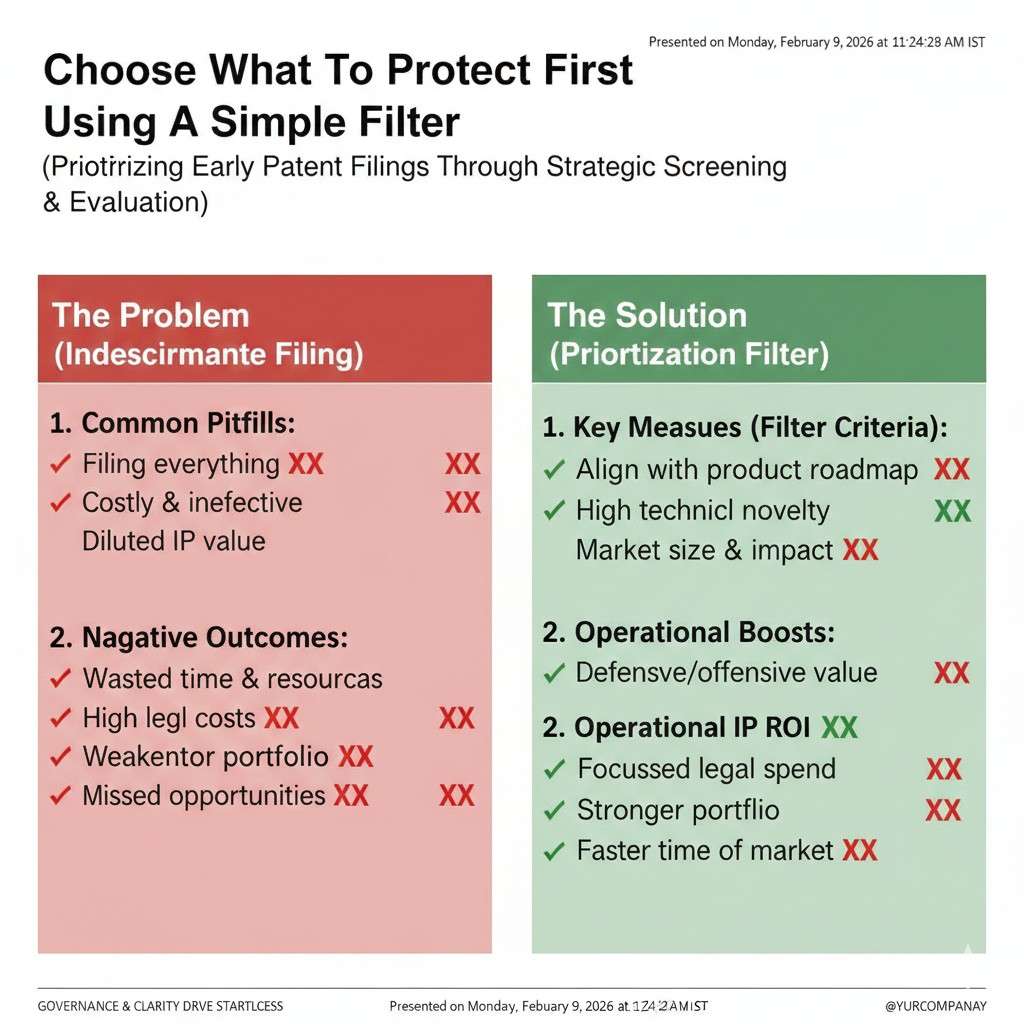
In Month 2, founders often ask, “Which patent should we file first?” The best answer is the one that reduces your biggest future risk.
A strong first filing usually protects something that would hurt badly if a competitor copied it, or something you must talk about soon in order to sell.
If you are about to do pilots, you will be asked about safety, reliability, and integration. Your first filing can focus on the method that makes the system stable, safe, or easy to deploy.
If you are about to raise, you will be asked why you can win. Your first filing can focus on the method that gives you a performance edge, a cost edge, or a deployment edge.
This is not about vanity. It is about sequencing. You protect the piece that supports the next business step you must take.
Avoid the “one patent to rule them all” trap
A common early mistake is trying to file one giant patent that covers everything. It sounds efficient, but it often produces weak protection.
Deep tech systems are complex. When you try to cover the whole system in one go, you end up with language that is too general. General language is easier to challenge, easier to design around, and often less convincing to investors who understand patents.
A better approach is to think like a builder. You protect the core method first, then you add follow-on filings that create a web of protection around the system.
This strategy is calmer and more realistic. It also matches how real engineering works: you ship and improve in stages.
Decide what is a patent and what stays as a trade secret
In Month 1, you likely labeled some things as “share carefully.” In Month 2, you make the call on what becomes a filing and what stays internal.
If a competitor could figure it out by testing your product, it is hard to keep as a secret. That leans toward filing.
If the value lives in a behind-the-scenes process that no one can infer from the outside, trade secret may fit better.
There is also a timing factor. Sometimes you keep something as a secret now, and you file later when you are ready to reveal more or when the invention has matured.
The key is that this is a choice, not an accident. A roadmap means you decide on purpose, with eyes open.
Build a “safe narrative” for customers and investors
You cannot hide forever. You must sell. You must recruit. You must raise.
So in Month 2, you create a clear narrative that is strong without giving away the recipe.
This narrative should explain the problem, explain why the current solutions fail, and explain your outcome in a confident way. It can share proof points and performance numbers.
But it should not reveal the exact steps that produce those results.
This is where many technical founders struggle, because they are used to proving competence through details. Your new skill is to show competence through clarity.
A simple test helps: if someone could take your deck and hand it to a team of engineers and say “build this,” did you reveal too much? If the answer is yes, you tighten the story.
Get your “invention disclosure” ready before drafting starts
When you file, the quality of the filing depends on the quality of the raw inputs. A rushed filing based on a fuzzy explanation leads to weak protection.
So you prepare an invention disclosure that captures the invention in a structured way.
It should explain the problem, the old approach, your new approach, and why it is better. It should include variations, edge cases, and alternatives you considered.
This matters because strong patents often cover not only your best version, but also nearby versions that a competitor might try.
You are not just describing what you built today. You are describing a family of methods that all share the same core idea.
Time your filing plan around public exposure
One of the highest-value uses of an early IP roadmap is to prevent accidental public disclosure before you file.
Public disclosure can include a public demo, a published paper, a public GitHub repo, a marketing page with too much detail, a conference talk, or even a detailed blog post.
In Month 2, you should look at your next 60–120 days and mark the moments where you are likely to expose your method.
If a conference is coming, you plan filings before the talk. If a pilot requires deep technical sharing, you file before you share. If a fundraising push is coming, you file before you pitch widely.
This is where startups win quietly. They do not “suddenly” have IP. They planned it around the moments that matter.
Fix ownership and contributor issues before they become painful
IP is not just about protection. It is also about clean ownership.
In Month 2, you should confirm that everyone who contributes has signed the right agreements, and that your company owns the inventions created for the company.
This includes founders, employees, contractors, advisors, and even friends who “helped out” early.
Investors often check this during diligence. If there is a gap, it can slow down a round or create legal risk that makes a deal feel messy.
The earlier you clean this up, the easier it is. Later, people disappear, relationships change, and signatures become hard to get.
Align your IP roadmap with the product roadmap
A strong IP plan does not live in a folder. It lives inside your build schedule.
If your next product milestone is a new sensing method, your roadmap should reflect that you will capture it in the invention log, review it quickly, and decide whether it becomes a filing.
If your next milestone is a deployment method, your roadmap should reflect how you will protect the method before you publish it in documentation or onboarding guides.
This is why IP is not a one-time event. It is a rhythm that matches how you ship.
Tran.vc helps founders build this rhythm early, so your protection grows as your product grows. Apply anytime here: https://www.tran.vc/apply-now-form/
What “good” looks like at Day 60
By Day 60, you should have three things that make you feel calmer.
First, you should have a clear list of priority inventions with strong reasons.
Second, you should have a safe way to explain your tech without exposing the recipe.
Third, you should have a near-term filing plan tied to real dates, based on when you will share, sell, or pitch.
If you have those, Month 3 becomes much easier, because you are no longer guessing. You are executing.