
Most technical founders wait too long to file a patent.
Not because they do not believe in IP. But because timing feels confusing. You have a demo coming up. An investor meeting next week. A conference in a month. A pilot with a big customer soon. And you keep thinking, “I will file after this one thing.”
The truth is simple: your first patent is not just a legal step. It is a business move. It can protect your edge, make your demo safer, and help you raise with more power. But if you file too early, you can waste time and money, and lock yourself into the wrong story. If you file too late, you might lose rights, leak your secret, or give a rival a free head start.
This article is about getting that timing right, especially around demos and fundraising. The goal is not to make you paranoid. The goal is to help you move with calm, clear steps.
And if you want a team to help you do this without losing speed, you can apply to Tran.vc anytime. Tran.vc invests up to $50,000 in in-kind patent and IP services for AI, robotics, and deep tech startups, so you can build a strong moat early while keeping control. Apply here: https://www.tran.vc/apply-now-form/
When to File Your First Patent: Timing It Around Demos and Fundraising
Why this timing question matters more than most founders think
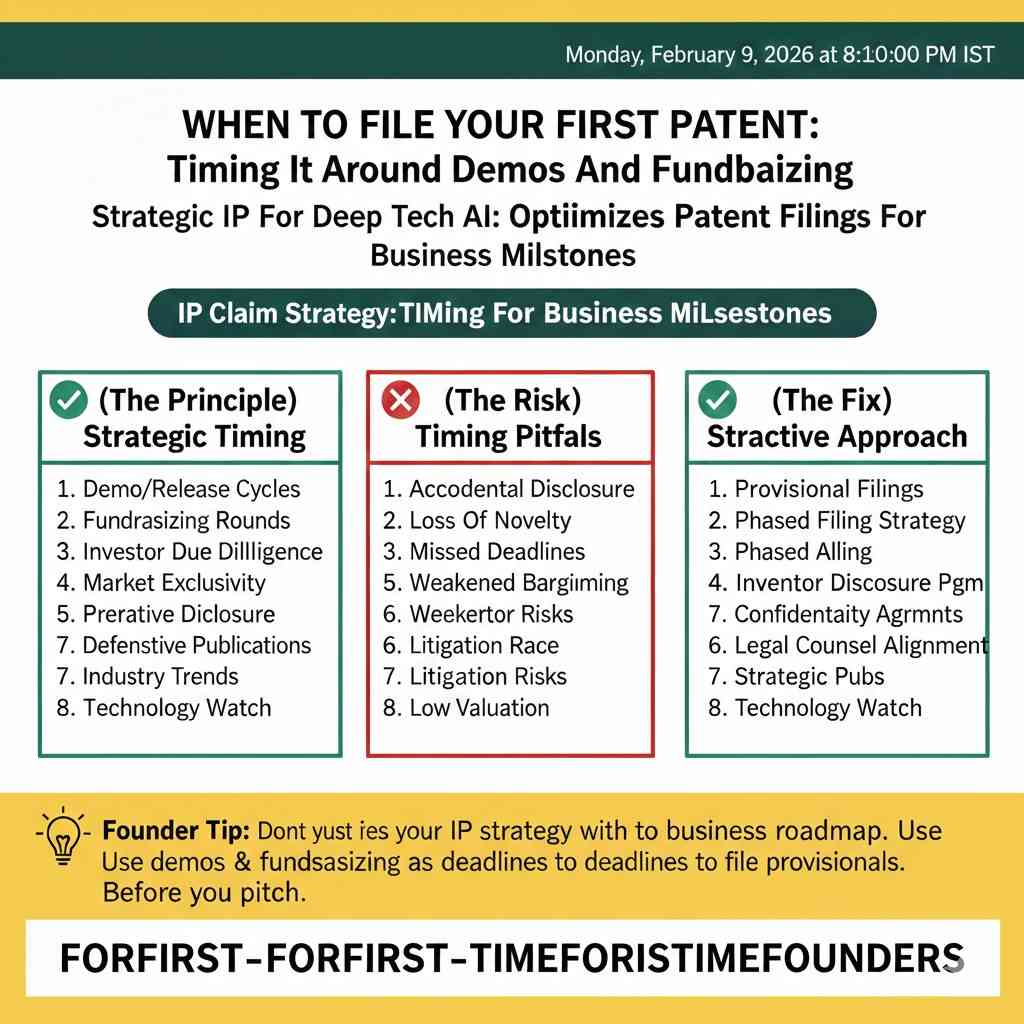
Most founders do not lose value because their tech is weak. They lose value because they share it at the wrong time, in the wrong way, with no protection. A good demo can open doors, but it can also leak the one idea that makes your product hard to copy.
Fundraising creates the same pressure. You want to move fast, show traction, and sound confident. But speed without a plan can turn into “accidental public disclosure,” and that can reduce what you can protect later.
If you are building in AI, robotics, or other hard tech, this gets even more serious. Your advantage often lives inside the method, the workflow, the system design, and the way the parts work together. That is exactly the kind of value you can protect early, if you time it well.
Tran.vc exists for this exact moment in a company’s life. They invest up to $50,000 in in-kind patent and IP services so technical founders can protect the core while still building fast. If you want to explore that path, you can apply anytime at https://www.tran.vc/apply-now-form/
What “filing a patent” really means in plain terms
When most people say “file a patent,” they imagine a big, final, expensive thing. That mental picture is one reason founders delay. But early-stage IP is often a step-by-step process, not a single leap.
In simple words, a patent filing is a dated record that says, “On this date, we had this invention, and here is how it works.” The date matters because it can help decide who was first, and it can protect you from someone else trying to claim your idea after seeing it.
The key is that you do not need to have everything finished to file something useful. But you do need enough detail that the invention is real, not just a hope.
The risk founders do not notice until it is too late
Many founders think the risk is only that someone will copy them. Copying is a risk, but it is not the only one. The other risk is that you might block yourself from getting strong protection later because you shared too much too soon.
If you show the “how” in a public setting before you file, you can create a problem. The size of that problem depends on where you file and what rules apply. In some places, the rules are strict, and early sharing can hurt your options.
That is why the timing around demos and fundraising matters so much. These are the two moments when founders naturally share the most.
The core rule that makes timing simple
File before you teach the world how it works
There is one rule that keeps you safe in most cases. If your demo or pitch teaches someone how to rebuild your system, you should file before you show it. Not after. Not “next week.” Before.
This does not mean you must hide everything. It means you should separate what you show from what you reveal. You can show results, benefits, and outcomes without showing the secret steps that make it possible.
But if you know the demo will include those secret steps, then the right move is to file first.
Not all demos create the same level of risk
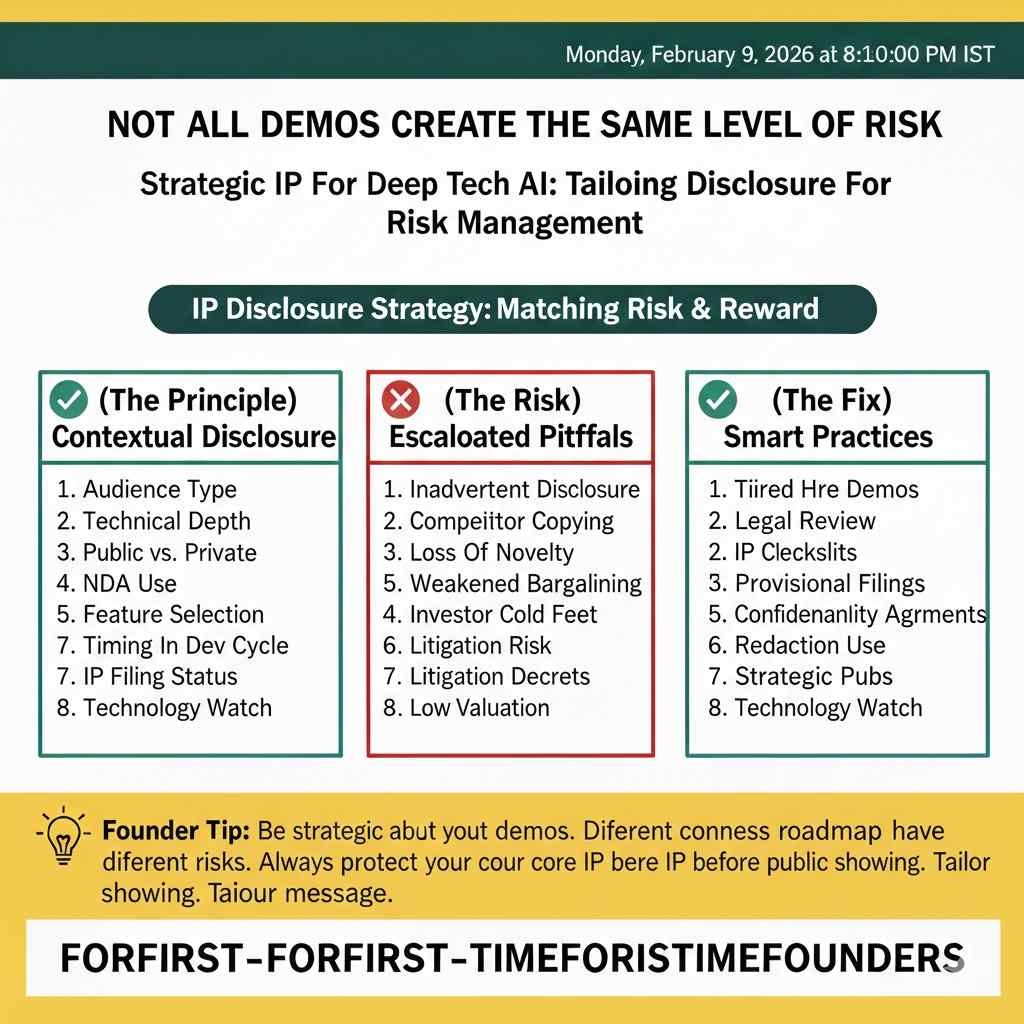
A demo can be many things. A private product walk-through to one trusted person is not the same as a stage demo at a conference. A closed-room investor meeting is not the same as a public YouTube video.
The more public your demo is, the more you should assume it will be recorded, shared, and studied. Even if the event says “no photos,” you should assume someone will take them anyway.
The more your demo shows the inner system, the more you should assume a smart competitor can learn from it. This is not fear. This is just how competitive markets work.
“But we only showed the UI” can still be a mistake
Some founders feel safe because they “only showed the interface.” That can be true, but it depends on the product. In software and AI, a UI can reveal workflow. In robotics, a simple video can reveal motion patterns, sensor placement, control timing, or how the robot reacts to edge cases.
The point is not to overthink it. The point is to quickly ask one question: does this demo reveal the method, even indirectly? If yes, filing before the demo is usually the safer move.
The three big moments when founders share too much
The first fundraising conversations
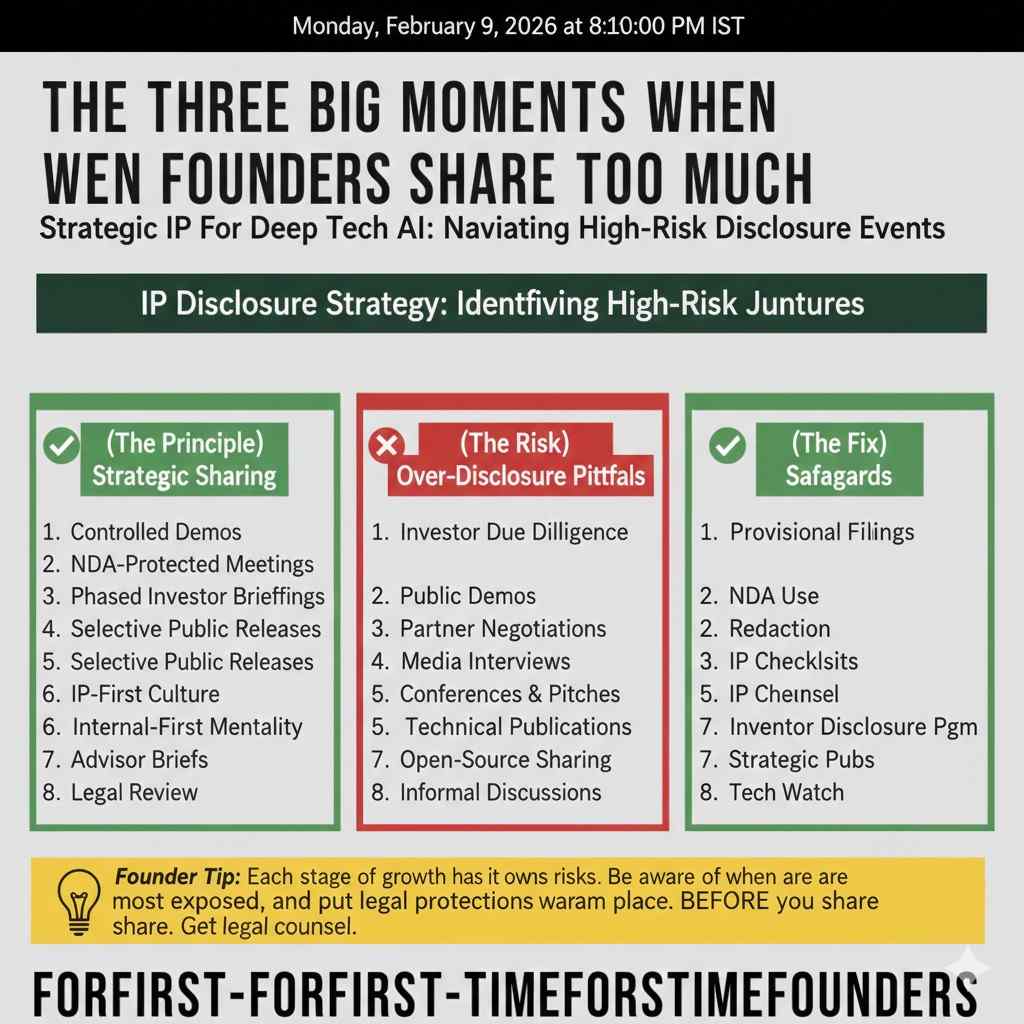
Early fundraising feels casual, especially with angels. You are excited. They ask smart questions. You want to impress them. So you go deeper and deeper into the technical details.
This is where many leaks happen. Not always because the investor is bad. Often because the investor is curious and technical, and they pull the details out of you without meaning harm.
If you are raising, you should expect more technical questions than you want. Your job is to answer in a way that explains the value, without giving away the recipe.
The “big demo day” that feels like a turning point
Accelerator demo days, pitch events, and public showcases create pressure. You want to prove you are real. You want to show something that looks hard. You want to stand out.
That is exactly when founders overshare. They put architecture diagrams on slides. They show the special data pipeline. They explain the trick they invented to make latency drop. They show the calibration approach that makes the robot stable.
If you know you will share these details, you should treat that event like a deadline. File before it.
The first large customer pilot
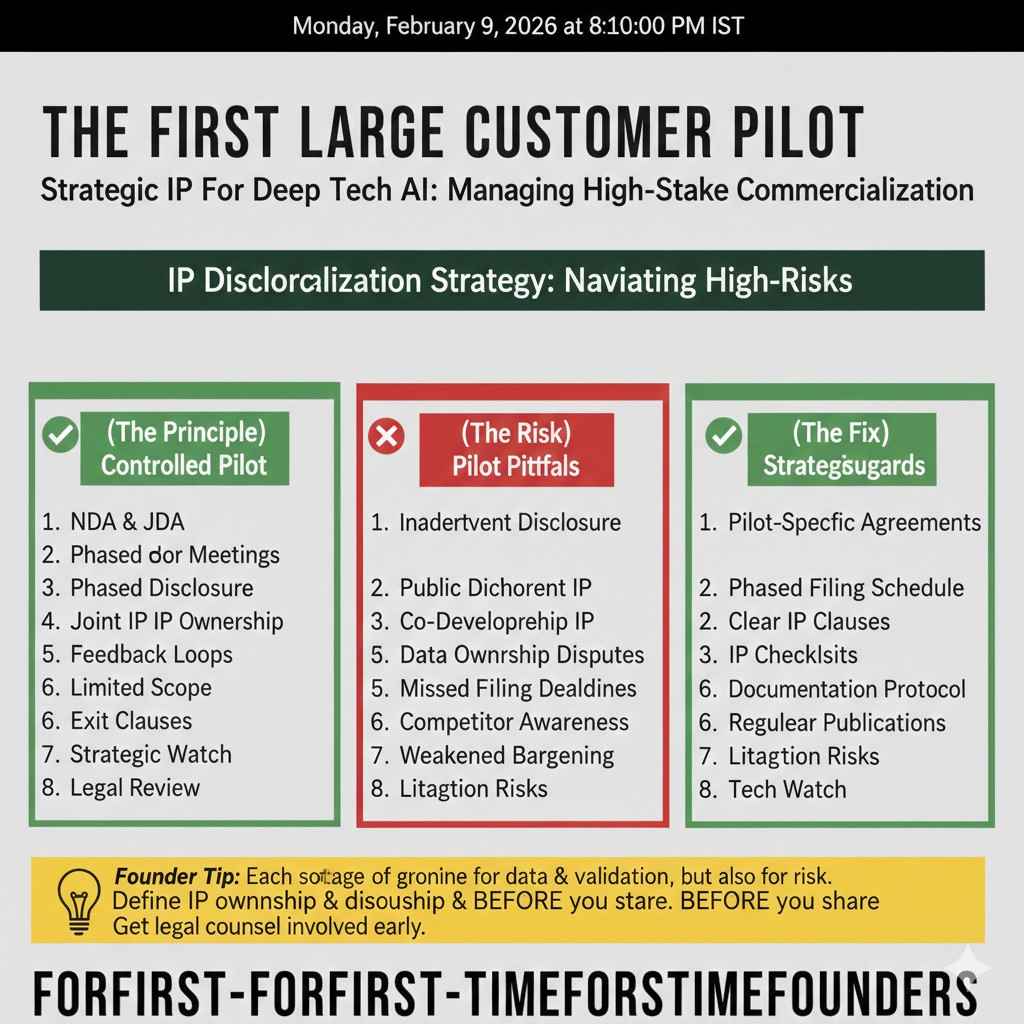
A big pilot can feel safer than a public demo, but it can be risky in a different way. Customer teams can include engineers. Those engineers can learn fast. Customers can also share what they learn with partners, vendors, and sometimes even other startups.
This is not about blaming customers. It is about protecting your company. Before a deep technical pilot, you should know what you will reveal, and what you want protected first.
How patents fit into fundraising without slowing you down
IP is not a trophy, it is leverage
Some founders treat patents like a badge. They want to say, “We have a patent,” because it sounds impressive. That is not the best way to think about it.
A first filing is leverage when it protects your core advantage and supports your story. It tells investors you are building a company that can defend its edge. It shows you are not just shipping features. You are building assets.
Even better, it can reduce investor fear. Investors worry about copycats. They worry about large companies. They worry about “what stops the next team from doing this?” A smart filing helps answer that.
The best time to file is often earlier than your gut says
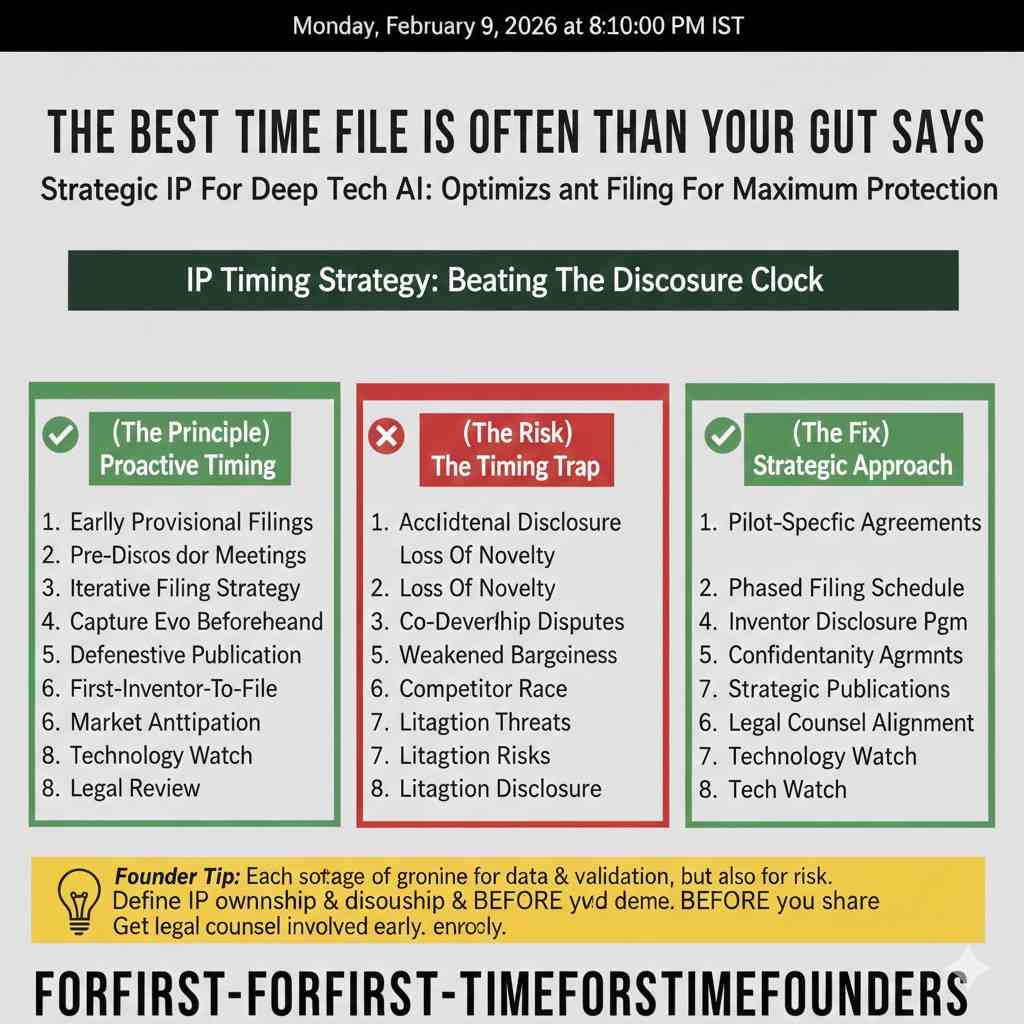
Many founders wait until they have revenue or a finished product. But the best time is often when you first have a working method that produces results, even if the product is still rough.
That is because the invention is often the method, not the polished wrapper around it. If you have a repeatable way to solve the hard part, you may already have something worth filing.
The key is to write it down clearly. What is the problem? What is the new way you solved it? What steps make it work? What variations might also work?
A filing can protect you while you iterate
Founders often worry that filing “locks them in.” The fear is that the idea will change, so the patent will become useless.
In practice, early filings can be written in a way that covers the core concept while leaving room for variations. You can protect the main approach and also describe different ways to implement it.
You should still be thoughtful, because a vague filing is not helpful. But you do not need perfection. You need a clear description of the invention you have now, plus the reasonable extensions you expect.
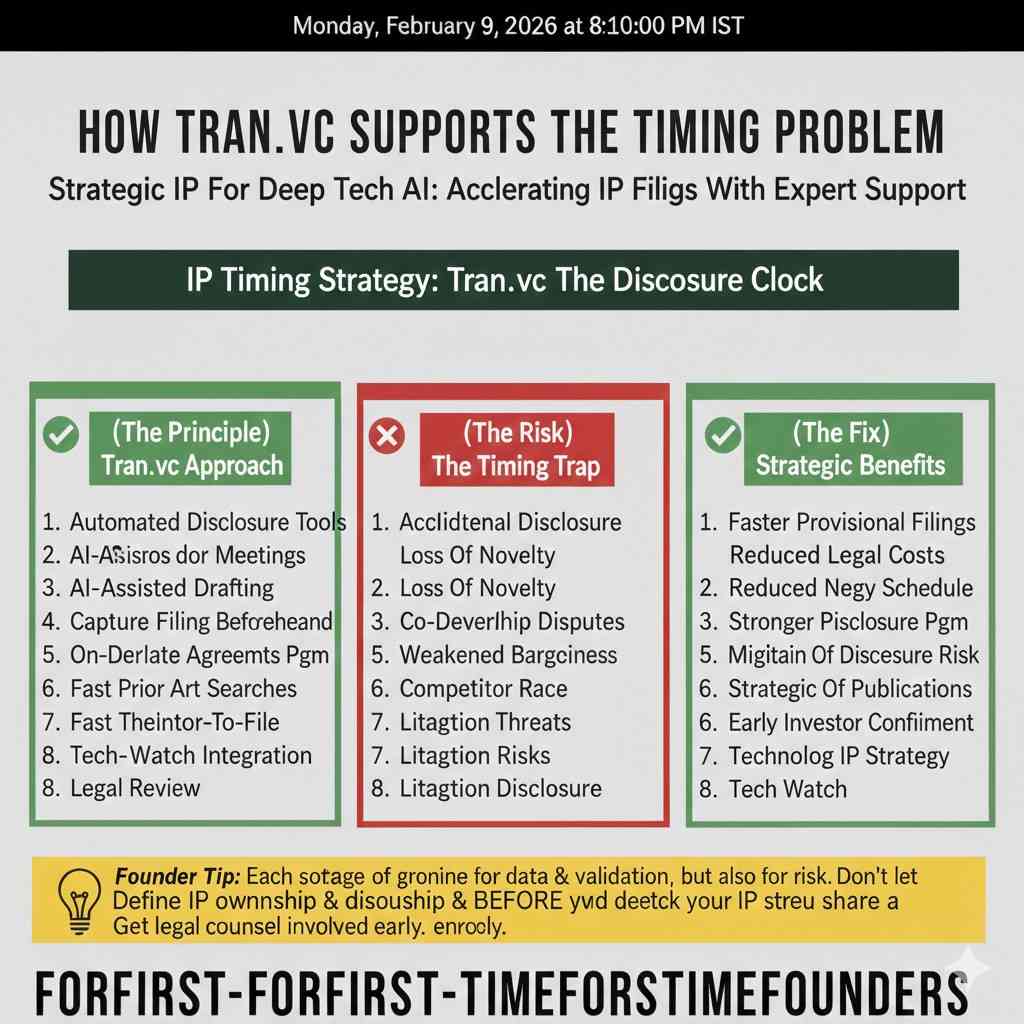
How Tran.vc supports the timing problem
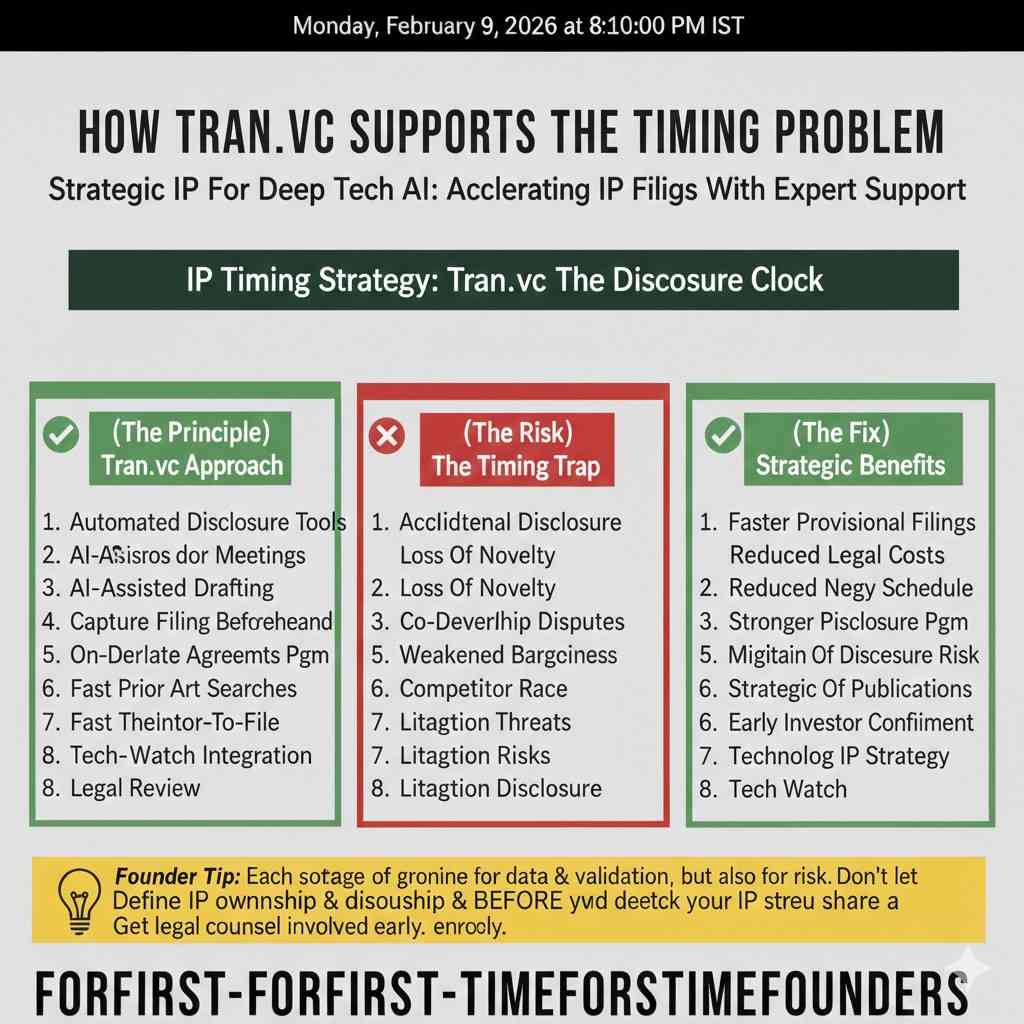
This is where many teams get stuck. They know they should file, but they do not know what to file, how broad to go, and how to time it without pausing product work.
Tran.vc is built to remove that stress. Tran.vc invests up to $50,000 in in-kind patenting and IP services, guided by experienced patent attorneys and startup operators. The goal is to help you protect the core before you share it widely, especially when demos and fundraising are coming up.
If you are in that stage right now, you can apply anytime at https://www.tran.vc/apply-now-form/
What investors actually want to see at seed
At seed, most investors do not expect a granted patent. They know that takes time. What they want is proof that you understand what is defensible, and that you are taking real steps to protect it.
A filed application can be a strong signal. It tells them you have identified the core invention and you moved to protect it. It also tells them you are thinking beyond the next demo.
You do not need to lead your pitch with “we have patents.” But you should be ready to explain what you filed, what it covers, and how it supports your moat.
The demo calendar approach founders can actually use
Start by labeling your next demo by “exposure level”
Think of each upcoming demo or pitch as having an exposure level. This is not a formal system. It is just a simple way to decide how careful you need to be.
A closed meeting with a single trusted person is lower exposure. A room with many people is higher exposure. A recorded event is even higher. Anything that goes online is the highest.
When exposure goes up, your need to file before the demo also goes up, especially if you will reveal method details.
Decide what you will show, then decide what must be protected
A strong demo does not require full disclosure. You can design a demo that shows outcomes, performance, and user impact without revealing the core method.
Before you build the demo, write down the parts you plan to show. Then ask, which part is the “secret sauce”? Which part would a smart team copy if they saw it?
If your demo includes those parts, you file first. If your demo can avoid those parts, you can delay filing while still staying safe.
Build a “two-layer story” for fundraising
Fundraising works best when you have two layers of explanation. The first layer explains value in simple terms. The second layer goes deeper for technical investors, but still avoids giving away the exact recipe.
This is not about being vague. It is about being precise about the problem, the results, and the system boundaries, without sharing the internal steps that recreate the method.
When you have this two-layer story, you can handle investor questions without oversharing. And you can decide when a filing becomes needed, based on how deep the second layer must go.
Use the filing as a deadline, not a burden
Many founders see filing as extra work. A better way to view it is as a deadline that protects your momentum.
If you have a major event in four weeks, you can plan backwards. You can decide what needs protection now, and what can wait. You can file the core invention before the event, then keep building after.
This approach turns IP into a tool that supports speed, instead of something that slows you down.
How to know what is worth patenting in the very beginning
The goal is not to patent “the product”
A common mistake is trying to patent the whole product. Early products change too fast. The user flow shifts. The features come and go. If you aim your first filing at the full product experience, you often end up with something too narrow or outdated.
Instead, focus on the technical heart. Look for the part that makes your system work when others fail. Look for the method that turns a hard problem into a repeatable result. That is usually the piece that stays stable even as the product evolves.
This is especially true in robotics and AI. The “product” might look like a dashboard, a robot arm, or an app. But the defensible part is often the control loop, the planning method, the training setup, the data pipeline, the sensor fusion approach, the safety logic, or the way you handle edge cases.
A simple test: could someone rebuild the value from what you share?
Here is a clean way to decide if something is worth filing. Imagine a sharp competitor watches your demo, reads your deck, and hears your answers in investor Q&A. Then they go back to their team for two weeks.
If they could rebuild the part that creates your big results, you are probably showing a “how.” And that “how” is often patent-worthy, or at least worth protecting in some way.
The key is not whether they could copy the exact code. The key is whether they could copy the method. In deep tech, method is the real asset.
Another test: do you have a repeatable recipe yet?
Many founders fear they must have perfect proof before filing. You do not. But you do need a real recipe.
If your system works once, but you cannot explain why, that is not ready. If it works only when one person on the team does magic, that is also not ready. But if you can run the process again and get similar results, and you can explain the steps, you likely have an invention worth capturing.
A repeatable recipe does not mean production-grade. It can still be rough. It just needs to be real.
What “patent-worthy” looks like in AI, in plain words
For AI teams, the patent-worthy part is often not “we used a neural network.” That is too broad and too common. The value is usually in the way you set up the learning, or the way the system runs in the real world.
It could be the way you reduce labeling needs. It could be the way you find hard examples automatically. It could be the way you keep the model stable as data drifts. It could be the way you combine rules with learning. It could be the way you meet latency limits on edge devices without losing accuracy.
If you can describe the steps clearly, and the steps are not obvious to others, you may have something to protect.
What “patent-worthy” looks like in robotics
For robotics, the invention often sits where software meets hardware. It might be a new way to calibrate. A new way to plan motion around uncertain objects. A new grasping method. A new control approach that keeps the robot safe while moving fast. A new sensing arrangement that improves reliability in messy settings.
It can also be a system-level invention. Many strong robotics patents are not one tiny trick. They protect a full workflow: sensing, planning, action, feedback, and recovery. That end-to-end loop is hard to copy when it is well protected.
What “patent-worthy” looks like in infrastructure and “deep software”
Some teams build things that are not flashy but are very defensible, like compilers, security systems, databases, networking, simulation engines, or tools that make AI deployment reliable.
In these cases, the invention can be the method that improves performance, reduces compute, increases safety, or makes outcomes predictable. Investors care about these inventions because they often create long-term advantage.
The challenge is that these inventions can be hard to explain in a pitch. That is another reason a smart filing helps. It forces clarity and creates a clean way to describe what is unique.
Demos: how founders accidentally disclose the invention
The “architecture slide” that feels harmless
Many decks have a slide that shows the system architecture. It looks professional. It makes the team feel real. But it can reveal the full recipe in one picture.
If your architecture slide shows the sequence of steps that make your system work, then it might be disclosing the invention. Even if you do not share code, a smart team can infer a lot from system flow.
A safer approach is to show a higher-level view in public, and keep the detailed version for private discussions after you have filed. You can still look serious without giving away the core.
The “training pipeline” explanation that gives away the edge
AI founders often explain training because it sounds impressive. They talk about data collection, labeling, augmentation, training loops, evaluation, and deployment.
The trouble is that many AI moats come from the pipeline itself. If your edge comes from how you generate training data, how you pick examples, how you reduce human work, or how you adapt after deployment, then a detailed pipeline talk is basically a free blueprint.
You can still discuss outcomes. You can still discuss what kinds of data you use in broad terms. But the moment you explain the internal mechanics step-by-step, you are very close to disclosing the invention.
The “we solved it with this one trick” moment
In live demos and investor meetings, there is a moment where someone asks a sharp question, and you feel the urge to prove you are brilliant.
So you say the trick out loud. You explain the special constraint. You describe the clever shortcut. You talk through the exact method you invented to make it work.
That moment feels good, but it can be expensive.
A better approach is to answer with confidence while keeping the detail protected. You can say, in plain words, what class of approach you use, why it works, and what results it produces. Then you can offer deeper detail after you have filed, or under the right protections.
The myth of the NDA as a safety net
Many founders rely on NDAs. NDAs can help in some cases, but they are not a complete shield. Many investors will not sign them. Many events are public. Many early customer talks move too fast for perfect paperwork.
Even when an NDA exists, enforcing it can be hard and slow. It is not the same as having a patent filing date on record.
Think of NDAs as one layer, not the whole plan. A filing is a stronger layer for protecting the invention itself.
Fundraising: using IP to raise with more control
The real question investors ask, even when they do not say it
Investors often ask about market size, team, and traction. But inside their head, they are also asking a quiet question: “If this works, can someone else do it too?”
If the answer is “yes, easily,” they get nervous. They worry about big players copying you. They worry about the next startup doing the same thing with better sales. They worry you are only a feature, not a company.
A well-timed patent filing helps answer that quiet question. It shows you are building something that can be defended.
How to talk about a filing without sounding like you are hiding
Some founders swing too far and become secretive. That can also hurt fundraising, because investors need to understand what they are buying into.
The best approach is balanced. You explain the problem clearly. You explain the results clearly. You explain, in broad terms, why your method works better than others. Then you state that you have filed or are filing to protect the core method.
This signals maturity. It tells the investor, “We are open enough to be evaluated, but we are also smart enough to protect what matters.”
Why filing before fundraising often changes the tone of the room
When you file before serious fundraising, you often notice a shift. You feel calmer. You answer questions with less fear. You can share more context without worrying you are giving away the store.
Investors also tend to lean in. They see you as more prepared. They see you as a team that understands long-term value, not just short-term hype.
This does not mean a filing guarantees funding. It means it can improve your posture and reduce the “copy risk” in the investor’s mind.
The best founders use IP to shape the narrative
Fundraising is a story. The story is not only “we built something.” It is also “we built something that will stay ours.”
When you file around the right time, you can frame the company as a platform, not a project. You can explain that you are creating core technology that becomes an asset. You can show that the work you do today keeps paying off later.
This is one reason Tran.vc focuses on early IP foundations. They help founders turn technical work into real assets that investors respect. If you want that kind of hands-on support, you can apply anytime at https://www.tran.vc/apply-now-form/
Timing a first filing when your product is still changing
File when the core method stabilizes, not when the UI is perfect
Your UI can change every week. Your sales pitch can change every day. Your product roadmap can flip based on one customer call.
The patent-worthy core often stabilizes earlier than you think. It is the method that makes the result possible. Once that method is clear and repeatable, you can usually file, even if the product is still ugly.
This keeps you from waiting for “perfect,” which rarely arrives.
How to avoid filing too early and wasting the shot
There is a real risk of filing too early. If you file when the invention is still just a loose idea, you may end up with a weak filing that does not cover the real version you later build.
To avoid this, you want enough detail that you can explain the steps in a way someone could follow. You want examples. You want variations. You want to describe what inputs come in, what process happens, and what outputs come out.
When founders do this well, the filing becomes a solid foundation. When they do it poorly, it becomes paperwork that does not protect much.
Why “one filing” is often the start, not the finish
Think of the first filing as a stake in the ground. It protects what you have now and creates a safe base for sharing.
As you build, you may create new inventions. You may improve the method. You may add new workflows. You may discover a second core idea that is just as valuable as the first.
Strong teams treat IP as a living strategy. They do not file every week, but they do keep a clear log of inventions and decide which ones deserve protection at the right moments.
A practical way to decide: the demo and raise timeline
If you have an important demo or fundraising push coming soon, timing becomes easier. You simply work backward.
If you plan to show the method in two weeks, you should aim to have a filing in before that. If you plan to meet investors and go deep on technical detail in three weeks, you file before those meetings. If you plan to present at a conference in a month, you file before the talk.
This is not about rushing sloppy work. It is about aligning protection with exposure.