
If you are building a robot, a drone, an AGV, a warehouse picker, a delivery bot, or any system that moves on its own, you are building two things at once.
First, you are building a product.
Second, you are building a set of decisions that the machine makes every second: what it thinks the world looks like, where it thinks it is, and where it should go next.
That second part is where SLAM and navigation live. And it is also where a lot of your real edge can hide.
Here is the problem. Many founders assume SLAM is “too academic” to patent, or that it is all open source, or that patents only cover a full product. So they wait. They keep shipping. They keep improving. Then one day they realize a competitor copied the same approach, or a big company filed around them, or an investor asks, “What can you defend?” and the answer feels thin.
The good news is this: startups can protect meaningful parts of SLAM and navigation. Not the broad idea of “doing SLAM,” of course. But the specific way you solve the messy real-world issues—bad sensors, moving people, shiny floors, GPS dropouts, tight aisles, low compute, odd camera angles, weak lighting, cheap IMUs, drift, wheel slip, and maps that never match reality.
Those are not “small details.” Those are the hard parts you spend months fixing. And those fixes often become protectable inventions when you describe them the right way.
This article will show you what parts of SLAM and navigation are often protectable, how to spot patent-worthy work inside your code and experiments, and how to write down your inventions so they stay yours. We will keep this practical and plain. No heavy legal talk. No theory for theory’s sake. Just how a technical team can build a real moat while still moving fast.
And if you want help turning your SLAM work into a strong patent plan—without slowing down your build—you can apply anytime here: https://www.tran.vc/apply-now-form/
Patenting SLAM and Navigation: What Startups Can Protect
Why SLAM patents matter for startups
When you are early, you do not have the luxury of winning by brand alone. A bigger team can copy your feature list fast. A well-funded rival can hire good engineers and rebuild your stack. And if you are selling into robotics buyers, they often ask one quiet question before they commit: “What stops others from offering the same thing?”
SLAM and navigation are often the strongest answer. Not because they sound fancy, but because they sit in the core of autonomy. If your robot can localize faster, map cleaner, recover better, and plan safer paths, you win real deals. That advantage is also the part competitors want most.
A good patent plan does not slow you down. It helps you keep the “hard-won fixes” tied to your company. That is the work you already did—just captured in a defensible way.
And if you want Tran.vc to help you shape that plan with real patent experts and startup operators, you can apply anytime here: https://www.tran.vc/apply-now-form/
The big misunderstanding about SLAM protection
Many founders think patents only cover a full end-to-end system, like “a robot that uses lidar and a camera to navigate.” That kind of claim is usually too broad and too easy to reject. Or it becomes so narrow that it is not worth much.
The better approach is to protect the specific techniques that make your system work in the real world. Think of the “glue” that turns academic SLAM into a product. That glue is often new, often valuable, and often patentable when written the right way.
The goal is not to patent “SLAM.” The goal is to patent what you do differently, and what you do better, in a way that others cannot copy without stepping on your claims.
What “protectable” really means in SLAM and navigation
Start with the difference between an idea and an implementation
In patents, you do not get to own a pure math concept like “graph optimization” or “Kalman filtering.” You also do not get to own a generic goal like “reduce drift” or “avoid obstacles.” Those are outcomes, not inventions.
What you can protect is a concrete method that achieves an outcome in a specific way. That method is often a sequence of steps, a data flow, a particular scoring rule, a special training or calibration process, or a smart decision logic that reacts to certain conditions.
If your team can explain, in plain steps, how your robot processes sensor data and makes choices, you are already close to something protectable. The key is that the steps should not be obvious, and they should solve a real technical pain.
The most common places protectable work hides
Protectable work is usually not in your “main pipeline diagram.” It is in the parts you added because the main pipeline failed on Tuesday in a customer site.
It might be the way you detect wheel slip and correct it without a full re-localization. It might be how you decide when to trust vision versus lidar. It might be how you keep mapping stable when people are moving around. It might be your trick for loop closure in long halls that all look the same.
Those sound like engineering details. In robotics, those details are the product. They are also the parts a competitor struggles to recreate.
The line between SLAM and navigation matters
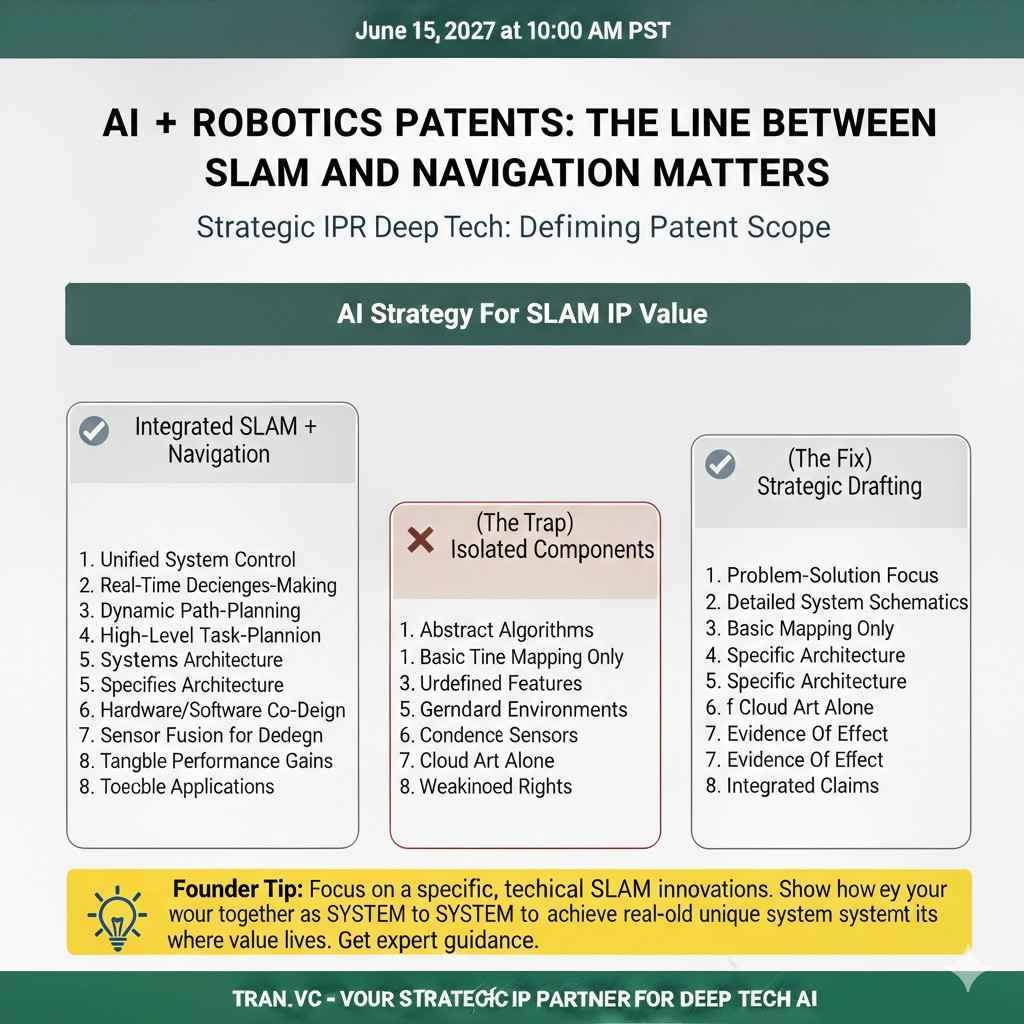
SLAM is about building a map and knowing where you are in it. Navigation is about choosing where to go, then getting there safely and efficiently.
They are connected, but they are not the same subject. That distinction matters because you can patent them separately. It also matters because startups often have stronger novelty in the “bridge” between them, where localization confidence changes planning behavior.
If your navigation system adapts based on SLAM uncertainty, sensor health, map quality, or change detection, you may have strong claim material. Many teams do this in practice, but they do not document it as an invention.
SLAM: what startups can often protect
Front-end perception and feature handling
The front-end is where raw sensor data becomes usable signals. In visual SLAM, this may involve feature detection, matching, and outlier removal. In lidar SLAM, it may involve scan preprocessing, keypoint extraction, and alignment choices. In radar or ultrasonic, it may involve custom filtering to make weak signals useful.
A lot of novelty lives here because real sensors are messy. Lighting changes, motion blur, reflective surfaces, vibrations, rolling shutter, and repeated patterns can break “standard” methods. If you created a rule set that adapts to these conditions, that can be protectable.
For example, if your system changes how it selects features based on robot speed, scene texture, or exposure level, that is a concrete method. If you fuse multiple feature types and weight them based on reliability signals, that can also be protectable. The key is that you describe the “when,” the “how,” and the “why,” not just the result.
Sensor fusion that is more than “we fused sensors”
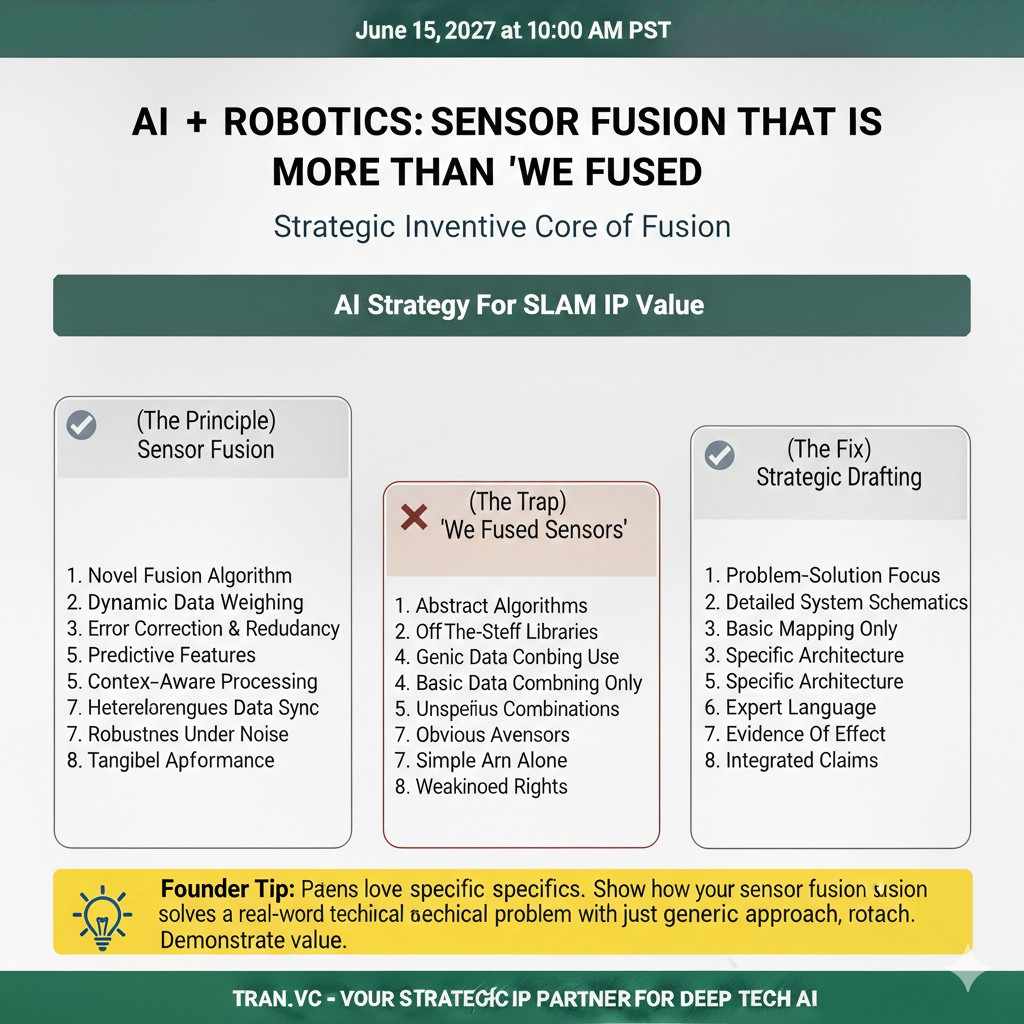
Many teams say they do sensor fusion, but the word alone does not create a patent. What matters is how you fuse, when you fuse, and what triggers changes in fusion strategy.
If your robot runs on cheap sensors, you likely built special logic to handle drift and noise. You may have a way to estimate bias on the fly, reject bad measurements, or switch modes when a sensor degrades. You may also have a system that keeps a confidence score for each sensor and uses that score to gate updates.
Those are all good invention shapes because they are specific. They are also hard to copy because they depend on a deep understanding of failure modes.
Back-end optimization and map management in real settings
The back-end is where you keep the world consistent over time. This can include pose graph optimization, loop closure decisions, map merging, and map maintenance.
In the real world, maps go stale. Forklifts move racks. Boxes appear. Doors open and close. Seasonal changes alter outdoor scenes. If your system can detect change and decide what to keep versus what to forget, that is often protectable.
A very strong category here is map lifecycle control. If your robot maintains multiple map layers, or keeps a stable “structural map” while allowing a “dynamic layer” to change, that can become a patentable method. If you built a rule to decide when to accept a loop closure and when to reject it based on environment cues, that can also be strong.
Re-localization and recovery after failure
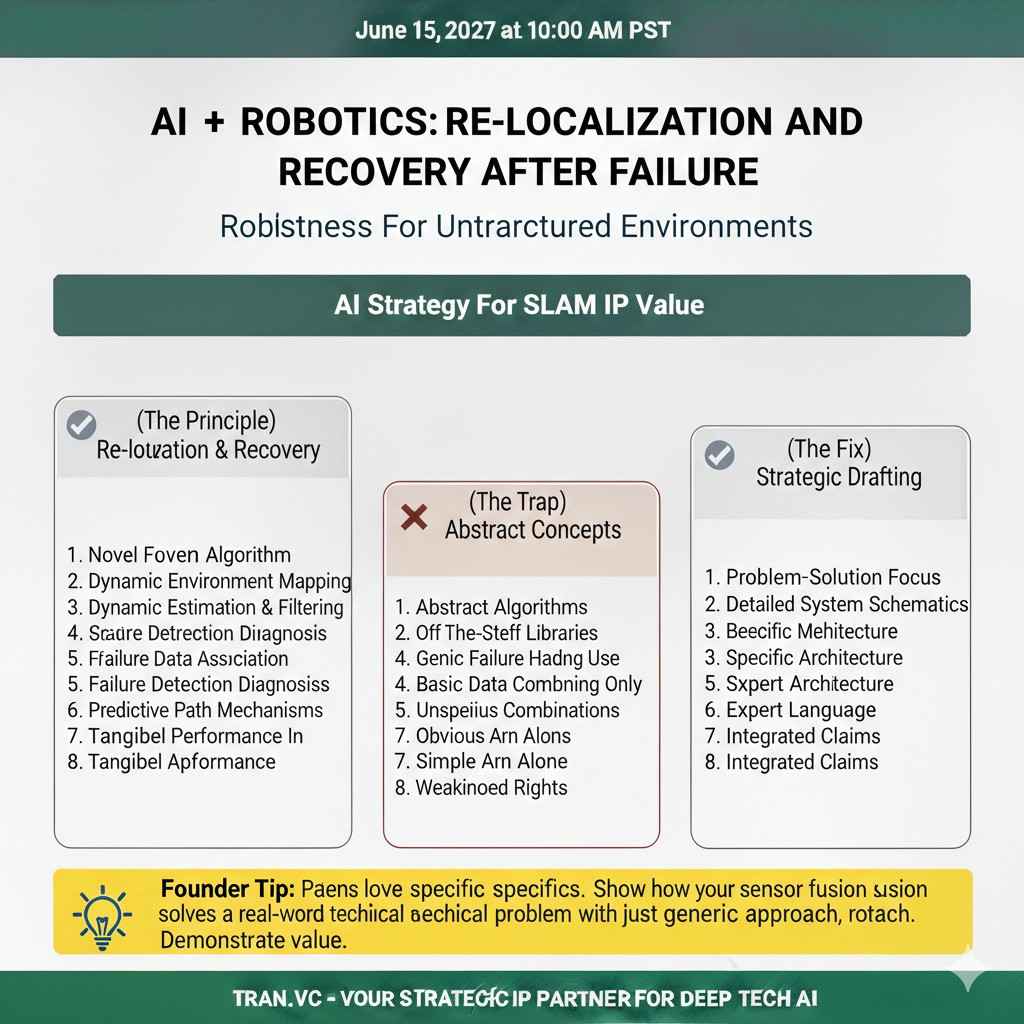
In product deployments, failures happen. The real question is what your robot does next. A re-localization method that is fast and reliable can be a major edge, especially in warehouses, hospitals, and malls where scenes repeat.
If you built a system that detects loss of localization early, changes behavior to reduce risk, and uses a targeted re-localization strategy, you may have a protectable invention. This is especially true if you do something smarter than “reset and try again.”
For example, you might maintain a small set of candidate poses, score them using a mix of sensors, and choose a recovery action that increases information gain. That is a clear method with clear steps, and it can be written in a way that is hard to design around.
Navigation: what startups can often protect
Planning that adapts to uncertainty, not just obstacles
Basic path planning is not new. What can be new is how planning changes when you are uncertain about where you are, or uncertain about what you see.
If your planner changes its safety margins, speed limits, or route choices based on SLAM confidence, that is a strong patent area. It becomes even stronger if you have a specific mechanism for computing confidence, and a specific set of actions tied to confidence thresholds.
This is where many startups have real originality. They do not just plan a path. They plan a path that reflects what the robot knows, what it does not know, and what it expects to learn next.
Local control that handles real-world edge cases
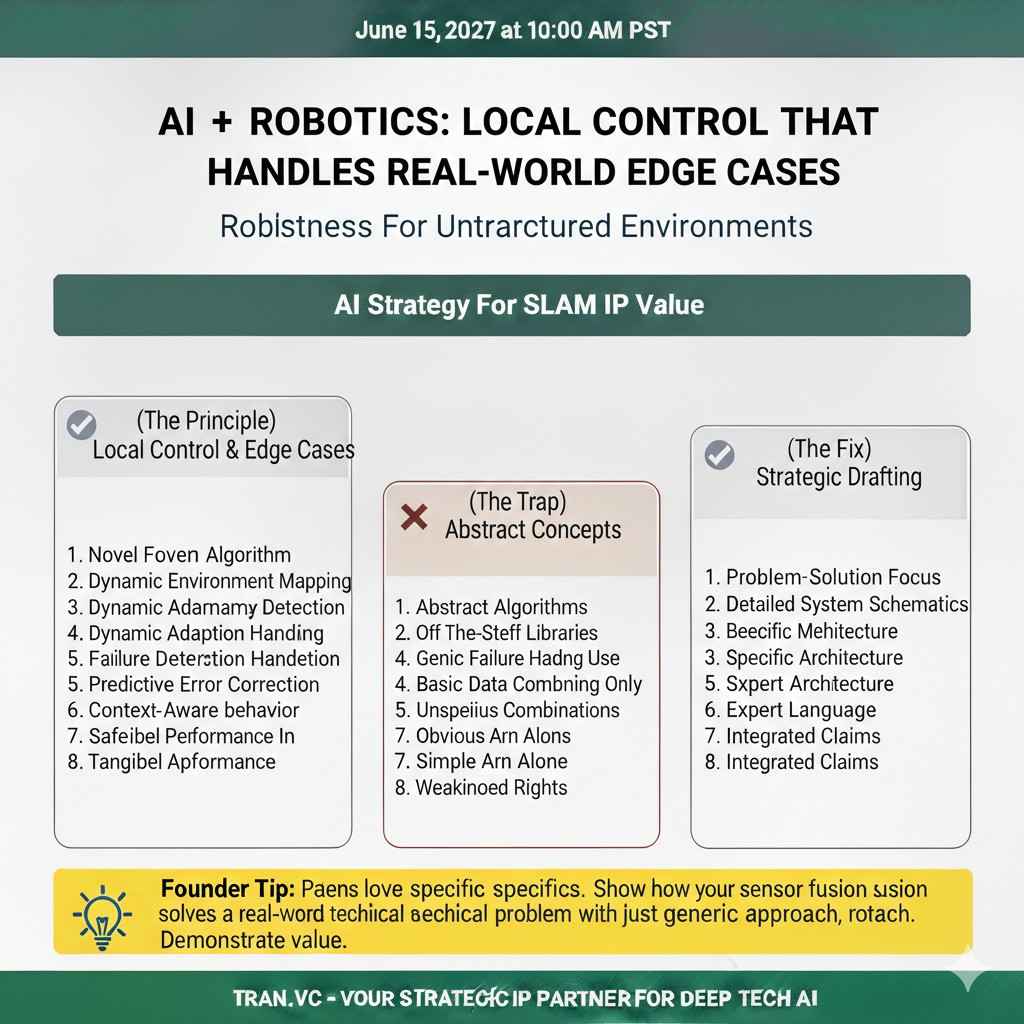
Local control is where many robots fail in the field. Tight turns, slippery floors, bumps, wheel slip, low traction, and actuator delays can cause wobble, overshoot, and collisions.
If your control system adapts to floor type, load weight, or speed, that can be protectable. If you built a way to detect slip from IMU patterns and wheel encoder mismatch, then change your controller behavior, that can be a solid invention.
Another protectable area is “safe behavior under degraded sensing.” If your robot can keep operating safely when a sensor is blocked, dirty, or misaligned, and your control behavior changes in a defined way, that is often patent-worthy.
Semantic navigation and task-aware movement
Many robots do not just move from A to B. They move to complete a job. That job creates constraints that generic navigation does not handle well.
If your robot changes navigation behavior based on task context—like carrying fragile items, towing a cart, scanning shelves, or interacting with people—that can create strong protection. The key is to show how task state feeds into planning and control, and how the system chooses actions differently than a generic navigator.
If you also combine this with map semantics, like identifying “no-go zones,” “yield areas,” “preferred lanes,” or “charging corridors,” you can build a strong set of claims. Even better if you have a method to update these semantics over time based on observations.
The bridge between SLAM and navigation: where many strong patents live
Using localization quality to change robot behavior
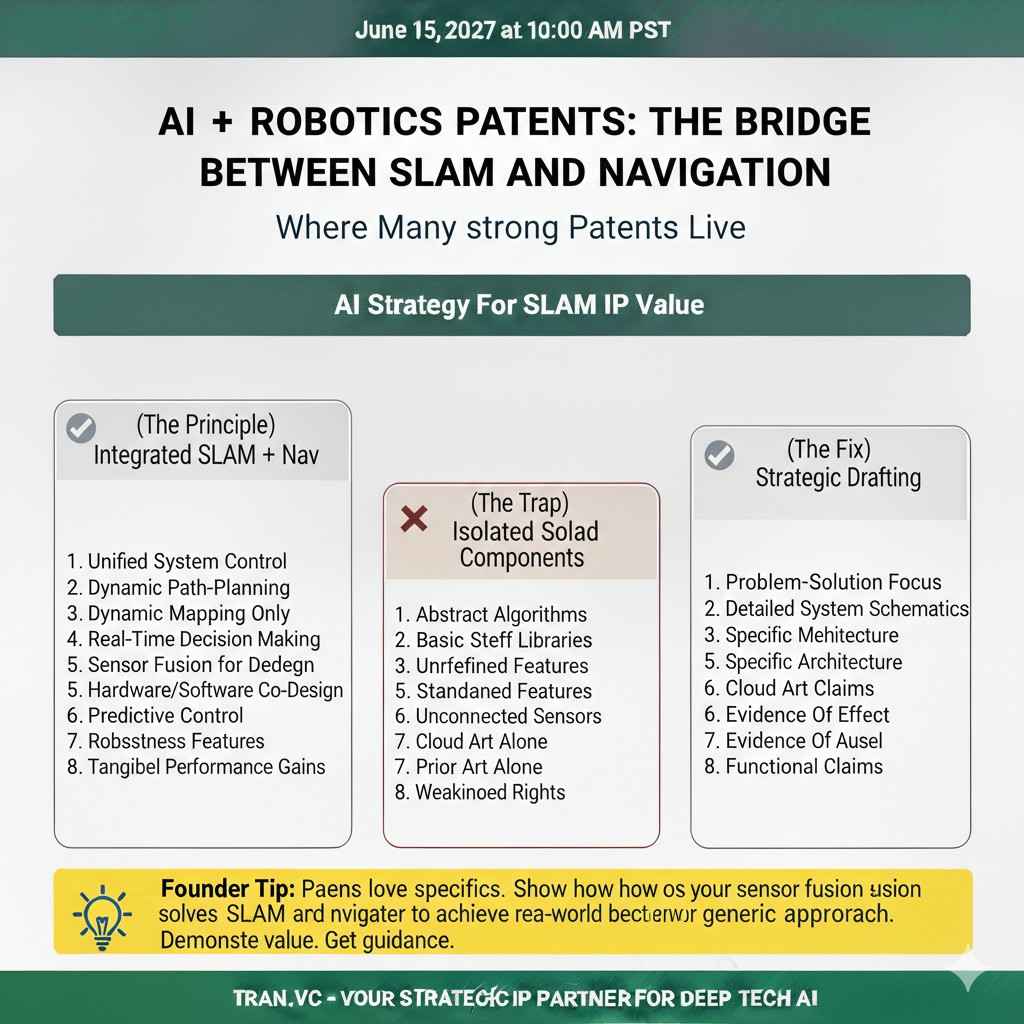
This is one of the best areas for startups, because it is very practical and very defensible.
If your robot estimates its own localization quality and uses that to change speed, route, or sensor use, you can often shape a strong patent. The invention is not “confidence scoring” by itself. The invention is the full behavior loop: how you compute confidence, what triggers state changes, and what the robot does in each state.
For instance, when confidence drops, your robot might slow down, choose wider paths, avoid narrow aisles, or move to a “re-localization zone” with better landmarks. If your system does this in a defined, repeatable way, you have something protectable.
Active mapping and active re-localization
Many systems are passive. They take what the world gives them. A more advanced system chooses actions that improve its own understanding.
If your robot picks a path that increases map quality, reduces uncertainty, or targets areas that need more coverage, that can be patent-worthy. This is especially useful in large sites where mapping time matters and updates must be done while operations continue.
The same applies to re-localization. If your robot actively seeks viewpoints that make matching easier, rather than waiting for a good frame by chance, that can be a meaningful invention.
Fleet-level learning and map sharing
If you have multiple robots, you may be doing things that single-robot systems cannot. Map sharing, change detection across a fleet, and distributed updates can all create protectable work.
The novelty often lies in how you merge maps safely, how you prevent bad updates from spreading, and how you decide which robot’s data to trust. If you built a gating system, a consensus system, or a method that uses “agreement signals” across robots, those can form strong claims.
This is also an area investors like, because it shows compounding advantage. Each deployment can make the system better, but in a controlled way.
How to spot patent-worthy material inside your current work
Look for the moments where you said “we had to hack it”
A simple way to find inventions is to scan your own engineering history. Look at bug tickets, incident reports, and Slack threads where someone wrote, “This breaks in Site X,” or “We had to add a special case,” or “We changed the pipeline to handle this.”
Those “special cases” are often inventions in disguise. They exist because standard methods did not work under your constraints.
If your team can explain the exact condition that caused failure, and the exact rule you added to fix it, you have the start of a patent story. The more real and specific the condition is, the better.
Focus on constraints: cheap sensors, low compute, hard scenes
Many strong robotics patents are really “constraint patents.” They protect a method that achieves good performance under tight limits.
If you run on low-cost hardware, you likely built a clever way to get high accuracy anyway. If you operate in harsh scenes, you likely built a clever way to maintain stability. If you need low power, you likely built a clever way to schedule compute.
These constraints make your invention feel less like a generic algorithm and more like a real technical solution. That is good for patents and good for business.
Track what is truly unique versus what is common
It helps to be honest here. If your approach is straight out of a popular paper and implemented in a known open-source stack, it may be hard to protect.
But most startups do not ship a pure academic approach. They combine ideas, change steps, add safeguards, and tune for their domain. That is where uniqueness shows up.
A practical test is this: if a skilled engineer joined your competitor, could they copy your behavior in two weeks just by reading common docs? If the answer is “no,” you likely have protectable work.
Turning technical work into strong patent claims without slowing down
Write invention notes like you write design docs
You do not need legal language to start. You need clear technical writing.
A useful invention note has a simple structure: the problem, why common approaches fail, what you do differently, and what results you get. Results can be expressed as stability, accuracy, speed, safety, or runtime improvements, but they should tie back to real tests.
Include the trigger conditions and decision logic. Include the data inputs and outputs. Include the steps in order. If there are thresholds, describe how they are chosen. If there is a fallback behavior, describe when it activates.
This is enough for a patent team to begin shaping claims while your engineers keep building.
Protect the method, not just the product
Startups often describe their invention as a product feature. That is fine for marketing, but not enough for patents.
Patents want the method. They want the system behavior. They want the pipeline and decision steps, described in a way that can apply across different robots, different sensors, and different deployments.
That does not mean you become vague. It means you describe the core mechanism in a flexible way. For example, you might say “range sensor” instead of “lidar,” or “image sensor” instead of “stereo camera,” while still describing the steps clearly.
Filing early without locking yourself into one version
A common fear is, “If we patent now, and we change the approach later, we wasted the filing.”
In practice, early filings can be written to cover the core concept and several variants. Good patent drafting includes optional paths, alternate inputs, and multiple ways to compute the same signal. That way, as your system evolves, the patent still fits the family of methods you built.
This is where having experienced patent strategists matters. You want filings that match how startups build: iterative, fast, and full of learning.
If you want that kind of help, Tran.vc was built for exactly this stage. You can apply anytime here: https://www.tran.vc/apply-now-form/