
Invented by KIM; Namyeong, KIM; Jeongki, CHOI; Jinsoo, JANG; Insun, LG ELECTRONICS INC.
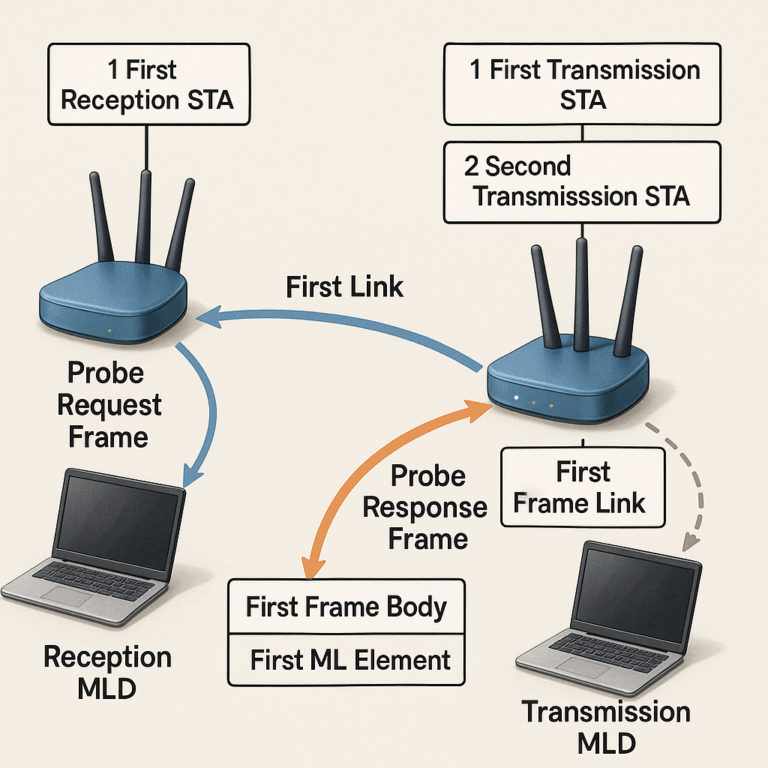
Wireless networks keep our lives connected. As new gadgets and smart devices fill our homes, the need for faster and smarter Wi-Fi grows. Today, we look at a recent patent application that tackles a tricky problem in next-generation Wi-Fi: how devices with many links (multi-link devices, or MLDs) can share just the right amount of information with each other. This new patent brings fresh ideas to help devices talk more smoothly, avoid repeating themselves, and use less airspace for their chatter. Let’s break down what this means for technology, how it builds on past work, and exactly how the invention works.
Background and Market Context
Wi-Fi has changed how we live. We use it for work, play, school, and even controlling our lights and fridges. As Wi-Fi grows, it faces new problems. More and more gadgets want to use the same airwaves. Sometimes, one device may have several radios working at once. These are called multi-link devices, or MLDs. They can talk on two, three, or even four different channels (called “links”) at the same time.
Why does this matter? Imagine you’re at a busy train station. If everyone shouts out their plans, the noise becomes overwhelming and nobody can hear. It’s the same with Wi-Fi. If every device sends all its information every time, the airwaves get crowded. Devices lose time repeating details, and the network slows down.
The latest Wi-Fi standards, like Wi-Fi 6E and the upcoming Wi-Fi 7 (called IEEE 802.11be or EHT), let devices use more links at once. This means they can send and receive data faster by using extra channels in the 2.4 GHz, 5 GHz, and 6 GHz bands. But with great power comes new problems: How do we make sure devices send only what’s needed, and not repeat the same information across each link?
In a world filled with smart watches, TVs, phones, and thermostats, every bit of saved space helps. Less time spent sending repeated information means more room for real data, faster connections, and less battery drain. That’s what the new patent aims to fix. It gives a better way for multi-link devices to ask for and share information, keeping things lean and efficient.
Scientific Rationale and Prior Art
The problem of devices repeating information in Wi-Fi isn’t new. In the early days, each device just sent what it had and didn’t worry about overlap. As Wi-Fi standards grew, smarter ways were invented: devices could “inherit” some information, meaning if it was already sent once, it didn’t have to be sent again.
The idea of “inheritance” shows up in standards like IEEE 802.11ax (Wi-Fi 6). There, devices sometimes send a big list of their capabilities or settings, but if several devices share the same settings, they might refer to a single copy instead of repeating it. This saves space.
But as multi-link devices became common, things got trickier. Now, a device might be one physical box, but have several “stations” inside—each working on its own link. Each of these stations might need to share some information about itself with other devices. Sometimes, two stations on different links have the same settings, and sometimes they don’t. Prior art handled this by sending all the information for each station, even if it was the same. This meant lots of repeated data, which used up valuable airtime.
Some patents and standards tried to fix this by letting devices group their information and mark what was the same. Others allowed for “partial” updates, where a device could request or send just a piece of its information. But none fully solved the problem of how to efficiently request and send only the needed data when multiple links are involved, and how to avoid sending the same details twice when not necessary.
With the new Wi-Fi 7 (EHT) standard, there’s even more push for efficiency. Devices can use more channels, send more data, and connect in more complex ways. That means the old way of sending everything, every time, just won’t work anymore. We need a smarter way for devices to ask for exactly what they want, and for the other side to reply with just what’s needed—no more, no less.
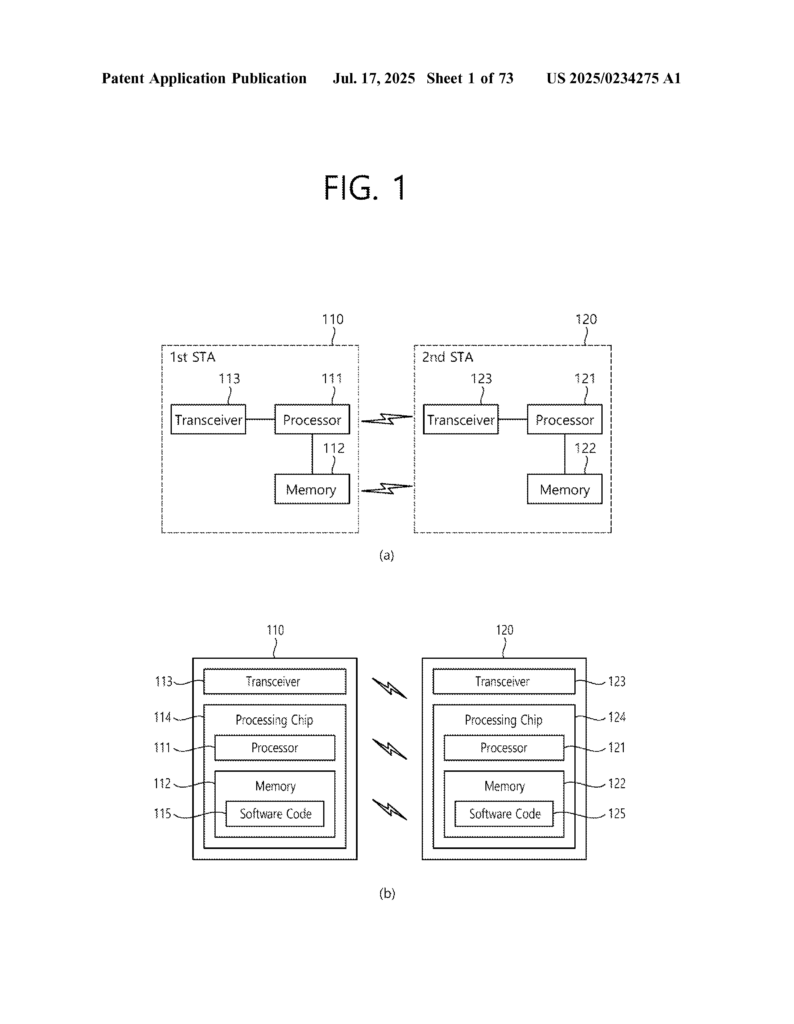
Invention Description and Key Innovations
This patent introduces a new method for multi-link devices to share information in a way that’s flexible and avoids repeats. Let’s walk through the core ideas, using simple words and examples.
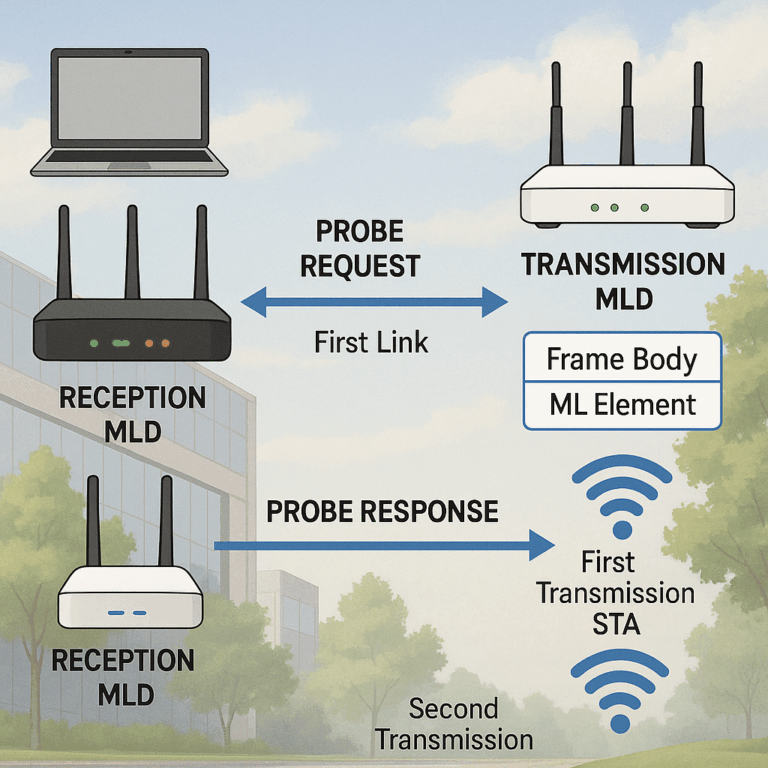
Imagine two multi-link devices: one is sending (the transmitter), the other is receiving. Each device has several “stations” inside, each working on a different channel (link). Sometimes, the receiving device wants to know something about all the links, sometimes just about one. Sometimes, the information it wants is the same for two links; sometimes it’s different.
Here’s how the new method works:
1. The receiving device asks for information by sending a “probe request.” It can ask for complete information (everything about a link) or partial information (just some details), and it can ask about several links at once.
2. The transmitting device replies with a “probe response.” Here’s where the magic happens: if the same information is asked for more than once (say, for two different links), the device sends it only once, and marks in the response that the information applies to both. If the information is different for each link, it sends each piece separately.
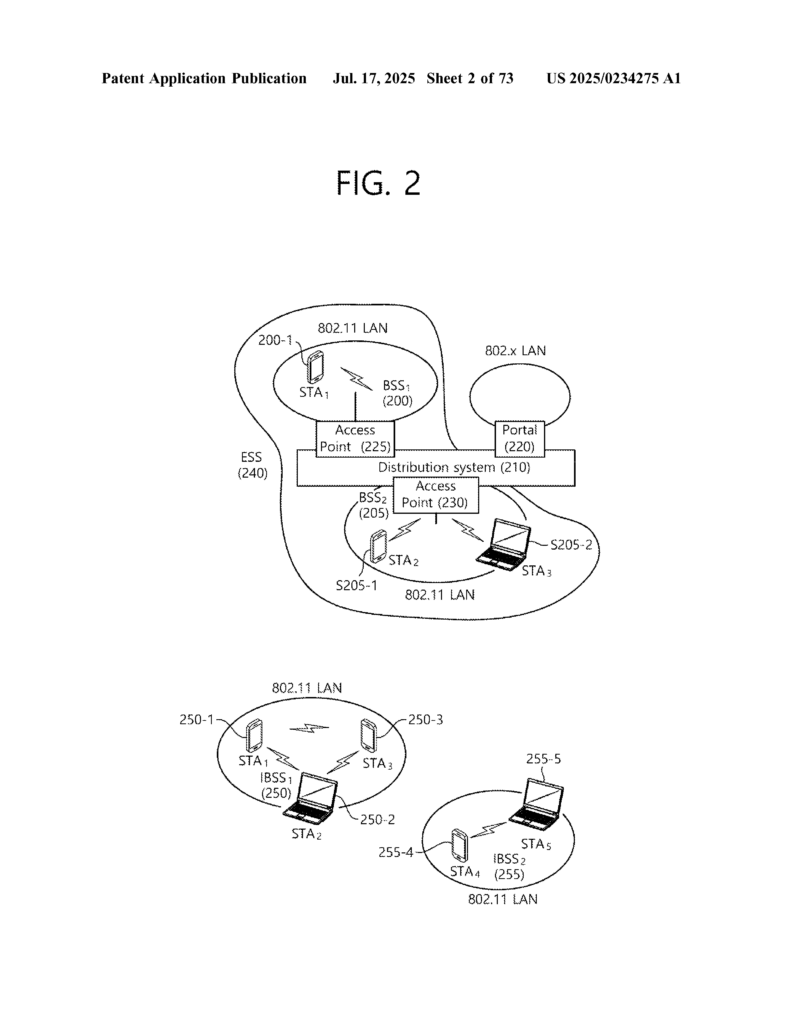
To do this, the invention uses a clever structure:
– There’s a “frame body” that holds the main information.
– There’s a “multi-link element” that has separate parts (called “profile subelements”) for each link.
– In each profile subelement, there’s a little flag (a “complete profile subfield”) that says if the information is complete or just partial.
– If two links share the same partial information, the device puts the data in the main frame body and just marks the other link’s subelement with a flag, without repeating the data. If the information is different, it’s included separately.
For example, let’s say the receiving device wants to know the “SSID” (network name) for both link 1 and link 2, and it’s the same for both. The transmitter puts the SSID in the main part of the response, marks in the link 2 subelement that it’s partial and “inherited” from the main body, and doesn’t repeat the SSID for link 2. This way, there’s no duplicate data.
But if the receiving device wants the SSID for link 1 and the “Supported Rates” for link 2, which are different, the transmitter puts each in its own place—no confusion.
What does this mean in practice? It means that when devices need the same info about several links, they get it just once. When they need different info, they get each piece separately. This saves space, makes messaging faster, and helps the whole network run better.
The patent also covers more complicated cases, like when there are three or four links, or when some information is complete and some is partial. The same idea applies: send only what’s needed, mark what’s inherited, and avoid repeating yourself.
The method is flexible. Devices can:
– Request all info or just some.
– Mix and match what they want for each link.
– Get clear signals in the response about what’s included and what’s not.
This helps in real-world uses. For instance, a phone connecting to a new Wi-Fi router can quickly learn everything it needs about each link without getting bogged down by repeated data. Gadgets that sleep to save battery can get only the updates they need, not a flood of old data. Routers can handle more devices without getting overloaded.
At its heart, this invention is about being tidy and smart with information. It gives devices a shared language to ask and answer in just the right way, cutting out the noise and keeping Wi-Fi fast and nimble.
Conclusion
Wi-Fi keeps getting faster, smarter, and more complex. As multi-link devices become common, it’s crucial to make their messages efficient. This patent brings a clever solution: only send what’s needed, don’t send the same thing twice, and make sure both sides know exactly what’s included. It’s a simple idea with big impact—faster setup, less wasted space, and smoother connections for all. As Wi-Fi 7 and beyond roll out, methods like this will help our gadgets keep up with the growing demand, keeping us all connected, seamlessly and efficiently.
Click here https://ppubs.uspto.gov/pubwebapp/ and search 20250234275.