
You don’t need a live product to show real value. You need clear proof that your idea solves a hard job, fast and safely. You can get that proof with small tests, real scenes, and simple numbers—weeks before you ship a public release. Do it right and partners will lean in, buyers will open doors, and investors will see a plan, not a pitch.
This guide shows you how to earn trust early with calm, honest signals: tight demos that mirror the field, safe shadow runs, quick expert reviews, crisp proxy metrics, and a tiny paid step that feels easy to say yes to. We’ll keep each move simple and practical so you can run it this month, even with a small team.
If you want a hands-on partner to help protect your core method while you build this proof, Tran.vc invests up to $50,000 in in-kind patent and IP services for AI, robotics, and deep tech teams. Apply any time at https://www.tran.vc/apply-now-form/.
Mirror the Field Before You Build

You can prove value with a demo that acts like the real world. It does not need perfect polish. It needs honest limits. When your demo uses the same inputs, the same speed, and the same noise your buyer faces on a normal day, people trust it.
Choose one job and one real scene
Pick the single job your product must do first. Say it in one short line a manager would use. Keep the scene plain and painful. It could be a camera facing glare at 30 frames per second. It could be a robot arm picking under mixed light. It could be a lab step that takes twenty minutes and breaks twice a week.
Freeze the bounds before you code. Lock the sensor type, the frame rate, the compute budget, the latency cap. Do not give yourself extra light or bigger hardware than a site would allow. Hard limits make your win believable and make your misses useful.
Write down why this scene matters now. One paragraph is enough. Later, when someone asks “why this,” you can answer in seconds. That calm answer is a signal. It shows you respect the work your buyer does, not just your own roadmap.
Make outputs measurable, not pretty
Define the target before the run. Use a unit the buyer already knows. Aim for a number and a clock. For vision, it might be false rejects under two percent at line speed. For control, it might be a safe move in four seconds with zero collisions.
Instrument your demo to log inputs, decisions, and time to decision. Save a short replay with the exact frame or step where your system made the call. Screenshots help. Logs prove. When you can replay the same call and show the same outcome, trust rises quickly.
Share a tiny report after the run. Put a table with scene, target, result, and run count. Add one still image. Keep the words plain. This is not marketing. It is a lab note that people can forward without you.
Capture the method as an asset
If your approach holds under glare, drift, or noise, write the steps in plain order. List inputs, transforms, checks, and fallbacks. Keep code out. Name the flow like a recipe. Recipes are easy to review and hard to steal once filed.
Draft a focused provisional around that flow. Cover the few variants you tested in your demo: different lenses, speeds, or materials. Tie each variant to a result in your report. Utility plus novelty makes a strong claim.
Add one quiet line to your report: “Method protected (provisional filed).” Now your early proof is not just a story. It is a moat you own. If you want help with filings while you build, Tran.vc invests up to $50,000 in in-kind IP work. You can apply any time at https://www.tran.vc/apply-now-form/.
Run Expert Walkthroughs Before Pilots
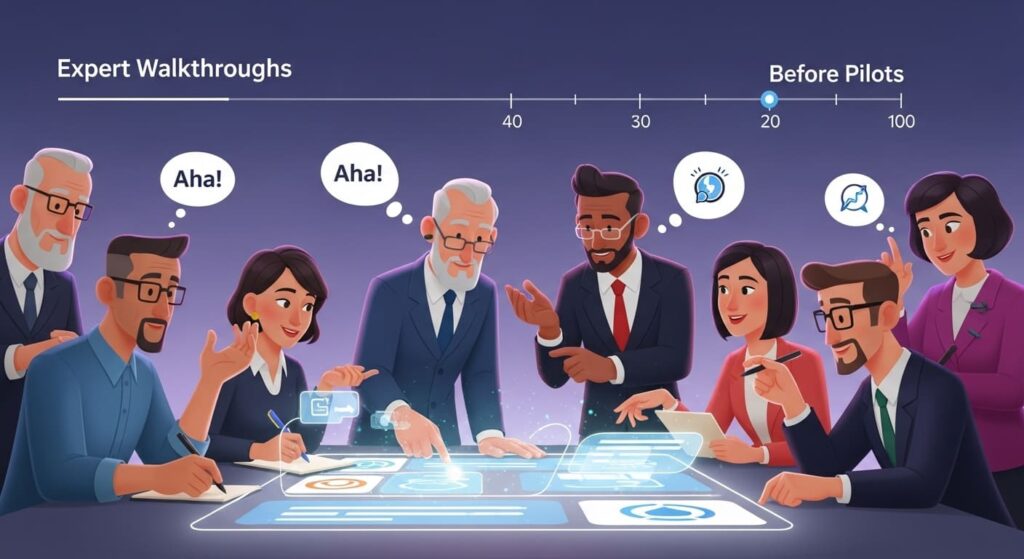
Experts are not your users yet, but they live the job. A short panel can stress your plan in days. If you run it like a build loop, you get fast truth without asking for a site or a PO.
Recruit hands-on voices, not only titles
Invite people who touch the work. A shift lead who resets the camera. A lab tech who preps samples at 6 a.m. A quality engineer who signs off on failure reports. Their words will be short, sharp, and concrete.
Aim for variety inside one wedge. Three similar lines with different lighting beat ten random firms. Small differences expose blind spots while the job stays the same. That keeps feedback useful and easy to act on.
Offer a clear give-get. Three one-hour sessions over three weeks. You bring a small stipend, early access, and a chance to shape a safe pilot. They bring scenes, numbers, and the “on Tuesday” truth you need.
Force real choices with real artifacts
Bring one artifact per session. A short clip with glare. A dry-run video. A one-page spec draft. Ask pass or fail and why, in their words. Stay in the past tense. “Tell me about the last time this happened.” Past tense pulls facts, not guesses.
Ask for counts and clocks. How often does this scene show up? How long until someone notices? Who gets called first? Numbers turn talk into targets you can test next week.
End each session with one change you will ship before the next call. Then show the change working on the same scene. You are no longer “collecting feedback.” You are “reducing risk.” That tone moves doors.
Turn opinions into validation data
Transcribe three short quotes in raw words. Tag each by role and scene. Keep them in one place. Real lines will power your site, your deck, and your product copy.
Write a one-page memo that lists accept thresholds the panel agreed on. Use their units and their clocks. “At 30 FPS under sodium light, false rejects under two percent.” This memo becomes your spec for demos, sims, and pilots.
If the same check or fallback keeps winning “pass,” capture it as a method. When it is new and useful, file it. Panel-backed claims age well because they match the job. Tran.vc can help convert this truth into strong filings while you move.
Shadow the Real Flow Without Owning It Yet

A shadow run is proof without risk. Your system watches the live feed, makes calls in parallel, and logs results while humans act. You learn under true pace. The buyer stays safe. Everyone moves faster toward a yes.
Match live pace and live limits
Install beside the real flow with the same sensors, latency, and compute you would use in production. Do not cheat. Do not downsample unless the site already does. Match reality so your numbers travel.
Log each decision with time to decision and a confidence score. Also capture what the operator actually did. That gives you pairs: what you would have done, what they did, and how long both took. Pairs reveal patterns fast.
Keep the window short. Two weeks across two shifts is often enough to see common edge cases. Short windows hold focus and keep “shadow forever” from eating months.
Score calls with a shared rubric
Agree on categories before you start. Correct pass, correct fail, false reject, false accept, and defer. Defer matters. It shows your system knows when to slow down and ask for help.
Review a random slice with the site lead every few days. Resolve any disagreement in the moment. Store rulings. This builds a shared truth and avoids long fights at the end.
Report with humility. If you deferred in glare on day one and improved after a preset on day four, say it with dates. A quiet slope with clear fixes reads like control, not spin.
Convert shadow proof into a tiny paid step
Turn the top two learnings into a narrow guardrail. Offer to take action only when the scene is within those safe bounds. Name the bound and the metric you will move. This makes the first step easy to approve.
Price the step modestly and set a clear clock. Promise to report the same rubric each day. If you hit the mark, expand. If not, you learned fast and kept risk low. Either way, you moved past talk.
Capture any new arbitration or fallback logic you created during shadow. If it is novel and practical, file it. Guardrail methods that buyers trust are hard to copy later. Protect them now. If you want a filing partner who works fast, Tran.vc can help—apply at https://www.tran.vc/apply-now-form/.
Use Proxy Metrics to Prove Value Without Invoices
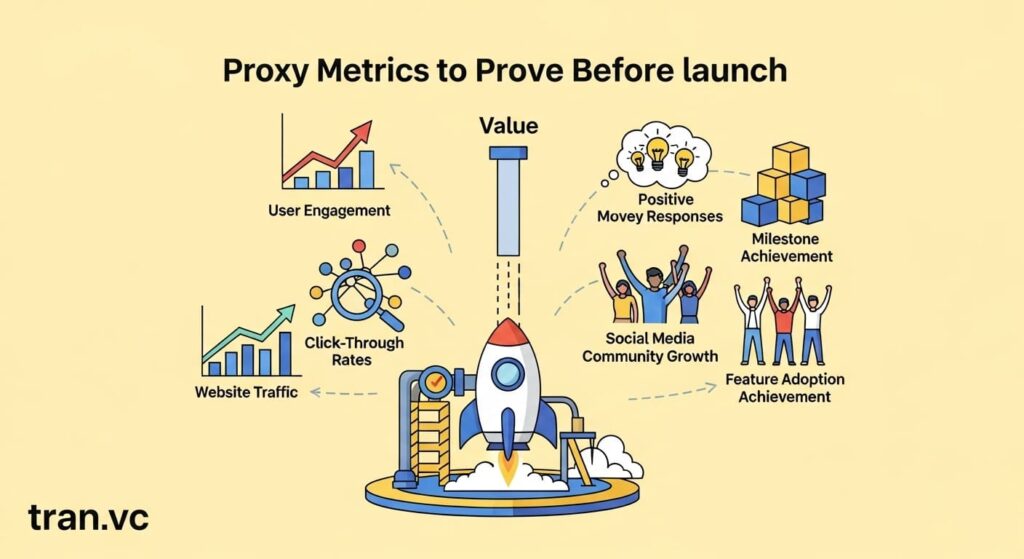
You can show worth before revenue by moving a number your buyer already tracks. Pick one proxy per job and measure it the same way every time. When the proxy moves, the room sees value.
Pick a proxy that maps to money or safety
Choose something close to pain. Minutes per changeover. False rejects at target speed. Time to safe resume after drift. Ask a manager how they report it today and who reads the report. That link makes later price talks simple.
Write the mapping in one short line. “Cutting re-teach minutes raises uptime.” “Fewer false rejects reduce scrap.” Put this line on your demo slide and pilot sheet.
Keep the proxy honest. If the number lives outside your tool, agree on a shared source with the buyer. Pull a sample together to check alignment before you claim a win.
Measure with stable, simple methods
Instrument your demo or shadow run to record the proxy the same way each time. Add cause tags to each improvement. A faster changeover due to presets is not the same as faster due to better detection.
Plot improvement by cohort of sessions, not as a rolling average. Cohorts show that gains persist with new runs, which feels real.
Store one clip per cohort with the same scene name and a timestamp. These clips end debates and cut email threads in half.
Turn proxy wins into tiny paid steps
When the proxy moves, offer a small, paid step anchored to the same number. Keep unit and scope tight. Use the buyer’s words.
If a specific method drove the gain—say, a new planner under glare—write it down and consider filing. A method tied to a measured lift is a strong claim.
Add one line to your slide: “Proxy moved +37%; method protected.” Calm words. Big impact.
Build Partner Sandboxes That Feel Like Live Sites

A strong partner can lend you a floor before you have one. A good sandbox gives you the same stress as a real site without the risk of downtime. When your rig matches their world, your wins transfer cleanly to sales.
Match tight constraints, not marketing wishes
Agree on the exact bounds first. Name the sensors, the light, the speed, the latency, and the compute cap. Keep them strict and write them down. This stops drift and keeps faith.
Ask the partner to supply both normal and bad cases. Normal keeps you honest about baseline. Bad cases teach you where to add guardrails. Store why each case matters in a sentence.
Build the rig once and test in short bursts. Two or three days per scenario is enough if logging is clear. Short loops help the team ship fixes between visits and keep trust high.
Measure what the owner really cares about
Before you press start, pick one outcome per scenario. Use the partner’s unit. Uptime, yield, safe resume time, or scrap rate. Speak their language so the result lands.
Log every attempt. Save inputs, your call, the time to call, and any defer. Defer is not failure when it avoids risk. It is proof of caution that buyers value early.
Send a one-page note after each block. Show target and actual in a tiny table, one still image, and two lines on what changed. Notes that read like lab logs travel farther than glossy PDFs.
Turn the sandbox into a repeatable suite
Freeze each scenario as a bundle with data clip, config, target, and outcome. Give it a stable name so you can rerun it before releases. Your “field-in-a-box” suite now guards quality.
If one method lifts results across bundles, document the steps. When those steps are novel and useful, file a provisional. You are protecting the engine that survived real stress.
Credit the partner in a neutral note if allowed. Two paragraphs and a chart will do. This proof in your data room makes later pilots faster. Tran.vc can help package and protect these methods while you scale.
Set Up Pre-Commit Pilots That Buyers Can Approve Fast
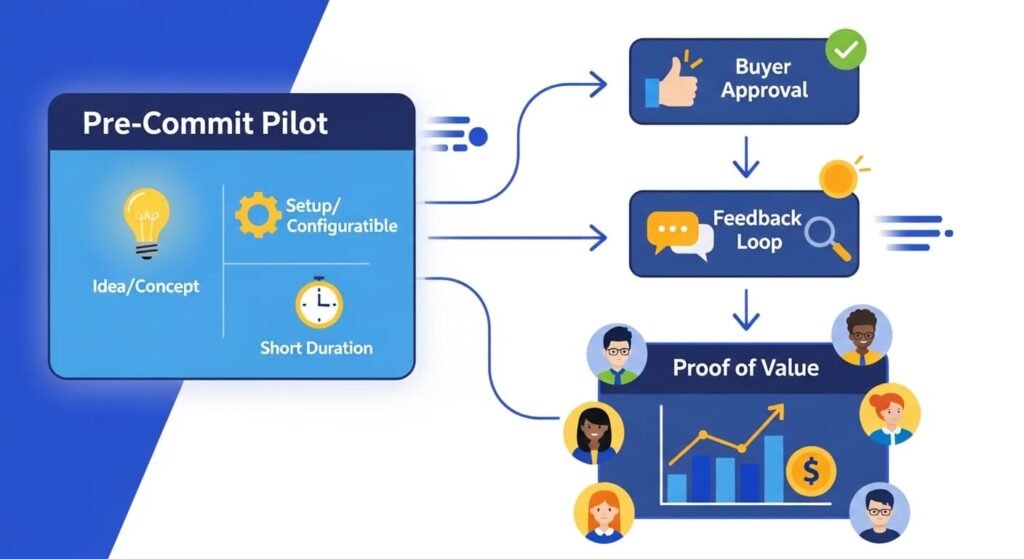
A tiny paid step before launch turns belief into action. Keep it safe, scoped, and easy to sign. When the first step is small and clear, legal and ops say yes.
Shape a narrow, guarded scope
Pick one scene, one metric, and one guardrail. State the frame rate, the light, the device, and the compute. Say what you will never do. Clear edges lower fear.
Time-box the run. Two weeks is long enough to learn and short enough to approve. Tie success to a number you already moved in sandbox or shadow.
Name owners on both sides. One tech lead, one ops lead. Names beat titles. When everyone knows who acts, the work flows.
Use paper that moves, not stalls
Draft a one-page order. Put scope, guardrails, metric, dates, fee, and data use in plain words. Avoid heavy terms that need board sign-off. Aim for the smallest approval path that is honest.
Attach a short safety page. Explain detect, decide, act, and fallbacks. One diagram helps more than ten paragraphs. Calm clarity wins reviews.
If security is strict, include a simple FAQ. What you collect, where it lives, who can see it, and how long you keep it. Fast answers save weeks.
Report like adults, not cheerleaders
Send two short updates per week. One screenshot, one number, one line on what you changed. Keep it steady. The rhythm builds trust and prevents scope creep.
If the run hits the mark, convert to the next step in 24 hours. Keep scope close and price fair. Momentum is precious; do not let it fade.
If the run falls short, show what you learned and the fix you will ship. Then pause with grace. Buyers remember care more than perfection. Pros come back when you act this way.
Treat Safety Cases as a Product, Not a Binder

Safety is your passport to the floor. A crisp safety case shows you know your edges and act with care. It shortens reviews, unlocks guarded pilots, and becomes part of your moat.
Draw boundaries in plain words
Define what you sense, what you decide, what you control, and what you never touch. Boundaries reduce fear. People relax when the edges are clear.
List the top hazards from panels, sandboxes, or shadow runs. For each, write detect, decide, act in short steps. Keep sentences simple.
Link each hazard to one proof clip or log. A small artifact beats a long claim. Proof ends arguments early.
Prove detect-decide-act with real artifacts
Record short clips where guardrails fire and harm is avoided. Show the path chosen, the time to act, and the fallback. Keep it dry and exact.
Store logs with reason codes. Glare, drift, occlusion, bad spec. Codes let you track patterns and show progress with dates.
Review weekly. Resolve any unclear cases with the site lead during shadow or pilot. Shared truth now prevents hard calls later.
Keep the case alive with small logs
Log every guardrail event with what, why, and outcome. Most will be routine; some will reveal a tiny fix that also helps retention.
When you ship a safety improvement, add a dated note to the case. Over time, it becomes a timeline of risk reduction. Timelines calm lawyers and speed deals.
If your arbitration or fusion logic is new and practical, file it. Safety engines buyers trust are hard to displace. Tran.vc helps turn these loops into claims without slowing your build.
Price Early Without Guessing

You can price a pre-launch step fairly using the numbers you already moved. Anchor to a proxy your buyer tracks, use their approval path, and learn in small, safe jumps.
Anchor to one proxy and one unit
Pick the proxy you improved: minutes per changeover, false rejects at speed, time to safe resume. Confirm with the manager how it maps to dollars or risk.
Choose a unit the buyer already uses: per line, per device, per run, or per team. Clear units shrink meetings.
State the offer in one line: “$X per line for a two-week run to cut Y by half under guardrail Z.” Simple words invite simple yes.
Match the buyer’s approval path
If a plant manager can sign a small PO, shape the step for that level. If a lab lead can swipe a card, price to that card. You are selling a safe step, not the whole future.
Put legal terms on one page. Keep data use strict and clear. These choices speed sign-off and show respect.
If procurement needs a form, prefill what you can. Remove work for them. Ease reads as care.
Learn your ceiling and floor with calm moves
When three buyers approve fast, try a modest raise on the next two. Keep scope the same so you can read the effect.
Ask where the pain was in the talk when a pushback hits. Unit, scope, or amount. Change one, not all. Note the result.
As proof stacks, expand gently. Move from one line to two lines, or one team to two teams. Earn each jump. Price will follow.
Package All Proof Into Two Slides People Can Carry
Busy rooms need a story they can retell without you. Two slides can do it: proof under real limits, and motion toward dollars. Keep the frame steady and swap in fresh dots as you learn.
Slide 1: Proof under real limits
Title with the job in buyer words. Show three boxes: sandbox, shadow, benchmark. Under each, put target, result, and constraint in tiny type. Add a still image. The eye learns the pattern fast.
Place one raw quote from an operator near the boxes. Real words make numbers human. Human sticks.
Add a quiet footer: “Method: glare-safe planner (provisional filed).” You just linked outcome to moat in one breath.
Slide 2: Motion to dollars
Left side: two dated release notes and the metric each moved. Right side: mini table of qualified pilots—Company, Stage, Next Step Date, Amount. Footer: “Pipeline ÷ Goal = 2.3×.”
Add a small line for “Median days to first paid step” with one date label like “one-page order.” Dates say control.
Close with your tiny paid step: scope, guardrail, metric, owner, start date. Clear doors get yes.
Keep assets one click away
Attach clips, bundles, the safety page, and the pilot order in the appendix. Name files so they can be found later.
Answer questions with artifacts, not adjectives. Fast answers win rooms.
Update monthly. The frame holds. The dots and deals refresh. Your deck stays true.
Build a Public Proof Shelf People Trust

Before launch, you can still show real work. A small, public shelf of proof lets buyers, partners, and investors see progress without a meeting. Keep it simple. Keep it true. Make every item easy to share.
Pick scenes that match the buyer’s week
Choose three everyday scenes your buyer knows. A glare clip at line speed. A drift event with a safe pause. A lab step that used to take twenty minutes. Short is better. Plain is best. The goal is, “I know this moment. I’ve lived it.”
Record each scene with the same constraints you would face in the field. Same devices. Same light. Same compute. Honest limits make small wins feel big because they transfer. Fancy rigs create doubt.
Write two lines under each scene. One names the target and result. One names the guardrail and clock. These lines turn a video into a fact. Facts travel in email threads and stand up in rooms you are not in.
Add one artifact per claim
If you say “false rejects fell,” show the chart and the frame where the call changed. If you say “safe resume in four seconds,” show the timer and the path. Pair words with a visual that proves the moment.
Keep files light and names clear. “Scene-Glare-03.mp4” beats “Demo_Final_v8.mov.” Clear names get opened, forwarded, and found again later.
Refresh one item a month. Replace the oldest clip with a fresher one. Add the date on the page. A living shelf suggests a living product. It builds quiet trust.
Protect the method behind the proof
When one method keeps winning across scenes, write the steps in plain order. Inputs. Checks. Actions. Fallbacks. Do not hide behind jargon. Clarity helps both examiners and buyers.
File a focused provisional if the steps are new and useful. Tie the filing to the shelf item in a small footer. “Method protected (provisional filed).” You just linked outcome to moat without noise.
Tran.vc helps founders curate proof shelves and file around the engines that power them. We invest up to $50,000 in in-kind IP services. Apply at https://www.tran.vc/apply-now-form/.
Pre-Brief Security and Legal Before You Ask for a Pilot
Reviews can stall early work. You can lower the friction by answering the top questions before they are asked. Treat security and legal like product. Build once. Reuse often. Keep it short and human.
Say what you do and what you never do
Describe your system boundary in one calm paragraph. Say what you sense, what you decide, what you control, and what you never touch. Boundaries reduce fear. Fear slows deals.
Add a simple diagram that shows data flow. Mark where data rests, who can see it, and for how long. Show defaults first and options second. Defaults win reviews.
Write a plain FAQ with ten answers. Encryption in transit and at rest. Access control. Logs. Regions. Retention. Deletion. Keep sentences short. Your goal is clarity, not a badge.
Offer paper people can sign fast
Draft a one-page order for a narrow, guarded pilot. Scope, metric, dates, fee, owners, and a data-use section in plain words. Light paper moves. Heavy paper sits.
Include a short DPA addendum if needed. Keep the template clean and editable. The faster legal can redline, the sooner you get a date on the calendar.
If a buyer needs a vendor form, prepare your common answers in advance. Copy. Paste. Done. You save days with preparation that took an afternoon.
Keep the record tidy
Store signed docs, FAQs, and diagrams in one place with dates in file names. Buyers will ask for them again. Investors will, too.
When you change a control, add a dated note. “MFA enforced for all roles—2025-01-12.” Timelines build trust. Timelines also help you remember why a metric moved.
If you built a novel way to get the same assurance with less data, capture it. Privacy-preserving methods can be protectable assets. Tran.vc can help you decide and file while you keep shipping.
Create a Reference Design Kit Your Champion Can Forward

Your champion wants to say yes, but they need a safe plan. Give them a kit they can send up and across without you. The kit should be small, visual, and true to the floor.
Draw the smallest safe deployment
Sketch how your system sits next to their stack. Use the device names they use. Show where you plug in and where you do not. Show the guardrail that stops harm.
Mark setup time and who does each step. One line per step. One owner per line. Names beat titles. Clarity beats promise.
Add a box that says what you never store. This single box does more work than a long promise. It removes a silent worry that blocks approvals.
Include proof that fits the drawing
Place one clip and one chart that match the exact rig. The less imagination the reader needs, the sooner they agree.
Under the clip, print the target and result in the buyer’s unit. “Under sodium light at 30 FPS, false rejects 1.7%.” Numbers in their language feel real.
End the page with the small paid step. Scope. Metric. Guardrail. Dates. Owners. You are not asking for a leap. You are asking for a walk.
Keep the kit fresh with one change a month
When you ship a preset or a safer fallback, swap the diagram and clip. Date the footer.
Archive the old version so you can answer, “What did you do in November?” with a file, not a story.
If your diagram encodes a unique arbitration or state-sync method, document it and consider filing. Glue is often the moat. Tran.vc helps protect the glue you invent.
Set Exit Criteria for “Pre-Launch” So You Know When to Launch
“Not yet” can last forever. Define the line you must cross to say “we launch.” Clear exit criteria keep the team focused and stop feature sprawl. They also make your updates crisp.
Choose a small set of measurable gates
Pick three gates tied to value and safety. A first-run success rate. A week-four return tail. A guardrail false-stop rate. State each gate in one line with a number and a window.
Do not hide behind vanity counts. Launch gates should reflect the job. If your job is safe motion, use safe motion. If your job is fewer false rejects, use fewer false rejects.
Share the gates with advisors and partners. When everyone knows the bar, the bar holds. The launch will feel earned, not rushed.
Run weekly reviews against the gates
Every Friday, write one line per gate with the latest number and the change you shipped. Add the date. Boring is good. Boring means progress.
If a gate stalls, pick one lever and try it for a week. Preset. Dry run. Clearer label. Safer fallback. Small changes teach fastest.
Record what worked and what did not. Launch is not the day you flip a switch. Launch is the day your log shows steady truth.
Tie gates to filings and offers
If a method moved a gate more than once, file it. “Glare-safe planner lifted tail two cohorts—provisional filed.” Now your launch is tied to assets, not luck.
When you clear the gates, freeze the kit you will ship to new buyers. The first public offer should mirror what cleared the bar, not a new dream.
If you want a calm partner through this phase, Tran.vc invests in-kind to help you pick the right gates, file the right claims, and cross the line with confidence.
Align Hiring to Proof, Not to Org Charts

Before launch, every hire should move a gate or shrink a risk. Hire for the wedge, not for the future org. Clear roles now compound into speed later.
Write the job as a weekly outcome
Instead of a title, write the weekly result. “Ship one preset that cuts time-to-first win.” “Reduce shadow scoring disputes by half.” Outcomes attract builders, not resume polishers.
Share the same scenes you use in demos during interviews. Ask candidates how they would change one step. Great people talk in steps.
Give a small paid project that touches your real rig. Evaluate on the artifact and the notes. Notes tell you how they think when no one is watching.
Plug hires into your field loop
Let new teammates sit in expert calls and shadow reviews in week one. Let them own one artifact on the proof shelf by week two. Ownership creates speed because it removes translation layers.
Tie their work to one gate. Show the number each Friday. People love to see how their step changes the curve.
Write down who owns which engine. Engines that move metrics deserve care and, often, claims. When many hands touch an engine, value leaks.
Keep the team small and pointed
Say no to roles that add meetings without moving gates. Titles can wait. Proof cannot.
When you must pick between a polished generalist and a narrow expert who solves your scene, pick the expert. Scenes win pilots. Pilots win raises.
If an expert invents a method while fixing a scene, capture it. File it. Celebrate it. Tran.vc helps teams turn these wins into IP while keeping headcount lean.
Conclusion: Proof First, Launch Second
You can show value before you ship. Mirror the field with honest bounds. Let experts pressure-test your plan. Run shadows at real pace. Move a proxy number your buyer already tracks. Offer a small, safe, paid step with clear guardrails. Package it all in two calm slides and a tidy kit your champion can forward. This is how trust forms early. This is how doors open without noise.
Keep the loop tight. One scene, one metric, one change, one clip—repeat. Date every move. Save the logs. Capture the method that makes the lift repeat and protect it. When your best results rest on assets you own, your story feels strong even before a full launch. Buyers see less risk. Partners see a plan. Investors see a company that learns fast and builds a moat as it goes.
If you want a partner for this phase, Tran.vc invests up to $50,000 in in-kind patent and IP services for AI, robotics, and deep tech teams. We help you choose the right wedge, file smart claims, and package early proof into a fundable story. If that fits your next step, apply now at https://www.tran.vc/apply-now-form/.