
Most founders try to “bootstrap” the same way: they avoid hiring, do everything themselves, and hope sheer effort carries them.
That works for a short sprint. Then reality shows up.
You hit a wall where the problem is not time. It is judgment. You do not just need more hands. You need better decisions: the right price, the right customer, the right roadmap, the right legal steps, the right story for investors, the right way to protect what you built.
Hiring employees too early is one way to buy help. It is also one of the fastest ways to burn money, add stress, and lock yourself into the wrong path.
There is a better middle step: bootstrap a team of advisors, not employees.
A good advisor is not a “fancy name” on your website. A good advisor is a shortcut. They pull you away from bad choices before those choices become expensive. They open doors you could not open alone. They help you move with more calm and more focus.
This is also where IP matters a lot. When you build in AI, robotics, or deep tech, your edge is often in your method, your design, your data flow, or your system. If you bring advisors in the wrong way, you can leak that edge. If you bring them in the right way, you can protect it and turn it into an asset investors respect.
Tran.vc exists for founders in that exact spot. They invest up to $50,000 in-kind in patent and IP services, so you can build a moat early without losing control or wasting months. If you want that kind of help, you can apply anytime at https://www.tran.vc/apply-now-form/
How to Bootstrap a Team of Advisors, Not Employees
Why this matters more than “saving money”
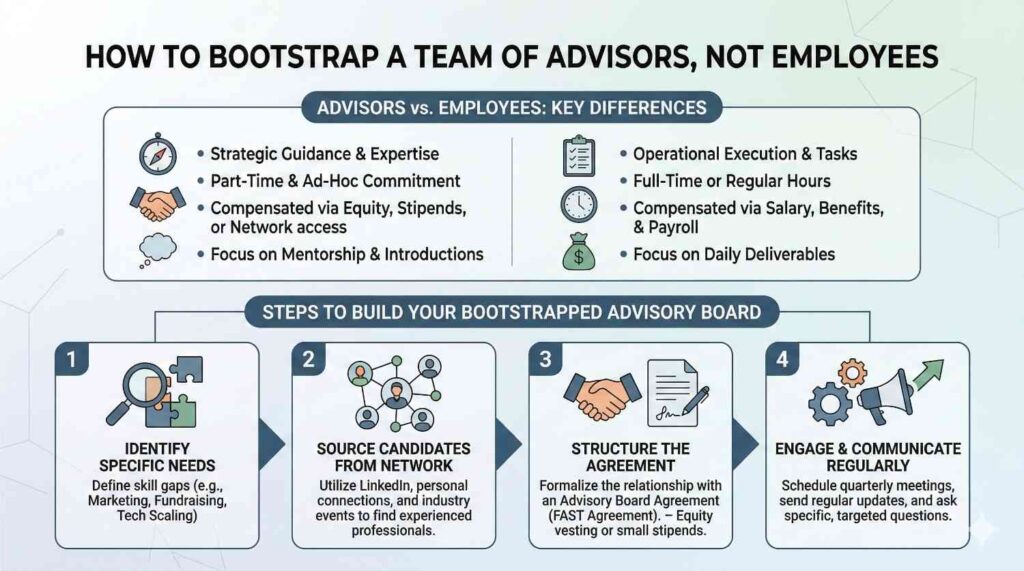
Bootstrapping is not just about spending less. It is about building with fewer mistakes. When you hire too early, you often hire to calm anxiety, not to solve the real problem. Then you carry that cost every month, even if the work changes next week.
Advisors give you something different. They give you better choices, faster. They help you aim, not just run. They can also keep you from “feature work” that feels busy but does not move the business.
If you are building in AI or robotics, this matters even more. The wrong choice can lock you into a design that is hard to change later. A strong advisor can help you pick clean paths early, so your product and your story stay tight.
Advisors are not decorations
Some founders collect advisors like trophies. They add names to a slide and call it traction. Real advisors do not work like that. A real advisor has a job to do, a clear lane, and a reason to care.
If you cannot say what you expect an advisor to change in your company, you do not need that advisor yet. The goal is not to look bigger. The goal is to make better moves with less waste.
The big trade most founders miss
When you do not hire, you save cash. But you still pay a cost. The cost is delay, wrong turns, and mental load. Advisors are one of the few tools that reduce that cost without adding a full-time burn.
They also help you keep control. Instead of giving away big chunks of your company to raise money early, you can grow with skill and structure. That is the heart of seed-strapping: build leverage first, then raise from strength.
If you want help building this kind of leverage through IP, Tran.vc does that hands-on. You can apply anytime at https://www.tran.vc/apply-now-form/
Employees vs Advisors
What employees really change
Employees give you capacity. They take tasks off your plate. That is valuable when the tasks are stable and repeat often. But early-stage work is not stable. Priorities shift fast, and every new hire adds a “management tax” you did not plan for.
Even a great early hire needs context, feedback, reviews, tools, and time. If you are still finding product-market fit, your best hours are precious. You need those hours for customer calls, product calls, and hard thinking.
Hiring too early can also freeze your company shape. The team you build becomes the product you build. If you hire a full-time marketing person before you know your real buyer, you may get good output in the wrong direction.
What advisors really change
Advisors give you judgment. They do not just do work. They help you decide which work matters. That is why they can replace hires at the start. You might not need a full-time sales lead yet, but you may need a sales advisor who helps you build your first pitch and sit in on a few calls.
You might not need a full-time legal hire, but you do need someone who can warn you before you sign a deal that gives away your core rights. You might not need a full-time product leader, but you may need a product advisor who helps you cut scope and focus on the one thing buyers will pay for.
The advisor model works best when you are short on cash but long on learning. In that stage, decision quality is more valuable than sheer speed.
A simple rule to choose one or the other
If the work is repeat work, an employee makes sense. If the work is “figure it out” work, an advisor is often better. Founders get stuck because they treat advisors like cheaper employees. That leads to frustration on both sides.
Your goal is to use advisors for direction, shape, and doors. Your goal is to use employees for execution once the direction is steady.
The Advisor Bench Mindset
Think in “gaps,” not in “people”
Most founders ask, “Who do I know that could advise me?” That is backwards. Start with the gaps that hurt your business. The gaps are not just skill gaps. They are also trust gaps, access gaps, and blind spots.
Maybe you cannot get meetings with the right buyers. That is an access gap. Maybe you keep changing the story and your pitch feels messy. That is a clarity gap. Maybe your roadmap is full of good ideas but nothing ships. That is a focus gap.
Write these gaps down in plain words. Not job titles. Not buzzwords. Just the pain you feel each week. Advisors should map to those pains like a key fits a lock.
Your first bench usually needs four lanes
Most early founders need advice in four areas, even if they do not admit it. First is customers, because revenue and proof come from real buyers. Second is product, because focus is the hardest job in the early days.
Third is go-to-market, which is not “marketing,” but the simple path from attention to trust to sales. Fourth is risk, meaning legal, IP, and deals. One bad contract or one leaked idea can set you back months.
You do not need a crowd. You need a small bench where each person has a clear lane, and you know why they are there.
The key is “adjacent experience”
The best advisor is not always the top person in the field. It is often someone who has done the same thing one level above where you are now. They remember the details. They know what broke. They know what surprised them.
If you are building a robotics tool for warehouses, a helpful advisor might be someone who sold into warehouse ops last year, not someone who ran a global supply chain ten years ago. Big names can help with trust, but only if they also show up and help you move.
What a Good Advisor Looks Like
Proof they can help you in your stage
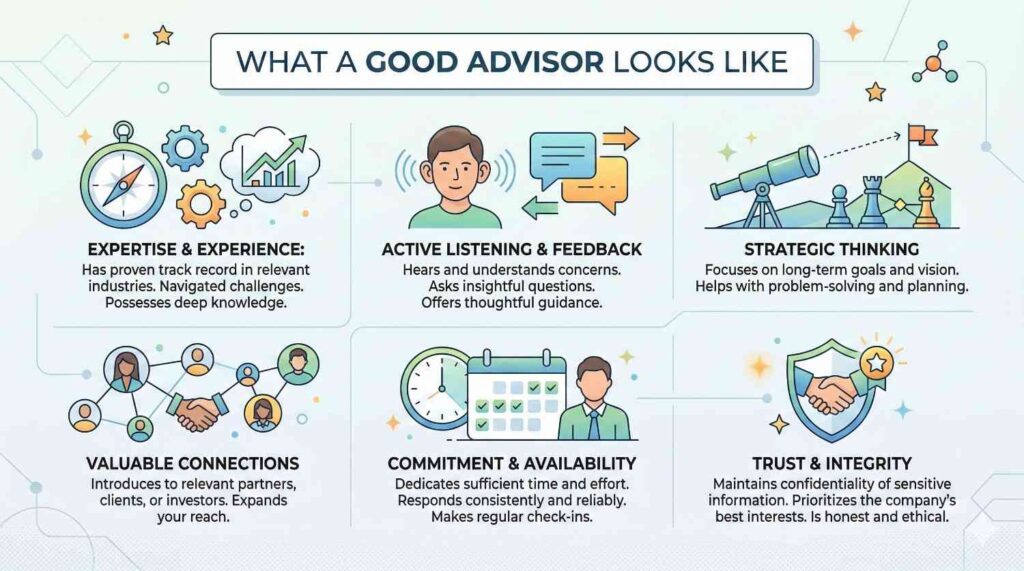
A good advisor for a pre-seed company understands chaos. They do not expect perfect plans. They are calm with change. They can give clean advice without making you feel small.
They also know the difference between “smart” and “useful.” Some people love to talk ideas. Fewer people can help you choose the next two steps. Your advisor should be able to say, “Do this first, because it unlocks that.”
They ask sharp questions, not just give answers
The best advisors do not flood you with opinions. They ask questions that reveal what you are missing. They will push you to name your real customer. They will make you show evidence, not hope.
A weak advisor tries to impress you. A strong advisor tries to understand you. That is how you get advice that fits your world, not advice that sounds good in a book.
They protect your time
A real advisor respects that you are building. They come prepared. They follow up. They do not drag you into long meetings that go nowhere. They do not treat your company like a casual hobby.
This sounds basic, but it is rare. Pay attention early. If they are flaky before they join, they will be flaky after they join.
Where to Find Advisors Without Paying Cash
Start with “earned access,” not cold asks
Most founders try to recruit advisors with a big ask right away. That often fails. Instead, start by earning small moments. One question. One short call. One simple follow-up where you show you listened.
People advise people they respect. Respect comes from action. When you send an update that shows progress, even tiny progress, you become more real. That makes the next ask easier.
If you want to be smart about it, stop asking for “advice.” Ask for help with one decision. Most experienced people will say yes to a clear, bounded problem.
Look for people who benefit from your win
Good advisors often have a reason to care beyond ego. Maybe they sell into the same market and want to learn. Maybe they invest and want early deal flow. Maybe they are a domain expert who wants to shape the future.
This does not mean using people. It means building a fair trade. Your company is not just asking for time. It is offering learning, access, and future upside if you structure it well.
Use “events” carefully
Events can work, but only if you show up with a plan. Do not collect business cards. Pick a few target people, learn what they care about, and open with a real question tied to your work.
After the event, follow up with something that proves you are serious. A simple note that says what you learned and what you changed is strong. Most people never do that. It makes you stand out.
How to Make the Ask Without Sounding Needy
Invite them into a specific role
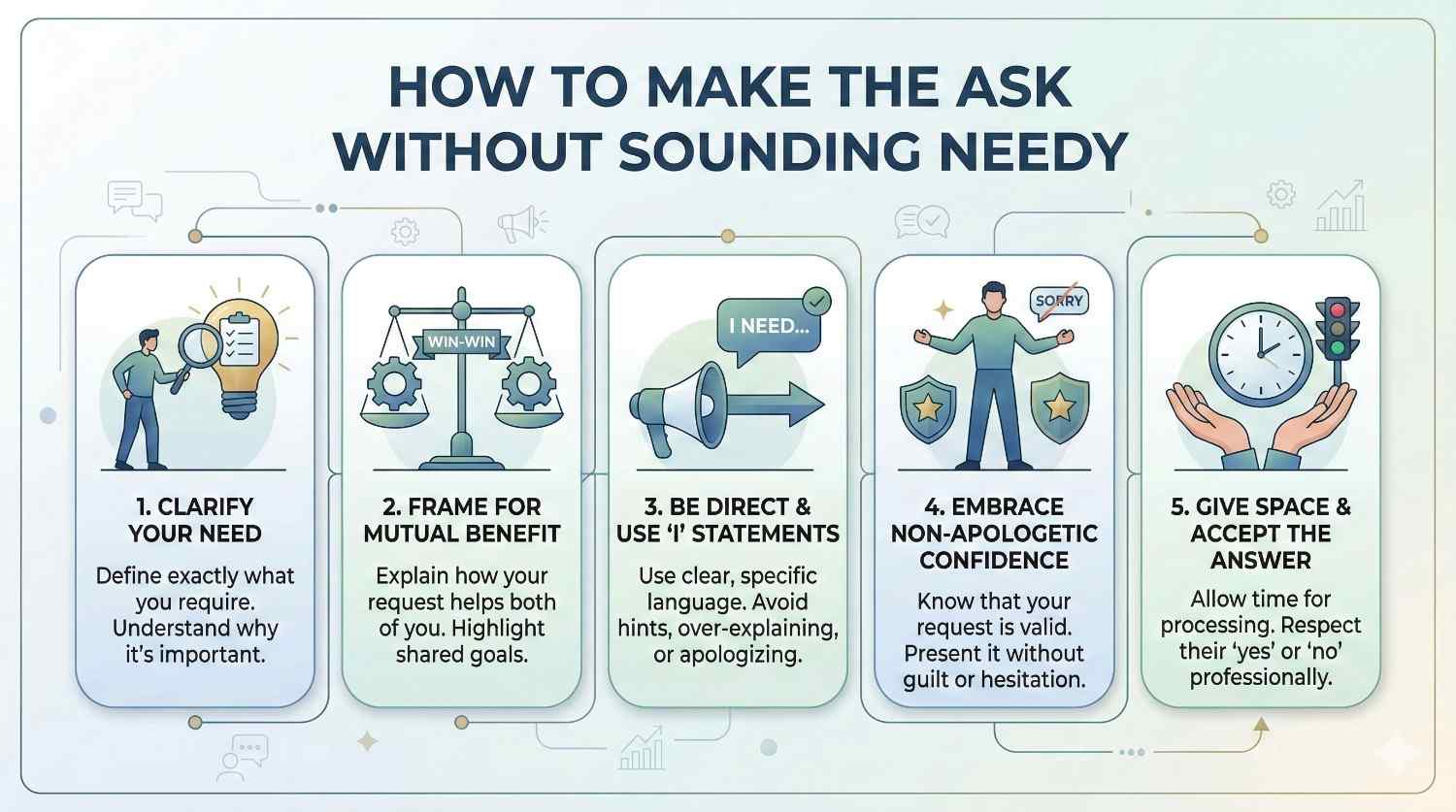
A vague ask creates vague results. Instead of saying, “Will you be my advisor?” say, “We are building X. We need help with Y. I want to ask if you can support us for Z months, with one call per month, plus quick texts when needed.”
When you define the shape, you make it easier to say yes. You also protect yourself from confusion later.
This is also where you set the tone that the advisor is not an employee. They are not taking tasks. They are helping you decide and connect.
Show them the “why now”
Strong people guard their time. They need to feel timing. Tell them what is happening in the next 60 to 90 days. A pilot. A key launch. A first sales push. A patent filing plan. A fundraising step.
When you link their help to a near-term moment, it feels real. They can picture the impact. That makes them more likely to commit and show up.
Make it safe for them to say no
A high-quality person may say no for timing reasons. Keep the door open without pressure. Thank them, ask if you can share updates, and ask if they know one person who is a better fit.
This approach keeps your reputation strong. It also builds your network in a clean way.
Structuring the Relationship
Time beats titles
Early on, time and access matter more than titles. “Advisor” is fine, but what matters is cadence. If you cannot get them on the calendar, you do not have an advisor. You have a name.
A simple structure that works is a monthly call with a short agenda, plus a quick follow-up note with decisions and next steps. That creates momentum. It also keeps advice tied to action.
Be clear about what you share
Advisors need context, but you do not have to share everything. Share what they need to do their job well. Keep your core IP and key methods protected, especially when talking to people who may have links to other companies.
This is not paranoia. It is basic hygiene. Many leaks happen through casual sharing, not theft. The safest founder is not the quietest founder. It is the founder who shares with care.
If you want help building a clean IP plan so you can talk to advisors and partners without fear, Tran.vc does that in a founder-friendly way. Apply anytime at https://www.tran.vc/apply-now-form/
Use simple agreements early
Even at the start, you should have basic paper in place. Confidentiality, advisor terms if equity is involved, and clear notes on ownership of inventions. This is extra important in AI and robotics, where “how it works” is often the value.
A good setup reduces risk for both sides. It also signals you are serious. Serious founders attract serious advisors.
Paying Advisors Without Cash
Equity is not free
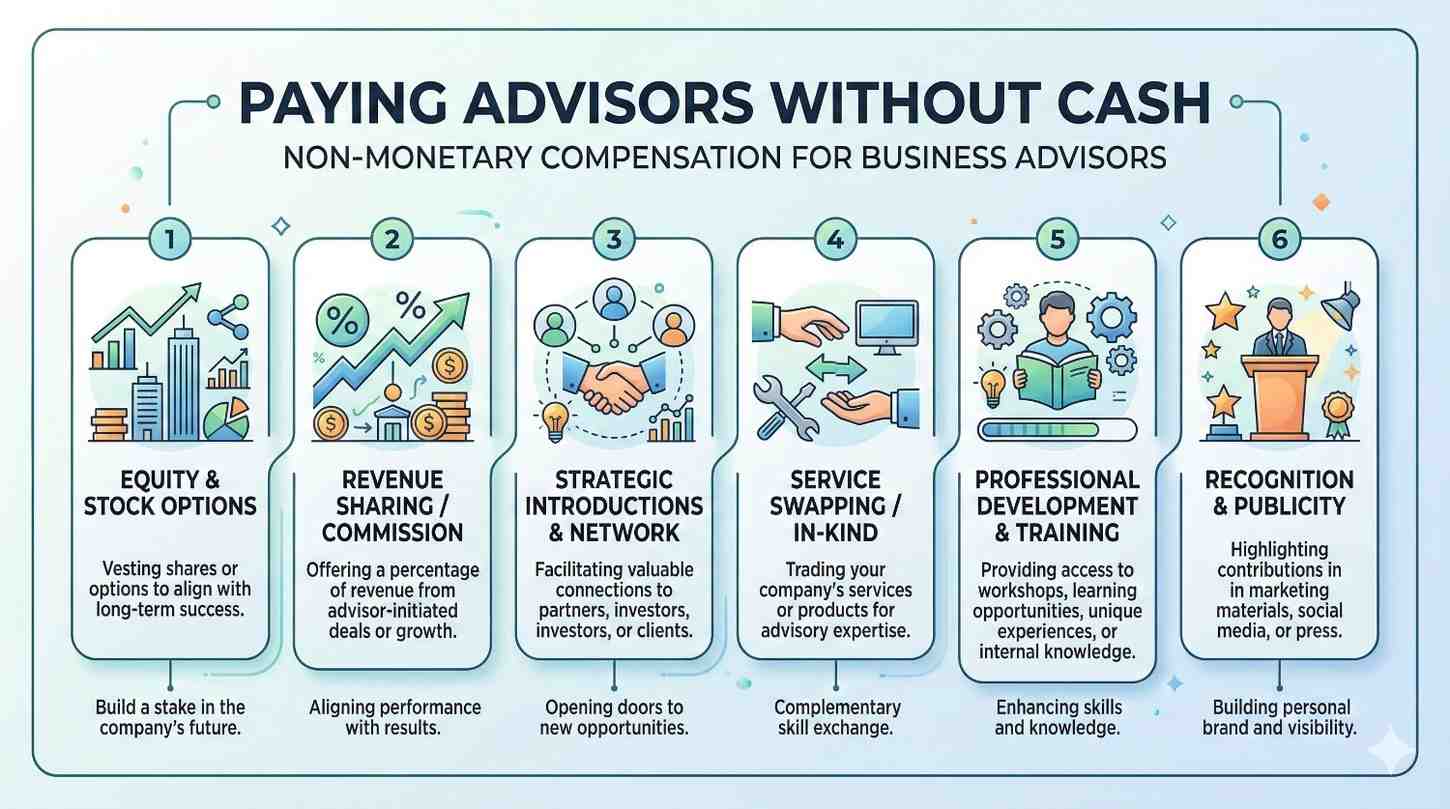
Many founders think equity is “cheap” because it is not cash. That is a trap. Equity is control and future value. Give it away too fast and you weaken your future rounds, your motivation, and your options.
If you do give equity, tie it to real commitment. Tie it to time and clear support. If someone will not meet, will not follow up, and will not make intros, they should not have a piece of your company.
Use “milestone-based” rewards
Instead of giving equity upfront, you can set it up so the advisor earns it over time. That keeps the relationship honest. It also protects you if the advisor disappears after the first call.
Milestones can be tied to time served, or tied to clear actions like introductions that lead to qualified meetings. The key is to keep it fair and easy to track.
The best payment is momentum
Some advisors do not want equity. They want to be part of something that is moving. They want good conversations, smart founders, and real progress. If you give them that, they often stay close even without a formal deal.
This is why founder updates matter. A short monthly update can keep advisors engaged and can attract new ones. It is simple, but it compounds.
Running Advisor Meetings So You Get Real Value
Set a tight agenda every time
Advisors are not there to hear everything. They are there to help you decide. A strong agenda is short and clear. It usually includes: what changed since last time, what you learned, and what decision you need help with today.
When you do this, the call stays sharp. The advisor feels useful. You get answers you can act on within days, not months.
Bring choices, not confusion
If you show up with a messy problem and no framing, you will get messy advice. Instead, bring two or three options and what you think the trade is.
For example, “We can sell to small labs first or go after large hospitals. Small labs are faster to close but smaller deal size. Hospitals take longer but the value is bigger. Which path would you test first and why?”
This invites judgment, which is the point.
Capture decisions and follow through
After each call, send a short note: what you decided, what you will do next, and when you will report back. This builds trust fast. It also trains your advisor to give advice that leads to outcomes.
Advisors love founders who execute. Those founders get more help, better help, and stronger intros.
Common Advisor Traps and How to Avoid Them
The “famous name” that never shows up
A well-known person can make your deck look stronger. But if they do not meet with you, they do not help you build. Worse, you may start to rely on their name as proof, and stop doing the harder work of earning real proof from customers.
A simple way to avoid this is to test the relationship before you formalize it. Ask for one call. See if they arrive on time. See if they read what you sent. See if they can give you one clear next step. If they cannot do that once, they likely will not do it monthly.
When you do bring on a visible name, make sure they have a lane. If their lane is “credibility,” that is still a lane, but it should come with specific actions. For example, they agree to join one or two key customer calls, or they agree to join a webinar, or they agree to introduce you to a short list of buyers they truly know.
The advisor who pulls you into their world
Some advisors give advice that is really a story about them. They push you toward the path they took, even if your market is different. They may also push you toward tools, vendors, or partners that benefit them.
This does not always come from bad intent. Often it comes from habit. They are used to their world, so they assume it fits yours. Your job is to keep the relationship clean. You can listen with respect and still choose your own path.
A good pattern is to ask, “What would make this advice wrong?” If they cannot answer, or if they get defensive, that is a sign they are giving you a script, not a thought process. You want advisors who can explain how they think, not just what they think.
The advisor who creates more work than help
Some advisors are energetic but chaotic. They throw out ten ideas, ask for ten decks, and introduce you to ten people with no fit. You end up spending your week feeding the advisor instead of building the company.
To prevent this, set a narrow rhythm. One call, one or two decisions, one or two asks. If they want to help in bigger ways, you can widen the lane later. Early on, the goal is high signal, low noise.
The advisor who wants control
Sometimes an “advisor” is really a hidden co-founder who does not want the risk but wants the say. They push on big choices, ask for special rights, or try to steer hiring and product like they are inside the company.
This is dangerous. Your advisors should advise. You decide. If someone cannot stay in that boundary, they are not an advisor fit. The clean way to handle it is to keep terms simple and avoid giving special veto powers. If you want a real operator with control, that is a hire or a co-founder conversation, not an advisor role.
The Advisor Stack for Deep Tech, AI, and Robotics
Why deep tech needs a different bench
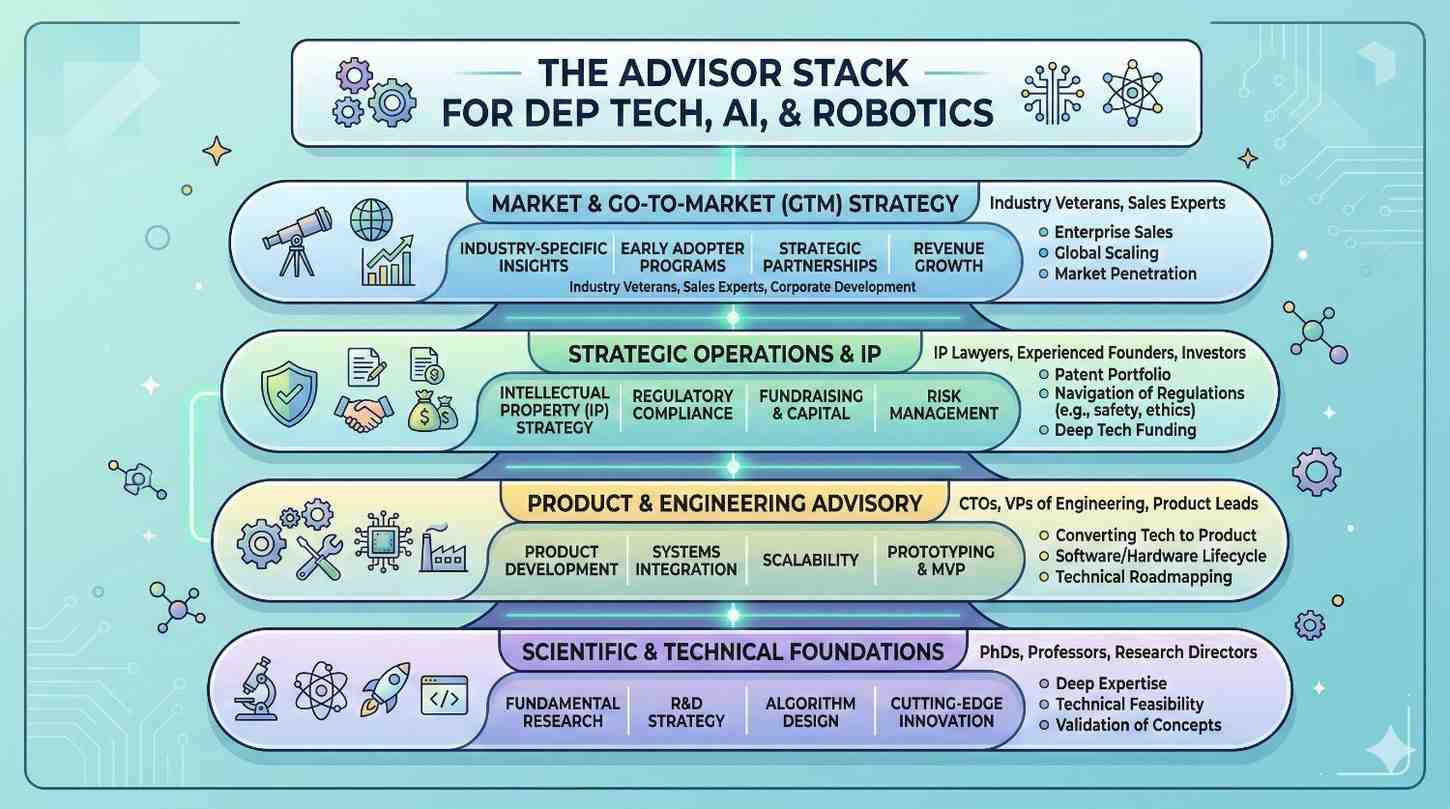
In many software startups, you can pivot fast without major costs. In AI and robotics, pivots can be slow and expensive. Hardware cycles, safety issues, data pipelines, and integration work can lock you into choices early.
That means you need advisors who reduce “dead-end work.” You want people who have lived through long build cycles, tough pilots, and slow procurement. They help you set expectations, price risk, and pick the right first customer type.
Your goal is not to build the most advanced system on day one. Your goal is to build the smallest system that proves value, without giving away what makes it special.
The technical reality advisor
This person helps you with truth. They can look at your system and say, “This will break here,” or “This will not scale the way you think,” or “Your sensor choice is fine, but your calibration plan is weak.”
The best version is someone who has built something similar in the wild, not only in a lab. They know what happens when users touch the product, when environments change, when uptime becomes a promise, and when support becomes part of the product.
They also help you choose what to ignore. That is a gift. Early teams can drown in edge cases. A strong technical advisor helps you ship with confidence without lying to yourself.
The customer and buying-process advisor
In robotics and AI, the buyer is often not the user. The user may love your product and still have no power to buy it. Procurement, security, IT, compliance, safety, and finance may all be part of the “yes.”
A buyer-process advisor helps you map the real path to purchase. They tell you what questions will come up in week four of a pilot. They warn you about “free trial traps” where the customer learns from you but never buys. They help you set terms that protect you.
This advisor is often a former operator in the target industry, or a sales leader who sold complex systems into that industry. The key is that they know the full journey, not just the first meeting.
The go-to-market story advisor
Deep tech founders often explain too much. The story becomes a lecture. Customers do not buy lectures. They buy outcomes they can picture.
A go-to-market story advisor helps you speak in plain results. They help you name the pain, the cost of waiting, and the simplest proof that you work. They help you build a story that can fit in one minute, then expand when needed.
This is not about hype. It is about clarity. The best stories are honest and simple. They respect the buyer’s time. They also make your product feel safer to try.
The IP and defensibility advisor
If your edge is in your method, your architecture, your training setup, your control loop, your data handling, or your mechanical design, you need an IP plan early. Not later, when someone else has filed around you, or when you have already shown too much in demos and decks.
An IP-focused advisor helps you decide what to patent, what to keep as trade secret, and how to talk about your system without handing away the recipe. They also help you avoid common traps like publishing too early, open-sourcing the wrong piece, or signing agreements that shift ownership.
This is exactly the lane Tran.vc supports in a hands-on way, with up to $50,000 in-kind patent and IP services for founders building serious tech. If you want to build a moat before you raise big money, apply anytime at https://www.tran.vc/apply-now-form/
How to Recruit Advisors Like a Pro
Start with a “one problem” conversation
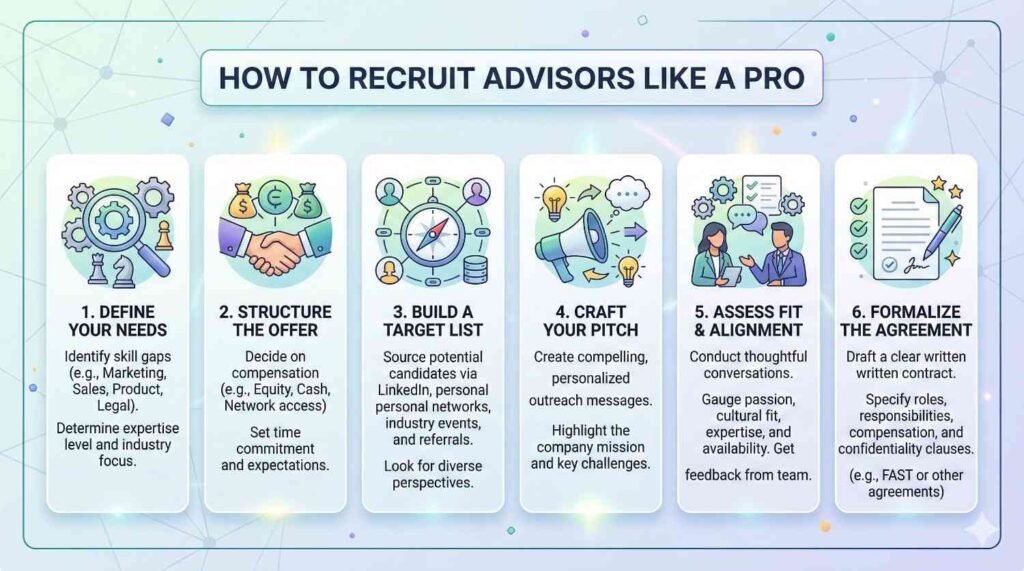
The easiest way to recruit strong advisors is not to recruit them at all at first. Start by asking for help on one problem that matters right now. Keep it short, clear, and respectful.
For example, “We are testing our first pilots with warehouse teams. I want to pressure-test our pilot terms so we do not get stuck in endless trials. Could I ask you for 20 minutes to review our plan?”
This works because it is not a vague commitment. It is a specific moment where their experience matters.
Use proof, not promises
Advisors hear big claims all day. If you want a serious person to lean in, show proof of action. Proof can be small. A prototype demo. A paid pilot. A letter of intent. A set of customer notes. Even a clear list of what you learned last month.
The point is to show you are not daydreaming. You are building. Advisors like builders. Builders make their help feel worth it.
Make the role attractive without overselling
The best advisors are picky. They want to work with founders who listen, move, and tell the truth. When you pitch the advisor role, be calm and direct.
Explain what you are building, why now, and what you need help with. Explain the time shape. Explain what success looks like in the next 90 days. Then stop talking and let them react.
If you oversell, you create doubt. If you speak plainly, you create trust.
Ask for commitment in stages
Instead of asking someone to “join” right away, ask for a short trial. For example, “Could we do three monthly calls and see if it is useful for both sides?” That feels safe and professional.
If the fit is strong, you can formalize it after. If the fit is weak, you can part ways without drama.
Making Advisors Useful Without Micromanaging
Give them clean context before the call
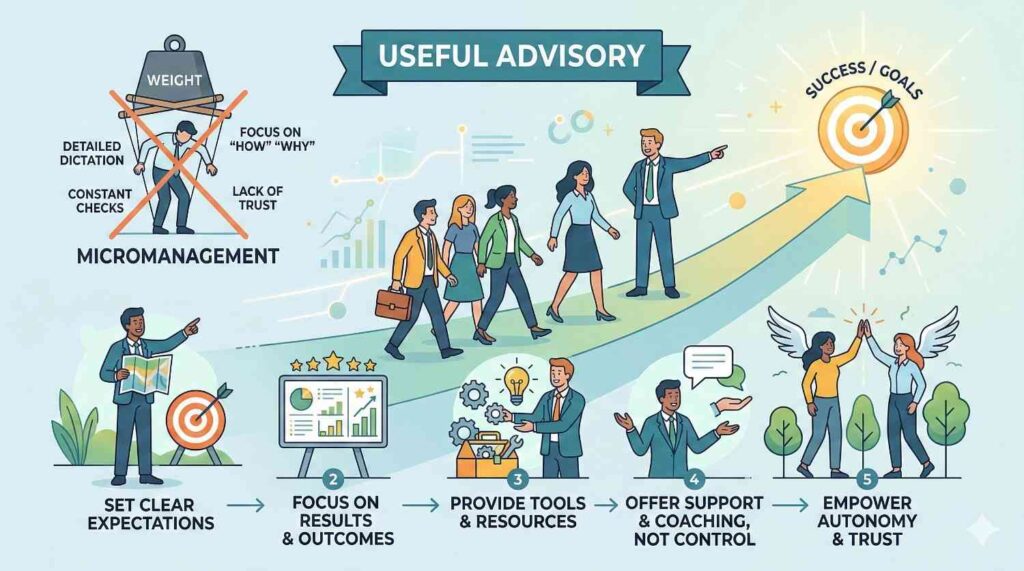
An advisor cannot help if they spend half the meeting learning basics. Send a short note 24 hours before the call with your key facts and questions.
Keep it plain. What you are building. What changed since last time. What you tried. What happened. What decision you need help with. This makes the call sharper and shows respect for their time.
Make one person on your team the “advisor owner”
Even if you are only two founders, pick one person to own each advisor relationship. If both founders treat the advisor as “shared,” it often becomes “nobody owns it.” Calls drift. Follow-ups slip.
When one person owns the relationship, the advisor knows who to reply to, who to trust, and who to push. That improves the quality of help.
Use advisors for leverage, not comfort
Some founders use advisors to feel better, not to get better. They ask for reassurance instead of pressure-testing. That is a waste.
Bring hard questions. Bring uncomfortable choices. Bring decisions with real cost. That is where advisors earn their value.
If you feel nervous to share a problem, that is often the problem you should share.