
Most founders build one company and move on.
But when your product is built on code, models, sensors, data, or a new way of doing things, there is a second “company” hiding inside your first one: your intellectual property (IP). That IP can become the thing that gives you leverage with investors, keeps copycats away, and makes future deals cleaner.
So the big question is simple:
Should your IP live inside your operating company… or inside a separate IP holding company?
This choice sounds like legal plumbing. It’s not. It shapes risk, taxes, fundraising, partnerships, and even how you sell the company later.
At Tran.vc, we see this decision come up early for robotics and AI teams—often right when things start working in the lab and before the first serious investor asks, “What do you own?” If you want a clean plan for how to protect and structure your IP, you can apply anytime at https://www.tran.vc/apply-now-form/.
Operating Company vs IP Holding Company
What an operating company really is
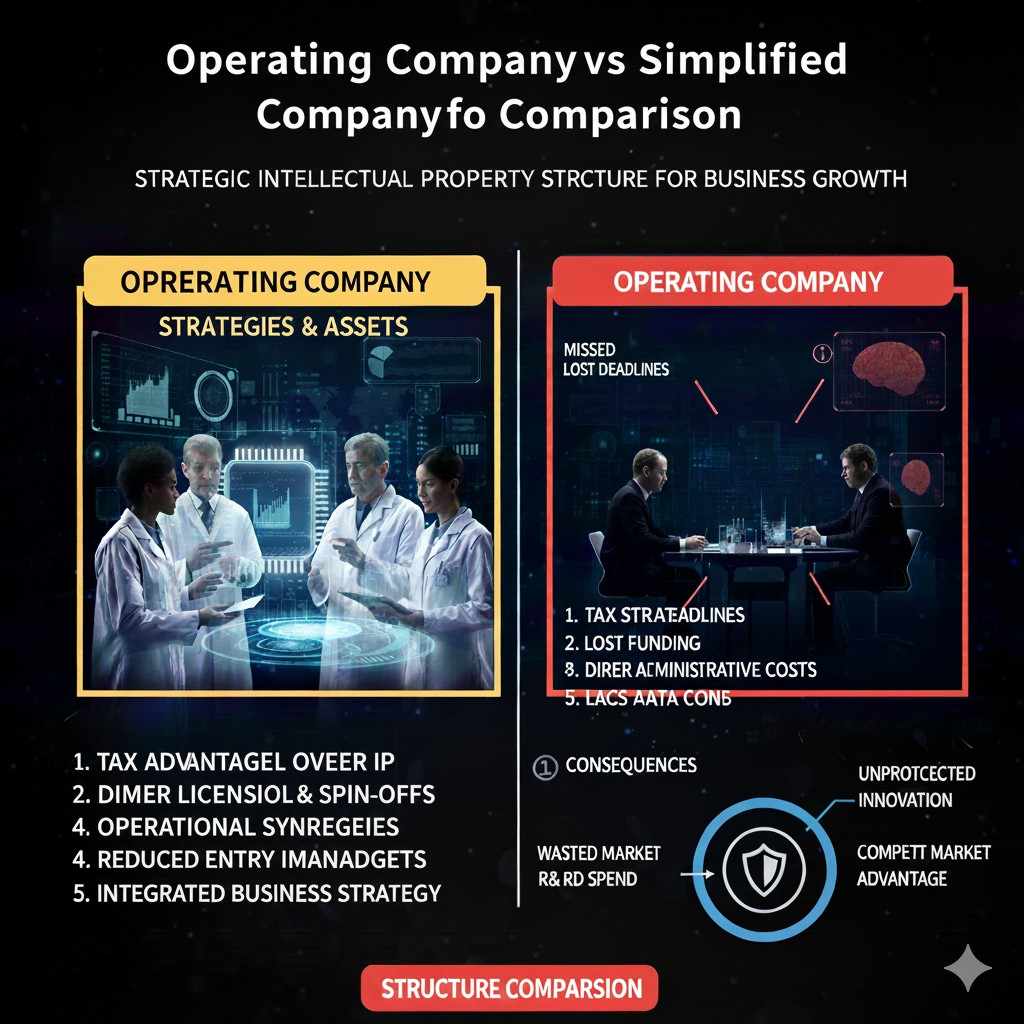
An operating company is the “doing” company. It builds the product, sells it, and signs the contracts that keep the business running. It hires the team, pays salaries, buys parts, runs cloud bills, and takes money from customers. If a customer has a complaint, they call this company.
In many startups, the operating company also owns the IP by default. That means the patents, patent filings, code, designs, and brand names sit in the same place as the sales contracts and payroll. It feels natural because everything is under one roof.
What an IP holding company really is
An IP holding company is the “owning” company. Its main job is to hold patents and other key rights. It usually does not sell the product and often has very few day-to-day activities. Think of it like a vault that stores the most valuable technical assets.
In this structure, the operating company uses the IP through a license. The license is a contract that says, “You can use this technology to run your business.” If that license is weak or unclear, the whole structure becomes risky fast.
The simple distinction that matters
The operating company is where work happens and where problems show up. The IP holding company is where ownership sits and where long-term control is supposed to live. In practice, your success depends on whether the operating company has clear, stable rights to use the IP without fear.
If investors or partners think the operating company could lose access, they treat the business as fragile. Even if the tech is brilliant, they will hesitate because ownership and control look uncertain.
Keeping IP inside the operating company
Why founders choose this path
Most early-stage startups keep IP in the operating company because it keeps things clean. One entity signs contracts, owns the product, owns the patents, and receives the value. When you raise money, investors see a simple picture: they buy shares in the company, and that company owns what makes the business real.
This matters a lot in deep tech. Investors already have to learn your technical story. If your legal structure is also complex, it adds friction at the exact moment you need speed.
Where this structure shines
This structure is strong when you are still in early build mode. You are experimenting, iterating, and changing direction quickly. Having everything in one entity makes paperwork easier and reduces the number of moving parts.
It also makes diligence easier. If a seed fund asks, “Who owns the patents and code?” you can answer in one sentence. That clarity can save weeks in a financing process.
The real downside founders feel later
The operating company is the one that touches the outside world. It sells, ships, installs, collects data, and works inside customer environments. That also means it carries most of the risk. If a contract dispute happens, or a customer claims harm, the operating company is the first target.
When the IP sits in the same entity, it can become part of the same fight. Even when you are right, the process can be expensive and distracting. Founders sometimes learn this only after the first serious pilot or deployment.
Using a separate IP holding company
The core reason founders consider it
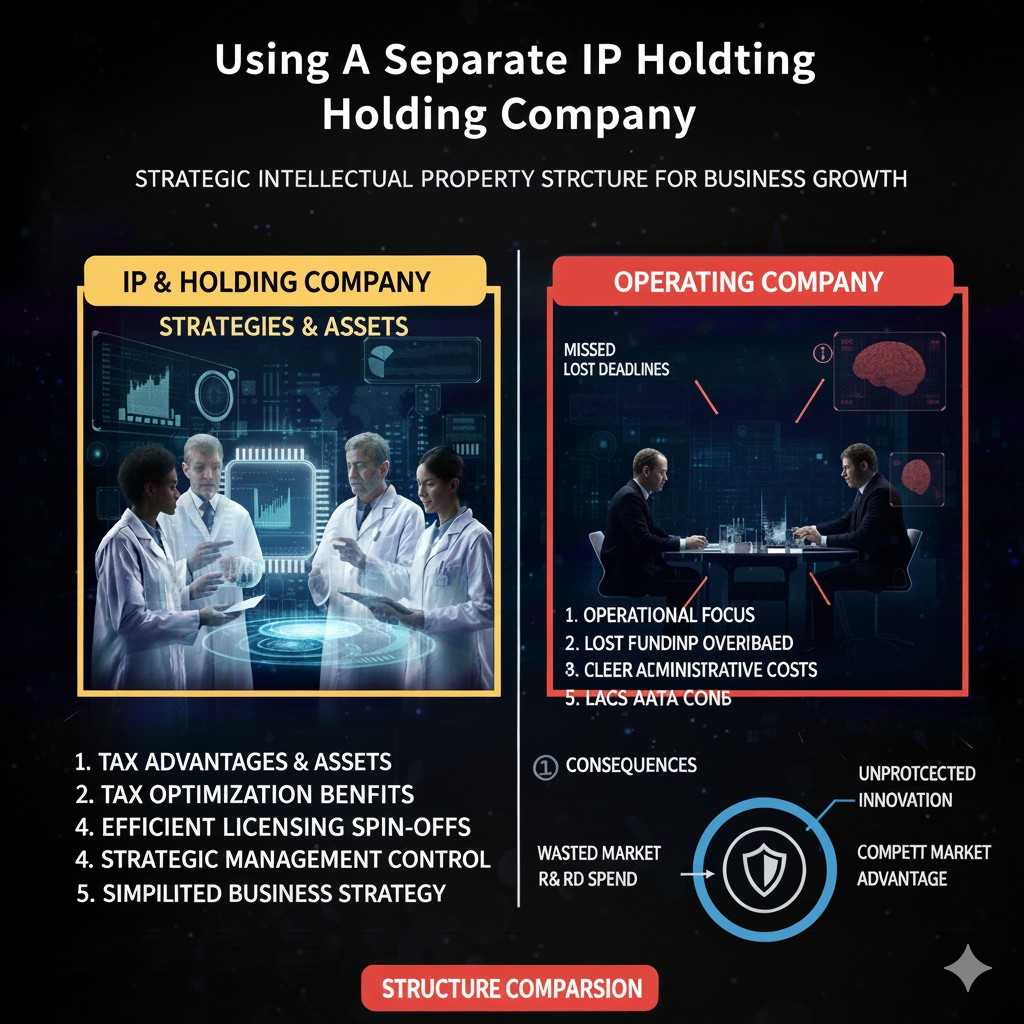
Founders consider a holding company because they want separation. They want the operating company to take the punches of day-to-day business, while the IP stays protected in a separate box. In robotics and AI, this desire often grows when pilots start and real-world failure risks go up.
It can also come up when founders have a long-term plan to license the tech into more than one market. A holding company seems like a neat way to keep ownership stable while different operating units use the same core invention.
How licensing changes everything
Once you split the entities, licensing becomes the heart of the structure. The operating company is no longer the owner. It becomes a user with contract rights. That can be totally fine if the license is strong and written for how the business will actually run.
But if the license is vague, short-term, or easy to terminate, the operating company looks weak. Investors and acquirers do not want to buy a business that depends on a contract that could change later.
The hidden cost: complexity and mistakes
Two companies means two sets of bank accounts, filings, accounting, and contracts. It also means people can get confused about which company owns what and who signed what. In early-stage startups, confusion is common because everyone is moving fast.
The biggest risk is not just paperwork. The biggest risk is an ownership gap. If invention assignment documents do not match who employed the inventors, you can create a hole in your chain of title. That is the kind of issue that shows up during fundraising and forces you into painful clean-up.
Investor reality: what they worry about
The fear of “founder side pockets”
Investors get nervous when a founder personally owns the holding company and the operating company licenses the IP from it. Even if your intentions are good, the structure can look like the founders kept the crown jewels outside the investor-owned company. That creates a trust problem.
From the investor’s view, the risk is simple. If things get tense later, founders could raise license fees, limit rights, or use the IP in a different venture. Many investors will either walk away or demand strict terms to remove that risk.
What investors usually want to see
Most investors prefer the operating company to own the IP outright. It is the simplest way to ensure the company they invest in controls what it needs to win. If a holding company exists, they usually want proof that the operating company has strong, permanent rights that cannot be casually changed.
They also want the ownership story to be clean. If the holding company is owned differently, or if past contributors never signed assignments, investors treat the IP as uncertain. In deep tech, uncertain IP can kill a deal even if revenue looks promising.
How this shows up in due diligence
Diligence is when investors ask for contracts, assignments, and proof. They will want to see invention assignment agreements from founders, employees, and contractors. They will check whether patent filings list the right inventors and whether the ownership trail is unbroken.
If you have two entities, diligence becomes more intense. Investors will ask for the license agreement and look for key rights, like rights to improve the IP and rights to enforce it. They will also look for termination clauses that could put the operating company at risk.
Risk and liability: what changes in real life
Operating risk is not abstract in robotics
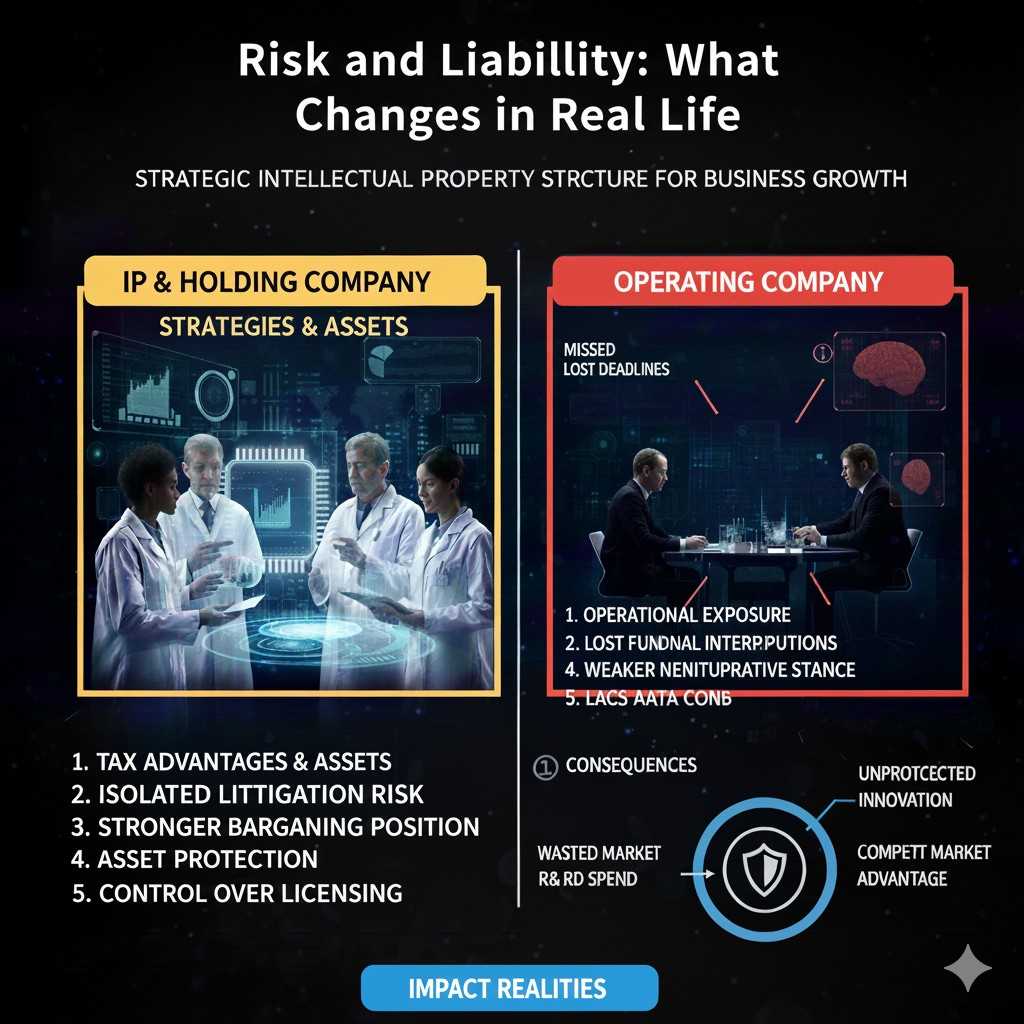
Robotics startups live in the physical world. Devices move, sensors fail, and edge cases happen. Even with great engineering, a customer can claim loss, harm, or downtime. Sometimes claims are fair. Sometimes they are just negotiation tactics.
In those moments, the entity that signed the contract is in the spotlight. If that entity also owns the patents and core code, those assets become tied to the same legal story. That is why some founders think about separating IP before large deployments.
Separation is not magic protection
A holding company is not a magic shield. If you treat both companies like one, or move money and contracts casually between them, the separation can be challenged. The legal idea of “separate entities” only works when you act like they are separate entities.
That means separate books, separate approvals, and clear agreements. Without that discipline, the structure may create more risk than it removes because now you have complexity without real protection.
A practical view of what separation can help with
A holding company can help in some situations, especially when your operating business will sign many contracts with varied risks. It can also help if you want to create multiple operating businesses that all rely on one core technical base.
But the best way to think about it is not “Will this save me in court?” The better question is “Will this reduce risk without scaring investors or slowing the business?” If the answer is no, the structure is not doing its job.
Deal flexibility and business strategy
When licensing is part of the business model
Some AI teams want to sell software and also license core models or methods to partners. Some robotics teams want to license navigation or perception into other device makers. If this is truly part of your plan, separating the IP can make the story cleaner.
A holding company can make it easier to describe the “core” as something that can be used across products. It can also help create a clear wall between what you license and what you keep exclusive.
You can still license without a holding company
This is important: you do not need a holding company to license IP. An operating company can license patents and code to partners directly. Many successful startups do exactly that, and investors are comfortable with it because the owner and the operator are the same entity.
So the decision is not about whether licensing is possible. The decision is about whether having ownership in a separate company makes the licensing strategy easier, safer, and more credible to outsiders.
The “spin-out” and “new product line” angle
Founders sometimes plan to build one core invention and then create separate products in different markets. A holding company can help you keep the core stable while allowing new operating companies to be created later.
But if you are still early, there is a risk you are building a structure for a future that never arrives. Many startups change markets and products. Early simplicity often beats early complexity.
Common structures founders actually use
One company only, done the right way
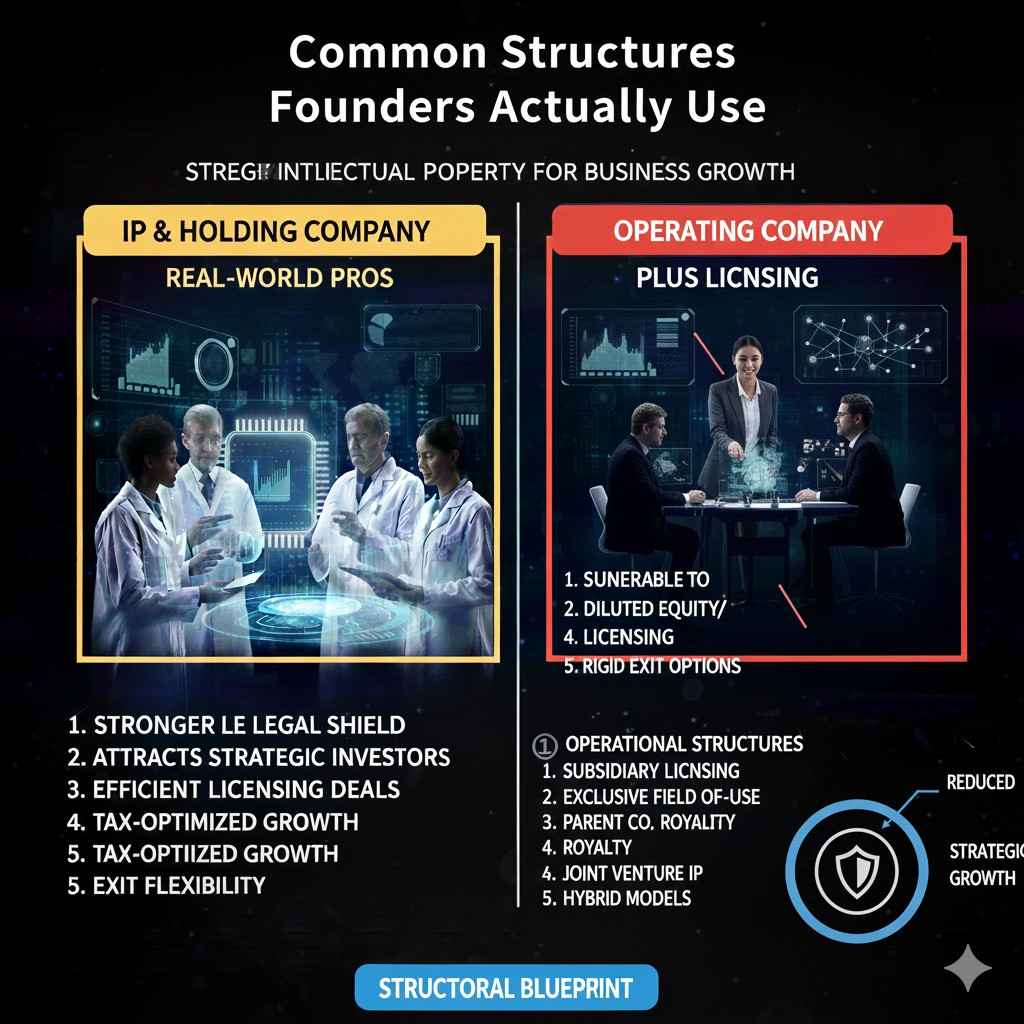
This is the most common approach for venture-backed startups. The operating company owns the IP, and every contributor assigns inventions to that entity. Patent filings are made in the company’s name, and contractors sign agreements that prevent ownership confusion.
This structure can still be very strong if your IP strategy is sharp. Strong claims, smart filing timing, and tight documentation often matter more than splitting entities.
Holding company as a subsidiary
Some teams place the IP in a holding company that is owned by the operating company. This can keep IP in a separate legal bucket while staying under the same ownership umbrella. Investors often find this easier to accept because they still feel they are buying control.
This structure can still add overhead, but it may reduce the “founder side pocket” fear. It can be a middle path when separation is needed but investor trust is still the priority.
Founder-owned holding company with a license
This is the most sensitive structure. It can work in some cases, but it often causes investor concern. If you go this route, the license must be extremely strong, long-term, and hard to change.
Even then, many investors will push to move the IP into the operating company before or at a priced round. Founders who resist can end up with tougher terms or lost deals.
Practical guidance: choosing the right path now
If you are pre-seed with no major deployments
If you are still building, testing, and not yet exposed to heavy customer risk, keeping IP in the operating company is usually the cleanest choice. You reduce complexity and keep fundraising easier. You can always restructure later if the business truly needs it.
At this stage, your biggest win is not entity structure. Your biggest win is making sure your inventions are captured, documented, and protected before public demos and partnerships.
If you are entering high-risk pilots and deployments
If your robots will be operating in real sites, or your system will be handling sensitive operations, then the risk picture changes. This is when some founders explore separation to reduce exposure of core IP.
But the structure only helps if it is built with discipline and if it does not hurt fundraising. If you plan to raise soon, you must design the structure so investors still feel the operating company has firm control.
If your plan depends on licensing across markets
If licensing is central, you should plan your IP strategy early. That includes what you patent, what you keep as trade secrets, and how you define the “core.” A holding company might help, but it is not required.
What matters most is that your agreements are clean and your ownership trail is clear. That is what makes partners and investors confident.
Pros and cons side by side in real startup life
Control versus protection
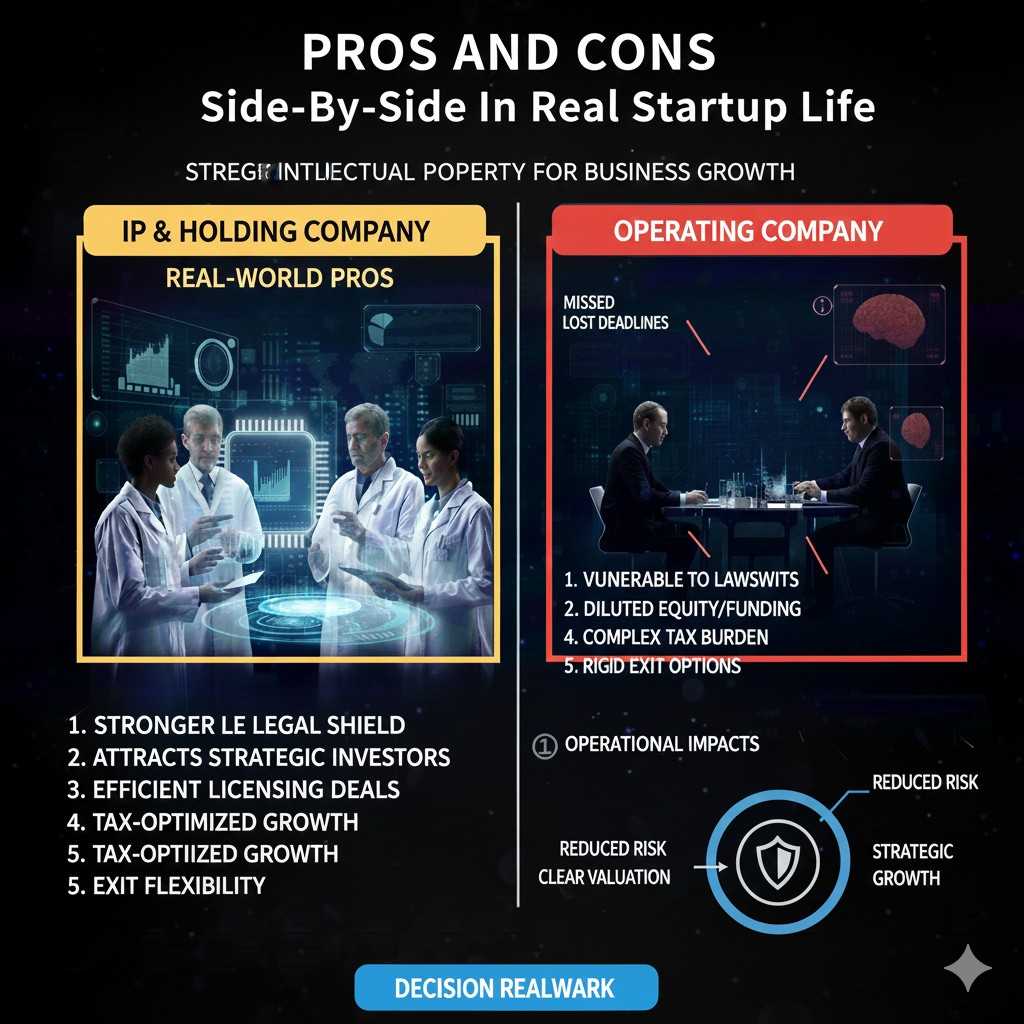
When IP lives in the operating company, control is simple and visible. The same company that builds and sells also owns what matters most. Investors, partners, and acquirers immediately understand who is in charge of the technology and who can make decisions.
With a holding company, protection is the promise. The idea is that even if the operating side faces trouble, the IP remains owned elsewhere. But this protection only works when the structure is respected every single day. Any shortcuts weaken the wall you are trying to build.
In practice, founders often underestimate how hard it is to maintain that separation while moving fast. Control feels weaker even if protection feels stronger.
Speed versus structure
Operating-company-owned IP allows speed. You can file patents quickly, sign deals without cross-checking licenses, and respond to investor questions in hours instead of weeks. This matters a lot in early stages when timing can decide whether you close a round or miss it.
A holding company adds structure, but structure takes time. Every new deal touches two entities. Every patent decision raises questions about who pays and who owns improvements. That time cost shows up when the team is already stretched thin.
Speed often wins early. Structure becomes more valuable later, when the business has stabilized.
Clarity versus optionality
Keeping IP in the operating company gives clarity. Everyone knows where value sits. Optionality is lower, but clarity is high. This is attractive to investors because it reduces future surprises.
A holding company increases optionality. You can imagine more paths: licensing, spin-outs, and shared platforms. But optionality only has value if you actually use it. If you never license or spin out, you paid the cost without capturing the benefit.
License terms that quietly decide everything
Exclusivity and scope
If you use a holding company, the operating company almost always needs exclusive rights in its field. Exclusive means no one else can use the same IP to compete in that space. Without exclusivity, the operating company looks replaceable.
Scope matters too. The license should clearly cover how the product works today and how it may evolve. If the license is too narrow, future features could fall outside its protection, creating new risk.
Duration and termination
Short-term licenses scare investors. If a license can expire or be terminated easily, the operating company’s future depends on ongoing goodwill. That is not something investors like to bet on.
Strong licenses usually last for the life of the IP and are hard to terminate unless something extreme happens. This gives the operating company stability and makes the structure feel closer to ownership.
Rights to improve and enforce
In deep tech, improvement never stops. The operating company must have the right to improve the IP and use those improvements freely. Otherwise, every new feature becomes a legal question.
Enforcement rights also matter. If a competitor copies your tech, someone must be able to act. If only the holding company can sue, it must be willing and able to do so. If the operating company can enforce, the license must clearly say that.
These clauses are often overlooked early and regretted later.
How this plays out in fundraising rounds
Pre-seed and seed rounds
At pre-seed and seed, investors value simplicity. They are making fast decisions with limited data. If they see a structure that feels unusual, they slow down and ask more questions.
Many founders lose momentum here by trying to be “too clever” with structure. Investors may not reject you outright, but they may move on to another deal that feels easier.
Series A and beyond
Later-stage investors still care about simplicity, but they are more open to structure if it clearly serves the business. By this stage, you may have revenue, customers, and multiple products. The reason for separation is easier to explain.
However, any structure created early will be reviewed closely. If it feels sloppy or biased toward founders at the expense of the company, it becomes a negotiation point. Fixing it later is often more expensive than doing it right early.
Acquisitions and exits
Buyers want to buy one thing and be done. They want to know that when they acquire the operating company, they also get full control of the technology without ongoing obligations to another entity.
If there is a holding company, buyers often ask for the IP to be moved into the operating company as part of the deal. This can delay closing and reduce leverage. Sometimes it reduces the price because it adds perceived risk.
Founder psychology and long-term trust
Why founders want separation
Many founders have been burned before. They worry about losing control, being pushed out, or watching others profit from their work. An IP holding company can feel like emotional insurance.
That feeling is understandable. Building deep tech takes years of effort. Wanting to protect it is human.
How that looks from the outside
From the outside, especially to investors, heavy founder protection can look like a lack of trust. Even if that is not your intent, perception matters. Investors want to believe founders and shareholders are aligned toward one outcome.
If the structure suggests future conflict, even unintentionally, it weakens confidence.
Alignment is more valuable than cleverness
The strongest companies align founders, investors, and employees around one entity that owns the mission and the assets. Alignment reduces friction and increases resilience when things get hard.
Clever structures rarely save companies. Clear ownership and shared incentives often do.
What Tran.vc sees again and again
Common early mistakes
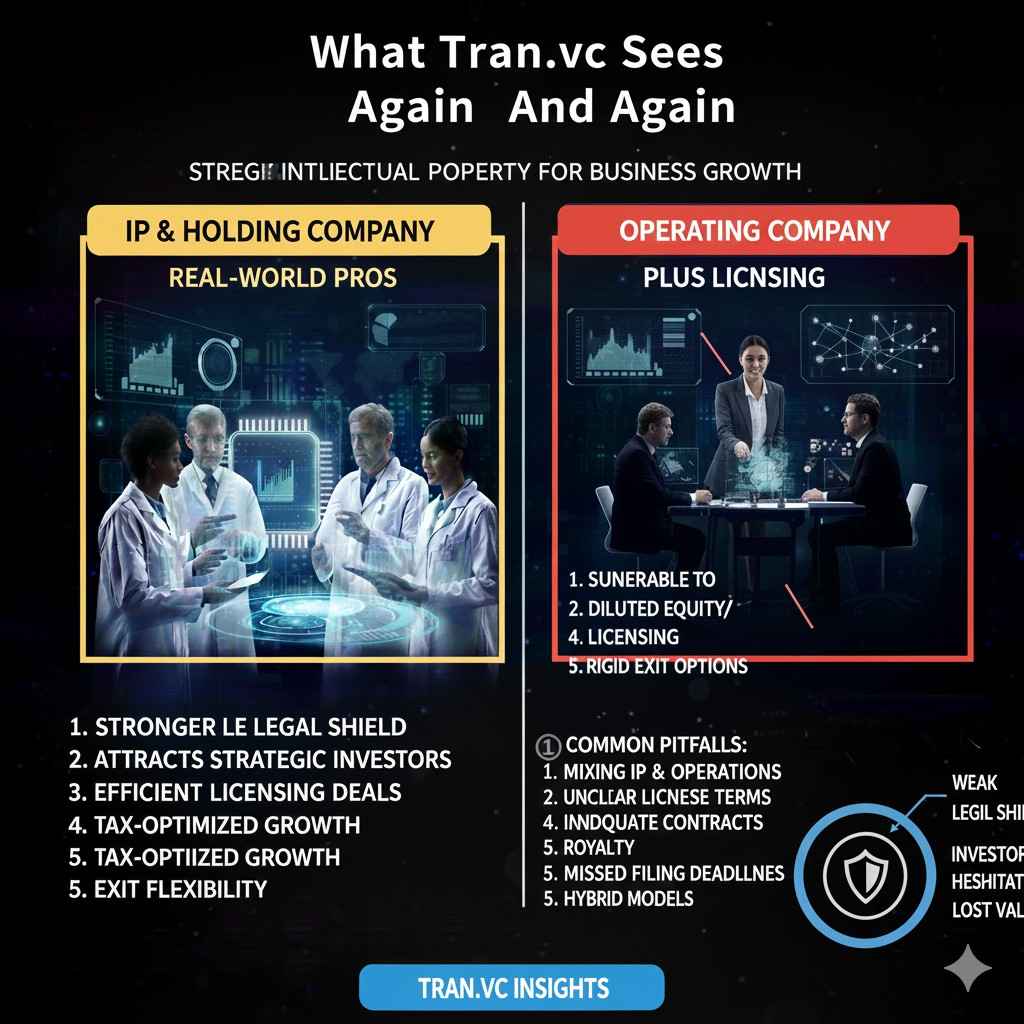
We often see teams delay patent filings because they are stuck deciding which entity should own the IP. During that delay, they demo, publish, or talk openly, reducing what can be protected later.
We also see teams create holding companies without strong licenses, then struggle in diligence. Fixing those issues later costs more time and money than doing it right at the start.
What works best in practice
For most robotics and AI startups, starting with IP in the operating company works best. It keeps momentum high and fundraising smoother. When separation is truly needed, it can be added later with clearer reasons and better resources.
The key is not the structure itself. The key is intentional IP strategy from day one.
How we help founders decide
At Tran.vc, we do not push one structure for everyone. We look at your product, your risk profile, your market plan, and your funding path. Then we help you choose the structure that supports your goals instead of fighting them.
We invest up to $50,000 in in-kind patent and IP services because strong foundations matter more than flashy headlines. If you want help building that foundation, you can apply anytime at https://www.tran.vc/apply-now-form/.
Final perspective before you choose
Ask the right question
The right question is not “Which structure is safer?” The right question is “Which structure helps my company grow, raise, and win with the least friction?”
Safety without growth is not success. Growth without control is also risky. The goal is balance.
Start simple, stay intentional
Most founders are best served by starting simple and staying intentional. Protect what matters, document everything, and avoid unnecessary complexity early.
If your business later demands separation, you can do it with clarity instead of fear.