
Seed money feels like oxygen. It shows up, and suddenly everything seems possible.
Then reality hits.
You have product work, hires, cloud bills, pilots, legal, security, and maybe a key conference. You also have something most teams ignore until it’s too late: your patents.
If you are building AI, robotics, or deep tech, your IP is not a “nice to have.” It is the part investors lean on when the market gets noisy. It is the part competitors struggle to copy. It is the part that can turn “cool demo” into “real company.”
This article is about one thing: how to budget a global patent plan on a seed round without draining your runway or guessing in the dark.
I’m going to keep this practical and plain. No fluff. No long lists. Just the thinking and the moves that work.
Also, if you want help building a patent plan that fits your seed round, you can apply anytime here: https://www.tran.vc/apply-now-form/
The first budgeting mistake: treating patents like a single bill
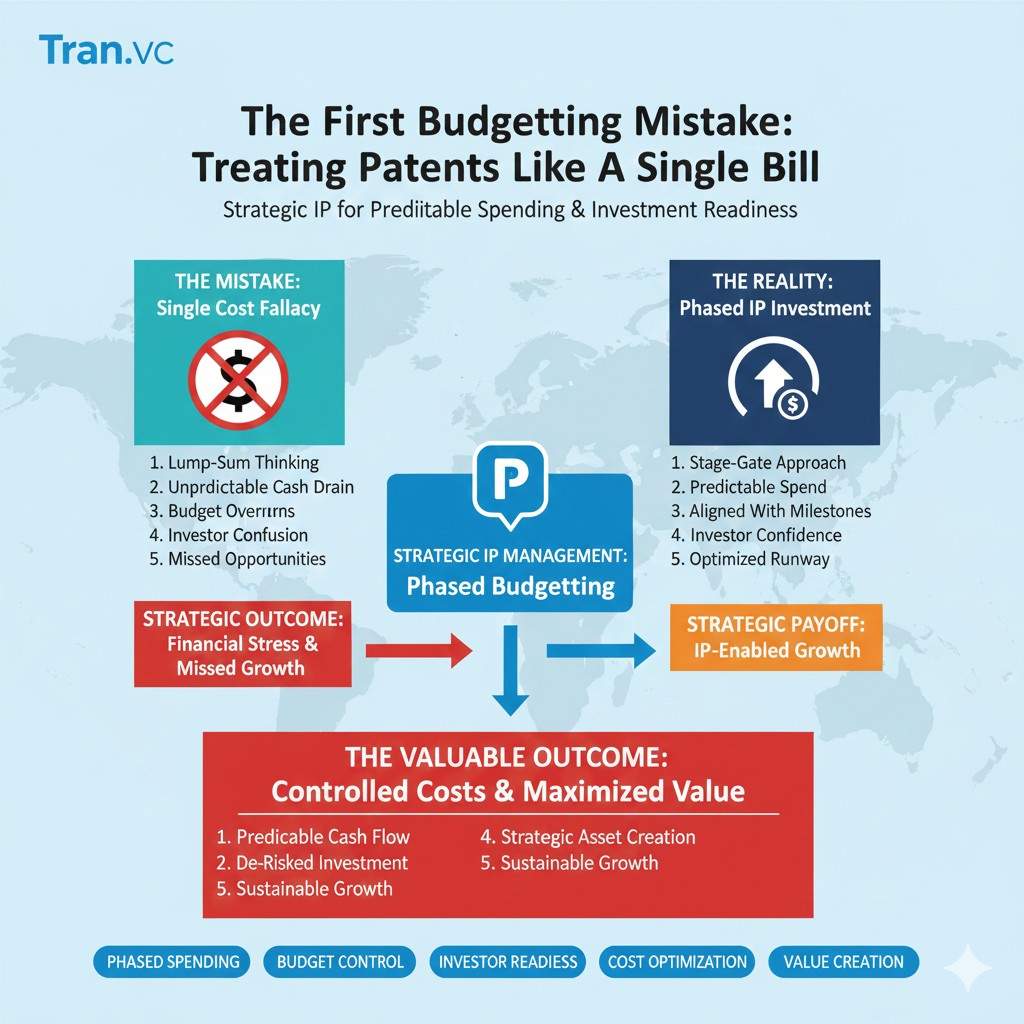
Most founders think of patents as one event.
“We’ll file a patent.”
But a global patent plan is not one bill. It is a timeline. And the budget is not a single number. It is a set of decisions that stack over months.
If you budget it like one bill, two things happen.
First, you under-budget. You file something quick, then you get hit with follow-on costs you did not plan for.
Second, you overreact. You hear scary numbers about “global patents,” then you decide to do nothing. That feels safe now, but it can become very expensive later.
A better approach is to treat patents like a roadmap with gates. You spend a bit to buy time. You use that time to learn. Then you spend again only when the data says it is worth it.
That is what smart global patent budgeting is: buying options, not buying everything.
What “global” really means, and why it gets pricey fast
When people say “global patents,” they usually picture one patent that covers the world.
That does not exist.
Patent rights are local. You are basically choosing countries or regions where you want protection. Each place has its own rules, fees, lawyers, deadlines, translations, and back-and-forth with examiners.
The big cost drivers are not mysterious. They are predictable:
- How many inventions you file.
- How complex the invention is to explain and claim.
- How many places you pursue.
- How long you keep the process going.
- How much you change the claims during review.
- Whether you need translations.
Here is the key: you can control most of this if you plan early.
You do not need to file everywhere. You need to file where it matters for your business.
And “matters” is not a guess. You can define it with a few clear business inputs.
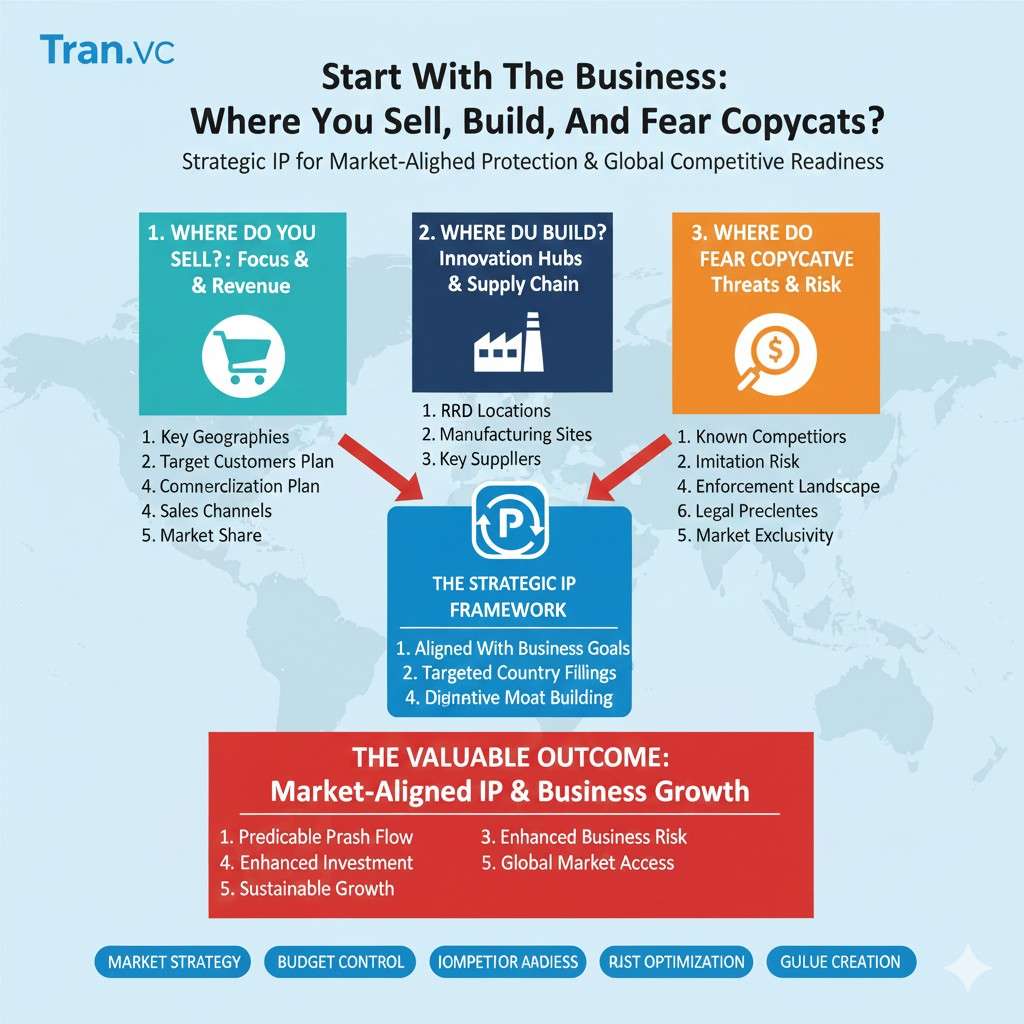
Start with the business: where do you sell, build, and fear copycats?
If you are budgeting a global plan, you need a simple truth:
A patent plan is not a legal plan. It is a business plan.
The goal is not to collect patents. The goal is to protect the parts of your product that drive value.
So before you budget anything, answer three business questions:
- Where will you make money in the next 3–5 years?
Think sales, partners, deployments, subscriptions, licenses, government buyers. - Where will the product be built or shipped from?
Manufacturing locations matter. If your robot is made in one country and shipped globally, that country can be very important. - Where is the real copy risk?
Copy risk is not “big companies.” It is “the easiest path for someone to replicate your advantage.”
For AI, that might be your training pipeline, data handling, model architecture details, or edge deployment tricks. For robotics, it might be your sensing method, control system, calibration process, end effector design, or safety routines.
When you can say “this is how we win” and “this is where we win,” budgeting gets easier.
Because now “global” is not a vague dream. It is a specific set of targets.
The seed-round reality: you’re buying time and leverage
At seed, you are not trying to finish a full global patent set.
You are trying to do three things:
- Put a stake in the ground early, before you demo publicly or ship widely.
- Create credible proof that you can build a moat.
- Keep your choices open while the product and market become clear.
That is why the best seed-stage patent plan usually looks like a staged plan.
You pay for the early work that locks in priority and gives you room to breathe. You delay the heavy global spend until you have more information.
This is not “being cheap.” It is being smart.
A staged plan also fits how seed investors think. They do not need you to have patents granted in ten countries on day one. They need to see you are not ignoring IP, and that your plan matches your roadmap.
If you can show: “Here is what we filed, here is why it matters, here is what we will expand into when revenue or fundraising supports it,” that is a strong story.
And story matters.
If you want a team that helps you build that story and the filings behind it, you can apply here: https://www.tran.vc/apply-now-form/
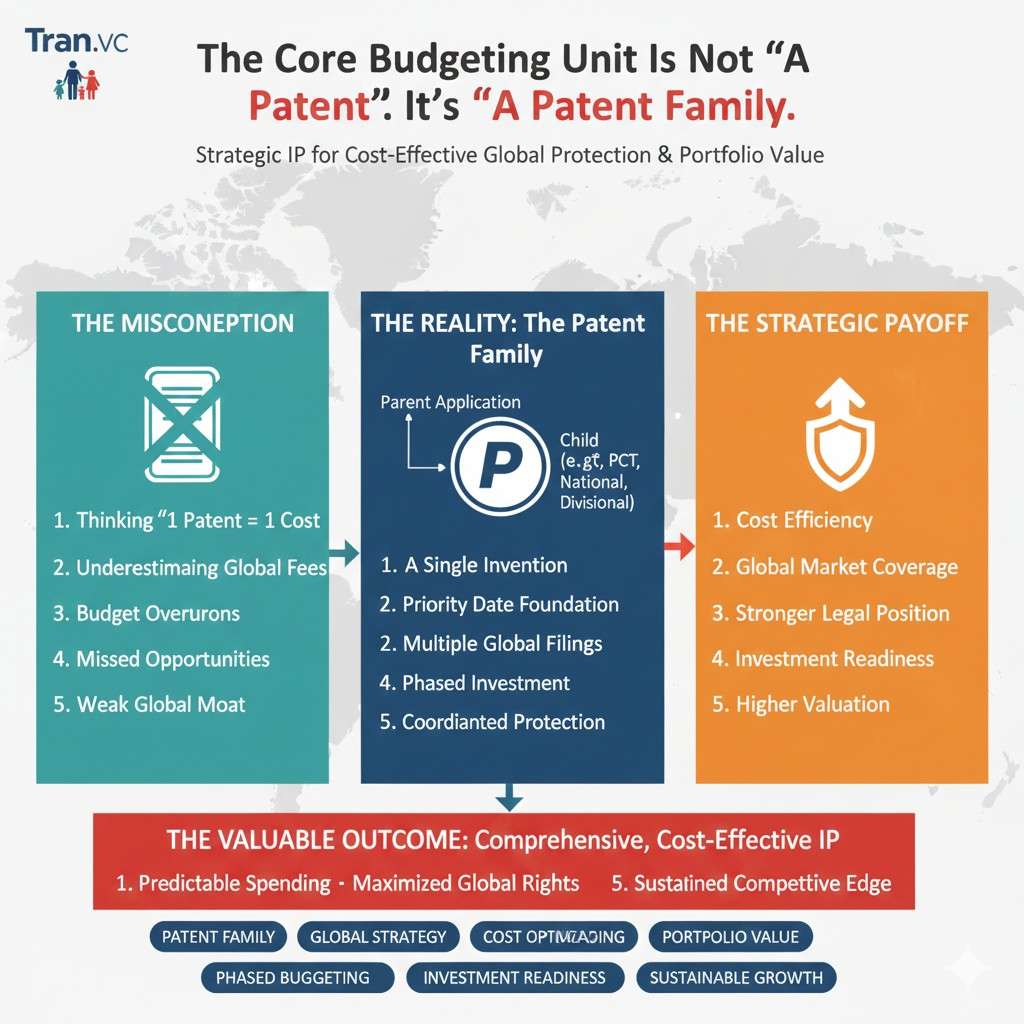
The core budgeting unit is not “a patent.” It’s “a patent family.”
Let’s use plain words.
A single invention can lead to multiple filings across time and countries. That set is often called a “patent family.”
If you budget by “one patent,” you can get surprised later when that one invention turns into multiple steps and multiple bills.
Budget by family instead.
When you do that, you start thinking like this:
- What is the invention?
- How important is it to the product?
- How long will it stay central to the business?
- Where might we need coverage?
Then you decide how much you want to invest in that family over time.
At seed, you usually want a small number of strong families, not a large number of weak filings.
Weak filings do not impress investors. They also do not scare competitors. They just cost money.
The practical first step: map your “protect list” to your product roadmap
You do not need a long list of inventions. You need a short set of “must protect” items.
Think of your product like a chain. If a competitor breaks one link, do they copy your value?
In robotics, this often includes:
- A unique way of sensing or perceiving the world.
- A control method that improves speed, safety, or precision.
- A mechanical design that makes the system cheaper or more reliable.
- A calibration or deployment method that cuts install time.
- A safety method that reduces risk and makes buyers say yes.
In AI, this often includes:
- A training approach that produces better results with less data.
- A data handling method that solves privacy, security, or compliance.
- An inference method that runs faster or cheaper on edge devices.
- A workflow that links multiple models into a reliable system.
- A method that improves accuracy in a special environment.
Now map those to your roadmap:
- What will ship in 3 months?
- What will ship in 6 months?
- What will ship in 12 months?
Your budget should follow that timing.
If something will not exist for a year, you do not need to file it today. You need a plan to capture it later, before it becomes public.
This is where many teams slip. They file too early on half-formed ideas. Or they file too late after a demo, a paper, or a customer pilot that already exposed the invention.
A smart plan matches the moment the invention becomes real and visible.
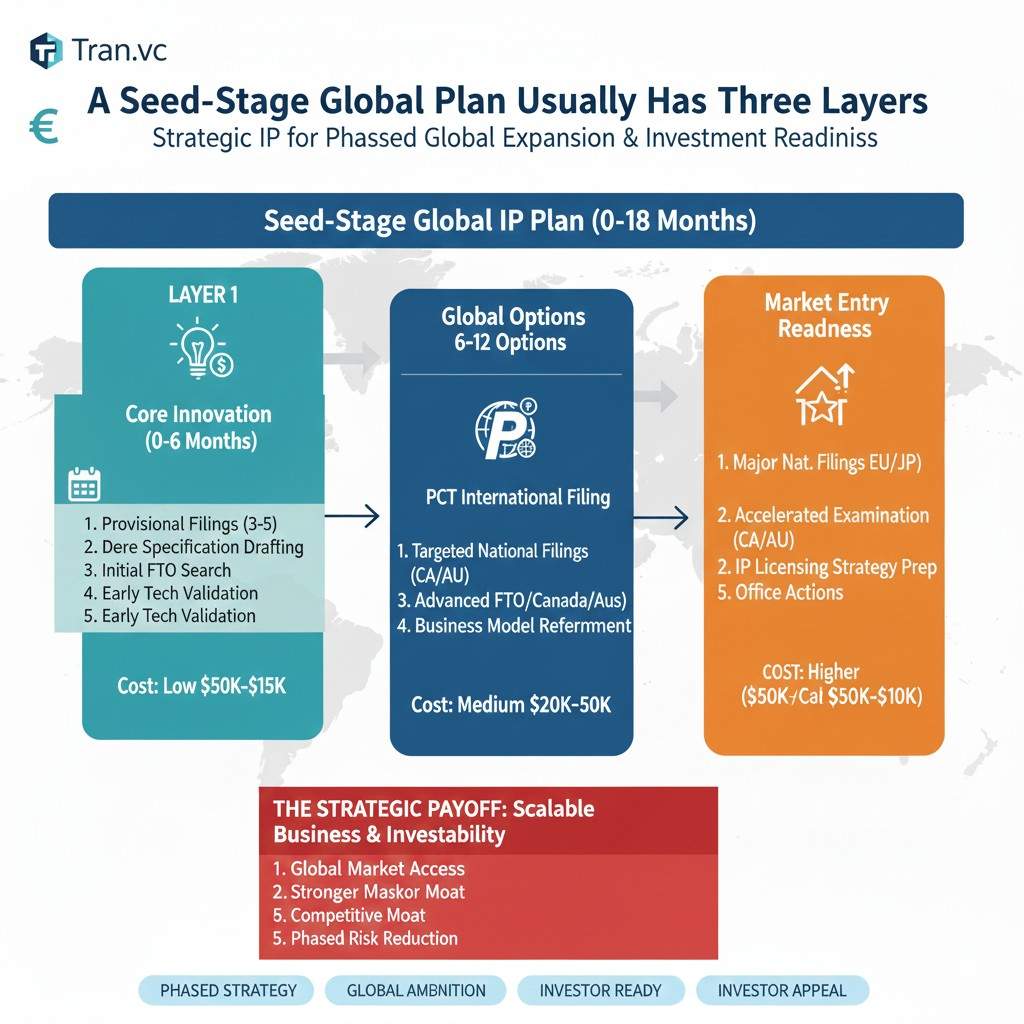
A seed-stage global plan usually has three layers
I’m going to describe this as a simple flow, not a big list of steps.
Layer one is the “priority lock.”
This is what establishes your earliest filing date for an invention. It buys you time.
Layer two is the “international bridge.”
This is what keeps the option open to go into many countries later.
Layer three is the “country picks.”
This is where you actually choose the places to pursue protection long term.
The important thing is that you do not need to buy layer three right away.
Most seed-stage companies should focus on layer one and layer two first.
The goal is to avoid spending big money before you know which markets will matter most.
How to budget layer one: lock priority without overspending
The first spend is usually around capturing the invention properly.
This is where quality matters a lot.
A cheap, rushed filing that does not describe the invention well can become a trap. It might not support the claims you want later. You may end up paying more to fix it, or you may lose the ability to claim what is truly valuable.
On the other hand, you also do not need to write a perfect, final document at seed if the invention is still changing.
So the budgeting sweet spot is: “solid enough to support future claims, but not loaded with unnecessary work.”
What does that mean in practice?
It means you work with someone who understands how to pull the real invention out of engineers and turn it into a clear story with multiple angles.
It means you include variations, alternative designs, and key details that keep your options open.
It means you do not file a vague idea. You file a real method or system with clear steps and structure.
If you are worried about cost, this is exactly where in-kind IP support can make a big difference. Tran.vc invests up to $50,000 worth of patent and IP services so you can do this right without burning all your cash. Apply here: https://www.tran.vc/apply-now-form/
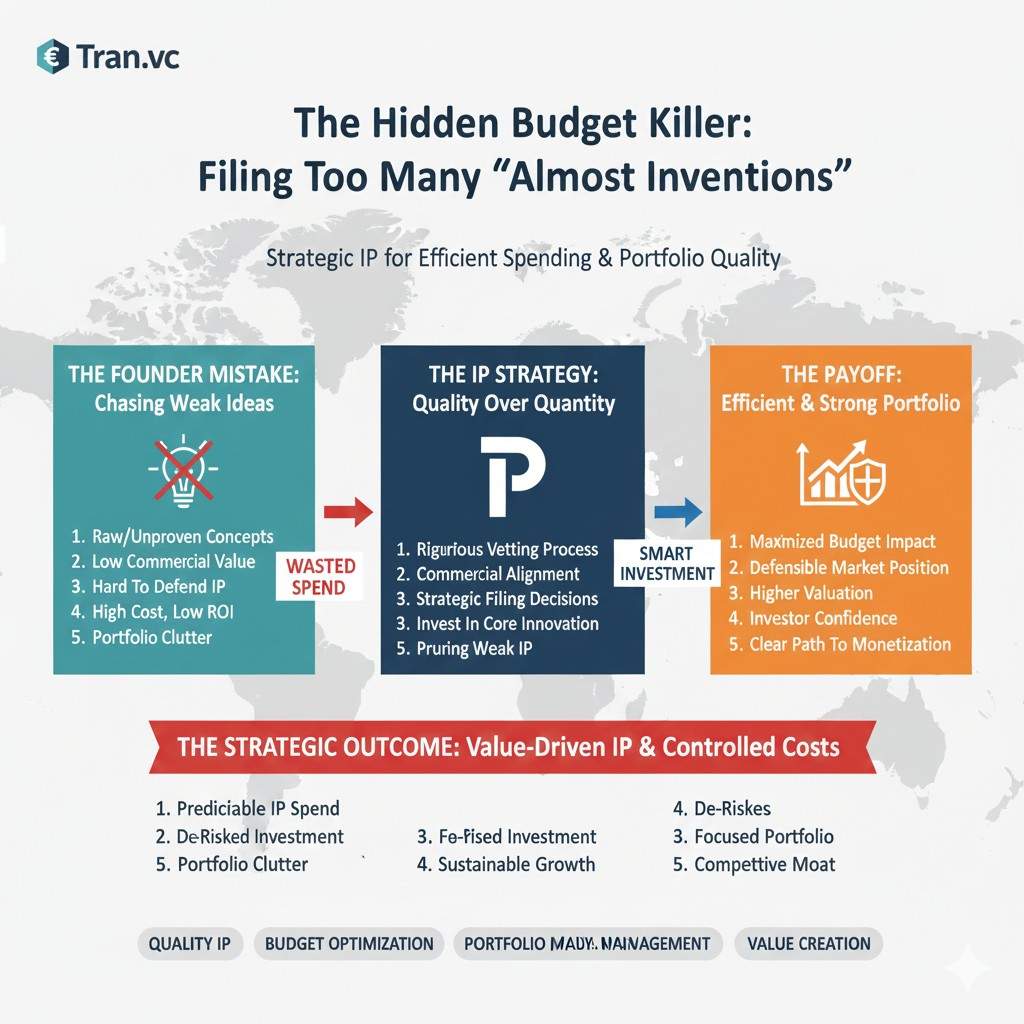
The hidden budget killer: filing too many “almost inventions”
A common seed-stage problem is excitement.
The team has five good ideas. They want to file all five.
But early inventions tend to evolve. Some will become irrelevant. Some will be replaced. Some will turn out to be hard to defend. Some will be easy to work around.
If you file everything, you will spend money on ideas that do not survive contact with the market.
A better approach is to choose the inventions that meet two tests:
First test: if a competitor had this, would we lose deals?
Second test: can we describe it clearly today, with enough detail that it would still matter in a year?
If it fails either test, you park it. You keep it as a trade secret for now, or you wait until it is more mature.
This simple filter protects your budget.
How to budget layer two: the international bridge that buys you 30 months
Most founders hear “international filing” and think it means “we must spend huge money now.”
Not necessarily.
There is a common path that many startups use to keep options open internationally while delaying the biggest expenses.
The point of this path is time.
Time to learn which markets matter.
Time to see where sales traction appears.
Time to raise the next round.
Time to refine the claims.
When you budget globally at seed, you are often budgeting for this bridge, not for the final country expansion.
This bridge can be one of the best financial moves you make for IP, because it keeps your global options alive without forcing you to commit early.
You still need to budget for it, but it is usually far less painful than trying to enter many countries right away.
Where founders get burned: forgetting the “later” costs
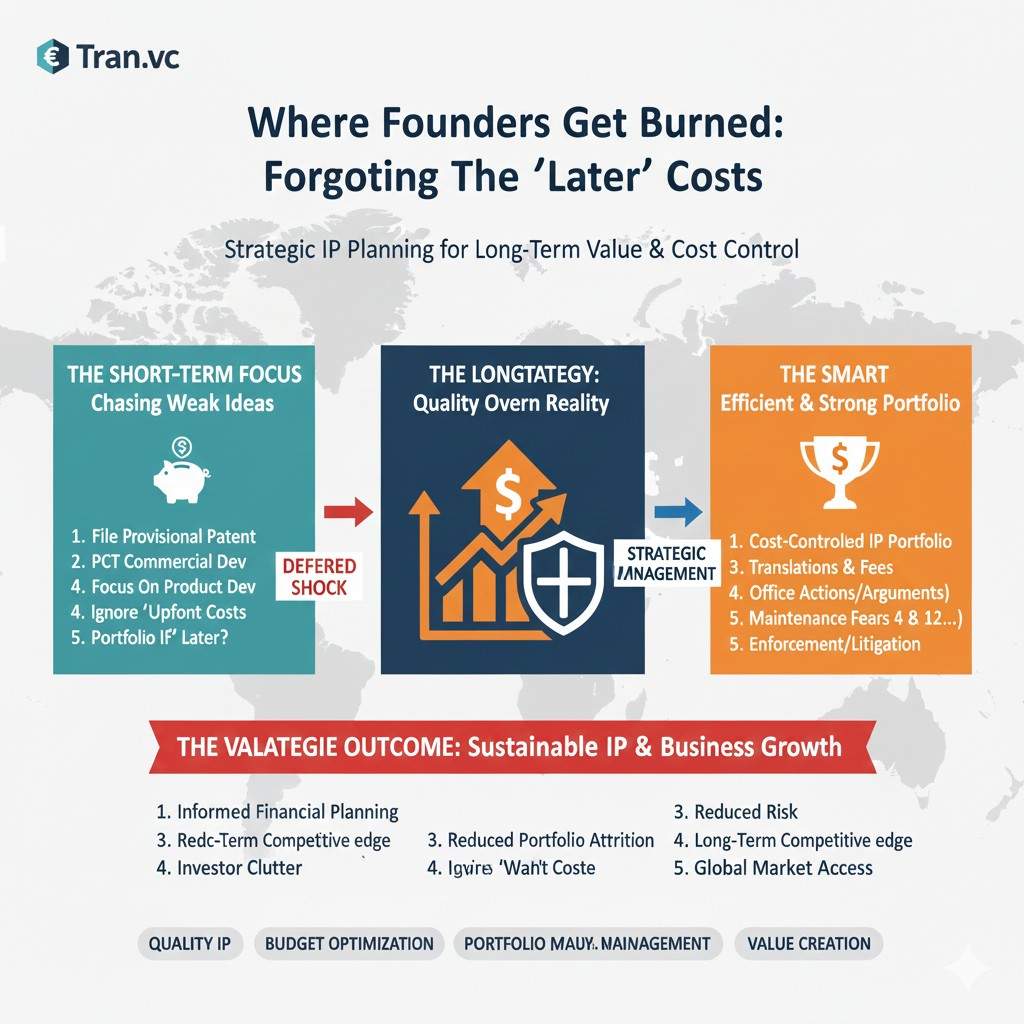
Even when a seed-stage company files well early, they often miss the follow-on costs.
They file, feel safe, then focus on product.
Then 10 months later, a deadline hits. A bill hits. It is not small. And now it’s an emergency.
This is why budgeting matters.
When you create a patent plan, you should also create a calendar with expected cost windows.
You do not need perfect numbers. You need awareness.
Think of it like this: “We spend a bit now. We will likely spend again around X month. Then again around Y month if traction is strong.”
When you do this, you avoid panic spending.
You also avoid the painful choice of abandoning protection simply because you did not plan.
A simple way to decide which countries matter
Country choices should not be emotional. They should be tied to money and risk.
Here are the clean drivers that usually make a country worth it:
- It is a major customer market for you.
- It is a major manufacturing or supply location.
- It is a place where enforcement has real teeth for your industry.
- It is a place competitors in your field tend to operate.
This is not about ego. It is about control.
Sometimes the best “global” plan is not ten countries. It might be two or three that cover most of the business value.
Sometimes you choose a region path that covers multiple countries through one system.
The right answer depends on your go-to-market plan, not on what other startups do.
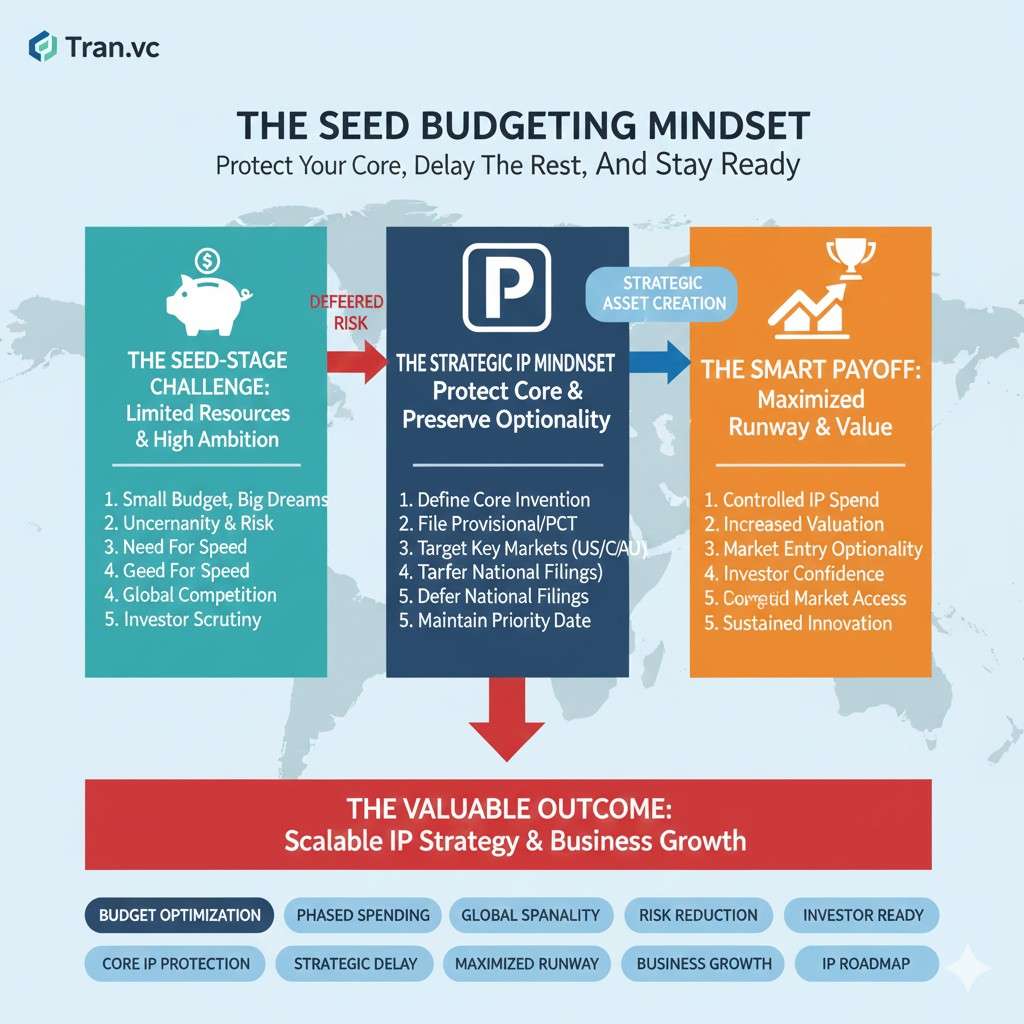
The seed budgeting mindset: protect your core, delay the rest, and stay ready
If you take only one idea from this introduction, take this:
You do not need a huge global patent spend at seed. You need a staged plan that protects what matters and keeps your options open.
A strong seed-stage budget usually prioritizes:
- One to three core inventions that truly define the product.
- High-quality capture of those inventions so you are not boxed in later.
- A path that preserves international options while you learn.
- A calendar that prevents deadline surprises.
This is exactly the kind of planning Tran.vc helps founders do. If you are building robotics, AI, or deep tech and want to turn your inventions into fundable assets without giving up control early, apply here: https://www.tran.vc/apply-now-form/
Budgeting a Global Patent Plan on a Seed Round
What this section will help you do
You are about to make money decisions while your product is still changing. That is normal at seed. The goal is not to guess perfectly. The goal is to spend in a way that protects what matters, keeps options open, and does not crush your runway.
This next part will show you how to think about patent spend like a plan with stages. It will also show you how to set a simple “IP run rate” so you do not get surprised by a deadline bill later.
If you want Tran.vc to help you build this plan and cover up to $50,000 in-kind patent and IP services, you can apply anytime at https://www.tran.vc/apply-now-form/
The seed round is not for “finishing” IP
A seed round is for proving you can win. That usually means building, shipping, testing, and learning fast. Your patent plan must match that pace.
When you treat patents like a final project, you either spend too much too early or you avoid IP until you are already exposed. A staged plan is the middle path. It is serious, but it is also realistic.
Build a simple IP budget model before you pick countries
Think in stages, not a single number
A global plan gets easier when you stop asking, “How much is a global patent?” and start asking, “What will we spend in each stage, and when?”
At seed, you are usually buying two things. First, you are buying a strong early filing that locks your date and captures the real invention. Second, you are buying time to decide where to go next.
This mindset helps because it turns a scary unknown into a timeline. Timelines can be planned. Panic cannot.
Use “families” instead of “patents”
Most founders budget for “one patent,” then they get surprised when that “one patent” becomes a chain of filings across time. A better unit is a patent family, meaning one invention that may lead to filings in several places over months or years.
When you budget by family, you can also choose quality over quantity. That matters at seed, because weak filings waste money and still leave you exposed.
Set an “IP run rate” like you set a cloud budget
Your company already has a spend rhythm. You know roughly what you can afford each month. IP needs the same treatment.
An IP run rate is a simple cap that keeps you from making emotional choices. It turns IP into a planned expense, not a random legal surprise.
Choose what to protect by tying it to your product advantage
Your goal is not to patent “features”
Many teams file patents around features because features are easy to name. The problem is that features change, and competitors can design around them.
Instead, focus on the parts that create the advantage underneath the feature. In AI, that might be the training method, the way you handle data, the way you run on edge, or the way you keep results stable in messy real life.
In robotics, it might be the way you sense the world, the way you control motion, the way you calibrate fast, or the way you reduce risk in a factory or hospital setting.
Use a “deal breaker” test
A practical test is to ask: if a competitor copied this exact method, would we lose deals? If the answer is yes, you should treat it like a core invention.
This test forces clarity. It also prevents you from filing on ideas that are interesting but not essential.
At seed, you want a small number of core families that matter a lot. That makes your story stronger and your spend cleaner.
Protect what will become visible soon
Patents become urgent when your invention is about to be exposed. Exposure happens in demos, customer pilots, papers, open-source releases, sales decks, and even job posts that explain too much.
If you are planning a public moment, you should plan the filing first. This is one of the easiest ways to avoid losing rights without even knowing it.
Build the staged plan that fits a seed round
Stage 1 is the “priority lock”
Stage 1 is where you capture the invention and file in a way that sets your earliest date. This date matters because later filings often depend on it.
The quality of this step is more important than many founders think. If your first filing is thin, later options shrink. You might not be able to claim the best parts later, even if you build them.
A good Stage 1 filing explains the core method clearly and includes variations. It gives you room to adjust as you learn, without losing the heart of what you invented.
Stage 2 is the “international bridge”
Stage 2 is about keeping the door open to file in many places later. The main value here is time.
That time lets you see where customers show up, where partners care, and where copy risk is real. It also gives you a chance to raise the next round before the larger global bills arrive.
When founders say “we want global coverage,” this stage is often what they truly need at seed. It gives confidence without forcing a huge commitment too early.
Stage 3 is the “country picks”
Stage 3 is where you commit to specific countries or regions. This is where the costs can rise quickly, especially when translations and local counsel are involved.
The mistake is doing Stage 3 before the business has signals. The smart move is to enter Stage 3 when you have traction, clear markets, and a real reason to invest.
This is also when your patent plan starts to mirror your go-to-market plan. That is a good thing. It means you are spending to protect revenue, not spending to look impressive.
Make country choices based on money and risk, not fear
Start with where you will sell
Countries are worth paying for when you expect real revenue there. This sounds obvious, but many teams choose countries based on what they have heard other startups do.
If you sell to the U.S. first, your early plan should reflect that. If you will sell to Europe early because of industry buyers or regulation, your plan should reflect that. The point is simple: protect where you win.
Add where you will build or ship from
Manufacturing and supply chains matter, especially in robotics and hardware-heavy systems. If your product is built in one place, that place can become a critical point of leverage.
This is not just about lawsuits. It is about business conversations. Strong IP in a key build location can change how partners treat you.
Add where copycats are most likely to operate
Copy risk is not always where you sell first. Sometimes it is where competitors are based or where low-cost clones appear quickly.
A clear way to think about this is to ask: if someone copied us, where would they do it, and where would they ship from? Those locations can matter as much as early customer markets.
Plan for the “later bills” so IP never becomes an emergency
Deadlines are predictable, even if the numbers are not
The most painful IP problems often come from surprise timing, not surprise cost. A bill can feel huge when it lands in a month where you also have hires and cloud spend.
The fix is to build a calendar. You do not need perfect numbers. You need a rough map of when costs tend to show up, so you can reserve runway.
This also makes fundraising easier because you can speak clearly about your next IP milestones. Investors trust founders who plan ahead.
Avoid the trap of filing too many “almost inventions”
Early-stage teams create ideas fast. That is a strength, but it can turn into waste if you file on everything.
The cost is not just the first filing. The cost is the follow-on work and the future decisions you must keep making for each family. Every extra family adds future pressure.
A better habit is to keep many ideas in an internal invention log, but only file the ones that pass the deal breaker test and are ready to be described with real detail.
Use trade secrets on purpose, not by accident
Some parts of AI and robotics can be kept as trade secrets if they stay inside your stack and are hard to reverse engineer. That can be a valid strategy, but only when it is a choice.
If you do not file and you also share the method in a way that makes it easy to copy, you get the worst of both worlds. You lose the chance for patent rights and you also lose secrecy.
A planned mix of patents and secrets is often the best fit for seed-stage companies. It keeps spend sane while still building a moat.
How Tran.vc fits into this budgeting problem
In-kind IP support changes the seed math
Many founders delay patents because they feel forced to choose between IP and runway. That choice is especially painful in deep tech, where investors expect serious IP thinking.
Tran.vc invests up to $50,000 worth of in-kind patent and IP services. That means you can build a strong staged plan, capture the right inventions properly, and avoid the cheap-first-filing trap that causes long-term pain.
It also means your seed dollars can stay focused on product and traction, while your IP foundation gets built by people who know the process.
The goal is leverage, not paperwork
A good IP plan gives you leverage in fundraising and leverage in the market. It helps you tell a clear story: what you invented, why it matters, and why it is hard to copy.
That story becomes part of your deck, your data room, and your diligence flow. It also becomes part of how you negotiate partnerships, especially in robotics supply chains and enterprise AI deals.
If you want to build that kind of IP-backed leverage early, apply here: https://www.tran.vc/apply-now-form/