
Most founders wait too long to set up a real board.
They tell themselves, “I’m early. I’ll do it after traction.” But the truth is simple: if you want to raise a strong Seed or Series A, your board setup is already part of the deal. Investors do not just fund the product. They fund how you make hard calls, how you manage risk, and how you prevent chaos when things move fast.
A good board is not a trophy. It is a tool. If you set it up well, it protects you, helps you raise faster, and makes big partners trust you sooner.
If you want Tran.vc to help you build a strong, defensible base from day one (including IP strategy and patents that investors respect), you can apply anytime here: https://www.tran.vc/apply-now-form/
Board setup for Seed and Series A readiness
Let’s start with a clear truth.
At Seed, your board does not need to look “big.” It needs to look “serious.”
At Series A, your board does not need to look “fancy.” It needs to look “functional.”
If a board is too small, you lack guidance and you look unprepared. If it is too big, decisions slow down and you lose focus. The goal is balance: enough structure to show maturity, but not so much process that it chokes speed.
What investors really look for when they look at your board
Most founders think investors judge the board by names.
They do not.
Investors judge it by signals:
They ask, “Can this team make clean decisions under stress?”
They ask, “Will the company break if the CEO gets sick for two weeks?”
They ask, “Is there adult supervision when the first big customer asks for a risky deal?”
They ask, “Does anyone here understand legal, finance, hiring, security, or IP risk?”
A strong board answers those questions without needing a speech.
A weak board raises worry, even if your metrics look fine.
And here is a point that matters for deep tech, AI, and robotics: boards also look at your defensibility. If your moat is only “we’re moving fast,” a smart investor knows a larger team can copy you. But if your moat includes real IP assets—patent filings, clear ownership, clean assignments, and a plan—your board looks like it belongs in a serious company.
That is exactly why Tran.vc exists. They invest up to $50,000 in-kind in patent and IP services so technical founders can turn inventions into assets early—before the first priced round forces you into a corner. Apply here if that is what you need: https://www.tran.vc/apply-now-form/
The simplest way to think about board readiness
Think of readiness as three layers:
Layer one: your company can be governed.
Meaning: decisions are recorded, roles are clear, and there is a normal way to approve key actions.
Layer two: your company can be financed.
Meaning: you can answer investor questions fast, you have clean documents, and you can run a real meeting cadence.
Layer three: your company can survive scale.
Meaning: you can hire leaders, keep controls, handle conflict, protect IP, and manage risk without drama.
Seed readiness is mostly layers one and two.
Series A readiness is all three.
Now let’s make this real and tactical.
First: understand what a board is (and what it is not)
A board is a legal body that represents stockholders. That sounds stiff, but the impact is very practical.
A board can hire and fire the CEO. A board can approve fundraising terms. A board can approve option pools. A board can approve budgets and big contracts. A board can approve acquisitions, debt, and major strategy shifts.
That is why this matters.
Because if you treat the board like a casual monthly chat, you will get surprised later, usually right when you are trying to close a round.
A board is not:
- a friend group you update once in a while
- a place to “show progress”
- a set of people you pick only for status
A board is:
- a decision system
- a risk filter
- a trust machine for investors and partners
When you set it up well, you create clean moments where the company makes key choices. That cleanliness is what investors buy into.
The Seed stage board: keep it small, keep it clean
At Seed, the most common board structure is simple:
- founders
- maybe one investor
- maybe one independent (but often later)
But the real point is not the count. The real point is control and clarity.
If you are raising Seed, you want to avoid a board that can deadlock.
Deadlock is when votes tie and no one can move forward.
It sounds rare. It is not.
Here is how it happens: two founders each have one seat, one investor has one seat, and then you add one more seat to “balance.” Now you can tie 2–2 on something important. It becomes a slow fight. People start using board votes as leverage. It drains time. It spooks new investors.
So your first tactical rule is:
Do not design a board that can easily tie.
If you can avoid it, keep odd numbers.
And if you cannot avoid it, then build tie-break logic into the docs.
This is a legal detail, yes, but it becomes a company life detail.
This is also why it helps to work with people who have done it many times before. Tran.vc’s model is built around bringing expert IP and early-stage guidance without taking control. If you want that, apply here: https://www.tran.vc/apply-now-form/
The difference between a board member and an advisor
This is where many founders get confused.
An advisor can give advice. They can open doors. They can help you think.
But they do not have legal power over the company. They do not vote. They do not carry the same duties.
A board member has legal duties to the company and stockholders. They can vote. They can shape major actions. They can also create liability if they are careless, so serious board members tend to be thoughtful.
That means:
If you want light help, use advisors.
If you need real governance and investor trust, use a board.
A common and healthy path is:
Start with a small board and a strong advisor bench. Then add an independent board member around late Seed or early A, when the business starts to carry more risk and more money.
What “Series A ready” looks like from the outside
Series A investors care about growth, yes.
But they also care about whether your company can hold their capital without wasting it.
At Series A, investors will look for:
- clean cap table and clean option grants
- clean board consents and approval trail
- clear IP ownership and IP strategy
- a board that can guide hiring and scaling
- a real meeting rhythm, not random updates
- no hidden bombs (old SAFE terms, unclear promises, side letters, messy advisor equity)
Board setup touches all of this.
Because the board is the place where “clean approvals” live.
If your approvals are messy, the investor assumes other things are messy too.
The real job of the CEO in board setup
The CEO’s job is not to “please the board.”
The CEO’s job is to run a process where the board can help.
This sounds small, but it changes everything.
A weak CEO uses the board to feel safe. They show slides, ask for praise, and avoid hard topics.
A strong CEO uses the board to sharpen decisions. They bring the hard topics first. They ask for help on the real issues. They make the meeting feel like a working session, not a show.
Series A investors can tell the difference in one meeting.
And it shows up in how you write your board materials.
If your deck is only wins and charts, it looks like you are hiding risk.
If your deck is clear about risks, choices, and next steps, it looks like you can scale.
The meeting cadence that signals maturity
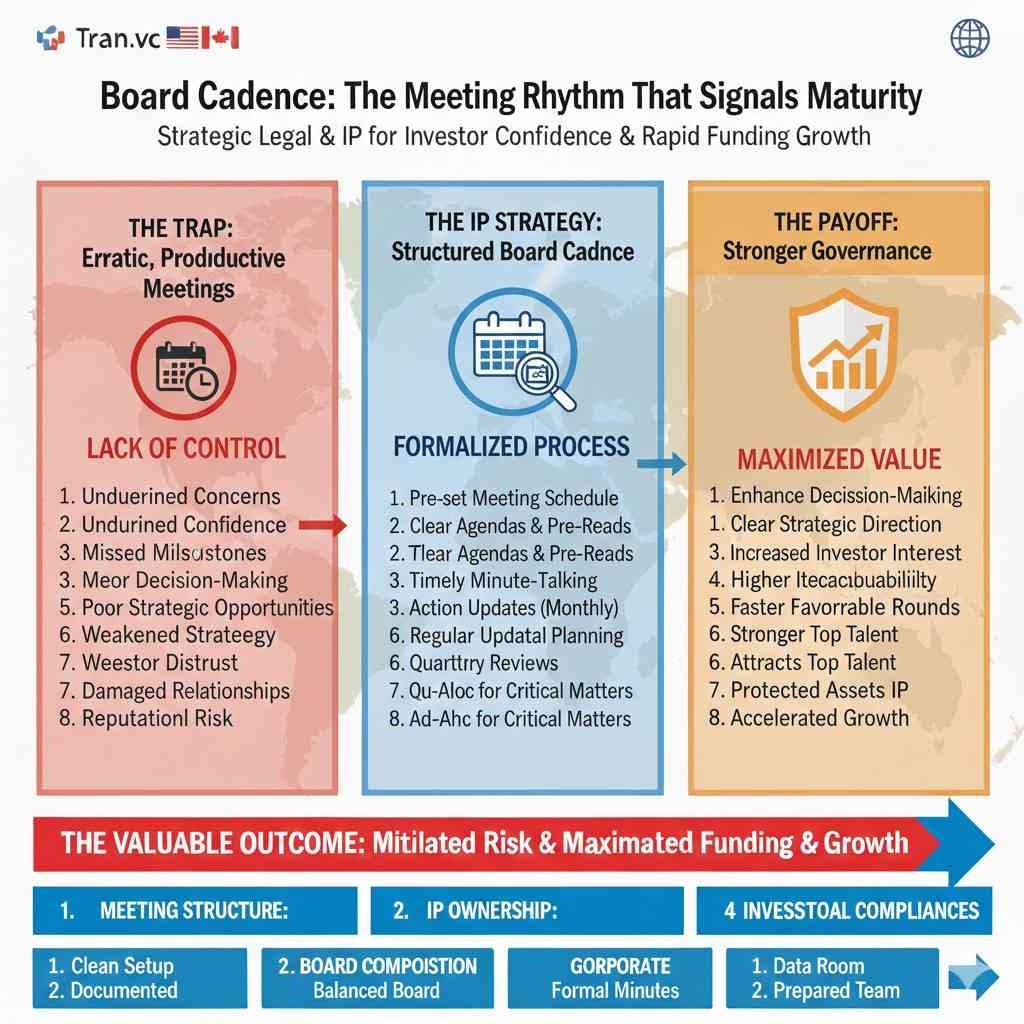
You do not need many board meetings early.
But you do need a steady rhythm.
A common pattern that works for most Seed-stage startups:
One formal board meeting each quarter, with shorter check-ins in between as needed.
But the deeper truth is this: investors do not care about the calendar. They care that you do not drift.
Drift is when the company slowly changes direction because of pressure, not because of decision.
A board meeting is a “decision checkpoint.” It forces you to state what you believe, what you are doing, and why.
That is what makes a board useful.
What to include in a Seed-stage board agenda
You asked for tactical guidance, and I will keep it plain.
A good Seed-stage board meeting should cover four things:
First, what changed since last time. Not everything. Just what matters.
Second, what you believe now. Your view of the market, customer pain, and why you are winning.
Third, what you need to decide. Hiring plans, spending, pricing changes, big deals, fundraising steps.
Fourth, what could break the company in the next 90 days. Product risk, security risk, legal risk, IP risk, team risk.
The last part is the one founders avoid. That is the one investors respect the most.
Especially for AI and robotics, where risk can show up in many forms—data rights, safety claims, export controls, model behavior, customer liability, hardware failures, supply chain, and IP conflicts.
If you show you can see these risks early, you look Series A ready sooner.
Board minutes and consents: the “boring” thing that saves you later
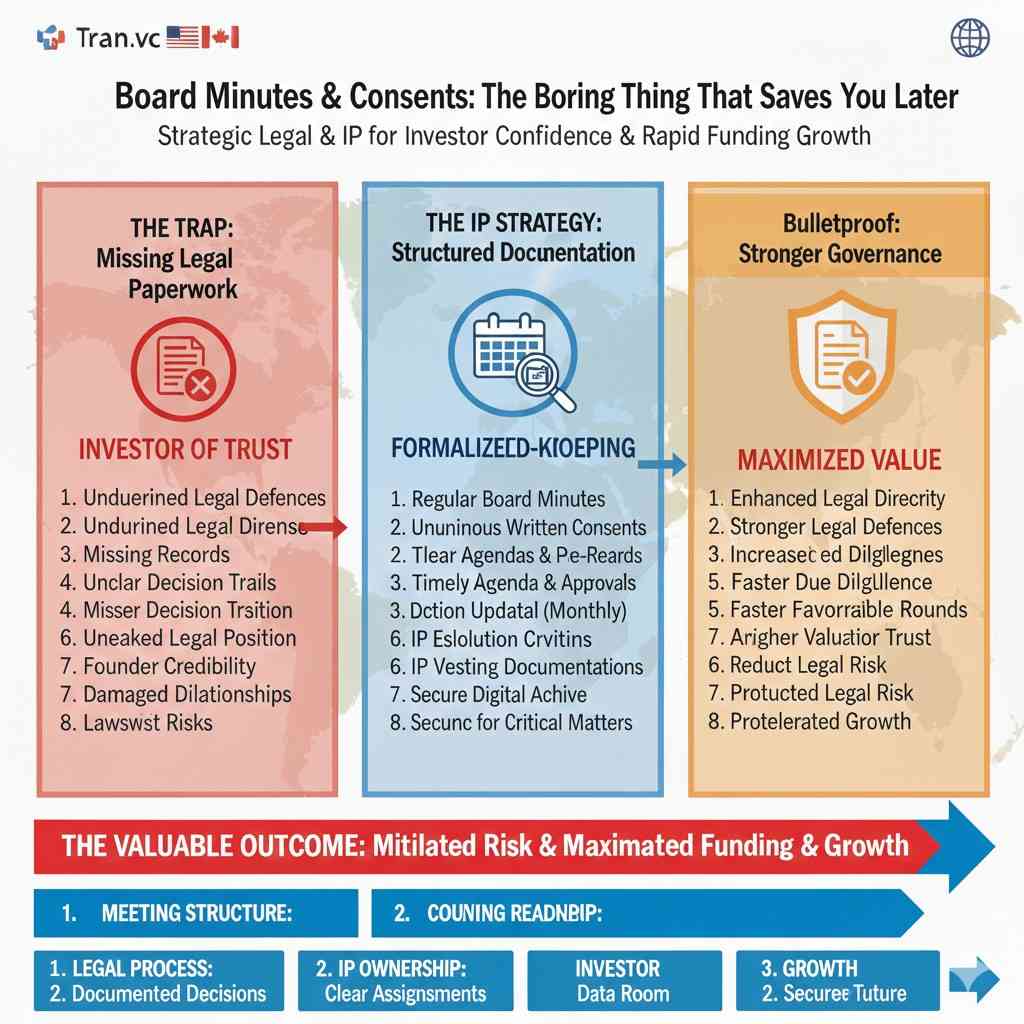
Most founders do not want to deal with minutes.
They feel like school.
But board minutes are not about writing a novel. They are about proving that key actions were approved the right way.
When you raise Series A, your lawyers and the investor’s lawyers will ask for proof of approvals. If you cannot show it, you end up doing cleanup under pressure. Cleanup under pressure causes mistakes. Mistakes cost money and trust.
A clean system is:
- each board meeting has a short written record
- each major action has a signed consent
- those files are stored in one place, organized by date
If you do that from Seed, you look “tight” at Series A.
And “tight” wins deals.
The single biggest board mistake at Seed
Here it is:
Giving away too much control too early, in the name of looking legit.
Founders sometimes offer a board seat like it is candy, just to close money.
That can backfire for years.
Not all investors are good board members. Some are. Many are not.
A board seat is not a thank-you gift. It is governance power.
So what should you do?
Treat board seats like you treat co-founder decisions: slow and careful.
If you need to honor an investor without giving a seat, you can offer:
- observer rights
- regular update calls
- involvement in hiring or customer intros
That keeps the governance clean while still building trust.
Observers: the quiet tool founders underuse
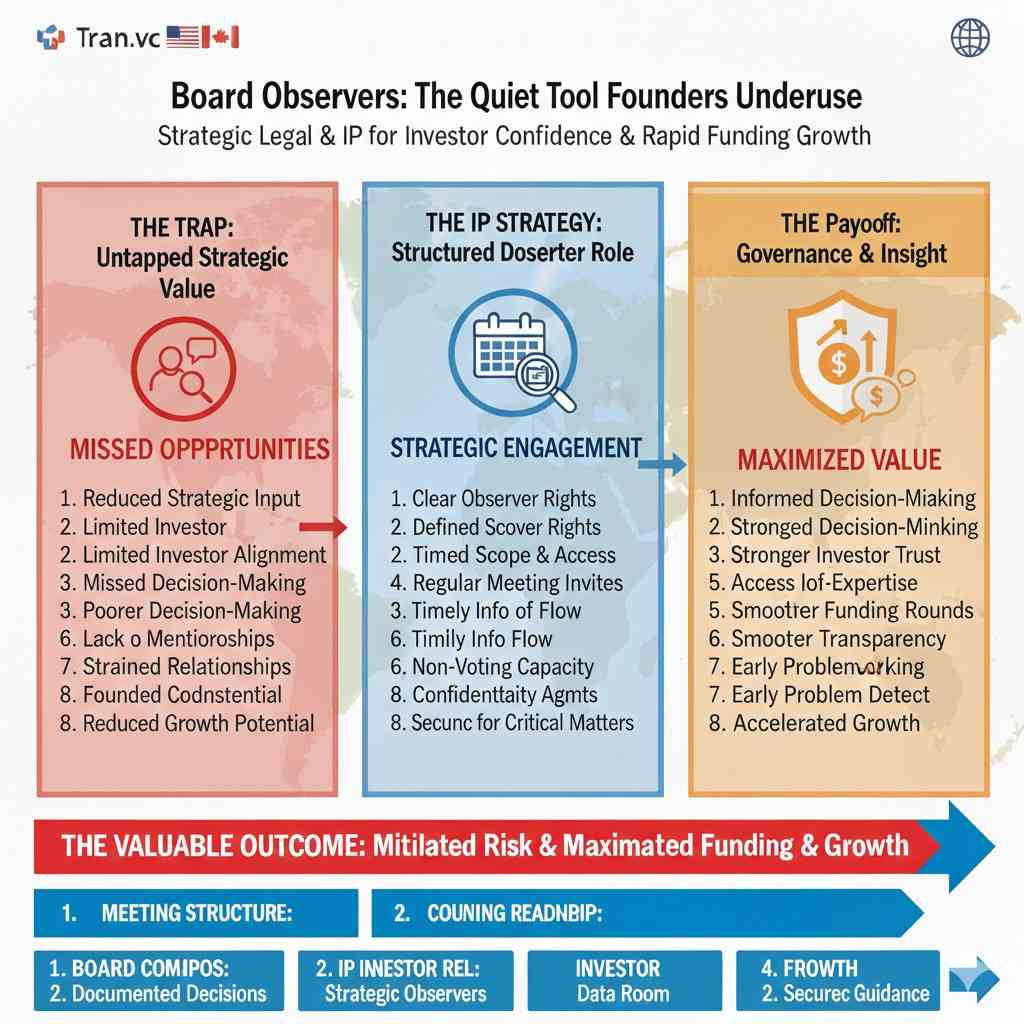
A board observer can attend meetings, get materials, and join discussion, but they do not vote.
This is a great tool at Seed because it lets investors stay close without making the board heavy.
It is also useful when you raise from a group and you do not want five voices voting.
You want input. You do not want a voting crowd.
Use observers when:
- the investor is helpful but you are not sure about long-term fit
- you have multiple small checks and want one “lead voice”
- you want to keep board seats limited until Series A
The independent board member: when to add, and how to pick
Founders often hear, “Add an independent to look mature.”
That advice is half true.
An independent is powerful when the business is entering a more complex stage. That often happens between Seed and Series A.
But a bad independent can be worse than no independent. They can waste time, create noise, or try to play referee without context.
A good independent should do three things:
They should know your world. Meaning deep tech, AI, robotics, enterprise sales, regulated domains, or whatever you live in.
They should have pattern recognition. Meaning they have seen scale-up issues before.
They should be calm. Meaning they do not panic, posture, or make meetings about themselves.
How do you find them?
Usually not through cold outreach.
You find them through trusted investors, founders a stage ahead, or operators who have sat in the seat before.
Pick someone who helps with decisions, not someone who looks good on a website.
Board composition as a story: what story are you telling?
Everything in fundraising is a story.
Your board is part of your story.
If your board is only founders and one investor, the story is “early, fast, building.”
If your board includes a strong independent with domain depth, the story is “we are building something real and we plan to scale it safely.”
If your board is crowded with investors, the story can become “the founders needed a lot of pressure to get here,” even if that is not true.
So ask yourself:
What story does your board tell a Series A investor who is deciding in two meetings?
The board and IP: where deep tech founders must be sharper
Now we get into a part most generic board articles skip.
For deep tech, AI, and robotics, the board is not only about money and hiring. It is also about assets.
Investors want to know:
Who owns the inventions?
Were all invention assignments signed?
Are contractors properly assigned?
Is open-source use tracked?
Do you have patents filed, or at least a clear strategy?
Are you building a moat you can defend?
This is where founders get surprised. They assume IP can wait.
But the moment you have a real competitor, a big partner, or a due diligence request, IP stops being optional.
If your board never discusses IP, it signals that you do not treat defensibility as a first-class job.
You do not need to turn every meeting into a legal session. But you do need a simple rhythm:
- once or twice a year, board reviews your IP plan
- major inventions are flagged early
- patent filings are aligned with product roadmap
- ownership is clean and documented
Tran.vc is built for this exact gap. They invest up to $50,000 in-kind in patent and IP services so your company can walk into Seed and Series A with real assets, not just claims. If you want to build that advantage now, apply here: https://www.tran.vc/apply-now-form/
How to run a board meeting that investors actually enjoy
Yes, enjoy.
Good investors like good board meetings. It is where they can help.
A board meeting goes well when:
The pre-read is sent on time.
The numbers are simple and consistent.
The hard issues are not hidden.
The CEO asks clear questions.
The meeting ends with decisions and owners.
That is the whole play.
It is not about fancy slides.
It is about clarity.
A practical way to do this is to structure the conversation around choices, not updates.
Instead of “Here is what we did,” shift to:
“Here are the three decisions we need to make. Here is what we think. Here are the tradeoffs. Here is what we recommend.”
That makes you look like a leader.
The board deck: keep it short, but not shallow
You said you want simple words and no fluff, so here is a plain rule:
Your board deck should help someone understand your business in 15 minutes.
Not because board members are lazy. Because speed matters.
A strong deck covers:
- the one metric that matters most right now
- pipeline and revenue reality, not hope
- product progress tied to customer value
- hiring plan tied to outcomes
- cash runway and burn
- risks and the plan to reduce them
If you are pre-revenue, do not pretend you are not. Investors hate fake certainty.
If you are post-revenue, do not hide churn or delays. They will find out.
Clarity builds trust.
Trust reduces friction.
Friction kills rounds.
Board Setup for Seed and Series A Readiness
Why your board matters earlier than you think
Most founders treat the board like something they will “fix later.” That delay usually costs them leverage when it matters most. A board is not just a formality for investors. It is a system that makes your company easier to trust, easier to fund, and easier to run when pressure rises.
A solid board setup also changes how you operate day to day. It pushes you to make clear choices, record important approvals, and spot risk before it becomes a crisis. Even at Seed, this signals maturity. At Series A, it becomes non-negotiable.
If you’re building in AI, robotics, or deep tech, the board also becomes a place where your moat is tested. Investors will not only ask what you are building, they will ask what stops others from copying it. This is why Tran.vc focuses on IP and patents early, as an in-kind investment up to $50,000, so technical teams can build real assets before they raise. You can apply anytime at: https://www.tran.vc/apply-now-form/
The core idea to hold onto
Board readiness is not about adding famous names. It is about building a clean decision engine. When investors see that your company can make hard calls without confusion, they assume you can scale without breaking. That assumption makes fundraising smoother, and it makes serious partners more willing to engage.
A board should not slow you down. The right structure keeps you fast while still being careful on the big moves. The goal is speed with control, not speed with chaos.
What changes from Seed to Series A
At Seed, you are proving that the business can be governed in a basic, reliable way. Your board should be simple, small, and functional. You want clear roles, clean approvals, and a cadence that keeps the company from drifting.
At Series A, the board must handle scale. The money is larger, hiring ramps up, and risks expand. Investors will expect a board that can guide budgeting, leadership hiring, enterprise sales cycles, security, legal exposure, and IP strategy. If those topics have no home, the investor assumes you will learn them the hard way.
The Seed Board: Small, Serious, and Built for Momentum
The simplest Seed board shape that works
A Seed board should be designed to keep decisions moving. In many startups, that means founders hold the core seats, and a lead investor may take one seat if they are truly leading the round. Sometimes there is no investor seat at all at Seed, and that can still be healthy if the company maintains a strong advisor bench.
What matters most is that the board does not become crowded. Crowds create noise. Noise creates slow decisions. Slow decisions are a hidden tax that shows up as missed hires, missed deals, and weaker fundraising outcomes.
Avoiding deadlock before it happens
A common board failure is the “tie problem.” It often starts with good intentions: two founders want equal say, and an investor wants a seat, so people add a fourth seat to “balance.” Now the board can split 2–2 on a critical decision. When that happens, strategy becomes a fight instead of a plan.
A Seed board works best when it is hard to tie. Odd numbers help. Clear voting rules help. Strong documentation helps. The goal is not to win arguments. The goal is to make decisions without turning every choice into a political event.
Board member vs advisor: don’t mix them up
An advisor can be incredibly useful at Seed. Advisors open doors, help you think, and bring pattern knowledge without formal power. This is often the best way to bring in experience early without handing over control.
A board member is different. A board member votes on major actions. They carry legal duties and can strongly shape outcomes. Because of that, you should give board seats only when the person is truly aligned and likely to be helpful for years, not weeks.
Observer rights: a clean middle option
If an investor wants to stay close but you are not ready to grant a voting seat, observer rights can be a good option. Observers can attend meetings, receive materials, and offer input, but they do not vote. This allows you to benefit from engagement without making governance heavy.
Observers are also useful when you raise from a group. Instead of five investor voices trying to steer the meeting, you keep one clear decision group and allow others to follow along. That structure signals control and maturity, not distance.
Board Mechanics That Make You “Due Diligence Ready”
The boring paperwork that protects you later
Most fundraising pain does not come from product questions. It comes from missing records. When a Series A investor runs diligence, they want proof that major actions were approved correctly. If your approvals are scattered across emails, Slack, or memory, you will be forced into cleanup work under time pressure.
Board minutes and written consents are what keep this clean. They do not need to be long. They need to be accurate and easy to find. This is one of the easiest ways to look more mature than your stage, because many startups never do it until they are forced.
What “clean approvals” actually include
Investors often want to see approvals for things like option grants, new option pool creation, fundraising terms, executive hiring, major contracts, debt, and large spending commitments. These are not small details to them. These approvals show whether your company is run with discipline.
If you set a simple system early, you prevent future stress. The system can be as simple as a shared folder with dated board packages, minutes, and signed consents, organized in a way any lawyer can understand in minutes.
Meeting cadence that feels stable, not heavy
A Seed company does not need endless board meetings. But it does need a steady rhythm. A predictable cadence creates confidence, and confidence reduces investor anxiety. Reduced anxiety often turns into faster decisions on funding and better terms.
Quarterly formal board meetings with short check-ins between them is a common approach. The point is not the calendar. The point is that the company has a repeating moment where strategy is reviewed, risks are surfaced, and key decisions are recorded.
Running Board Meetings That Investors Respect
Stop treating meetings like performances
Many founders walk into board meetings trying to “look good.” They share wins, hide problems, and hope the board leaves impressed. Experienced investors see through that quickly. It does not build trust. It creates suspicion.
A strong meeting feels like work, not theatre. You bring the hard topics early. You explain tradeoffs clearly. You ask specific questions where you want input. When board members feel you are direct, they engage deeply and support you more when things get tough.
The difference between updates and decisions
Updates are easy to give. Decisions are where leadership shows. Investors do not fund companies because they can produce nice slides. They fund companies because they can choose a direction, commit, and execute.
So the best board meetings revolve around decisions. Instead of “here is what happened,” move toward “here is what we must choose next.” Then share what you recommend, why you recommend it, and what you need from the board to proceed cleanly.
Board materials that feel clear in 15 minutes
Your board deck should be simple enough that someone can grasp the company quickly. That does not mean shallow. It means focused. If the deck is cluttered, the meeting becomes a confusing tour. If the deck is too thin, the board feels blind.
A strong deck shows the main business truth right now. It matches your stage, and it does not pretend you are something you are not. Pre-revenue companies should not hide that. Revenue companies should not hide churn, delays, or customer concentration. Clear truth earns trust faster than polished optimism.
The IP and Patent Layer: The Deep Tech Difference
Why boards care about IP earlier in AI and robotics
In deep tech, investors look at your defensibility as part of board readiness. They want to know what you own, what you can protect, and what a competitor cannot easily copy. If the board never talks about IP, it signals a gap in how the company thinks about long-term advantage.
IP is not only about filing patents. It is also about clean ownership. If contractors built key parts, are assignments signed? If you used open-source, do you track obligations? If key ideas came from research work, are rights clear? These questions show up in diligence, and boards are a natural place to manage them over time.
How to make IP board-ready without turning meetings into legal sessions
You do not need to talk about patents every meeting. But you do need a simple rhythm. A practical approach is to review the IP plan once or twice a year, and to flag major inventions early so filing decisions can match the product roadmap.
This is where Tran.vc’s approach fits naturally. They invest up to $50,000 in-kind in patenting and IP services so founders can build a real moat early, with guidance that matches how startups move. If you want to build that foundation now, apply here: https://www.tran.vc/apply-now-form/
The signal investors notice immediately
When you can explain your IP position in plain words, you stand out. If you can say what is novel, what is protectable, what is filed, what is planned, and why it matters to customers, you reduce uncertainty. Reduced uncertainty is one of the biggest drivers of faster funding decisions.
Investors know not every company has patents at Seed. But they expect you to have a plan, and they expect ownership to be clean. A board that tracks this makes the company feel investable.
Series A Board Readiness: What Needs to Change
Why Series A boards become more structured
At Series A, your company starts carrying more weight. Headcount grows, spend grows, and outside expectations grow. A Series A investor will want a board that can handle bigger decisions without chaos, and they will want confidence that governance will not break under stress.
This often means the board becomes slightly more formal. Meeting materials get more consistent. Metrics become more standardized. Approvals become more frequent and more carefully tracked. The purpose is not bureaucracy. The purpose is control at higher speed.
Adding an independent director at the right time
An independent director can be very helpful as you approach Series A, especially if they bring domain depth and scaling experience. The best independents are calm, practical, and focused on decisions, not status. They help the CEO think clearly, and they help the board avoid turning into a tug-of-war between founders and investors.
Timing matters. Add an independent when there is enough complexity for them to add real value. Too early, and the seat can be wasted. Too late, and you may add one under pressure, which increases the chance of picking the wrong person.
Keeping control while welcoming support
Series A investors will often ask for a seat. Sometimes that is reasonable, especially if they are leading the round. The key is to protect your ability to run the company without constant friction. You want strong partners, not daily supervisors.
This comes back to structure. If the board is designed well, it supports the CEO while keeping decision rights clear. If it is designed poorly, it becomes a place where every choice requires politics. Mature investors prefer clean structures too, because they want the company to move.