
Most founders worry about equity splits way too late.
It usually starts as a friendly talk between two people building something exciting. The split feels like a “relationship” decision, not a business decision. So it becomes a quick handshake, a clean 50/50, and everyone moves on.
Then real pressure shows up.
One person starts carrying sales calls and investor meetings. Another person ships code every night. Someone quits their job early. Someone else stays “part time” for six months. A third person joins and wants “just a little.” An advisor asks for 2%. A pre-seed investor asks who owns what. A seed fund asks the same question, but colder.
And suddenly, the cap table becomes a trust test.
VCs do not expect perfection. But they do respect one thing: splits that look like they were made with eyes open.
This article is about that. It is not about being “fair” in a feelings-first way. It is about being fair in a work-first way that still protects the bond between founders. It is also about making sure your company does not look fragile when you finally step into a real fundraise.
And since you’re building in robotics, AI, or hard tech, this matters even more. In deep tech, the split is not just a payout plan. It is a signal of commitment, clarity, and control. It tells an investor if the team can make hard calls without breaking.
If you want Tran.vc to help you build leverage early—by turning your invention into real assets through patent and IP work—you can apply any time here: https://www.tran.vc/apply-now-form/
Now, let’s start with what “VC-respected” really means.
A split that VCs respect has three traits.
First, it matches reality. If one founder is the true engine of the product and the other is lightly involved, the equity should not pretend they are equal. Investors do not punish friendship. They punish denial.
Second, it protects the company from future stress. A clean split that creates a silent time bomb is not clean. The goal is not to “avoid conflict today.” The goal is to reduce conflict later when pressure is higher and money is on the table.
Third, it keeps the company fundable. Fundable does not mean “made to please investors.” It means “built so the next round is possible.” Some splits make the next round hard because too much equity is stuck in the wrong hands too early. Or because the CEO ends up with too little to lead. Or because one key person can walk away with a huge stake after doing little work.
When investors say “we care about founder ownership,” they are not talking about greed. They are talking about incentives and risk. A VC is buying into a team’s future behavior. Equity is one of the strongest predictors of behavior.
Let’s talk about the split most teams pick: 50/50.
A 50/50 split can work. But it only works when your partnership truly functions like a balanced pair and stays that way under stress. The problem is that most 50/50 splits are not chosen because they are correct. They are chosen because they end the discussion fast.
Here is the hidden issue. A 50/50 split removes the “tie breaker.” And ties happen more often than founders expect. When you do not have a clear final decision maker, you will either freeze or fight. And investors can smell that from a mile away.
Even if you plan to be “co-CEOs,” most serious investors dislike that structure. They want to know who owns the final call. Not because they want one person to dominate, but because they want the company to move.
If you are set on 50/50, you can still make it VC-respected by adding a clear way to break ties. That can be a board structure, an independent third board member later, or a written rule for major decisions. The details matter less than the fact that you took the problem seriously.
Now let’s talk about the split VCs tend to trust faster: something like 60/40.
A 60/40 split often signals two things. One founder is the CEO and will carry the outside load: fundraising, hiring, partnerships, tough calls. The other founder is core and critical, but not the final decision maker.
This split is common because it fits how startups actually work. Someone needs to be the “face” and the “closer.” Someone needs to have the last word when speed matters.
But do not use 60/40 as a costume. Use it only if the roles match.
If the CEO is only CEO “on paper” and the other founder is doing the hard, irreplaceable product work, then 60/40 can backfire. Investors might still fund you, but you will feel the mismatch later and it will hurt.
So what do you actually base a split on?
Not titles. Not seniority. Not who had the idea. Not who is older. Not who is louder.
You base it on four things: risk taken, work done, work to be done, and replaceability.
Risk taken is simple. Who quit their job first? Who put cash in? Who moved cities? Who signed personal guarantees? Who burned savings?
Work done is also simple. Who already built the prototype? Who got the first design win? Who filed the first patent disclosure? Who opened the first door that mattered?
Work to be done is where most teams make mistakes. They split based on what happened in the last 30 days instead of what must happen in the next 36 months. Equity is for the future. The big work is still ahead.
Replaceability is the hard one to talk about, but it matters. If one founder is truly rare for the problem—say, a robotics founder with hands-on control systems skill, or a ML founder who built the core model and can keep improving it—then replacing them would cost time and kill momentum. That founder is higher leverage.
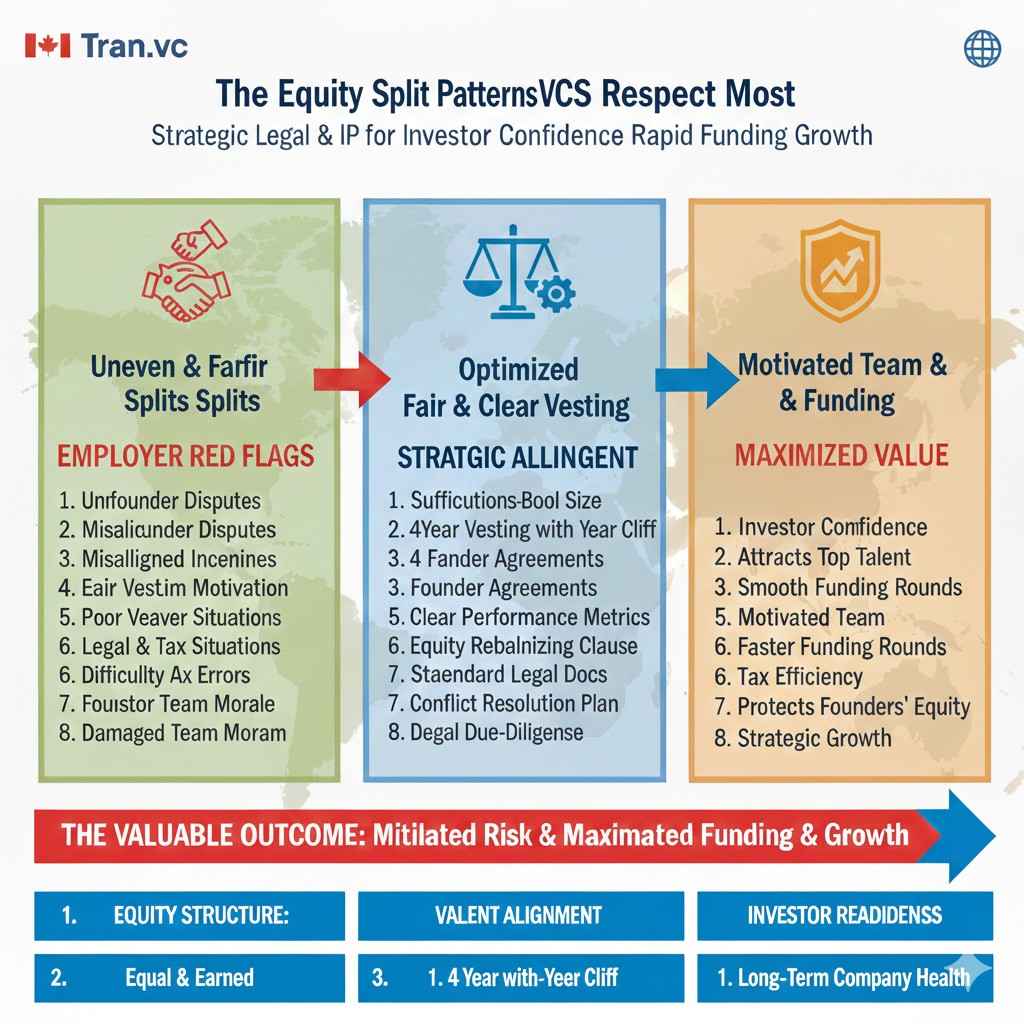
The Split Patterns VCs Respect Most
Why investors care more than you think
When a VC looks at your split, they are not judging your friendship. They are checking if the company can survive stress. Equity is the map of power, effort, and future rewards. If the map looks messy, investors assume the team will get messy when things get hard.
They also know equity splits are hard to change later. Once people emotionally “own” a number, it becomes part of their identity. That is why investors pay attention early. A split that makes sense now usually means the team can make other tough calls later too.
What “respect” looks like in a cap table
A respected split does not have to be common. It just has to be defensible. If the CEO has clear ownership and the technical leader has strong ownership, and nobody is sitting on a huge chunk without real work, investors feel safer.
Respect also means the split matches roles, commitment, and risk. When the numbers match the story, the company looks mature. When the story and numbers fight each other, investors worry about hidden conflict.
The signal a split sends to your next hire
Early hires often ask who owns what, even if they do it politely. If they see a cap table where the team looks unbalanced or unfair, they assume the culture will be the same. The best people will pick another company, because they want to work where effort is valued.
A split that feels thoughtful helps hiring. It shows the team is serious about building long-term. And it leaves room for future talent without resentment.
The CEO Question VCs Always Ask
One leader does not mean one brain
Many technical teams fear choosing a clear CEO because they think it means one person is “above” the other. But that is not what investors mean. They want a clear decision maker, not a dictator.
A strong CEO can still share credit, listen deeply, and split responsibilities fairly. The point is speed and accountability, not ego. When a company is young, slow decisions can kill it faster than bad decisions.
What a CEO really owns in early-stage startups
In the first two years, the CEO usually owns the outside work. That means fundraising, hiring, partnerships, pricing, and constant selling. Even deep tech startups must sell early, because cash and trust are oxygen.
This role also comes with emotional load. The CEO often absorbs rejection from investors, customers, and candidates. If equity does not reflect that load, the CEO role becomes hard to sustain.
Why co-CEO structures rarely help
Co-CEO is often chosen to avoid a hard talk. It feels polite and equal, but it can create confusion. When customers, hires, and investors do not know who leads, they hesitate. And hesitation is expensive.
Some co-CEO pairs do work, but investors usually need extra proof. They want to see a strong tie-breaker system and very clean division of responsibilities. Without that, the structure reads as risk.
The Common Split Ranges and What They Signal
The clean 50/50 and when it actually works
A 50/50 split can be respected if both founders are truly equal in commitment, ability, and control. That means both are full-time, both are essential, and both share leadership in a structured way.
It also needs a tie-break plan. If you cannot break ties, you can get stuck during critical moments like fundraising, pivots, or hiring. When investors see a real mechanism for final decisions, 50/50 becomes less scary.
The 60/40 and why it is so common
A 60/40 split often signals a clear CEO and a strong second founder. It suggests the company has a leader who will be accountable for outcomes, while still keeping the technical core well-incentivized.
Investors tend to be comfortable with this structure because it mirrors how many successful startups operate. One person leads, one person anchors execution, and both have enough equity to stay motivated through hard years.
The 70/30 and when it raises questions
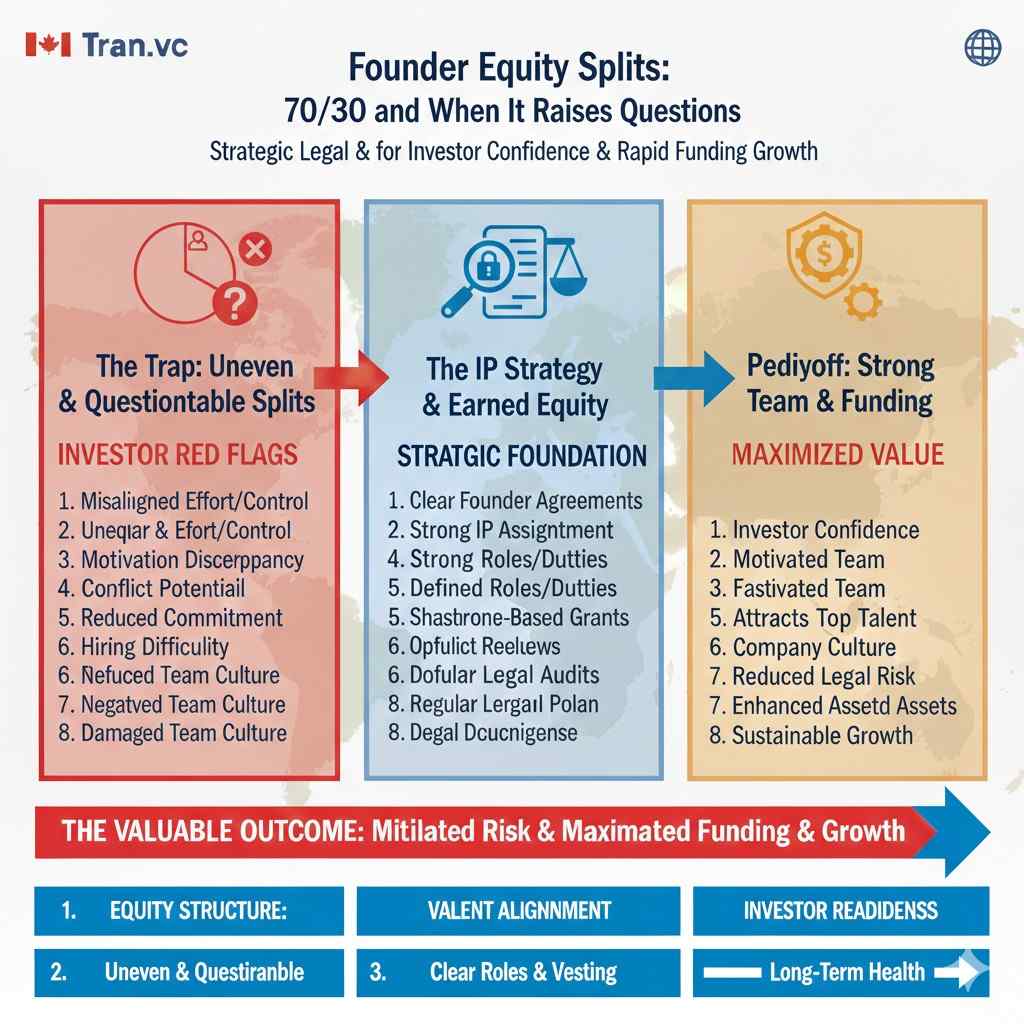
A 70/30 split can still be respected, but it must have a strong reason. Maybe one founder built the product for a year before the other joined. Maybe one founder took major financial risk. Or maybe one founder is bringing rare expertise and traction.
The risk is that 30% can feel small if that founder is deeply essential. If the technical founder has 30% but is doing most of the core invention work, investors may worry about long-term retention and morale.
Anything more extreme than 80/20
Once splits get very lopsided, investors start asking harder questions. If one founder has a small slice, is that founder truly committed? If they leave, can the company survive? If they stay, will they feel valued?
Sometimes an 85/15 can be fine when one person is an early joiner, not a true co-founder. But you need to be honest about labels. Investors do not like when teams call someone a co-founder but treat them like an early employee.
How to Decide Your Split Without Guessing
Start with time, not emotion
Equity should follow commitment. A founder working full-time from day one is taking a different risk than a founder who joins nights and weekends. This is not about character. It is about reality.
Write down when each person truly becomes full-time. Use actual dates. Then write down what “full-time” means in your context. If one person is building and another person is “advising,” the split should not pretend those are the same.
Then look at risk taken so far
Risk includes quitting a job, putting in savings, or moving your life around. Risk also includes opportunity cost. A founder who walked away from a strong role to build this company made a bet with real downside.
When investors see that risk and equity aligned, they feel better. It shows the founders understand incentives. It also reduces the chance one founder feels “used” later.
Then look at the next 18 months of work
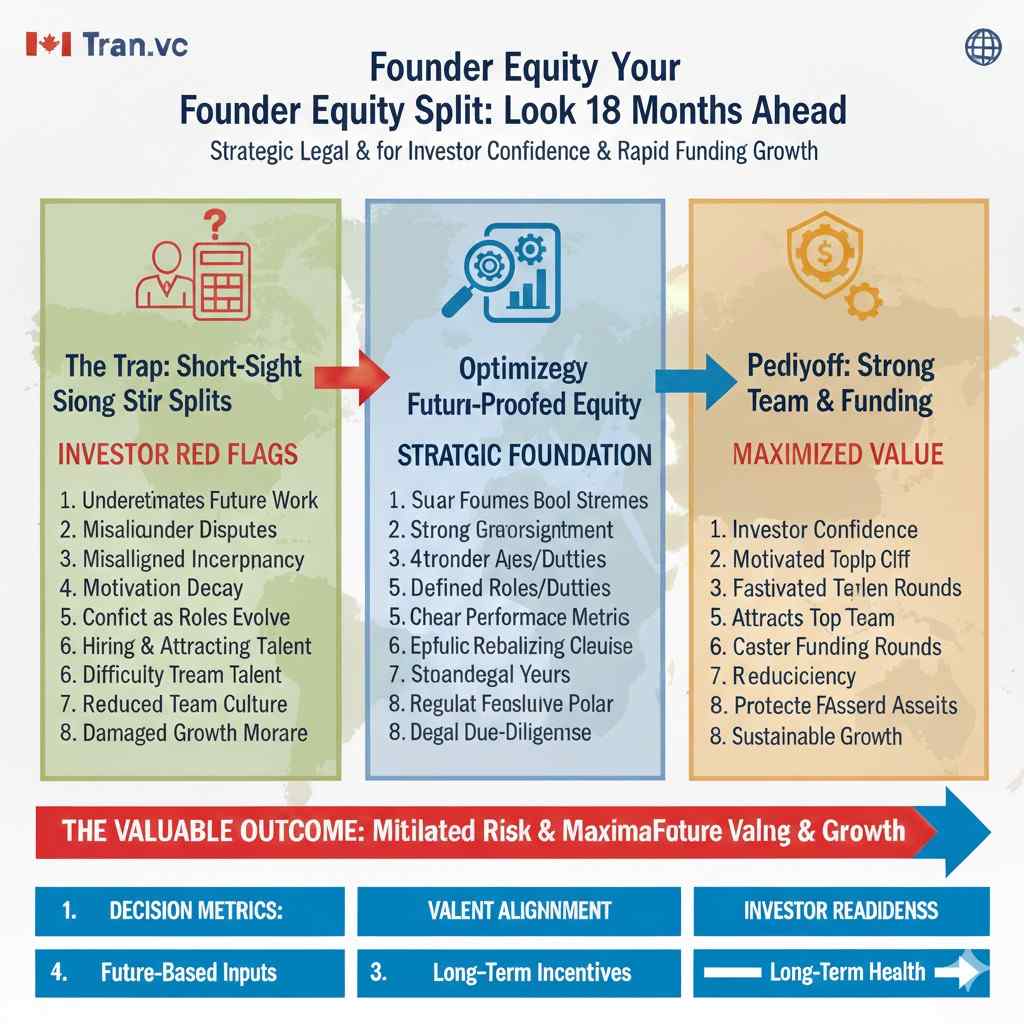
This is where good splits are made. The next year and a half is usually when the company either becomes real or fades out. So the question is not only “who did what,” but “who will carry what.”
If one founder will run technical development, customer pilots, and hiring for engineering, that is huge. If the other founder will raise money, close early customers, and build partnerships, that is also huge. The split should reflect that future load, not only past effort.
Finally, confront replaceability with respect
This is not about ego. It is about what happens if someone disappears. If replacing a founder would take a year and derail the company, that role is high leverage.
In robotics and AI, the rare skill is often tied to core invention. If one founder built the key model, the control stack, the data pipeline, or the hardware architecture, that founder is hard to replace. A split that ignores that can look careless to investors.
Vesting: The Most Important Part of Any Split
Vesting is what makes a split “real”
A split without vesting is like giving away the company upfront. It assumes the future will be smooth. But startups are never smooth. People get tired, family needs change, and sometimes the fit is not right.
Vesting turns equity into something you earn by staying and building. It protects the team and keeps the cap table healthy. Investors see vesting and feel that the team understands how to manage risk.
The one-year cliff and why it matters
The cliff is the moment when a founder “proves” they are truly in it. If someone leaves before a year, they typically do not keep any vested shares. That might sound harsh, but it prevents a painful situation where someone who barely stayed can block future hiring and fundraising.
This is especially important when you have part-time founders early. A cliff forces clarity. Either they commit and stay, or they step aside without damaging the company.
Founder vesting also protects the friendship
Most founder friendships break because of silent resentment. Someone feels like they worked more but got the same. Or someone feels like they were “locked in” while the other had an escape hatch.
Vesting reduces that tension because it ties ownership to staying power. It also creates a shared rule that feels fair even when emotions are high.
The Part-Time Founder Problem
Why VCs dislike “half-in, half-out”
Investors want to see that the people with the most equity are fully committed. If a founder owns a large piece but is not full-time, investors worry about execution speed. They also worry about what happens when the job gets harder.
This does not mean part-time founders are bad people. It means the company must reflect reality. If someone cannot commit yet, their equity should be structured to match that timeline.
How to handle it without conflict
One clean way is to delay part of the equity until full-time starts. Another is to create a smaller founder stake and then a clear option grant that grows when commitment grows. The point is to avoid pretending.
When the structure matches real commitment, investors do not panic. They may still invest, especially if the tech is strong. But they want proof that the team will become fully aligned soon.
The hidden cost: dead equity
Dead equity is ownership held by someone who is not building anymore. It becomes a tax on every new hire and every new investor. It also becomes a constant reminder of a painful chapter.
VCs fear dead equity because it makes future rounds harder. If too much ownership is locked away, the company cannot attract talent without heavy dilution, and the whole system becomes tight and unhappy.
The Advisor Equity Trap
Why “just a little” adds up fast
Many early founders hand out advisor equity like thank-you notes. It feels harmless. But those small slices stack up, and suddenly 5% to 10% is gone before you have a product.
Investors look at that and ask, “Why did this happen?” Not because advisors are bad, but because early equity is precious. If you give away a lot early, it signals you may not protect the company’s long-term health.
How VCs think about advisors
Investors expect advisors to help, but not to own the company. Most advisors are not carrying the company through nights, pivots, and near-death moments. That work is what equity is for.
If an advisor is truly doing heavy work, then treat them like an operator with a defined role and a clear agreement. If they are giving occasional advice, keep the equity small and time-based.
Keep it tied to outcomes or time
The safest approach is to tie advisor equity to continued engagement. That way, if the advisor disappears, they do not keep a big chunk. This also keeps the relationship clean because expectations are clear from the start.
This is one place where structure reduces awkwardness. A good agreement prevents a future argument.
Why IP Changes How Equity Should Feel
Deep tech equity is not only about labor
In software-only startups, the product can move fast and copycats are common. In robotics and AI, the core invention can be the entire company. That means protectable work matters.
When you build and protect your inventions early, your equity becomes connected to real assets. Investors like that because it reduces competitive risk. It also strengthens pricing power later.
Patents and IP strategy can reduce founder tension
When founders feel like the company has a real moat, they worry less about “who gets what.” The pie feels more real. The work feels less fragile.
This is why Tran.vc invests up to $50,000 in-kind in patent and IP services for early robotics, AI, and tech startups. The goal is to help founders turn invention into leverage before the first priced round.
If you want to build that foundation early, apply any time here: https://www.tran.vc/apply-now-form/
A cap table backed by IP reads stronger
When VCs see a team with clear splits, clean vesting, and a real IP plan, they often lean in. It tells them the founders are not just building features. They are building a defensible company.
That does not replace traction, but it makes traction more valuable. It also makes your story easier to believe, because you have something others cannot easily copy.