
Before you ever take a VC call, you need to act like you are already in due diligence.
That does not mean you need a 40-page binder. It means you need a small set of legal papers that make you look serious, protect what you built, and keep you from saying “yes” to something you can’t undo later.
Most founders wait too long. They start pitching with a deck, a demo, and a dream. Then a VC asks one simple question:
“Can you share your data room?”
If you freeze, you lose time. If you share the wrong thing, you can lose your company.
This guide is about the legal docs you should have ready before you start talking to VCs. Not to impress them. To protect yourself, move faster, and keep control.
And if you want help building an IP base that makes investors lean in, you can apply to Tran.vc anytime here: https://www.tran.vc/apply-now-form/
The mindset that saves you later
When you speak with VCs, you are doing two things at the same time:
You are selling the future.
And you are exposing your present.
Even if the meeting feels friendly, you are sharing details about your product, your market, your team, and your edge. If you do it without the right legal setup, you create three common risks:
First, you leak your key idea. Maybe not on purpose. Maybe just by “explaining it clearly.” If you are building AI or robotics, that edge can be in data, training tricks, control loops, hardware design, or workflow secrets. Those can spread.
Second, you weaken your IP position. This one is quiet and dangerous. Public disclosure rules, bad invention ownership, messy contractor work, or missing assignments can make patents harder, narrower, or more expensive later.
Third, you slow down your fundraise. Not because VCs are mean. Because they have a process. If your legal foundation is messy, you look risky. And risk makes investors stall.
So the goal is simple: walk into VC talks with your base layer done.
Not perfect. Done.
Tran.vc exists to help founders do this early in a practical way—especially the IP part—without burning cash. If you want that kind of hands-on help, apply here: https://www.tran.vc/apply-now-form/
Doc #1: The paper that proves you own what you built
This is the most important one.
Investors do not just invest in a product. They invest in the right to own the company that owns the product.
If the company does not clearly own the code, the models, the designs, the data pipelines, or the inventions, a VC will worry about one thing:
“What if someone later claims they own part of this?”
That fear kills deals.
What you need in plain terms
You need signed papers that say:
- Anything built for the company belongs to the company
- Any invention made for the company belongs to the company
- Past work is also assigned to the company (if it was used)
There are a few ways this is handled depending on who did the work.
If you built it as a founder, you usually need a Founder IP Assignment. This is a clean statement where you transfer any relevant IP you created into the company.
If an employee built it, it should be covered by an employment agreement with invention assignment language.
If a contractor built it, you need a contractor agreement that includes an IP assignment clause. This is where many startups fail. They pay a contractor, get code, and assume they own it. Payment is not ownership. A signature is ownership.
Here is the hard truth: if a contractor wrote a key part of your system and you do not have assignment language signed, the contractor might still own the rights. Even if they are nice, even if they “would never do that.” Investors do not fund “nice.” They fund clear.
Tactical way to check yourself in one hour
Open a simple list of every person who wrote code, designed hardware, trained models, built datasets, made drawings, or wrote specs.
Now ask one question for each person: “Do we have a signed agreement that assigns their work to the company?”
If the answer is no for even one key person, fix it before your next VC call.
If you want to build a real IP foundation early and avoid these gaps, Tran.vc can help you do it the right way, fast. Apply here: https://www.tran.vc/apply-now-form/
Doc #2: The NDA question (and the truth VCs won’t say out loud)
Founders often ask: “Should I make VCs sign an NDA?”
Most VCs will not sign one for a first meeting. And pushing hard can backfire. They see a lot of deals in the same space. They do not want legal risk from hearing pitches.
So what do you do?
You do not rely on an NDA as your main defense.
You rely on how you talk and what legal position you have before you talk.
What to do instead of forcing an NDA
You keep the first meetings high level. You explain the problem, the user, the market, the proof you have, your traction, and why you will win. But you do not hand over the “secret recipe.”
Then, once there is real interest—when a partner asks for deeper technical detail, code review, customer names, or access—you can share under a controlled process.
At that stage, sometimes you can use an NDA with certain parties (like strategic partners, vendors, or potential acquirers). With VCs, it depends. Some will sign a limited NDA for very specific materials later, many will still say no.
So the key doc is not “an NDA for VCs.”
The key doc is your Confidentiality policy and sharing rules, so you do not overshare under pressure.
This is not complicated. It is a simple written rule inside the company, like:
“We do not share training data, source code, model weights, hardware CAD files, or customer contracts until we have a term sheet or a written diligence plan.”
This sounds basic, but it saves founders constantly.
Also, if you are building patentable tech, a strong patent plan can give you more safety than an NDA ever will. Tran.vc invests in IP services as in-kind funding for this exact reason. Apply here if you want that advantage: https://www.tran.vc/apply-now-form/
Doc #3: Your incorporation docs (because “we’re forming soon” makes you look unready)
If you are talking to VCs, you should already have a company formed. In most VC-backed startups in the US, that means a Delaware C-Corp. There are exceptions, but if you are raising from institutional seed funds, this is the default.
Investors want to see:
- The company exists
- The founders’ ownership is clear
- The company can issue stock
- The company can sign contracts
If you are not incorporated, you can still take intro meetings. But you are going to hit a wall quickly, because you cannot cleanly accept money or grant equity.
What documents matter here
You do not need to memorize legal names. You need to know what problem each doc solves.
You need papers that show:
The company was formed properly.
The founders agreed on ownership.
The board structure is clear.
You can legally issue shares.
And you need a cap table that matches those papers.
If your cap table is “in a notebook” or “we’ll sort it out later,” you are stepping into one of the worst traps in startup life. Because once you start pitching, your story spreads. Different people hear different versions. Then you end up promising things you cannot keep.
So even if your cap table is simple—two founders, 50/50—write it down. Put it in a proper tool. Make it match the legal docs.
A clean cap table makes investors relax. A messy cap table makes them assume more hidden mess exists.
Doc #4: Founder agreements that prevent breakup disasters
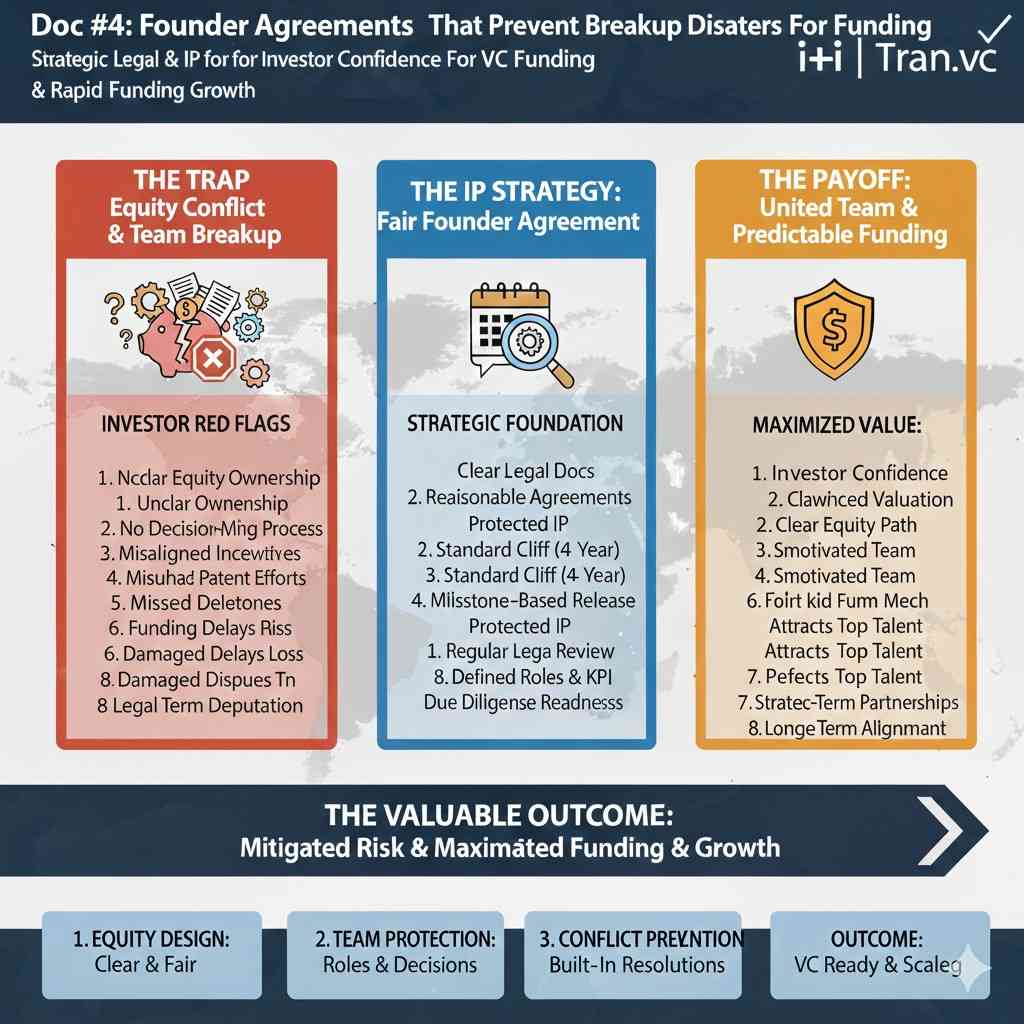
Most startups do not die from competition. They die from founder conflict.
VCs know this. That is why they pay attention to founder setup.
You need a clear agreement that covers:
Who owns what today.
What happens if someone leaves.
How shares vest over time.
Who makes decisions.
The key concept here is vesting. If a founder quits after three months but keeps a large chunk of equity forever, the company becomes harder to fund and harder to run.
So investors want to see founder equity that vests, usually over four years with a one-year cliff. That is standard. It is not punishment. It is alignment.
If you are pre-seed and you have not set this up, do it before you go deep with VCs. Because it is easier to do now than later. And it signals maturity.
Also, this is where many teams accidentally create tax problems by giving equity in the wrong way at the wrong time. If you do not know what you are doing, get proper legal help.
If you are building deep tech and you also need a strong IP plan alongside clean founder docs, Tran.vc can guide both angles so your foundation supports fundraising. Apply here: https://www.tran.vc/apply-now-form/
Doc #5: Your stock option plan (even if you haven’t hired yet)
You might think: “We don’t have employees yet, why do we need an option plan?”
Because hiring happens fast once fundraising starts. And VCs often expect you to have an option pool ready or be ready to create one.
Also, a well-made option plan keeps you from making painful mistakes when you make your first key hire.
Founders sometimes promise equity casually, like:
“We’ll give you 2%.”
Then they learn later that 2% meant different things to each person. Pre-money? Post-money? Fully diluted? After the option pool? Before the new round?
This causes resentment and can break trust.
Having an option plan doesn’t solve every hiring issue, but it gives you a proper system so offers are clear and consistent.
And for VCs, it signals you are building a real company, not just a project.
Doc #6: Your IP strategy in writing (this is not a patent, it’s a plan)
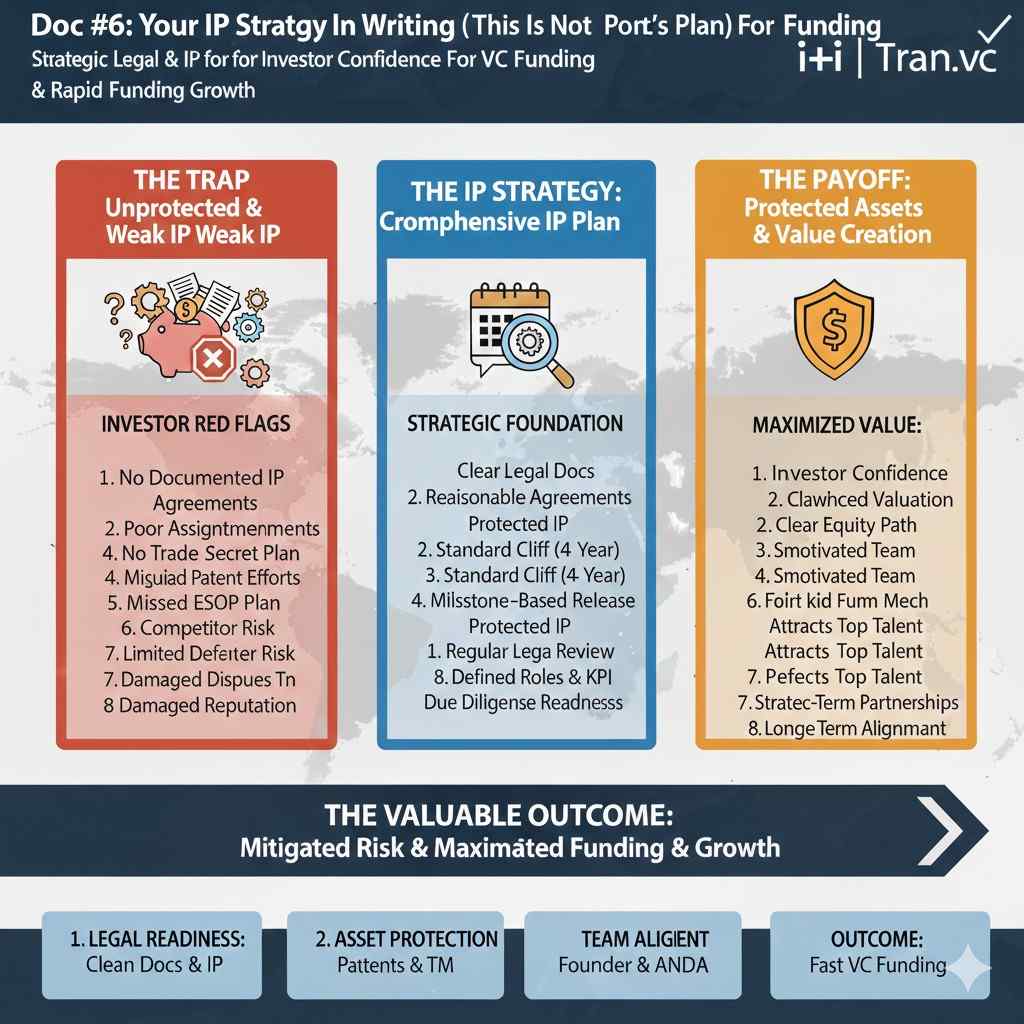
This is where deep tech founders can stand out fast.
A lot of VCs hear “we have patents” from founders who do not understand patents. Others hear “we plan to file later” from founders who should file now. Many hear nothing at all, which makes the startup feel like a feature, not a company.
You do not need a giant IP report. You need a simple, credible strategy document that answers:
What is actually novel here?
What parts are easiest to copy?
What parts are worth protecting first?
What will you file, and when?
How will you avoid public disclosure mistakes?
This is especially important in AI and robotics, where the “invention” can be a system, a method, a pipeline, a control approach, a training method, a hardware setup, or a data handling flow.
If you can show that you know what you are protecting and why, you build confidence.
Tran.vc’s model is built around this. Instead of giving cash and walking away, they invest up to $50,000 worth of in-kind patent and IP services so founders can build a moat early and raise from a stronger position. Apply here: https://www.tran.vc/apply-now-form/
Doc #7: A clean “data room” folder structure (so you don’t panic when they ask)
A data room does not need to be fancy. It needs to be organized.
When an investor asks for diligence items, they are not trying to hurt you. They are trying to reduce risk so they can say yes.
If you scramble, it creates doubt.
So you create a simple set of folders now, even if some are empty. The act of setting it up forces you to find gaps early.
Think of it like laying out tools before you start building.
At minimum, you should have folders for:
- Company formation and governance
- Cap table and equity grants
- Founder and employee agreements
- Contractor agreements
- IP assignments
- Patents and filings (if any)
- Key customer contracts (if any)
- Security and privacy basics (if relevant)
You do not need to upload everything before first VC chats. But you should be able to do it quickly once interest is real.
And you should never share this folder broadly. You share it with select parties, with access control, at the right stage.
The most common mistakes that cause painful delays
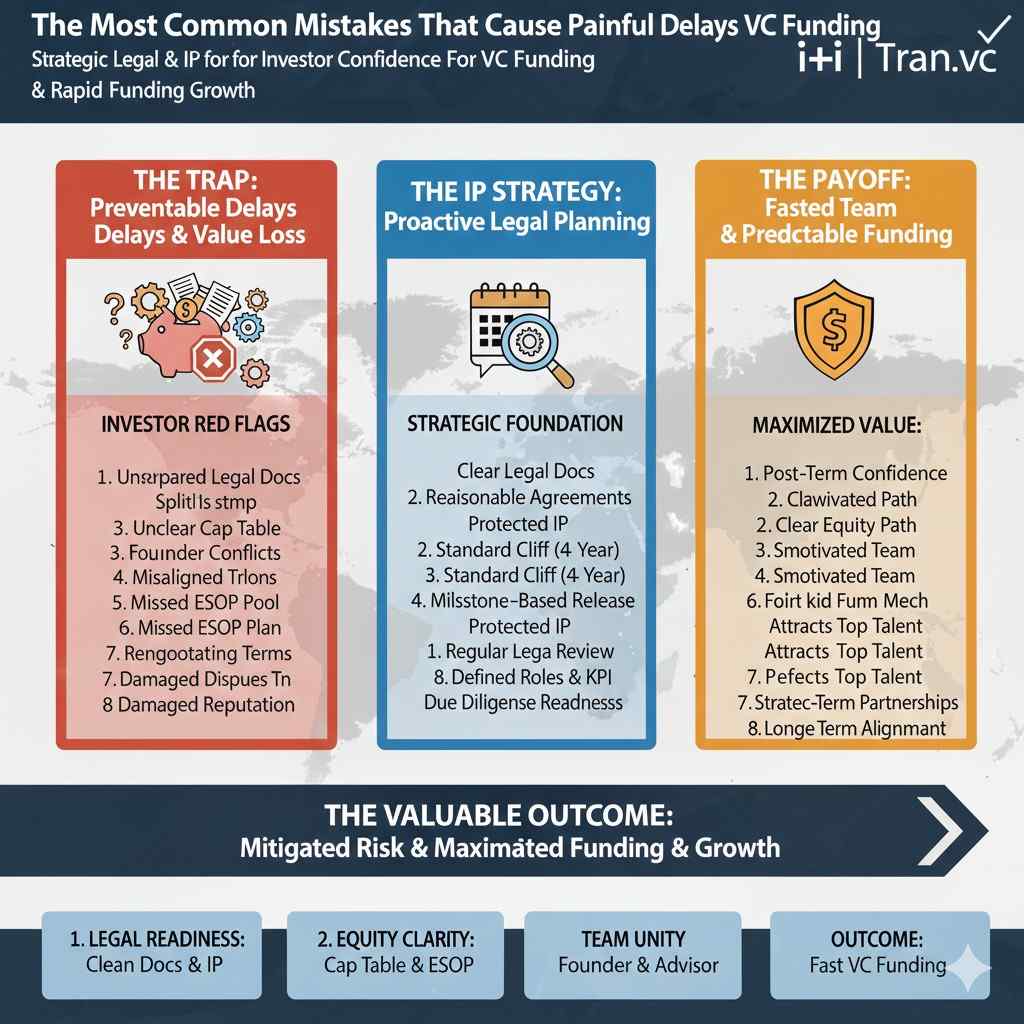
Let’s make this real. These are patterns VCs see all the time:
A contractor built the MVP and no IP assignment exists.
A founder used code from a past employer and never checked ownership.
The company is not incorporated but they are “raising.”
The cap table does not match any signed documents.
A founder promised advisory equity with no paperwork.
They publicly posted deep technical detail before filing anything.
Each one of these can be fixed. The problem is not the mistake. The problem is finding it when you are already mid-fundraise and momentum matters.
That is why this article exists.
And it is also why Tran.vc starts with foundations—especially patents and IP—so you can raise with leverage instead of stress. If that’s what you want, apply here: https://www.tran.vc/apply-now-form/
Quick reality check: you don’t need to be perfect
If you take one idea from this intro, take this:
You do not need “more legal.” You need “clean legal.”
Simple, signed, consistent.
That’s it.
When those basics are in place, VC talks become easier because you are not defensive. You are focused on the business.
Customer and Revenue Docs
Why VCs care about these earlier than you think
Even if you are pre-revenue, investors still want proof that real people want what you are building. They are not only judging the product. They are judging risk, speed, and how clearly you understand the buyer.
If you have customers, these papers show if the business is solid or shaky. If you do not have customers yet, these papers show whether you are setting the company up to sell the right way.
This is also where founders often overshare by accident. They send full contracts, pricing sheets, or private emails too early. You can show traction without giving away sensitive details.
Apply anytime if you want Tran.vc to help you build the IP base that strengthens these conversations: https://www.tran.vc/apply-now-form/
The “proof” documents that keep traction believable
The first doc is simple: a clean list of who paid you, what they bought, and when. It can be a basic table, but it must match reality. VCs will often ask follow-up questions, and mismatch creates doubt fast.
If you have signed customers, the next step is having your main agreements in one place. That might be a pilot agreement, a paid proof-of-concept, a services agreement, or a subscription contract.
You do not need to share every line in early talks. But you must know what you signed. If your contract gives the customer ownership of what you built, or broad rights to your IP, it can scare investors.
LOIs, pilots, and paid trials without getting trapped
Letters of intent can help, but only if they are clear. Some LOIs sound exciting yet mean nothing. Others contain terms that quietly control your future pricing, your exclusivity, or your ability to work with competitors.
A pilot agreement is often better than an LOI because it sets real expectations. It should state what you deliver, what success looks like, who owns what, and what happens next if the pilot works.
If you are in AI or robotics, ownership language matters even more. Customers may try to claim rights to models, training flows, data labeling work, hardware designs, or improvements you make during the pilot.
That is why your IP plan and your contracts must agree with each other. If you want help aligning those early, Tran.vc is built for it: https://www.tran.vc/apply-now-form/
Privacy, Security, and Data Handling
The simple truth: one bad answer can end a deal
Many founders think privacy and security is “later.” Investors often think the opposite, especially in AI. If your product touches user data, enterprise data, health data, financial data, or anything that can identify a person, you will be asked what you do to protect it.
The good news is you do not need a huge program to start. You need a clear story, basic controls, and a few documents that prove you are not careless.
VCs are not expecting perfection. They are looking for responsibility. A calm, clear answer here builds trust.
The privacy policy is not just a website checkbox
If your product is public-facing, you will likely need a privacy policy and terms of service. These are not only for compliance. They show what data you collect, why you collect it, and how you store it.
If you collect data and you cannot explain it, you look risky. If you collect more data than you need, you look careless.
Early-stage policies can be simple, but they should be consistent with how your product actually works. A policy that says one thing while your system does another is worse than having no policy at all.
Data processing terms for B2B buyers
If you sell to companies, they may ask for a data processing agreement. This is common when you handle their data as a service provider.
You do not need to write one from scratch every time. But you should have a base version ready so you are not stuck for weeks when a buyer’s legal team asks.
This is also connected to IP. Sometimes customers try to add clauses that give them rights to your improvements or your models. Your legal documents should protect your core tech while still making the customer comfortable.
If you want your IP and your contracts to work together instead of fighting each other, apply to Tran.vc: https://www.tran.vc/apply-now-form/