
Most founder fights do not start with ego. They start with silence.
Two smart people build fast for a few months. Decisions happen in the moment. One person “just handles” hiring. The other “just handles” product. It feels smooth… until the company gets real traction, real stress, and real money on the line.
Then a simple question turns into a power fight:
“Who gets to decide this?”
If you do not answer that early, your company will answer it for you later. And it will not be kind.
This article is about setting clear founder roles and clear decision rights, so you can move fast without stepping on each other. Not with heavy rules or long meetings. With simple agreements that protect trust, speed, and the future of the company.
And one quick note from Tran.vc before we begin: if you are building robotics, AI, or deep tech, roles and decision rights also touch your IP. If you do not know who owns what, who approves filings, and who can share what, you can lose the very edge that makes you investable. Tran.vc helps technical founders lock this down early and turn it into fundable assets. You can apply anytime here: https://www.tran.vc/apply-now-form/
Now, let’s set the foundation.
Why founders fight about power
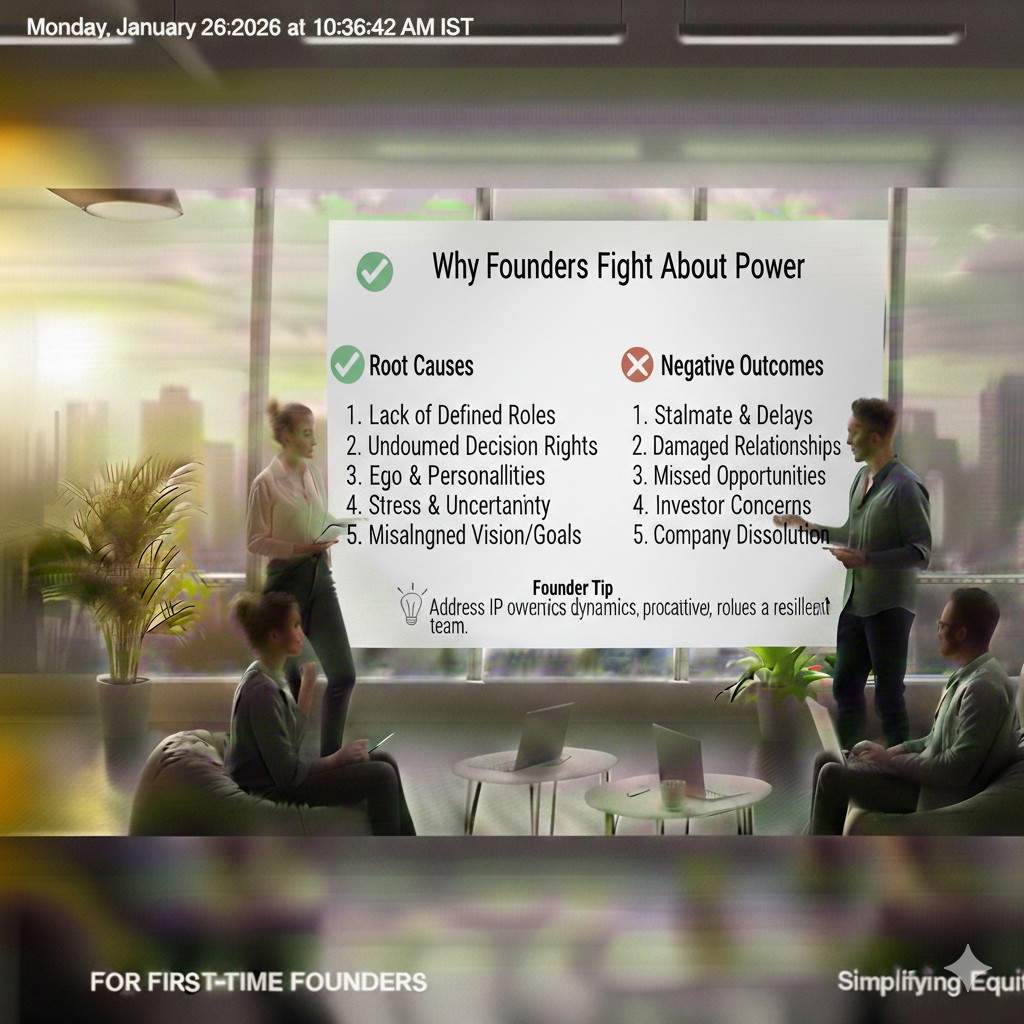
Founders rarely say, “I want power.” They say things like:
- “We can’t keep changing the plan.”
- “We’re making promises we can’t build.”
- “We’re moving too slow.”
- “You didn’t tell me.”
- “I feel like I’m carrying this.”
Those lines are not about power. They are about control, safety, and fairness.
In early stage startups, every big decision feels like it can break the company. That makes people grab tighter. One founder starts double-checking everything. Another starts making calls alone to keep speed. Both feel forced. Both feel right. Both feel betrayed.
The fix is not “better communication” as a vague idea. The fix is simple: define who decides what, how the other founder is included, and what happens when you disagree.
That is decision rights.
Roles are not titles. They are promises.
Many teams pick titles early: CEO, CTO, COO. Then they assume the title tells everyone what to do.
It doesn’t.
A title is a label. A role is a promise.
A role says: “If this area goes well or goes badly, I own it. I will make the call. I will take the heat.”
When roles are fuzzy, founders act like roommates. They both care, so they both comment on everything. That sounds helpful. It becomes draining. It creates a slow bleed of trust.
So the goal is not to cut the other founder out. The goal is to stop surprise overlap.
Overlap is the silent killer. It creates “soft veto.” It creates second-guessing. It turns normal debate into personal conflict.
The best founder teams have fewer debates, not because they agree on everything, but because they already know who is deciding.
Decision rights: the simplest definition
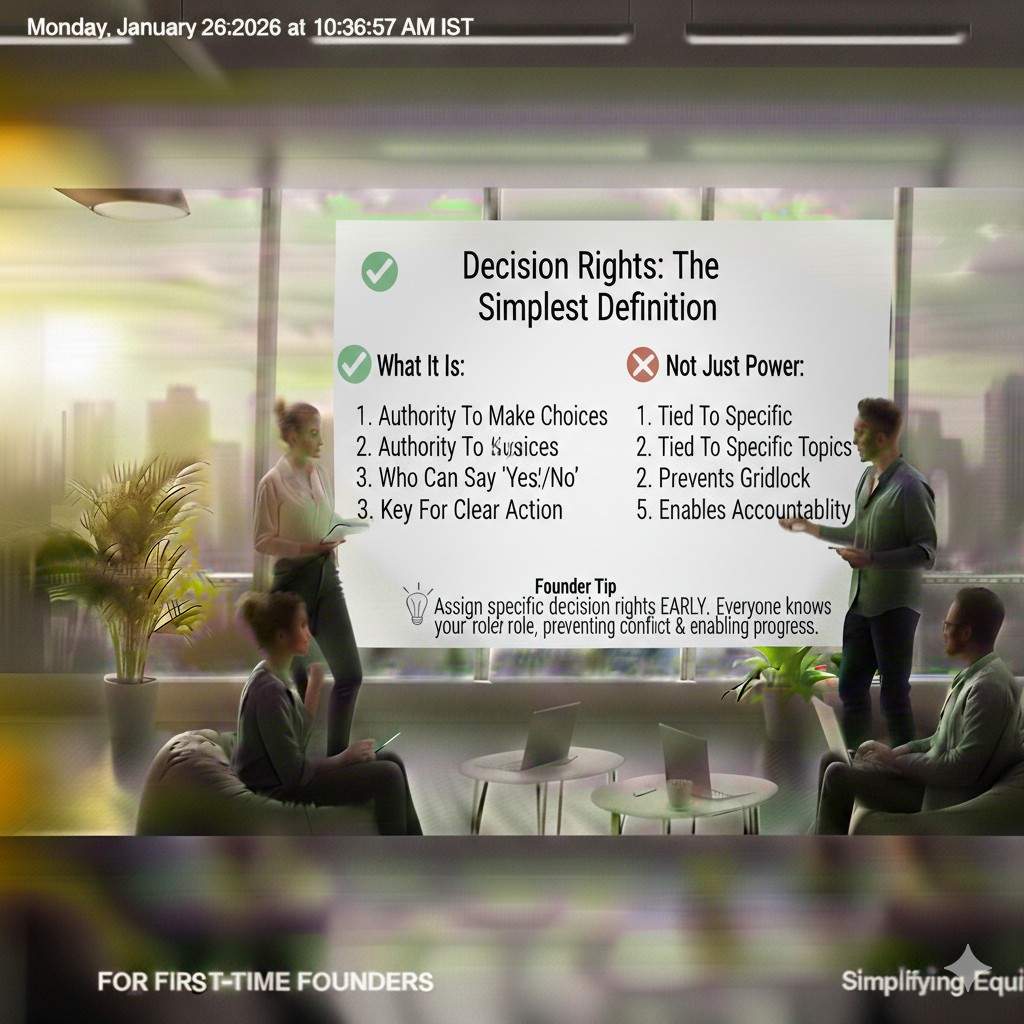
Decision rights answer three questions:
- Who makes the final call?
- Who must be consulted before that call?
- Who must be informed after the call?
That’s it.
You do not need a big system. You need clarity.
Most founders skip this because it feels too early. But here is the truth: if it feels too early, that’s exactly when it is easiest to do.
Once you have employees, investors, and customers, changing decision rights gets political. People take sides. It becomes “team CEO” vs “team CTO.” That is hard to undo.
So we do it now, when it is just two (or three) people trying to win together.
The hidden trap: “equal” is not the same as “clear”
Many co-founders want things to be equal. Equal ownership. Equal voice. Equal respect.
That is fair.
But equal does not mean both people decide everything. In fact, that is how you get stuck.
You can be equal partners and still have clear lanes.
Think of it like a cockpit. Two pilots. Both trained. Both trusted. Still, one is the pilot flying right now. The other is the pilot monitoring. They switch. They check each other. But they do not both pull the stick at the same time.
Startups need the same.
The four decision zones every startup must name
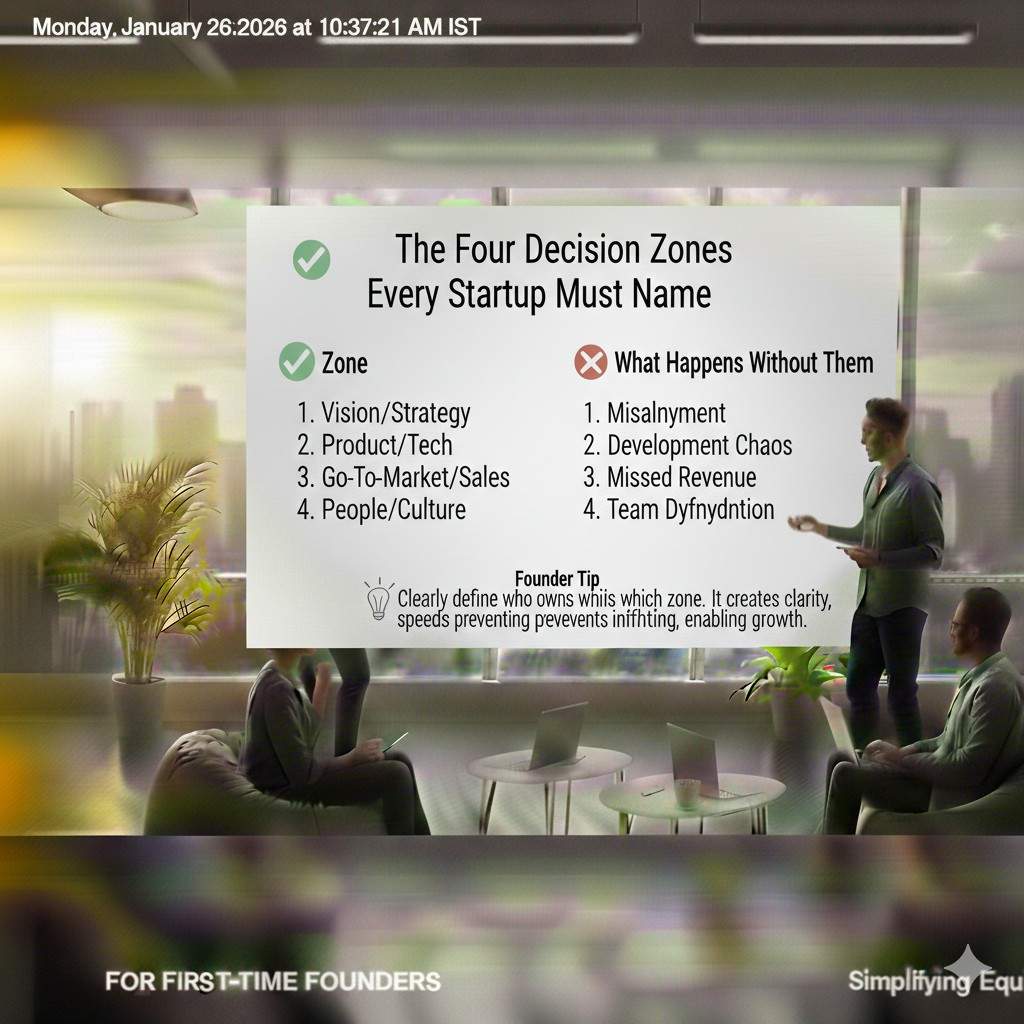
You can break most founder decisions into four zones. The names do not matter. The clarity does.
Zone 1: One owner decides.
This is a lane decision. Like a product choice, an architecture choice, a sales tool, a hire in a team the owner leads. The other founder can give input, but does not get a veto.
Zone 2: One owner decides, but only after consulting.
This is still one owner, but the impact is wide. Like changing pricing, changing the target customer, signing a big partner deal, hiring a senior leader. The decision owner must listen. But the owner still decides.
Zone 3: Both must agree.
These are “company identity” choices. Like raising money, changing equity, selling the company, major legal risk, taking on debt, changing the company’s core mission.
Zone 4: Nobody decides alone in a rush.
This is a safety zone for high emotion. If one founder is angry, tired, or scared, you pause. Not forever. Just long enough to not break trust. If you have ever sent a heated message and regretted it, you understand why this zone matters.
You do not need a long list inside each zone. Keep it simple. But you must agree on the zones.
The most common founder role splits (and where they break)
Let’s talk about the real world.
Most technical startups split like this:
One founder leads product and engineering.
The other leads growth, sales, and ops.
On paper, this is clean.
In practice, the fights happen in the overlap areas:
- Hiring (because everyone has an opinion)
- Roadmap (because it affects sales promises)
- Pricing (because it affects product scope)
- Brand and messaging (because it affects what gets built)
- Customer commitments (because they affect deadlines)
- Fundraising (because it affects time and control)
The trick is to name the overlap areas early and assign decision rights there. Not “we both decide.” That sounds fair but creates endless loops.
Instead, you pick an owner and add a rule for consultation.
Example: “Head of Product owns roadmap. Head of Growth must be consulted before any roadmap change that affects customer commitments.”
That one line prevents ten future fights.
The core principle: the person closest to the work should decide
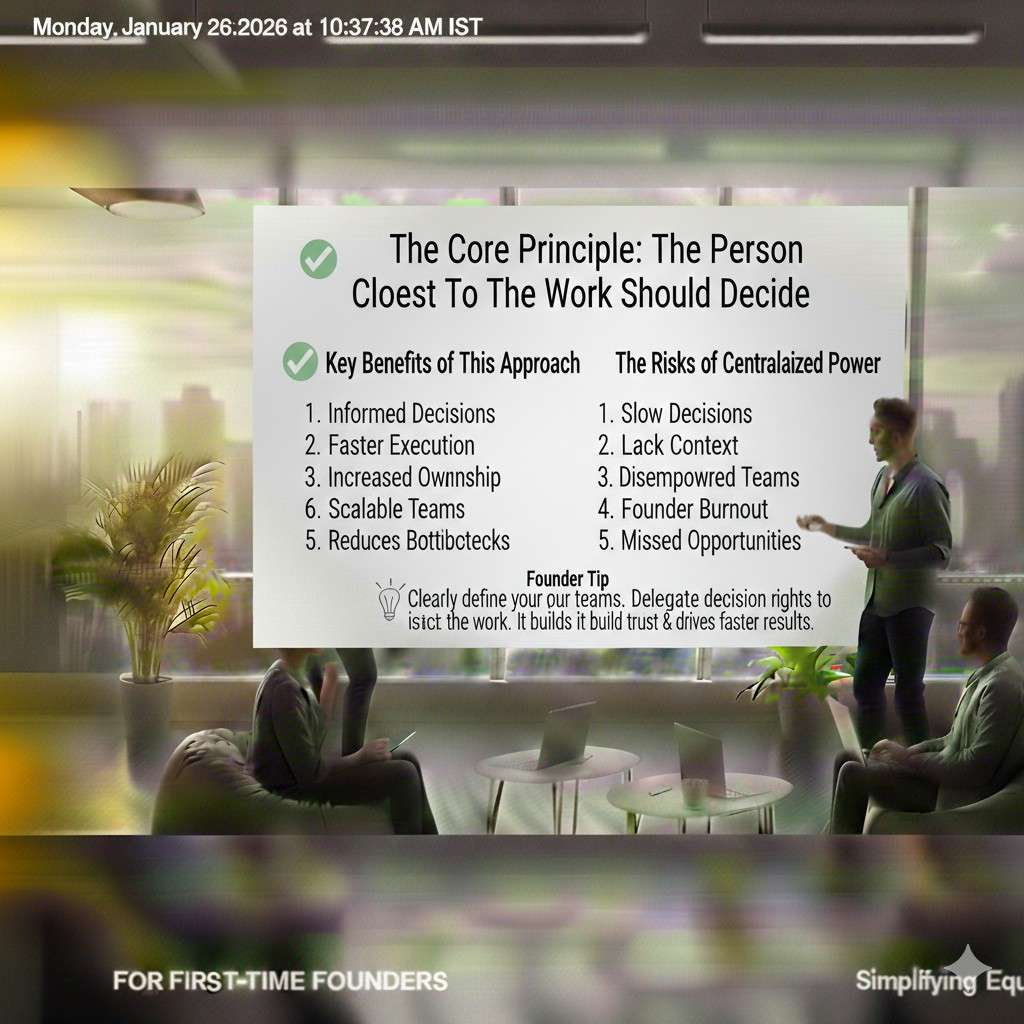
Founders sometimes assign decision rights by status: “CEO decides everything.”
That can work later, but early on, it often breaks speed and morale.
A better rule early is: the person doing the work decides the work.
If one founder is building the system, they decide architecture. If one founder is selling, they decide the pitch and pipeline process.
This reduces “armchair veto.” It respects time. It reduces resentment.
It also creates accountability, because you cannot blame the other founder for a choice you owned.
What about the CEO?
Many co-founders avoid the CEO label because it feels political. They say, “We’re co-CEOs.”
That may feel calm now, but it often causes confusion later.
Employees do not know who to follow. Investors do not know who to push. Customers do not know who can sign. And when a hard moment hits, the “co-CEO” idea tends to collapse into a fight.
If you want a simple approach:
- Pick a CEO based on who can be the main decision maker for “company direction” calls and who can carry the outside-facing job: fundraising, key hires, major partners, and big customer trust.
- Give the other founder clear decision rights over their domain, with real freedom.
This is not a value judgement. It is a function.
A company needs one final tie-breaker for company-wide decisions. That can be the CEO, or it can be a rule like “we escalate to an advisor board.” But it must be named.
And remember: being CEO is not “more important.” It is often more stressful and less fun. It is the job of being blamed first.
A tactical way to set roles without a long document
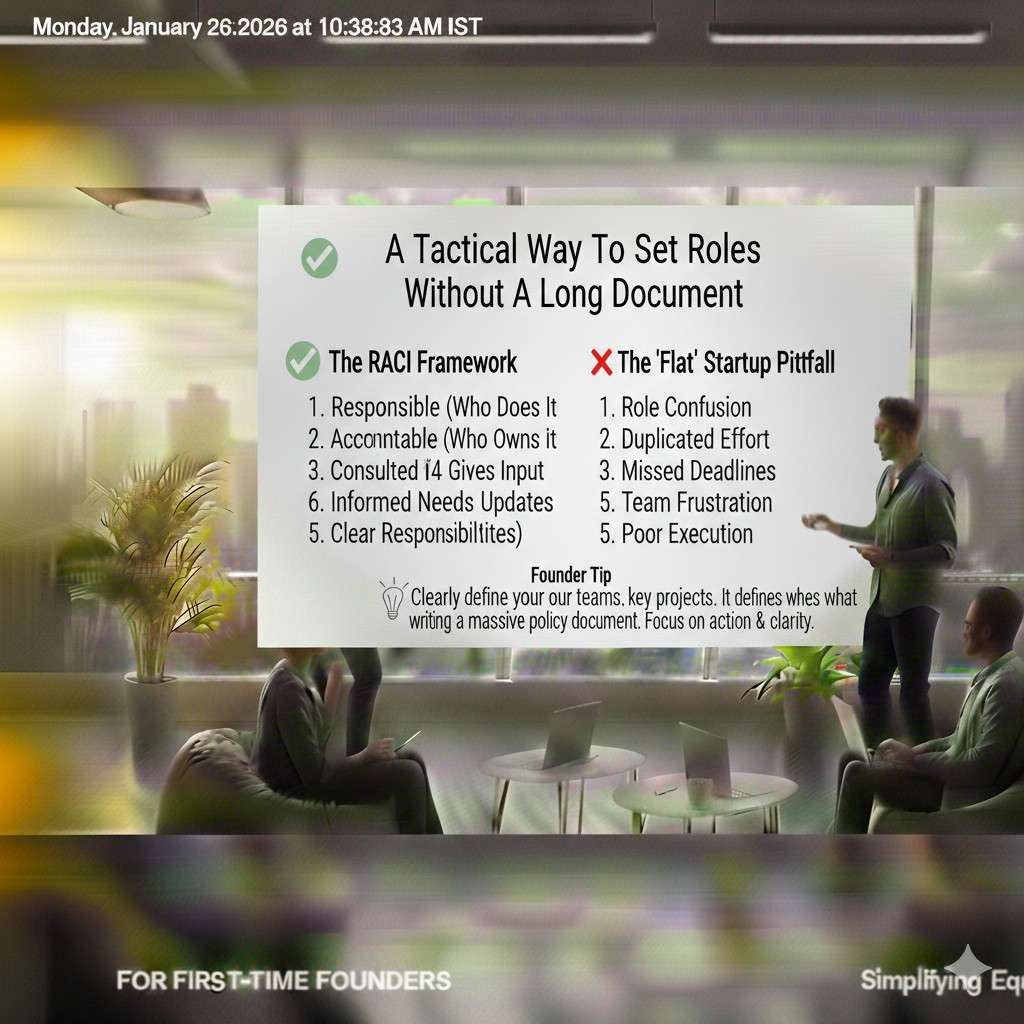
You do not need a 20-page founder agreement to start. You need one page you can both read in two minutes.
Here is the structure (in plain language):
- Each founder’s main job (one sentence)
- Each founder’s decision zones (what they decide)
- A short list of “we both must agree” items
- A short rule for disagreement
- A short rule for emergency decisions
- A short rule for revisiting the agreement
If you do this and actually use it, you will feel the stress drop. Not because there is no conflict, but because conflict has rails.
It becomes: “This is in your lane, I’ll share my view, you decide.”
Or: “This is a shared decision, let’s set a time to close it.”
That is how you keep respect while moving fast.
The disagreement rule that saves relationships
Founders think the main risk is disagreement.
It isn’t.
The main risk is never closing decisions or closing them in a way that makes one founder feel ignored.
A simple rule that works:
If it’s in one person’s lane, the lane owner decides after honest input.
If it’s shared, you set a deadline to decide.
If you cannot agree by the deadline, you use a tie-break rule.
The tie-break rule can be:
- CEO decides
- A trusted advisor decides
- A simple test decides (like a small customer test)
- A coin flip (rare, but surprisingly useful for low-risk calls)
The tie-break rule matters because it stops endless debate from turning into personal war.
If you have no tie-break rule, you will eventually tie-break with emotion. That is the worst way.
The IP angle most founders miss

Since Tran.vc works with robotics and AI teams, we see the same pattern again and again:
Two founders build. One files a patent draft. The other shares a deck with a key diagram. Someone posts a demo video. A contractor helps on code. A customer asks for details.
Later, during fundraising or diligence, the investor asks:
- Who approved public disclosure?
- Who owns the invention?
- Were assignments signed?
- Does the company have clean rights to the work?
- Was anything disclosed before filing?
If you cannot answer fast, it raises doubt.
Decision rights must include IP decisions, even early. It does not need to be complex. It can be as simple as:
“CTO owns invention capture and patent input. CEO owns filing timelines and budget. Both must approve any public release of core technical details until filings are submitted.”
That single rule can save your moat.
Tran.vc helps founders do this in a founder-friendly way, without slowing the build. If you want help setting IP lanes and getting filings done early as in-kind services (up to $50,000), you can apply here: https://www.tran.vc/apply-now-form/
The moment you must set this (and most teams wait too long)
If you are still two founders in a room, you can fix this in one hour.
If you already have employees, you can still fix it, but you must be more careful. People notice changes in power. They worry.
If you already raised money, you can still fix it, but now you also have board expectations.
So the best time is when:
- you are about to hire your first employee
- you are about to raise a pre-seed or seed
- you are about to sign your first big customer
- you are about to ship something that could be copied
Those are “pressure points.” Pressure exposes weak agreements.
If you set roles and decision rights before those moments, you prevent fights when the stakes are high.
The real causes of founder power fights
Power fights usually start as “quality” fights
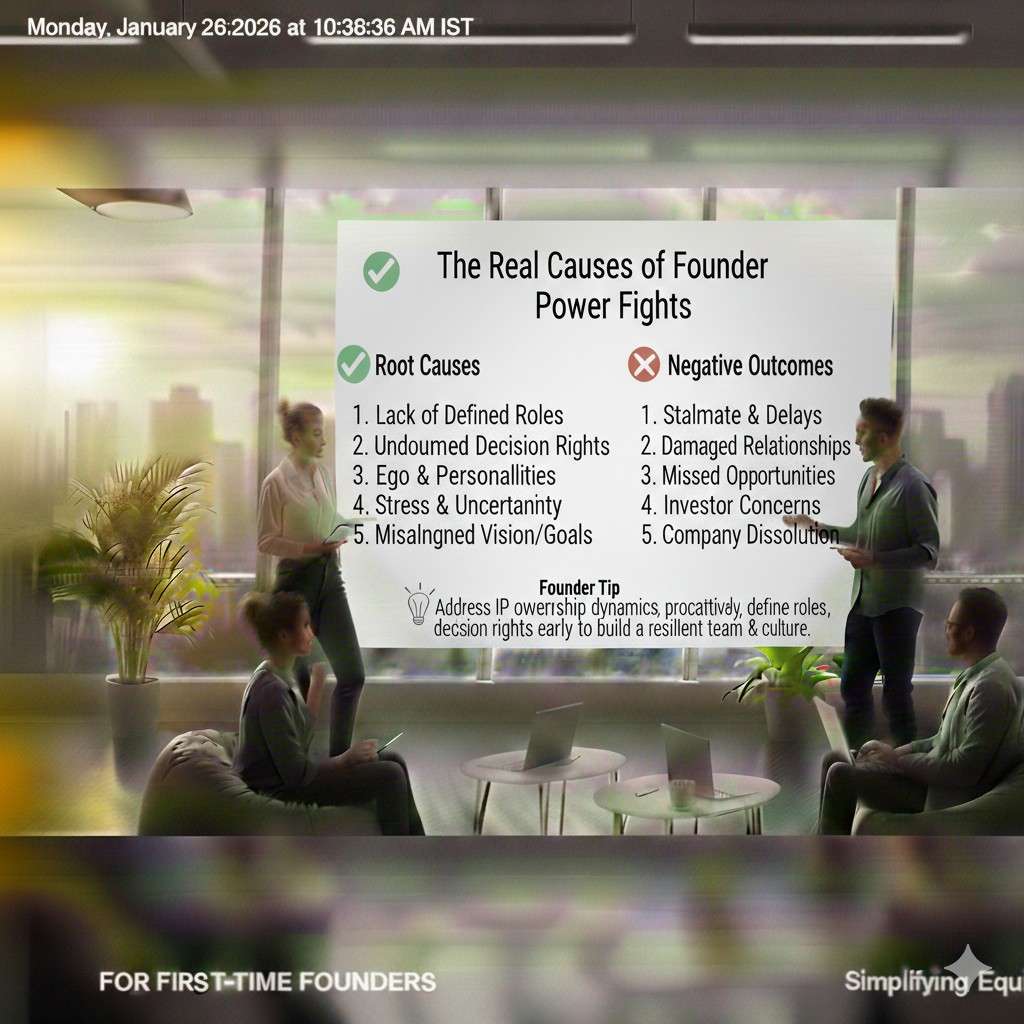
Most founders do not wake up wanting control. They wake up wanting the company to win. One founder pushes for speed because the market feels urgent. The other pushes for caution because the tech must work and the brand must stay trusted.
Both are trying to protect the company. The trouble is that protection looks different from each seat. When nobody owns the final call, the debate keeps looping until it turns personal.
A helpful shift is to stop calling it a “power” issue. Call it a “decision” issue. That one word change makes it easier to solve without shame.
The story you tell yourself shapes the fight
In founder conflict, each person tends to build a private story. “They don’t respect my work.” “They’re reckless.” “They’re blocking growth.” These stories feel true because they are built from real moments.
But the story is not the full truth. It is a snapshot from one angle. If you do not replace the story with a shared rule, the story becomes the rule.
That is why decision rights matter. They replace hidden stories with visible agreements.
Overlap is the silent trigger
Overlap sounds healthy. It feels like teamwork. In reality, overlap without a clear owner creates two problems at once: double effort and double authority.
When both founders feel responsible, both feel entitled to decide. Even polite feedback can feel like a veto. Over time, one founder stops sharing early drafts, and the other founder starts feeling shut out.
The fix is not less care. The fix is cleaner lanes, plus a clear way to consult.
Founder roles that work in real startups
A role is a job you can be measured on
A strong founder role is not a vague area like “business.” It is a job with visible outcomes. It is something a founder can point to and say, “This is mine to carry.”
If a role cannot be measured in any way, it becomes a debate zone. Debate zones feel fair at first, but they turn into endless meetings later.
A good role also comes with a “no.” If one founder owns it, the other founder does not run it day to day. That boundary protects time and reduces friction.
The CEO and CTO split needs extra clarity
In deep tech startups, the CEO and CTO split often looks clean on paper. The CEO handles customers, hiring, fundraising, and the outside world. The CTO handles product, engineering, and the core system.
The conflict shows up when the CEO sells a promise and the CTO has to build it. Or when the CTO designs a roadmap and the CEO worries it will not sell. Both are valid.
So the split must include a bridge rule. The bridge rule says when the CEO must pull the CTO in early, and when the CTO must adapt for market reality.
Operations is not a side task
Operations often becomes the “extra” work that nobody owns. Payroll, tools, contractor contracts, security basics, and account access end up scattered. That is dangerous because small ops mistakes can cause big damage later.
If you do not want a COO early, pick a founder who owns ops until you hire for it. This is not glamorous work, but it keeps the company safe and steady.
Clarity here reduces stress because founders stop arguing about small process issues that feel bigger than they are.
Decision rights as a speed system
Decision rights are not control, they are a system
Many founders hear “decision rights” and imagine heavy process. In practice, decision rights are a shortcut. They stop re-litigating the same topics again and again.
Once the team knows who decides, discussions become sharper. Input becomes useful, not political. People stop waiting for “alignment” and start acting with confidence.
The company moves faster because it spends less time negotiating authority.
The three simple roles in any decision
Every decision can be mapped with three simple labels. One person decides. Some people are consulted before the decision. Some people are informed after the decision.
This is simple, but it changes everything. It ends surprise. It reduces “I didn’t know you were doing that.” It creates a normal rhythm that protects trust.
If you only adopt one tool from this article, adopt these three labels and use them in real life.
“Consulted” must be real, not performative
Being consulted cannot mean getting a message after the decision is already made. It must mean the person has a real chance to influence the call.
That does not mean the decision maker must agree. It means the decision maker must listen, ask questions, and reflect back what they heard.
Founders accept tough decisions more easily when they feel heard early. They resist even good decisions when they feel ignored.
The subjects that must be distinct early
Product decisions are not sales decisions
Product decisions include what the product does, what it does not do, and what quality bar it must meet. They also include what you build first and what you delay.
Sales decisions include who you sell to, what you promise, how you price, and what proof you show to win trust.
The conflict happens when sales pushes product into a rushed build, or when product builds what sales cannot sell. To avoid that, assign a product owner and a sales owner, then define when each must consult the other.
The clean rule is this: the product owner decides the roadmap, but the sales owner must be consulted before any roadmap change that affects deals already in motion.
Hiring decisions are not culture decisions
Hiring feels like one topic, but it is two. Hiring decisions are about skill, output, and fit for a role. Culture decisions are about values and how people behave together.
Many teams fight because they argue culture in the hiring moment. “I don’t like their vibe” becomes a veto that is hard to debate. Or “we need speed” becomes a push that ignores warning signs.
A better way is to define culture rules when you are calm, not when you are under hiring pressure. Then hiring becomes simpler because you are applying a shared standard, not debating feelings.
Money decisions are not strategy decisions
Money decisions are about spend, runway, and trade-offs. Strategy decisions are about where the company is going and why.
Founders often mix them. One founder says, “We can’t afford this,” but what they mean is, “I don’t believe in this direction.” The other founder hears it as fear or control.
Separate these on purpose. If the issue is money, talk runway and budget. If the issue is strategy, talk customer, timing, and risk.
This one separation reduces emotional heat because you are arguing the real topic, not a proxy topic.
IP decisions are not “legal later” decisions
In robotics and AI, IP is not paperwork. It is part of the product edge. The moment you share a key method, a key diagram, or a key training approach, you might weaken your ability to protect it.
That is why IP must have decision rights early. Who decides what is confidential? Who approves public demos? Who owns invention capture? Who owns patent timing?
Tran.vc exists to help founders do this without slowing down. If you want support turning your technical work into protected, fundable assets through in-kind patent and IP services up to $50,000, you can apply anytime at https://www.tran.vc/apply-now-form/
A practical way to assign decision rights without adding process
Start with the decisions that happen every week
You do not need to map every possible decision. Start with the ones that show up weekly. Roadmap changes. Customer asks. Hiring interviews. Spend approvals. Public posts. Partner conversations.
If you make those clear, most other decisions become easier because the team learns the pattern. Clarity compounds.
This also prevents the common trap where founders write a “perfect” plan and never use it. A smaller plan that you use is better than a big plan you ignore.
Use one page, not a shared folder of docs
A single page forces focus. It also makes it easier to revisit. The goal is to create shared memory, not a legal contract.
Your one page should be easy to read and easy to update. If it takes effort to open, people stop using it. If it is simple, you will actually check it when tension rises.
This is what makes decision rights real. Not the wording. The fact that you use it when you need it.
Write it like a promise, not a policy
Policies feel cold. Promises feel human. A promise says, “I will do this, so you can trust me.”
For example, “I own the product roadmap, and I will consult you before changes that affect customer commitments.” That is a promise. It invites trust and sets a boundary.
When both founders write promises like this, the document stops being about control. It becomes about protecting each other.