
When a startup hires someone in another country, the first question sounds simple: “Are they a contractor or an employee?” But for investors, that one choice can decide whether a deal feels clean—or risky.
Here is the hard truth: many teams call someone a “contractor” because it feels faster, cheaper, and easier. Then, months later, a government agency, a court, or even the worker says, “No. That was an employee.” And suddenly you are not just fixing paperwork. You are dealing with back pay, taxes, social benefits, penalties, and sometimes a ban on doing business in that country. If you are an investor, this can show up right when you least want it—during diligence, right before a priced round, or right after an acquisition offer.
This topic hits deep tech startups even harder. Robotics and AI teams often build core value with small, sharp teams spread across borders. The code is the company. The data pipeline is the company. The model training method is the company. If the person who built key parts was misclassified, you may not fully own what you think you own. That is not a “legal detail.” That is the heart of the asset.
At Tran.vc, we look at early risk the same way we look at early IP: if you ignore it now, you will pay for it later, with interest. We invest up to $50,000 in in-kind patent and IP services so founders can lock down what matters early—before the next round forces rushed fixes. If your team is global, classification and IP ownership need to be handled with the same care as your patents, because they are linked.
In this article, we are going to talk like real people about what goes wrong, why investors care, and what a founder can do this week to lower risk without slowing the build.
If you want Tran.vc to help you build an IP-backed foundation that investors trust, you can apply anytime here: https://www.tran.vc/apply-now-form/
Contractor vs Employee Abroad: Legal Risk for Investors
Why investors care about this so much
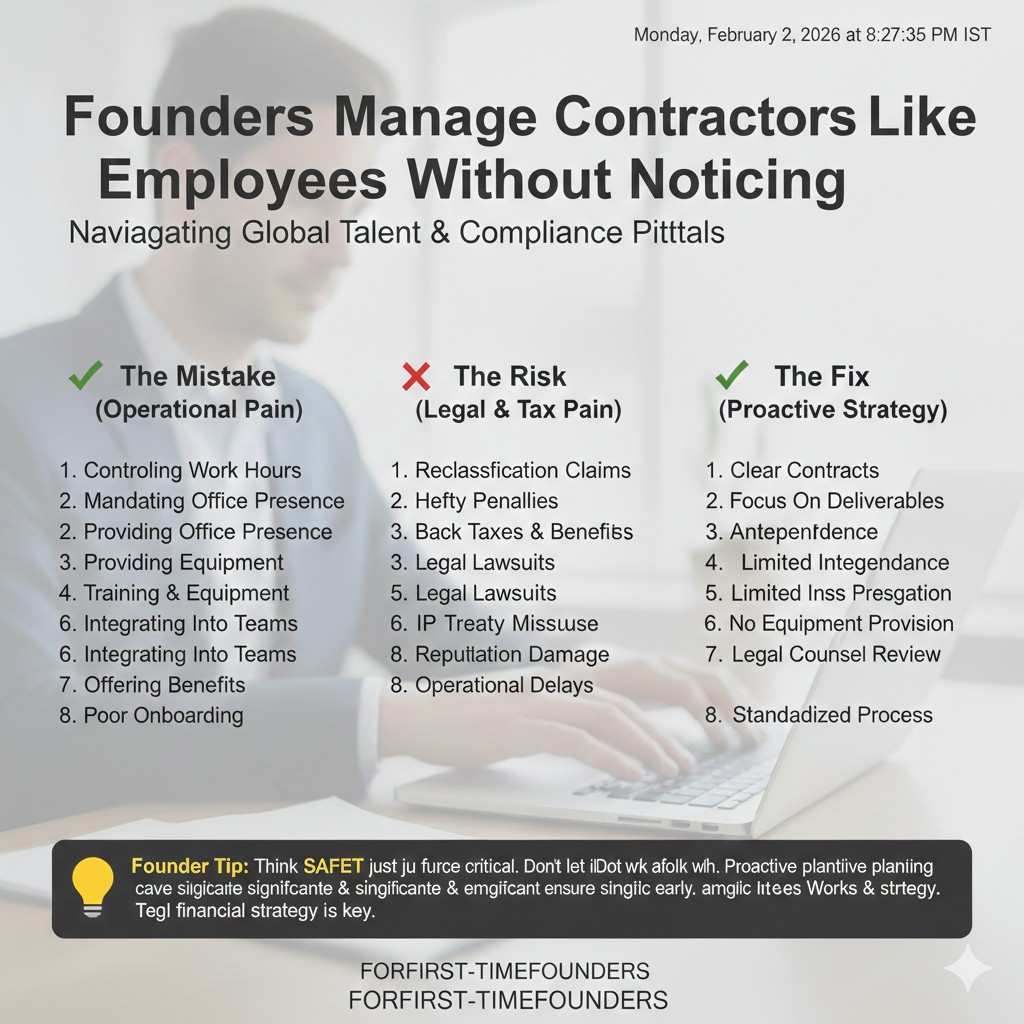
Investors do not only invest in a product idea. They invest in the ability of a team to build, sell, and scale without hidden landmines. Hiring abroad is common now, but the legal rules around “contractor” and “employee” are not flexible just because a startup is moving fast.
When a company mislabels a worker, the risk is not limited to a legal memo. It can become unpaid taxes, social charges, fines, back wages, and forced benefits. Even worse, it can bring fights over who owns the work that was created. That is why investors look closely at global hiring during diligence, even at pre-seed and seed.
This is also why founders should treat hiring structure as part of the company’s foundation. The same way you protect your inventions early, you want to protect your team setup early. If you want help building an IP-backed company that holds up under investor review, you can apply to Tran.vc here: https://www.tran.vc/apply-now-form/
The problem with “we’ll fix it later”
Fixing it late tends to cost more because you are working under pressure. You are also trying to rewrite the past, which is harder than setting it up right from day one. Investors know this pattern, so they treat misclassification like a signal of weak controls.
Why cross-border work makes it harder

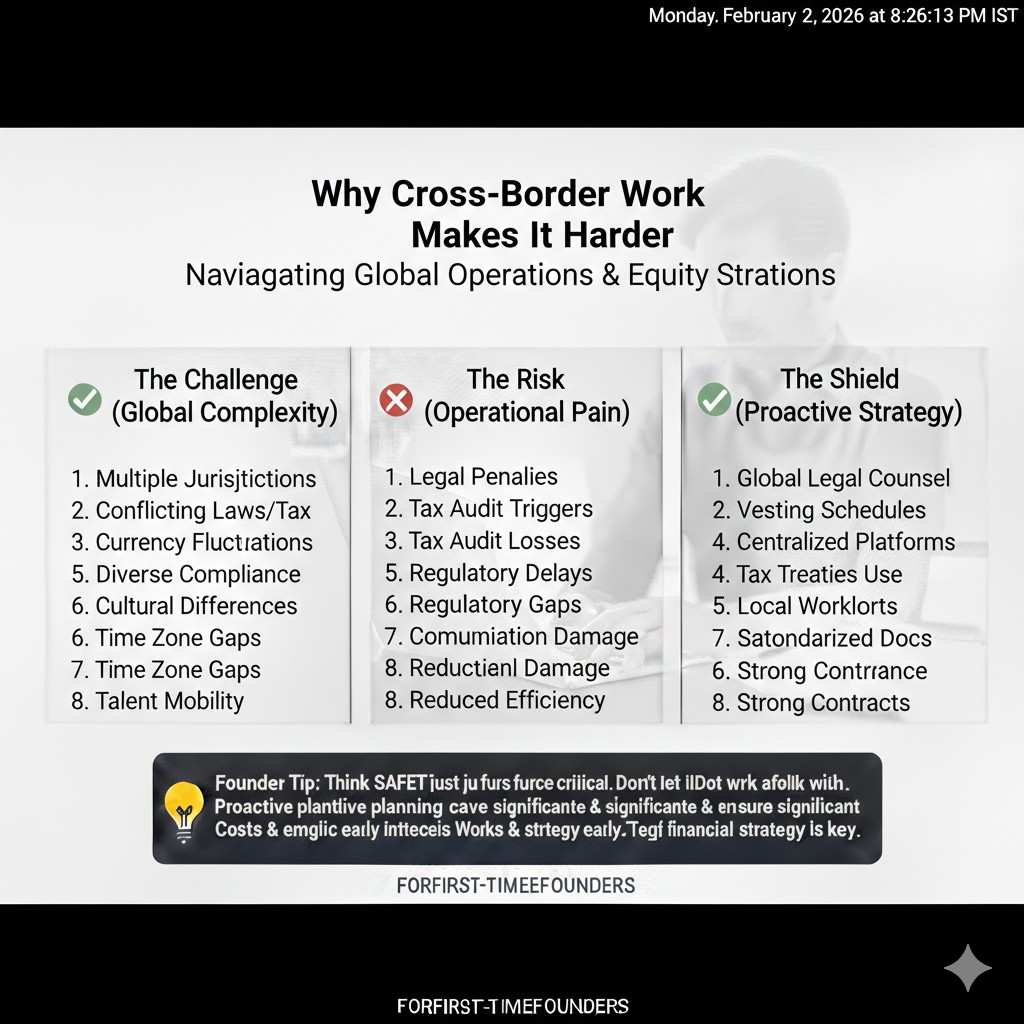
Each country has its own tests for what makes a worker an employee. Some places focus on control and supervision. Others focus on whether the person is part of the company’s core business. Many look at the real working relationship, not the contract label.
That means you can have a perfect-looking contractor agreement and still lose if the facts show employee-like work. Investors worry because the risk is not only legal. It can stop hiring, delay a round, or create a cap table mess if equity was granted under the wrong assumptions.
The real difference between a contractor and an employee
The label is not the truth
Founders often think the contract decides the status. In many countries, the contract is only one piece of evidence. If the day-to-day reality looks like employment, the government or court may treat it as employment.
This matters because a contractor setup is meant for independent work. Employment is meant for ongoing service under the company’s direction. The legal system usually tries to protect workers from being denied benefits by a simple label change.
Control is the center of the question
A simple way to think about it is control. If the company tells a person when to work, how to work, what tools to use, and who to report to, that starts to look like an employee relationship. If the person sets their own schedule and methods and only commits to deliver a result, it leans more toward contractor.
In practice, startups blur these lines because speed matters. A founder may run daily standups with a “contractor,” assign tasks in the same sprint board as employees, and review work like a manager. That is normal startup behavior, but it can create legal risk abroad.
Integration into the business is a major signal
Many legal systems ask whether the worker is integrated into the business. If the person is doing core work that looks like the company’s main product, that can point toward employment. For a robotics or AI startup, “core work” might mean model training, sensor fusion code, motion planning, or data labeling strategy.
A contractor is often supposed to look like an outside specialist. They might do a defined project, for a limited time, for multiple clients. When the person looks like a long-term team member, that is when investors start to worry.
Economic dependence can matter more than founders expect
Some countries care about whether the person depends on the company for income. If the worker has only one client and that client is the startup, it can be a red flag. The logic is simple: if the person’s livelihood depends on one company, the law may want them treated like an employee.
Startups often want focus and loyalty, so they prefer exclusivity. But exclusivity can clash with contractor status in places where independence is required. Investors want founders to understand that “exclusive contractor” can be an unstable category.
Tools, systems, and access can change the story
Another common factor is tools and systems. If the company provides a laptop, email, Slack access, and internal admin rights, it can look like the person is part of the company. If the person uses their own tools and works through their own systems, it supports contractor status.
This does not mean you should isolate contractors from your systems in a way that breaks work. It means you should be intentional. When investors see a contractor who has the same access and routine as employees, they start asking hard questions.
Where founders get it wrong when hiring abroad
Startups use “contractor” as a speed hack
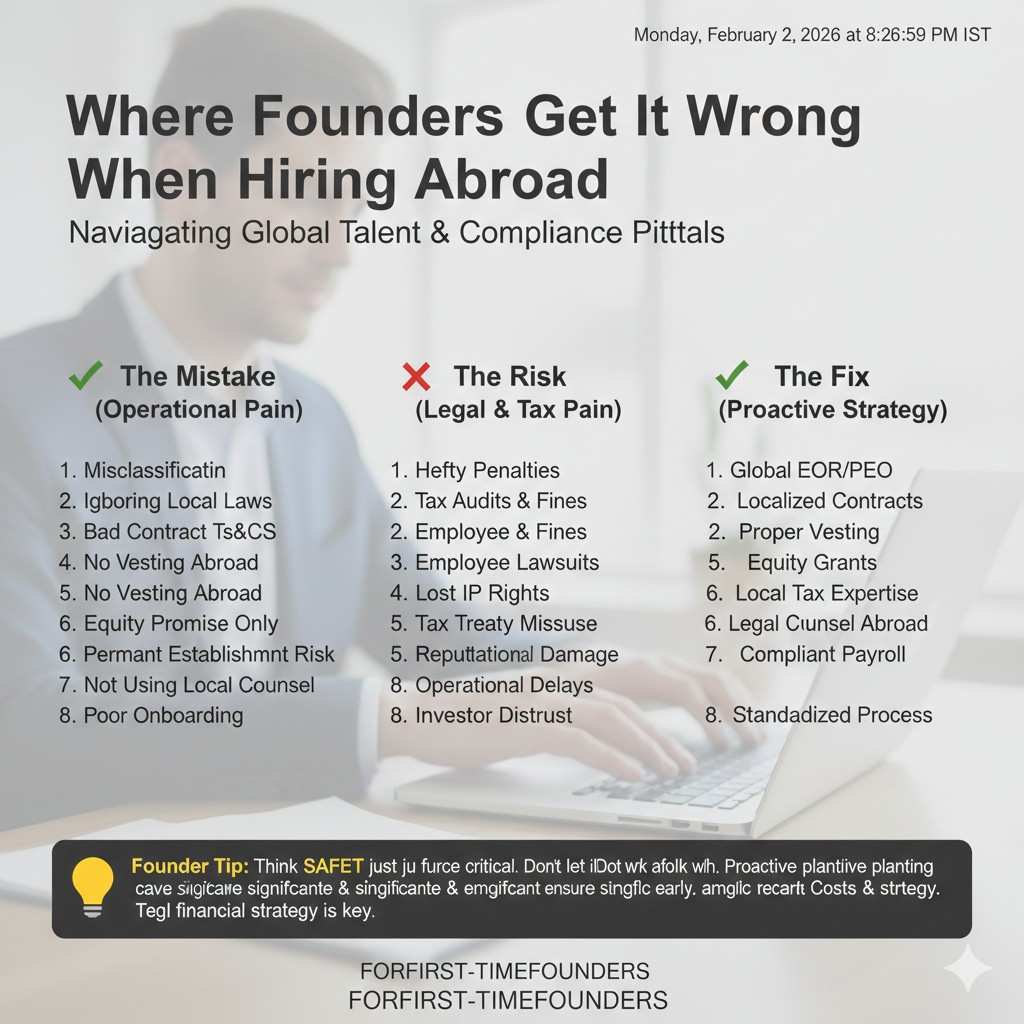
Many founders default to contractors because setting up employment abroad can feel slow. They may not have a local entity. They may not want to deal with payroll and local benefits. They may also feel uncertain about how to terminate employment if it does not work out.
This is understandable, but speed choices come with tradeoffs. Investors will ask whether the startup chose contractors for a real project-based need or simply to avoid employment rules. The second reason is where risk grows, because regulators often view it the same way.
The work starts small and slowly becomes full-time
Misclassification often begins with a short project. A developer in another country helps fix bugs or build an early prototype. Then, because the person is good, they take on more tasks. Soon they are in every sprint. They are building key modules. They are attending weekly planning calls.
Nothing feels wrong day to day. But the legal status is drifting. The agreement still says “contractor,” while the real relationship looks like an employee. Investors worry because these situations rarely stay quiet forever.
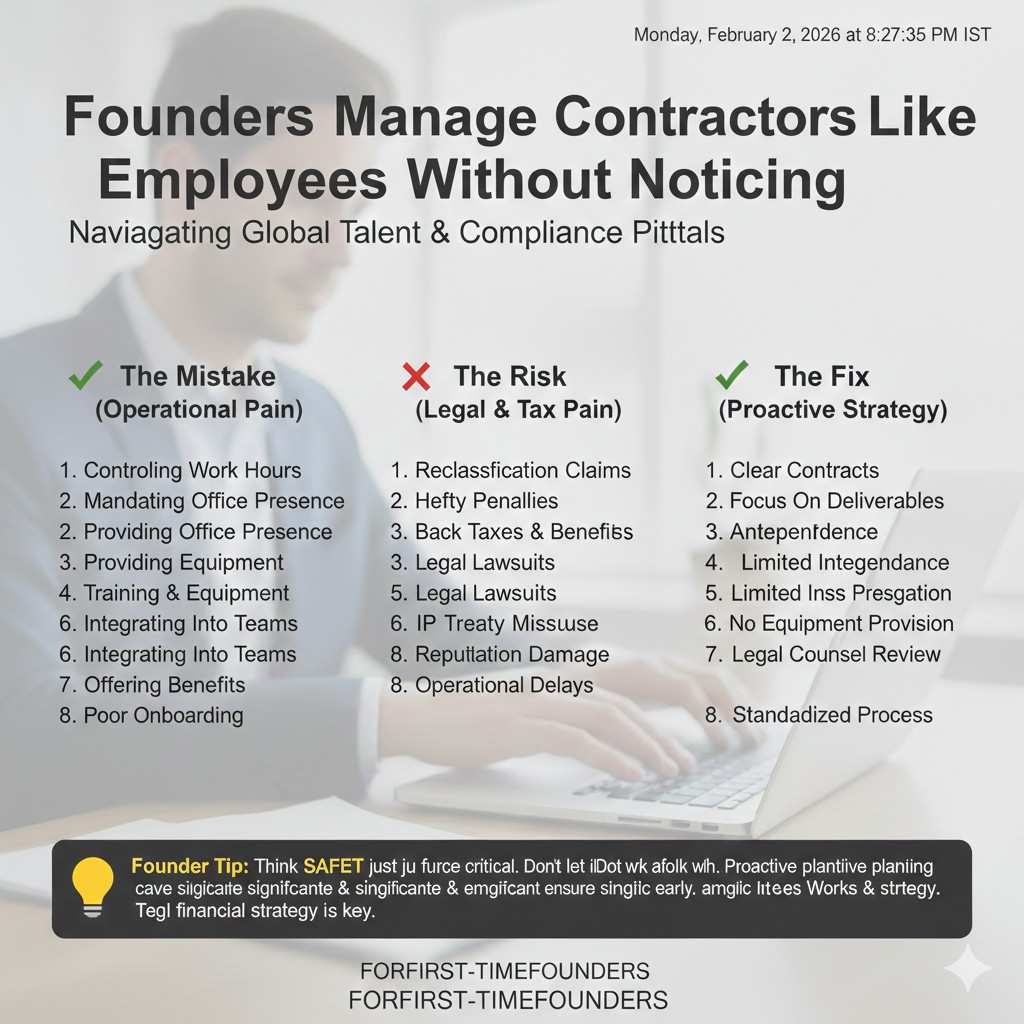
Founders manage contractors like employees without noticing
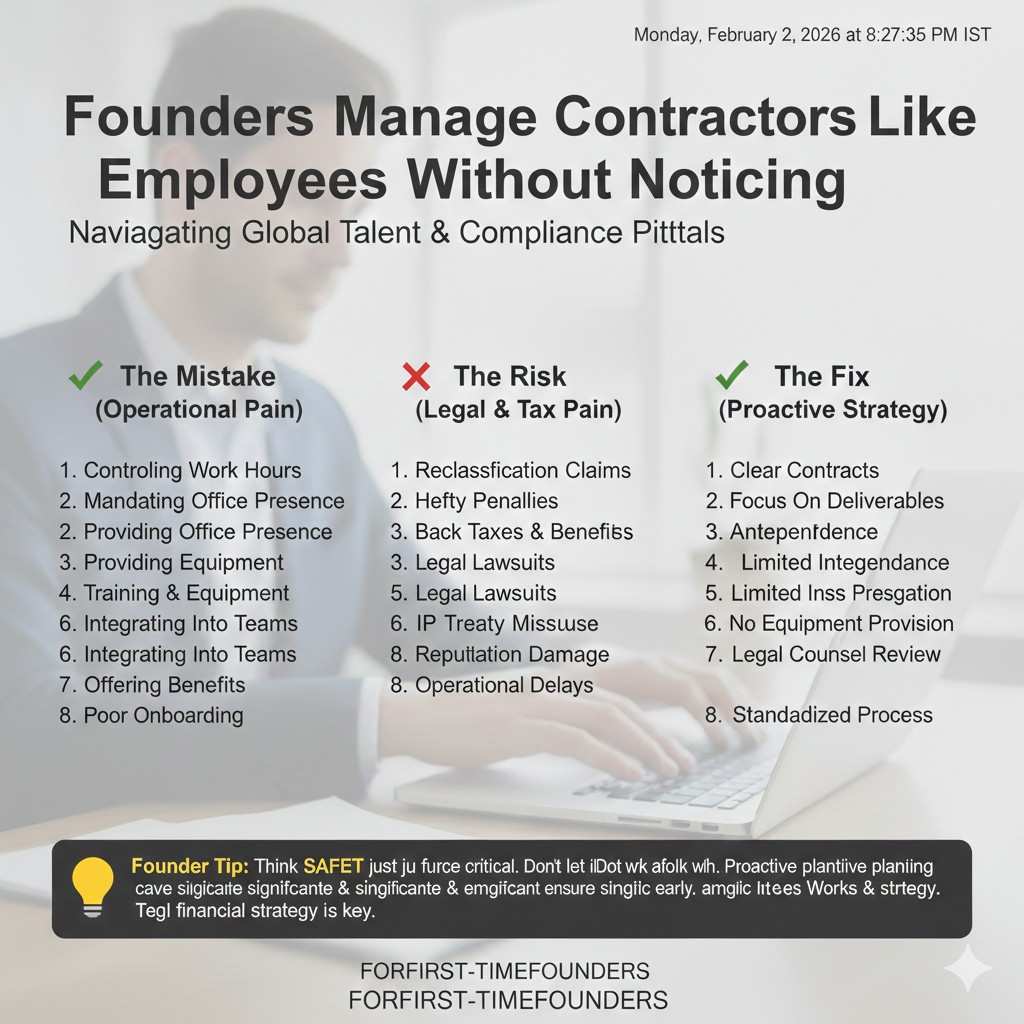
If a founder is giving daily direction, setting priorities, approving time off, and evaluating performance, it starts to resemble employment. Many founders do this because it is how you run a team. But abroad, it can be the main evidence used to reclassify a worker.
A contractor relationship usually works best when you define outcomes and leave the “how” to the contractor. If you need hands-on control, that is often a sign you should consider employment or a formal employer-of-record setup.
Equity and “startup culture” can trigger extra risk
A lot of startups offer equity to contractors. They do it to conserve cash and keep talent engaged. But in some places, giving equity, setting vesting, and treating the person like a core team member can support an argument that the person is really an employee.
This also links to investor concerns about IP ownership. If someone who built important code was not properly classified, the equity paperwork may be messy. It can create disputes about compensation and ownership at the worst possible time.
What this means for investors during diligence
Misclassification can become a deal blocker
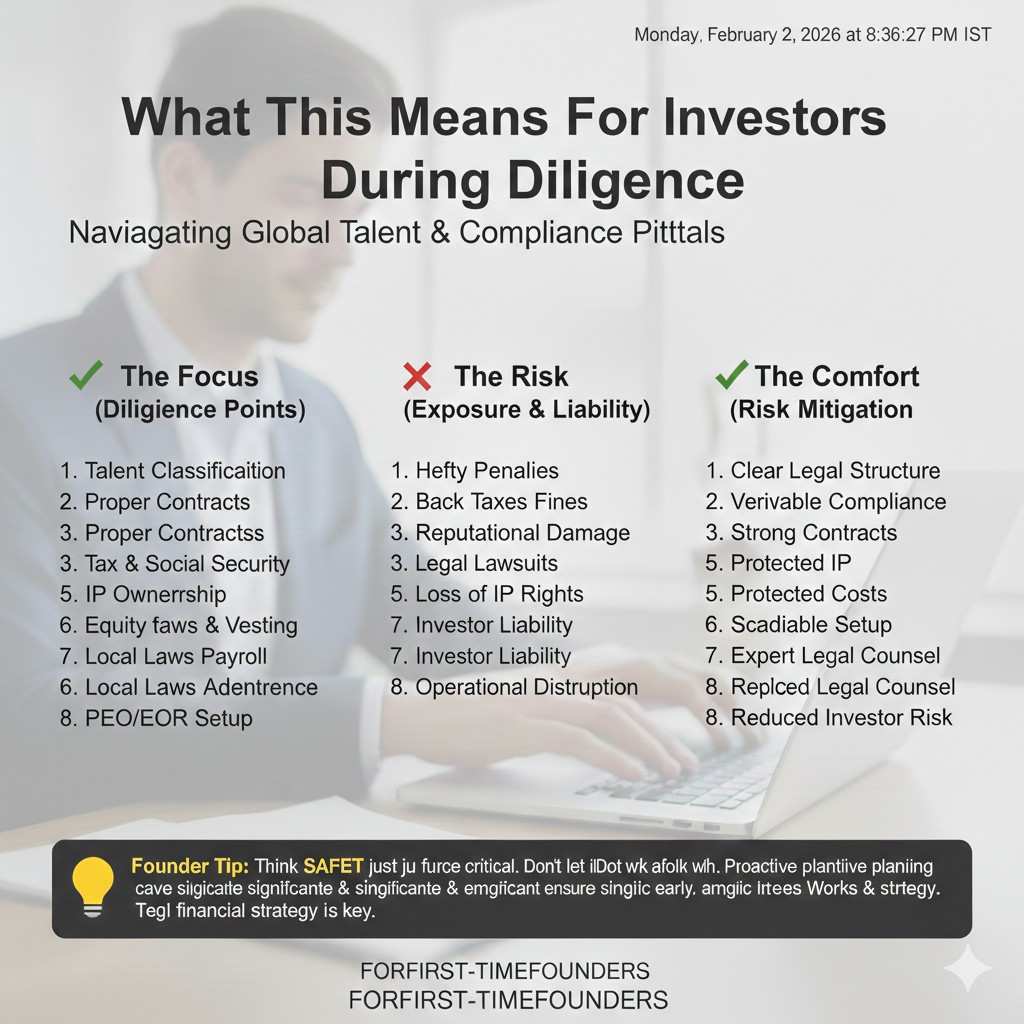
Investors do not expect a pre-seed company to be perfect. But they do expect the company to be honest and fixable. If a startup has many foreign “contractors” who act like employees, investors may slow down a deal or require changes before signing.
This can look like requiring an employer-of-record, requiring conversion to employment, or requiring proof that taxes and contributions are handled. Even if the investor still wants the deal, the founder loses time and leverage.
IP ownership can become unclear
Investors care deeply about who owns what was built. If a worker is misclassified, local law may grant them rights that do not match the contract. Some places treat employee inventions differently from contractor inventions. Some require specific assignment language, local formalities, or extra compensation.
If the code or invention is central, investors may ask for a “chain of title” review. This means tracking every person who touched core work and checking that the company owns it. If that chain has weak links, the investor may reduce valuation or walk away.
This is one reason Tran.vc focuses on building strong IP foundations early. When your team is global, IP is not just patents. It is also clean ownership. If you want support from people who do this every day, you can apply here: https://www.tran.vc/apply-now-form/
Taxes and benefits can show up as hidden debt

If a person should have been treated as an employee, the company may owe payroll taxes, social contributions, and penalties. This can accumulate quietly. It can also be hard to estimate because it depends on local rules and how long the relationship lasted.
Investors treat hidden liabilities like debt. If the number is large, it can change how much money they want to put in, or the terms they want. Even if the company later fixes the setup, the back period may still be exposed.
How to make the distinction in a way that holds up
Start with the real need, not the legal form
A strong approach is to decide based on the work itself. If you need someone for a defined project with a clear deliverable, contractor can fit. If you need ongoing work that changes week to week, and you plan to manage the person closely, employment is often the safer path.
This is not about being overly cautious. It is about matching form to reality. Investors prefer reality-aligned structures because they create fewer surprises later.
Shape the working relationship to match the choice
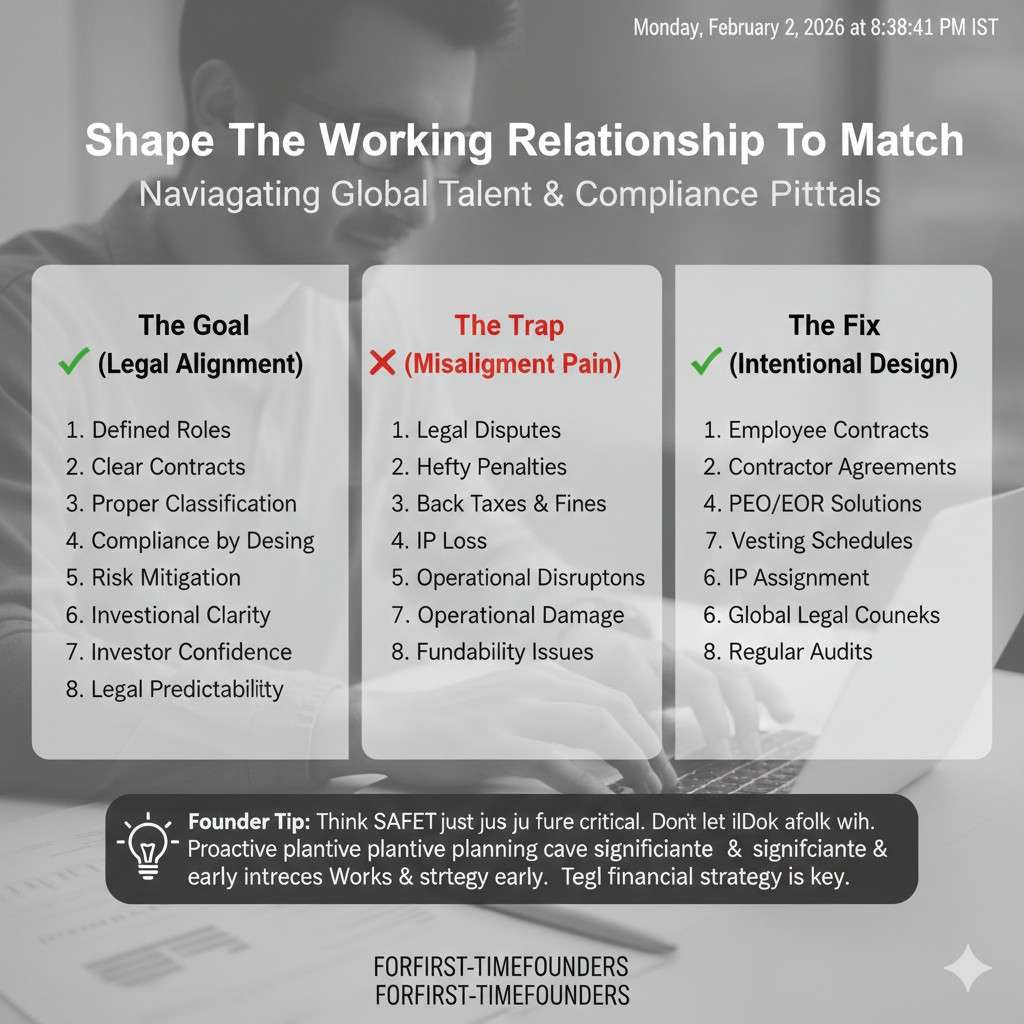
If you choose contractor, the relationship should reflect contractor behavior. That means focusing on outcomes, allowing flexibility in hours, and avoiding deep internal management. You can still communicate often, but the tone and structure matter.
If you choose employee, accept that local rules may require benefits, payroll handling, and certain termination steps. That is not “red tape.” It is the price of building a stable team in that location. Investors often prefer this stability over brittle contractor setups for core roles.
Use clear IP assignment language either way
Whether someone is a contractor or an employee, you need strong IP assignment terms that fit the country. Many founders use a generic template and assume it works everywhere. That is risky because some places require extra steps, specific wording, or separate invention assignments.
The goal is simple: anything created for the company should belong to the company. If you cannot prove that cleanly, investors will worry. This is one of the areas where Tran.vc’s IP-first approach helps, because the earlier you fix ownership, the cheaper it is to fix.
Apply anytime if you want help building defensible IP and clean foundations: https://www.tran.vc/apply-now-form/
Country-by-country reality: why “contractor” is not the same everywhere
Why one contract cannot cover the whole world

Founders often ask, “Can we just use one global contractor agreement?” It sounds efficient. But most countries do not care that the document looks professional. They care about local worker rules, local tax rules, and the real working pattern.
Investors know this. They have seen deals get delayed because a company used a U.S.-style contractor template in places that treat contractors very narrowly. What feels like a normal startup setup in one country can look like clear misclassification in another.
The “facts on the ground” test shows up almost everywhere
Across many places, the same theme repeats. If the person works like your employee, the law may treat them like your employee. Judges and agencies usually look at what really happened, not what you hoped was happening.
This is why country risk cannot be solved only with paperwork. You need to shape daily work so it matches the category you chose. When investors ask questions, they are often testing whether you understand this difference.
Why stricter countries create bigger investor stress
Some countries have strong worker protections and strong enforcement. In these places, reclassification claims can move quickly and can become expensive. Even if a claim does not end in court, the cost to settle and clean up can still be painful.
Investors do not always avoid these countries. But they do price risk. They may demand fixes before closing, and they may hold back money until the risk is reduced. For a founder, that can feel like a surprise “tax” on the round.
What “high-risk misclassification” looks like in real life
When a contractor becomes “the only engineer on a core system”
A common pattern is a foreign contractor who becomes the key builder of a core system. In robotics, that might be perception code, mapping, or control logic. In AI, that might be model training, data tooling, or evaluation methods.
The more central the work, the more likely the person is treated like a team member. They join planning calls. They get tasks each week. They work long stretches without a clear project end. The relationship becomes ongoing, which is exactly what many legal systems view as employment.When the company sets the daily rhythm
Daily standups, sprint planning, and fixed working hours can be normal in a startup. But if you apply the same system to contractors abroad, you may be building evidence against your own classification.
Investors will ask about this in plain language. “Do they attend team meetings?” “Do you assign them tickets like employees?” “Do they report to a manager?” These questions sound basic, but they go straight to the legal test.
When the contractor is blocked from other clients
Many founders want focus. They may ask the contractor not to work for anyone else. They may even write that into the agreement. In some places, that looks like control and dependence, which supports employee status.
A contractor is usually expected to have business freedom. When that freedom is missing, the “independent business” story is harder to defend. Investors often flag exclusivity as one of the fastest ways to turn a contractor relationship into an employment argument.
When pay looks like a salary
Some teams pay contractors the same amount every month, like a paycheck. They may also reimburse expenses, approve time off, or pay for holiday weeks. All of this can be kind and fair, but it can also look like employment.
The key issue is not generosity. It is consistency with the legal category. If you want employee-style stability, it may be safer to use an employee structure rather than trying to imitate it through a contractor agreement.
The investor lens: how diligence teams spot problems fast
The “org chart test”
A simple diligence trick is to map the work like an org chart. Who reports to whom? Who reviews whose work? Who is in daily workflow? If foreign “contractors” sit inside the org chart like employees, the investor sees risk.
This is why founders should not wait for diligence to discover the problem. If you plan to raise in the next six to twelve months, it is smarter to clean up now. Cleanups are smoother when nobody is rushing.