
If you’re building an AI or robotics startup, you’re not just shipping code and hardware. You’re shipping risk, too. Not “scary” risk—just real-world risk: safety, privacy, security, and rules that change fast. The good news is this: compliance does not have to slow you down. When you treat it like a build tool (not a legal fire drill), it can make your product stronger, help you sell faster, and make investors trust you sooner.
This guide is a practical checklist in plain words. It’s written for founders and builders who want to move fast without stepping on landmines. It’s also built around a truth most teams learn late: the best time to do compliance is when the system is still simple, before you scale, before you ship broadly, and before one bad incident forces you into damage control.
A quick note on Tran.vc: we help AI, robotics, and deep tech startups lock in defensible value early—often before a seed round—by investing up to $50,000 in in-kind IP and patenting services. That means real patent strategy and filings that turn what you’re building into assets investors can’t ignore. If you want help building an IP moat while you build your product, you can apply anytime here: https://www.tran.vc/apply-now-form/
Now, here’s how to think about compliance in a way that actually helps you.
Most founders hear “compliance” and picture long forms, slow meetings, and people saying “no.” In practice, good compliance work is the opposite. It is a set of clear choices you make early so you don’t rewrite your product later. It is how you avoid selling into a wall. It is how you pass procurement. It is how you keep a hospital, a factory, a school, or a city from rejecting your product after months of sales work.
And it’s how you stay alive if something goes wrong.
What “compliance” really means for AI and robotics
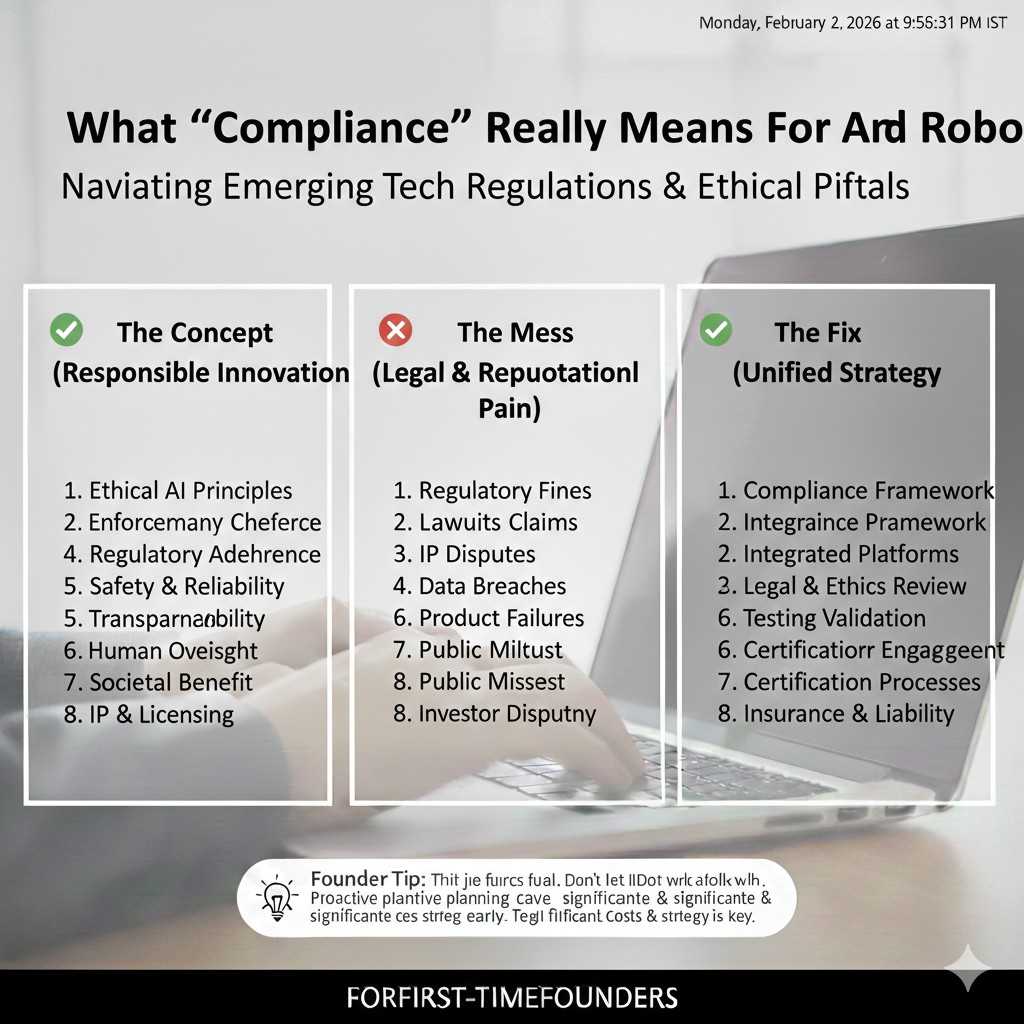
Compliance is not one big thing. It’s a handful of areas that touch almost every AI and robotics product:
Safety: Will your robot hurt someone? Will your AI cause harm in a way you could have prevented?
Security: Can someone take over your device, steal your model, or pull private data from your system?
Privacy: Are you collecting personal data? Are you storing it safely? Are you using it in a way users agreed to?
Product rules: Are there rules for your product type? Medical devices, drones, cars, workplace robots, and kid-facing tech all have extra layers.
Data and model governance: Can you explain what data trained the model, where it came from, and what rights you have?
Claims and marketing: Are you making promises that are not backed by tests?
Contracts and customer proof: Do you have the paperwork and evidence a real customer needs to buy from you?
For early startups, the goal is not to build a perfect “compliance machine.” The goal is to build a repeatable, simple system you can grow later. If you can answer a customer’s hard questions without panic, you’re ahead.
The simple compliance mindset that keeps you moving fast
Here’s the mindset that works: treat compliance like a product feature.
When you build a robot, you already think about failure modes. You think about what breaks, what overheats, what slips, what jams. Compliance is the same, but broader. It asks: what could go wrong for users, for customers, for society, for regulators, for your company?
Then it asks: what controls reduce that risk?
Controls can be small. A log. A kill switch. A data delete button. A clear warning label. A model card. A human review step for the highest-risk outputs. A locked-down update channel. A test plan that proves your robot stops when it should stop.
Small controls, done early, save months later.
Who this checklist is for
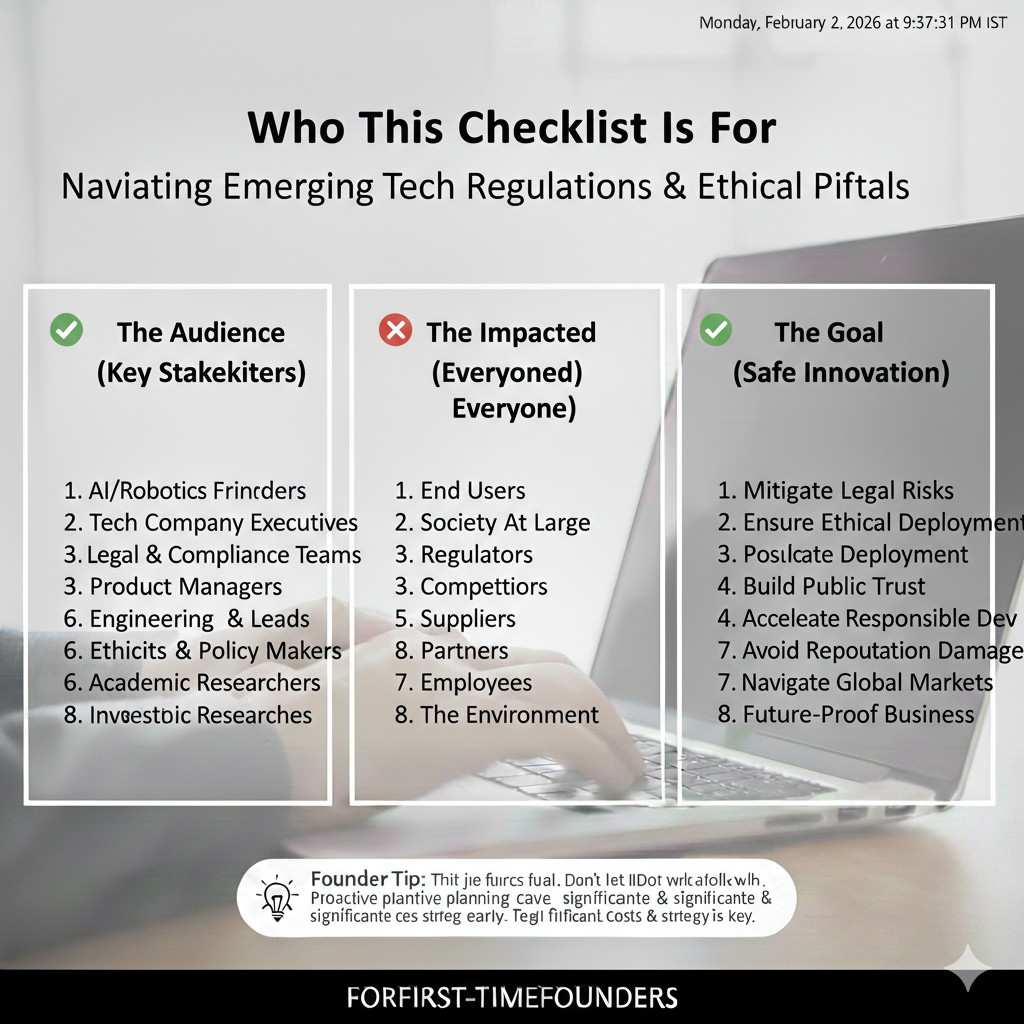
This checklist is for:
- AI startups that ship models, agents, copilots, decision tools, or perception systems
- Robotics startups building hardware plus software, or software that controls physical motion
- Teams selling B2B into serious places like factories, warehouses, health, energy, defense, cities, schools, and finance
- Founders who want to raise money with leverage, not fear, and want to look “ready” even at seed stage
If that’s you, you’ll get value from this even if you have no lawyer on staff and no compliance lead yet.
The “do this first” promise
Before we get into the full checklist, I want to give you one promise: you do not need to do everything at once.
What you do need is a clean starting point. You want to set up compliance like you set up engineering: with simple habits and clear ownership.
If you only do three things in the next two weeks, do these:
- Write down what your system does and where it will be used.
- Write down what data you collect and where it flows.
- Write down what could cause harm and how your product prevents it.
That’s it. That becomes your base document. Everything else grows from there.
Also, while you’re building the compliance base, it’s smart to build your IP base in parallel. A strong patent plan can protect the very controls and technical methods that make your product safer and more trusted. Tran.vc helps with that early, with hands-on support and in-kind patent and IP services—up to $50,000. Apply anytime: https://www.tran.vc/apply-now-form/
AI & Robotics Compliance Checklist for Startups
Know your product risk
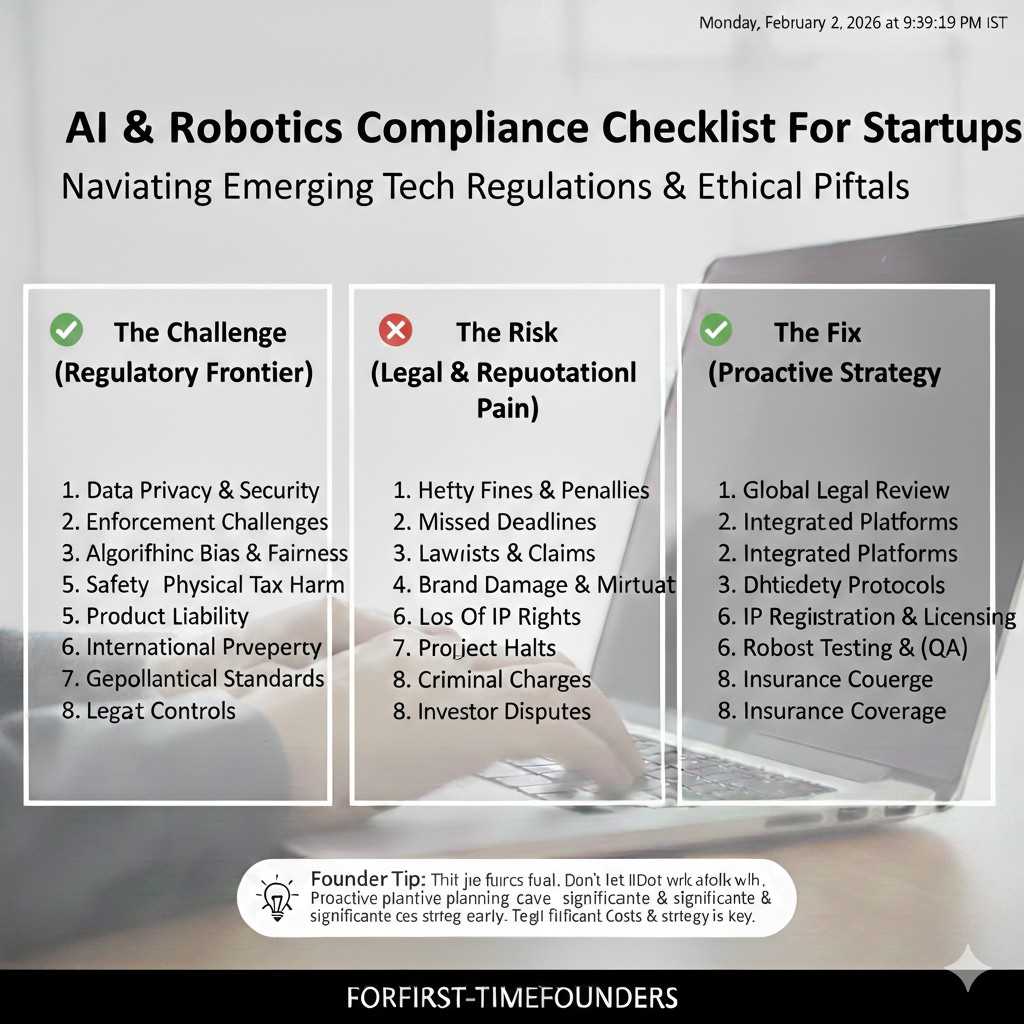
The fastest teams do not skip risk. They name it early, then design around it. This is not about fear. It is about building a product that can live in the real world without surprises that ruin trust.
Start by writing a plain, one-page description of what your system does. Include where it will be used, who will use it, and what the “success” outcome looks like. Keep it simple and true. This page becomes your anchor for every later decision.
Now write the “harm story” next to it. If the system fails, what could happen to a person, a customer site, or the business? Do not write a long list. Write full sentences. Imagine one bad day, and describe it clearly.
Map your system in human words
A good risk picture needs a simple map. Not a diagram that only engineers can read. A map that a buyer, a lawyer, and an investor can all understand without guessing.
Describe the parts of your system in a few short paragraphs. For example, what runs on the device, what runs in the cloud, and what runs on the customer’s network. Explain how the parts talk to each other and where decisions are made.
If you use third-party tools, name them. If you call outside APIs, say what they do and what data they see. If you run on customer data, explain how it enters, how long you keep it, and how it leaves.
Classify your use case before you ship
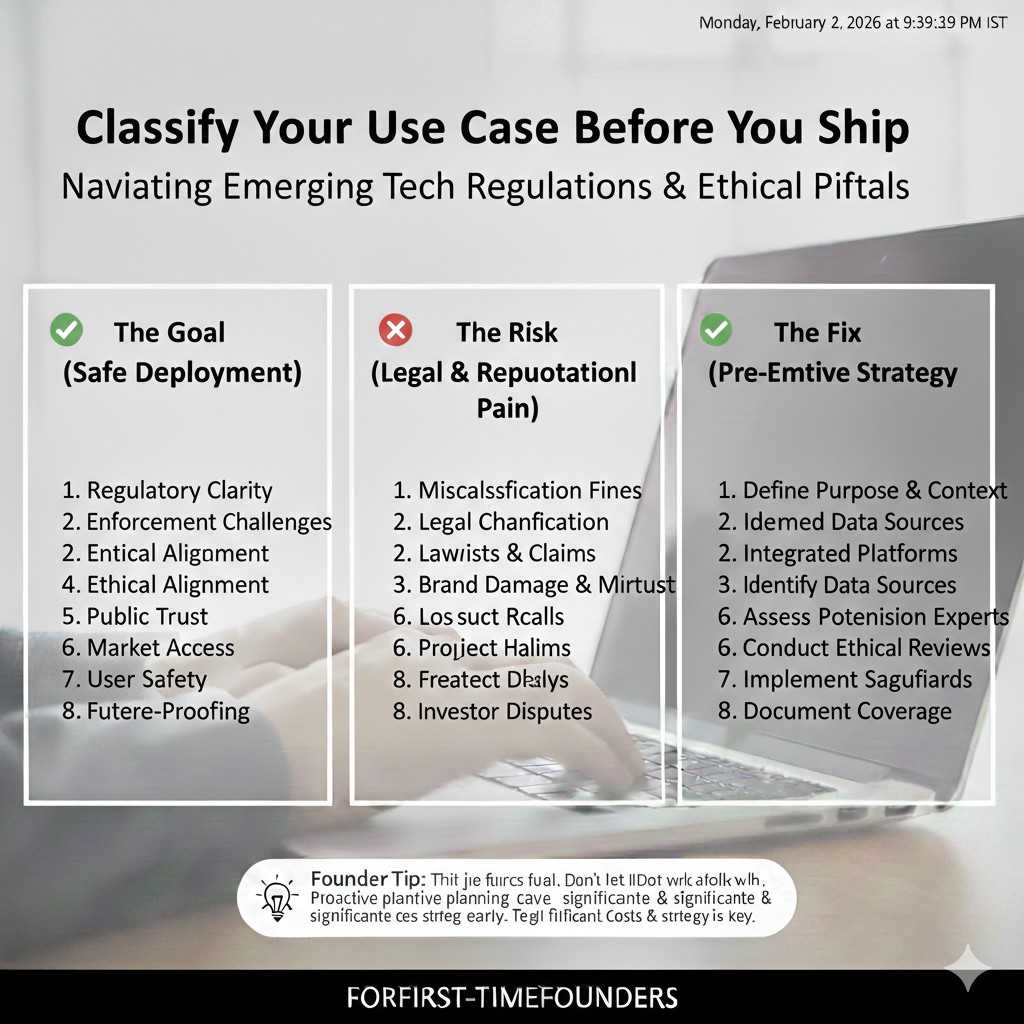
Many startups learn too late that the same AI can be “low risk” in one place and “high risk” in another. A warehouse pick robot is not the same as a robot that moves near kids. A scheduling AI is not the same as an AI that denies a loan.
Write a short paragraph that states the highest-stakes decision your system touches. Then write another paragraph that states what your system does not do. This helps you avoid accidental claims that raise your risk level.
If your system influences hiring, credit, insurance, medical care, law, or public services, treat it as high risk from day one. Even if the model is simple, the impact is not.
Set ownership and a weekly habit
Compliance fails when it belongs to “everyone.” It works when one person owns it, even part time. Pick a single owner who can say yes or no and can follow up.
Then set a weekly habit that takes less than an hour. The owner asks three questions: what changed in the product, what changed in the data, and what new risk did we introduce. This keeps you moving without creating a slow process.
If you are raising money soon, this habit becomes an investor signal. It shows you do not build blindly. It shows you can scale without chaos.
Use IP to protect the safety methods you invent
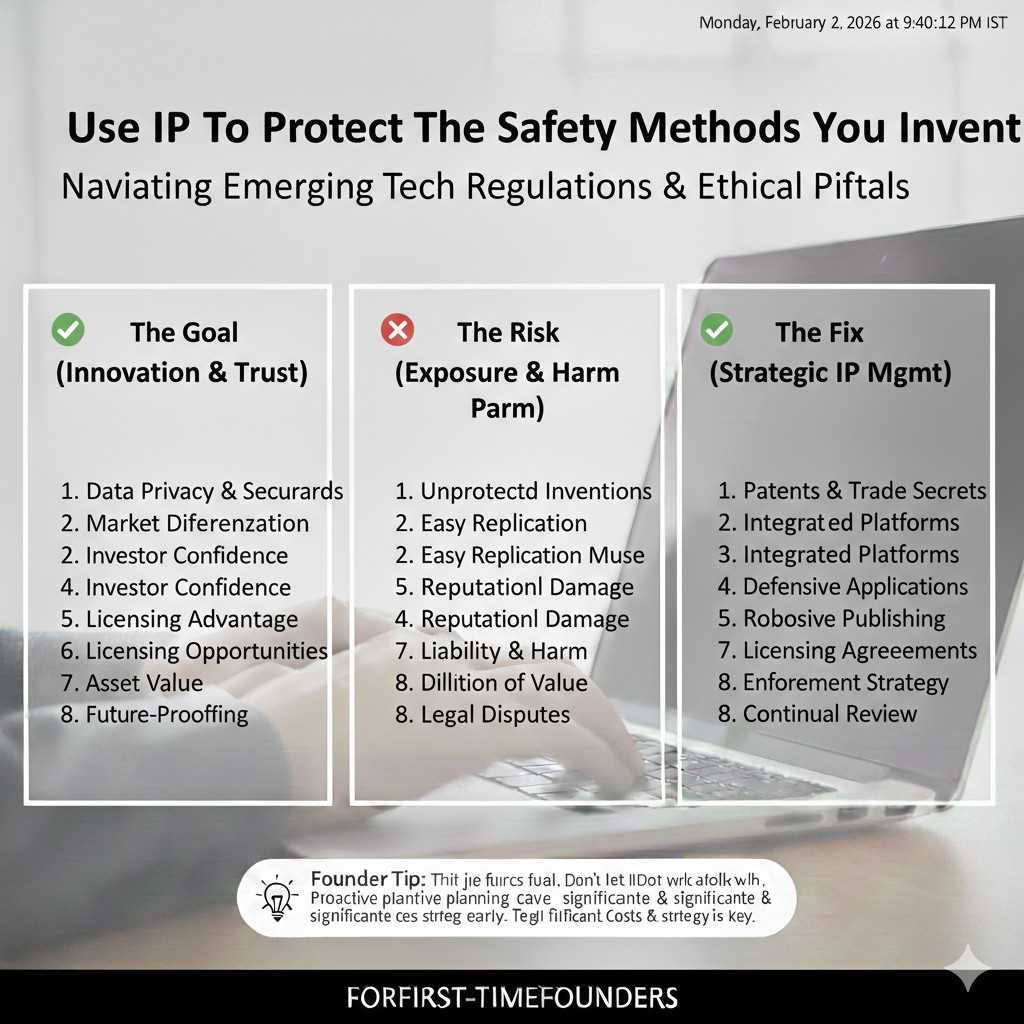
As you design safer systems, you often create new technical methods. You may build unique sensor fusion, safer motion plans, better control logic, or special ways to reduce model error.
Those methods can become patentable assets. They are not “paperwork.” They are leverage. They can make your company harder to copy and easier to fund.
Tran.vc helps technical founders do this early, with up to $50,000 in in-kind IP and patenting services. If you want to build safety and defensibility together, you can apply anytime at https://www.tran.vc/apply-now-form/
Data inventory you can defend
Most compliance pain starts with one simple question: what data do you have, and why do you have it? If you cannot answer that in plain words, customers will not trust you, and you will struggle when laws and contracts tighten.
Create a short “data inventory” doc that anyone on the team can read. It should explain what data you collect, where it comes from, and what you use it for. It should also state what you do not collect, so you avoid confusion later.
Do not overbuild this. The goal is not beauty. The goal is truth. A simple document that stays updated is better than a perfect one that becomes stale.
Personal data versus business data
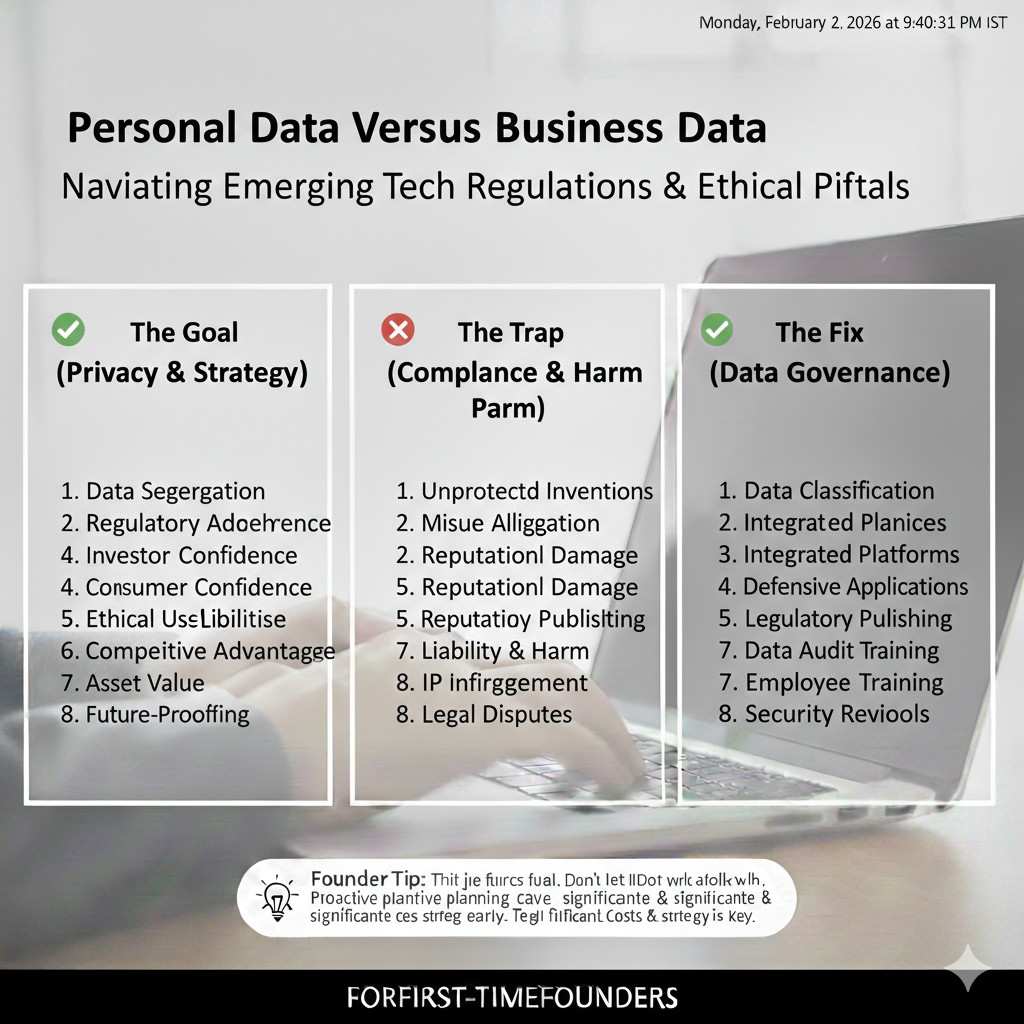
Many founders think they do not collect personal data, but they often do. Video, audio, faces, voices, location trails, and device IDs can all become personal data depending on context.
Write a paragraph that explains whether your system can see or hear people. If it can, explain what happens to that data. Is it stored, and if so, where? Is it used to train models, and if so, how is consent handled?
If your product is “B2B,” do not assume privacy is easy. Your customer’s workplace still has people in it. Their legal team will ask.
Data flow and retention in simple terms
You need a clear story for how data moves. Buyers will want to know what stays on device, what leaves the site, and what a third party can access.
Write a short description of data flow from start to end. Include logs, telemetry, support data, and error reports. These “side channels” are often where privacy problems hide.
Then write your retention rule. How long do you keep raw data, derived data, and logs? If you do not know yet, choose a conservative default and adjust later. Keeping data forever without a reason is hard to defend.
Consent and notice you can explain
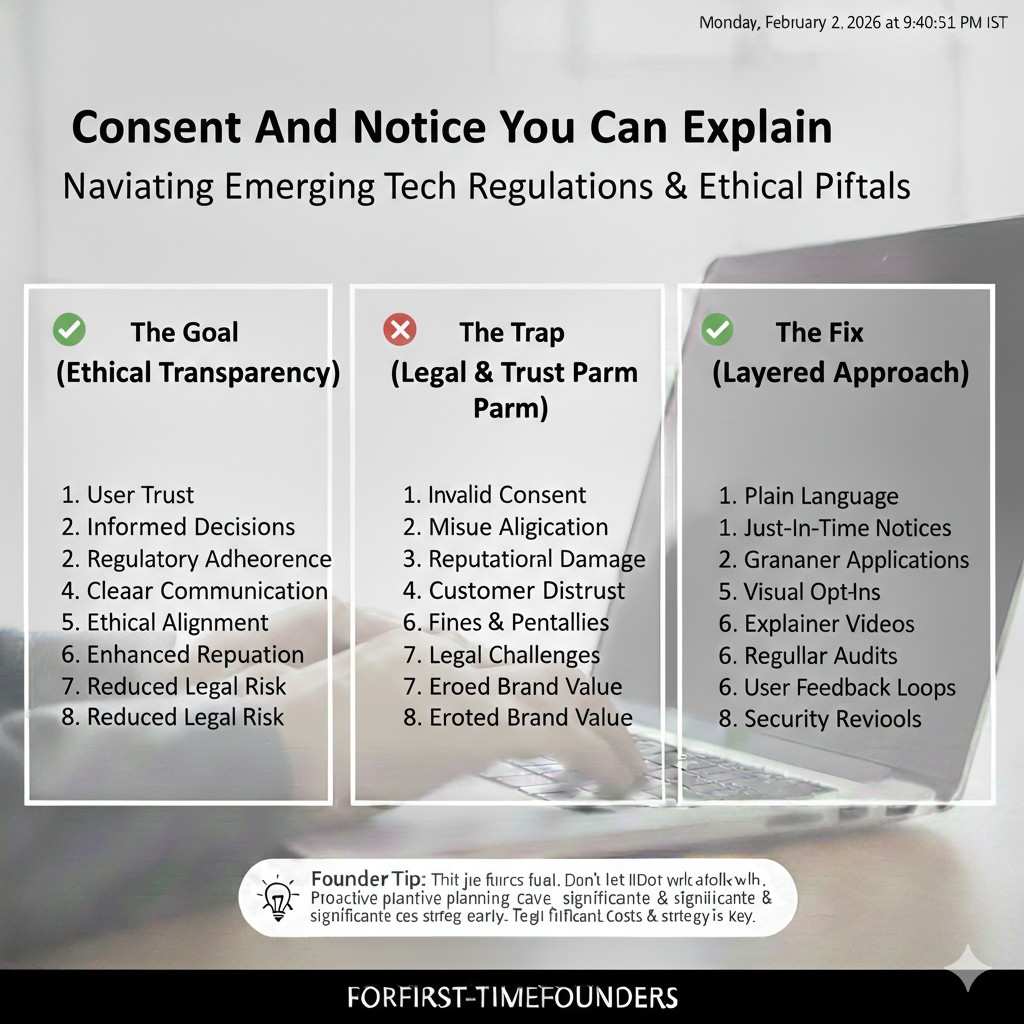
A common startup mistake is to hide notice inside a long policy nobody reads. Real compliance means people can understand what happens without digging.
If your system collects data from people who are not the buyer, you need a plan for notice. That can be signage, an onboarding flow, or a customer-facing guide. The key is that it is clear and practical.
Also think about consent. In many settings, consent is not simple because the user may not have a real choice. When that is the case, the focus shifts to minimizing data and reducing exposure.
Data rights and training data proof
Founders often use public data, vendor data, or customer data to train models. The compliance question becomes: do you have the right to use it that way?
Write a paragraph for each training data source. Explain where it came from and what rights you believe you have. If you used a dataset with a license, store the license terms with the dataset record.
This is not just legal hygiene. It is a sales tool. When procurement asks where your data came from, you can answer without scrambling.
Security that matches real threats
Security is not just “we use encryption.” Buyers have heard that line too many times. They want to know how you prevent the threats that matter for your product type.
Start by describing what an attacker would want. Do they want to take control of the robot? Do they want to steal customer data? Do they want to copy your model? Do they want to cause downtime?
Once you name the prize, you can build the defenses. This makes security feel like engineering again, not a vague checklist.
Device and cloud hardening basics
If you ship a robot or an edge device, lock down access. Remove default passwords. Use strong authentication. Limit open ports. Keep software updated.
For cloud systems, control who can access what. Use role-based access. Protect secrets. Monitor for unusual access and failed logins. These steps are simple, but they stop many real attacks.
Also plan for updates. Secure updates prevent tampering. If your update channel is weak, your product is weak.
Model and prompt security
AI products have their own risks. People may try to extract training data, steal prompts, or force the model to reveal hidden instructions. They may also try to use your system to generate harmful outputs that create legal trouble.
Write a short threat story for your model. What should it never reveal? What actions should it never take? What kind of user input should trigger safeguards?
Then implement controls that match your risk. Rate limits, content filters, logging, and human review for the highest-stakes cases can go a long way when used wisely.
Incident response that does not panic
Bad things happen. A sensor fails. A model behaves strangely. A customer reports an issue. The difference between a small incident and a company-killer is often how you respond.
Create a simple incident plan in writing. Explain who gets paged, what “stop the line” looks like, and how you communicate with customers. Keep it short, but keep it real.
Also plan how you will collect evidence. Logs, device state, and model versions matter. Without them, you cannot diagnose quickly, and trust erodes.
Privacy by design in everyday choices
Privacy-by-design sounds big, but it’s mostly small choices made early. Collect less data. Keep it for less time. Process on device when you can. Redact what you do not need.
Write down the minimum data your system needs to function. Then compare it to what you collect today. If there is a gap, fix it.
This also reduces cost. Less stored data means less storage, less risk, and fewer scary conversations with buyers.
Access controls and internal discipline
Most leaks are not hackers. They are accidents. A link shared in the wrong place. A test dataset copied to a personal drive. An intern with broad access.
Set basic access rules now. Only the people who need production data should have it. Everyone else should use test data that is safe.
Also add a simple review step before shipping features that touch data collection. This one step prevents many problems.
Customer controls that buyers expect
Enterprise buyers want control. They want to choose where data is stored. They want to delete it. They want audit logs. They want to control user access.
You may not ship all of that at first, but you should know what is expected. Build your roadmap so those controls can be added without rebuilding the core system.
If you plan for this early, you will close bigger deals sooner.
Robotics safety in the real world
Robotics compliance starts with physics. Robots move. They can collide. They can pinch. They can drop objects. They can surprise people.
Your safety story must be clear. Buyers will ask how the robot behaves in failure. They will ask what happens when a sensor fails, when a motor overheats, or when the network drops.
Answering these questions with confidence is part engineering, part documentation, and part testing discipline.
Hazard analysis in plain language
Do a hazard analysis using real scenarios, not abstract words. Describe one scenario where a person steps into the robot’s path. Describe one scenario where an object slips. Describe one scenario where the robot loses localization.
For each scenario, explain how the system reduces harm. That might be speed limits, zone limits, safe stop behavior, redundancy, or better perception checks.
This is not about writing a thick report. It is about having a safety narrative that matches reality.
Safe stop, emergency stop, and manual override
Every robot needs a clear way to stop safely. Buyers will ask what happens when the robot must stop right now, and what happens when it should stop in a controlled way.
Explain the difference between emergency stop and controlled stop in your own words. Then make sure your product behavior matches those words.
Also think about manual override. Who can take control, under what conditions, and how you prevent unsafe takeover.
Testing evidence you can show
Compliance is not only about what you say. It is about what you can prove. Testing creates proof.
Create a test plan that covers normal use and edge cases. Include safety tests, sensor failure tests, network drop tests, and update tests. Keep records of results.
When a buyer asks for proof, you will not need to “trust me.” You will have a simple packet that shows what you tested and what happened.
Model governance that keeps you credible
For AI, buyers will ask what model you use, how you evaluate it, and how you manage changes. They will want to know how you prevent regressions and how you detect drift.
Start with a model fact sheet. Describe the model’s purpose, what it is good at, what it is not good at, and what data it uses at run time.
Then define how you update models. Do you push updates automatically? Do customers approve? Can they pin a version? These decisions are both product and compliance decisions.
Evaluation that matches customer reality
A model can look great in a lab and fail in a factory. Your evaluation needs to reflect where the system will run.
Describe how you test with real conditions: lighting changes, noise, motion blur, reflective surfaces, or uncommon accents and languages. If you do not test in real conditions, do not pretend you do.
Buyers respect honesty and clear plans. They do not respect inflated claims.
Monitoring and drift detection
Models change over time, even if you do not update them. Data changes. Environments change. Users change.
Write down what you monitor in production. That could be error rates, confidence scores, or safety overrides. Also write what triggers a response, such as rolling back a model or alerting the team.
Monitoring is not only a dashboard. It is a decision system.
Claims, marketing, and sales discipline
Many compliance disasters start in marketing. A website says “guaranteed” or “fully autonomous” without proof. A sales deck promises outcomes the product cannot deliver.
Write your key claims in plain words. Then attach the proof for each claim, like test results or case data. If you cannot prove it, soften the claim.
This protects you legally and helps your brand. Buyers can sense when a company is careful and honest.
Contracts and customer security reviews
Even early customers will ask for security and privacy details. Many will send a questionnaire. If you cannot answer, deals stall.
Start building a “trust packet.” It can include your data flow description, your security controls, your incident plan, and your basic policies. Keep it short and readable.
This packet also helps investors. It shows you can sell into real markets, not just demos.
Build compliance into your roadmap
The biggest mistake is treating compliance as a separate project. It should be part of product planning.
When you add a feature, ask how it changes data collection, safety risk, and security exposure. Then add the needed controls as part of the same work.
This is how you move fast and stay stable at the same time.
Use patents to turn compliance work into a moat
When you build unique safety systems, unique control logic, unique monitoring, or unique model governance, you are often creating valuable invention.
Patents can protect the way you reduce harm, the way you detect failure, and the way you manage high-stakes decisions. That protection is not only defensive. It can also help you raise money and win deals.
Tran.vc exists for this early stage moment. We invest up to $50,000 in in-kind patent and IP services so founders can protect what they build before the market gets crowded. If that fits your startup, apply anytime at https://www.tran.vc/apply-now-form/