
Product-market fit sounds like a fancy finish line. Like one day you wake up, your product “clicks,” growth is easy, and money shows up.
Real life is messier.
Most founders hit product-market fit the boring way: by talking to the right people, solving one painful problem, shipping small changes fast, and staying alive long enough for the pattern to become obvious.
And if you are building in AI, robotics, or deep tech, it is even harder—because your build costs are real, your cycles are slow, and it is easy to spend months perfecting tech that nobody buys.
This guide is about getting to product-market fit when you do not have a big budget. It is written for teams that want traction without burning cash. It is also written for technical founders who can build, but want a clear path to “people will pay for this” as soon as possible.
If you want help building leverage early—especially by turning your tech into protectable IP—Tran.vc can help. You can apply anytime here: https://www.tran.vc/apply-now-form/
Book the right customer talks fast
Stop chasing “anyone who will talk”

When money is tight, your time is the first budget you run out of. If you spend weeks talking to people who will never buy, you will feel busy but you will not move.
The goal is not more calls. The goal is the right calls. You want people who live with the problem, who feel it often, and who have some power to spend.
That usually means the person who owns the work, not the person who only watches it. In many companies, the buyer is not the CEO. It is the head of operations, the plant lead, the QA lead, the product lead, or the team manager who is tired of firefighting.
Build a short target list with tight filters
Pick one clear customer type and then make a list of real companies that match. Keep it narrow at first, because narrow makes patterns show up faster.
If you build for warehouses, choose a warehouse size range and a type of operation. If you build for robotics in factories, choose a factory type and a line type. If you build for AI in insurance, choose a policy type and a team.
When you choose filters like this, you start hearing the same words again and again. That is how you know you are in a real lane.
Use simple outreach that does not feel like a pitch
Most cold messages fail because they sound like marketing. People can smell that from far away, and they protect their time.
Use plain words and a small ask. Ask for learning, not buying. The goal is to earn a conversation, not to “close” on the first message.
A clean approach is to say you are studying how teams handle a specific job. Say you are not trying to sell. Ask for 15 minutes. If you have built something, mention it softly, but do not push it.
Use warm paths first because they are cheap
Warm intros are the highest return path when you have no budget. Ask founders, old coworkers, angel investors, advisors, and friends for introductions to one role at one company type.
Do not ask for “anyone in manufacturing.” Ask for “a quality manager in a mid-size electronics factory.” The more exact you are, the easier it is for someone to help you.
Also, ask for one introduction at a time. People help more when the request feels easy and specific.
Treat calls like an experiment, not a chat
A call is not a friendly conversation. It is a test. You are trying to learn what is true, what hurts, and what they would pay to change.
If you treat calls as casual, you will leave with nice feelings and zero data. If you treat them like experiments, you will start noticing patterns that guide what to build next.
Ask questions that make people tell the truth
Start with a real day, not opinions
People are bad at predicting what they will do. They are better at describing what already happened.
So avoid questions like, “Would you use this?” or “Do you like this idea?” Those questions invite polite answers.
Instead, ask them to walk you through the last time the problem happened. Ask what triggered it, what broke, what they tried, and what it cost. Real stories reveal real pain.
Pull out numbers in a gentle way
Most founders avoid numbers because it feels awkward. But numbers are what turn a story into a business.
Ask simple “how often” and “how long” questions. Ask what happens when it fails. Ask who gets involved. Ask what the downstream impact is.
Even rough numbers help. If a problem costs two hours every day, that is very different from once a month. Frequency and cost tell you where urgency lives.
Watch for emotion and urgency, not compliments
Compliments are cheap. A buyer saying “this is interesting” is not a sign of anything.
What matters is urgency. Urgency shows up as tension. You hear it when they say they are stuck, embarrassed, exposed to risk, or tired of a repeat mess.
When someone says, “We have to fix this,” or “This keeps happening,” or “I hate this part,” you should lean in. Ask more. Get the full shape of the pain.
Learn what they do today, even if it is ugly
Every problem has a current solution. Sometimes it is a tool. Sometimes it is a human. Sometimes it is a messy spreadsheet.
Your job is to understand that current solution well enough that you could do their job tomorrow. If you do not understand what they do today, you will build something that does not fit their world.
Also, current solutions reveal budgets. If they already pay for a tool, or they already hire people to do it, then money is already flowing. That is a strong sign.
Ask about buying without making it weird
You do not need to push hard, but you do need to ask.
A simple way is to say, “If we could solve this in a way that fits your team, how would you buy it?” Then pause.
You can ask who needs to approve, what the budget bucket is, and what makes a project easy or hard to start. This helps you design a path that does not die in paperwork.
Spot fake interest before it burns your time
Learn the difference between curiosity and demand
Curiosity sounds like, “That’s cool.” Demand sounds like, “When can we start?”
Curiosity asks for more information. Demand asks for a next step. Demand introduces other people without you pushing. Demand wants pricing and a timeline.
If you are hearing only curiosity, you may be too early, too broad, or talking to the wrong role.
Look for commitment signals
Real buyers do small things that cost them something. They give you time. They share data. They set up meetings with the right people. They agree to a paid pilot.
If someone will not do any of those, they are not a buyer right now. They may still be useful for learning, but do not build your plan around them.
Beware of “pilot forever”
Some companies love pilots because pilots feel safe. They get free learning and no risk.
A pilot is not bad. A pilot without a clear path to a paid contract is bad.
When you hear “Let’s pilot,” ask what happens if the pilot works. Ask what success looks like. Ask if there is budget already planned. Ask who signs the next contract.
If nobody can answer those questions, it is often a trap.
Do not confuse enterprise logos with early traction
A famous logo looks great on a slide. But famous companies often move slowly, demand heavy compliance, and stretch pilots for months.
On a tight budget, you need speed. You need a buyer who can move in weeks, not quarters.
Later, when your product is solid and your story is sharp, you can chase slower, bigger deals. Early on, speed is survival.
Design a low-cost pilot that converts
Pick a pilot that proves one outcome
A good pilot does not try to prove your whole vision. It proves one clear outcome that the buyer cares about.
The outcome should be measurable in plain terms. Faster cycle time, fewer errors, less downtime, fewer false alarms, higher yield, fewer missed issues.
If you cannot name the outcome in one line, your pilot is too vague. Vague pilots turn into endless meetings and unclear results.
Limit the scope so you do not drown
Scope is the silent killer in deep tech.
For robotics, limit the task, the cell, the object types, and the success range. For AI, limit the dataset slice, the workflow step, and the edge case set you will support. For software, limit the team and the systems you will integrate with first.
A tight scope is not you being small. It is you being smart. Tight scope protects delivery, and delivery builds trust.
Build the pilot around their real workflow
A pilot that lives outside their day-to-day work does not teach you much. It also does not convert well.
You want the pilot to plug into the exact spot where the pain happens. That is where value becomes real. That is where your product becomes sticky.
This also forces you to learn integration and change management early, which is where most B2B products win or lose.
Put success criteria in writing
Do not rely on memory. Write it down in simple words.
Define what “good” looks like. Define what data you will use. Define the time window. Define what you will deliver. Define what the customer will provide.
This keeps both sides honest. It also stops the pilot from becoming a moving target.
Charge for the pilot, even if it is modest
Free pilots attract people who are not serious. Paid pilots attract people who want a result.
Charging also changes how they treat you. When money is involved, they show up to meetings, provide data faster, and take the work seriously.
If you feel nervous about pricing, start with a number that covers your costs and proves intent. Then raise it as you learn what value you create.
Create a clear “after” plan
A pilot should not end with a report and a handshake.
Before you start, define what happens if it works. That can be a rollout plan, a subscription, a deployment fee, or a longer contract.
The buyer should know the next step. You should know the next step. If you do not, the pilot often ends in silence.
Build only what the pilot needs
Use “manual first” to protect your runway

When budgets are tight, the best move is to keep the early system simple behind the scenes.
You can do parts manually while the customer sees a smooth result. This lets you learn what matters before you invest in full automation.
Manual work is not a sign of weakness. It is a learning tool. You are buying clarity with time, instead of burning cash on features that might not matter.
Build a thin layer that makes you look real
Even if you do manual work behind the scenes, the customer still needs a clear experience.
That might be a simple dashboard, a weekly report, an alert system, or a basic integration. The point is to make the result easy to consume.
If the result is hard to use, value gets lost. If it is easy to use, your work becomes visible and trusted.
Focus on reliability before fancy features
Early buyers do not need every feature. They need the thing to work.
Reliability wins trust. Trust wins rollout.
In robotics, safety and repeatability matter more than speed at first. In AI, stable performance matters more than clever model tricks. In B2B software, uptime and simple onboarding beat advanced options.
Protect your edge while you learn
Deep tech needs a moat early
If your work is novel, it can become a real asset. But only if you treat it like one.
Many founders wait too long to protect what they built. Then competitors catch up, or bigger firms copy the idea with better distribution.
A smart IP plan is not about paperwork for the sake of it. It is about making sure your core advantage stays yours.
Use IP to create leverage with buyers and investors
When you can show that your approach is unique and protectable, you change the conversation.
Investors see that you are not just building a feature. Buyers feel safer betting on you. Partners take you more seriously.
This is especially true in AI and robotics, where the “how” is often the real value.
Tran.vc can help you do this without wasting time
Tran.vc invests up to $50,000 in in-kind patenting and IP services for robotics, AI, and other technical startups. The goal is to help you protect what matters early, so you can raise later with more power.
If you want to build toward product-market fit with a stronger foundation, you can apply anytime here: https://www.tran.vc/apply-now-form/
Tighten your positioning so buyers “get it” fast
Write your positioning for one person, not for everyone
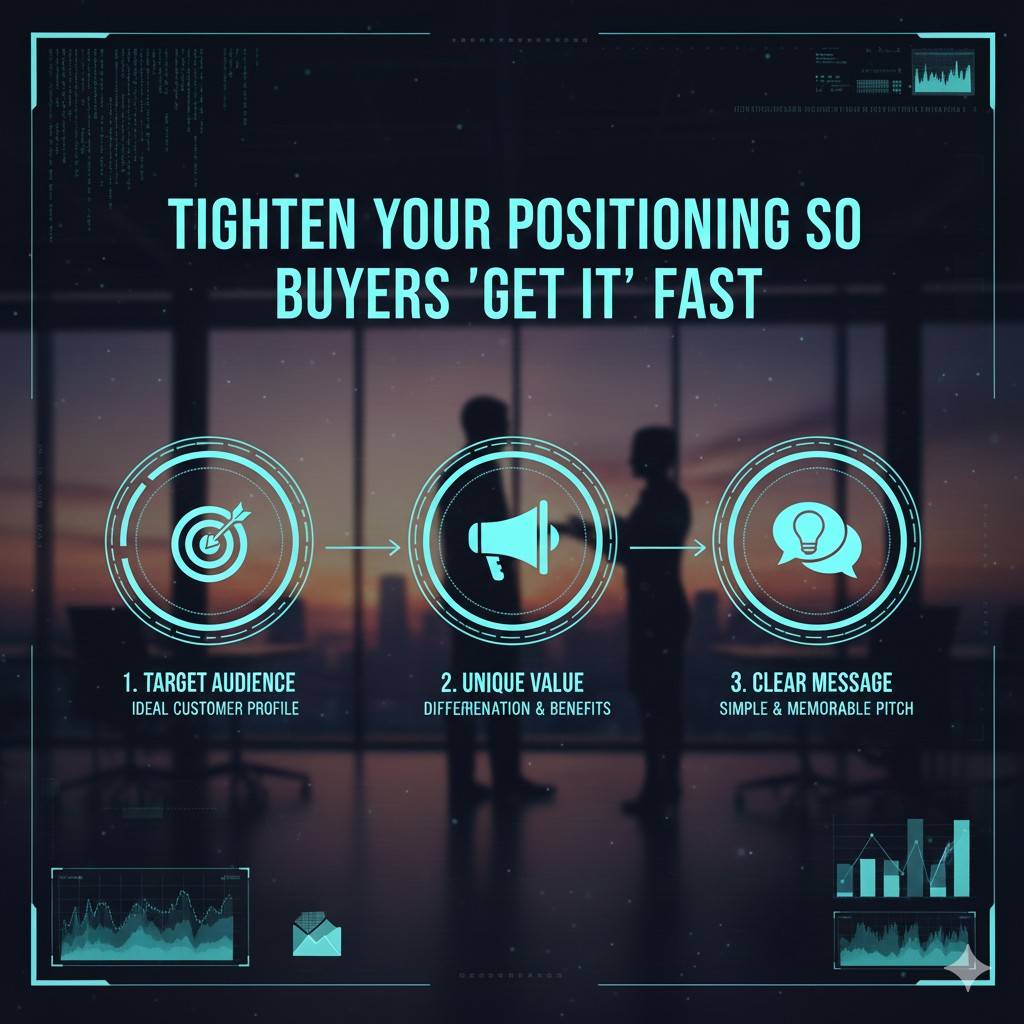
When you are early, you do not need a message that works for the whole world. You need a message that makes one type of buyer say, “This is for me.”
The fastest way to lose people is to describe your product in broad terms. Broad terms make you sound like every other startup. They also make buyers unsure if you fit their case.
A strong early message is narrow. It names the role. It names the job. It names the pain. It names the result.
If you do that, the right people lean in. The wrong people self-select out. That is good. It saves your time and your budget.
Use the buyer’s words, not your words
Technical founders often describe what they built. Buyers care about what changes in their day.
So do not lead with model types, control systems, sensors, or architecture. Those things matter later, after trust is built.
Lead with what the buyer told you. Use their exact phrases, the ones they said with emotion.
When a warehouse lead says, “We keep shipping the wrong items and it causes chargebacks,” that line is more powerful than any technical claim.
When a QA manager says, “We miss defects and then we eat the cost,” that line is the message.
Your job is to reflect the buyer back to themselves. That makes them feel understood. Feeling understood is what opens doors.
Make the “before” and “after” very clear
Most messaging fails because it is fuzzy. It hints at improvement but does not show the change.
Keep it concrete.
Describe the “before” in plain detail. Describe the “after” in plain detail. Tie it to time, cost, or risk.
If a buyer can picture the before and after, they can sell your product internally. If they cannot, they will stall.
The best early positioning is almost boring. It is simple, direct, and obvious.
Remove anything that sounds like a feature list
Features are not the headline.
A buyer does not buy “a dashboard.” They buy fewer mistakes. They buy less downtime. They buy fewer fires.
If you talk like a tool catalog, you make the buyer do the work of connecting dots. Busy people do not do that work. They just move on.
Your message should feel like a problem statement and a promise. Features can show up later, after interest is earned.
Pricing and packaging without guessing
Start from the cost of the pain
Pricing becomes easier when you stop thinking about your cost and start thinking about their loss.
A useful question is, “What does this problem cost you in a month?”
Sometimes the cost is direct money. Sometimes it is wasted hours. Sometimes it is missed revenue. Sometimes it is risk and fines. Sometimes it is churn and unhappy customers.
You do not need perfect math. You need a reasonable range that tells you if the problem is worth paying to fix.
If the pain is small, product-market fit will be hard, because you will fight for every dollar. If the pain is big, pricing becomes simpler, because value is obvious.
Package your offer as an outcome, not as access
Early on, “access to software” can feel abstract. Outcomes feel real.
So you can frame your package around what you deliver.
For example, instead of “AI monitoring platform,” you can frame it as “alert reduction program.” Instead of “robotics automation toolkit,” you can frame it as “cell automation deployment.”
This matters because early buyers are taking a risk on you. Outcomes reduce fear. Outcomes help them justify spend.
It also keeps you focused on what matters. If you sell outcomes, you build what drives those outcomes.
Choose one simple pricing shape
You do not need a complex pricing page.
Choose a simple shape that matches the buyer’s world.
If value grows with usage, you can price by unit. If value is stable, you can price per site or per team. If value is tied to a deployment, you can price as a setup fee plus a monthly.
The worst early choice is something so complex that the buyer cannot explain it to finance.
Keep it boring. Make it easy to approve.
Avoid discounting as your main tool
Discounts can help in rare cases, but they can also train buyers to wait.
If the buyer is unsure, a discount rarely fixes the real issue. The real issue is usually trust, scope, timing, or internal ownership.
Instead of cutting price, tighten scope. Shorten the pilot. Reduce the number of integrations. Provide clearer success criteria.
That protects your value and protects your future pricing.
Treat price as part of qualification
If someone cannot afford even a modest pilot, they might not be a fit for this stage.
You can still learn from them. You can still keep a relationship. But do not build your plan around them.
The goal is not to win every conversation. The goal is to find the lane where deals are possible, repeatable, and growing.
Turn one good pilot into repeatable sales
Your first win should become a playbook
After a pilot works, most founders rush to the next deal and forget to capture what they learned.
Do not do that.
Write down what made the pilot work. Write down the exact steps. Write down what the buyer cared about. Write down what almost broke.
You are building a repeatable system.
On a tight budget, repeatability is your friend. It lowers effort per deal. It shortens cycles. It makes growth less stressful.
Ask for expansion while the value is fresh
The best time to ask for the next step is right after you show results.
If you wait a month, the urgency fades, other fires take over, and your project becomes “nice to have.”
So when the pilot hits success criteria, schedule a next-step meeting quickly.
In that meeting, do not only share results. Also share a simple rollout plan.
Show what happens in month one, month two, month three. Keep it realistic. Keep it light.
This turns a win into momentum.
Convert results into internal proof
Many deals die because the buyer cannot sell it inside their company.
Help them.
Give them a simple one-page summary. Use plain numbers. Use plain language. Show the before and after.
Include what the team did, what you did, and what changed. Include the measured outcome. Include a clear next step.
Make it easy for them to forward it to their boss.
This is cheap to create and extremely powerful.
Ask for a referral in a natural way
Referrals can feel awkward if you ask too early. But after a clear win, it is normal.
You can say, “Do you know one other team like yours that has this same problem?” Then pause.
If the value was real, buyers often want to help. It makes them look good to share a solution.
This is one of the lowest-cost growth tools you have.
Use the second deal to confirm it was not luck
Your first win might be special. It might be a perfect buyer, a perfect setting, or a perfect storm.
The second deal tells you if the pattern is real.
So after your first win, try to repeat it with a similar customer type and the same core problem.
If the second deal also closes faster than the first, you are moving toward fit.
If the second deal feels totally different, your scope might be too wide, or your customer type might still be unclear.
Build a simple growth loop that does not require ad spend
Create a small list of “proof stories”

As you win pilots, you gain stories. Stories sell better than claims.
A proof story is a short case in plain language: what the problem was, what was tried before, what you did, and what changed.
Even one proof story can power many sales conversations.
It also makes cold outreach easier, because you are not asking people to trust a promise. You are showing a result.
Use content only if it is tied to real buyer questions
Content can be a waste if it is written for “everyone.”
If you write, write for the same buyer you sell to. Answer the questions they ask on calls.
Write about how to measure the problem. Write about what causes it. Write about common mistakes. Write about how teams try to solve it today.
This kind of content does two things.
It attracts the right people, and it pre-sells them by showing you understand their world.
It also improves your sales calls, because the buyer arrives with trust.
Keep distribution simple and direct
You do not need complex funnels early.
Share your proof story with your network. Post it where your buyers spend time. Send it to people you talked to before and ask if it matches their experience.
This is slow, but it is cheap. And it compounds.
The key is to stay consistent and stay focused on one lane.
Use IP and defensibility to support your path to fit
Defensibility is not only for later

Many founders think patents and IP are “later,” after revenue.
But in deep tech, early IP can support sales and fundraising sooner than you think.
It helps buyers trust that you are serious. It helps investors see you have something real. It reduces fear that a bigger player will copy you next month.
It also helps you stay focused on what is truly unique in your system.
Patents can shape what you build next
A good patent strategy is not only about filing.
It can help you identify the core invention inside your product. It can help you see what is special, what is common, and what parts are worth protecting.
That clarity can improve your roadmap. It can also help your messaging, because you can explain your unique approach with confidence.
Tran.vc supports this early, without the typical trade-offs
Tran.vc invests up to $50,000 in in-kind patenting and IP services for robotics, AI, and other tech startups. That means real work done with you to build a defendable base while you push toward product-market fit.
If you want to build traction and protect your edge at the same time, you can apply anytime here: https://www.tran.vc/apply-now-form/