
When you are building a company from scratch, everything feels urgent.
Every idea looks important.
Every feature seems like it could change the game.
But you do not have endless time, money, or energy. You have a small team, a short runway, and a long list of things you “should” do. If you try to do it all, you spread yourself thin. You move, but you do not move far.
Early on, your real job is not to work harder.
Your real job is to choose better.
You need to pick the few things that give you the biggest return on effort. That means you decide what to do now, what to delay, and what to ignore. It sounds simple. It is not. There is emotion, fear, and pressure in every choice.
At Tran.vc, we work with deep tech, AI, and robotics founders who live inside this chaos every day. They are brilliant builders. They can ship hard things. But even they get stuck on the same question:
“Out of all the things we could do next, what should we do first?”
This article will help you answer that.
We will walk through how to think about ROI at the early stage, how to cut noise, and how to focus on work that actually moves the company. Not just this week, but for funding, for growth, and for long term defensibility.
We will also show how smart use of IP and patents can give you leverage that most founders ignore, and how that changes what you prioritize.
If you already know that you need clearer priorities and a stronger IP base, you can apply to work with Tran.vc at any time here:
https://www.tran.vc/apply-now-form/
Why Prioritization Is Your Real Early-Stage Advantage
You Cannot Optimize What You Do Not Choose
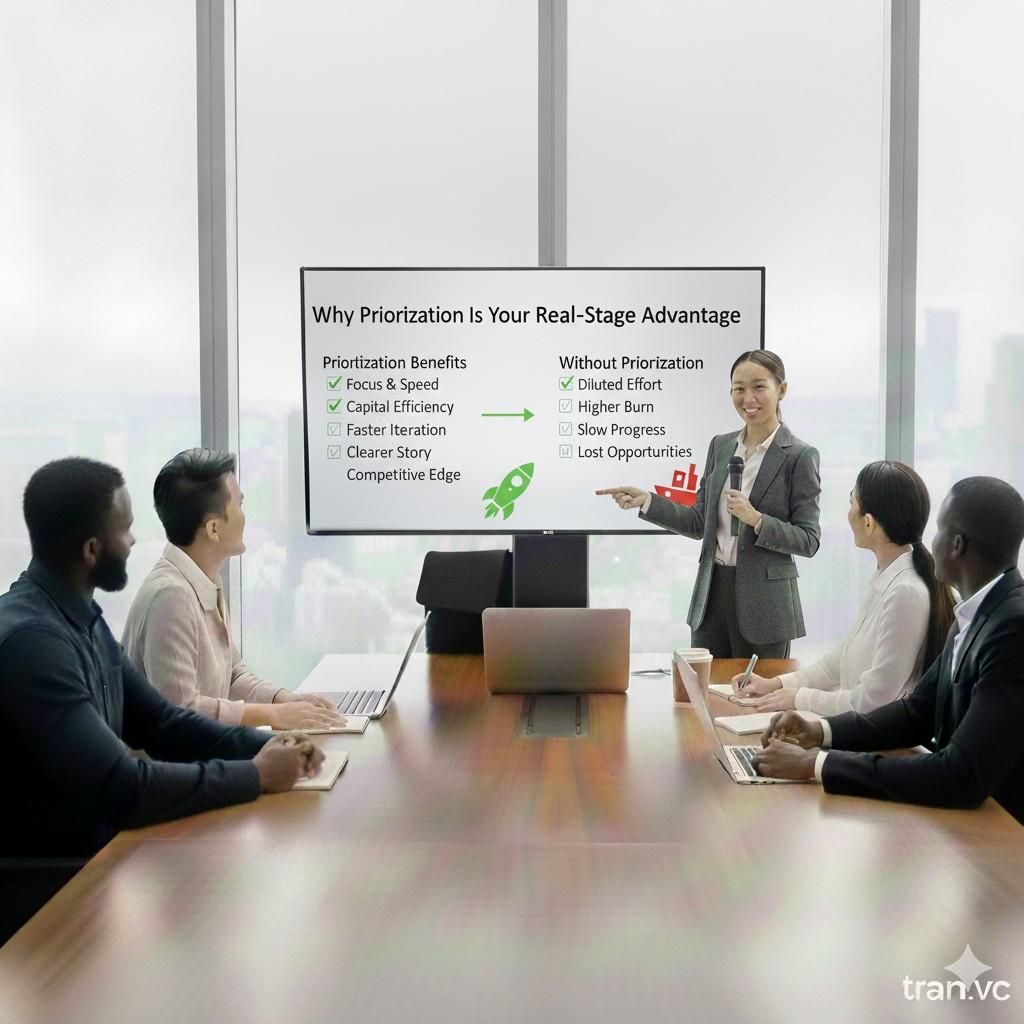
In the early stage, it is tempting to think your main problem is lack of money, small team size, or slow sales. Those issues are real, but they are not the core problem. The deeper issue is that you have more options than capacity. You can build thousands of things, talk to many customer segments, test different pitches, or chase several grant programs at once. If you try to move on all of them, you end up moving none of them far enough to matter.
Prioritization is how you turn chaos into progress. When you choose one main path for a period of time, you give your team a clear message about what matters this week and this month. That clarity reduces friction, confusion, and internal debate. Instead of arguing every day about what to do, you make one deliberate choice, then commit to it long enough to see results. This is how small teams punch above their weight and move faster than much larger companies.
For deep tech and AI founders, this is even more important. You are often working on complex systems that have long build times and many interlocking parts. If you do not decide what problem you are really solving right now, you risk spending months on tech that looks impressive but does not move you toward a fundable, defensible business. A clear priority system protects you from your own talent and curiosity. It sets boundaries around the work so you do not drift into endless “cool” experiments that never turn into assets.
At Tran.vc, we see a noticeable shift when founders learn to say “no” on purpose. Once they stop treating every idea as urgent and every feature as critical, their roadmap becomes cleaner and their story becomes sharper. This is also when their IP strategy starts to make sense. When you know the path you are on, it becomes much easier to see which inventions are central and need protection now, and which can wait. If you already feel that you are doing too much and still not moving fast enough, it may be time to apply this kind of intentional focus. You can start that process with us anytime at: https://www.tran.vc/apply-now-form/
Busy Is Not The Same As Effective
Many early-stage teams confuse motion with progress. The calendar is full, the Slack channels are active, features ship, decks get updated, and everyone feels tired. Yet when you zoom out after three months, it is hard to point to one major shift in the business. You have worked a lot, but you have not created real leverage. This gap between effort and outcome is almost always a prioritization problem, not a work ethic problem.
Being effective means directing your energy where it has the highest impact on risk and proof. At the earliest stage, investors are not just buying your product; they are buying your ability to learn, to focus, and to build something that is hard to copy. That comes from a few thoughtful bets, not a long list of fragmented tasks. If you are doing ten small things at once, you may feel committed, but you are really just avoiding the hard choice of what matters most now.
A simple way to check if you are being effective is to ask yourself one question every week: “What changed in our level of proof this week?” Proof can mean more than revenue. It can be a signed pilot, a working demo, a patent filing, or a key technical milestone. If you cannot name a clear, step-change in proof for your company after several weeks of effort, your priorities are loose. You are busy, but not directed. The fix is not to work longer hours. The fix is to pick different work.
Tran.vc works closely with founders to link their weekly work to long term proof. When we help a team shape its IP strategy, we are not just helping them file patents. We are helping them choose what to build and what to protect first, so that their effort creates an asset that makes every future conversation with investors easier. That shift from random work to asset-building work is often the moment when a team stops spinning and starts compounding.
What ROI Really Means At The Earliest Stage
ROI Is Not Just About Revenue
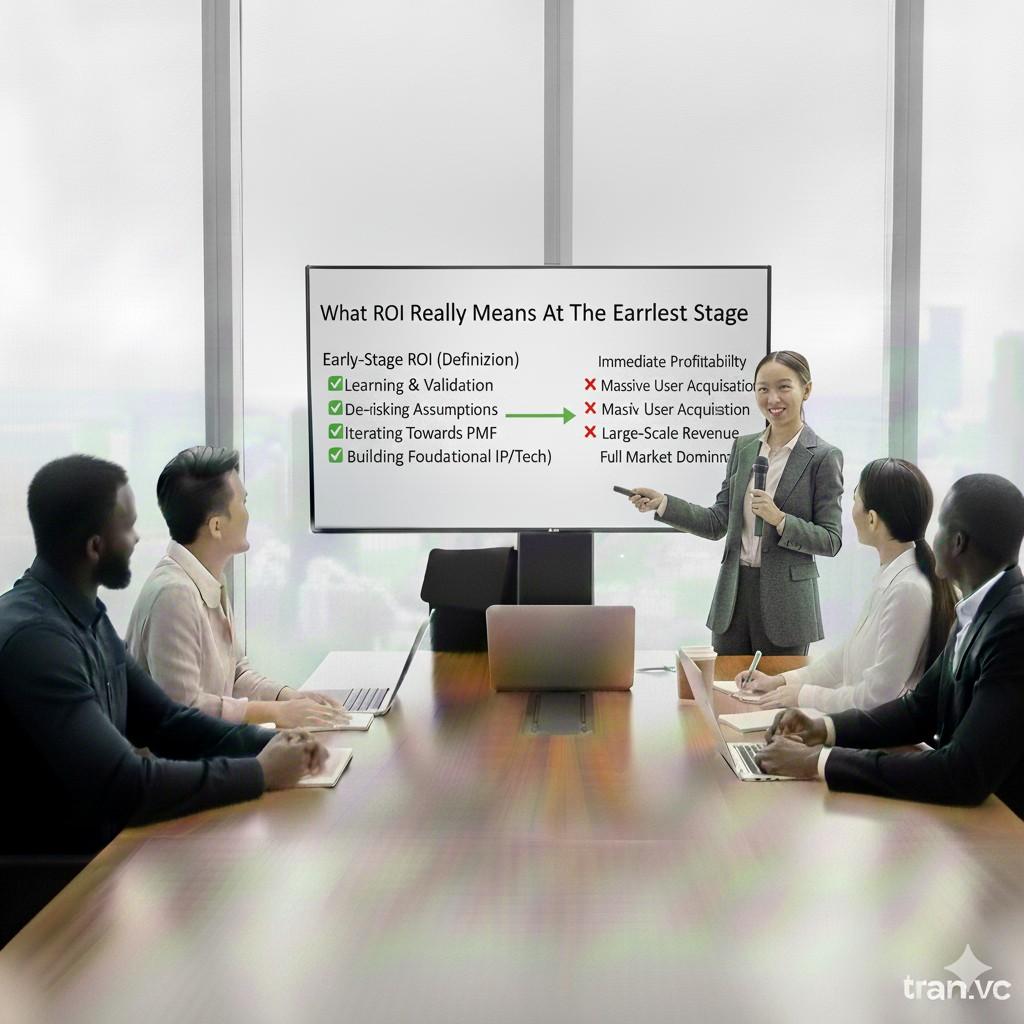
When people hear “ROI,” they think of money in and money out. That classic view is useful later, but very limiting at the start. In the early stage, you are not a mature company trying to squeeze a few more percentage points out of a stable system. You are trying to prove that this company should exist at all and that you are the right team to build it. If you treat ROI only as short-term revenue, you will over-prioritize quick wins and under-prioritize deep, defensible work.
Real early-stage ROI includes every outcome that changes the power of your position. A patent filing that covers a key core method may not bring in cash this month, but it shifts your long term bargaining power with investors, partners, and even acquirers. A clear demonstration that your robot can perform a task that others cannot may not be fully productized yet, but it can be the difference between a “maybe later” and a term sheet. A great ROI move is any step that strengthens your proof, your defensibility, or your speed, without burning your runway in a reckless way.
When you think this way, a lot of noisy tasks fall away. Every social post, conference, or small integration starts competing with actions like “file a core patent on our key algorithm” or “get the first paid pilot with a real customer.” In that comparison, the real high-ROI work becomes obvious. It is often less glamorous, sometimes more boring, but incredibly powerful for your future. This is why at Tran.vc we invest in IP services as our main form of seed support. Strong IP may not show up as revenue in your dashboard next month, but it changes your long term ROI curve in a way that simple marketing pushes cannot.
Learning, Proof, And Leverage
Think In Terms Of Learning, Proof, And Leverage

One useful frame for early-stage ROI is to break outcomes into three buckets in your own mind: learning, proof, and leverage. Learning is about reducing uncertainty. Proof is about showing that your claims are real. Leverage is about making each future step easier or cheaper. High ROI work often hits at least two of these areas at the same time.
For example, building a trimmed-down demo to test with three real users gives you learning about their needs, proof that your tech works outside the lab, and leverage in future sales or investor talks. Filing a patent on a core process may not give you customer learning, but it gives strong proof that your invention is unique, and leverage in every future negotiation. On the other hand, redesigning your logo at this stage might feel nice, but it delivers almost no learning, no proof, and no leverage. It is low ROI work dressed up as progress.
When Tran.vc works with founders, we look at their roadmap through this learning-proof-leverage lens. We ask which tasks will help them answer the big unknown questions about their market or tech. We ask which steps will create assets that keep paying off: patents, data sets, system designs, key reference customers. Then we encourage them to rank those above everything else. This simple mental model helps cut through emotional bias and fear. Instead of asking, “What do we feel like doing?” you ask, “What gives us the most combined learning, proof, and leverage for the time and money we spend?”
If you sense that your current roadmap is full of tasks that do not shift your learning, proof, or leverage in a clear way, it may be time to reframe your view of ROI. You do not have to do this alone. You can reach out to Tran.vc and let us help you re-center your work around real value creation and IP-backed assets. Our application form is always open at: https://www.tran.vc/apply-now-form/
Step 1: Get Clear On Your Real Constraints
Know Your Time, Team, And Cash Limits
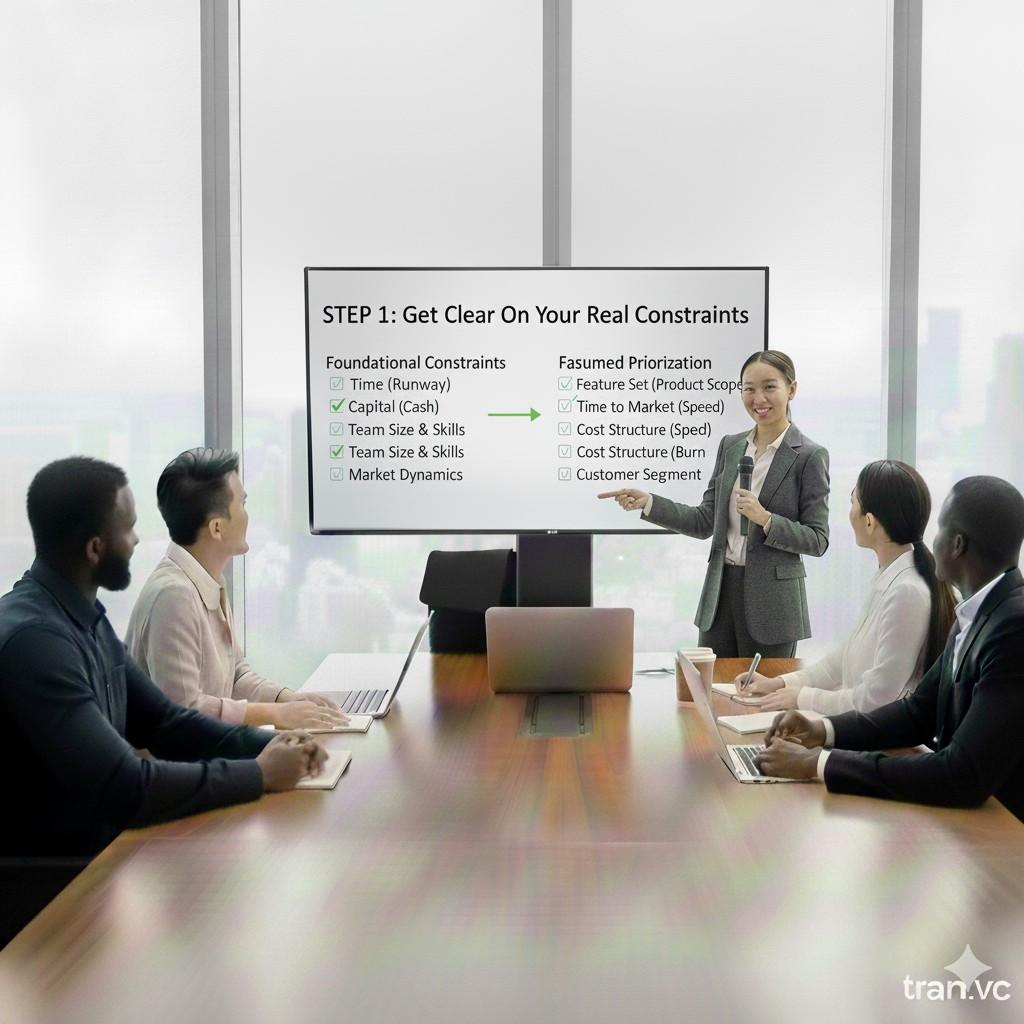
Every smart priority decision starts with a clear picture of your limits. Many founders skip this step and pay for it later. They plan as if they have more time than they do, more energy than they really have, and more money than is in the bank. This leads to roadmaps that look good in a slide deck but collapse in real life. To prioritize well, you need to be honest about the box you are working inside. That box is formed by your time, your team, and your cash.
Time is not just about months of runway. It is also about attention. If your core builder is split between fundraising, customer support, and coding, you do not have a full-time builder. If you are also holding a day job or consulting on the side to cover costs, your actual focused hours on the startup may be far smaller than you tell yourself. Being clear about this gives you a more realistic sense of how much you can do in a given quarter. That honesty forces sharper trade-offs, which is good.
Your team also sets a hard limit. A small, strong team can do amazing things, but it cannot do everything at once. If you only have one senior engineer, you cannot build four major features and a fresh internal tool at the same time without quality dropping. If no one on the team is strong at sales, it will take longer to land pilots, and your roadmap should reflect that. Instead of pretending these limits do not exist, you design around them. You pick the few efforts that match the strengths you have today, while slowly building the strengths you will need later.
Cash might feel like the most obvious constraint, but many founders still treat it as an abstract number. The real question is not just how much money you have, but how many meaningful shots on goal that money gives you. If each major experiment or feature build costs a certain amount of time and money, and you can only afford a handful of them, you must become ruthless about which ones you take. That is the heart of prioritization. When we work with founders at Tran.vc, we aim to turn some of that spend into long term IP assets, so that even when an experiment fails, the work leaves behind something that can protect or support the company later.
Know Your IP And Technical Edge Limits
There is another kind of constraint that deep tech and AI founders often overlook. It is the limit around what you can defend. You might be able to build many things, but not all of them will be unique, and not all will be worth protecting. If you spread your technical effort across areas that are hard to own, you risk building a product that others can copy as soon as you show it. That is a hidden constraint: your defensibility.
Understanding your IP boundaries early helps you make better calls about what to build first. If a feature depends on a generic model or off-the-shelf part that any competitor can adopt in weeks, it may not be the best center of your roadmap. On the other hand, if you have a novel control method, a training pipeline, or a hardware mechanism that could be protected, that may be a better anchor for your work. When you know where your edge can be formalized and defended, you start to plan your tech and product tasks around those core elements.
This is where many founders benefit from outside help. Patent law, prior art searches, and IP strategy are real crafts. Trying to learn them on the side while also building and selling can slow you down. At Tran.vc, our entire model is based on giving you up to $50,000 in in-kind IP and patent services so that you do not have to pick between building and protecting. We help you see which parts of your system are most strategic to claim and how that should shape your roadmap. The goal is not to file as many patents as possible. The goal is to align your build plan with a small number of high-value IP assets that change the game for funding and growth.
When you bring your constraints into the light—time, team, cash, and defensibility—prioritization stops being guesswork. It becomes a design problem. You are no longer asking, “What do we feel like doing next?” You are asking, “Given our real limits and our IP edge, what is the smartest next move?” That shift alone can save you months of waste and give you a much stronger story the next time you talk to a seed investor. If you want guided help in mapping those constraints and turning them into a clear plan, you can apply to work with us at: https://www.tran.vc/apply-now-form/
Step 2: Define What “Winning” Looks Like In The Next 90 Days
Set A Target That Is Clear Enough To guide Every Choice
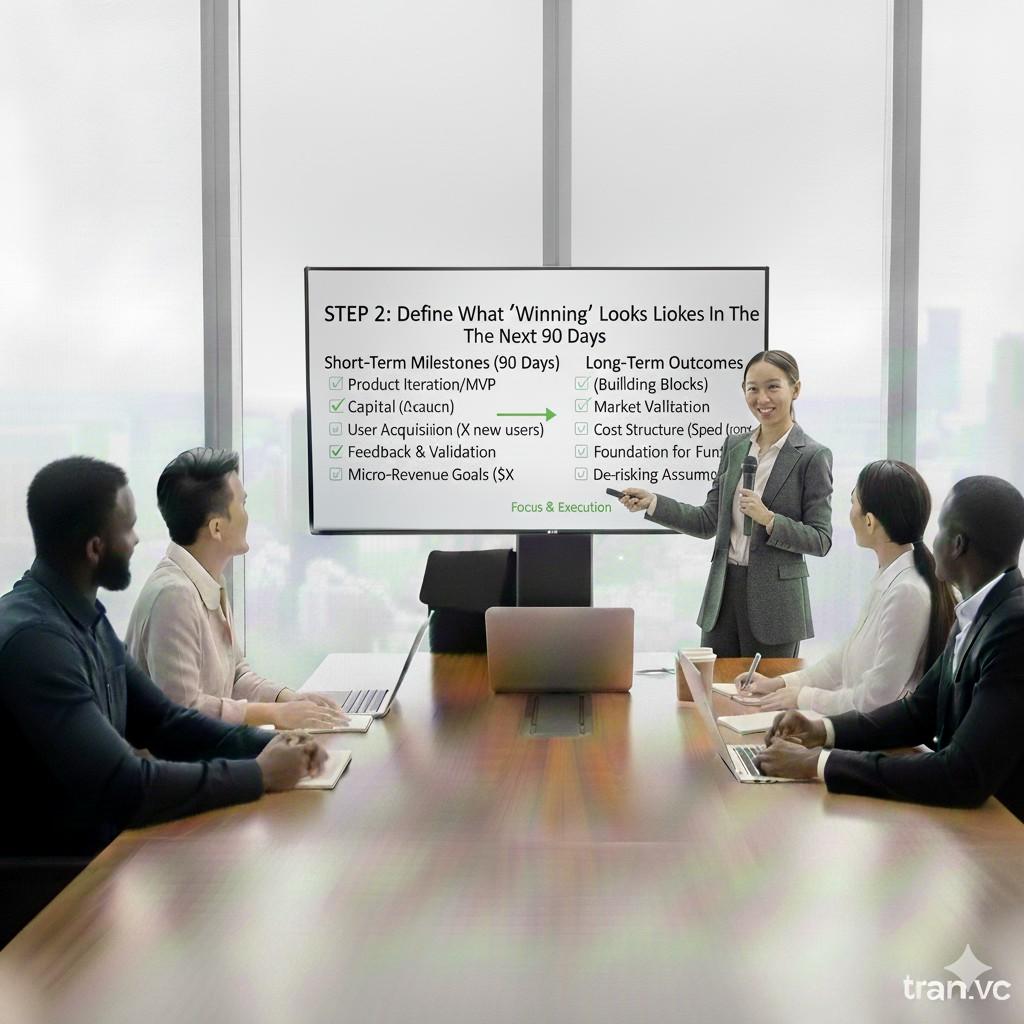
Most early teams say they have goals, but what they really have are hopes. They want traction, funding, growth, or recognition, but these targets are too vague to guide choices. When your goal is fuzzy, everything feels important. When everything feels important, nothing gets done in the right order. To prioritize well, you need a clear picture of what a “win” in the next 90 days looks like. It does not need to be fancy or complex. It only needs to be specific enough that it shapes every decision you make.
A good 90-day target should point toward something that changes your company’s position. It might be landing one strong pilot with a real customer who cares deeply about your outcome. It could be proving a technical milestone that unlocks your next demo or patent claim. It could even be building a small but working loop of your product that lets an investor see your value without you speaking a word. The point is to choose one main thing that, if reached, gives you more leverage than you have today.
This level of clarity makes the messy day-to-day far simpler. When you and your team know exactly what you are moving toward, you stop fighting over small tasks and start asking a more grounded question: “Does this help us hit our 90-day win?” If the answer is no, you can let the task drop or push it to a later cycle without guilt. This is how mature teams move. They do not try to carry everything. They carry the few things that move the needle.
At Tran.vc, this is often where founders feel a sense of relief. Once we help them anchor their next 90 days around a clear technical proof, a patent filing, or a customer milestone, the noise drops away. The team becomes calmer and more confident because they are no longer chasing everything at once. If you want help identifying what your next meaningful milestone should be, our application form is open anytime at: https://www.tran.vc/apply-now-form/
Make The Target Hard Enough To Stretch You But Not So Hard That You Freeze
Setting a clear 90-day target is not just about focus. It is also about pace. You want a goal that stretches your team enough to create urgency but not so much that it feels impossible. When a target feels impossible, people either freeze or quietly give up. When it feels too easy, they drift and lose the sharp edge that early companies need. Finding the right balance is a skill, and it often comes from honest reflection about past cycles.
A useful rule is that a good 90-day goal should feel slightly uncomfortable. It should make you think, “This will take real effort, but we can do it if we focus and if we cut out the extra noise.” That discomfort is healthy. It pulls you out of routine habits and forces you to use your time with intention. It also helps you notice trade-offs sooner. If you want to hit a big technical win in 90 days, you will not spend weeks polishing your brand colors or rewriting your pitch deck for the tenth time. The urgency of the goal acts as a natural filter.
This kind of goal also aligns closely with how seed investors think. They want to see that you can pick a meaningful milestone and execute it without drifting. They want to see that your team moves with purpose, not chaos. Hitting a well-chosen 90-day goal signals that you can focus, learn, and deliver. Even if the milestone is technical and not commercial, it shows discipline. That discipline matters just as much as the milestone itself.
When Tran.vc works with founders, we often help them calibrate their goals in this exact way. We look at their tech, team capacity, and IP roadmap. Then we help them shape a target that is ambitious enough to matter but realistic enough to hit. When founders do this well, their next three months are often the most productive stretch they have ever had. If you are unsure how to size or shape a strong 90-day win, you can always reach out to us at: https://www.tran.vc/apply-now-form/
Step 3: Use A Simple Filter To Choose What To Do First
Ask Which Tasks Remove The Most Risk
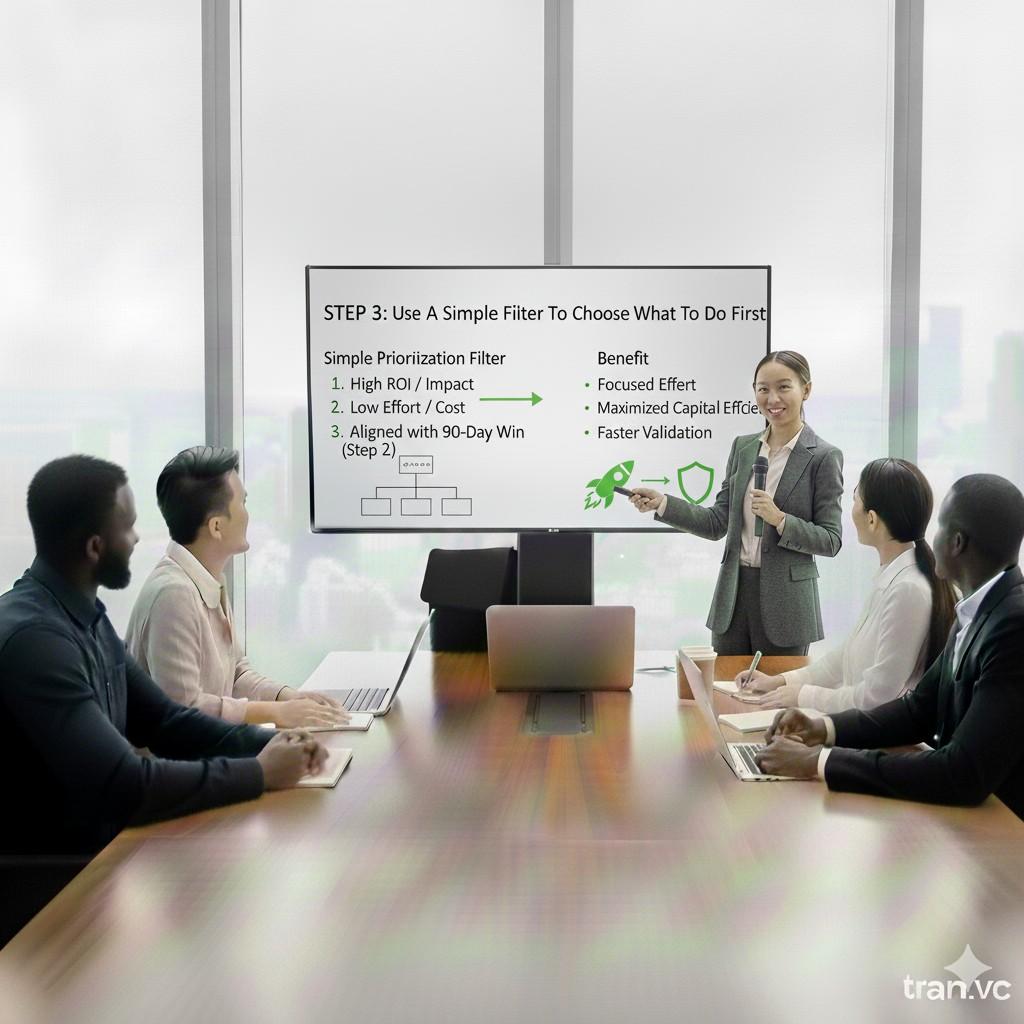
Every early-stage company is a bundle of risks. There are technical risks, market risks, team risks, and defensibility risks. You cannot remove all of them at once, but you can remove them in a smart order. The tasks that deserve your attention first are the ones that eliminate the biggest risks standing between you and your next major win. Those are the tasks with the highest ROI because they unlock everything that comes after them.
For many deep tech founders, the biggest risk early on is technical uncertainty. If your core method, model, or mechanism is still unproven, then sales, partners, and fundraising will all be uphill. That means your first priority may be to prove that the tech works in a clear and measurable way. Once that risk falls, many other doors open. You can talk to customers with confidence. You can show investors something real. You can capture IP based on working evidence instead of vague ideas.
For other founders, the biggest risk might be customer clarity. Maybe you built something impressive, but you are unsure who needs it most or who is willing to pay. In that case, the highest ROI activity might be hands-on conversations, small pilots, or targeted field tests. These steps may not feel technical, but they reduce a fundamental risk: the risk of building something that no one is desperate to adopt. Removing that risk early protects you from months of blind development.
At Tran.vc, we look closely at which risks block your ability to raise or grow. We then help you focus on the moves that shrink those risks first. Often, this includes building an IP layer that covers your most defensible work. Reducing the risk that someone else can copy your invention is just as important as proving the invention works. When you see risk this way, you start to view your tasks in a clearer order. You stop trying to do everything and start doing the few things that unblock the rest.
Create Assets, Not Just Output
Ask Which Tasks Create Assets, Not Just Output

The next filter you should use is to ask which tasks create lasting assets. Assets are things that help you again and again. They compound over time. Output, in contrast, is something you do that fades quickly. A rushed blog post, a messy prototype, or a deck update might feel productive, but these outputs do not give you leverage later. They vanish or require constant upkeep.
Assets look very different. They can be patents, data sets, system diagrams, well-tested modules, recorded customer insights, or strong demo videos. They can also be relationships, such as a committed pilot partner or a technical advisor. Assets help you speed up future cycles. They help you avoid repeating work. They help you show your value without needing long explanations. High-ROI work often leads to assets, not temporary output.
One of the most overlooked assets is early IP. Many founders delay patent filings until later, either because they think it is too early or because they worry about the cost. But early filings on the right ideas can reshape your long-term position. They turn technical work into property. They give you leverage in deals. They give you protection before you become visible in the market. This is why Tran.vc invests up to $50,000 of IP services into the companies we work with. We want you to build assets that keep paying off, not just outputs that disappear.
If you are stuck between two tasks and unsure which to choose, ask yourself which one creates an asset that strengthens your company’s footing for months or years. When you choose asset-building work more often, your company starts to feel more solid, more defensible, and more fundable. That sensation is not an accident. It is the result of stacking real assets instead of chasing shallow wins.