
Setting up founder stock should be one of the simplest parts of starting a company.
It is not.
It often becomes the first “silent disaster” that follows a startup for years. Not because the founders did anything evil. Usually it happens because smart people move fast, copy a template, sign something they do not fully understand, and tell themselves they will “clean it up later.”
Later shows up as: a co-founder leaving with too much equity, a messy cap table that scares investors, tax surprises, unclear ownership of code, or a board fight that started from day one but nobody noticed. The painful part is that most of this chaos is avoidable if you set founder stock up the right way in the first week or two.
This article is about doing that—without turning your early days into a legal project. We are going to keep it plain and real. Not “lawyer talk.” Just the key moves that prevent chaos: what founder stock is, how it should be issued, what documents matter, what decisions you must make early, and what mistakes create the kind of mess that is expensive to fix.
And because Tran.vc works with technical founders every day—AI, robotics, deep tech—we will also talk about the hidden IP traps that can break your stock setup. Founder stock is not only about “who owns what.” It is also about “who can prove they own what,” including the inventions inside your product.
If you want help doing this cleanly, you can apply any time here: https://www.tran.vc/apply-now-form/
Now, before we get tactical, let’s get one thing straight.
Founder stock is not a vibe. It is not a handshake. It is not a shared Google Doc with percentages. It is a real asset with legal weight. If you issue it wrong, the problem does not stay small. It grows with every new hire, every investor call, and every line of code you ship.
When people say “we split it 50/50,” that sounds fair. But fairness is not the same as clarity. And clarity is what investors, attorneys, and future team members will demand from you. Clear stock setup is not about being rigid. It is about being safe. It is like putting guard rails on a road before you start driving fast.
Here is the simplest way to think about it:
Founder stock is the ownership you get at the start, when the company is worth almost nothing. That is why it is cheap. But because it is cheap, the rules around it must be tight. If you do not set those rules, the IRS, a future buyer, or a future investor may set them for you—and they will not do it in your favor.
So what does “set it up right” actually mean?
It means you do a few core things, in the right order, with clean paper:
You form the company properly.
You authorize shares.
You issue founder shares with vesting.
You sign the right purchase and IP documents.
You handle tax filings like the 83(b) on time.
You keep records that match reality.
You avoid common traps like “we will paper it later,” “we will just use a SAFE first,” or “we can fix the cap table after we raise.”
That is the path to no legal chaos.
But if you have never done it, it is easy to make a mistake without knowing it. Let me show you what “mistake” looks like in real life.
A typical chaos story goes like this:
Two founders build a product for six months. They are both writing code. One founder also pays for servers and a few contractors. They agree on a 50/50 split. They incorporate. They issue shares, but they do not set vesting because it “feels weird to not trust each other.” Nobody signs an invention assignment. They do not file 83(b) because nobody told them. Then one founder leaves. Now the company is stuck: half the company belongs to someone who is not building anymore. If the remaining founder tries to raise, investors ask, “How do you get those shares back?” There is no clean way. The only way is negotiation. The person who left knows this. The price goes up. The company slows down. The remaining founder gets bitter. The new investor walks away. That is chaos.
Or another one:
A single founder incorporates and issues themselves a huge pile of shares with no paperwork. Months later they bring in a co-founder. They “promise” them 20%. They never issue it. The co-founder works for a year. Then it is time to raise. Now the cap table shows the co-founder owns nothing. The co-founder is angry. The investor is nervous. The founder tries to fix it by issuing shares late, but now the company has value, and the stock is not cheap anymore. That can create tax problems for the co-founder. It also creates trust problems that can kill the working relationship. More chaos.
And one more, very common in deep tech:
A founder has been working on an invention in a prior job, a PhD lab, or a past startup. They start a new company and issue founder stock. But the invention rights are not clean. The university might claim ownership. The old employer might claim it. Or a contractor wrote key code, and there is no assignment. Investors do diligence and say, “We cannot tell if the company owns its own tech.” Founder stock setup is now tied to IP setup, and because it is unclear, everything is harder and slower.
This is exactly why Tran.vc exists. We help founders set up strong foundations early, including IP strategy and patent support, so your ownership is real, defensible, and fundable. If you want to talk, you can apply here: https://www.tran.vc/apply-now-form/
Now let’s move into the practical heart of this.
Founder stock is usually common stock. It is the same class of stock employees may get later, but founders get it at the start when it is very low priced. The company is young, there are no revenues, and the risk is high. That is why the price per share is tiny. Sometimes it is fractions of a cent.
This low price is good. It means you can buy a lot of shares for very little money. You are not “getting free stock.” You are buying it cheaply because the company is worth very little right then.
That purchase part matters. If you do not actually “purchase” the stock properly, you can create confusion later. Founders sometimes skip the purchase step and treat it like a gift. That is not ideal. A clean founder stock setup has a clear purchase agreement, a clear number of shares, a clear price, and a clear payment record.
But the bigger issue is vesting.
If you remember one thing from this entire article, remember this:
Founder stock should almost always vest.
Vesting is the rule that says: you earn your shares over time. If you leave early, you keep only what you earned. The rest goes back to the company.
This is not about trust. It is about reality.
Startups are not stable. People get sick. Life changes. Co-founders break up. The company pivots. The person you thought would build with you for ten years might be gone in ten months. Vesting protects everyone, including the person who stays.
Without vesting, you can end up in a situation where a non-working founder owns a large part of the company forever. That blocks hiring, fundraising, and sometimes even basic decisions.
The standard vesting pattern in venture-backed startups is four years with a one-year cliff. In simple words, that means:
Nothing is earned in the first year. At the one-year mark, you earn a chunk. After that, you earn the rest monthly over the next three years.
Why does the cliff exist? Because it prevents a short-term situation where someone joins, leaves in two months, and keeps equity they did not earn. The first year is a test. If you both make it through the first year, then equity begins to lock in.
Founders sometimes push back on vesting. They say, “But I came up with the idea,” or “I already built the first version,” or “I am putting in money.” That may all be true. Vesting can still work with that reality. You can handle early work in a fair way by adjusting the split, or by using a small amount of immediate vesting, or by granting extra shares that vest faster. The point is not to ignore past work. The point is to avoid a future trap.
If you think vesting is only for employees, not founders, you will learn otherwise the first time an investor asks for your documents. Most serious investors expect to see vesting on founder shares, especially when a company is early. If you do not have it, they may require you to add it as a condition of investing. Doing it later is harder. It can also create tax issues.
Speaking of taxes, we need to talk about the 83(b) election.
This is the single most missed step in founder stock setup.
And the worst part is that it is easy.
When your stock is subject to vesting, the IRS treats it in a special way. If you do nothing, you may owe taxes later as the shares vest, based on the value at that later time. If your company grows, that value can be much higher. So the tax bill can become huge, even though you did not sell anything and did not receive any cash.
The 83(b) election is a simple filing that tells the IRS: “Tax me now, when the stock is cheap, not later when it is expensive.” Most founders should file it within 30 days of receiving the stock. Not 30 days from incorporation. Not 30 days from your lawyer emailing you. Thirty days from the date the stock is issued to you.
Miss the window, and you usually cannot fix it.
This is why a clean founder stock setup is also a calendar problem. You need a system that makes sure the filing happens on time, with proof.
I am not giving tax advice here. But I am telling you the common reality: founders who file 83(b) early usually sleep better. Founders who miss it often do not learn they missed it until much later, when the stakes are high.
Now let’s talk about another part that feels “small” early but becomes huge later: how many shares to authorize and issue.
Many founders obsess about percentages. They say, “I want 60% and you get 40%.”
Percentages matter, but share count matters too. Your company needs a cap table that can grow. That means you need enough authorized shares to grant stock to future hires, advisors, and investors without needing to amend things constantly.
In many startups, founders authorize a large number of shares at formation—often something like 10 million shares of common stock. Then founders issue themselves a portion of that. The remaining shares sit in the option pool or remain unissued until needed.
The exact number is less important than the idea: you want a clean structure that is easy to work with later. Using “10,000 shares total” might seem simpler, but it can create awkward math later when you want to grant tiny fractions to employees. Using a larger share count makes grants feel normal in whole numbers.
But again, the real problem is not the number. It is whether the paperwork matches reality.
The legal chaos comes when:
the founders think they own shares, but the shares were never properly issued
the cap table says one thing, the signed documents say another
the vesting terms are in someone’s head, not in a contract
the founder paid nothing for shares, and nobody recorded payment
the company used a template, but did not follow the steps the template assumes
When investors do diligence, they are not only looking for whether your idea is good. They are looking for whether your company is safe to invest in. A messy stock setup signals risk. It signals future lawsuits. It signals wasted time. Investors do not want to spend their money cleaning up past mistakes.
Now, there is one more layer for Tran.vc founders, especially in AI and robotics: IP.
If your company does not own the inventions, then what does your stock really represent?
This is why founder stock setup must include invention assignment and IP assignment documents. These are agreements where each founder assigns their relevant inventions and work product to the company. It is how the company, as an entity, becomes the owner of the tech.
This matters more than most people realize.
If you build something before incorporation, you should still assign it to the company after you incorporate. If you build it while employed somewhere else, you need to check your employment agreement. If you use contractors, you need proper contractor agreements that assign IP to the company. Otherwise the company may not own what it thinks it owns.
This becomes critical when you file patents.
Patents are not just “nice to have.” For deep tech, they can be a major part of your moat. But patents also force clarity. Inventorship, assignment, who paid for filings, and who owns the rights—all of it ties back into the company structure and founder stock. If your founder stock setup is messy, your IP story often becomes messy too. And that is a red flag in deep tech fundraising.
Tran.vc invests up to $50,000 in-kind in patent and IP services to help you build this foundation early—before you raise a seed round, while everything is still simple. If you want that kind of help, apply here: https://www.tran.vc/apply-now-form/
At this point, we have covered the “why” and the core concepts. Next, I would move into the step-by-step setup in the real order founders should do it, including the exact decisions to make (split logic, vesting terms, reverse vesting mechanics, board approvals), the documents that matter, and the common traps like “issuing stock before incorporation,” “forgetting to authorize shares,” and “using SAFEs before the cap table is clean.”
How to Set Up Founder Stock Without Legal Chaos
Step 1: Start with the company, not the split
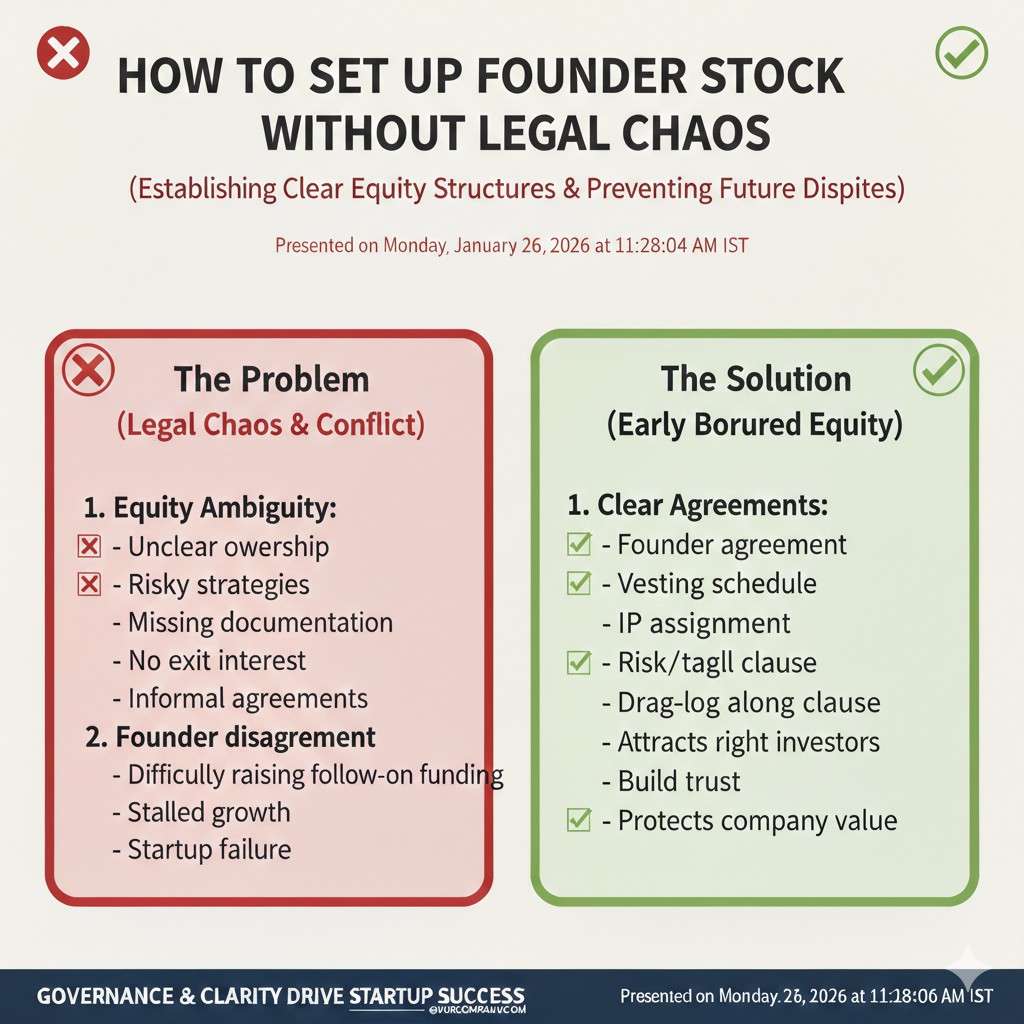
Before you talk about who gets what, make sure the company exists in a clean way. Many founders agree on equity first, then incorporate later, then try to “map” the agreement onto real shares. That is where confusion starts.
A proper setup begins with forming the company, authorizing shares, and setting up a simple system for records. When this is done first, every later step becomes easier because you are working with real documents, not promises.
If you are building in AI, robotics, or deep tech, this step matters even more. Investors will check whether your company was formed correctly because it is tied to ownership of code, inventions, and patents.
Step 2: Understand what founder stock really is
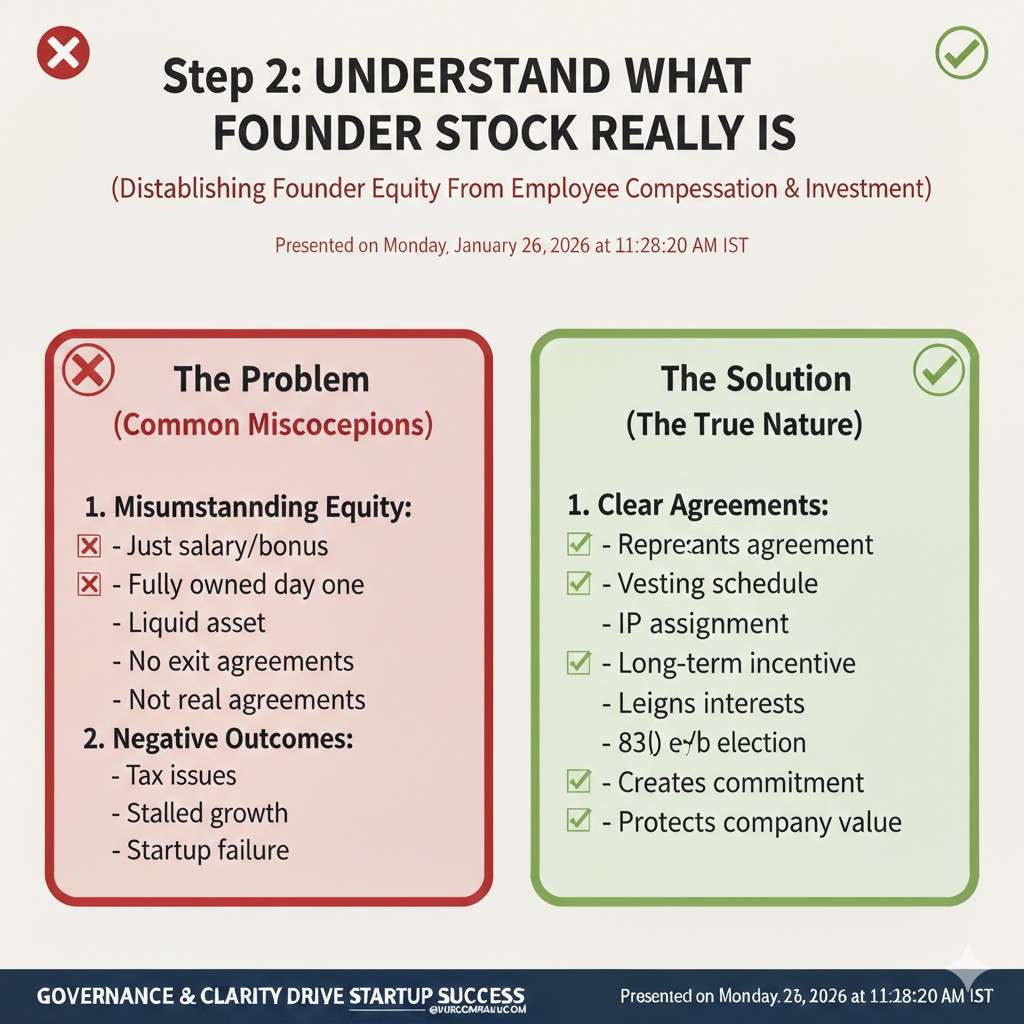
Founder stock is usually common stock issued at the earliest stage when the company has close to no value. That is why the purchase price is low. The low price is normal, but it comes with responsibilities.
The core idea is simple: you are buying ownership in a legal entity. That ownership should be clear enough that a stranger can read your documents and know exactly who owns what, under what terms, and under what conditions.
If your “ownership” only lives in texts, emails, or a spreadsheet, you do not have real certainty. You have a story. The moment outside money, new hires, or a co-founder conflict appears, stories break.
Step 3: Decide the split based on work, risk, and time
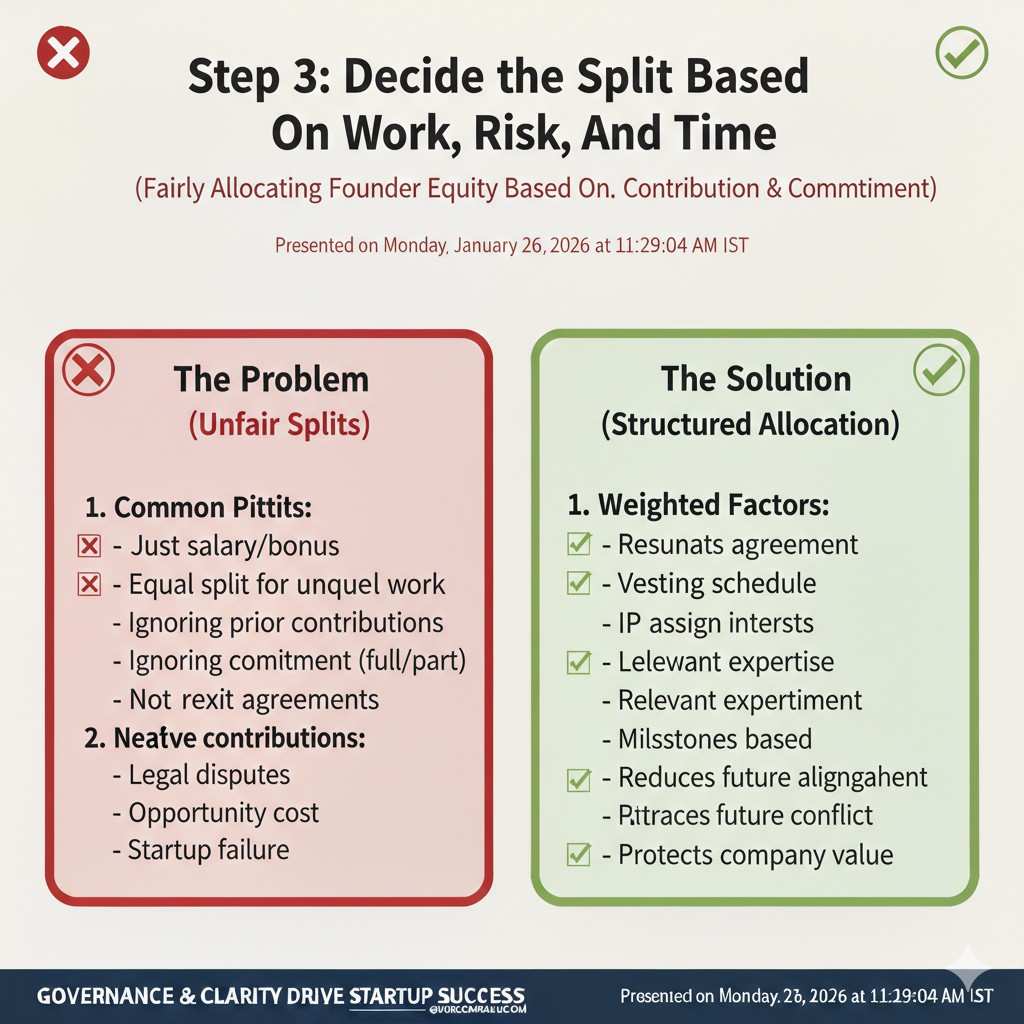
Most founder fights start because equity feels personal. It is not only about money. It feels like respect. That is why you need a clean way to decide, so the split does not turn into a quiet grudge.
A fair split is not always equal. It depends on who is taking the bigger risk, who is working full time, who is putting in cash, and who is making the key early decisions. It also depends on what happens if someone leaves.
The split should be decided before stock is issued, but after you agree on roles. If one founder is building the product full time and another is “helping on weekends,” the split should reflect reality, not hope.
Step 4: Use vesting even when you trust each other
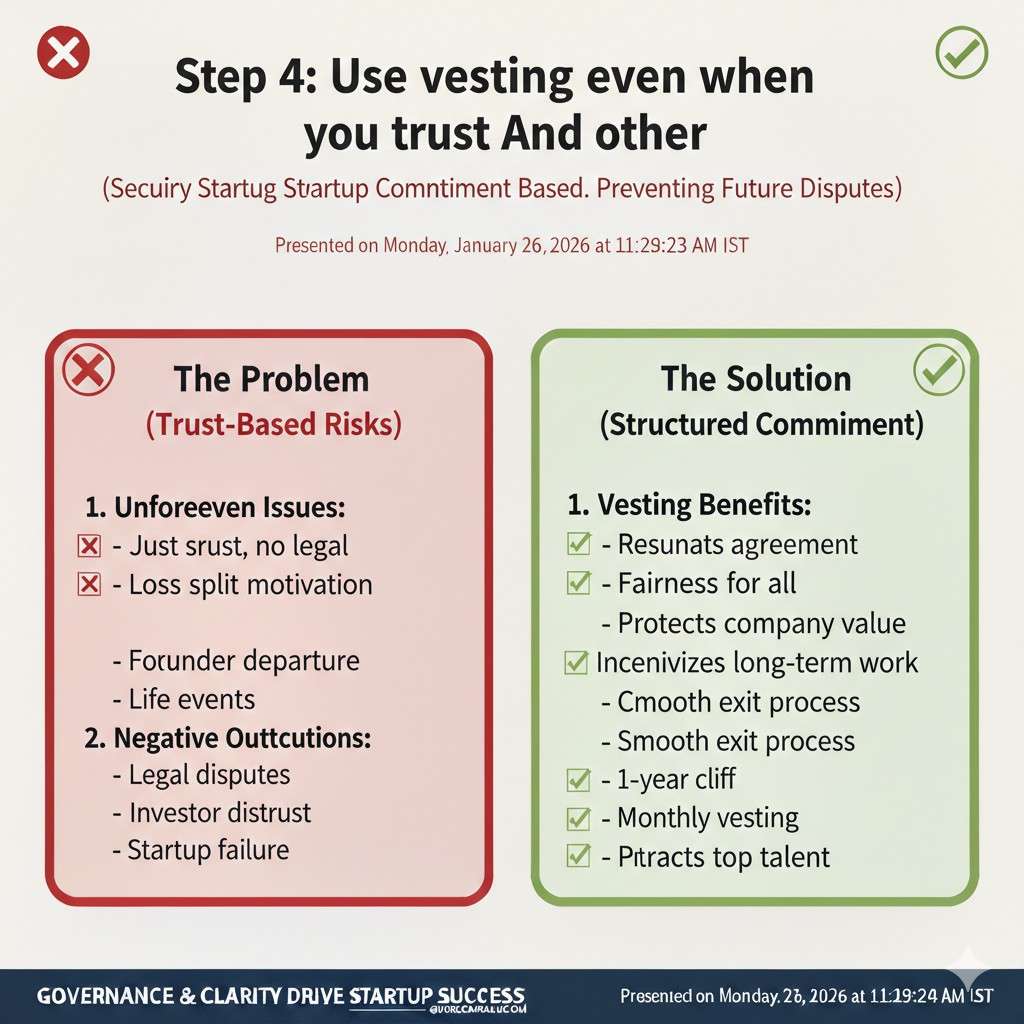
Vesting is the single best tool for preventing early equity disasters. It means founders earn shares over time. If someone leaves early, they do not keep what they did not earn.
Many founders avoid vesting because it feels like distrust. But vesting is not a sign of doubt. It is a sign that you understand startups are uncertain and you want to protect the company from avoidable damage.
The common setup is four years of vesting with a one-year cliff. In plain terms, that means nothing is earned until one year passes. After that, shares earn gradually over the remaining time.
Step 5: Know what “reverse vesting” really means
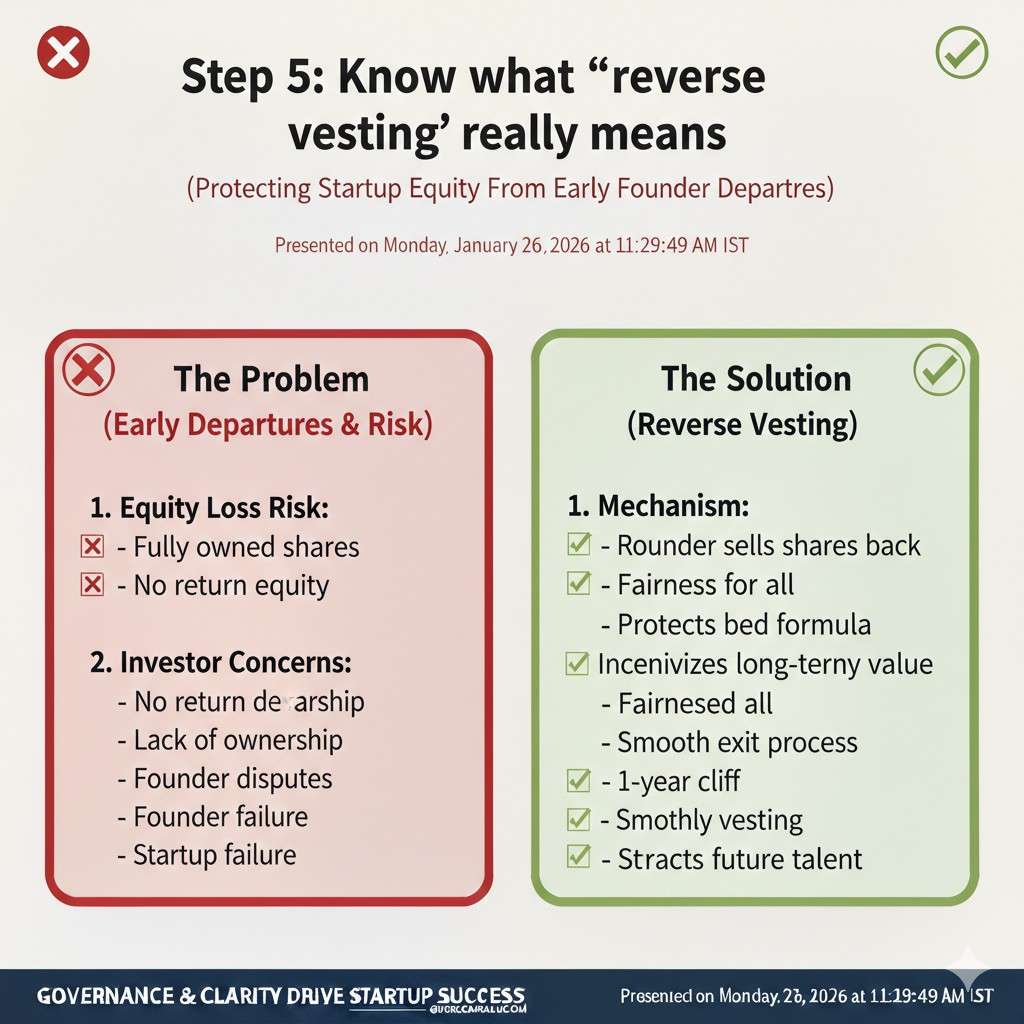
With founder stock, vesting often works through something called reverse vesting. This sounds complex, but the meaning is simple.
You receive all your shares upfront, but the company has the right to buy back the unvested part if you leave. So you start as an owner, but you must stay and contribute over time to fully keep the shares.
This matters because it keeps the cap table stable. It also makes the rules clear when someone exits. If the documents are set right, the company can recover unearned shares without a long negotiation.