
Most co-founder fights do not start with the product. They start with equity.
At the start, equity feels like a math problem. Later, it becomes a trust problem. It can shape who stays, who leaves, who feels valued, and who feels trapped. A “small” mistake in week one can cost you years of stress, slow decisions, and legal cleanup.
So let’s do this the right way: simple, fair, and built to hold up when things get hard.
Also, quick note from Tran.vc: if you are building in AI, robotics, or deep tech, and you want to turn your invention into real assets investors respect, you can apply anytime here: https://www.tran.vc/apply-now-form/
Equity is not a prize. It is a promise.
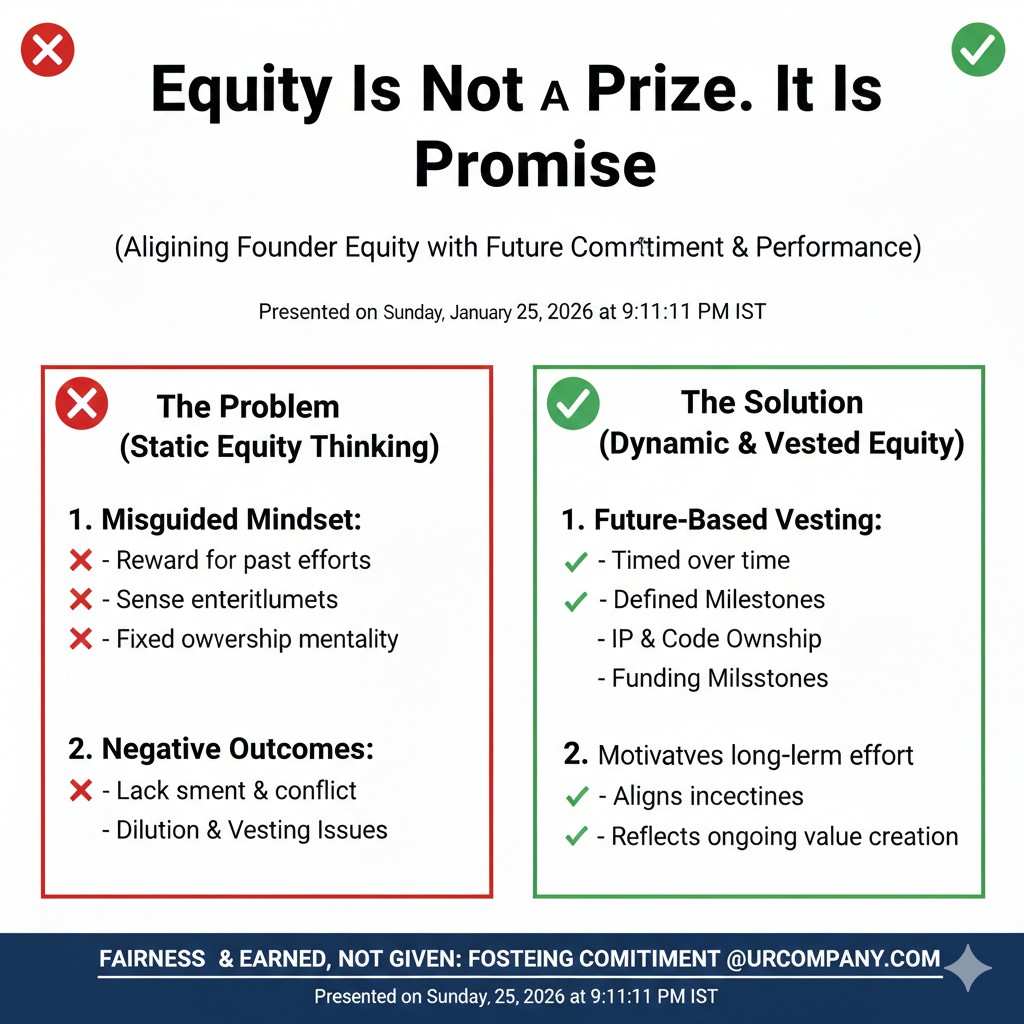
When you split equity, you are not paying someone for work already done. You are making a promise about the future.
Equity says: “We are going to build this together. We will carry risk together. We will make sacrifices together. And if this works, we will share the upside.”
That is why “50/50 because we are friends” is not always fair. Sometimes it is fair. Many times, it is not. The test is not friendship. The test is what happens when one person is doing more hard work for longer, or taking bigger risk, or is harder to replace.
A fair split is one you can defend with calm reasons. Not one you made because it felt awkward to talk about.
If you avoid the talk now, you will be forced to have it later, when you are tired, under pressure, and maybe angry.
The goal is fairness, not equality
People mix these up.
Equality is “same numbers.”
Fairness is “numbers that match reality.”
Reality includes time, risk, skill, cash, relationships, and commitment.
If you and your co-founder are both going all-in, both quitting jobs, both working full time, both leading core areas that are hard to replace, and both carrying the same personal risk, then a near-equal split can be fair.
But if one person is part-time, or joining later, or bringing only an idea, or not taking real risk, a 50/50 split can quietly build resentment. Resentment is slow poison. It leaks into meetings. It shows up in tone. It makes small problems feel personal. It makes the company feel heavy.
Fair equity prevents that.
Before you talk numbers, talk roles
If you jump straight to percentages, you will argue about outcomes instead of facts.
A better path is to first agree on what each person owns.
Not “owns” like control. Owns like responsibility.
Who is responsible for building the product? Not “helping,” but owning it end to end.
Who is responsible for shipping? Who manages the roadmap? Who makes tradeoffs when there is no perfect answer?
Who is responsible for customers? Not “talking to people,” but getting real demand, closing early users, and learning what people pay for.
Who is responsible for hiring? Who is responsible for the team’s health, not just tasks?
Who handles fundraising when the time comes? Investor calls, updates, decks, follow-ups, and the “no” pile.
Who handles legal and finance? Even if you outsource it, someone must manage it.
In deep tech and AI, roles can be even more serious. If the company depends on a core model, robotics stack, novel sensor approach, or a key method that is hard to copy, the person responsible for that technical edge is carrying a special weight. If that edge is the moat, the person building it is not “just engineering.” They are the heart of the company.
Tran.vc exists because this part is often ignored. Founders build amazing tech, then forget to protect it. Patents and IP strategy can turn fragile advantage into real strength. If you want help there, apply anytime: https://www.tran.vc/apply-now-form/
Back to roles: once you agree on clear ownership, equity talks become easier. You stop guessing and start matching numbers to work.
The four questions that decide a fair split
A fair split almost always comes down to four simple questions. Not fancy. Just honest.
1) Who is taking real risk?
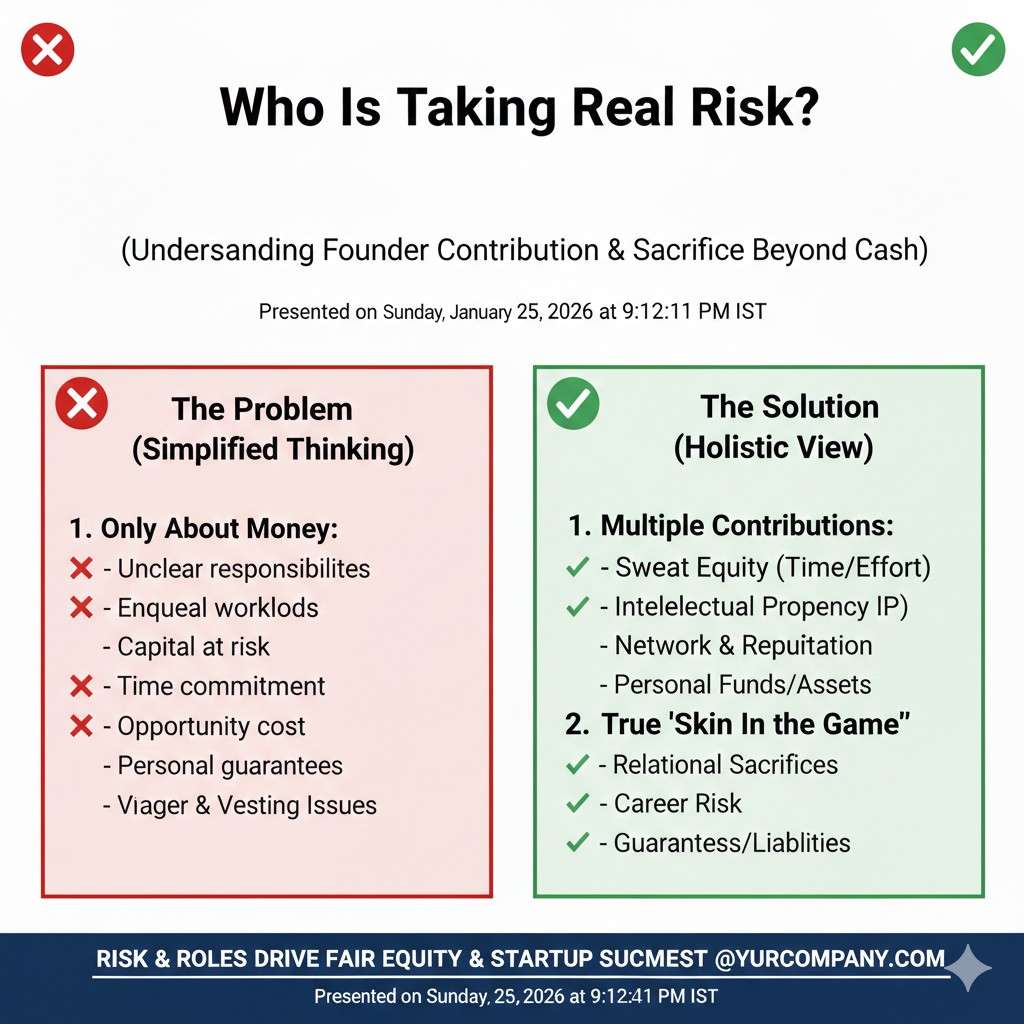
Risk is not effort. Risk is what you lose if this fails.
If one founder quits a high-paying job, moves cities, turns down other offers, and burns savings, they are taking real risk.
If the other founder stays employed “until we raise,” that is a different risk level. Sometimes that is a smart choice. But it should show up in the split, or be handled through a clear plan to rebalance later.
A common mistake: treating part-time founders like full-time founders “because they will go full-time soon.” Soon can become never. And even if they do go full-time later, the early months matter most. That is when the company is fragile and needs speed.
2) Who is committing the most time, for the longest time?
Time has two parts: intensity and duration.
Intensity is hours and focus. Duration is how long those hours will continue.
Someone can work 60 hours a week for 3 months, then leave when it gets boring. Another person can work 45 hours a week for 3 years and carry the company through multiple hard phases. Equity should reward the people who stay in the storm.
This is why vesting matters, which we will get to soon. Vesting is the safety system that keeps equity fair over time.
3) Who brings scarce, hard-to-replace skill?
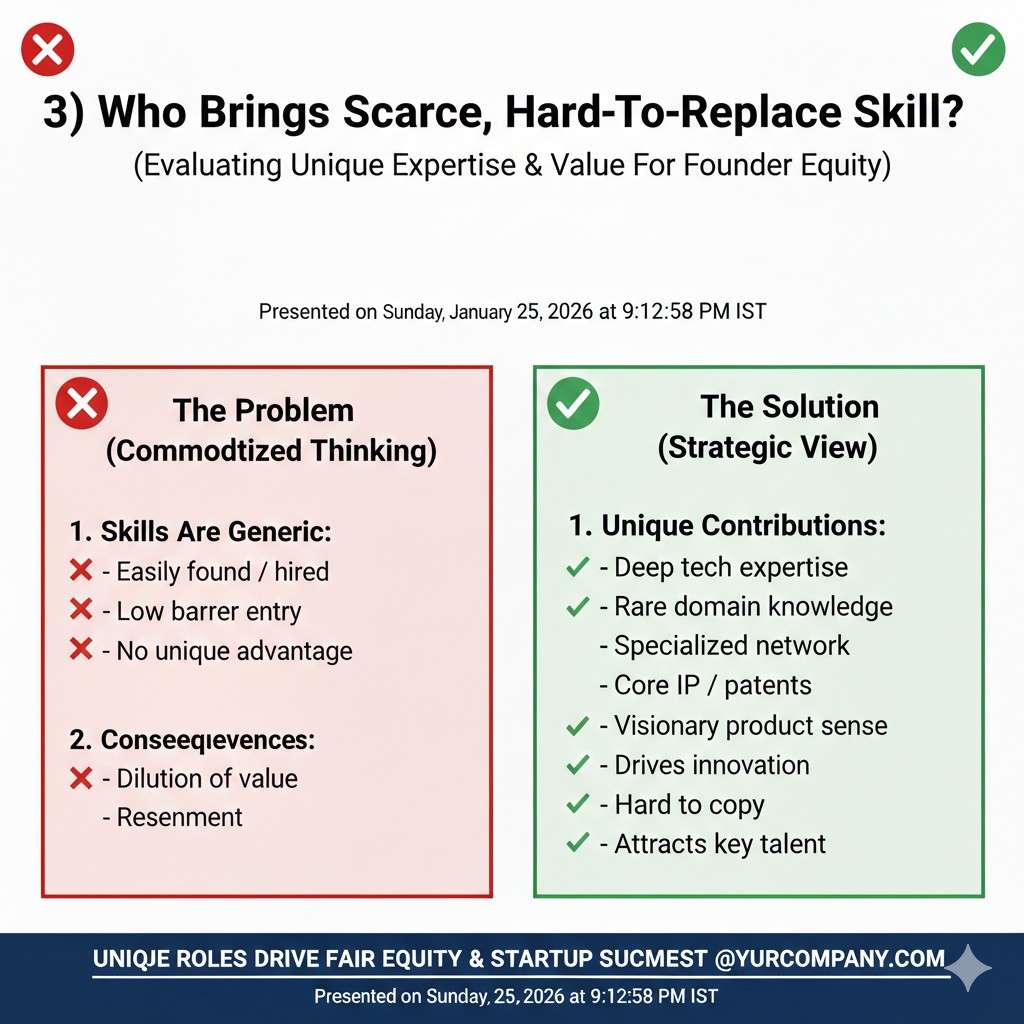
Not all skills are equal at every stage.
Early on, the most valuable skill is usually the one that removes the biggest risk.
If you are building a robotics company and one person can actually make the robot work, while the other can “help with marketing later,” those are not equal in the first year.
If you are building a deep AI product and one founder can build the core model, data pipeline, evaluation setup, and deployment system, while the other does generic ops, the technical founder may be harder to replace early.
This does not mean non-technical founders are less important. It means value depends on timing. Sales can be the hardest thing later. But in month one, you need a product worth selling.
A fair split respects what is scarce today, and also respects the ability to carry the company later.
4) Who is responsible for the company’s direction?
There is a hidden job in every startup: making decisions when there is not enough info.
This is not “being the boss.” It is owning the weight of choices.
If one founder is leading strategy, hiring, and key calls, that is real responsibility. It should be recognized.
But be careful here. Many people want control, but fewer people carry control. Carrying control means you take blame when things fail and you fix them, not argue.
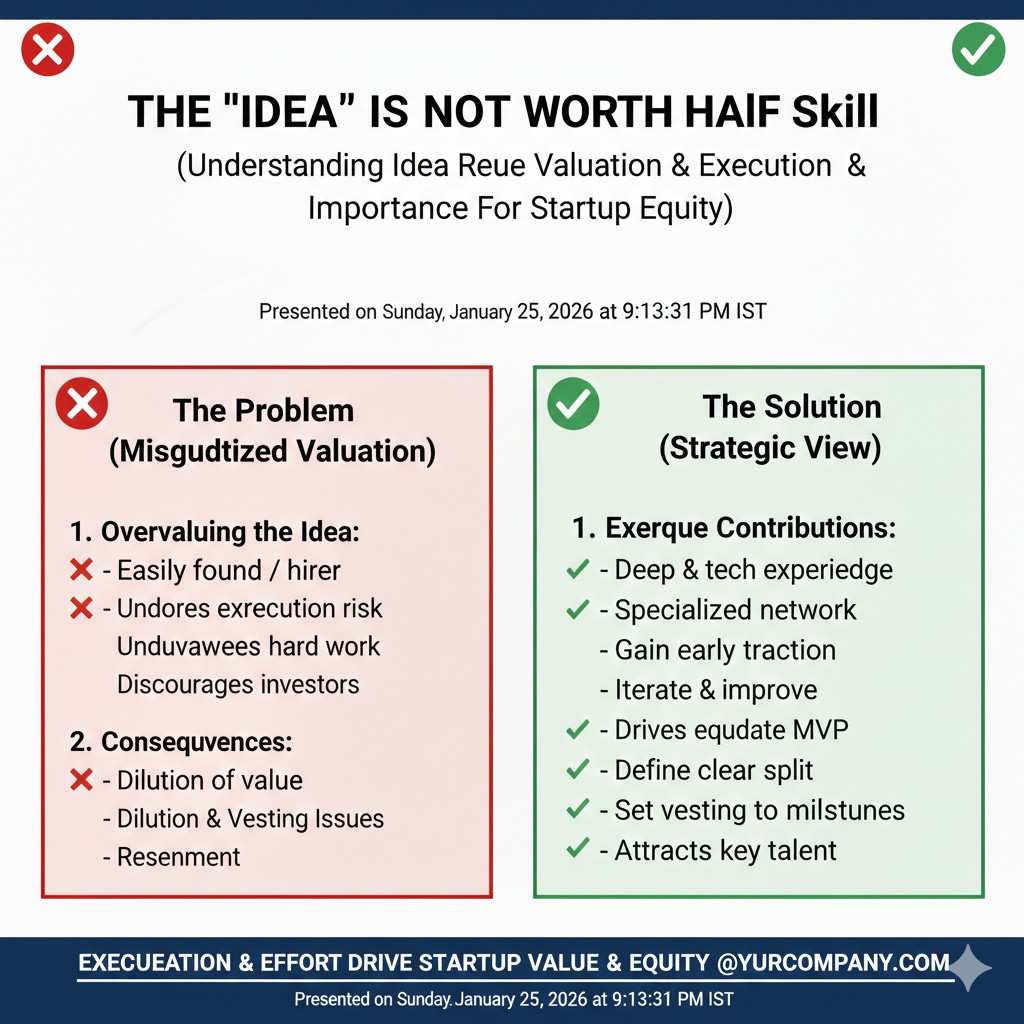
The “idea” is not worth half
This is where many splits go wrong.
Ideas feel special because they are the first spark. But most ideas change. And many ideas are obvious once you are inside the space.
Execution is what turns an idea into something real.
If one founder brings the idea, and the other founder builds most of the product, finds early users, and works full-time, it is rarely fair to give the idea-founder half unless they also bring major risk, major skill, or major capital.
A simple way to think about it: if you took the exact same idea to a different team, could they build it? If yes, the idea is not the moat.
In AI and robotics, the moat is often the method, the data, the system design, and the IP that protects it. That is why IP matters early. If you want to build defensible tech from day one, Tran.vc can help as a venture partner by investing up to $50,000 in in-kind patent and IP services. Apply here: https://www.tran.vc/apply-now-form/
The rule that keeps everything fair: vesting
Even the best split can become unfair over time. People change. Life happens. Energy drops. One person carries more.
Vesting is how you keep the split fair as reality unfolds.
Here is the simple version: nobody truly earns all their equity on day one. They earn it over time by staying and building.
The standard setup is four years with a one-year cliff. In plain words:
- If a founder leaves before 12 months, they earn none of their equity.
- After 12 months, they start earning it month by month.
- After four years, they earn it all.
This protects the company from a founder who leaves early but keeps a big chunk forever.
If you skip vesting because it feels “too legal,” you are setting a trap for your future self.
Vesting is not a sign of distrust. It is a sign you are planning like adults.
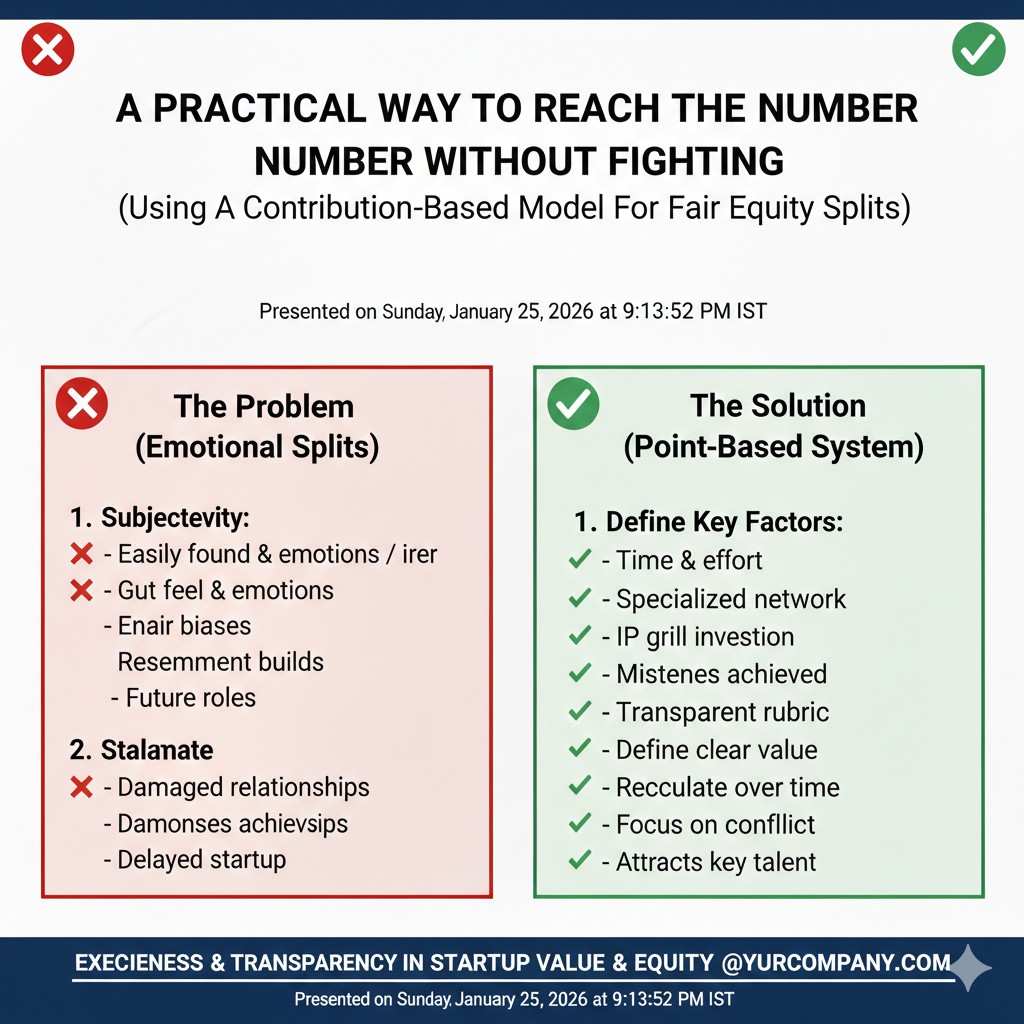
A practical way to reach the number without fighting
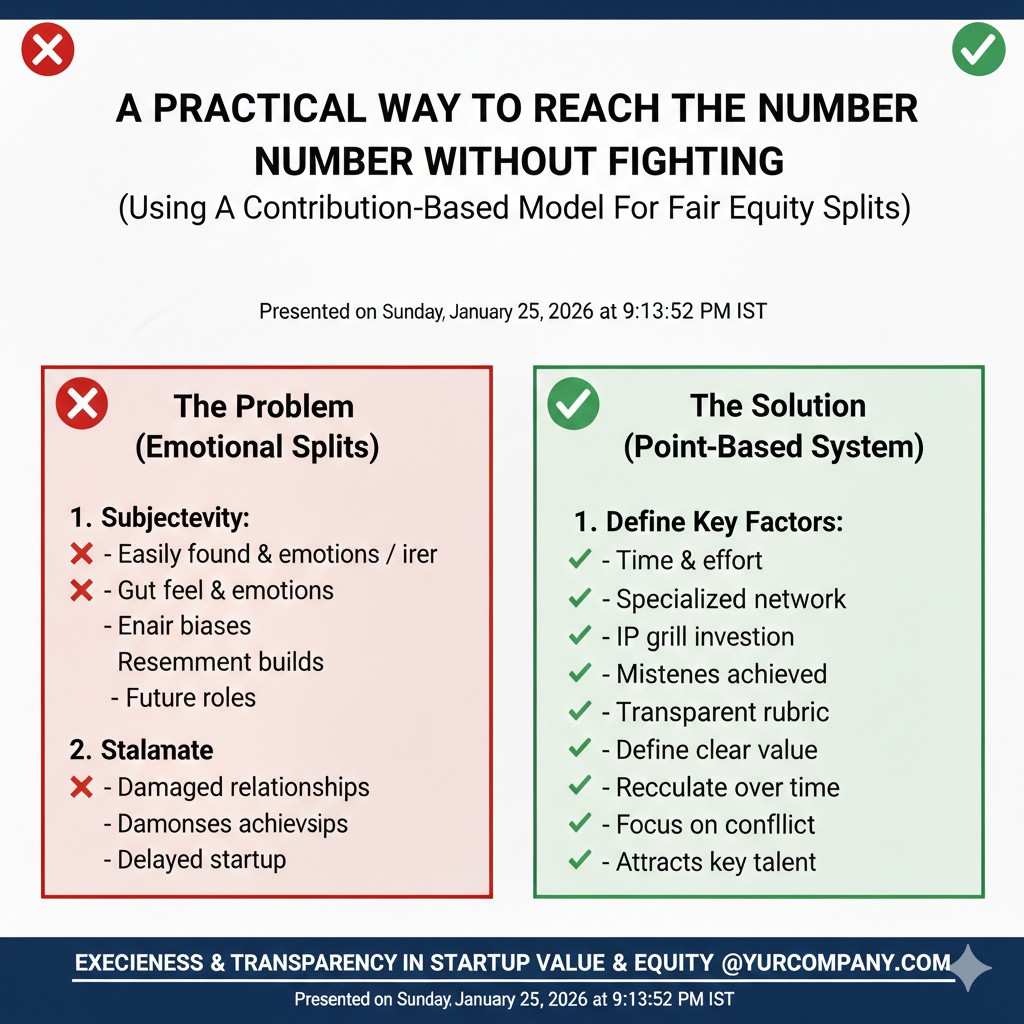
Now let’s talk about how to actually pick a split, without turning it into a power struggle.
Start by writing down what each person is truly contributing in the next 12 months. Not dreams. Not “later.” Real contributions.
You can think in terms of:
- Who is full-time on day one?
- Who is paying bills and taking a pay cut?
- Who is building the core tech?
- Who is talking to customers every week?
- Who is setting up the company basics?
- Who has the relationships that will matter soon?
Then talk through gaps. Gently, but clearly.
If one founder is part-time, say it plainly: “Part-time is real, but it is not the same risk as full-time. Let’s reflect that fairly.”
If one founder is joining later, say it plainly: “Joining later reduces early risk. We should reflect that.”
If one founder is putting in cash, say it plainly: “Cash is a real contribution. Let’s decide if it is equity, a loan, or both.”
The key is to describe facts, not judge people.
This is not “you care less than me.” It is “your situation is different, so the structure should be different.”
A few common splits that are often fair
I am not going to dump a big list of scenarios. But I will share a few patterns you will see often.
If two founders start at the same time, both go full-time, both carry similar risk, and their skills are both core, you will often see something close to 50/50.
If one founder is clearly leading and taking more risk, and the other is still essential but not equal in commitment, you may see something like 60/40.
If one founder is full-time and the other is part-time for a long period, you may see something like 70/30 or even more, depending on the gap.
These are not rules. They are sanity checks.
If your split is far from what your facts suggest, ask why. Sometimes there is a good reason. Often there is not.
The hardest part: saying the quiet truths out loud
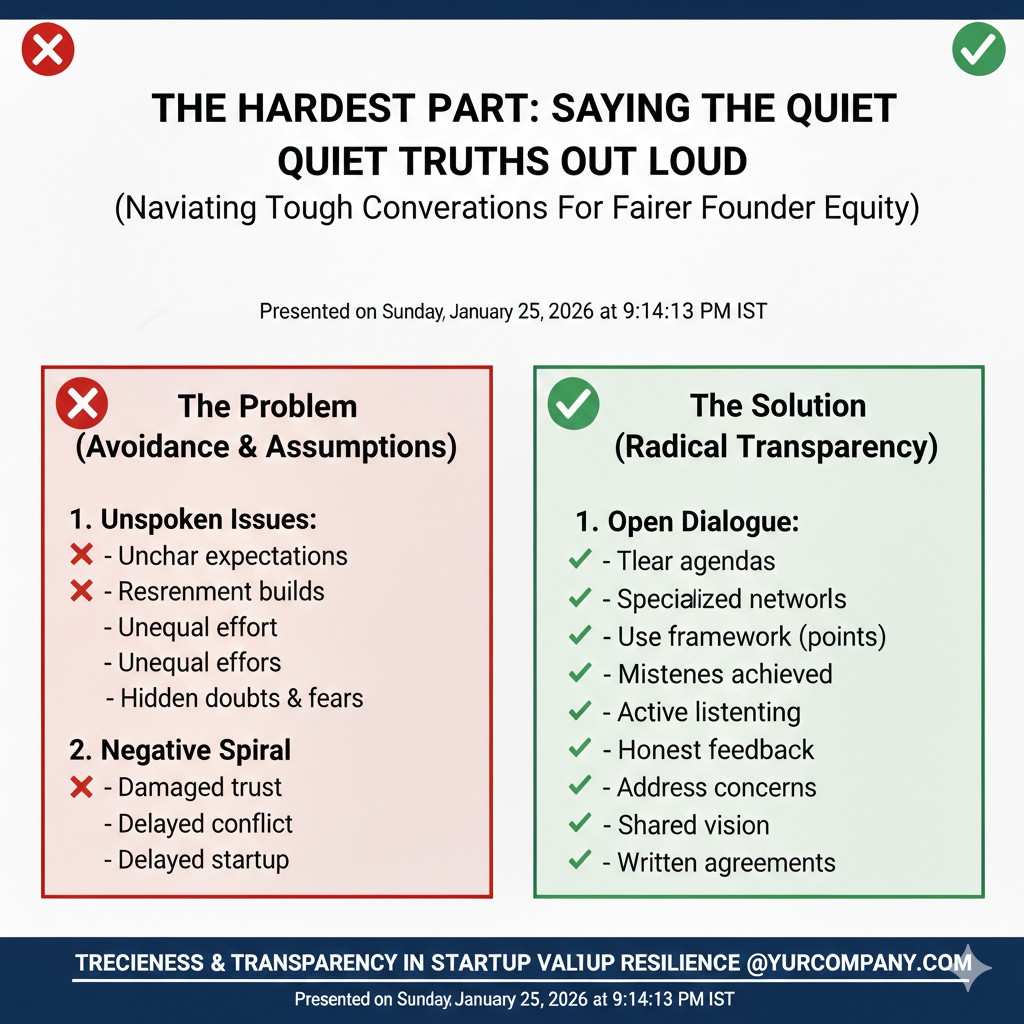
Most equity talks fail because people hide what they really think.
They fear conflict. They fear hurting feelings. They fear losing the relationship.
But avoiding truth now is what destroys relationships later.
You do not need to be harsh. You just need to be direct.
Try language like:
- “I want us to feel good about this a year from now, not just today.”
- “I want us to protect the friendship by being clear.”
- “Let’s make sure the split matches commitment and risk.”
- “Let’s set it up so if life changes, it stays fair.”
This keeps the tone professional. And it makes fairness the shared goal.
Understanding what equity really means
Equity is a long-term trade, not a quick reward
Equity is not a “thank you” for work you already did. It is a deal about the future. When you give equity to a co-founder, you are saying, “We will build this together, and if it works, we will share what we create.” That is why a split should be based on real commitment, not just excitement in the first few weeks.
Equity also affects daily behavior. It shapes who feels responsible, who feels heard, and who feels safe taking risks. If someone feels under-valued, they may stop giving their best ideas. If someone feels over-protected, they may stop pushing themselves. A fair split keeps both people motivated when the work gets hard.
Why “equal” and “fair” are not the same
Equal means the same number. Fair means the number matches what each person truly puts in. Early-stage startups are messy, so “fair” cannot be perfect. But it can be reasonable, explainable, and stable under stress.
If you split 50/50 only because the talk feels uncomfortable, you may be trading short-term comfort for long-term pain. Fairness is not about winning. It is about preventing regret later, when emotions are stronger and the stakes are higher.
The hidden cost of getting it wrong
When the split is off, decision-making slows down. Small disagreements turn into power struggles. You start keeping score. Instead of focusing on customers and shipping, you waste energy on “who deserves what.”
This can also damage fundraising. Investors often ask about co-founder dynamics. If your split looks messy, or one founder seems bitter, it raises risk. A clean, thoughtful structure sends a signal that you operate like professionals.
If you are building in AI, robotics, or deep tech, another hidden cost is weak IP. If your core advantage is not protected, equity becomes less meaningful because the company is easier to copy. Tran.vc helps founders turn technical work into defensible assets with up to $50,000 in in-kind patent and IP services. You can apply anytime at https://www.tran.vc/apply-now-form/
Setting the foundation before you talk percentages
Start with roles, not numbers
Most equity talks fail because founders start with a number and argue from emotion. A better method is to begin with roles. You want to be clear about what each person owns day to day, and what outcomes each person is responsible for.
A simple test is this: if something fails, who is the person expected to fix it without being asked? That person “owns” it. Ownership means carrying problems to the finish line, not just helping when it is convenient.
Define what “owning” a function really looks like
Owning product means you decide what gets built now versus later, and you accept the tradeoffs when time and money are limited. Owning engineering means you deliver working systems, handle quality, and keep the tech stable as you move fast.
Owning growth or sales means you do the hard work of getting meetings, hearing “no,” learning the market, and turning interest into revenue. Owning operations means you keep the company healthy, compliant, and able to move without chaos.
When these are clearly defined, the equity talk becomes less personal. It becomes a match between responsibility and reward.
Make future expectations explicit, not assumed
Many co-founder splits break because people assume the future will unfold in a certain way. Someone says they will go full-time “soon.” Someone says they will take over sales “after the product is done.” Someone promises to introduce investors “when the timing is right.”
Instead of assuming, agree on what happens if those things do not happen. This is not negative thinking. It is basic planning. The strongest co-founder relationships are built on clear expectations, not vague hope.
The four drivers of a fair co-founder split
Risk: what each person can lose
Risk is not about how passionate you feel. Risk is what you truly put on the line. If one founder quits a stable job, loses a paycheck, and uses savings to survive, they are taking a bigger personal risk.
If another founder keeps their job and works nights for six months, they are still contributing, but the downside is smaller. That difference does not make anyone “better.” It simply changes what is fair.
Time: both intensity and duration
Time is not only hours per week. It is also how long you will be in the fight. Some people work very hard for a short burst, then burn out or shift priorities. Other people stay consistent through years of uncertainty.
A fair split respects the person who carries the long haul. It also respects the person who can reliably show up week after week, not just during exciting moments. Consistency is one of the rarest traits in startups.
Skill: how hard the person is to replace
Some skills are common, and some are scarce at a specific stage. In early-stage AI or robotics, the ability to build the core system is often the hardest piece. If your company depends on a model, a control loop, a hardware design, or a specialized stack, that skill is not easy to replace.
This does not mean non-technical work is less important. It means the split should reflect what removes the biggest risk right now. Over time, the “hardest to replace” role may change, so your structure should handle that without drama.
Responsibility: who carries the final call
In every startup, someone carries the burden of final calls. That person decides when information is incomplete and mistakes are possible. If one founder is doing that work, it should be recognized as part of the equity conversation.
At the same time, responsibility should be real, not symbolic. A founder who wants control must also accept accountability. Control without accountability is one of the fastest ways to break trust.
A step-by-step method to reach the split without fighting
Step one: write down the next 12 months in plain terms
Instead of guessing what the company will look like in five years, focus on the next year. Write down what must happen for the startup to survive and grow. This keeps the discussion grounded in reality.
For example, if the company must ship an MVP, run pilots, gather data, file patents, and close first customers, those are concrete goals. Then you can clearly map who is responsible for each goal and who is doing the hardest parts.
Step two: compare commitment, not personalities
Equity should never be decided by who is louder or more confident. It should be decided by what each person is committing. Commitment means time, risk, and responsibility, not charisma.
When you compare facts, you reduce emotional conflict. You can say, “We are not matching energy. We are matching commitments.” That keeps the tone professional and fair.
Step three: agree on what changes the split later
Some founders start part-time for a real reason, like visa issues, family needs, or financial constraints. That can be reasonable. But you should still design a structure that stays fair if the part-time situation lasts longer than expected.
You can plan for specific “milestones” that trigger changes. For example, when a founder goes full-time, when they take over a key function, or when they bring in a major customer. The key is to put the agreement in writing so nobody feels tricked later.
Vesting: the safety net that keeps equity fair over time
Why vesting protects both founders
Vesting means equity is earned over time, not granted all at once. This is one of the most important tools for fairness. It protects the company if a founder leaves early. It also protects a founder who stays and carries the company forward.
Without vesting, a founder can leave after a short period and still keep a large piece of the company. That can block future hiring, fundraising, and even simple decisions. Vesting prevents that kind of lock-in.
The common structure and what it means
A common structure is four years with a one-year cliff. In simple terms, if someone leaves before one year, they earn none of the equity. After one year, they begin earning it gradually, usually monthly, until four years.
This structure is widely understood by investors, lawyers, and accelerators. It is not a sign of distrust. It is a normal system that keeps things fair as life changes.
How vesting reduces resentment in real life
Even strong teams face uneven effort at times. Someone gets sick. Someone has family pressure. Someone loses momentum. When equity vests over time, it naturally matches who stays engaged long-term.
This reduces silent resentment because the structure reflects reality. It is much easier to have a calm conversation when the system already protects fairness.
Handling special cases that often cause conflict
When one founder joins later
A founder who joins later missed the earliest risk. That does not mean they are less important. But it does mean the split should reflect timing. Often, the later founder receives less equity than someone who started at day one, especially if the company already has progress.
The fair approach is to measure what was built before they joined and how much uncertainty has already been removed. The more risk has already been removed, the more the equity should shift toward the earlier founder.
When one founder invests cash
Cash can be handled in different ways. It can be treated as an investment, a loan, or a mix. Each option has tradeoffs, and the “right” answer depends on your goals and risk.
If you treat cash as equity, the founder putting in money receives a larger share. If you treat it as a loan, the company pays it back later, and the equity split can stay closer to the work split. A mixed approach can sometimes feel fairest, but it should be clean and written down.
When one founder brings “the idea”
Ideas matter, but they are rarely the main value. Most ideas change once you meet customers. Most ideas are not defensible unless the team builds something hard to copy.
In deep tech, defensibility often comes from technical execution and IP. If the idea founder is also the one building the moat, that is different. But if they only brought the idea and little else, it is usually not fair for them to hold half the company.
Tran.vc focuses on this exact gap. Many founders build valuable tech but fail to protect it early, which weakens their leverage later. If you want to build an IP-backed foundation while keeping control, you can apply anytime at https://www.tran.vc/apply-now-form/