
Remote teams feel simple. You hire great people, send them a laptop, and keep building.
But taxes do not work like software.
If your company has people working in another country, that country may say, “You are doing business here.” And if they say that, they may also say, “You owe tax here.”
This is what people mean by Permanent Establishment risk, often called PE risk. It can hit early-stage startups hard because it shows up late, costs a lot to fix, and can scare investors during diligence.
Tran.vc works with technical founders who are building AI, robotics, and other deep tech companies. When we help founders build strong patent and IP foundations, we also see a pattern: the best teams protect more than code. They protect the company’s ability to grow without hidden landmines. PE risk is one of those landmines.
If you want support building an IP-backed company from day one, you can apply any time here: https://www.tran.vc/apply-now-form/
What “Permanent Establishment” really means in plain words
A “Permanent Establishment” is a tax idea used by many countries.
In simple terms, it means: your company has a meaningful business presence in a country, even if you do not have an office there.
If the country decides you have that kind of presence, they may tax part of your profit in that country. They may also expect local filings, records, and in some cases, back taxes, penalties, and interest.
Here is the part that surprises founders: you do not need a building with your logo on it. A PE can happen because of people.
A remote employee can create a “business footprint” for the company. The footprint gets deeper when that person does important work, talks to customers, signs deals, or runs core parts of the business.
A good rule of thumb is this: the more “real business” the person does in that country, the more PE risk grows.
Why PE risk is a bigger deal now
Ten years ago, many startups stayed close to home. Today, teams are global early. You may have:
A founding team in the US
An ML engineer in Canada
A robotics hire in Germany
A sales lead in the UK
A support person in India
That can be a great way to build fast. But tax rules were not built for “Slack-first companies.” Most tax systems still think in terms of offices, branches, and local business activity.
Also, tax authorities have gotten better at data. Payroll records, social insurance, visas, and payment trails make it easier for countries to spot foreign companies with local workers.
So, what used to be “unlikely” is now more common. And when it happens, it usually happens at the worst time: right before a seed or Series A, during an acquisition, or when you open a big enterprise deal.
The two PE types founders run into most
Different countries use different tests, but PE usually shows up in two big ways.
The “fixed place” idea
This one is about having a place where business is carried on. It can be an office, lab, or even a regular space used for company work.
Remote teams ask: “Does a home office count?”
Sometimes, yes. Not always, but it can. Some tax authorities look at whether the company “requires” the person to work from home, whether the home space is used on a stable basis, and whether the company is effectively operating from that location.
If your company has no office anywhere and your team member’s home is the only place the business is run from in that country, the question becomes sharper.
The “dependent agent” idea
This one is about people who act on behalf of the company.
If someone in a country is closing deals, negotiating key terms, or has authority to sign contracts, many countries may treat that as PE.
Founders often assume only a “sales person” triggers this. But it can be broader. In some places, a person who plays the main role in getting contracts signed can create risk, even if the final signature happens elsewhere.
That means a “business lead” or “partnerships person” can be a risk point if they are effectively making the deal happen in that country.
The real-world triggers that create PE risk
Let’s make this practical.
PE risk is not usually caused by a single small thing. It is caused by patterns that look like local business operations.
Here are common patterns that get founders into trouble.
Hiring a senior person who runs a key function from another country
A junior engineer working on a narrow task is one thing. A country manager, a head of sales, or a lead who runs a whole region is another.
If a person is the face of the company in that country, tax teams may argue the company is effectively present there.
Letting a remote team member negotiate and “lock” contract terms
This often happens naturally. Your sales lead in Country X has good relationships. They handle negotiations. They send the redlines. They say “we can do that.” The customer agrees. You sign from HQ.
From a tax view, the question is: who really made the deal happen? If the local person did most of the heavy lifting, some countries may see that as the company doing business there through that person.
Having local employees who manage customers day to day
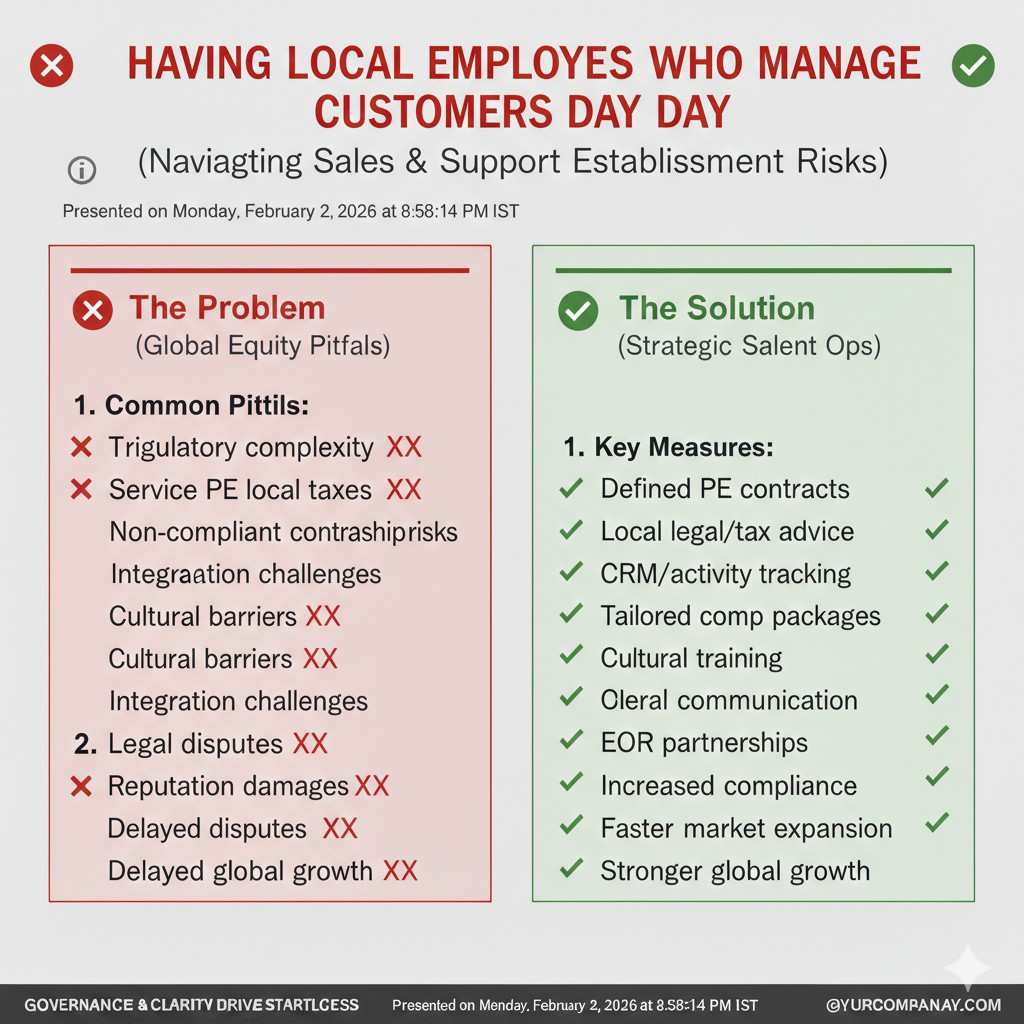
Customer success can also matter. If your team member is handling renewals, upsells, or pricing discussions, it can start looking like a local business operation.
Using a local address, local phone number, or local “office” identity
Even small marketing choices can add to the story. If your website says “Germany office” but it is really one person’s home, that can create a mismatch that invites questions.
Sending people into a country for long stretches
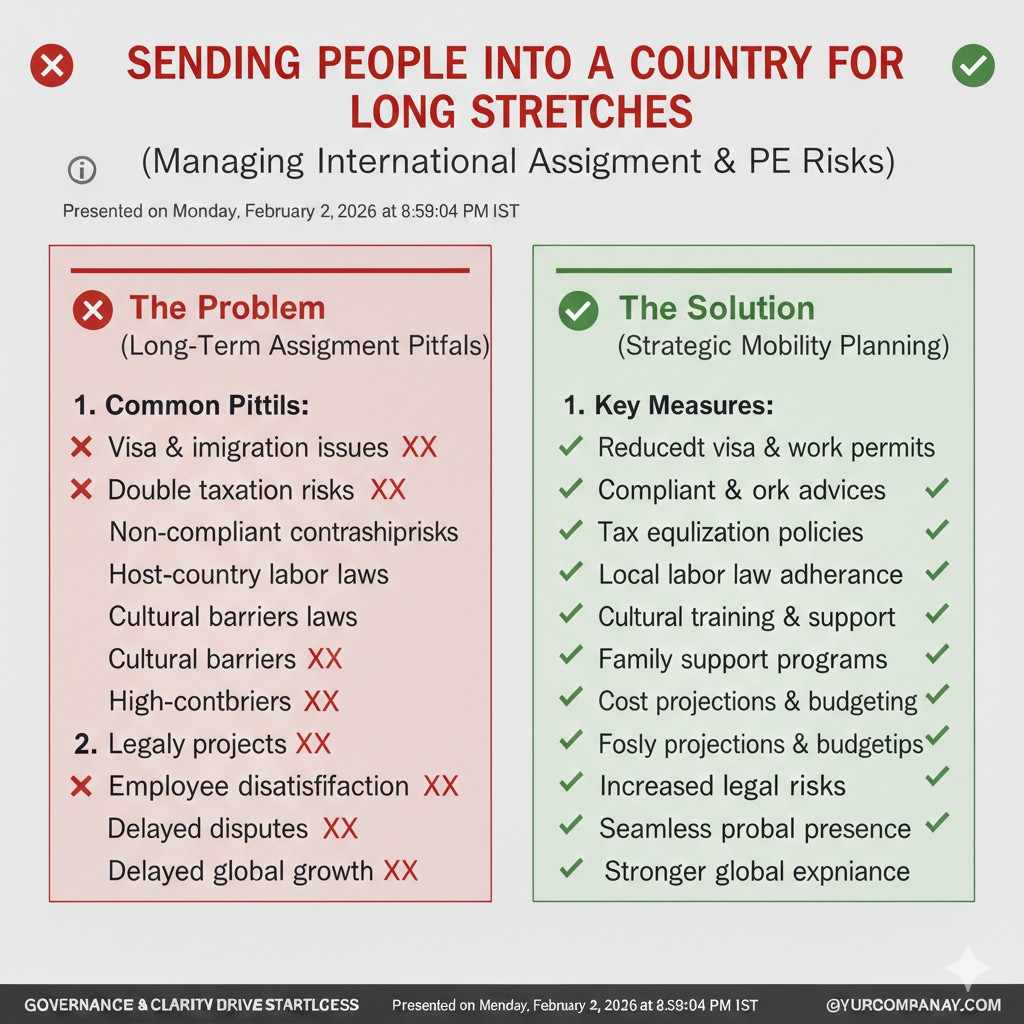
Founders also trigger risk through travel. If executives spend significant time in a country meeting customers, doing demos, or running projects, the pattern can support a PE argument.
This is especially true if your company is delivering services on-site, or running a long implementation.
Why this matters to startups more than big companies
A big company can absorb tax surprises. A startup cannot.
When PE risk becomes real, it can cause problems like:
You may need to register for corporate tax and file returns in that country
The country may claim part of your profit should be taxed there
You may need local bookkeeping and local advisors
You may face penalties if authorities believe you should have filed earlier
Your investors may pause or renegotiate if the risk looks messy
Your acquirer may reduce price or demand escrow to cover the risk
And even if you end up paying little or no extra tax, the process itself can be expensive and time-consuming.
The investor angle: why PE risk shows up in diligence
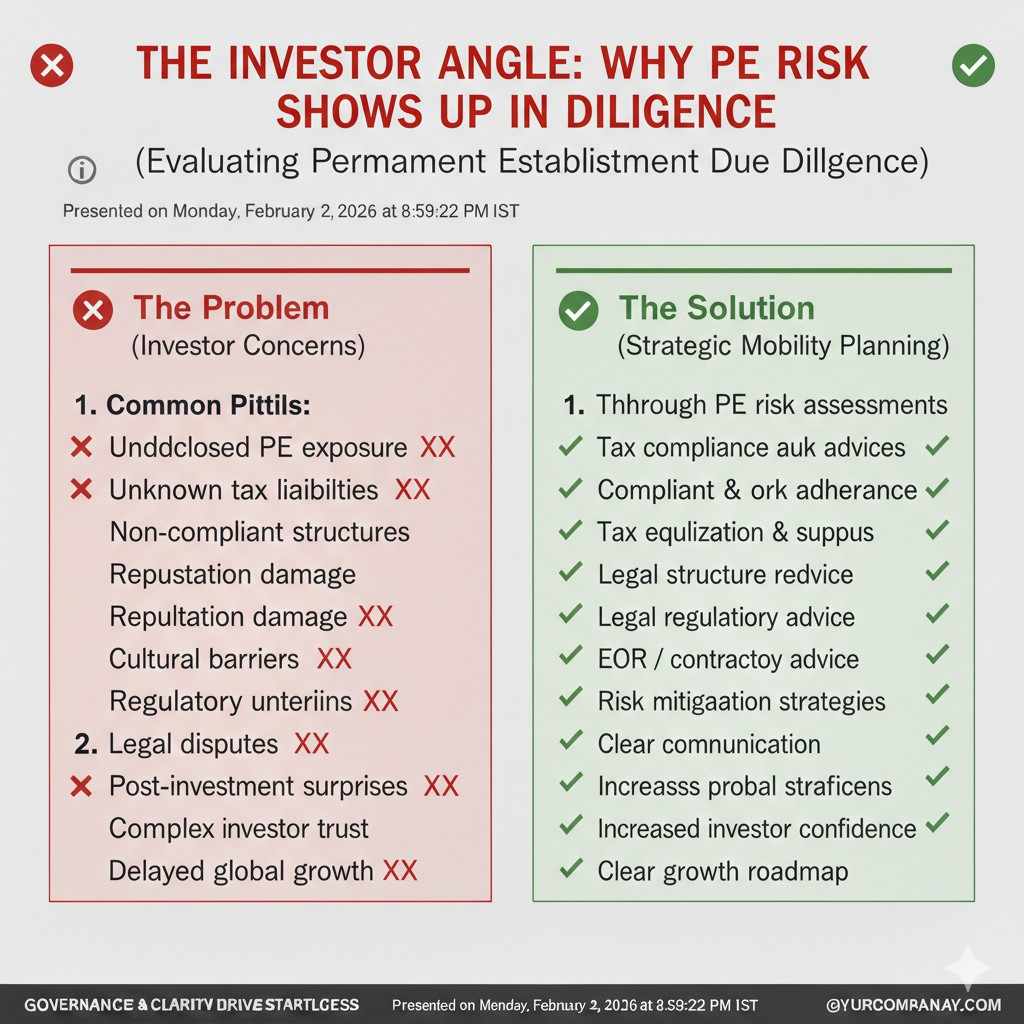
Investors are not trying to be difficult. They are trying to avoid surprises.
A common diligence question is: “Do you have employees or contractors outside your home country? If yes, how are you managing tax, employment law, and IP assignment?”
This is where PE risk connects to IP, too. If your core invention work is done in another country, you want clean assignments, clear invention records, and good patent strategy. But you also want the company structure to be clean so your patents and your tax position do not become a fight later.
Tran.vc’s whole approach is about building companies that can raise with strength. That includes building defensible IP. It also includes reducing avoidable risk that makes investors nervous.
If you are building in AI, robotics, or deep tech and want help turning your inventions into real assets investors respect, apply here: https://www.tran.vc/apply-now-form/
How to spot your PE risk early, before it becomes expensive
Most founders only learn about PE after they already have it. You can do better than that with a simple habit: map your “business actions” by country.
Instead of thinking, “Where do we have people?” think, “Where do we do business?”
Ask yourself:
Where are contracts being negotiated?
Where are customers being managed?
Where are key decisions being made?
Where are core functions being run from?
Where is revenue being generated from on-the-ground activity?
When you map it this way, you see risk sooner.
A country where you have one engineer working on internal code might be lower risk. A country where you have a sales leader driving deals and managing customer terms is higher risk.
One story you do not want to live through
Imagine this.
You are raising a seed round. A strong investor is excited. The product is working. The patents are in progress. Your team is sharp.
Then diligence finds you have a sales lead in another country who has been negotiating deals for 18 months. No local filings. No local structure. No documented limits in their role.
The investor asks, “Could this create PE?” Your lawyer says, “It could.” The investor asks, “How much?” Your lawyer says, “Hard to know without local counsel.”
Now your timeline breaks. You have to hire local tax advisors, reconstruct deal history, estimate exposure, and decide whether you need to register and file.
This is how a great round turns into a slow, stressful, expensive process.
PE risk is not theoretical. It is a real diligence killer when it is unmanaged.
The good news: you can reduce PE risk with how you operate
You cannot always avoid PE risk. If you want real presence in a country, you may choose to set up properly there.
But most early-stage teams do not need “real presence.” They just need talent.
So the goal is often not “zero risk.” The goal is controlled risk. Clear roles, clear limits, clean paperwork, and good decisions about where revenue activity happens.
Operating rules that lower PE risk fast
Start with a simple map of work by country
Before you change anything, you need clarity. Open a doc and list every country where anyone works for you, even part time. Under each country, write what those people actually do day to day, not their job title.
Titles hide risk. Actions create risk. When you describe the real work, you can see where the company is “showing up” in another place.
Separate “build work” from “sell work”
Many startups mix building and selling across borders without noticing. In most countries, engineering work that supports the business internally is often less likely to create PE than work that directly drives deals.
That does not mean engineering is always safe. But it is a different story than a person who is out in the market, meeting buyers, and shaping contracts.
Treat PE risk like a product bug
A bug is easier to fix when it is small. PE risk is the same. If you wait until you have big contracts and lots of activity, the cleanup is painful.
If you catch it early, many fixes are simple: adjust responsibilities, change who negotiates, tighten documents, and build a clean operating rhythm.
Roles and authority
Why “who can commit the company” matters most
PE risk often spikes when someone in another country can commit the company to a deal. Commitment can look like signing a contract, but it can also look like final pricing approval, agreeing to key terms, or making promises customers rely on.
When a tax authority reviews facts, they look for the person who truly drives the deal. If the local person is the one making it happen, the company can look locally present.
Redesign job scope for international hires
A practical approach is to design international roles so they support the company without acting as the company in-market. For example, a person can do lead generation, early discovery calls, and product education while final negotiation and approvals stay with a team located in your home country.
This is not about tricks. It is about keeping the story consistent. If your company says it does not operate locally, your operations should match that claim.
Put negotiation boundaries in writing
Boundaries need to be more than “everyone knows.” Put them in offer letters, contractor agreements, and internal playbooks. Spell out that the person cannot sign contracts, cannot finalize terms, and cannot make binding promises about pricing, delivery timelines, or special conditions.
Then align reality with the paper. If your internal messages show the person regularly closing terms, the documents will not help much.
Sales and business development
The deal-making trap remote teams fall into
Startups move fast. A sales lead in another country pushes a deal forward and the founder is busy building. The sales lead “handles it” and the founder signs at the end.
From a PE lens, the country may view that sales lead as the company’s local deal engine. Even if the founder signs, the substance can matter more than the signature.
A safer workflow for cross-border deals
A safer pattern is to let the local person run early conversations and qualification, then hand off negotiation and term-setting to a person based in your home country. The local person stays involved, but as support rather than the driver of final terms.
This approach also helps you build better deal discipline. Your pricing, risk terms, and delivery language become more consistent when one core team owns the last mile.
Watch out for renewals, upsells, and “small changes”
Founders often focus only on new sales. But renewals and upsells can carry the same risk signals because they involve commercial decisions. Even small changes like a discount, a special clause, or a service add-on can look like local contract negotiation.
If your customer success team sits in another country, keep clear lines around what they can and cannot agree to without approval.
Engineering, R&D, and product work
Engineering usually feels “safe,” but not always
Many founders assume product work cannot create PE because it does not touch customers. That can be true in many cases, but you should not treat it as a blanket rule.
Some countries look at where core value is created. If your company’s main work happens in a country through a stable team, authorities may argue the company has a meaningful presence there.
Reduce risk by keeping leadership and control centralized
Risk tends to rise when a remote team becomes the true control center. If product leadership, roadmap decisions, and major technical approvals all happen in one foreign country, that can look like the company is effectively run from there.
A practical control step is to keep final decision-making documented and anchored in your home country. Meeting notes, approval trails, and decision logs help show where control sits.
Keep IP ownership and invention records clean
This is where Tran.vc’s world overlaps strongly. If your inventions are created across borders, you need airtight IP assignment and invention capture so your patents stay strong.
Clean IP does not remove PE risk, but messy IP makes everything worse. When diligence hits, investors will look at both tax exposure and whether your most valuable work is properly owned by the company.
If you want help building strong patents and IP strategy early, you can apply here: https://www.tran.vc/apply-now-form/
Contractors, freelancers, and “it’s not an employee”
Why contractor status does not automatically reduce PE risk
Founders often think contractors are safer than employees. From a PE view, that is not always true.
Authorities look at what the person does and how they act for the company. A contractor who negotiates deals and behaves like your local representative can create similar risks to an employee.
Control and direction can increase risk
If you tightly manage a contractor like an employee, that can also create other compliance problems. But even beyond employment law, heavy control can support the story that the person is part of your local business machine.
A cleaner approach is to give contractors scoped deliverables, avoid giving them company-facing authority, and keep commercial decision rights with the core team.
Keep contractor agreements aligned with how work happens
If your contract says “no authority to bind the company,” but in practice the contractor is promising discounts and delivery dates, you have a mismatch. Mismatches are what get companies in trouble, because they signal that paper controls are not real controls.
EOR platforms and local payroll providers
What an EOR helps with and what it does not
An Employer of Record can help you hire legally in a country without setting up your own entity. It can handle payroll, benefits, and local employment steps.
But an EOR is not a “PE shield.” You can still create PE through the activities of the person you hired, even if payroll is handled by a third party.
How to use an EOR in a lower-risk way
If you use an EOR, make sure the role scope stays consistent with a low-PE story. That usually means limiting local commercial authority and keeping final deal decisions elsewhere.
Also keep a clean record of who approves pricing, who approves legal terms, and who signs. When you later explain your structure, you want a simple, believable story.
Avoid “country manager” roles too early
EOR hiring often makes it easy to hire “regional heads” fast. That can be great for growth, but it can also raise PE risk quickly because those roles tend to come with real market authority.
If you are not ready to set up a local entity, consider a role design that supports market learning and pipeline building, while core deal authority stays centralized.
Travel, on-site work, and time in country
Repeated trips can add to a PE story
Founders travel to close deals, support pilots, and build partnerships. One trip is rarely the issue. Patterns are the issue.
If your leadership team is spending long stretches in another country doing revenue work, it can support the idea that your company is operating there in a stable way.
On-site delivery can change the picture
If your company delivers services on-site, installs equipment, runs training, or supports long projects in a country, that can trigger separate tax concepts. Some countries have rules tied to project length and the nature of the work.
For robotics and enterprise AI, this is common because pilots can involve real on-site activity. You want to track project duration and who is doing what work in-country.
Keep a travel log like you keep a sprint log
This sounds boring, but it can save you later. Track dates, purpose of trip, and what business activity happened. If questions come up, you have facts instead of guesses.
Documentation that actually helps
Paper matters only when it matches reality
Founders sometimes treat documentation as a legal checkbox. For PE risk, paper is useful only when it reflects how you truly operate.
If your agreements say one thing but your emails show another, the emails will win. So build a workflow where the agreements are true in practice.
The key documents to tighten early
You want clear language in employment agreements and contractor agreements about authority limits. You also want a sales process that shows where approvals happen.
You do not need a giant policy manual. You need a few strong controls that you follow consistently.
Build an internal approval trail
When someone asks for a discount, a special term, or a delivery exception, route it through the right approval owner. Do this in writing, inside the tools you already use.
This creates a history that shows decision-making is centralized where you say it is.
When you should stop “minimizing” PE risk and set up locally
The moment the business really becomes local
If you are hiring a full local sales team, running long projects, or building a strong customer base in a country, it may be time to formalize.
Trying to keep a “no presence” story while acting like you have a local office is where trouble grows. Sometimes the best risk move is to set up correctly.
Local setup can make fundraising easier
Investors are not afraid of global business. They are afraid of hidden mess.
A clean local entity, clear intercompany agreements, and proper filings can reduce uncertainty. It can also make larger customers more comfortable, especially in regulated markets.
Make the decision with numbers and timing
You do not need to overbuild. But you do need to choose intentionally. If a country is becoming a core revenue source, consider whether the cost of proper setup is now worth the reduced risk and smoother growth.
The IP connection founders often miss
PE and IP often collide during diligence
Deep tech diligence looks at where invention work happens, who owns it, and how protected it is. If invention work is happening in multiple countries, buyers and investors will ask hard questions.
If PE risk is also present, the diligence load gets heavier. The company can look less controlled, even if the product is strong.
Strong patents help, but they are not enough alone
Patents create value and defensibility. They make your company harder to copy and more attractive to serious investors.
But you also want the company structure to be clean so your patents sit inside a company that can scale without tax surprises. This is part of building leverage early.
If you are building AI, robotics, or deep tech and want to turn your inventions into investor-ready assets, apply here: https://www.tran.vc/apply-now-form/
A practical way to act this week
Do a 60-minute “PE risk review” with your team
Pick one hour. List countries. List what people do. Highlight who touches customers, who negotiates, who approves terms, and who signs.
Then adjust the workflow so approvals and negotiations happen where you want them. Update agreements so they match that workflow. Finally, set a calendar reminder to repeat this review every quarter.
Bring in local advice only when the facts warrant it
You do not need to pay for a tax memo for every country where you have one engineer. But you should seek local advice when you are adding sales presence, running long on-site projects, or seeing real revenue in a country.
The goal is not to spend money early. The goal is to spend wisely before risk becomes expensive.