
A provisional patent can feel like a safety net.
You have something new. You can see the product in your head. Maybe you already built a working demo. Maybe you have real users. Maybe you are about to show it to a big customer or a partner. And someone says, “Just file a provisional. It’s cheap. It buys you a year.”
That advice is sometimes right.
And sometimes it is the fastest way to waste time, waste money, and create a false sense of safety.
This article is going to be very plain about what a provisional patent is, what it is not, and when it truly helps a startup. I’ll also show you the common traps founders fall into, like filing too early, filing too thin, or filing something that does not match what you will actually build.
This is written for founders building real tech—AI, robotics, software, sensors, edge systems, data platforms, and anything where the “secret sauce” is in the method, the system design, the training flow, the control loop, or the way parts work together.
If you’re building something like that, and you want to protect it without slowing down your company, a provisional patent can be a strong tool.
If you want help doing it the right way, Tran.vc invests up to $50,000 in in-kind patent and IP services to help technical founders build a defensible foundation early—before you raise a seed round. You can apply anytime here: https://www.tran.vc/apply-now-form/
What a Provisional Patent Really Is
It is a “priority marker,” not a patent
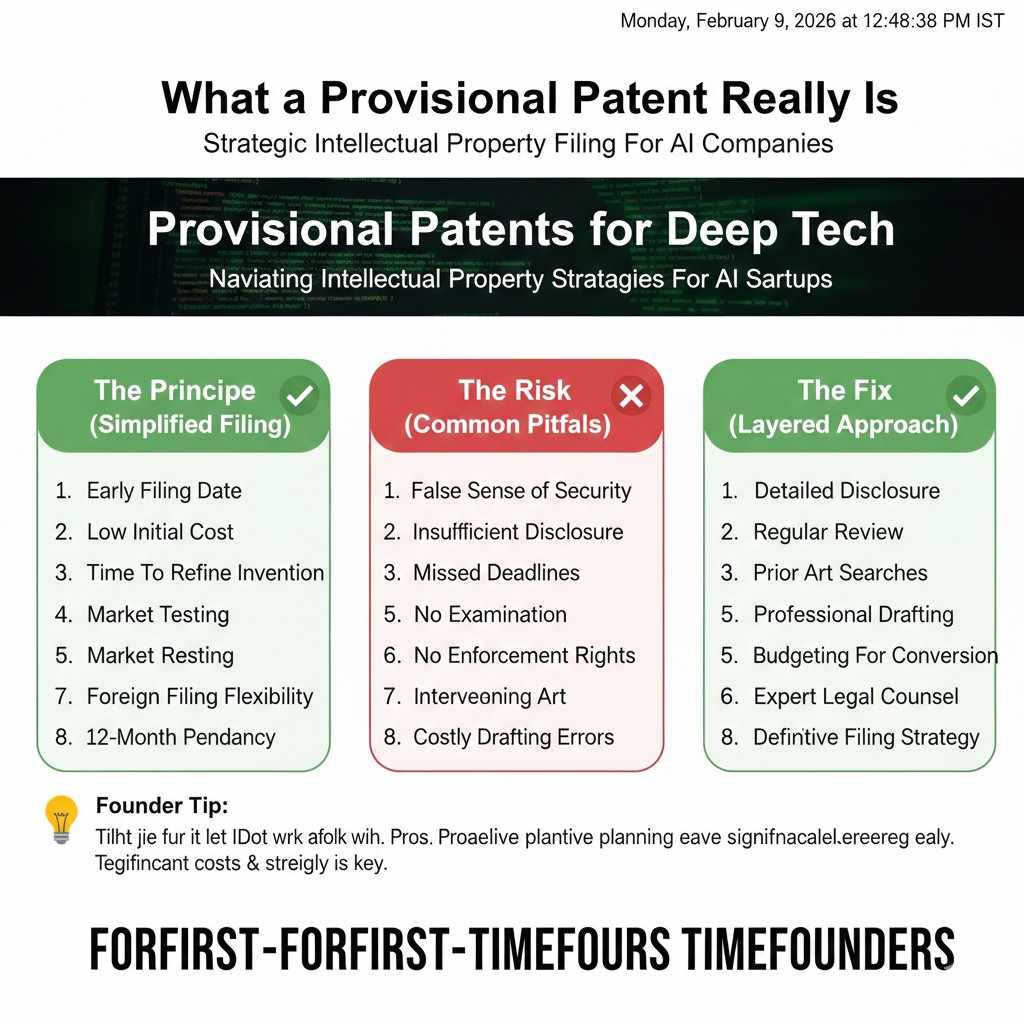
A provisional patent is not a granted right. It does not give you the power to stop anyone. It does not get examined. It does not turn into a patent by itself.
What it does is lock in a date. If you later file a full patent application that matches what you described, you may be able to claim that earlier date.
That earlier date can matter a lot. In the U.S., patents generally go to the first person to file, not the first person to invent. So a good provisional can act like a strong “time stamp” for your invention.
It is only as strong as what you actually write
Many founders think a provisional is like a placeholder. They believe they can file something short today and “fix it later.”
That is risky. If your provisional does not clearly teach the invention, then it may not support your later claims. In plain terms: if it is thin, it can fail to protect the very thing you care about.
A provisional is not judged by how fast you filed it. It is judged by whether it explains the invention well enough that someone skilled in the field could build it without guesswork.
It is a one-year window, but not a free pass
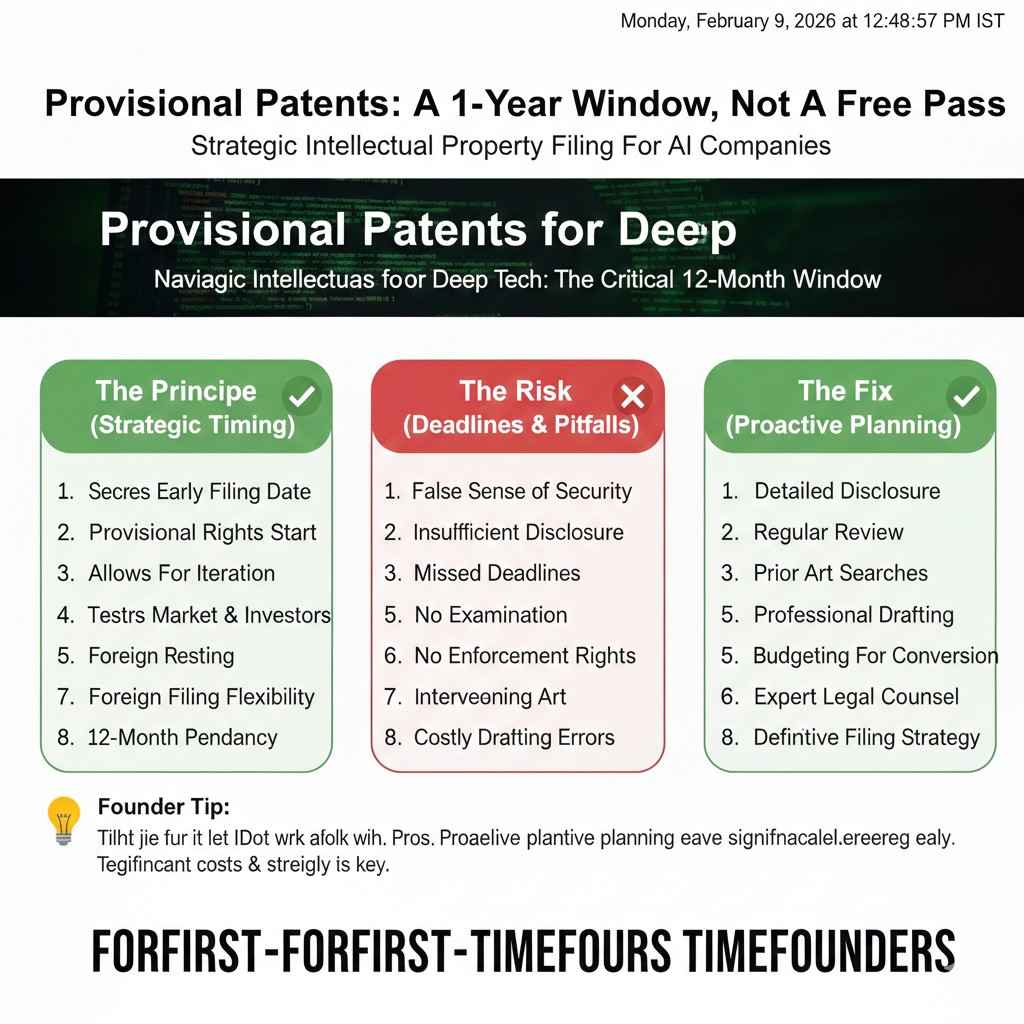
A provisional gives you up to 12 months to file a non-provisional (the full application). That year can be helpful when a startup is moving fast.
But the year can also create a trap. Founders file a weak provisional, feel “covered,” and then share details too freely. If the provisional is not detailed, those public disclosures can come back to hurt you later.
The best way to think of a provisional is this: it is a draft of your real patent plan, not a napkin note.
Why Provisional Patents Can Help Startups
They can buy time at the right moment
Startups rarely have a clean, calm moment to file. Product changes happen. Customer needs shift. Engineers keep improving the system.
A strong provisional can buy you time when you are at a turning point. For example, you may be about to demo to a strategic partner. Or you may be about to pitch investors. Or you may be preparing to publish a paper.
In these moments, a provisional can help you move forward without pausing progress for a long patent process.
They can help you capture the invention before it spreads
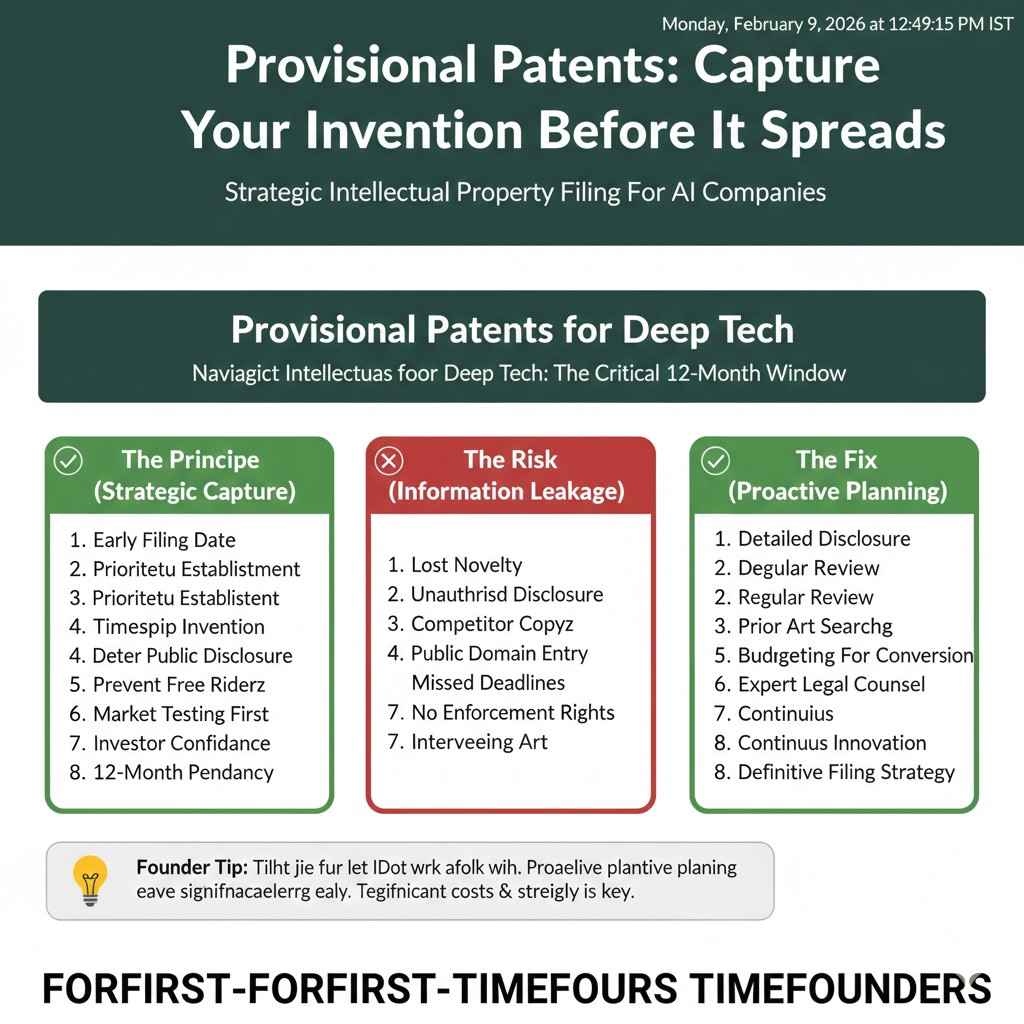
In early-stage companies, ideas move fast across people. You might have contractors, advisors, pilot customers, and design partners.
Even with NDAs, details can leak. Sometimes it is not even malicious. People talk. Slides get forwarded. Someone references your work in a meeting.
A well-written provisional can reduce the risk that a “leak” becomes a loss of priority. It does not stop copying by itself, but it can help you keep your place in line.
They can support fundraising when used honestly
Some investors care deeply about IP. Others care less. But almost all investors like to see that the founder thinks clearly about defensibility.
A provisional can be part of that story if it is real and meaningful. The key is that it must match a real technical advantage, not vague marketing words.
If your provisional is strong, you can talk about it with confidence. If it is weak, it can create awkward questions later, especially during diligence.
If Tran.vc is a fit, this is one of the big ways we help. We work with founders to build IP that investors can respect, without slowing down shipping. Apply here anytime: https://www.tran.vc/apply-now-form/
Where Provisional Patents Often Fail Founders
Filing too early can lock you into the wrong version
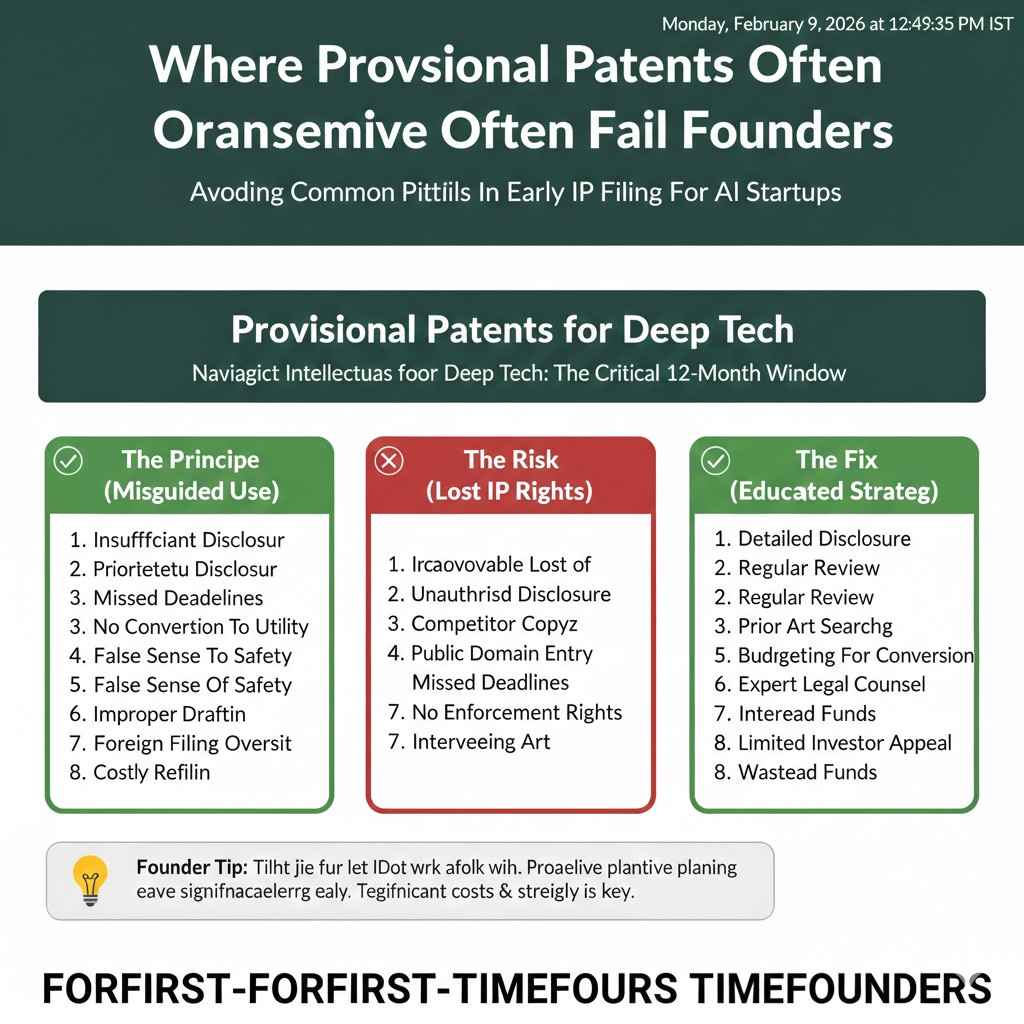
A very common mistake is filing before the invention is real. A founder gets excited and files when the concept is still changing daily.
Then, over the next months, the team builds the real system. The architecture changes. The model changes. The workflow changes. The key insight changes.
Now the provisional covers an older version that no longer matters. Worse, the team may think they are protected when they are not.
If you file early, you must do it with discipline: write it in a way that captures the core idea and likely variations, not just the first rough draft.
Filing too shallow creates “paper armor”
Some provisionals are basically a short story about the product. They describe a problem and a high-level solution. They include a few diagrams that look nice.
But they do not explain the “how” in enough detail. They do not show the steps, the logic, the data flow, the control loop, the edge cases, the system limits, or the key parameters.
This kind of filing can feel comforting, but it can fail when it matters. A later full application might not be able to claim the early date for the real invention.
That is why “cheap and fast” is not always a good goal. The goal is “clear and defensible.”
Filing the wrong thing wastes your best shots
Startups often file on the product surface, not the technical moat. They file on what the user sees, not what makes the system hard to copy.
For AI, that often means filing on generic “use machine learning to do X.” For robotics, it can mean filing on the robot doing a task, without capturing the control method that makes it work reliably.
A better filing is focused on what would hurt you if a competitor copied it. If a large company could rebuild your demo in 30 days, what part would they struggle to replicate?
That is the part you want to protect.
Provisional vs Non-Provisional: The Real Difference
The provisional is your foundation, the non-provisional is your legal engine
A non-provisional is the full patent application that gets examined. It has claims. Those claims define the legal boundary of the invention.
Your provisional does not need claims in the same way, but it must support the claims you want later. That means your provisional must include enough details and enough variations to give you room.
If you want the non-provisional to be broad, the provisional needs broad support. If you want it to cover many versions, the provisional must show those versions.
So the “real difference” is not just formality. It is the level of care needed to make sure your later claims have a strong base.
A weak provisional can narrow your future options
Many founders think they can start narrow and then expand later. But the earlier date only attaches to what you actually disclosed.
If you leave out key variations, then you may not be able to claim them later with the same priority date. And in fast-moving fields, even a few months can matter.
That is why a good provisional is not just “what we built this week.” It is “what we built, plus what we will likely build next, plus the key alternative paths.”
The one-year clock changes behavior
The one-year window can be useful for planning. It also forces decisions.
If you file a provisional today, you will need to either file a non-provisional within 12 months or let it go. That deadline can be good because it prevents endless delay.
But it can also create stress later if you filed without a clear plan. You do not want to arrive at month 11 with a weak provisional and a rushed full filing.
A clean IP plan avoids that. If you want help building that plan, Tran.vc was built for this exact early-stage moment. Apply anytime: https://www.tran.vc/apply-now-form/
When a Provisional Patent Helps Most
When you are about to disclose key details
The best timing is often tied to disclosure. If you are about to show the “how” to people outside the company, that is a moment to consider filing.
This includes investor decks that go deep, partner demos where engineers ask technical questions, pilots where you share system diagrams, or papers and talks.
If you can delay disclosure, sometimes you can delay filing. But if disclosure is necessary to move forward, a strong provisional can be a smart step.
When you have identified the technical core that will likely stay
Startups change, but not everything changes. Often there is a technical core that survives the pivots.
In AI, it might be a data pipeline method that produces better labels with less cost. In robotics, it might be a safety method that allows faster operation without crashes. In infra, it might be a scheduling method that reduces compute.
When you can name that core clearly, you are in a better position to file something that will still matter a year from now.
When you can write it with enough detail to stand on its own
A provisional works best when it reads like a real technical document. Not a marketing brief.
It should explain what the system is, what the system does, and exactly how it does it. It should show variations and alternatives. It should describe data inputs, outputs, and steps.
If you cannot yet explain the invention clearly, you may not be ready to file, or you may need support to translate engineering reality into patent-ready detail.
This is where Tran.vc can be unusually helpful. We invest up to $50,000 in in-kind IP work so you do not have to choose between speed and quality. Apply here anytime: https://www.tran.vc/apply-now-form/
When a Provisional Patent Does Not Help
When it is used as a shortcut for real strategy
A provisional is a tool. It is not a strategy.
If the team files because they feel nervous, but they cannot answer what they are protecting and why, the provisional is unlikely to deliver value.
In that case, a better first step is often an IP mapping session: identify the real inventive pieces, rank them by business value, and decide what to file first.
When the invention is not yet a true invention
Some ideas are good business ideas, but not patentable inventions. A patent needs a technical solution, not a business plan.
If the “new” part is mostly pricing, packaging, or process, a provisional will not create defensibility. It may create a false sense of progress.
In that case, trade secrets, speed, and distribution may matter more. Or you may need to dig deeper and find what technical method truly makes the business work.
When the company cannot follow through within 12 months
If you know you will not have the budget or discipline to file the non-provisional within the year, you should think carefully.
A provisional that dies may still have some value in internal learning, but it often becomes a sunk cost. It can also create confusion if the team keeps saying “we filed a patent” when it is no longer active.
A clear plan matters more than a quick filing.
The Biggest Misunderstanding: “Provisional Means Protected”
What “patent pending” does and does not signal
After you file a provisional, you can often say “patent pending.” That phrase can feel powerful. It can also be misunderstood.
“Patent pending” does not mean you have a patent. It does not mean a court will stop a competitor. It does not mean an investor will assume you have strong IP. It simply means you filed something.
If the filing is solid, that signal can help. If the filing is weak, the signal is mostly noise. The risk is that founders start acting like they have a shield when they only have a timestamp.
A better mindset is simple: the filing is only useful if it can support strong claims later.
The real job of the provisional is to preserve details
A good provisional is not a slogan. It is a careful record of how the invention works.
It should include the pieces that matter most: system parts, steps, logic, flows, control rules, training and tuning methods, edge conditions, and what changes when the environment changes.
This is why a one-page provisional is almost always a bad idea for deep tech. Deep tech value is usually in the details. If the details are missing, the value is missing too.
Why “we’ll write the real one later” often fails
Startups are busy. If you plan to write the “real version” later, later often never comes.
The team ships product, chases pilots, fixes bugs, and hires people. The deadline creeps up. Then you end up rushing the non-provisional at month eleven with a messy record of what was actually invented.
If you treat the provisional as the first serious draft, you avoid that panic. You also make it much easier to build a steady filing plan, instead of one big stressful scramble.
Provisional Patents and Fundraising: The Honest Way to Use Them
What investors actually want to know
Most strong investors are not impressed by the existence of a filing. They want to know what the filing covers.
They are trying to understand whether your advantage can last. They will ask, in plain terms: “If a well-funded team tries to copy this, what stops them?”
A provisional helps when you can answer that question clearly. It hurts when you use it as a vague badge and cannot explain the technical boundary.
A good approach is to connect the filing to a simple story: what is new, why it works, and why it would be hard to rebuild without your method.
How to talk about a provisional without over-claiming
You can say you filed a provisional and that you plan to convert it to a full application. You can describe the invention at a high level. You can say it covers a specific system or method.
What you should not do is imply that you have granted protection or that competitors are legally blocked. That can create trust issues later during diligence.
If you want the filing to help in fundraising, be precise. Keep it grounded in what you actually filed and what you will file next.
How Tran.vc fits into this moment
This is one reason Tran.vc exists. Many founders know they need IP, but they do not want to burn cash on legal work before they have traction.
Tran.vc invests up to $50,000 in in-kind patent and IP services so you can build a real moat early, with guidance from people who have done this before.
If you want to raise with more leverage, IP done well can be a key part of that. You can apply anytime here: https://www.tran.vc/apply-now-form/
The Core Distinction: Filing for “The Product” vs Filing for “The Moat”
Product features change; the moat should not
A product feature is what customers notice today. A moat is what stays valuable even if the UI, the market, or the pricing changes.
A lot of weak provisionals read like product brochures. They focus on what the app does, or what the robot looks like, or what the dashboard shows.
Strong provisionals focus on the hard part. The part that took real work. The part that required trial and error. The part that is not obvious to a skilled competitor.
When you file on the moat, your IP stays relevant longer.
A simple test to find the moat
Imagine you had to onboard a strong competitor for one month. They get your website, your demo videos, and your marketing deck.
Now ask a blunt question: what still blocks them? What knowledge do they still not have?
If the answer is “our control method,” “our training setup,” “our sensor fusion approach,” “our constraint handling,” “our data labeling pipeline,” or “our runtime architecture,” you are close to moat territory.
If the answer is “our brand” or “our idea,” that is not patent territory. That may be a business advantage, but it is not what a patent protects.
What “file on the moat” looks like in writing
It looks like a clear explanation of the technical steps, not just the outcome.
Instead of saying “we use AI to detect defects,” you explain how the system learns, how it handles noise, how it treats rare cases, how it updates safely, and how it sets confidence thresholds.
Instead of saying “the robot moves items,” you explain the sensing loop, the planning method, the safety constraints, the recovery behaviors, and how the system adapts when it fails.
The writing must teach. It must not only describe.
Provisional Patents for AI Startups: Where They Work and Where They Break
“Model plus data” is not enough to be new
In AI, many teams think the model is the invention. Often the model is not the invention.
If you are using common architectures and standard training, the novelty might be thin. A provisional that says “we train a neural network” is usually not helpful.
What is more often novel is the system around the model. The way data is collected, cleaned, labeled, or generated. The way uncertainty is handled. The way human feedback is used. The way the model is deployed safely.
That is where you should look first.