
Early on, you need proof that buyers want what you are building. You may not have big revenue yet. That’s okay. Simple, clear documents can help you show real demand. Two tools do this well: a Letter of Intent (LOI) and a Memorandum of Understanding (MOU). They are short, plain, and fast. They turn “nice idea” into “we plan to work together.” Investors take notice because risk feels lower and the path to dollars looks close.
An LOI says, in simple words, what a buyer plans to do if a few things go right. An MOU says how you both plan to work, step by step, before a full contract. Neither needs to be heavy. Both can be honest and tight. Used well, they unlock pilots, speed up legal, and give you a story you can defend in the room.
This guide shows how to draft them, when to use each, what to promise, what to avoid, and how to turn them into real traction. We’ll keep it practical and calm. You’ll get lines you can paste into emails, slides you can share, and steps you can run this week.
LOI vs. MOU: What They Are and Why They Matter
Think of an LOI as a promise of intent. It says a buyer plans to take a step with you if clear conditions are met. It is short. It is not a full contract. It is a signal that your work matches a real need. You can use it to open doors, align teams, and set a date on the calendar. Investors read an LOI and see momentum that is close to cash.
An MOU is a plan to work together. It maps the path to a pilot or a small rollout. It names who does what and when. It sets scope, safety lines, and how you will measure results. It also keeps risk low for both sides. An MOU is useful when the buyer is ready to move but not ready for a heavy agreement. It moves you from talk to action.
Use them together when it helps. The LOI can state intent to run a guarded pilot and to negotiate a larger order if results show up. The MOU can state the exact steps to run that pilot. One says “we plan to do this.” The other says “here is how.” In a raise, this pair tells a simple story: a path to value is clear, and the first move is ready.
Why Investors Care About These Documents

LOIs and MOUs lower uncertainty. They show that a buyer understands your product, agrees on the job to be done, and has a way to approve the next step. This cuts risk in three ways. First, it proves interest is not vague. Second, it shows the scope is small and safe. Third, it shows a clock and owners. Those three make a room relax.
They also compress time. When a partner signs an LOI, internal teams start moving. Legal gets looped in. Security starts a short review. Operations blocks a time slot. This pace gets you to a pilot faster. Faster pilots mean faster proof. Faster proof means stronger terms in your round.
Finally, they frame price. A clear LOI can name a unit that matches real value. Per line. Per device. Per team. A strong MOU can tie that unit to one metric you will move. Minutes saved. False rejects cut. Safe resumes faster. Now price lives next to outcome. This is what a good seed story needs.
When to Use an LOI vs. an MOU
Use an LOI when a buyer says, “we want this” but needs a few checks done first. The LOI can state intent to purchase a pilot or a first block of units if the checks pass. It should put a date on those checks: security review, site test, or a benchmark. It should also say who signs the order when the checks are done. This clarity turns interest into a plan.
Use an MOU when both sides agree on the shape of work. You have a scene to test. You have a metric to move. You have a guardrail to keep risk low. The MOU writes those down in simple words. It assigns owners on both sides. It sets a start date, an end date, and what “done” means. With this in place, the pilot can start fast.
You can also step from one to the other. Start with a simple LOI to align intent and budget band. Move to an MOU to set the steps. Then, when you hit the metric, move to a small order. This path is clean. It avoids big leaps. It keeps the buyer in control and you in motion.
How to Draft an LOI That Holds Up
Keep the language plain. Say what the buyer plans to do and when. Name the job to be done in one line. Name the unit of value. Name the conditions that must be met. State who has authority to sign. Add a simple window for the next decision. A two-page LOI written this way is more useful than a long one full of legal terms.
Be specific on scope. If the intent is to run a two-week pilot on line two, under a glare guardrail, say that. If the intent is to buy ten devices after a pass, say that. Ambiguity creates stalls. Specifics help teams inside the buyer move in sync.
Keep the tone balanced. An LOI is not a squeeze. It is a signal. It should respect that the buyer needs to check safety, security, and change management. Add those steps in the conditions. Date them. This respect speeds the path, because it matches how the buyer really works.
How to Draft an MOU That Moves Work Forward

Open with the goal in one sentence. Tie it to the buyer’s words. Then map the steps. Who installs. Who observes. Who approves. Include the guardrail that keeps risk low. Include the metric you will report. Include the clock. The shorter the path, the faster the “yes.”
Set clear success criteria. Define the number, the unit, and the window. “False rejects under two percent at 30 FPS for five shifts.” “Safe resume under four seconds with zero collisions during this scenario set.” Use measures the buyer already tracks. This avoids fights later and makes your win easy to share up the chain.
Add a simple paper trail. One short status mid-week. One wrap note at the end. Each note should have a screenshot and a number. This rhythm keeps focus high and makes decisions easy. It also gives you artifacts you can use in your deck with permission.
Make These Documents Credible
Use real constraints. If the line runs under sodium light at 30 FPS on a set GPU, write that. If the lab uses a certain prep, write that. Honest bounds build trust. Pretty promises do not.
Anchor outcomes to current pain. If the buyer loses forty minutes at changeover, state how your run will change that. If scrap spikes when glare hits, state how your run will lower it. The closer your words are to daily work, the stronger the signal.
Name owners. Titles are fine, names are better. “Operations lead: Priya.” “Quality lead: Marco.” People move faster when they can see who acts. This is true for your team too.
Avoid Common Pitfalls
Do not promise volume too soon. Keep the LOI tied to a pilot or a small first block. You can add a non-binding note that says, “if success, parties intend to discuss expansion.” That is enough.
Do not skip safety and security lines. If you need to “never store raw images,” say so. If a dry run must be used before live action, state it. If a manual stop is always possible, write it. These lines cut review time and prevent last-minute fear.
Do not write like a lawyer if you are not one. Use simple words. If a clause is needed, keep it short. If a term is new, explain it in a footnote. Plain language reduces error and speeds sign-off. You can always add heavier terms later when you sign a larger deal.
Tie LOIs and MOUs to Pricing Without Drama

Keep the first step small, paid, and fair. Use the unit that matches the outcome. Price at a level a manager can approve. This keeps momentum. It also gives you a clean speed-to-dollar slide in your deck.
Leave room to learn. If a number feels tight, put a range and state how you will refine it after the run. “If results hold across five shifts, parties will review price per line in the $X–$Y range.” This honesty disarms pushback and keeps the door open.
Connect price to a single metric. One line, one number. “Fee covers two weeks to cut re-teach minutes by half.” The simpler the link, the fewer the emails.
Use These Docs in Your Deck
Place one excerpt from an LOI or MOU on a slide. Redact sensitive parts. Show the sentence that states intent, the date, and the owner. Add one screenshot from the scene you will test and the metric you will move. This is enough. It reads like control. It reads like a plan.
Pair the excerpt with your “two-week guarded pilot” offer. State scope, guardrail, metric, owner, and start date. Put both on one page. The room sees a buyer who plans to act and a team that knows how to start. That mix is rare and powerful at pre-seed.
If your method is the reason the buyer signed, note it in small type. “Method protected (provisional filed).” Traction plus moat in one breath is the line people remember.
Connect LOIs/MOUs to IP and Data Use
These papers should reflect your edge. If a glare-safe planner or a special arbitration loop made the buyer lean in, write the steps down in plain order and protect them. When your LOIs rest on methods you own, your position strengthens as you sell.
Be clear on data. Say what you collect, where it lives, who can see it, and for how long. If you use privacy-preserving tricks to get the same insight with less data, describe them simply. These details calm legal, shorten reviews, and often become protectable assets on their own.
Tran.vc can sit with you to align LOIs, MOUs, and filings so the story is tight and defensible. We invest up to $50,000 in in-kind IP services to make that real. Apply at https://www.tran.vc/apply-now-form/.
Simple LOI Template You Can Adapt Today
You do not need fancy language. You need clear intent, dates, and owners. Start with a short header that names both parties and the job to be done in one line. Follow with a paragraph that states the plan: a narrow pilot or a first buy if named checks pass. End with a paragraph that lists conditions, a target date, and who will sign the next paper. Keep each paragraph under five lines. Plain beats poetic.
Write the job in the buyer’s words. “Reduce false rejects on line two at 30 FPS under sodium light.” Add the unit you will use later to price. “Per line” or “per device” is enough. Put a simple window for the next move. “Target pilot start by March 10.” Name the approver by title and, if allowed, by name. “Operations Director (Priya N.).” This turns a soft “yes” into a visible path.
Close with a fair clause that protects both sides. Say the LOI is non-binding except for confidentiality and permitted publicity (if any). Add a sentence that both parties will act in good faith to complete reviews. You are not locking either side in. You are setting an honest plan with a clock. That is what speeds work.
Simple MOU Template That Starts Work Fast

Open with the goal in one sentence. “Run a two-week guarded pilot on line two to cut re-teach minutes by half.” Add a short scope paragraph: scene, device, compute, light, and the guardrail that keeps risk low. Write it like a checklist, but as sentences. “Use existing camera. No raw images stored. Dry run before live motion. Manual stop available.” Clear edges lower fear.
Add responsibilities by role, not department. “Vendor: install preset, run daily report, attend two standups. Buyer: provide access window, name on-shift owner, share baseline.” Assign names if possible. Names beat titles. Everyone sees who is on point. Put dates on start, mid-check, and end. Three dates keep the project moving without long calls.
End with measurement and wrap-up. State the metric, the unit, and the window. “False rejects under two percent across five shifts.” Say how results will be shared. “Daily one-pager with screenshot and number.” Say what happens next if the goal is met. “If goal is met, parties plan to sign a two-line expansion order within ten business days.” This closes the loop without big legal words.
How to Get to “Yes” in One Call
Bring one scene, one number, and one page. The scene should look like last Tuesday. The number should match a report the buyer already reads. The page should lay out the guarded pilot as above. When the buyer says “this looks right,” ask for the smallest paper they can sign to start. Keep the ask small. “Can we lock a two-week pilot slot and route this one-pager today?”
Answer security in plain words. Say what you collect, where it lives, who can see it, and for how long. If you never store raw images, say so. If you only keep metadata, say which fields. If you have a privacy-preserving trick that gets the same insight with less data, describe it simply. Calm answers cut through fear and shorten the thread.
Leave the room with owners and dates. Write them down and read them back. “Priya owns access. Marco owns QA checks. We start March 10. Mid-check March 15. Wrap March 21.” Send a recap within one hour. The recap is your first proof artifact. It keeps momentum and shows you respect their time.
Using LOIs and MOUs With Partners
A channel partner can move you into sites faster. Use an LOI to set the three-way intent: partner introduces a matched site; buyer hosts a guarded pilot; you deliver results under clear bounds. Keep it balanced. Give the partner credit for the intro and a small finder’s fee upon a paid step, but keep your method and your black boxes yours.
Use an MOU to define who does what on the floor. Partners often handle rigs and cabling. You handle presets, safety logic, and daily reports. The buyer names the on-shift owner and the window. When each side sees their steps on paper, friction drops. Add one line that says the partner will not disclose internals without permission. You are making friends, not giving away the magic.
If a partner process or scaffold is unique and lowers risk, write it down as a method. A setup jig, a calibration pass, or a preset sequence that always works may be protectable. Capture the steps and the conditions. If it is new and useful, consider filing. Tran.vc helps teams convert this kind of field wisdom into claims without slowing the program.
International Use: Keep It Even Simpler
Cross-border reviews can stall over terms. Keep LOIs and MOUs extra plain. Drop idioms. Spell units. Use dates with months written out. Name local data regions and retention rules if they matter. If translation helps, provide a bilingual header and define which version governs to avoid confusion.
Respect local approval paths. In some regions, a plant manager can sign a pilot; in others, central legal must see any commitment. Ask early who signs what and shape your paper to that path. Your goal is not a perfect document. Your goal is a fast, fair step that honors the buyer’s process.
If export rules or safety codes apply, cite the specific standard and the clause you match. A short note that says “tested under [standard], section [x] bounds” calms risk reviewers. Pair the note with a short clip from your sandbox or shadow. Visual proof crosses language better than long text.
Common Negotiation Stalls and How to Unblock Them
Budget stalls: offer a smaller scope with the same guardrail and a shorter window. Keep the unit and outcome the same so learning transfers. “One week on one station instead of two weeks on two.” Scarcity helps too. “We can hold this slot if we route paper this week.”
Legal stalls: send your one-page order and your FAQ the same day. Propose a short DPA addendum if needed. Ask which clause is blocking and offer practical alternatives. Most stalls come from unclear data flows and retention. Solve those with a diagram, not a speech.
Fear stalls: add a dry run or a manual approval step. Show a clip of the guardrail firing and the safe path chosen. Fear melts when people see the system choose caution. Write that choice into the MOU so reviewers know the default is safe.
Measure the Impact of LOIs and MOUs in Your Metrics

Track “days from LOI to pilot start” and “days from MOU to first result.” These two clocks tell you if your paper moves work or adds steps. When you tighten language or add a new FAQ, watch the clocks for two cohorts and write down the change. Dates and deltas become a strong slide later.
Track conversion: LOIs to MOUs, MOUs to paid pilots, paid pilots to expansions. Keep the sample small and true. A short table with owners and dates is enough. Label the fix that raised each conversion. “Security FAQ cut LOI→MOU days by nine.” This reads like control.
Attach artifacts in your data room. For each LOI and MOU, store the signed PDF, the kickoff recap, and one mid-pilot note. Investors see a clean chain: intent → plan → action → result. Clean chains shorten diligence, which shortens the round.
Tie LOIs and MOUs to Your IP Story
When a buyer signs because a method lowered risk or sped setup, say that on the page. “Parties chose Vendor’s glare-safe preset sequence to reduce re-teach time.” Keep it factual. Later, on your slide, you can add “method protected (provisional filed).” You are not waving patents in their face. You are linking outcomes to assets with quiet confidence.
If your MOU encodes a unique arbitration loop—how signals blend, thresholds adapt, fallbacks trigger—write the flow in plain steps outside the contract and file. Contracts move business. Claims protect engines. Doing both keeps speed and defends value. Tran.vc exists to help you run this loop while you build.
A Small Example You Can Borrow
Here’s the heart of a plain LOI paragraph you can adapt:
“Company A intends to run a two-week guarded pilot with Company B on Line 2 to reduce re-teach minutes by 50% at 30 FPS under existing lighting, using Company B’s dry-run preset and manual approval guardrail. Subject to completion of security review and site access by March 10, Company A intends to issue a pilot order not to exceed $X per line. Upon meeting the above goal, parties intend to discuss a two-line expansion order in the $Y–$Z range. Approver: Operations Director (Name).”
And here’s the core of an MOU sentence:
“Parties agree to measure re-teach minutes per changeover across five shifts; Vendor will deliver a daily one-page report with screenshot and number; Customer will assign on-shift owner to supervise manual approvals; no raw images will be stored; dry run precedes any live motion.”
Do not copy these blindly. Fit the scene and the unit to your wedge. The power is in the simplicity and the match to daily work.
How to Use LOIs and MOUs in Your Raise
Place one redacted LOI excerpt on a slide with the date and the approver title. Beside it, place one MOU line with scope, metric, and start date. Under both, show your tiny paid step offer. The slide says: a buyer wants this, a plan exists, and a door to dollars is open. That is all a smart room needs.
In your update after the meeting, send a single screen with the same LOI/MOU frame and a fresh dot on “days to pilot start.” Consistent frames make motion obvious. Motion raises terms.
If you want help shaping these papers and protecting the method that makes buyers sign them, Tran.vc invests up to $50,000 in in-kind patent and IP services for AI, robotics, and deep tech teams. We sit with you, draft, refine, and file while you build. Apply any time at https://www.tran.vc/apply-now-form/.
Handle Redlines Without Losing Speed
Redlines will come. Treat them like product bugs, not battles. Read each change for intent first. Is the buyer trying to avoid risk, cap scope, or clarify data use? When you see the aim, you can answer with a simpler line that meets the need without heavy legal weight. Respond the same day with a clean revision and a short note that explains what changed and why. Fast, calm replies keep momentum and show you are easy to work with.
Group edits by theme before you answer. Data retention edits belong together. Indemnity tweaks belong together. Scope cuts belong together. This makes your counter shorter and easier to accept because reviewers can approve a theme, not a grab bag. Put dates on each turn. If a thread drifts, your timeline shows who moved what and when, which helps both sides get to “done.”
When a redline asks for something you can’t do, offer a concrete, safer alternative. If they want wide data rights, offer narrow rights with a longer retention for audit. If they want you to control live motion on day one, propose a dry-run-first rule with a manual override. Specific, safer options beat a simple “no” and often get a quick “yes.”
Align Many Stakeholders with One Page
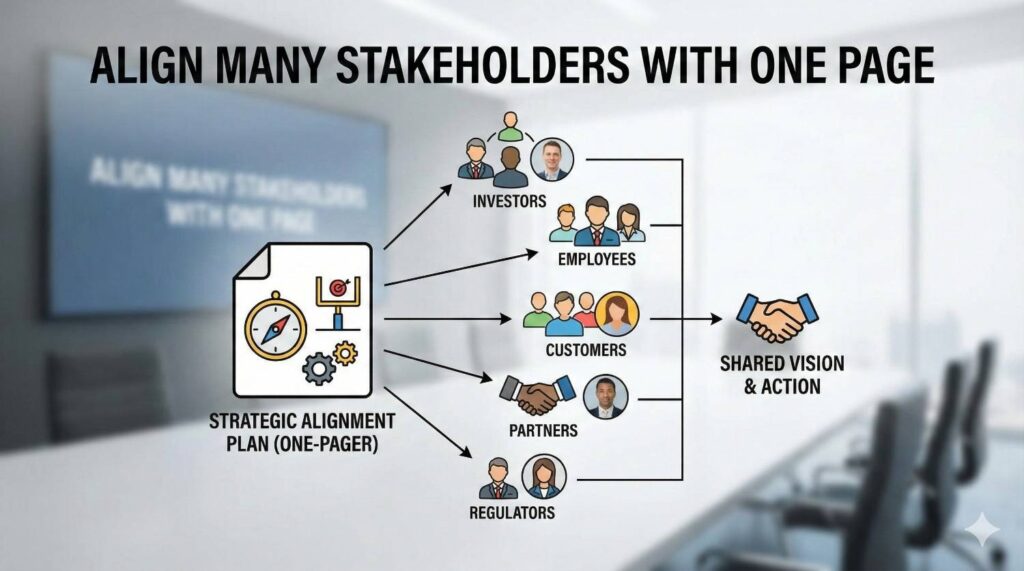
Big buyers have many voices. Operations wants uptime. Quality wants fewer errors. Security wants control. Legal wants clarity. Your LOI and MOU should speak to all four without growing heavy. Use one page that shows the scene, the goal, the guardrails, the data flow, the owners, and the dates. Each role finds their line and relaxes.
Name a single on-shift owner on the buyer side. When someone is clearly on point, small snags get solved in minutes, not days. Pair that owner with your on-call owner for the pilot window. Put both names on the page. People respond to names faster than to teams.
Close the loop with a mid-run huddle. Ten minutes, midway through the window, with all stakeholders. Show one clip, one number, and one change you shipped. Ask for one blocker you can remove. This small ritual saves long email threads and keeps everyone pulling in the same direction.
Use LOIs to Shape Your Message and Market
Every signed LOI is a mirror. It tells you which words landed, which scenes felt real, and which unit made price feel fair. Read your last three and underline phrases your buyer wrote that differ from your wording. Put those phrases in your site, your deck, and your demo script. Buyer language is a growth lever. It removes translation and shortens calls.
Study the approver title on each LOI. If line managers approve fast and central IT slows, design your first steps for managers and keep IT’s needs simple and pre-answered. If a specific region moves faster, double down on it with focused proof and fresh references. Your early market is the path of least resistance. Your LOIs reveal it.
If a method is named in multiple LOIs as a reason for intent—your glare-safe preset, your arbitration loop, your privacy step—write that method as a short flow and protect it. You are not only tuning words. You are locking in the engine those words point to.
When Not to Use an LOI or MOU
Sometimes a buyer wants a quick pilot with a credit card and no paper. Do not force an LOI. Take the win, use your simple order page, and move. The best document is the one that gets you to the floor fastest with safety and scope intact.
If a buyer asks for a huge, multi-year MSA before any field proof, push for a small MOU instead. Explain that a short, guarded run will answer real questions and make the big paper easier. If they refuse, keep the door open but do not stall your roadmap. Pre-seed teams lose time trying to win paperwork instead of winning scenes.
If an LOI asks for massive exclusivity or broad IP rights, pause. Explain you cannot give away your engine to get a pilot. Offer a narrow field exclusivity for a brief window or a right of first discussion on expansion. Protect the core. Deals that trade the core for a logo are not wins.
Read the Clock: Time Metrics That Matter

These documents should compress time. Track three clocks with dates. First, days from LOI signature to pilot start. Second, days from MOU signature to first result. Third, days from first result to paid expansion. Watch these like product metrics. When you change wording or add a FAQ, look for a drop in days over two cohorts.
Share the clocks in your updates with one-sentence causes. “Security FAQ cut LOI→MOU by 9 days.” “One-page order cut MOU→first result by 6.” These are non-revenue signals investors respect because they show control and a repeatable path to dollars.
If a clock expands, say it plainly and fix the cause. “Legal added 12 days on DPA—added region line, now back to 7.” Calm truth beats spin. It proves you manage risk and time with care.
Protect Data the Buyer Cares About
Write your data line first and keep it strict. Say what you collect, where it lives, who can see it, and for how long. If you can achieve the goal with less data, say so and show how. Keep raw media out when possible; keep metadata small and documented. Less data speeds reviews and reduces real risk.
Offer a simple audit path. A daily report with timestamp, decision, and reason code is often enough. When trouble happens, people want a clear record, not a giant dump. Your MOU should promise this small trail and your LOI can reference it. Clean trails calm legal and quality at once.
If your privacy method is novel—like a way to score without storing raw inputs—document it and consider filing. Useful privacy is a moat. Buyers say yes faster, and rivals have a harder time catching up.
Convert Paper to Dollars with a Guarded Offer
Do not let an LOI sit without a door to money. Attach a small, paid step that matches the LOI scene. Scope it to one line, one metric, and one guardrail. Price it so a manager can approve. Put owners and dates on it. The MOU then becomes the “how” for that step.
When you hit the number, move to a micro-expansion within 24–48 hours. Two lines instead of one. One team instead of a single station. Keep the guardrail. Keep the unit. Keep the cadence. You are building a habit of yes. Habits turn into revenue faster than big leaps do.
If you miss the number, share what you learned and the fix you will ship. Ask for one more short window. Many teams will respect the honesty and give you the shot. Your report becomes a proof artifact you can reuse later.
Use LOIs and MOUs to Train Your Team

Treat each signed paper as a playbook. Walk new hires through a real LOI and MOU. Show the scene, the metric, the guardrails, the data line, and the owners. Explain why each word is there. This training aligns product, sales, and success around field reality, not internal lore.
Turn the best patterns into templates. Keep them in a shared folder. Update wording when you learn a better phrase from a buyer. Protect the methods that drive the wins those words describe. Your team will start to think in scenes, guardrails, and units. That mindset shows up in demos, builds, and emails. It is how small teams look big and calm.
Make a short win wall: one clip, one number, one LOI line, one MOU line. When the wall grows, morale rises—and the story in your deck gets stronger without extra work.
A Short Field Story You Can Model
A robotics startup targeted glare at changeover. They built a sandbox under sodium light at 30 FPS and logged results. They ran an expert panel, learned to add a dry run before live motion, and filed on a glare-safe preset sequence. With one clip and one chart, they secured an LOI from a regional plant operator: a two-week run on line two to cut re-teach minutes by half.
They issued a one-page MOU with scope, guardrails, metric, owners, and dates. Security signed off in two days using a simple FAQ and diagram. Midweek, they shipped a preset tweak that shaved eight minutes. They hit the goal, moved to a two-line expansion in 48 hours, and used the same wording and clip to open three more sites. Their deck showed the LOI excerpt, the MOU goal, the before/after clock, and a quiet footer: “Method protected (provisional filed).” The round moved quickly because the path was clear and defensible.
Conclusion: Put Simple Paper to Work
LOIs and MOUs are small tools with big impact. They turn interest into intent, intent into a plan, and a plan into action—without heavy contracts or long fights. When you write them in plain words, anchor them to a real scene, and pair them with a guarded, paid step, you compress time and lower fear. That is what buyers need to say yes. That is what investors need to believe your path to dollars is real.
Keep the loop tight. One scene. One metric. One guardrail. One page. One date. Move from LOI to MOU to first result in days, not months. Save the clip, the number, and the sentence that mattered. When the same method keeps winning, write the steps and protect them. Now your traction rests on assets you own, not on luck or promises.
If you want a partner to help you shape these documents, compress the clocks, and protect the method behind your wins, Tran.vc invests up to $50,000 in in-kind patent and IP services for AI, robotics, and deep tech teams. We roll up our sleeves on strategy, filings, and proof packaging so you can raise with calm confidence. If that is your next step, apply now at https://www.tran.vc/apply-now-form/.