
A “50/50 split” sounds fair. Two people. Same risk. Same reward. Clean math. No drama.
And yet, I’ve seen more startups get stuck, slow down, or break apart because of a 50/50 split than almost any other early decision. Not because the founders were bad people. Not because they didn’t work hard. But because “equal” is not always the same as “fair,” and fairness changes as the company changes.
If you are building in AI, robotics, or any hard tech, this matters even more. These companies take longer. They cost more. They need strong focus for years. Small cracks turn into big ones when you are tired, low on cash, and trying to ship a real product.
This article will help you decide when a 50/50 split is a smart move, and when it is a quiet trap. We will talk about how these splits fail in real life, how to spot the risk early, and how to set things up so you do not lose the company you are trying to build.
And one quick note before we go further: equity is only one piece of the power puzzle. The other big piece is your moat—what makes your work hard to copy. For deep tech, that usually means strong IP. If you want help turning your tech into patents and a clean IP plan without giving up control too early, Tran.vc can help. You can apply anytime here: https://www.tran.vc/apply-now-form/
50/50 Splits: When They Work and When They Don’t
Why this topic matters more than most founders think
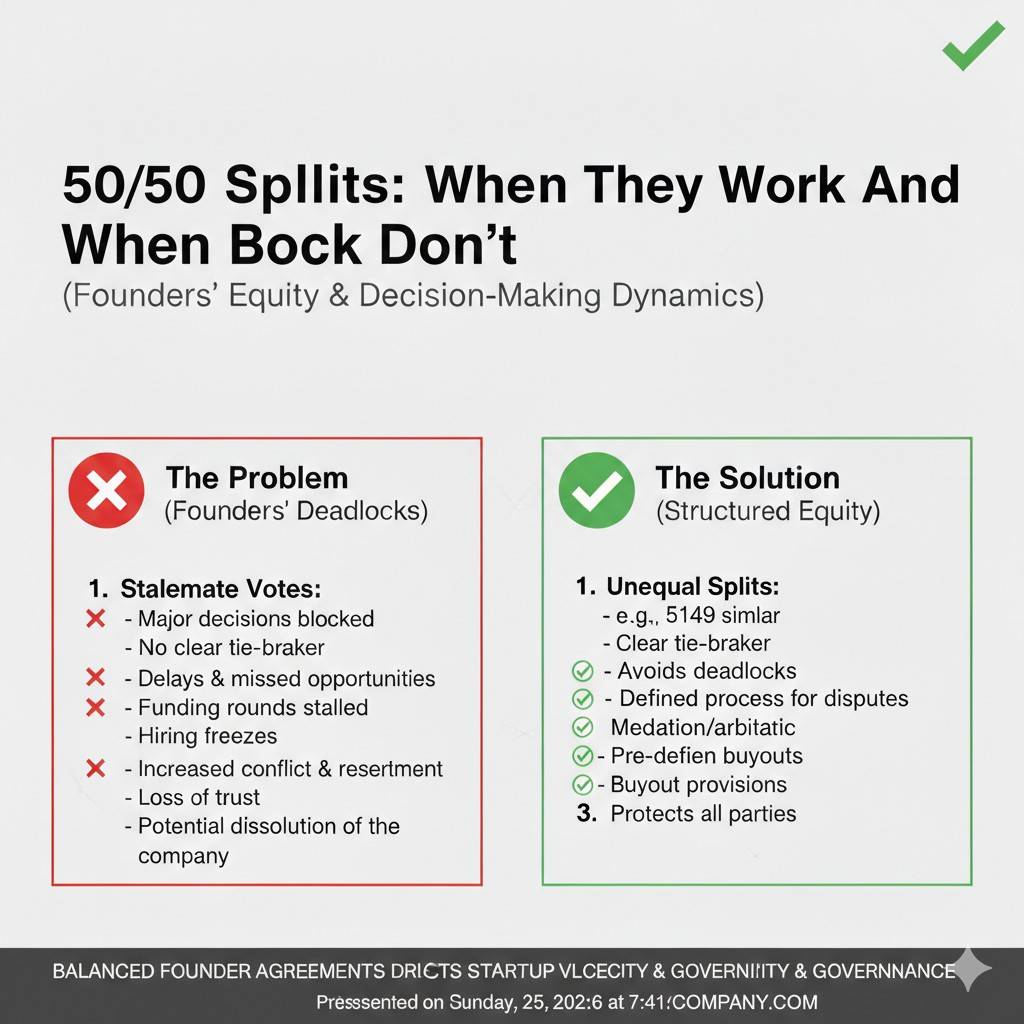
A 50/50 split feels like the safest choice when you are starting. It avoids awkward talks. It lets both people feel respected. It also gives you a simple story to tell friends, early hires, and even investors.
But equity is not just a number. It is a tool that shapes behavior. It decides who has control when you disagree. It decides who stays calm when things get hard. It decides who can keep the company moving when one person slows down.
In deep tech, decisions get heavy fast. You will face long build cycles, slow customer proof, and big technical risk. That is when a clean “equal split” can turn into a gridlock that wastes months you cannot afford to lose.
What founders usually mean when they say “50/50”
Most founders do not mean “we will always do exactly the same amount.” They mean “we trust each other.” They mean “we are both all-in.” They mean “we do not want one person to feel smaller.”
That is a fair emotion. The problem is that emotions do not run a company. Reality does. And reality changes in the first six months more than founders expect.
One founder may end up running sales because they can talk to buyers. The other may end up deep in the lab because the product is hard. Both can work long hours and still create very different kinds of value at different times.
Why “equal” and “fair” drift apart over time
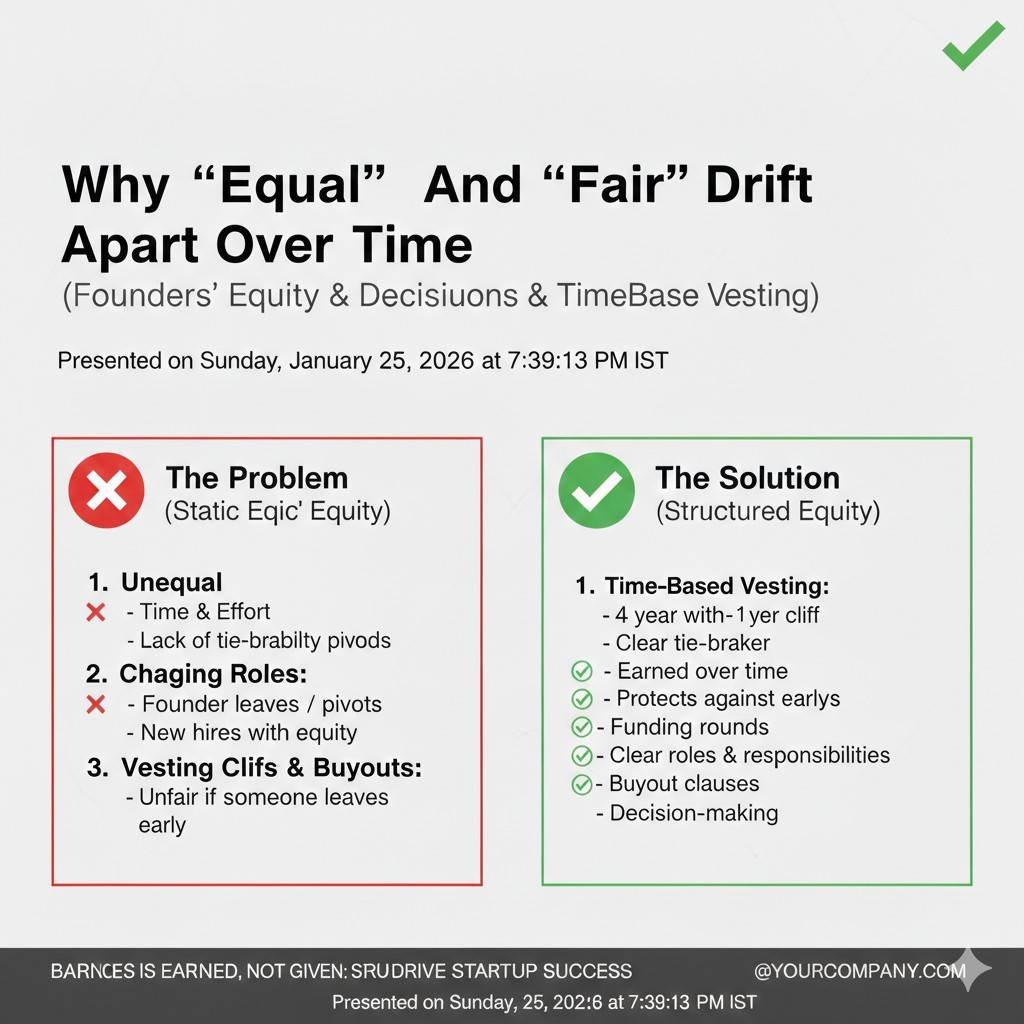
In the beginning, you are building a plan, a prototype, and a story. Later, you are building a team, a product, a pipeline, and trust in the market. The work shifts as you learn what the business truly needs.
This is where trouble starts. A 50/50 split locks you into a view of the world that may not match the company you are actually building. If you keep the split anyway, you may start keeping score, even if you do not say it out loud.
That quiet scorekeeping is a warning sign. It turns small differences into personal fights. It makes every hard week feel like proof that the split was wrong.
The hidden cost of avoiding the “hard talk” early
A lot of founders choose 50/50 because they want peace. They want to start building right away. They worry that any other split will cause stress, or even end the partnership.
The hard truth is that avoiding the talk does not remove the stress. It delays it. When the talk returns later, it shows up at the worst time, like after a missed deadline, a lost deal, or a tough investor call.
That is why equity talks are not a nice-to-have. They are part of risk control. If you can not handle this conversation early, it is a sign you may struggle with bigger ones later.
How 50/50 splits can block decisions
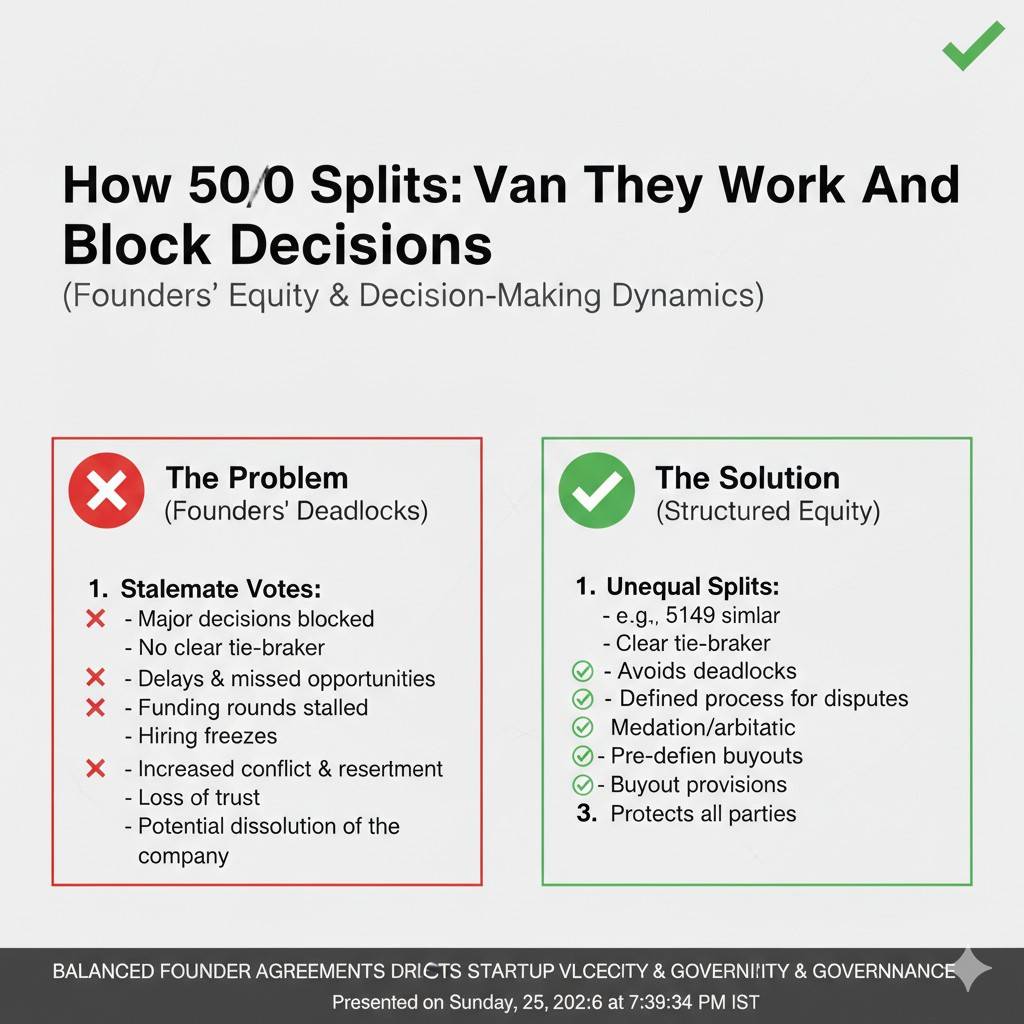
When two people own the same and have the same vote, a tie becomes easy. Ties feel fair in theory. In practice, they freeze the company.
A frozen company does not die in one day. It dies in slow motion. You pause hiring. You delay product calls. You avoid big bets. You keep meeting and talking, but the work stops moving.
This is why many investors flinch at a true 50/50 split with equal control. They are not judging your friendship. They are thinking about what happens when, not if, you disagree.
The most common deadlock moments
Deadlocks do not usually happen over small things. They happen over painful choices where both options feel risky. Examples include whether to pivot, whether to fire an early hire, whether to price higher, or whether to accept a funding offer that comes with control terms.
In robotics and AI, deadlocks also happen around the build plan. One founder may want to perfect the system before shipping anything. The other may want to ship a narrow version fast to learn from real users.
Both views can be smart. The issue is not who is right. The issue is what the company does when the founders cannot agree.
Why a tie can become a power fight
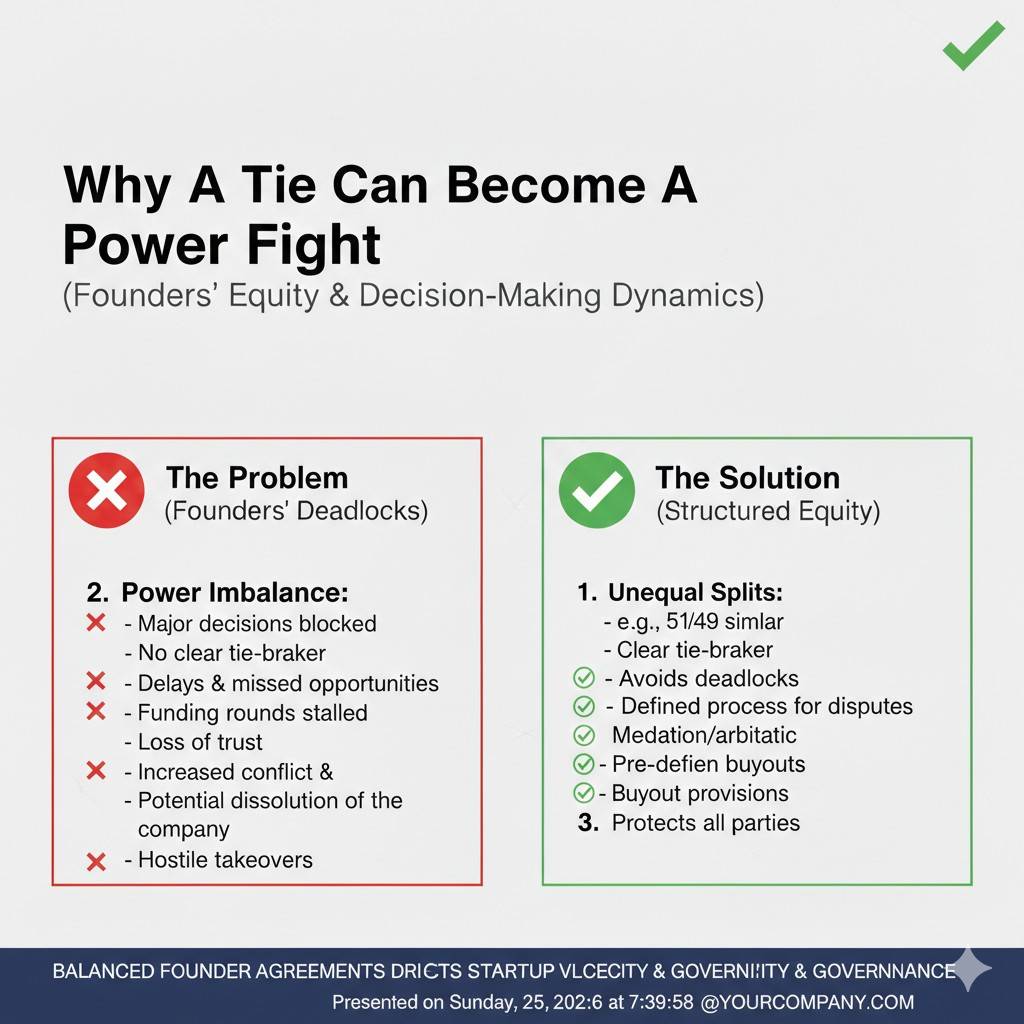
When founders can not break a tie, they often try to win in other ways. They may lobby employees. They may talk to advisors to “prove” they are right. They may start making side plans without the other person.
Even if nobody says the word “control,” control becomes the real topic. That shift is dangerous because it changes the tone of the relationship.
Now every debate is not just about product or money. It becomes about respect. And once respect is on the table, fights get personal fast.
The difference between shared ownership and clear leadership
A startup can have shared ownership and still have clear leadership. These are not opposites. You can respect a partner deeply and still agree that one person makes the final call in specific areas.
Clear leadership does not mean one founder is better. It means the company has a way to move forward when time is tight. It also protects the relationship because you are not re-fighting the same debate every week.
Many strong teams work well because they divide decision zones. One leads product and engineering calls. The other leads go-to-market, hiring, and money calls. They still debate, but they know who decides.
Where Tran.vc fits into this picture
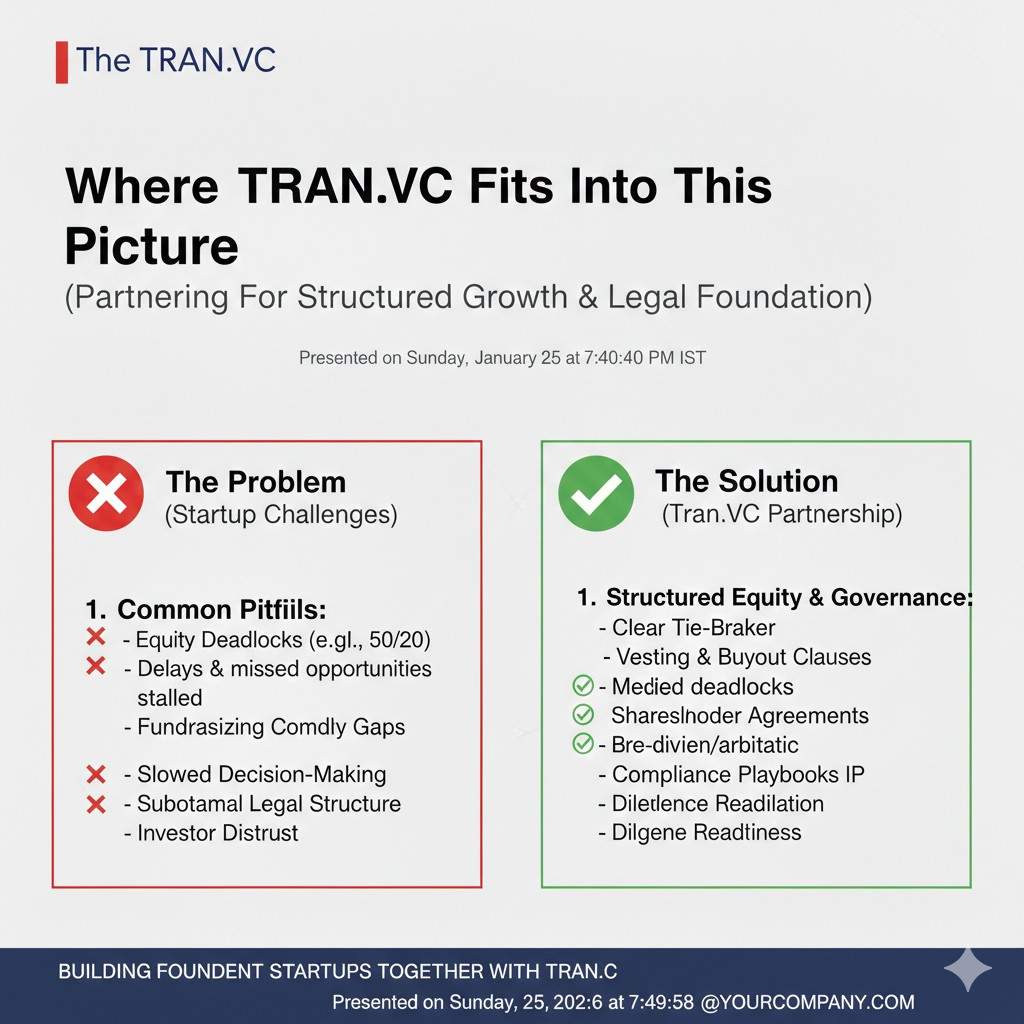
Equity is one part of building a company that can raise on good terms. Another part is building assets that make investors feel safe, like strong patent work and clear IP ownership.
Tran.vc helps technical founders build that foundation early, before the seed round pressure forces bad choices. If you are building in AI, robotics, or deep tech and want to turn your work into a real moat, you can apply anytime here: https://www.tran.vc/apply-now-form/
What we will do next
Next, we will get very clear about when 50/50 splits actually work. There are cases where they are a great choice, and I will explain those cases in plain detail.
Then we will look at the failure patterns that show up again and again, including what happens when one founder outgrows the other, when life events hit, and when roles shift in ways you did not expect.
50/50 Splits: When They Work and When They Don’t
When a 50/50 split can actually be the right move
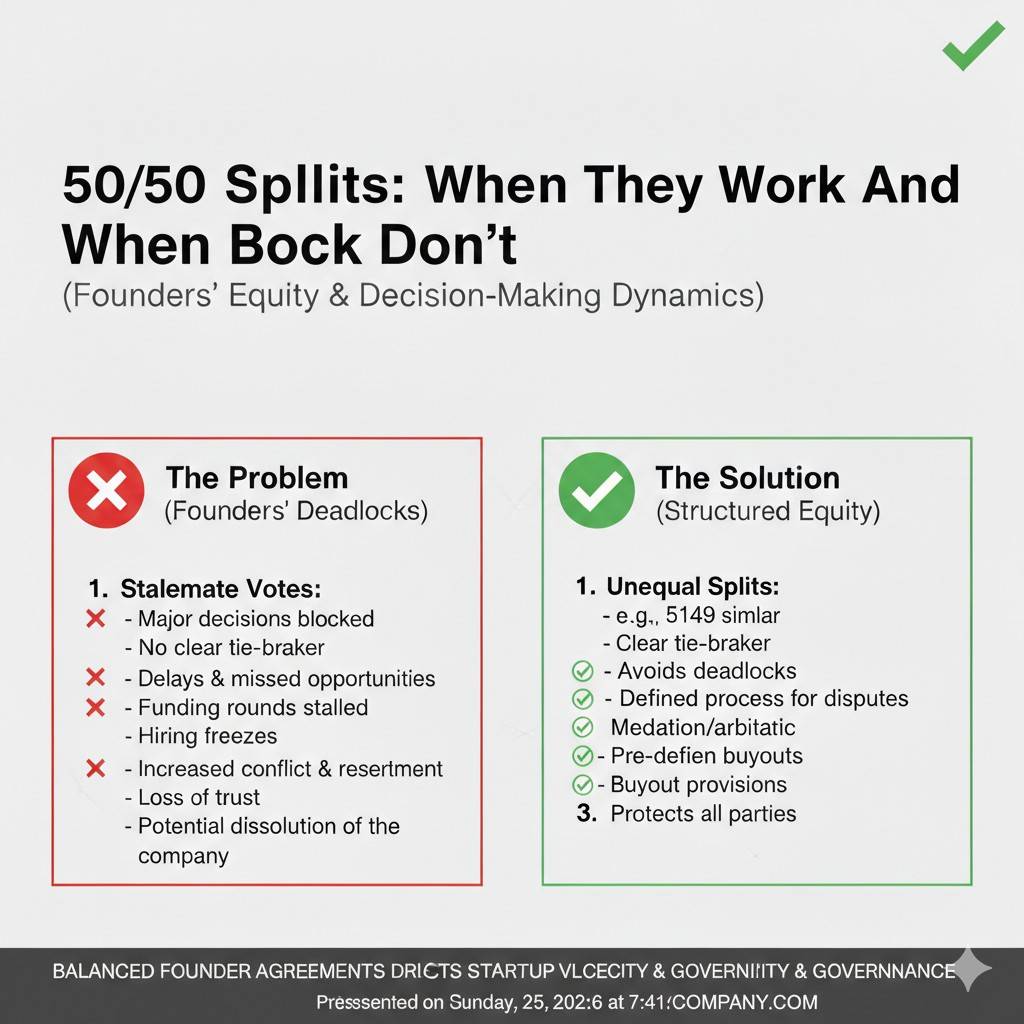
A 50/50 split is not always a mistake. In some cases, it is the cleanest way to start. The key is that the split must match the real working shape of the partnership, not the hope of what it might become.
When a 50/50 split works, it usually works because both founders bring equal weight in the areas that matter most right now. They also have a strong way to break ties without turning every hard call into a long fight.
It is less about the number and more about the system around the number. If the system is strong, the split can stay strong.
When both founders truly carry the company from day one
The best case for 50/50 is when the company would not exist without both people, and that is true in a practical way, not just a moral way. One founder may bring the core invention and the ability to build it. The other may bring the buyer access, the market insight, and the ability to get early revenue.
In deep tech, this can look like one person who can design the model or the robot system, and another person who has lived inside the target industry and can open doors. If either person leaves, the company does not just slow down. It loses its path.
If that is your situation, a 50/50 split can reflect the truth. But it still needs guardrails because equal effort today does not guarantee equal effort next year.
When roles are distinct and respected
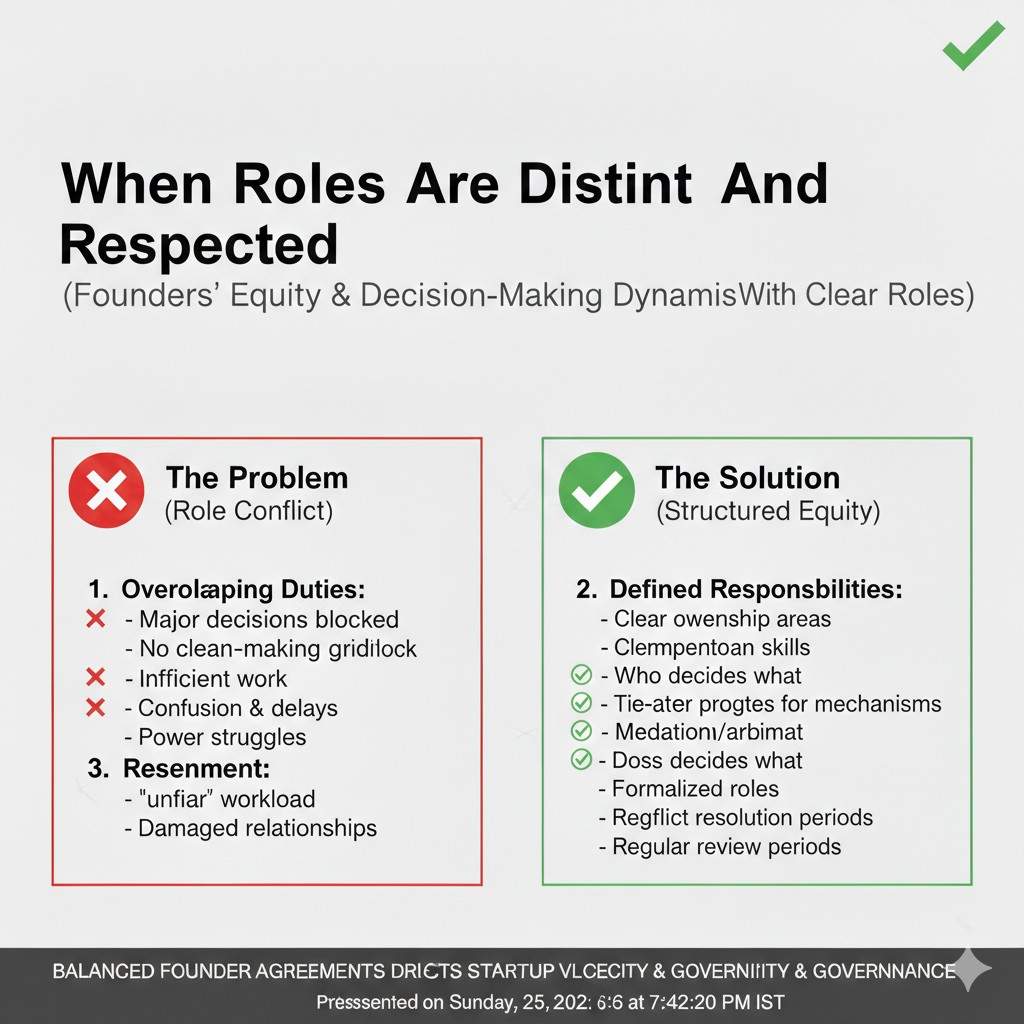
A 50/50 split can work well when each founder owns a clear lane and stays in it. This does not mean you never cross over. It means you do not step on each other’s toes every day.
In practice, the healthiest pairs have very clear default control. If one founder runs engineering, they set the tech plan and the build order. If the other runs go-to-market, they set pricing tests, pipeline steps, and customer focus.
Respect is the fuel here. If you both trust that the other person is doing hard work in their lane, you do not need to fight over small calls. That reduces the chance that a tie vote becomes a full company freeze.
When the company has a built-in tie-break plan
A true 50/50 split needs a tie-break plan the same way a car needs brakes. You might not use it often, but you must have it before you need it.
The tie-break plan can take many forms. Some teams assign a “final call” owner per category, like product versus sales. Some teams use a trusted advisor or board member as the tie-break voice on specific issues.
What matters is that you decide this while you still like each other. If you wait until you are angry, you will design a tie-break that feels like a weapon, not a safety tool.
When both founders have similar risk and life setup
This part is often ignored, but it can decide whether 50/50 survives. If one founder can work unpaid for a year and the other can not, the pressure will not be equal. If one founder has a stable visa and the other is under time stress, the risk profile is not equal.
It is not about judging anyone. It is about being honest about the real load. Over time, uneven pressure turns into resentment, even if both people are talented.
A 50/50 split works better when both founders have similar runway, similar time freedom, and similar ability to handle uncertainty without panic choices.
When both founders share the same standards for speed and quality
Two founders can be equally smart and still clash every week because they define “done” in different ways. In AI and robotics, this can be extreme.
One person may feel a demo is good enough when it works once and proves the concept. The other may feel it is not real until it works ten times in a row, under many conditions, with clean logs and safety checks.
Neither view is wrong. The danger is that if you do not align on standards, you will fight over the same topic forever. A 50/50 split is safest when you match on what “good” looks like and how fast you plan to move.
When both founders are equally strong at handling conflict
A 50/50 split is basically a promise that you will solve conflict well. If you avoid conflict, or if one person tends to shut down, equal control will not feel equal. It will feel like long tension that never clears.
Strong conflict skills look simple on the outside. It is the ability to say, “I disagree, and here is why,” without attacking the other person. It is the ability to admit you were wrong without losing status. It is the ability to decide and move on.
If you and your cofounder can do that, you can carry a 50/50 split without it turning into a power struggle.
When both founders are committed for the same time horizon
A lot of 50/50 splits break when one founder is thinking in months and the other is thinking in years. One person may treat the startup like a high-potential project. The other treats it like their life’s work.
That mismatch is brutal in hard tech because outcomes take time. The product is not finished quickly. The sales cycle is not short. The early wins are not big checks. They are small proof points.
A 50/50 split works best when both founders are truly signed up for the long climb. Not just excited today, but ready to stay when it gets boring and hard.
How to pressure-test a 50/50 split before you lock it in
If you are considering 50/50, do a simple test: imagine the next twelve months going wrong. Not a little wrong. Very wrong.
Picture missing your first target market. Picture burning six months on the wrong design. Picture a key hire failing. Picture a tough personal event, like illness in the family, that reduces one founder’s time.
Then ask one question: if any of those things happen, will you still feel good about 50/50? If the honest answer is “I’m not sure,” it does not mean you should not do it. It means you need stronger rules and clearer expectations.
This is also where vesting matters. Vesting is not a trust issue. It is a fairness system for the future. If one founder stops showing up, vesting protects the company from being held hostage by dead equity.
The link between equity splits and IP ownership
In deep tech, equity and IP are tied together more than people think. If the IP is not cleanly assigned to the company, it becomes a risk that scares investors. If the patents are not filed correctly, the moat may not exist when competitors arrive.
This matters even more in a 50/50 split because you are already in a structure where deadlock is possible. The last thing you want is a messy IP situation where one founder can block filings, delay assignments, or create uncertainty around who owns what.
Tran.vc focuses on helping technical teams build strong, defensible IP early, so when you raise, you do it from a position of strength. If you want help making your inventions into assets that investors respect, you can apply anytime at: https://www.tran.vc/apply-now-form/
The main takeaway from the “it can work” cases
A 50/50 split is healthiest when your partnership is already balanced in real ways, and when the company has a way to keep moving during disagreement.
If you can not describe your tie-break plan clearly, or if your roles overlap in messy ways, or if your time and risk are not similar, the split may still be possible, but it will need extra structure.
In the next section, we will shift from “when it works” to “when it fails,” and we will get specific. Not with scary stories, but with patterns you can spot early, so you can fix them before they cost you the company.