
AI is moving fast. But speed can trick founders into skipping the one thing that makes the business real: ownership.
In AI and ML, “ownership” is not just your logo and your domain name. It is your model work, your data work, and the way you built the whole system so it actually works in the real world. If you do not protect that early, you may end up building a product that others can copy with less effort than it took you to make it.
This is why IP strategy matters in AI. Not as a legal form you fill out later. As a product decision you make now.
When people think about patents, they often picture a single “idea” you lock up. AI does not work like that. Most AI products are not one magic trick. They are a chain of methods, choices, and small moves that add up to results. The data comes in a certain way. The labels are made with care. The model is trained with your own steps. The system is tuned to reduce errors that matter. The output is checked. The tool learns over time. The product has guardrails. There is a lot there. And a lot of it can be protected if you plan it right.
This article is about an AI and ML IP strategy that fits real startups. Not a big-company plan that needs a legal team. A clear plan a small team can follow while shipping.
We will focus on three things:
First, how to protect models. Not the “model type” everyone can find in a paper, but the parts you made that change performance, speed, cost, or safety.
Second, how to protect data. Not just the raw files, but the way you collect it, clean it, label it, and use it.
Third, how to protect methods. The full “how” of your system. The training steps, the feedback loops, the tests, the post-work you do after the model predicts, and the way your product keeps getting better.
One more thing before we go deeper. A strong IP plan is not only about stopping copycats. It also helps you raise with strength. It gives you a clear story: “Here is what we built, here is why it is hard to copy, and here is how we will keep the lead.” Seed investors understand that story fast. Even better, it helps you run the company with focus. You stop guessing what is “special” and you start treating your best work like an asset.
That is the mindset Tran.vc brings to AI and deep tech teams. Tran.vc invests up to $50,000 of in-kind patent and IP services so you can build a real moat early, without giving up control too soon. If you are building in AI, robotics, or hard tech and you want to lock in what makes you different, you can apply any time here: https://www.tran.vc/apply-now-form/
Map Your AI Product Into Protectable Pieces
Start with what you are really selling
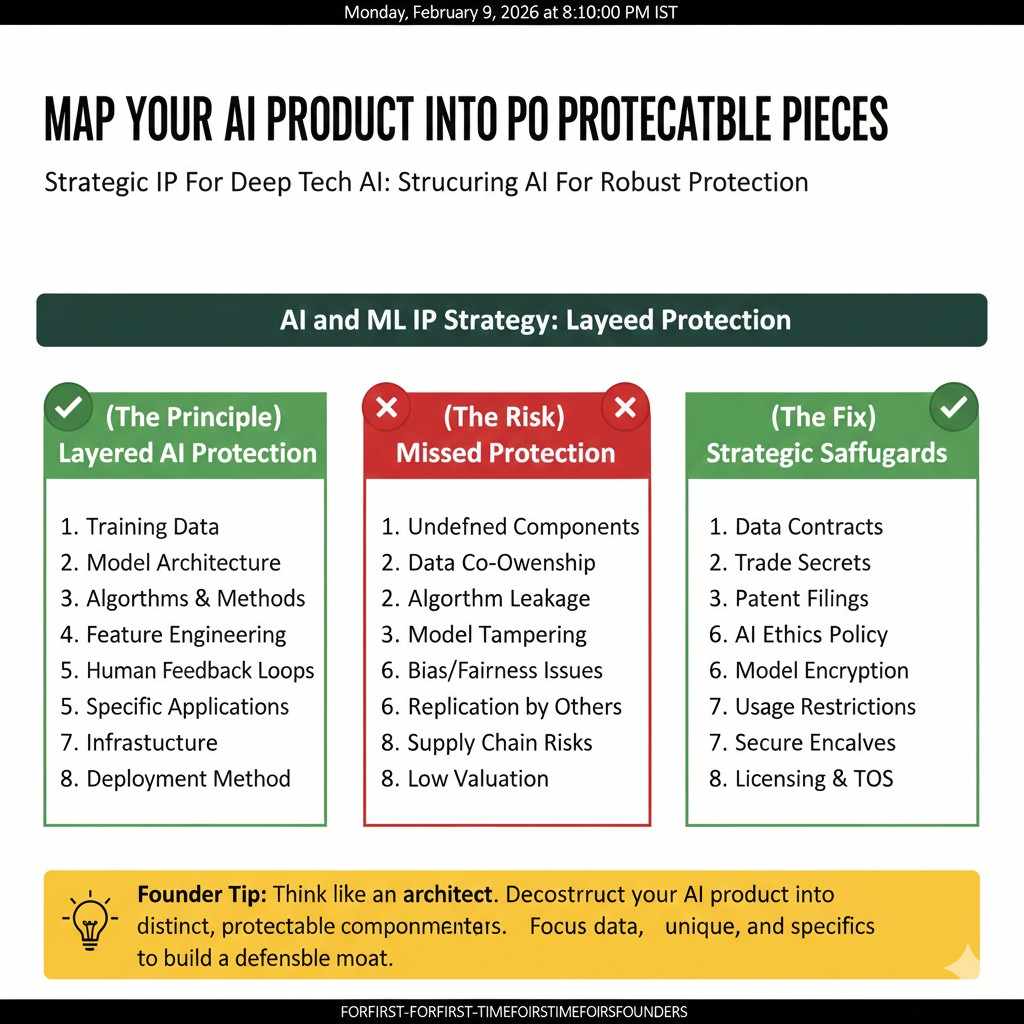
Most AI teams say they sell “a model.” In truth, customers pay for an outcome. That outcome comes from many parts working together: data flow, training steps, checks, and the way the product fits into a user’s day.
When you see the full system, you stop trying to patent a vague idea. You start protecting the parts that make the outcome repeatable, fast, and hard to copy. That is where real IP lives.
Use a simple “three box” map
Think in three boxes: models, data, and methods. A model is the trained thing that makes predictions. Data is what teaches it and keeps it honest. Methods are the steps and rules you use before and after the model runs.
This map helps you decide what should become a patent, what should stay a trade secret, and what can safely be shared in a blog or paper. It also helps you explain the moat to investors in plain words.
Separate “common” from “unique” early
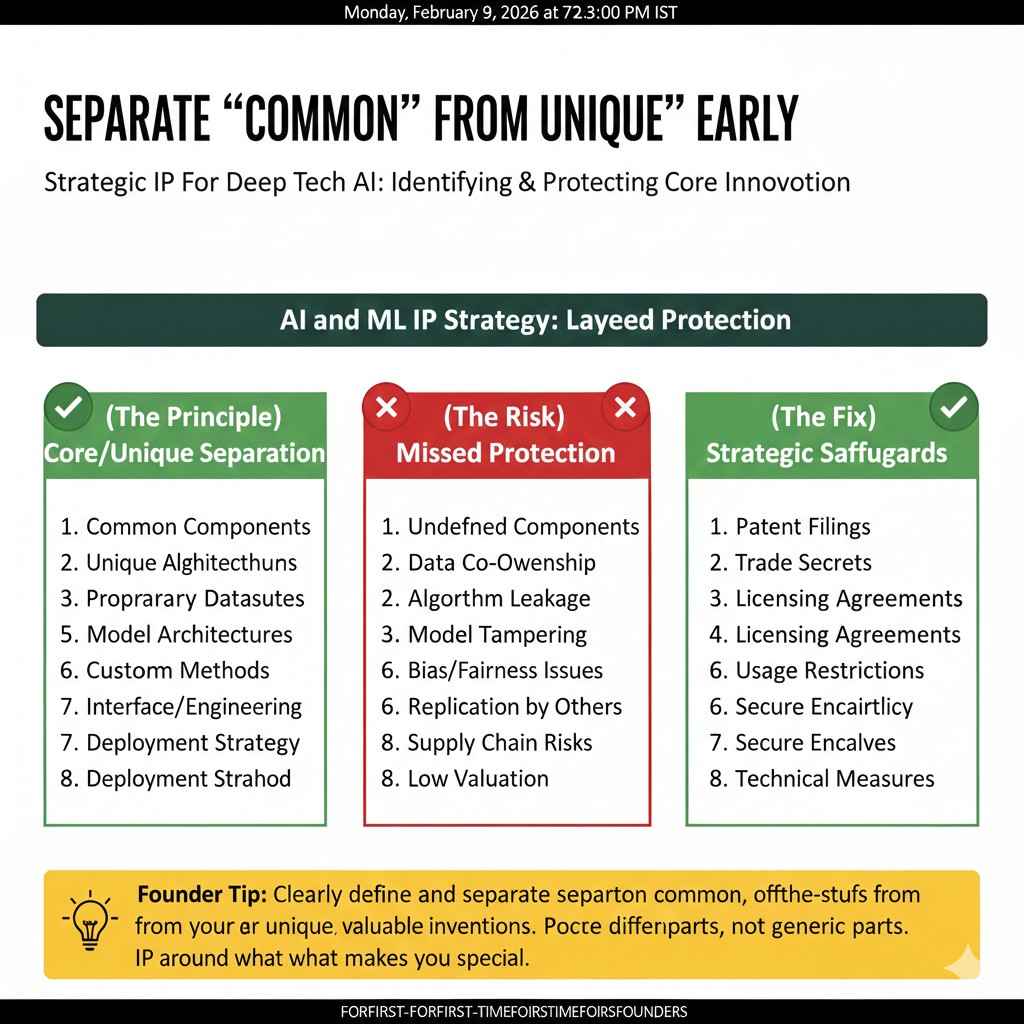
AI has many common parts now. Using a known model type, using standard loss, or using a popular library is usually not the part that makes you special. Your edge is often in small choices that stack up.
Your job is to spot the choices you made that changed results in a way others will struggle to repeat. That is what you write down, test, and protect.
Keep a weekly invention log, not a big rewrite later
Founders often try to “remember everything” right before fundraising. That is risky. You forget key steps, and you lose dates that matter. Instead, keep a simple invention log each week.
Write what you changed, why you changed it, what improved, and what the system now does that it did not do before. These notes become gold when you draft claims and build a clean IP story.
Decide early what becomes public and what stays private
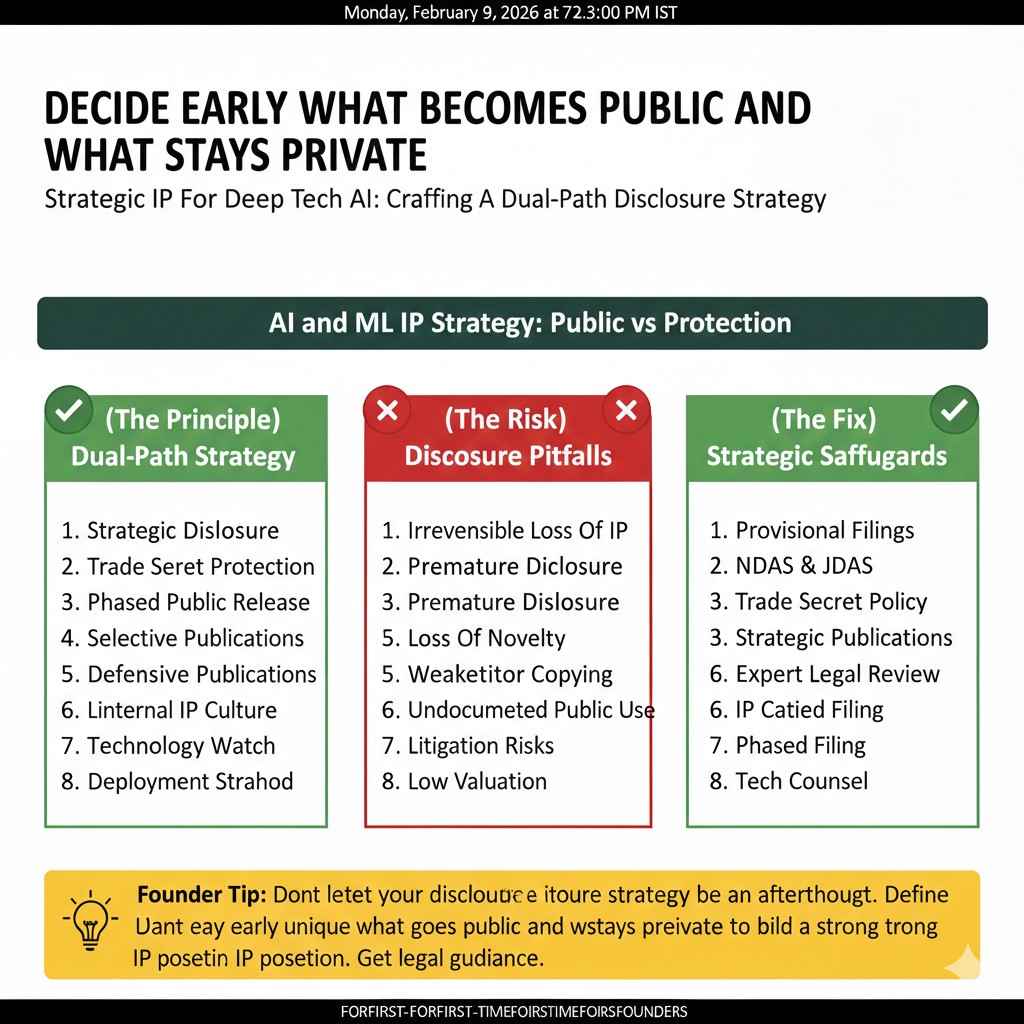
Some things should be shared because they attract talent and trust. Other things should not be shared because they are the playbook. The trick is choosing with care, not fear.
A good IP partner helps you publish what builds the brand while still locking down what protects the business. That balance is what most early teams miss.
If you want help building this map and turning it into a real filing plan, Tran.vc does this every day for AI and robotics teams. You can apply any time here: https://www.tran.vc/apply-now-form/
Protecting Models
Do not try to patent “a model,” protect what makes it work in your case
A patent does not reward you for using a known model class. It rewards you for a new and useful way to achieve a result. In AI, that “way” is often the training setup, the fine-tune path, the model shape you picked for a constraint, or the way the model handles edge cases.
If your model gets strong results on messy real data, there is usually a reason. That reason can often be described as a method with steps. Steps are something patents can hold.
Focus on model behavior that creates business value
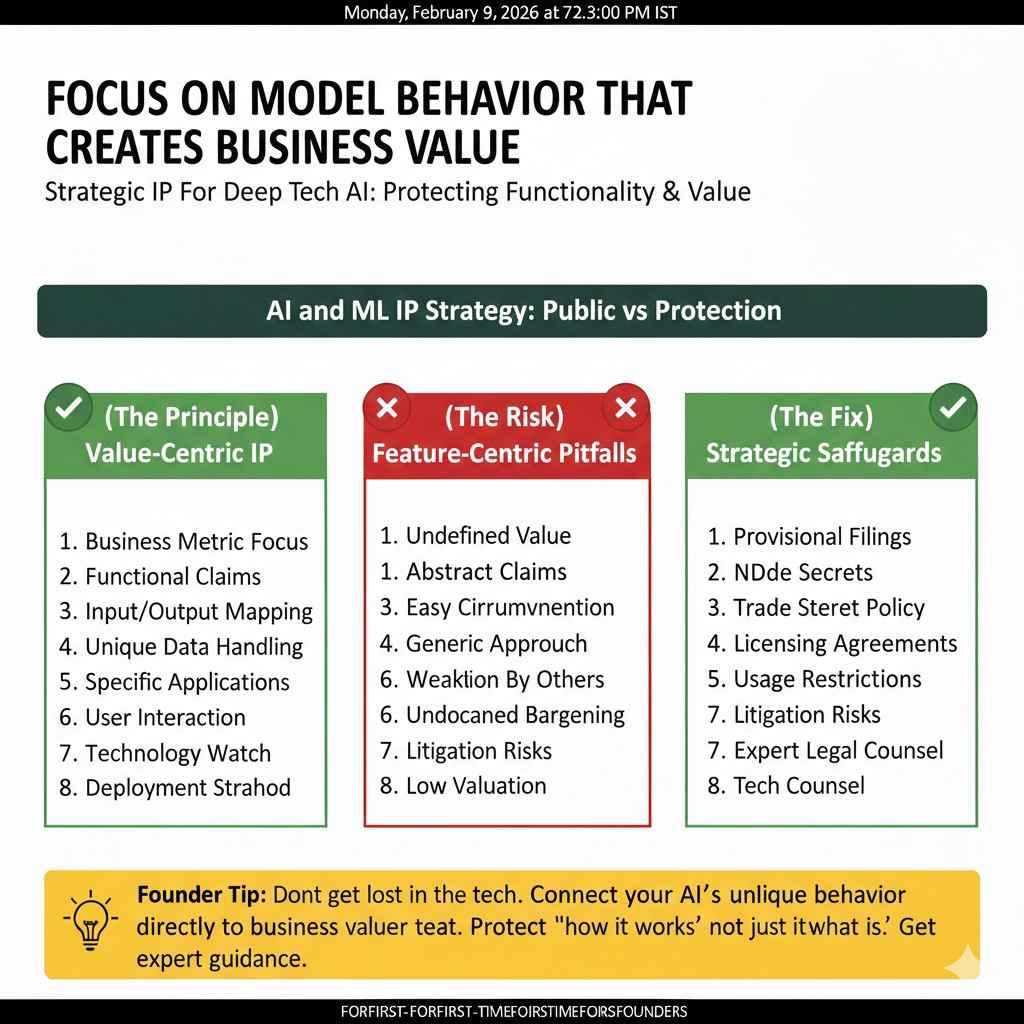
Investors and examiners care about outcomes. “Better accuracy” is vague. “Lower false alarms in a safety system,” “faster inference on a small device,” or “stable output under noisy inputs” is clearer.
When you tie the model to a real problem, you also make it easier to draft a strong patent story. You are not claiming math in the air. You are claiming a system that solves a real pain.
Protect the training recipe when it is your edge
Many teams win because of how they train, not what they train. This can include the order of training stages, how you mix data sources, how you use weak labels, or how you choose hard examples.
If your results depend on a specific training flow, write it down as a series of steps that could be followed by another engineer. That detail matters. It shows the invention is real, not a wish.
Claim the “constraints” you solved, not just the model
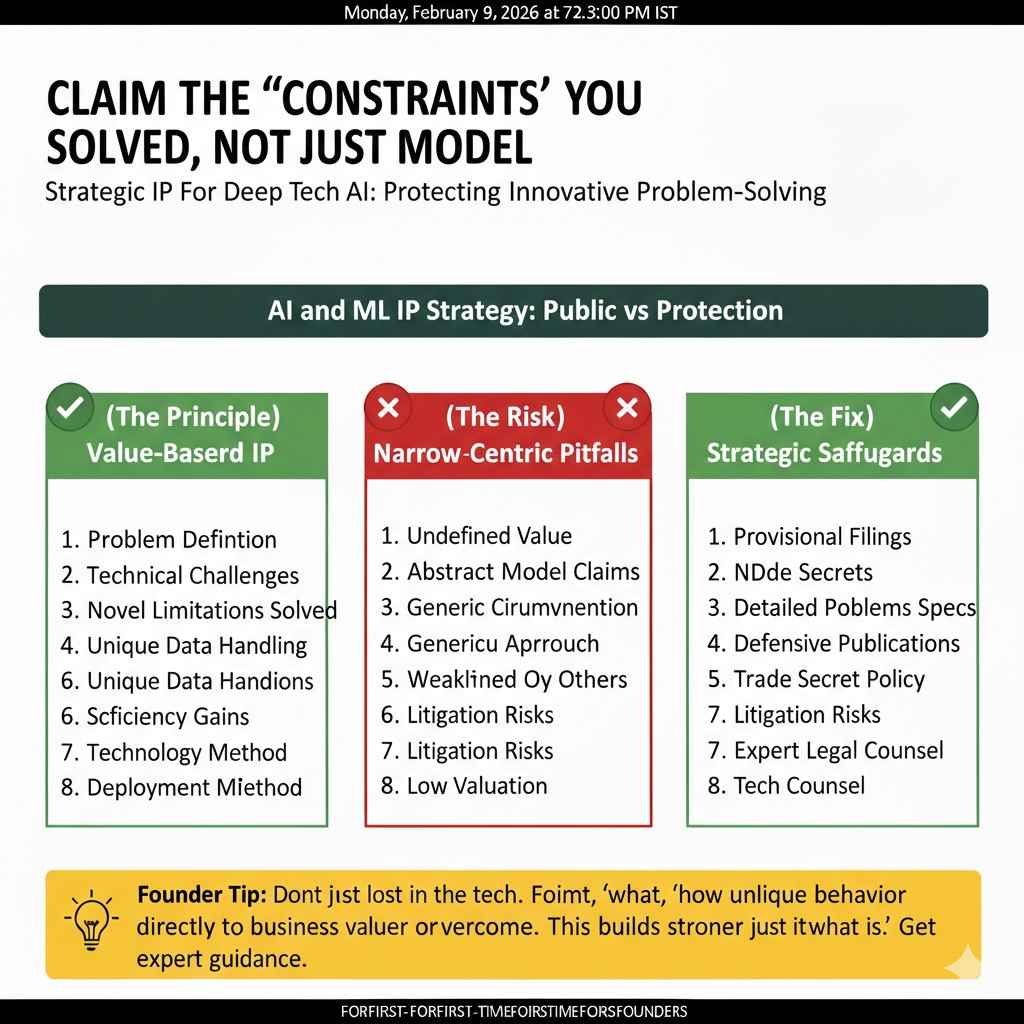
AI products live inside limits. You may need to run on a phone, a robot, or a low-cost chip. You may need fast answers, low power, or privacy. If you found a way to hit those limits while keeping output quality, that is often protectable.
This is also a strong fundraising story. It shows you did hard work that others cannot copy by just downloading a model.
Think about deployment tricks as part of the model IP
Some of the most valuable work happens after training. You may compress the model, split it, cache parts of it, or run a small model first and a big one only when needed.
These choices look like “engineering,” but they can be IP when they are new, useful, and tied to a clear result. Many startups leave this value on the table because they assume it cannot be protected.
Use “claim shapes” that fit AI reality
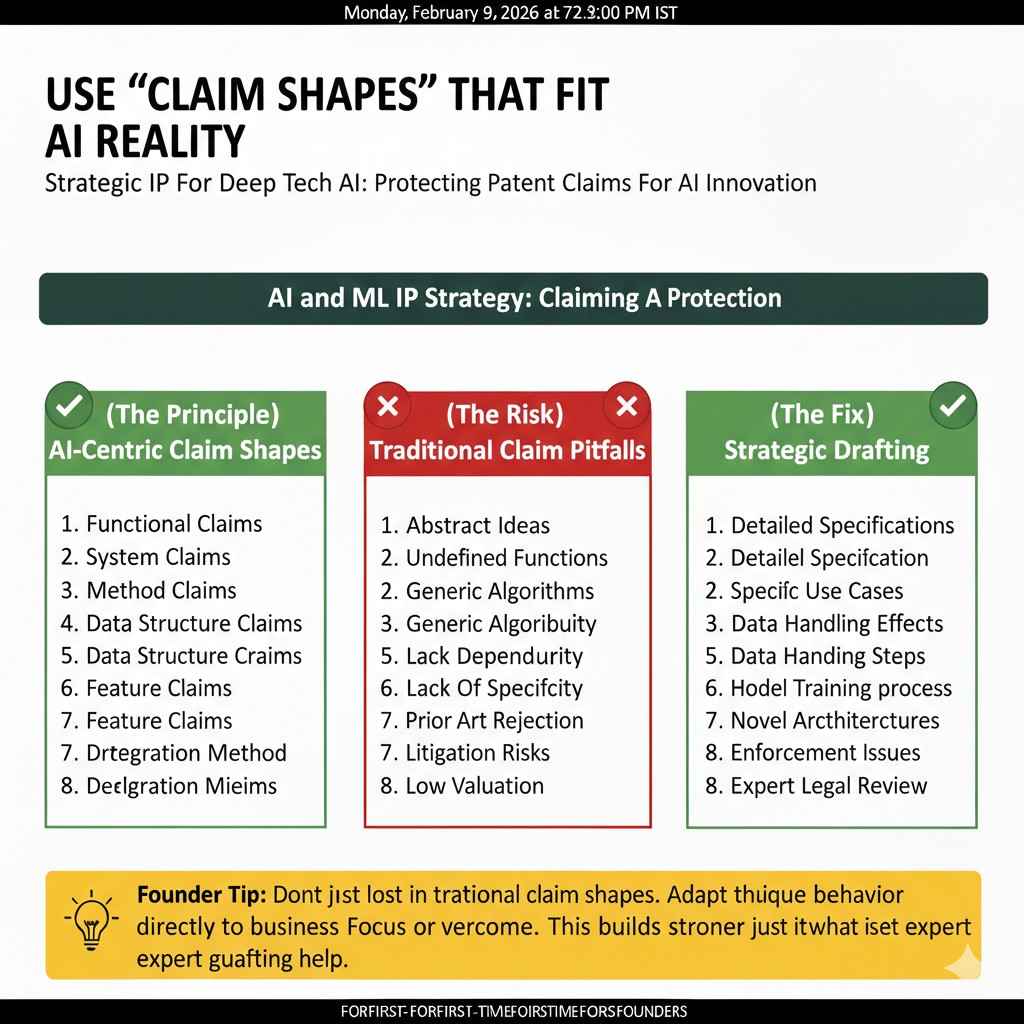
A strong AI patent is often not “the model.” It is “a method of operating a system” with clear steps. It can also be “a non-transitory computer readable medium” with instructions, and “a system” with parts that do the steps.
This matters because it gives you options later. If a competitor copies the workflow but changes the model type, you still have coverage if your claims focus on the method and result.
Avoid risky oversharing before you file
Teams love demos, talks, and blog posts. These can be great for hiring and growth. But if you share the unique training flow or the special model handling you built, you may weaken future patent options in many places.
A safe habit is to treat any technical post like a product launch. You plan it, you review it, and you file first when needed. That keeps your public story strong without giving away the blueprint.
Tran.vc helps founders decide what to file, what to keep as a trade secret, and what to share for growth. If you are building a model-driven product and want to protect the parts that matter, apply here: https://www.tran.vc/apply-now-form/
Protecting Data
Treat data as an asset, not a pile of files
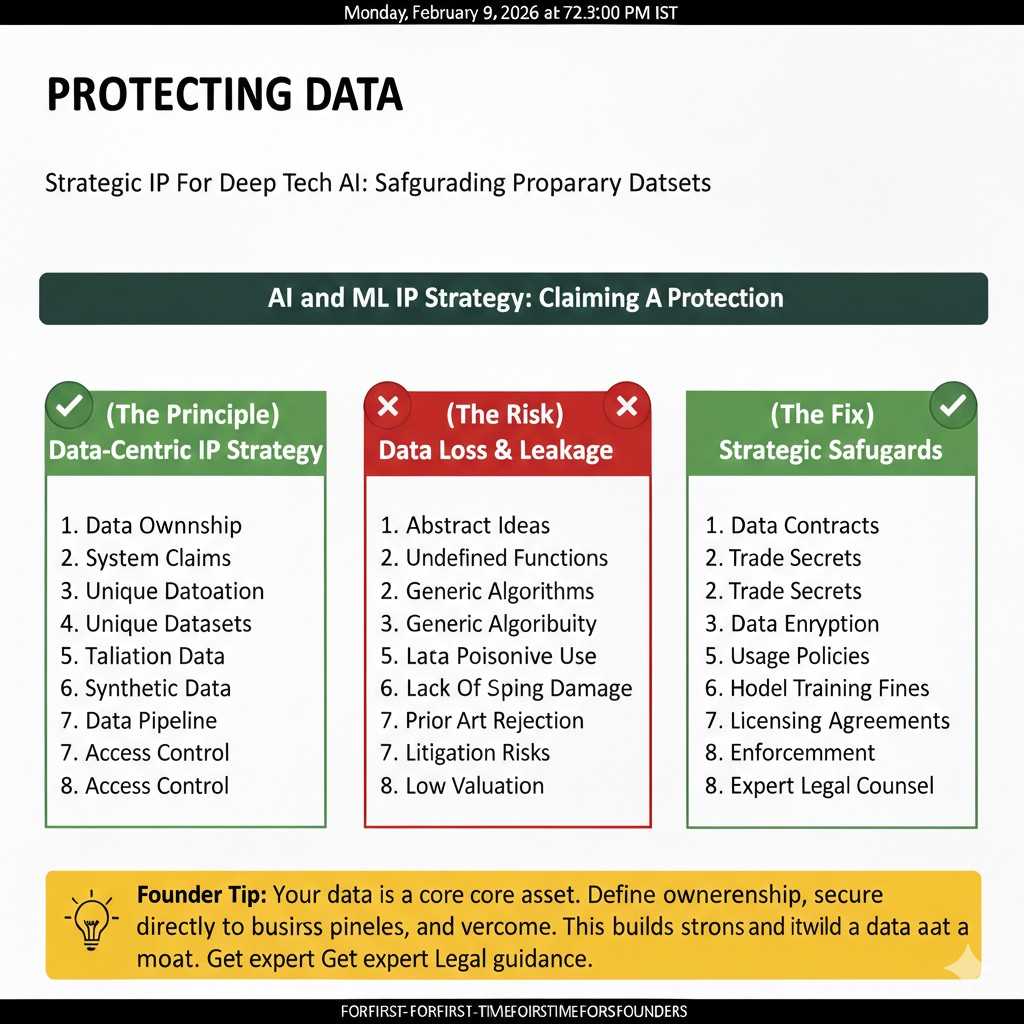
In AI, data is not only “input.” It is the source of your advantage, your proof, and your learning loop. A competitor can copy your UI, but they cannot easily copy years of clean, well-shaped data that fits the job.
The question is not only “do we have data.” The question is “what about our data makes the system better and harder to copy.”
Protect the way you collect data, especially in the real world
If you built a process to gather data in a setting others cannot reach, that can be protectable. This is common in robotics, medical, factory work, and field tools. The collection setup can include sensors, timing, filters, and rules that keep the data useful.
Even when the raw data cannot be owned like a patent, the collection method can be. And the collection pipeline can also be kept as a trade secret.
Labeling is often the hidden moat
Labeling is not just “tag it and move on.” High-value labeling includes rules, tools, checks, and the way you handle hard cases. It also includes how you reduce human time while keeping label quality.
If your model quality depends on a special labeling flow, you may have an invention in that flow. This is one of the most overlooked areas in AI IP.
Data cleaning and shaping can be protectable when it is not obvious
Many founders think cleaning is “basic.” Yet in real systems, cleaning is where you solve the problem. You may remove noise in a special way, rebuild missing parts, or detect bad samples with a custom method.
If your approach is repeatable and tied to a clear improvement, it can support a patent story. At the very least, it should be documented as a trade secret.
Use contracts to protect data rights, not just tech
IP strategy is not only patents. Data rights also come from agreements. If you collect data from customers, partners, or users, you need clear terms that say what you can do with it.
This is where many startups create risk without knowing it. They build a model on data they do not truly have rights to use at scale. Fixing that later can be painful and slow.
Build a “data boundary” to reduce leaks
Data can leak through exports, logs, support tickets, and even model outputs. A strong plan includes rules for who can access raw data, how it is stored, and how long it stays around.
This is not about paranoia. It is about protecting a core asset. The more your company grows, the harder it becomes to clean up weak habits.
Make your data story easy to explain
When investors ask, “Why can’t someone else do this?” a strong answer is often about data. But the answer must be clear. You should be able to say where the data comes from, why it is hard to get, and how it gets better over time.
This story becomes even stronger when paired with filings that protect key parts of your collection and labeling methods.
Protecting Methods
See the full workflow, not just the prediction step
Most AI teams focus on the model’s output. But in real products, the value often lives in the full workflow around the model. The steps before input reaches the model and the steps after output leaves it are where real business value is created.
If you map your full system from start to finish, you will often see many structured steps. These steps can form the base of strong patent claims because they show a clear process that solves a real-world problem.
Protect the pre-processing pipeline when it changes outcomes
Before data reaches the model, you may filter, normalize, rank, or segment it. You may select only certain features based on context. You may change how data is grouped based on time or location.
If these pre-processing steps lead to better stability, lower cost, or better results, they are not “small details.” They are part of your invention. A patent can protect a sequence of technical steps that prepare input in a new way.
Capture post-processing logic that reduces risk
After a model predicts, many teams apply rules. They may reject low-confidence results, combine outputs from multiple models, or trigger a human review under certain cases. These safety and quality layers are critical.
If your system reduces false positives in a medical tool or avoids unsafe actions in a robot through a structured logic layer, that method can be protected. This is especially powerful when the method is tied to a measurable improvement.
Guardrails and control layers can be patentable
AI systems often need guardrails. You may have built a rule engine that overrides predictions under specific conditions. You may have a safety check that runs in parallel and blocks actions that fall outside limits.
These control systems are often highly technical and specific to the domain. When described clearly as a method of operating a system, they can form the core of a strong patent filing.
Feedback loops are long-term value engines
One of the strongest forms of AI IP is a feedback loop. This is where user actions, corrections, or outcomes are fed back into the system in a structured way. Over time, this loop improves performance.
If your feedback loop includes specific steps, thresholds, and retraining triggers, that structure can be protected. It shows that your system is not static. It learns in a defined and engineered way.
Evaluation frameworks can become part of the moat
Serious AI teams build internal evaluation tools. These tools test models under stress, rare events, or edge cases. They may simulate difficult inputs or measure performance across many segments.
If your evaluation system includes a unique testing method that leads to better deployment decisions, it can support IP protection. It also strengthens your investor story because it shows discipline and rigor.
Combine model, data, and method into one system claim
The strongest AI patents often combine all three boxes. They describe a system that collects data in a specific way, trains a model using defined steps, and deploys it with structured post-processing and feedback.
This creates layered protection. A competitor cannot easily avoid your patent by changing one small piece. The protection sits around the integrated system.
Decide what stays secret and what gets filed
Not every method should be patented. Some methods are better kept as trade secrets, especially when they are hard to reverse engineer. The choice depends on how visible the method is and how long you expect it to matter.
A thoughtful IP strategy balances patents and secrets. It protects what must be disclosed and hides what can safely remain inside the company.
Tran.vc works closely with technical founders to shape these decisions early. Instead of filing random ideas, the goal is to build a connected set of filings that protect your core workflow over time. If you are building an AI or robotics company and want to secure your methods before raising, apply here: https://www.tran.vc/apply-now-form/
Building an AI IP Strategy That Supports Fundraising
Align IP with your product roadmap
Your IP plan should match where the product is going, not just where it is today. If you know you will expand into new use cases, new data sources, or new hardware, your filings should leave room for that growth.
This requires thinking ahead. It means drafting claims that are broad enough to cover future versions, while still grounded in what you have built.
File early, but file with purpose
Speed matters in startups. Filing early can secure priority dates that protect your position. But filing without clarity can waste time and money.
A focused filing strategy starts with mapping your strongest technical differentiators. It then turns them into a clear story that can stand up under review. This approach gives you leverage in future rounds.
Use IP to change the investor conversation
When you walk into a seed meeting with a clear AI IP strategy, the tone shifts. Instead of debating whether your idea can be copied, you show structured protection around your core system.
This builds confidence. It signals that you are building a company, not just a demo. It also supports stronger terms because you are reducing perceived risk.
Build a portfolio, not a single filing
One patent is rarely enough in AI. As your product evolves, new improvements should be captured. Over time, this creates a portfolio that reflects real technical growth.
Each filing can protect a layer: data collection, model training, system control, or deployment efficiency. Together, they form a wall that becomes harder to bypass.
Connect IP to your hiring and culture
When engineers know that invention logs matter and improvements can become protected assets, they think differently. They write better notes. They experiment with more intention.
IP then becomes part of the culture. It is not a legal task at the end of the quarter. It is a habit built into product development.
Avoid common early mistakes
Many AI startups make the mistake of waiting until they are ready to raise before thinking about IP. By then, public demos, blog posts, and conference talks may have weakened options.
Another mistake is copying big company patent styles without adapting to startup speed. A lean, focused strategy works better for early teams.
Tran.vc was built for this exact stage. The team invests up to $50,000 in in-kind patent and IP services so founders can build strong foundations before a big round. You keep control. You build leverage. You protect what matters.
If you are serious about turning your AI work into real assets, apply here: https://www.tran.vc/apply-now-form/