
Robotics is hard. You are building real things that move in the real world. A small change in a gear, a motor driver, a sensor fuse, or a control loop can change everything.
And yet, many robotics teams treat IP like paperwork they will “do later.”
That is risky.
Because robotics IP is not just one thing. It is hardware plus software plus control logic plus the way your system learns, adapts, and stays safe. If you only protect one layer, a competitor can copy the rest and still ship something that feels like yours.
This is what a strong robotics IP strategy does: it protects the whole stack, in a way that matches how robotics products are actually built and sold.
At Tran.vc, we work with technical founders who are deep in the build. We invest up to $50,000 in-kind as patent and IP services, so you can lock in a real moat early—before the market gets loud and crowded. If you want help shaping a full-stack robotics IP plan, you can apply any time here: https://www.tran.vc/apply-now-form/
Here is what we will cover in this guide.
We will start with the “why” that matters most: what investors and buyers really look for when they ask about IP in robotics. Then we will go layer by layer—hardware, software, and control systems—and show you how to spot what is truly protectable. Not in theory. In the way you build: prototypes, field tests, firmware updates, model changes, and safety fixes.
We will also talk about the traps robotics teams fall into. Things like filing too late, filing the wrong thing, filing too narrow, or filing only what is easy to describe. Robotics teams often protect the part that is the most visible, not the part that is hardest to copy. The best IP is usually hidden inside the system behavior, the way parts interact, and the way you hit key limits like power, heat, latency, drift, and wear.
Most of all, we will keep this practical. If you read this and do nothing, it is wasted. The goal is that you can read a section, look at your robot, and immediately say: “Oh. That is a claim.” Or: “That is a trade secret.” Or: “We need to document that test result right now.”
One more thing before we go deep.
Robotics IP is not about being “first.” It is about being hard to replace. When a customer buys a robot, they are not buying a demo. They are buying uptime, safety, and performance over time. If your IP strategy protects the things that make you reliable in the field, you become the safe choice. That is what wins deals and pulls in strong seed investors.
If you want to build that kind of protection from day one, Tran.vc can help. Apply here whenever you are ready: https://www.tran.vc/apply-now-form/
The Foundation: Think in Layers, Not Features
What most robotics teams get wrong
Many teams try to “pick the invention” like it is one single thing.
But a robot is not one invention. It is a stack of working parts that depend on each other. If you protect only one feature, a fast follower can copy the rest of the stack and still get close to your results.
A strong strategy starts by naming the layers you built, then deciding what type of protection fits each layer. That simple shift changes everything, because it stops you from filing random patents and starts you filing the right ones.
Why investors ask about IP so early
Investors do not ask about IP because they love legal work.
They ask because robotics is expensive. Hardware takes time. Field failures cost money and trust. If your system is easy to copy, the first big player that notices you can squeeze you before you reach scale.
When you show clear IP coverage across hardware, software, and control, you signal that you can defend your price, protect your margins, and stay in the market long enough to win.
The “three-layer map” you should make this week
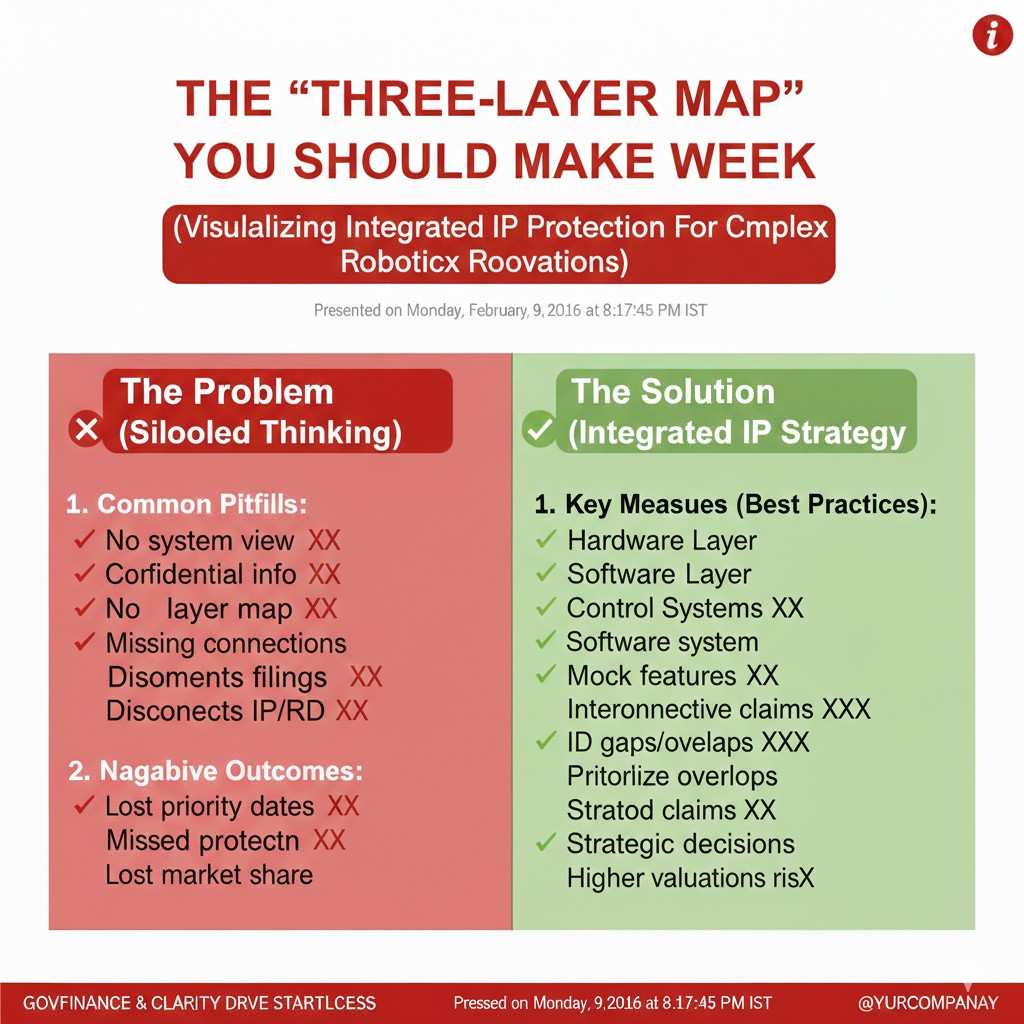
Before you talk to any patent attorney, you should map your system in three layers: hardware, software, and control systems.
This is not a long document. It is a clear view of what your robot is, how it senses the world, how it decides what to do, and how it moves safely. The point is to see your true value, not just your product features.
Once you see the stack clearly, you can spot the parts that are hardest to copy. Those are often the best patent targets.
Where Tran.vc fits in early
This is exactly where founders lose time if they do it alone.
At Tran.vc, we help you turn your real engineering work into a clean IP plan, then into filings that match how the robot works in the field. We invest up to $50,000 in-kind as patent and IP services so you can move fast without burning cash.
If you want to build your IP plan with experienced operators and patent attorneys, you can apply here: https://www.tran.vc/apply-now-form/
Hardware IP: Protect What Touches the World
Hardware patents are not only about parts
Robotics hardware is often treated like “just mechanics.”
But in modern robotics, the value is usually in the way parts work together to hit a hard limit. That limit might be weight, heat, cost, speed, battery life, shock, dust, water, or maintenance time.
A patent that only says “a bracket shaped like this” is easy to design around. A patent that captures “a system that achieves this result under these limits” is far harder to escape.
Start with constraints, not components
A useful way to find patent ideas is to list the problems the market forces you to solve.
If your robot must run eight hours, lift a heavy load, stay safe near people, and survive drops, those constraints shape your design. The clever steps you took to satisfy those constraints are often your invention.
This is why two robots can look similar from the outside, yet one performs far better in the real world. Your IP should focus on the hidden choices that create that advantage.
Mechanical structures that are often worth protecting
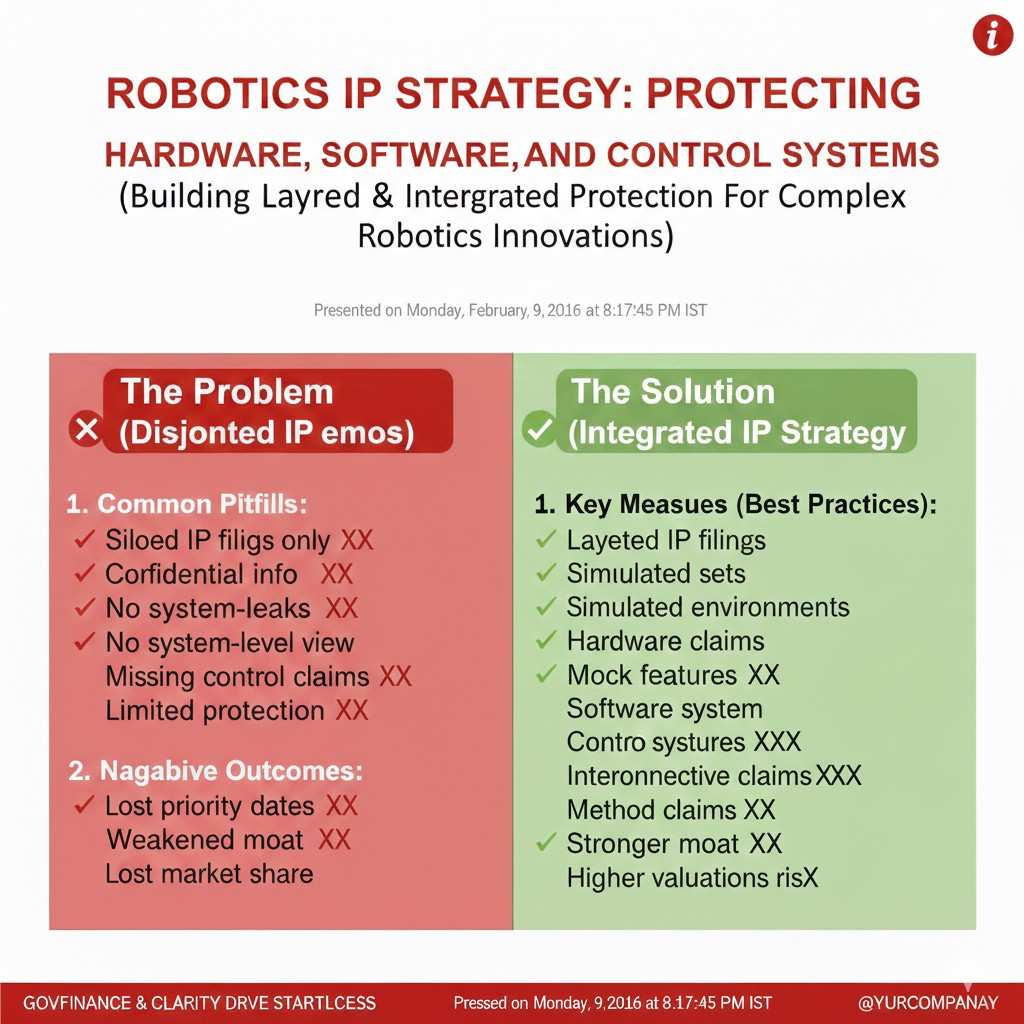
Certain hardware topics show up again and again in strong robotics portfolios.
End effectors that handle many objects without changing tools, joints that reduce backlash while keeping cost low, mounts that cut vibration at the sensor, and frames that simplify assembly are all common sources of real defensibility.
The key is not the part alone. It is the part plus the reason it is shaped that way and the result it enables under real use.
Sensors and placement can be a moat
Teams often assume sensors are “off the shelf,” so they skip patent work.
But sensor placement, calibration methods, shielding, and fusion logic often create major performance gains. The way your robot sees the world is not only the sensor. It is the full sensing system.
If your camera and IMU are placed in a way that reduces drift, or your lidar is mounted to avoid vibration artifacts, those choices can be protectable when described as a system that solves a specific failure mode.
Power and thermal design are underused IP areas
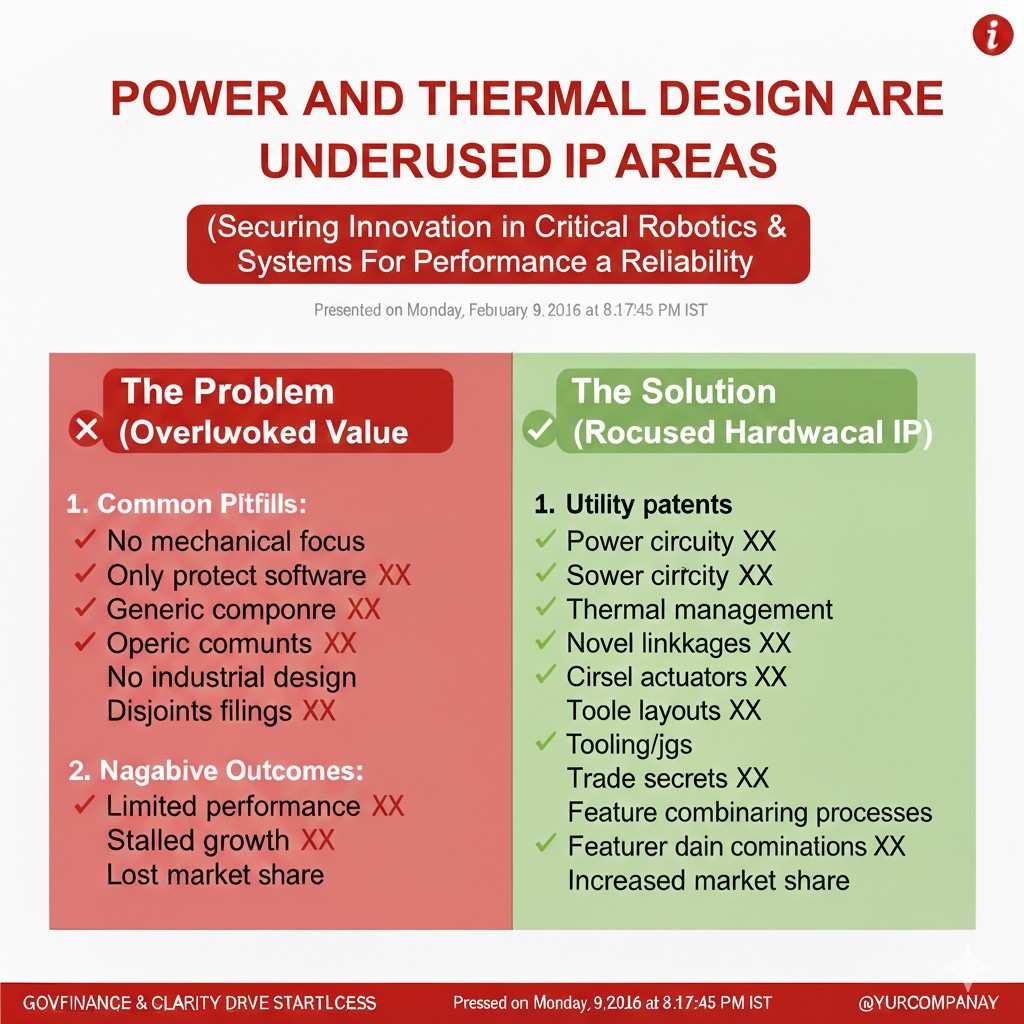
Power delivery and heat are where many robots fail in the field.
If you built a battery and power path that reduces voltage sag under peak load, or you designed a thermal route that keeps a motor controller stable without a heavy heat sink, those are strong engineering solutions.
Patents here can be powerful because they protect reliability. Reliability is what customers pay for, and it is what competitors struggle to match quickly.
Manufacturing and service design can also be protectable
Robotics teams often learn expensive lessons during assembly and servicing.
If your design allows fast alignment, quick replacement of wear parts, safer wiring routing, or simpler calibration during manufacturing, you may have an invention that lowers cost and improves uptime.
That is not “boring.” It is business-critical. IP that protects how you build and service the robot can make your unit economics hard to copy.
Software IP: Protect the Behavior, Not Just the Code
Code is not protected the way founders think

Many founders assume copyright will protect their software.
Copyright protects the exact code text, not the idea behind it. A competitor can rewrite the same logic in a different way and still get the same behavior.
That is why patents matter for robotics software. Patents can protect the method, the pipeline, and the system behavior—even if the code changes.
Where software inventions usually live in robotics
Robotics software is full of protectable inventions, but not in the obvious places.
They often live in data flows, timing choices, state machines, decision rules, and the way you handle real-world messiness. Things like noisy sensors, missing frames, wheel slip, contact events, and network dropouts.
If you solved a real failure mode in a way that improved uptime or safety, you likely have a patentable method.
Perception pipelines can be a deep moat
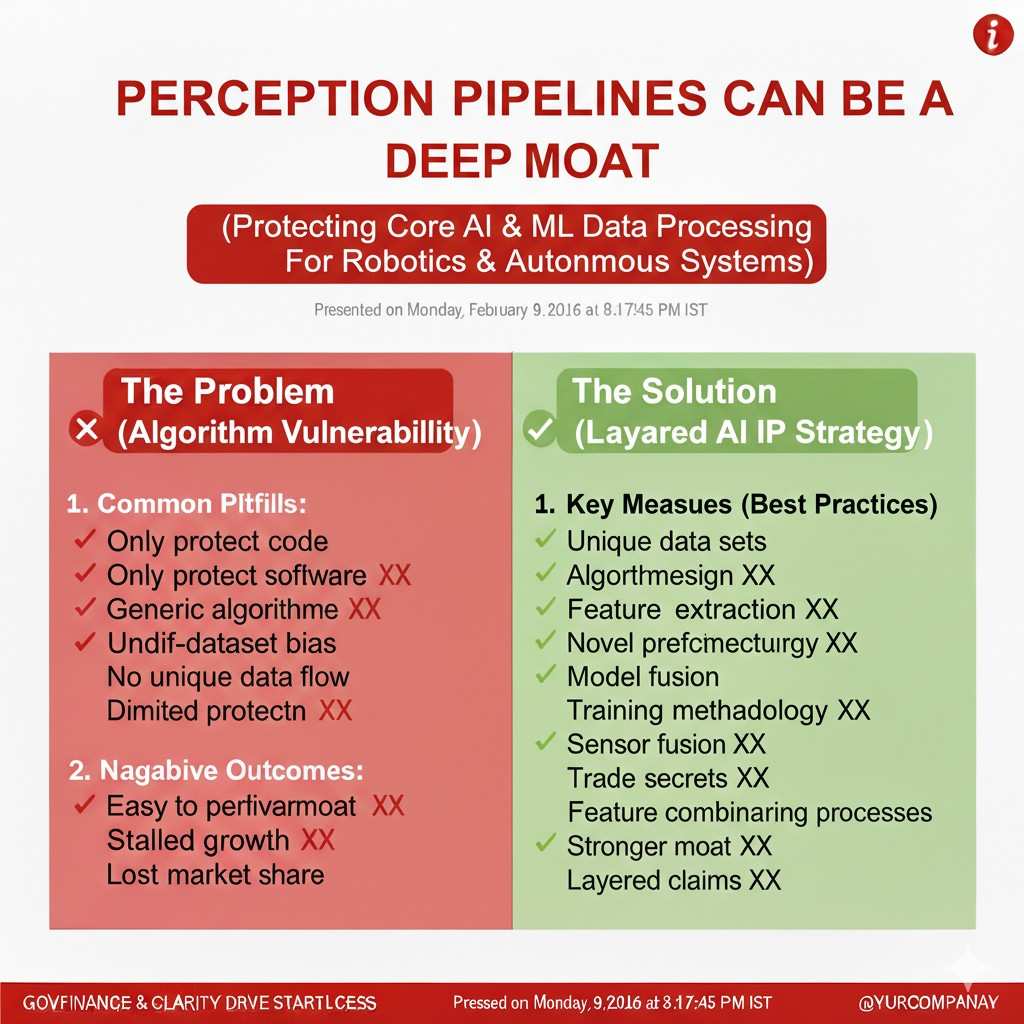
Perception is more than “we use a model.”
It is how you collect data, clean it, label it, train it, deploy it, and monitor it. It is how you fuse sensors and decide what is reliable at each moment.
If your robot can see well in glare, fog, dust, low light, or clutter, there is usually a reason. That reason can often be turned into claims when written as a system that improves detection while meeting latency and compute limits.
Planning and task logic can be just as valuable
Planning is where the robot chooses what to do next.
If you built a planner that handles tight spaces, avoids dead ends, recovers from failures, or balances speed with safety, those methods can be defensible. The protectable part is often the rule set and the structured way you recover when reality differs from the map.
Competitors can copy the idea of “navigation,” but it is harder to copy a robust planner that works in messy customer sites.
Fleet learning and updates create patent opportunities
Many robotics products get better after deployment.
If your fleet sends back data, you detect failure patterns, and you push updates that improve performance without breaking safety, there may be key inventions there. Especially if you have a careful way to validate changes, roll them out, and roll them back.
That whole loop—monitor, learn, update, verify—can be where your moat lives. It is also where smart patents can make it difficult for others to match your pace.
When trade secrets beat patents in software
Not every software advantage should be patented.
If the value is in a dataset you cannot recreate, a tuning method you can keep private, or a monitoring system that is hard to observe from outside, trade secrets may be stronger. But trade secrets only work if you treat them like secrets.
That means access control, clear internal rules, and careful handling in demos and customer pilots. If it leaks, it is gone.
If you want help deciding what to patent versus what to keep as a secret, Tran.vc can guide that decision as part of your IP strategy. Apply here: https://www.tran.vc/apply-now-form/
Control Systems IP: Protect Stability, Safety, and Performance
Control is where robotics becomes hard to copy
Control systems are often the heart of robotics performance.
Two robots can have the same motors and sensors and still behave very differently. Control is why one robot feels smooth and safe, while another looks shaky or dangerous.
If your control stack achieves stable motion under changing loads, wear, and uncertain contact, you may have strong IP that is difficult to design around.
Claim the problem you solved in the real world
Control inventions often start with a field problem.
Maybe your robot slips on ramps, or it oscillates with payload changes, or it loses accuracy after long runs because of heat. If you built a control method that adapts to those conditions, you likely have a patentable approach.
The best control patents do not read like a textbook. They read like a solution to a specific failure mode that customers actually see.
Safety control can be a major differentiator
Safety is not only a compliance checklist.
It is how you sense risk, set limits, and respond when things go wrong. If your robot can detect unsafe states early, slow down smoothly, avoid collisions, and recover without a hard stop, that is valuable.
Patents in safety control can matter a lot because they protect trust. Trust is the hidden reason a buyer chooses you, even when a competitor is cheaper.
Real-time constraints are part of the invention
Robotics control is always fighting time.
Latency, scheduling, compute limits, and sensor timing affect behavior. If you found a way to maintain stability while running on low-cost hardware, or you reduced delay between sensing and actuation, that can be protectable.
The invention is not “we run fast.” It is the method you use to meet real-time needs while staying stable and safe.
Calibration and tuning methods can be protectable
Control performance depends on good calibration.
If you built an easier way to tune controllers, auto-calibrate sensors, or adjust gains based on payload and wear, that can be a strong invention. These methods often reduce service cost and downtime, which directly impacts customer value.
These are also the kinds of methods competitors struggle to copy because they rely on deep field knowledge.
Turning Engineering Work Into IP: A Practical Workflow
Capture invention moments before they disappear
Robotics teams move fast, and good ideas vanish.
A small fix during testing can become a major advantage later, but only if you record it. The goal is not to write long reports. The goal is to capture what changed, why it changed, and what improved.
When you document these moments, you create clean raw material for patents.
Use prototypes and test logs as IP evidence
Your prototype history is valuable.
Photos of setups, test results, version notes, and even failure videos can help show what you built and why it matters. This makes it easier to draft strong filings that match real performance gains.
It also helps you avoid weak patents that describe a concept but miss the details that make it work.
Align filings to product milestones
The timing of filings matters.
If you wait until launch, you risk public disclosure before filing. If you file too early, you might file the wrong version and waste budget.
A practical approach is to connect filings to major design locks, pilot deployments, and key field learnings, so the patent covers what you will truly ship.
How Tran.vc helps you move fast without wasting effort
This is where founders often feel stuck.
You know you have valuable work, but you do not want to spend months on legal work, and you do not want weak patents. Tran.vc is designed for this moment. We invest up to $50,000 in-kind IP services so you can build a solid portfolio early while staying focused on shipping.
If you want to build your robotics IP plan with experienced support, apply here: https://www.tran.vc/apply-now-form/