
If you built an AI model that works well, your first thought might be simple: “Can I patent this?” And right after that comes the real fear: “If I can’t, can someone copy it and beat me to market?”
Here’s the practical answer in plain words: you usually cannot patent an AI model as “a model” in the broad, generic sense. But you often can patent what makes your model valuable in the real world—how it is trained, how it is used, how it improves results, and how it ties to a real system or product. That difference matters. It can be the difference between “nice demo” and “defensible company.”
Most founders get stuck because they ask the wrong question. They ask, “Can I patent my AI model?” The better question is, “What part of this AI work is truly new, and how do I frame it so it becomes protectable?”
Think about it like this. A model is like an engine. Many engines exist. If you walk into a patent office and say, “I built an engine,” the response is likely: “So what?” But if you say, “I built an engine that uses a new fuel mix, a new control method, and a new way to prevent overheating in a specific machine,” now you are talking about something that can be checked, tested, and compared. That is the kind of thing patents are made for.
AI is the same. A lot of AI work looks like math and code on paper. Patent rules are not kind to “pure math” or “just an idea.” So your job is to show the invention as a real, useful system that creates a real result. Not hype. Not a vague promise. A concrete method that solves a real problem in a way others were not doing before.
This is also why two teams can build similar models, but only one team ends up with a strong patent position. The strong team does not try to patent “AI.” They patent the specific technical moves that make their AI better, cheaper, faster, safer, more accurate, or easier to deploy. They also write it in a way that fits what patent examiners accept.
And yes—this matters even more in AI and robotics than in most other fields. Because the pace is fast, and copycats move quickly. If your “secret sauce” can be seen in a paper, a repo, or a product demo, you should assume someone will try to recreate it. A patent strategy is not about showing off. It is about putting up real fences around what you built.
At Tran.vc, this is the work we do with technical founders early—before the seed round, before the pressure, before the story gets messy. Tran.vc invests up to $50,000 in in-kind patent and IP services for AI, robotics, and other deep tech startups, so you can turn real engineering into real assets. If you want to see if your model has patentable parts, you can apply anytime here: https://www.tran.vc/apply-now-form/
What “Patent an AI Model” Really Means
The plain problem with the question
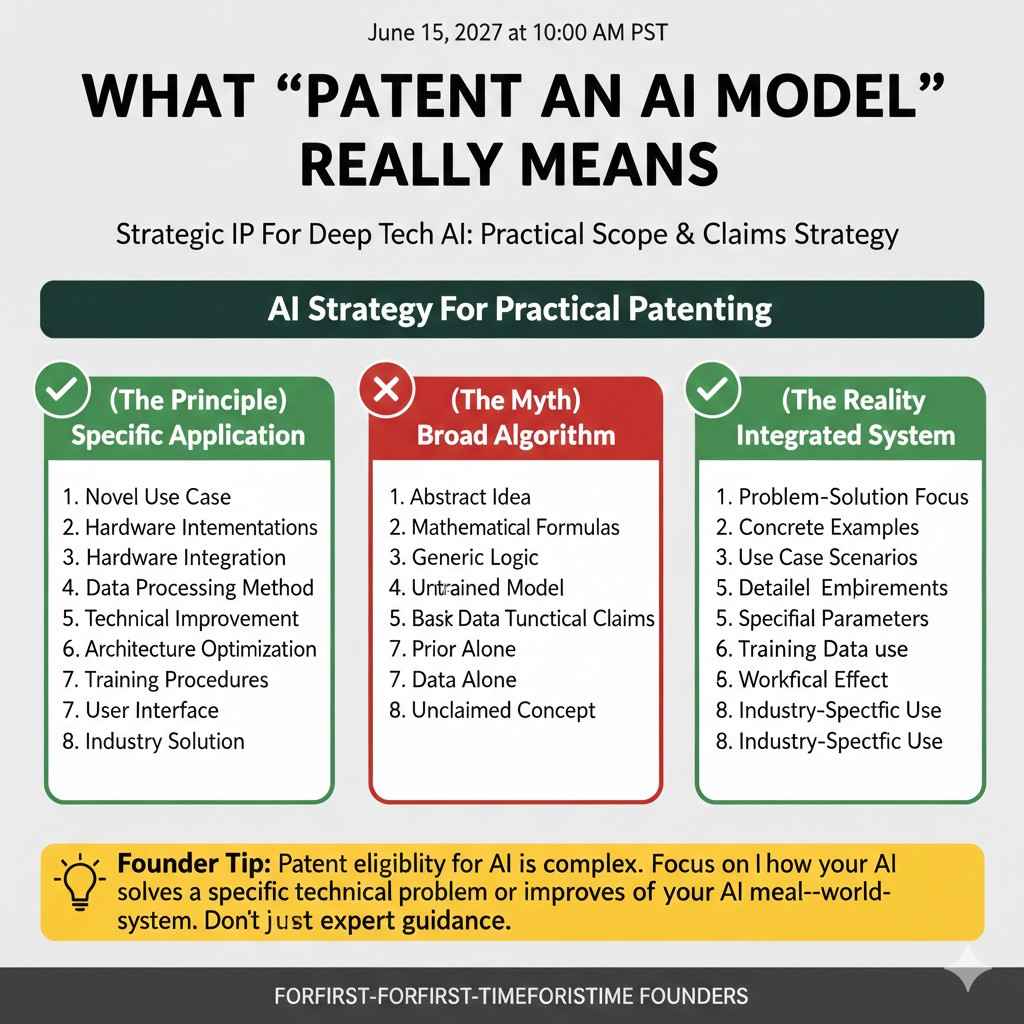
When people say “patent my AI model,” they often mean one of three things. They might mean the trained weights, the model design, or the whole product that uses the model.
These are not the same thing. Patent law treats them very differently, and examiners react differently depending on what you claim.
If you do not separate these parts, you can waste months writing the wrong patent. Or worse, you file something broad that gets rejected, and you lose time during your most important fundraise window.
Model, method, and system are not the same
A trained model is usually a set of numbers. In many cases, it looks like math stored in a file. A patent examiner may see that and think “abstract idea,” which is a fast path to a rejection.
A method is what you do to get results. This includes training steps, data handling, special loss functions, special tuning loops, and the steps you run at inference time.
A system is how the method runs in the real world. It includes the device, the network, the sensors, the data flow, the timing rules, and the way results control a real process.
Most strong AI patents are written around methods and systems, not around “a model” as a stand-alone thing.
What you can protect, in practical terms
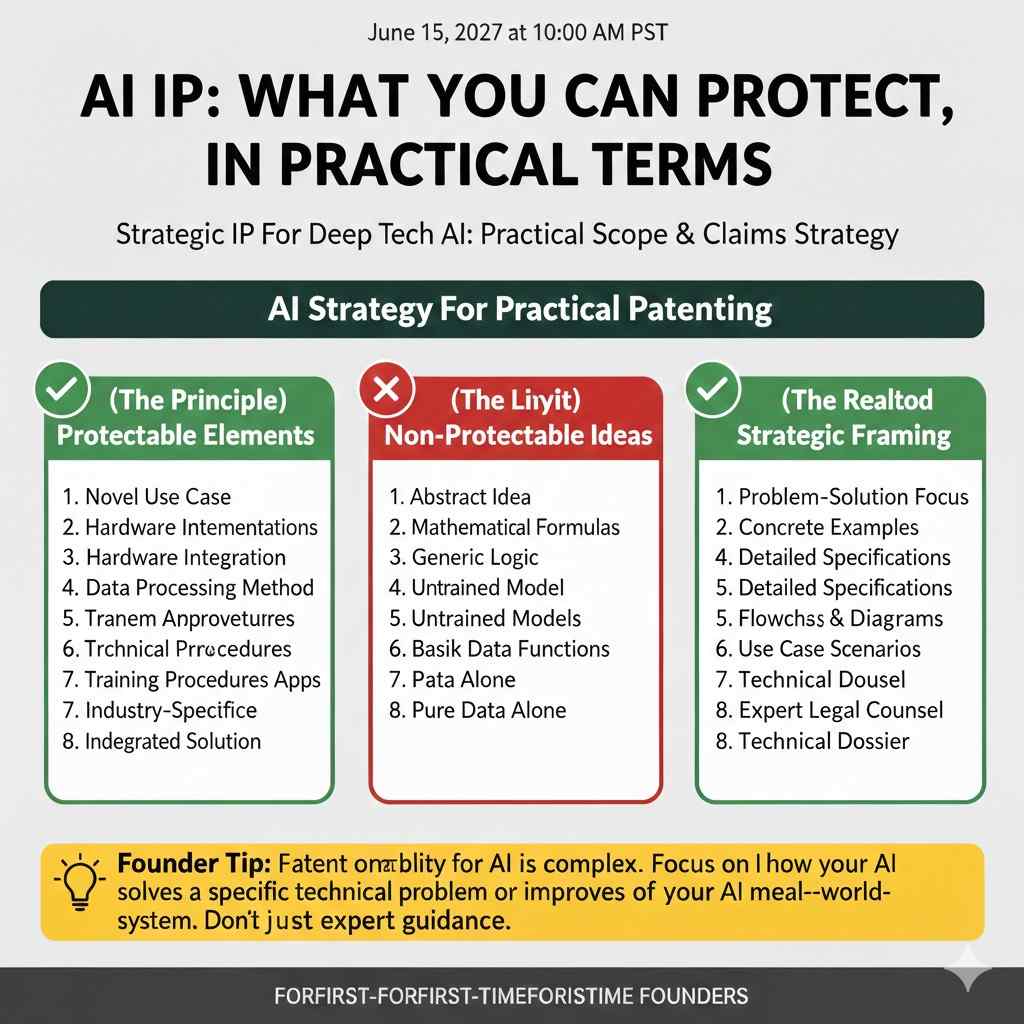
Patents are best at protecting how a technical result is achieved. That means you want to tie your invention to a measurable outcome.
This outcome might be lower compute cost, better accuracy under hard conditions, safer behavior, less drift, less data needed, or stable results in edge devices.
The more you can describe “what changed” and “why it improved,” the more your invention looks like engineering and less like a generic idea.
Why this matters for founders
Founders often try to keep everything secret. That can work for a while, but secrets are fragile once you ship.
A patent is not about telling the world everything. It is about claiming the important parts in a way that blocks copycats, even if they rewrite code.
If you are building for AI or robotics, you are usually building a pipeline and a loop, not a single model file. That is good news, because pipelines and loops are often where the best patent claims live.
A quick Tran.vc note before we go deeper
Tran.vc helps technical teams do this early, while the work is still fresh and before the story becomes “too general.” We invest up to $50,000 in in-kind patent and IP services for AI, robotics, and deep tech startups.
If you want a clear answer on what parts of your AI work are protectable, you can apply anytime here: https://www.tran.vc/apply-now-form/
What Usually Cannot Be Patented
“I used AI to do X” is rarely enough
If the core claim is “use a neural network to predict, classify, rank, or recommend,” that is often too broad. It sounds like a goal, not an invention.
Examiners see many filings that look like this. They will ask what is actually new, and they will compare your words to older papers, patents, and common tools.
If your description could fit almost any model and almost any dataset, it will not hold up well.
Abstract ideas and pure math are a common trap
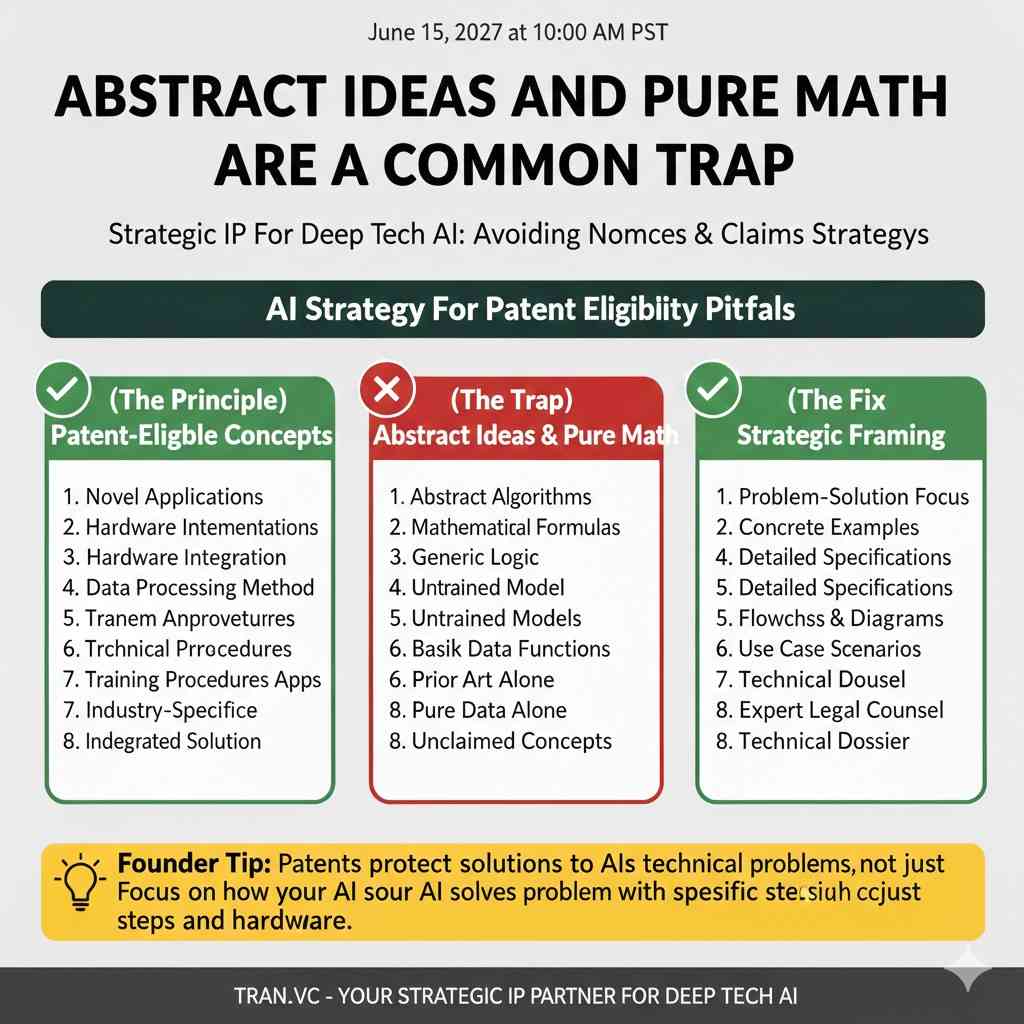
In many places, patent law does not allow patents on pure math. Many model ideas can be described as math.
When your claim reads like “a function that maps inputs to outputs,” it can sound like an abstract idea. Even if your code is real and your results are strong.
That does not mean AI is not patentable. It means you must write the invention as a technical method in a technical setting, with clear steps and clear effects.
Common architectures are hard to own
Using a well-known architecture, by itself, rarely creates a strong patent. If you say “Transformer,” “U-Net,” “ResNet,” or “diffusion,” you are starting from something the world already knows.
You might still have patentable work, but it will not be “the architecture.” It will be what you changed, what you added, and what problem that change solved.
If your only difference is “we trained it better,” that is also hard. “Better training” must be explained as a specific, new training method.
Trained weights are not usually the best target
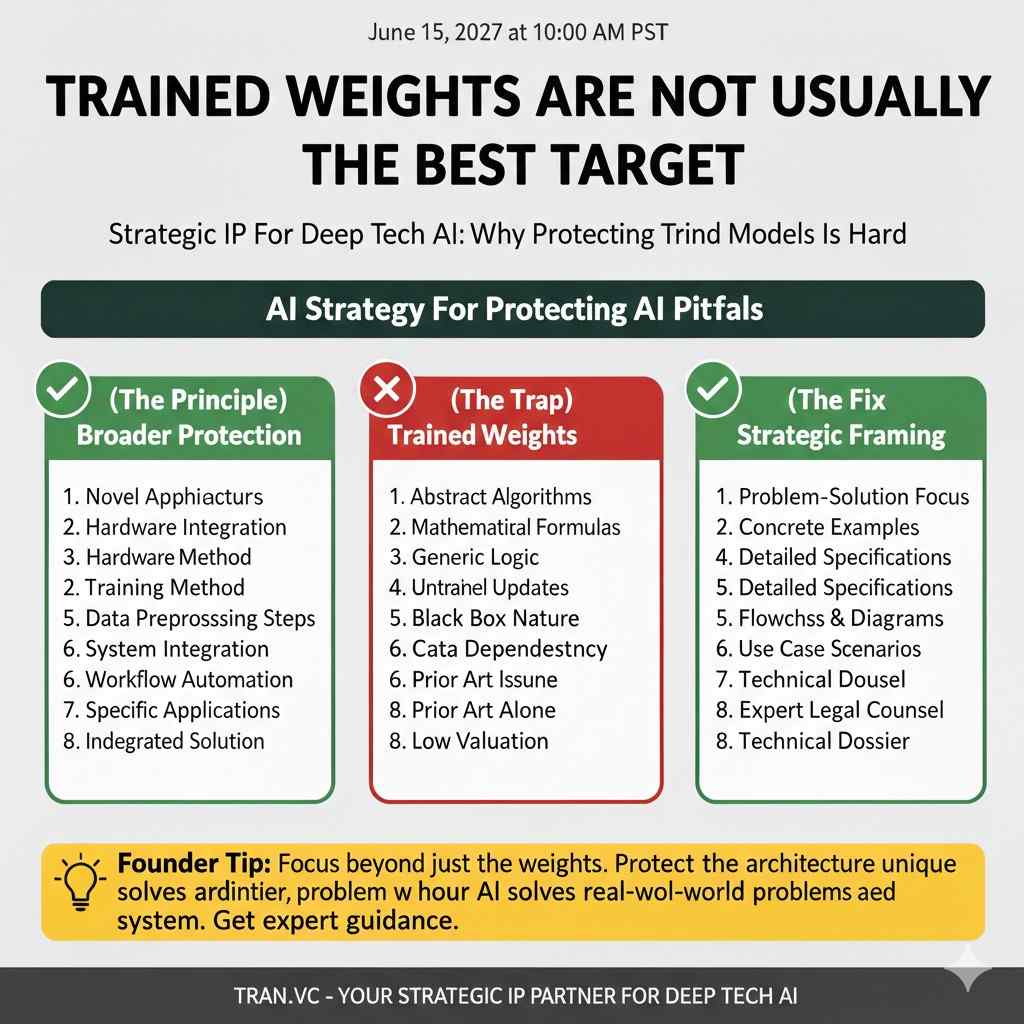
Some founders ask if they can patent the actual trained weights. In practice, that is a weak target for patents.
First, weights can be changed and still behave similarly. Second, it is hard to prove someone copied your exact weights. Third, examiners may see weights as data.
If your main advantage is in the weights, you may be thinking about trade secrets, access control, and deployment strategy. But patents can still help if you claim the training method or the inference method that produces the behavior.
Business results alone do not carry a patent
Another common issue is filing claims around business outcomes. Things like “better engagement,” “higher conversion,” or “better targeting” do not feel technical to an examiner.
AI is often used in business settings, but strong patents focus on technical changes and technical results.
If you can link the method to a technical improvement, like lower latency, fewer errors, better robustness, or lower compute, you are in a stronger position.
What Often Can Be Patented
Improvements that change real performance
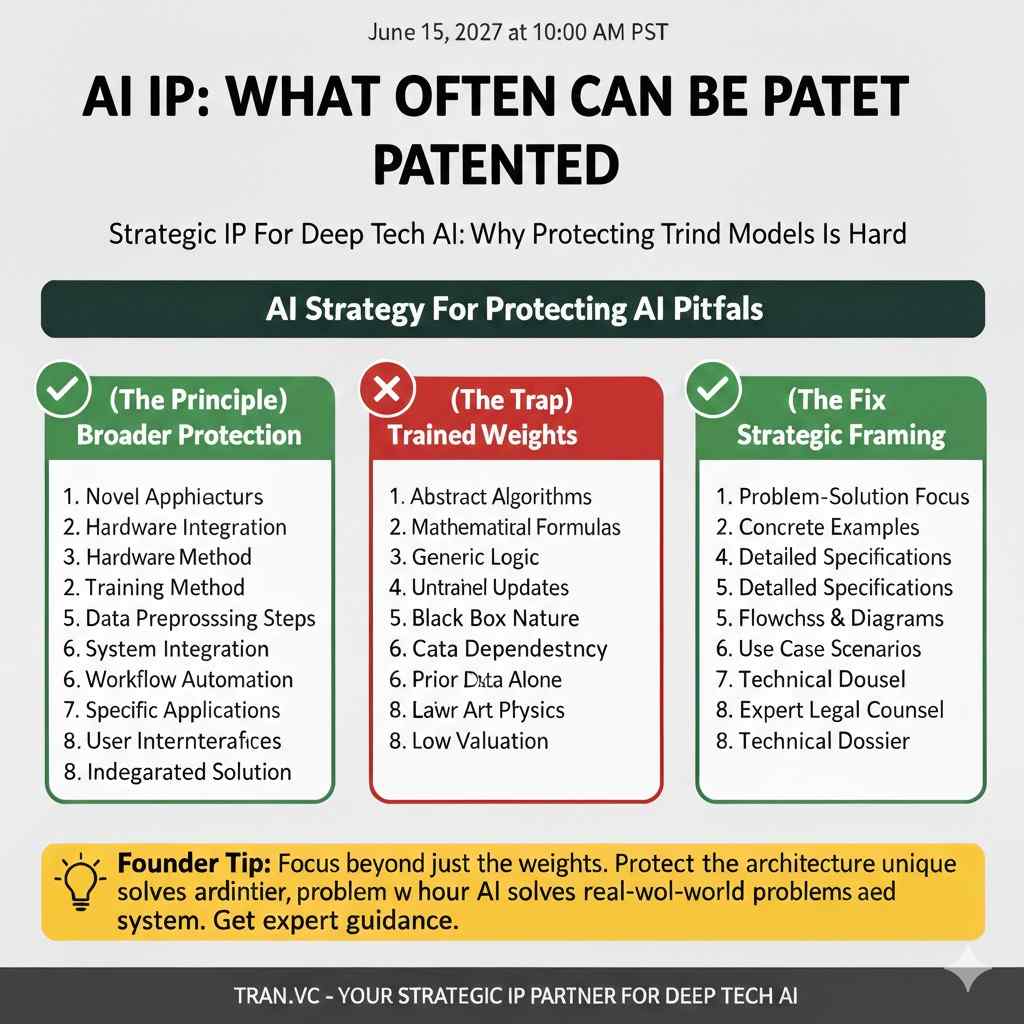
The easiest way to think about a patentable AI invention is to ask: “What did we change that made the system work better in a hard, measurable way?”
This could be accuracy in rare events, stability in noisy sensors, performance on small devices, or reduced data needs.
When you have a clear “before and after,” your patent story becomes concrete. You are not saying “AI can do this.” You are saying “this method makes AI do it in a new way.”
Training methods that are truly specific
Training is a goldmine when it is specific. Not “we trained with more data,” but “we trained with a new loop that selects data, labels it, and updates the model under defined rules.”
This includes special data generation, special sampling, special loss terms, special constraints, and special ways to reduce drift.
If your training approach lets you use less labeled data, handle edge cases, or adapt safely in the field, that can be a strong foundation for claims.
Inference methods and deployment tricks
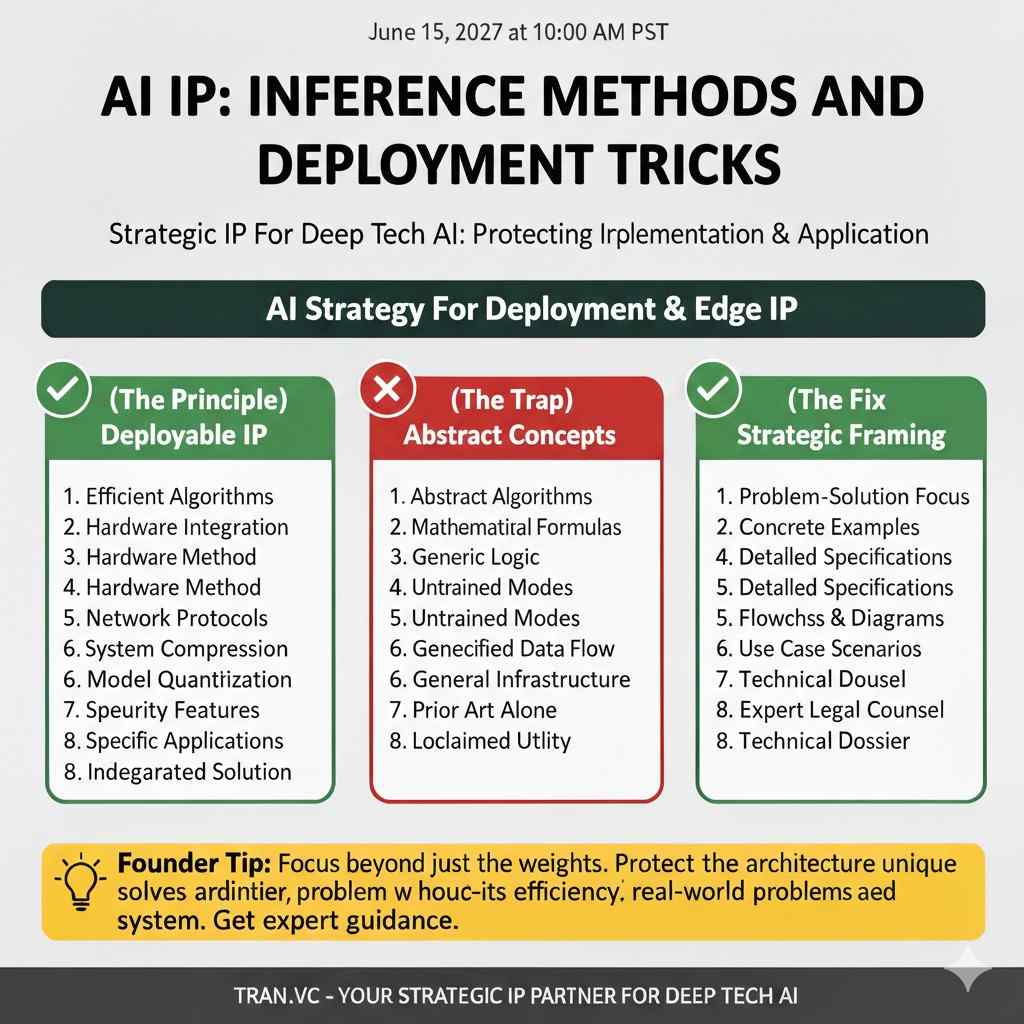
A lot of product value happens after training. How you run inference can be the difference between a lab demo and a real product.
If you do caching, pruning, early exit, confidence gating, model routing, or multi-stage reasoning in a specific way, you may have something protectable.
This is especially true in robotics, where timing, safety, and sensor fusion matter. A method that keeps the system stable under delay or packet loss can be a strong patent anchor.
Data pipelines that create technical advantages
Data is not “just data” when the pipeline is engineered. If your system cleans, aligns, filters, and labels signals in a new way, that is often a technical method.
For example, if you align camera and IMU data with a special time correction step, or you detect bad labels automatically and repair them, that is more than a dataset.
When the pipeline is described as steps that cause a measurable improvement, it becomes much more than “we used data.”
AI tied to hardware and real systems
AI and robotics fit well together for patents because the invention can be grounded in a real system. Sensors, motors, controllers, and constraints make the story concrete.
If your model helps a robot grasp, navigate, inspect, sort, or balance in a way that is safer or more reliable, you can often claim the method and the system.
The key is to describe the technical problem and the technical fix, not just the task.
How to Tell If Your AI Work Has a Patent Core
Ask “What would a smart copycat copy?”
A simple test is to imagine a strong engineer at a competitor. They see your demo and want to recreate it.
What do they need to copy to get close? Is it the architecture, the data trick, the training loop, the sensor setup, or the runtime pipeline?
That “copy target” is often your patent core. It is the part you should describe in detail and claim in multiple ways.
Look for constraints you had to solve
Real inventions often come from constraints. Maybe you had limited compute, limited power, limited bandwidth, messy data, or safety requirements.
If you had to engineer around these constraints, you likely created a method, not just a model.
Patents like constraint solutions because they show real engineering. “We solved X under Y limits” is a strong frame.
Identify what is new, not what is impressive
Many founders focus on results, like a benchmark score. That is useful, but patents care about what is new.
You want to capture the steps you invented, the structure you created, and the rules you designed. Those are what a patent can actually protect.
A strong patent can cover many future model versions if the method stays the same. That is the goal.
Write down the “recipe,” not the “dream”
If your description reads like a vision statement, it will not be strong. If it reads like a recipe with steps and conditions, you are closer.
This does not mean you expose every detail publicly right now. It means you document it so your patent attorney can shape it into claims and support.
If you want help turning that recipe into a defensible filing, Tran.vc’s model is built for this exact stage. You can apply here anytime: https://www.tran.vc/apply-now-form/
What Patent Examiners Usually Want to See
Clear steps that can be compared
Patent examiners do not “feel” your product. They read words and compare them to older words.
So you want to give them steps they can line up side-by-side against prior art. Steps like “detect,” “generate,” “select,” “update,” “control,” “synchronize,” and “validate.”
When your method is specific, it becomes easier to argue that it is new. Vague methods are harder to defend.
Technical effects, not just outcomes
A technical effect is something like reduced latency, improved stability, fewer compute cycles, lower memory use, or better robustness under noise.
An outcome like “better user satisfaction” does not help much. Even if it is true.
If your invention produces a technical effect, describe it plainly and link it to the steps that cause it. That linkage matters.
Real-world context that anchors the invention
Many AI filings fail because they float in the air. They do not connect to a real system.
If your AI runs in a robot, a camera system, a medical device, a factory line, or an edge module, describe the system. Explain the constraints and why your method works there.
This is not fluff. It is part of what makes the invention look like engineering instead of a general idea.
The Patent Rules That Shape AI Patents
Why “software patents” feel confusing
Many founders hear “software patents are hard” and stop there. The truth is more practical. You can patent software when it is framed as a technical method that improves how a system works.
AI often looks like software. But AI is also a control method, a signal method, a sensor method, and a data processing method. When you show that connection, your chances improve.
The main mistake is treating the patent as a marketing story. A patent is closer to an engineering spec written for a skeptical reader.
The two questions examiners silently ask
When an examiner reads an AI patent, they often ask two quiet questions. First: is this just an idea, or is it a concrete method with steps?
Second: is this new compared to what already exists? That includes papers, open-source projects, blog posts, and older patents.
If your filing answers both questions clearly, you are already ahead of most AI filings.
Novelty versus “it works well”
A model can work very well and still not be patentable if the method is already known. This happens when teams use common tools in a smart way, but do not create a new method.
It can also happen when the real invention is in small details, but the filing stays broad and generic. Examiners do not guess. If the details are not there, you cannot rely on them later.
This is why founders should capture the exact steps that made the difference, while they still remember them.
Why prior art hits AI harder than you expect
AI is public by default. People publish papers quickly, share code fast, and talk openly online. That creates a lot of prior art.
It is common for a founder to feel they are first, but an examiner can find an older paper with a similar idea. Even a blog post can be used.
So the goal is not “we use AI for X.” The goal is “we use this specific method for X, and it solves this hard technical problem in a new way.”
The good news for robotics and applied AI
If you build AI that touches the physical world, you often have more to work with. Real systems have messy signals, timing limits, safety checks, and hardware constraints.
That context helps you describe technical improvements that look patentable.
A robot that sees and acts is not the same as a generic model that predicts a label. If your invention changes how the robot makes decisions under real constraints, you can often craft strong claims.
How to Frame an AI Invention So It Can Be Patented
Start with the pain the machine faces
A strong patent starts with a technical problem. Not a market problem. A machine problem.
For example, a camera feed is noisy. A robot arm slips. A sensor drifts. A network drops frames. A small device cannot run a large model.
When you begin here, your invention sounds like engineering. You show the examiner why common approaches fail and why your approach exists.
Describe the “mechanism,” not the “magic”
Many AI teams explain their work with words like “learns,” “understands,” or “reasons.” Those words can be useful in product talk, but they are weak in patent writing.
Instead, describe the mechanism. What data enters, what processing happens, what signals are produced, and how those signals change behavior.
This is where you can show your unique steps. You can also show why those steps create a technical effect.
Tie the method to a measurable improvement
A patent gets stronger when it ties steps to outcomes that a technical person can test.
Maybe your method reduces false positives in rare cases. Maybe it reduces compute by skipping expensive steps under defined conditions. Maybe it keeps the robot stable when sensors disagree.
You do not need to share every internal number in the blog world. But you should have those numbers in your internal notes, so your patent filing can describe the improvement in a credible way.
Use multiple “angles” for the same core idea
A common mistake is filing one narrow claim around one version of the invention.
In practice, your invention can be described as a method, a system, and sometimes a non-transitory computer readable medium. The wording changes, but the core steps stay the same.
This matters because competitors attack narrow claims. If you cover the core idea from several angles, you become harder to work around.
This is also why you should not wait until the product is finished. Early filing lets you capture the core while it is still clear.
A simple way to collect what you need
After every engineering sprint, take 30 minutes and write down what changed and why it helped. Capture the exact steps.
When a bug fix becomes a clever stability trick, or a data issue forces a new labeling method, you might have created patentable material.
This habit is one of the easiest “unfair advantages” a technical founder can build. Most teams do not document well, and they lose protectable ideas.
If you want a structured way to do this with help from experienced patent professionals, Tran.vc is built for that. You can apply anytime here: https://www.tran.vc/apply-now-form/