
Most robotics teams do not lose because their robot is worse. They lose because someone else copies the best parts, files first, and turns the same idea into a “protected” product. Then investors ask the hardest question: “What do you own that nobody can take?”
If you are building AI + robotics, you are not building one invention. You are building a full stack of inventions, from sensors to motion to learning to the way your system runs in the real world. The good news is: that full stack can be claimed. The bad news is: if you only patent the “robot” or only patent the “model,” you leave wide open doors for others to walk through.
This guide is about how to claim the full stack in a practical way. Not theory. Not legal talk. Real steps you can take while you are still building.
And if you want expert help doing this the right way, Tran.vc can invest up to $50,000 in in-kind patent and IP services for AI, robotics, and deep tech teams. You can apply anytime here: https://www.tran.vc/apply-now-form/
Before we go deeper, here is the core idea you need to hold in your head:
A strong robotics patent plan is not one patent. It is a map.
It is a map of what creates your edge, where that edge lives in the stack, how others might copy it, and how you block those paths with clear claims. It is also a plan that matches your business stage. Early on, you need speed, coverage, and clean proof that you can defend your space. Later, you can add more depth and more filings.
When people say “full stack” in AI + robotics, they usually mean the product pieces. Hardware. Software. Data. Models. Deployment. But for patents, full stack has a sharper meaning. It means you claim the system from the bottom to the top, in a way that still works even if a competitor swaps out parts.
That last part matters more than most founders realize.
Because competitors rarely copy you line by line. They copy the outcome. They keep what works, change what is easy, and say, “This is different.” If your patent only covers one narrow version, it may be easy to walk around. If your patent covers the right layer of the stack, and the right “cause of the outcome,” then “different” is not different.
So, how do you find the right layers to claim?
Start by asking a simple question: what is the hard part?
In AI + robotics, the hard part is almost never the robot arm by itself. It is not the camera by itself. It is not “we use reinforcement learning” by itself. The hard part is usually in the link between the robot and the world.
Robots live in mess. Lighting changes. Parts are bent. Floors are slick. Boxes are soft. Humans move. Signals drop. Sensors lie. Motors heat up. That is where your team earns its advantage. Your system does not just compute. It survives reality.
That survival is what you want to patent.
And that survival is often made of many small moves that add up to one big result. A better grasp. A safer path. A faster cycle time. A lower error rate. A robot that can work without a cage. A robot that can learn a new task from a short demo. A robot that can recover when something goes wrong.
Investors do not only want to hear “we can do it.” They want to know “can others do it too?” Patents help answer that, if they are done with intent.
Here is where teams go wrong early:
They treat patents like a trophy.
They file one big patent that says, “A robot system that uses AI to do X.” It sounds impressive. It feels broad. But it often does not lock down the true advantage. It can also be easy to reject, because it reads like a wish, not a method. Or it gets allowed, but with narrow claims that do not scare a real competitor.
The better way is to treat patents like a fence.
You do not build a fence by placing one post. You place posts in the right spots. You connect them. You cover the gaps. You make it hard to step over, hard to go under, and annoying to go around.
That is what “claiming the full stack” really means.
Now, let’s make this real with a quick picture.
Imagine you are building a warehouse picking robot. Your edge might look like “our robot can pick messy items from a bin.” But that edge is not one thing. It is a chain:
Your sensor setup sees more than others in bad light.
Your perception pipeline builds a stable 3D scene even when the camera shakes.
Your model predicts grasp points that work on deformable objects.
Your motion planner chooses paths that avoid collisions in tight spaces.
Your control loop adapts grip force in real time based on slip signals.
Your system learns from failed picks and updates the policy without a full retrain.
Your safety layer slows down near humans and still stays productive.
Your deployment setup runs fast enough on edge hardware to hit cycle time.
If you only patent “AI grasp prediction,” a competitor can keep the grasp model and change the sensors. Or keep the sensors and change the model. Or avoid the model and do a rules-based approach plus better force feedback. The result might be close enough to beat you in the market.
But if you claim the chain in the right way, you can protect the core idea across many versions.
That does not mean you must patent every detail. You do not. You should not. It means you choose the right “choke points.” The places where copying you forces them to also copy a key method.
In this article, we will walk through how to find those choke points, how to write patents that cover the full system without being vague, and how to build a portfolio that matches how robotics companies really grow.
We will also cover the parts that many AI teams miss:
How to protect data workflows without claiming “the data”
How to patent training and deployment in a way that holds up
How to claim feedback loops between sensing, learning, and control
How to keep your claims useful even as models change fast
How to avoid the common traps that make patents weak or easy to design around
How to time filings so you do not burn money too early
All of this is work you can start before product-market fit. In fact, that is when it is easiest. Later, you are busy shipping and selling, and you also risk public disclosure that can limit your options.
If you want help building this plan with real patent support, Tran.vc does this as a core service. They invest up to $50,000 in in-kind patenting and IP services for robotics, AI, and deep tech startups, so you can build a real moat early without giving up control too soon. Apply anytime here: https://www.tran.vc/apply-now-form/
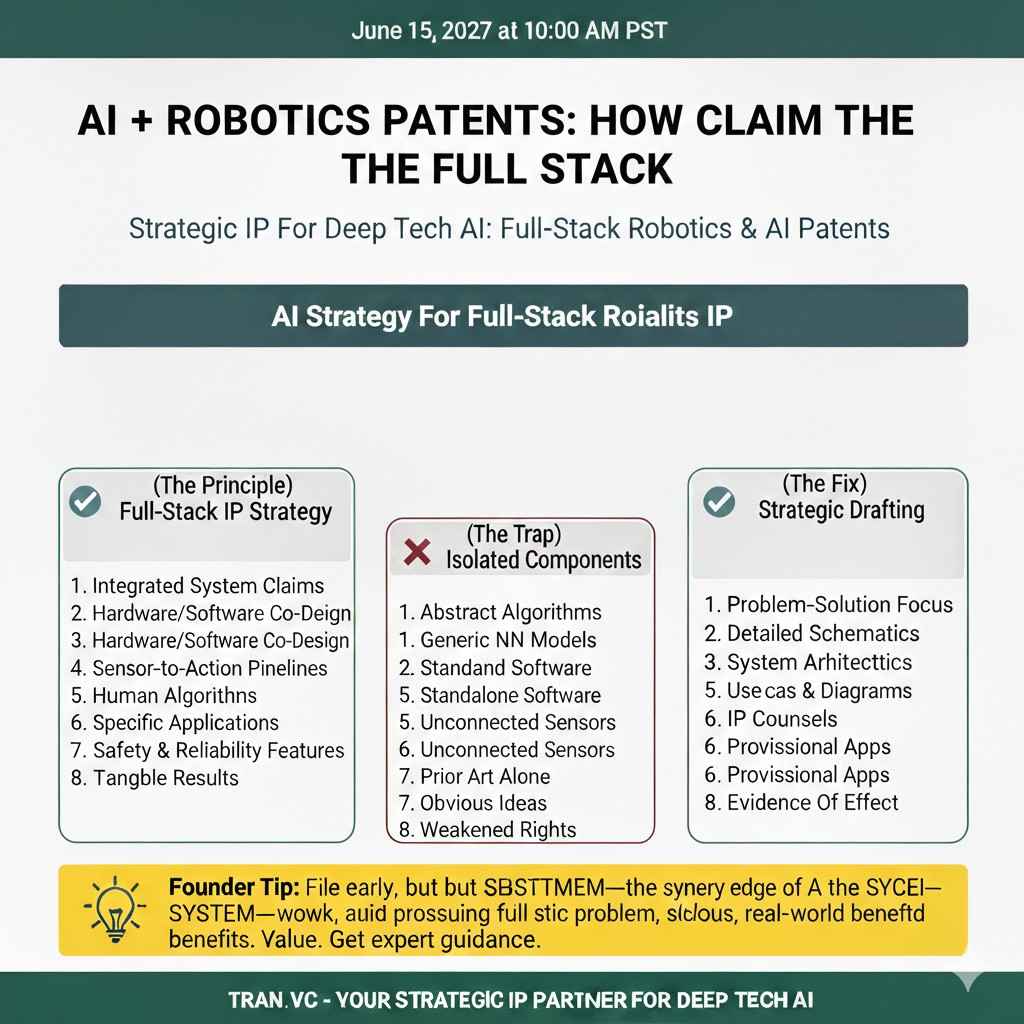
AI + Robotics Patents: How to Claim the Full Stack
Why “Full Stack” Matters in Patents
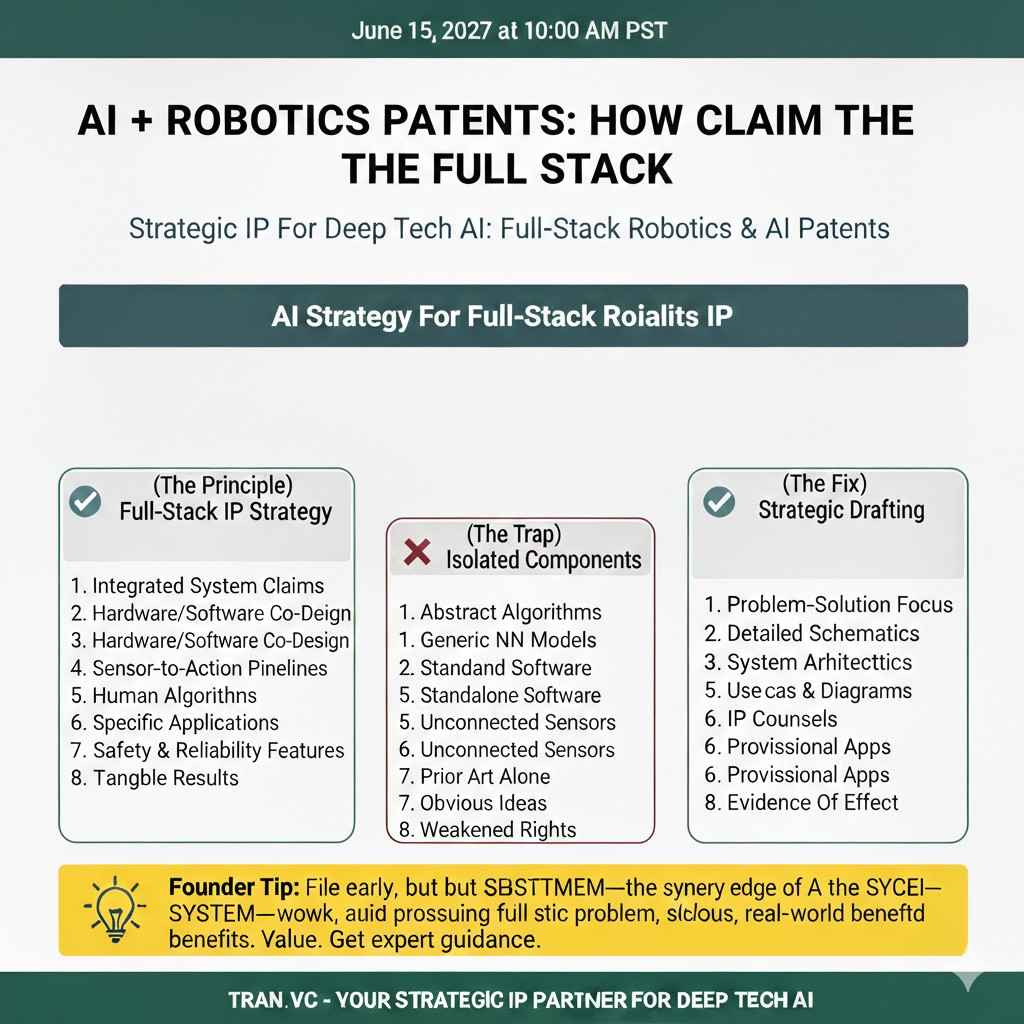
When founders hear “full stack,” they think product. They think hardware plus software plus data. That is true, but patents demand a sharper view. A patent is not a story about what you built. It is a tool that stops others from taking the value you created and selling it as their own.
In AI + robotics, that value is almost never in one part. It lives in how parts work together, especially when the world is messy. If your patent only covers one narrow part, a competitor can swap the rest and still reach the same result. Full stack claiming is how you reduce those easy escape routes.
The Hidden Risk of “One Big Patent”
Many teams file a single broad patent early. It sounds bold, but it often turns into weak protection. Examiners push back on vague language, and the allowed claims end up small. Worse, the patent may not cover what truly makes your robot win in real settings.
A stronger plan is a portfolio that covers your key choke points. These are the places where competitors must copy you to match your performance. Full stack does not mean “patent everything.” It means “patent what forces imitation to be expensive.”
What You Are Really Protecting
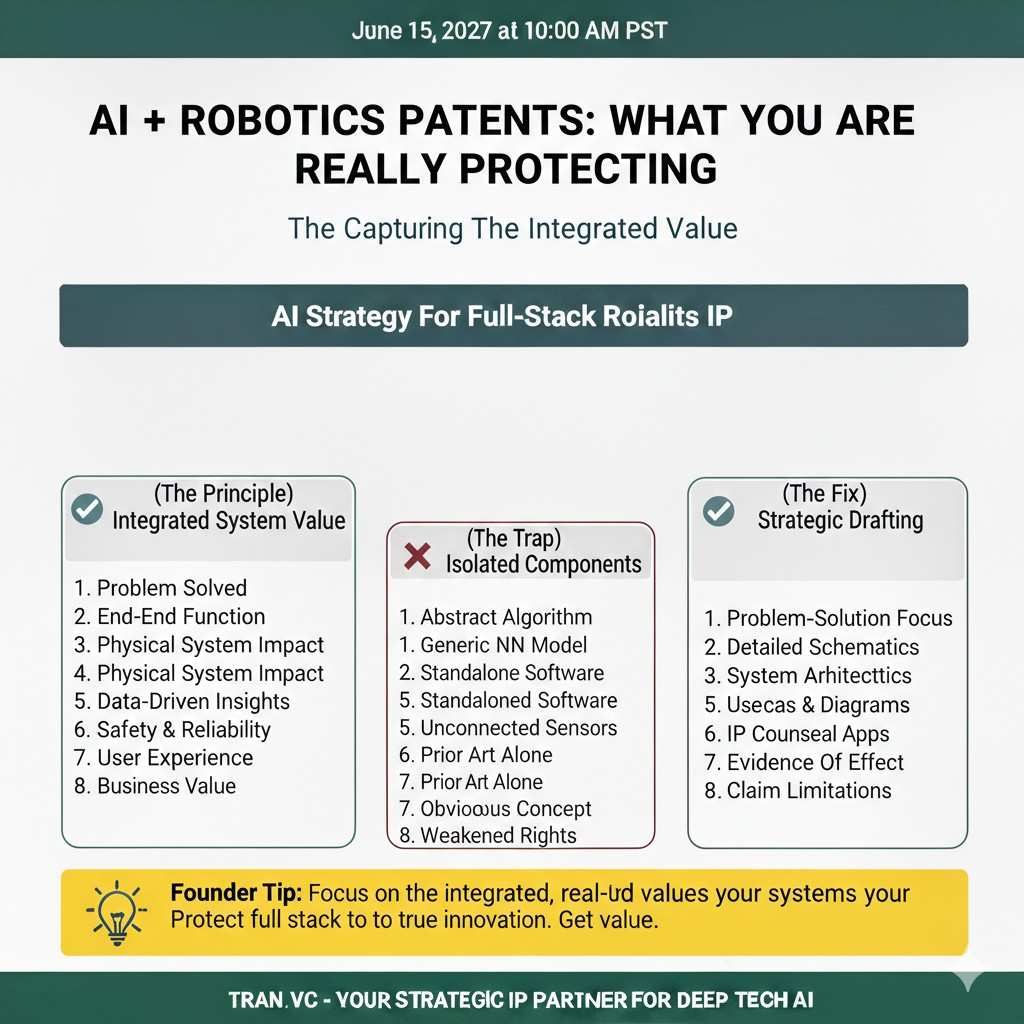
You are not protecting a robot arm, a camera, or a model name. You are protecting an advantage that keeps working across versions. Your system will change. Sensors will change. Models will change. Compute will change. What should remain stable is the method you use to reach a hard outcome.
That stable method is what you want to claim. When you claim it well, your patent stays useful even as your tech evolves. That is the difference between a patent that looks nice on paper and one that gives you leverage in funding and competition.
Step One: Map the Stack Before You Write Anything
Start With Outcomes, Not Components
A good stack map begins with outcomes, because outcomes are what buyers and investors care about. In robotics, outcomes are usually tied to reliability, speed, safety, and cost. Your robot is valuable because it does a job well, in the real world, without constant babysitting.
Write down your top two or three outcomes in plain words. Then ask what makes those outcomes possible. You are hunting for the “because” behind the result. That “because” is often where the patentable inventions live.
Turn “Because” Into a Chain
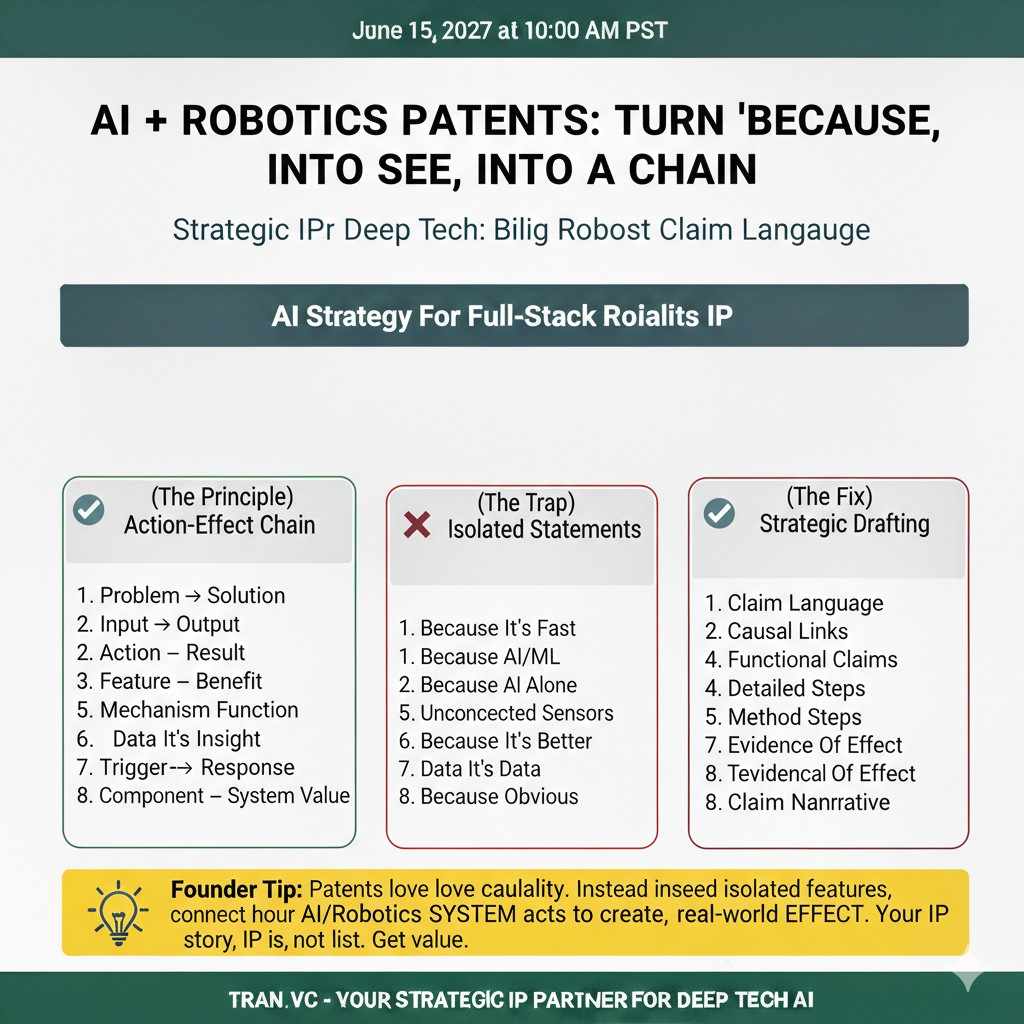
Robotics systems succeed through chains. A chain might start with sensing and end with action, but it also includes learning, recovery, and monitoring. Each link changes the next link. If one link is special, the chain becomes hard to copy without copying that link.
When you build this chain, do not use marketing words. Use steps. Use decisions. Use signals. Use timing. If your system makes a choice based on a sensor reading, that is a step. If it changes behavior after a failure, that is a step. These steps are often the heart of strong claims.
Look for “Switch Costs” in the Design
A competitor will try to copy your outcome and switch your parts. They will change sensors. They will change the model. They will change the control method. The question is whether they can still get close to your performance after those changes.
A “switch cost” is the pain they feel when they try to change one part. If changing a part breaks the method, that is a sign you found a choke point. Patents should aim at these choke points because they remain important even when the surface details change.
The Full Stack in AI + Robotics: Where Patents Usually Live
Hardware Layer: More Than a Mechanical Shape
Hardware patents in robotics are not only about new shapes and brackets. They can cover sensor placement that improves signal quality, end-effectors that adapt to object variety, and mechanical choices that enable safer motion or better feedback. The key is to tie hardware to function, not appearance.
If your gripper design changes how you measure slip, or how you distribute force, or how you detect contact, you may have an invention that is both mechanical and algorithmic. These mixed inventions are often strong because competitors cannot copy the software benefit without also dealing with the physical design.
Sensing Layer: Turning Bad Signals Into Useful Truth
Most robots struggle because sensing is imperfect. Cameras face glare. Depth sensors fail on shiny parts. Force sensors drift. Encoders miss tiny errors. If your system has a method for making sense of unreliable inputs, you may have strong patent material.
Patents here often focus on how signals are combined, filtered, timed, or validated. If you use multiple sensors to cross-check one another, or if you change sensing behavior based on the task phase, that can be claimable. The goal is not to claim “we use cameras.” The goal is to claim how you make sensing dependable in the wild.
Perception Layer: Stable Scene Understanding Under Motion
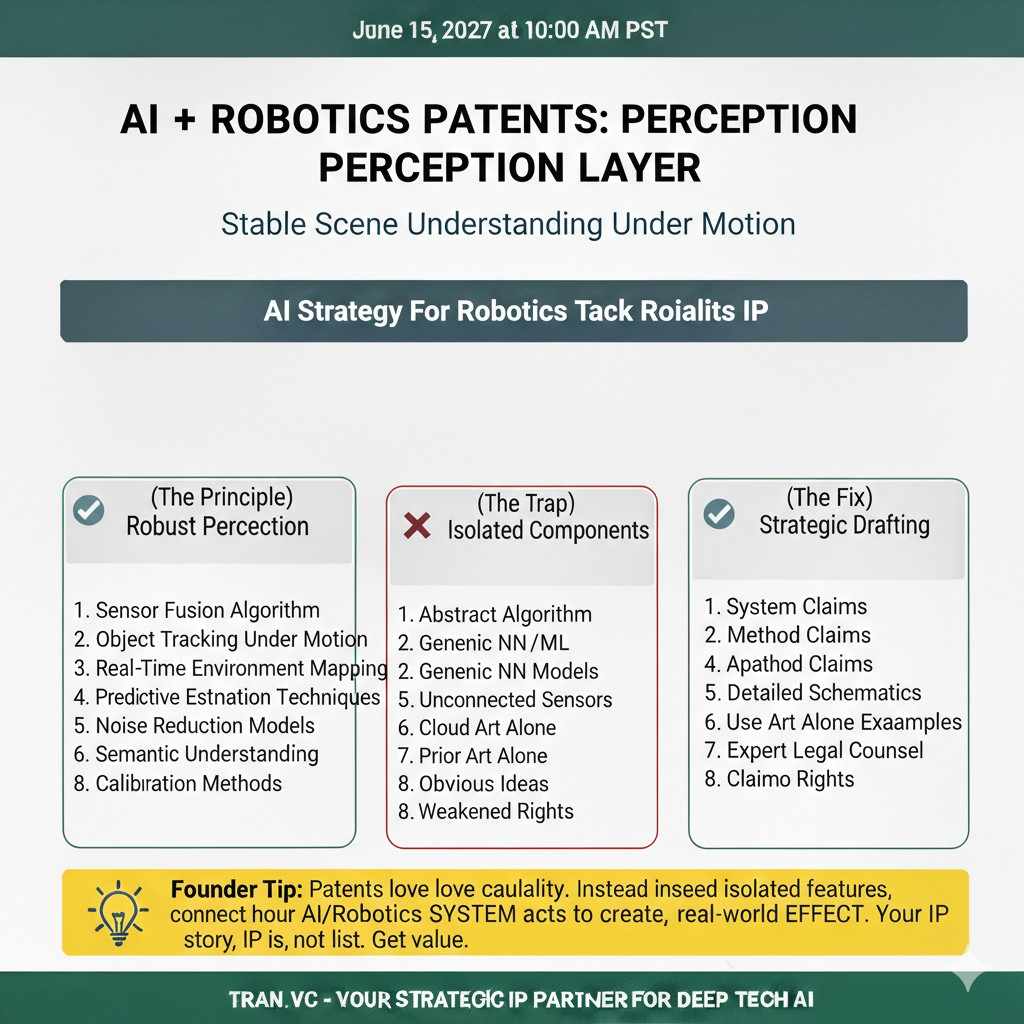
Perception is where many teams say “we use AI,” but patents should say what the AI is doing in a structured way. For example, how you build a stable scene model when the robot moves, when the view is blocked, or when objects deform. These are not generic claims, and that is good.
If your perception pipeline improves performance through a special method of tracking objects, updating maps, or estimating pose under uncertainty, you may be able to claim those steps. Strong perception patents usually explain how the system handles failure cases, not just the happy path.
Learning and Models: Claims That Survive Model Changes
Models change fast. If your patent relies on a specific model type, you risk writing something that becomes outdated. The better approach is to claim what the model enables and how it is used in the loop, rather than naming one architecture as the invention.
For example, if your system learns from weak signals, or learns safely without risky exploration, or adapts to new items with very few examples, those are durable ideas. If your method creates a reliable policy update using real robot data plus simulation in a controlled way, that can be a strong claim even if the model type changes later.
Planning and Control: Where Real-World Performance Is Won
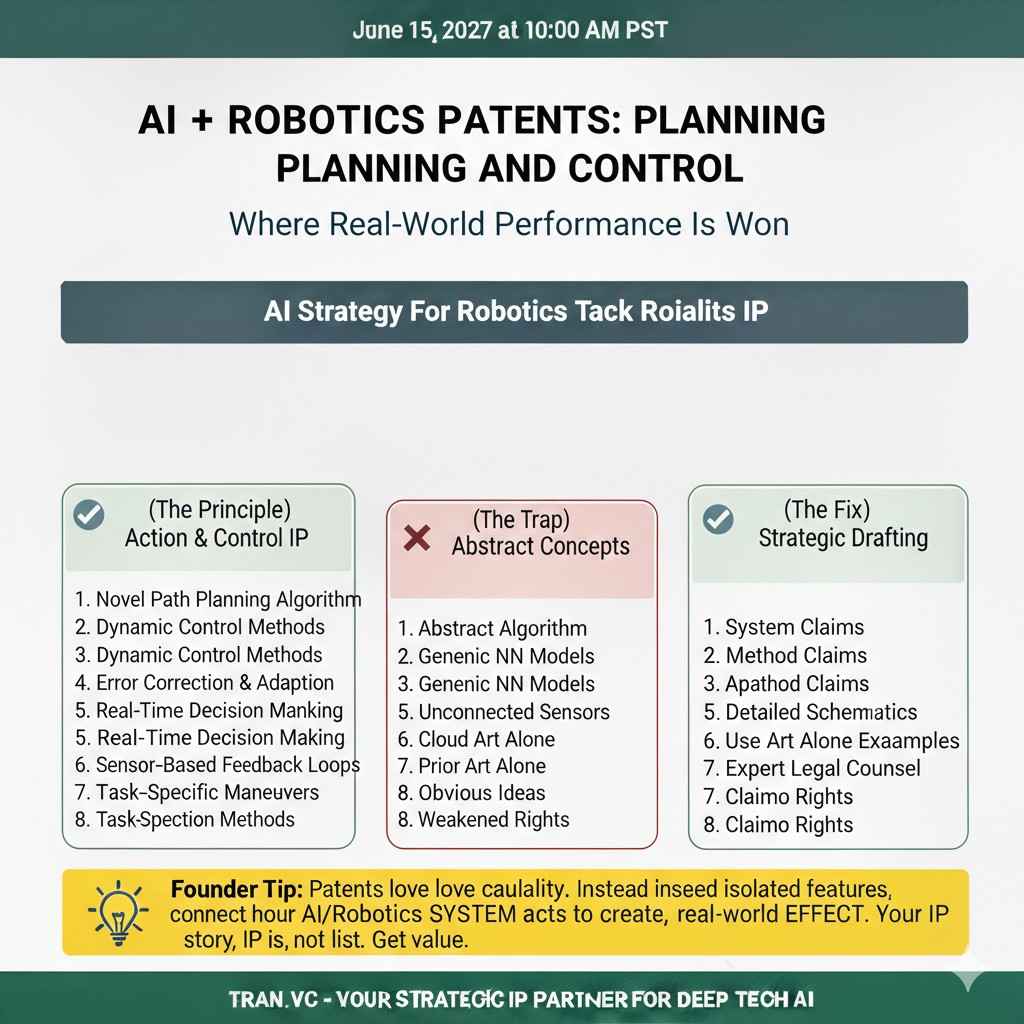
Planning and control are often where the real “secret sauce” sits, because they translate intelligence into safe, smooth motion. In patents, this can include how you choose actions based on uncertainty, how you adjust control gains in response to contact, and how you plan in tight spaces with limited compute.
These are powerful places to claim because competitors must solve the same physics problems. If your robot moves better, faster, or safer because of a specific method, it is worth exploring as IP. The trick is to describe it in steps that are repeatable and testable, not in broad claims about “optimizing motion.”
System Layer: The Feedback Loop Is Often the Invention
Many teams think patents should cover a part. In AI + robotics, the invention is often the loop. The loop might be “sense, predict, act, measure, update.” If you have a special loop that improves over time or recovers from failures in a new way, that can be hard to copy.
System claims become stronger when they explain what triggers changes. What signals cause a re-plan. What thresholds cause a safety slow-down. What metrics cause a model update. If your robot behaves intelligently because of these triggers, that behavior can often be claimed as a method.
How to Find Your Choke Points in One Working Session
Use Your Debug Logs as an IP Goldmine
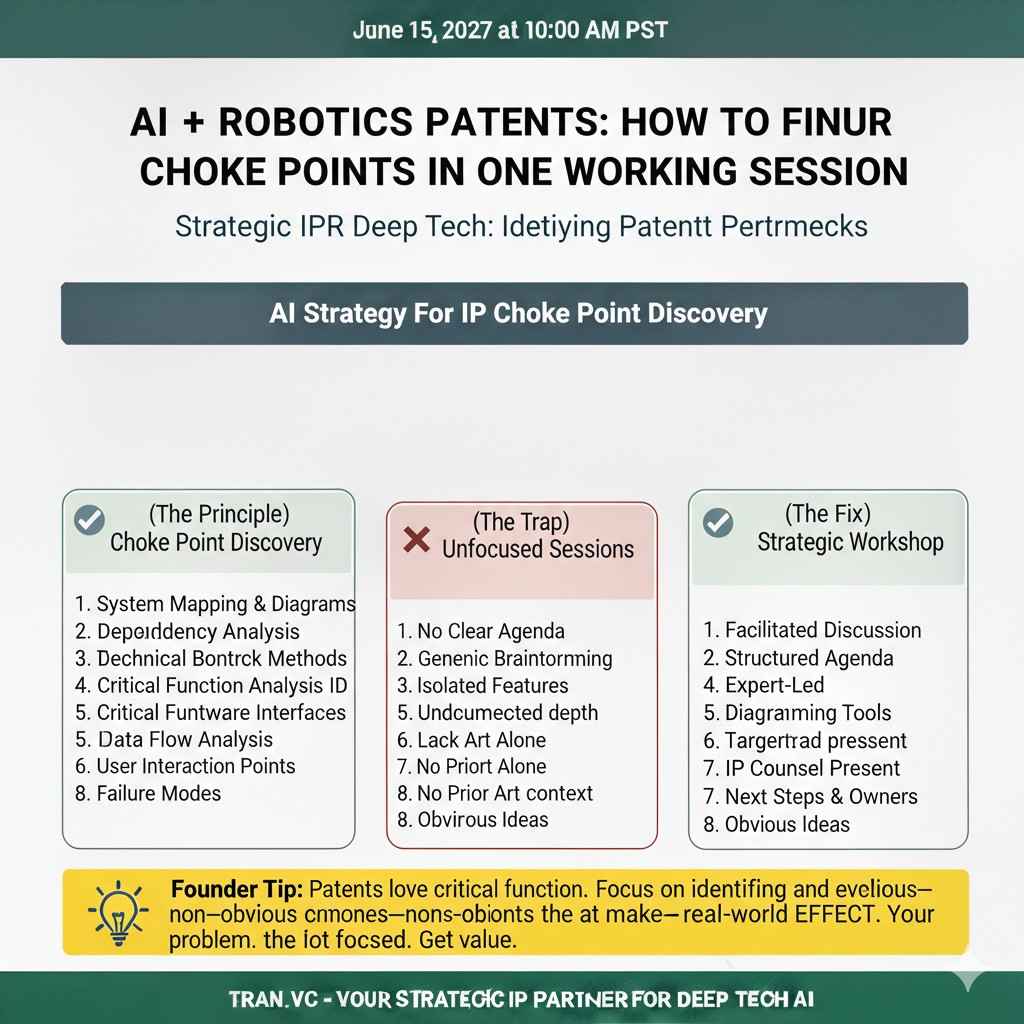
Your logs show where reality fought your system. Every time your team fixed a failure, you likely created a method worth capturing. The final performance is not magic. It is a list of solved problems. Those solved problems are your patent candidates.
Go through recent issues your team closed. Focus on the fixes that changed behavior, not just refactors. If a fix added a new signal, a new decision rule, a new model input, or a new recovery step, it may be a claimable idea.
Track the “Hardest Ten Minutes” of the Robot’s Job
Most robotics tasks have a moment where everything goes wrong. Objects clump together. Parts slip. Humans walk by. Dust covers the sensor. If your robot performs well in that hardest moment, your advantage likely lives there.
Describe that moment in detail. Then write what your system does differently during that moment. The difference between “normal mode” and “hard mode” is often the invention. Patents that cover these transitions can be surprisingly strong.
Identify What a Competitor Would Try First
Pretend you are a competitor. You see your demo video. You read your website. You know what problem you solve. What would you try first to copy the result cheaply? Most competitors will start with the visible parts and avoid the deeper work.
Your choke point is the part they cannot avoid once they get serious. If they must copy your specific data workflow, your specific feedback loop, or your specific recovery process, that is a good target. The goal is to patent what they must do, not what they might do.
Turning a Stack Map Into Patent Claims Without Getting Vague
Write Claims Around Actions and Decisions
Patents become weak when they sound like goals. “Improve accuracy.” “Reduce errors.” “Increase safety.” These outcomes are important, but they are not the claim by themselves. Claims need actions and decisions that produce the outcome.
Think in verbs. Measuring, estimating, selecting, adjusting, updating, validating, triggering. If your system’s edge comes from a set of decisions it makes, describe those decisions. That description becomes the raw material for strong patent language later.
Protect the Method, Not the Brand Name
Do not anchor your patents on a model name, a toolkit, or an internal project name. Those names may change. They also do not help you in enforcement. What helps is the method, expressed in steps.
If your system uses “a learned policy,” describe how that policy is trained, what it consumes, what constraints it respects, and how it is updated. If your system uses “sensor fusion,” describe how the fusion is timed, how conflicts are resolved, and how confidence is assigned. These details create real boundaries.
Keep One Eye on Design-Around Tricks
Competitors design around patents by changing inputs, changing outputs, or moving steps around. Good claiming anticipates those tricks. If your key idea is the relationship between input signals and action selection, you want claims that cover the relationship, not one exact format of the input.
This is why full stack thinking matters. If you claim both the method and its role in the system, you reduce the number of escape routes. The goal is not to be broad for the sake of ego. It is to be broad where your method is truly general.