
Capital is loud.
But the way you use it is what really tells your story.
Most early founders do not fail because they are “not funded enough.”
They fail because they burn time, money, and focus on the wrong things, in the wrong order.
This article is about the opposite of that.
It is about capital-efficient playbooks that actually work in the real world.
Not theory. Not “growth hacks.”
Just clear, simple ways to build a strong, fundable company without lighting money on fire.
And if you’re a technical founder in AI, robotics, or deep tech, this matters even more.
Your work is complex. Your cycle times are long. Your runway feels short.
You cannot afford to move like a spray-and-pray startup.
You need a sharper way to build.
Before we dive in, one quick note: if you’re a technical founder and you already feel the pressure to raise, scale, and do “big startup things” fast, Tran.vc was built for you. We invest up to $50,000 worth of in-kind patent and IP services so you can turn your code and ideas into real assets, before you give up control or chase a big round. You can apply any time at: https://www.tran.vc/apply-now-form/
The Core Playbooks of Capital-Efficient Startups
Why Early Focus Beats Early Funding

Many founders try to solve every problem at once, and it pulls them in too many directions.
When you pick one clear goal and make the entire company serve that goal, you build momentum faster and waste less money.
This is how small teams stay sharp and create more progress than bigger teams that are spread thin.Early focus also reduces pressure. You stop chasing growth for the sake of growth and start building something real.Tran.vc works closely with founders on this shift. We help you identify the one thing that creates leverage for your startup today, not in some distant future. That clarity alone saves months of burn and keeps founders in control while they build.Apply anytime at: https://www.tran.vc/apply-now-form/
How Small Technical Wins Become Big Business Leverage
A small technical win is not just code or a demo. It is a chance to learn something real about your market and use that knowledge to build confidence in your roadmap.
When you collect many small wins, you build a story that investors trust because it is tied to real progress, not slides.These wins also show you where your unfair advantage lives. You may discover a faster model, a cheaper workflow, or a smarter mechanical trick.Once you know these edges, you can protect them early through smart IP.
This is why Tran.vc invests in patent work, not just advice.
Your small innovations, once captured well, become assets that grow in value and help you raise on better terms later.This keeps your company capital-efficient because your best ideas become leverage instead of risks.
Why Deep Tech Needs Slow Thinking and Fast Building
Deep tech moves differently from software. You need time to think, test, and refine your ideas before anyone else sees them. But that does not mean you should move slowly when building simple, visible proof that your idea works. Fast building does not mean rushing. It means cutting the problem into small pieces and proving each one with the least amount of effort and money. This keeps you moving without slipping into long, expensive cycles.
Tran.vc helps founders run rapid cycles while still protecting core inventions early. You get speed and safety at the same time, which is rare at the seed stage. It is one of the reasons our founders stay focused on progress, not panic.
If you want support on this, you can apply anytime at: https://www.tran.vc/apply-now-form/
Building Moats Before Markets
How IP Turns Your Work Into a Real Moat
A moat is not hype or branding.A moat is a barrier that keeps others from copying the thing that makes your product special.For deep tech and AI founders, this barrier often comes from early patents and smart documentation.When you file early, you protect your space before bigger companies notice you.This gives you confidence to share more with customers, partners, and investors because you know the core is safe.It also helps you raise later because investors love teams that already secured what matters.
Tran.vc exists to make this easy for founders. Our in-kind investment gives you up to $50,000 of patent and IP work so you can build a moat without spending your small budget on legal fees. This single step changes how you build and how others see your company.
Why “Protect First, Then Build Fast” Works
Many founders do the opposite.
They build fast first, share everything, get early traction, and only later think about patents.
By then, it is too late because the idea is already public and harder to protect.
When you flip the order, you get both speed and safety.
You can show your prototype to more people without worrying.
You can launch early versions of your product without hiding your best ideas.
This makes your whole journey smoother.
You stop holding back out of fear, and you start building with confidence.
Your conversations with customers and investors become more open and useful.
Tran.vc guides you through this process so you never lose control of your inventions.
All founders should build fast, but only after protecting what gives them an edge.
The Hidden Cost of Not Protecting Your Work
Many technical founders skip IP because it feels expensive or complicated.
But the true cost of skipping it is much higher.
It shows up later when you try to raise money and investors ask, “What stops someone else from doing this?”
If your answer is weak, your round becomes harder and slower.
Your valuation may drop because your risk goes up.
And worst of all, a bigger team with more resources can enter your space and move faster than you.
By contrast, when your IP story is strong, investors see durability.
They see a company that will last.
They see a founder who builds with intention, not luck.
Tran.vc helps founders avoid this painful mistake by giving them expert IP support before they raise.
If this is the help you need, apply anytime at: https://www.tran.vc/apply-now-form/
Turning Your Work Into a Fundable Story
How to Build a Clear and Simple Narrative
Investors do not fund complexity. They fund clarity. But clarity is hard when you are building deep tech because so much of your work is invisible to others.
A good founder story starts simple:
What problem exists, what part of it matters, and why your approach is the best path to solve it.
This story must be clean enough to repeat over and over without losing meaning.When your story is simple, people remember it. When people remember it, they repeat it.
When they repeat it, opportunities open up on their own.
Tran.vc helps founders craft this story by tying the narrative back to their IP, product plan, and early proof.
This creates a clean arc from “idea” to “asset” to “impact,” which is exactly what seed investors want to see.
Why Story Without Proof Doesn’t Work
A polished pitch deck can sound great, but without proof it feels empty.Investors may smile, nod, and say nice things, but they do not lean in.A polished pitch deck can sound great, but without proof it feels empty.Investors may smile, nod, and say nice things, but they do not lean in. A working demo, a rough prototype, a pilot with one customer, or a set of internal tests that show a clear lift.These do not need to be perfect; they just need to show direction.
When you combine proof with a strong IP foundation, your story becomes powerful. You stop sounding like a dream and start sounding like a company ready for real capital.
The Power of Early Signals
Early signals are small signs that your work matters. Maybe a researcher reaches out. Maybe a potential customer as ks for a demo.Maybe someone in your field says, “This is interesting.” These signals guide your roadmap. They tell you what to do next with confidence.They also show investors that your work is pulling real interest even before you scale. Capital-efficient founders pay close attention to these signals because they help avoid waste. You stop building features nobody needs and start building toward clear demand.
Tran.vc helps founders read and act on these signals with intention, not panic.This lets you build a stronger fundraising story with less burn. You can apply anytime at: https://www.tran.vc/apply-now-form/
Seed-Strapping: Growing Without Chasing Money
Why Founder-Led Execution Beats Early Hiring
In the early days, your startup does not need a big team. It needs a clear brain, fast decisions, and tight feedback loops.That almost always means the founders should stay close to the work instead of rushing to hire. When you hire too early, you add layers between the problem and the person who can fix it. Work becomes slower, and coordination costs creep in.You spend more of your precious time managing people rather than understanding the market and shaping the product.
Founder-led execution keeps your burn low and your learning rate high. You can change direction in a day, not in a quarter. You can keep the bar for quality and speed where it needs to be, because you see everything up close.
At Tran.vc, we often see that the strongest early teams are very small but very intentional. They use experts like IP attorneys, not as full-time hires, but as sharp tools to get specific jobs done right.
That is why our support is in-kind: you keep your headcount lean while still getting top-level IP help when it matters most.
If this is how you want to build, you can apply anytime at: https://www.tran.vc/apply-now-form/
Using Automation to Stretch Every Hour
Capital efficiency is not only about money. It is also about time. Many early teams treat their time as if it is cheap, but in reality it is your rarest resource. Automation lets you take work that repeats and turn it into something that runs with almost no effort. This could be a simple script to process logs, a small tool to prepare training data, or an internal dashboard that shows key numbers at a glance. Each bit of automation gives you hours back every week Those hours matter. They let you spend more time talking to users, thinking about IP strategy, or refining your core model or hardware. You stop feeling like you are drowning in small tasks and start feeling like you are steering the ship again. A capital-efficient founder looks at every repeated task and asks, “Can this be automated?” You do not need complex tools or big systems at first.
Even small scripts and simple workflows can lift a huge weight off the team.
At Tran.vc, we encourage “automation first” thinking because it compounds over time.
The more of your daily work you can systemize, the more energy you have for deep thinking and invention.That is where real value is born, and that is what investors want to back.
Setting Tiny Runway Targets, Not Huge Funding Goals
Most founders talk about how much they want to raise.They dream of big rounds and bold headlines.
But very few ask a more useful question: “What do we want to prove in the next six to twelve months?” When you think in terms of proof, your planning becomes sharper. You start from one or two clear outcomes, like a working prototype, a patent filing, or a signed pilot. Then you work backward to find the minimum time and money needed to reach them.This approach turns big, vague dreams into small, concrete targets.
Instead of saying, “We need millions,” you say, “We need enough to secure these assets and learn these things.”
Suddenly, the path feels less scary and more doable.
This is the heart of seed-strapping. You stretch each dollar to move from idea to asset to traction, step by step.
You might raise later, but when you do, you are raising from a position of strength, not fear.
Tran.vc fits into this by helping you lock in one of the most important early assets: your IP foundation.
With up to $50,000 of in-kind patent and IP support, your next six to twelve months can include real protection, not just motion.If that sounds like the kind of plan you want, you can apply at: https://www.tran.vc/apply-now-form/
Designing a Lean Go-To-Market for Deep Tech
Finding Your First Real Use Case
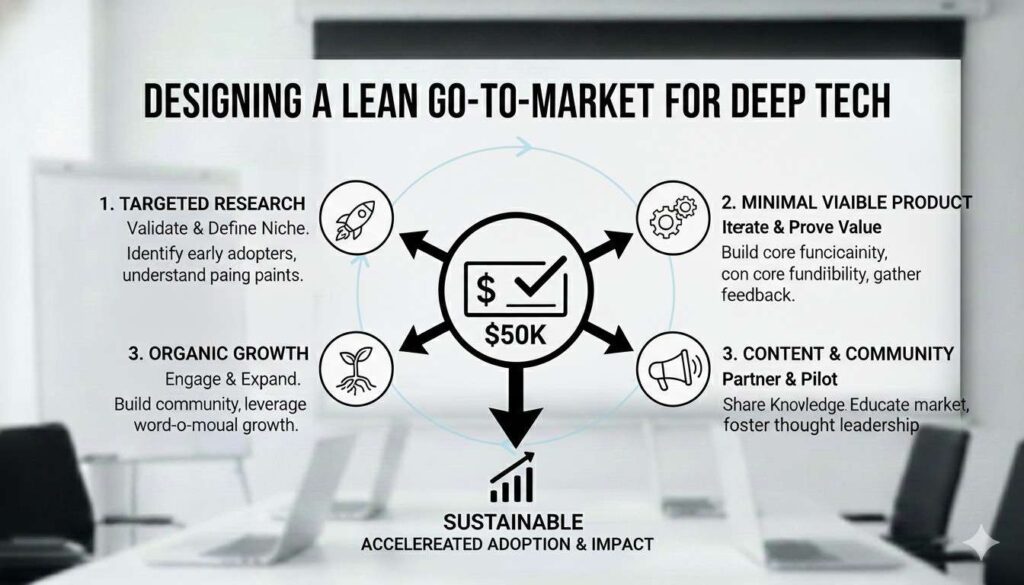
Deep tech often has many possible uses. You may see ten industries that could benefit from your work. If you try to chase them all, you will likely end up with half-finished ideas and no real traction.A capital-efficient go-to-market starts with one narrow use case. You look for a problem that is painful, urgent, and clearly linked to your special edge. You also look for a type of customer who is open to pilots and early tools, even if things are still rough.
Once you pick that use case, you commit to it for a while.You learn the language of that customer, the flow of their day, and the real barriers they face when trying something new. You build just enough product to fit into that world and see real use. This might feel slower at first, because you are saying no to many tempting paths.But in practice, it is faster, because your learning is focused. Instead of shallow feedback from many places, you get deep feedback from a few.
Tran.vc supports this kind of focus by helping you see which parts of your tech are most defensible and most valuable. When your IP strategy and your use case line up, your story becomes clear and your roadmap becomes easier to follow.
How to Run Tiny Pilots That Actually Teach You Something
Many pilots fail because they are too big, too vague, or too loose. Both sides walk away tired, with little to show for the effort. Capital-efficient founders design pilots that are small, clear, and time-bounded. A good pilot has a simple question at its core.
For example, “Can our tool cut this process time by half?” or “Can our robot handle this one repetitive task safely?”
You and the partner agree on what success looks like before you begin. You also agree on scope. You limit the pilot to a single workflow, a single site, or a single team. This keeps it easier to run and easier to understand when it ends.
During the pilot, you stay very close to the user. You watch how they use the tool, where they get stuck, and what they try to do that you did not expect. You treat every complaint as a gift, because it tells you where to improve. At the end, you gather clear results and simple stories. You take these back into your design, your narrative, and your IP strategy. You ask, “Did this reveal a new method or improvement worth protecting?”
Tran.vc helps teams translate pilot learnings into stronger IP and sharper pitches. This way, your pilots are not just sales experiments. They become steps in building a deeper moat around your company. If you want help turning your work into this kind of asset-backed story, you can apply anytime at: https://www.tran.vc/apply-now-form/
Pricing Early Without Underselling Your Value
Pricing scares many founders, especially in deep tech. You worry that if you price too high, nobody will try the product. If you price too low, you train the market to see your work as a cheap tool instead of a key system. A capital-efficient approach starts simple. First, you understand the value you create. Do you save time, cut errors, reduce labor, or open new revenue?
Then you think in ranges, not exact numbers. You set a fair price band that feels small compared to the value you bring, but large enough to respect the depth of your work. Within that band, you can adjust based on risk, effort, and the kind of partner you are working with. For early pilots, you can use creative structures.
Some teams charge a reduced fee for the pilot itself but attach a clear price for future expansion if things go well.
Others link a part of the fee to specific outcomes, which helps build trust with cautious buyers.
The key is to avoid a race to the bottom. If you give everything away or price at near zero, you may win a short-term experiment, but you lose long-term respect. Your tech becomes “nice to have” instead of “core to how we work.” Strong IP can also support higher pricing. When customers see that your solution is unique and protected, they understand why it is not a commodity. They are more willing to invest because they know they cannot just “get it somewhere else.”
Tran.vc helps founders connect the dots between value, IP, and pricing. This gives you more confidence in money conversations, which is a big part of building a real business, not just a cool project.
Working With Investors On Your Terms
Choosing When You Are Actually Ready to Raise
Raising money is not a badge. It is a tool. You are ready to raise when more money will help you do more of what is already working. You are not ready when money is a way to hide that you still do not know what works. A capital-efficient founder waits for a few clear signs. You have a real use case that someone cares about. You have some proof, even if small, that your tech can solve that use case. You have a basic plan for how more money will turn that proof into a repeatable motion.You also know what you will protect with that money. This could be more patents, stronger data assets, or better systems. If you raise into clear assets, you keep control.
Tran.vc helps you use the time before your round to build those assets. Our in-kind IP support turns loose ideas into a strong base that you can show to future investors.
If you want to do that work now, you can apply at: https://www.tran.vc/apply-now-form/
Framing Your Company as an Asset, Not Just a Promise
Many early founders sell hope. They talk about what could happen “one day.” You will stand out if you talk about what you already have today. Even early, you can point to real things. You might have a first patent filed, a working demo, or a simple pilot that showed a clear gain. These are assets. They do not vanish if a deal falls through. They do not depend on one customer or one hire.
When you meet investors, walk them through these assets in plain words. Show how your IP, your product, and your early proof all fit together. Make it easy for them to see that more money will grow a base that is already strong.This is why we care so much about IP at Tran.vc. It is not just legal work. It turns your daily deep tech grind into something clear that investors can hold onto.
Saying “No” to the Wrong Money
Not all money is equal. Some comes with support and trust. Some comes with pressure and noise. A capital-efficient founder is willing to say no. You say no when the terms feel heavy for your stage. You say no when an investor pushes you to grow in ways that do not match your tech or your market. Saying no is easier when you have a strong base.If you have patents in place, working code, and real signals from the market, you can walk away. You know more chances will come.
At Tran.vc, we want founders to stay in that power zone. Our in-kind work helps you grow your leverage first, so you can choose better money later. That is how you keep your company yours while you still grow fast.
Avoiding the Biggest Capital Traps
The Burn-For-Brand Trap
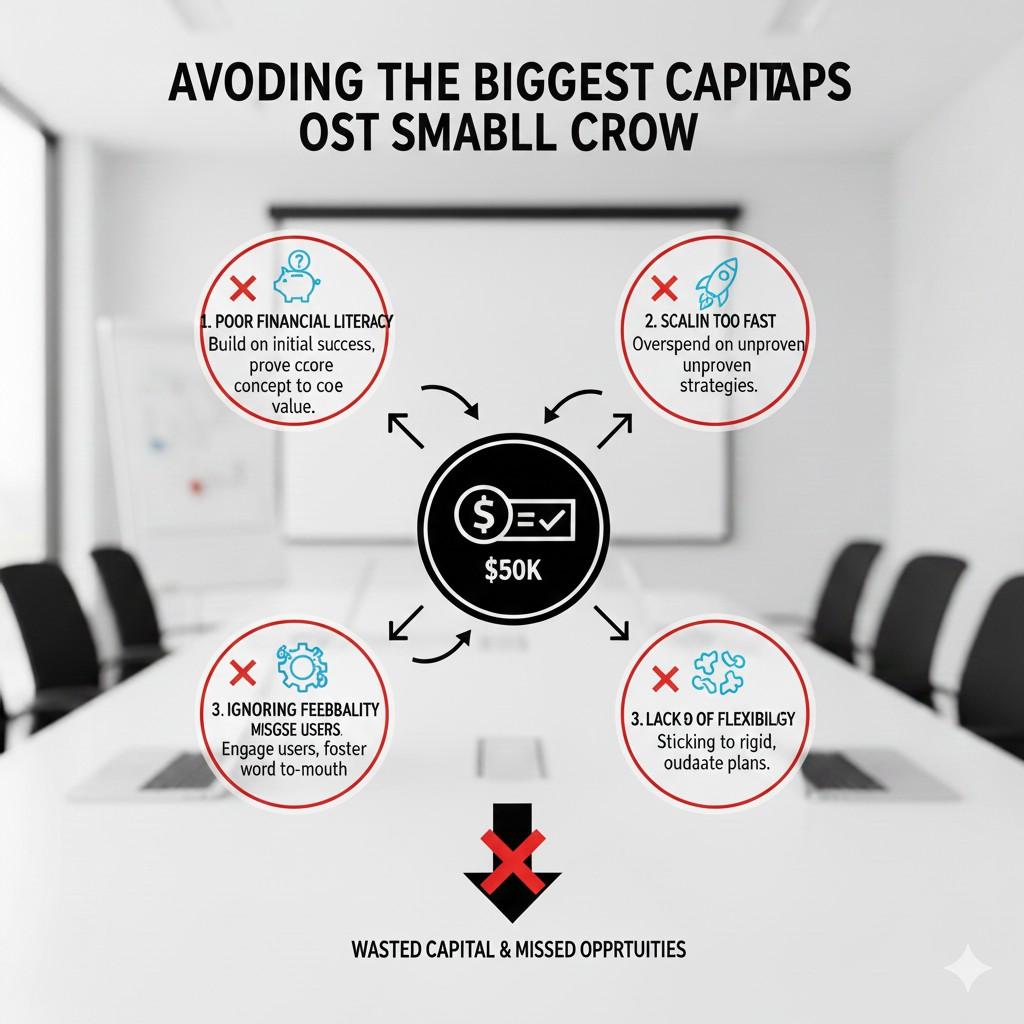
It is easy to chase brand too early. You see other startups on stage, in press, on social feeds. You feel like you need that same spotlight now. So you spend on events, design, and ads. You post often, but nothing real sits behind the image. The burn goes up, but your moat and your product do not get stronger. This is the burn-for-brand trap. You trade real progress for a short spike in hype. Soon you need a bigger round just to keep up the show. The better way is quiet strength. Spend your early time and money on things that last. Spend on your IP, your core tech, and your first real users. Brand will come later, and it will be built on truth, not smoke.
Tran.vc backs this quiet strength.
We help you build what matters first, even if the outside world has not noticed you yet.
The Hire-Too-Fast Trap
Many founders think “real” startups must grow the headcount fast. They feel proud when they say, “We are already twenty people.” But each extra person brings cost and also friction.More meetings, more tools, more chances for confusion. If your base is not stable, the weight of a big team can crush you. The hire-too-fast trap shows up when you add people before you have clear systems. You bring in sales before you know what you are selling. You bring in managers before you have simple ways to track work.
Capital-efficient founders wait. They first make the core work simple and repeatable. They use automation, clear docs, and a tight roadmap. Then, when they hire, new people plug into a machine that already runs. Each hire adds speed, not chaos. Your burn rises, but so does your output per dollar.
The “We’ll Protect It Later” Trap
This is the most dangerous trap for deep tech, AI, and robotics teams. You are heads-down building.
You think, “We will get to patents when we have more time or more money.” Then you share your idea widely. You post, pitch, and demo without limits. By the time you go to an attorney, much of your best work is already public.You may still file, but your options are weaker. Some claims are no longer possible.You end up with a shallow shield instead of a deep moat.The cure is simple but requires discipline.You bring IP thinking into the first months of your build. You talk to people who know how to spot what is worth filing and what is not.
This is exactly what Tran.vc offers through in-kind support. We help you avoid the “later” trap by doing the right IP work now, while your ideas are still fresh and private. If you want to lock in that advantage, you can apply at: https://www.tran.vc/apply-now-form/
Putting Your Capital-Efficient Playbook Into Action
Start With a Simple, Written Plan
Capital efficiency does not happen by accident. It starts with a simple plan you can read in one page. You do not need fancy slides. You just need to write down a few key things. What you are building now, what you want to prove in the next year, and what assets you want in place by then.
You might list a working core system, one or two patent filings, a first pilot, and a small but strong user base. Then you map your weeks to these goals. Every task should serve at least one of them. When you see it written, you can make better trade-offs. You can cut work that does not help. You can tell at a glance if you are moving or just spinning.
At Tran.vc, we often help founders shape this one-page plan. We make sure IP sits inside it, not outside as an afterthought. This gives your company a clear track to run on.
Treat Every Week as a Chance to Add One Asset
Think in small, steady steps. Ask, “What asset did we add this week?”
Some weeks, the asset is code. You ship a feature that makes the product more useful. Other weeks, it is learning from a pilot or a new draft of a patent claim. By thinking this way, you turn time into a stack of permanent gains. Even slow weeks still move you forward. You stop judging your progress only by short-term revenue or hype.
This also helps with morale. Technical work can feel heavy because big wins take time. But when you can point to a new asset each week, the team feels the climb.Tran.vc pushes this mindset with all our founders. We ask often, “What new asset did we create together this month?” Over a year, those small wins add up to a very strong base.
Make IP a Natural Part of Product Work
Many teams treat IP as a separate world. Product goes one way, legal goes another.
This split wastes time and weakens both sides. The better path is to weave IP into product talks.When you design a new method or system, you ask, “Is this special enough to protect?” You build light habits. Engineers note down key ideas as they test. You keep a simple log of “things that might matter.” You share this list with your IP partner often. This way, you do not need big, scary “IP days.” Protection grows as the product grows. Your patents end up closer to the true heart of your system.
This is exactly how Tran.vc works with founders. We join your roadmap talks, not just your filings. We help you see hidden value in your own work and capture it while it is still fresh.
How Tran.vc Fits Into Your Capital-Efficient Journey
Why In-Kind IP Support Is a Different Kind of Seed
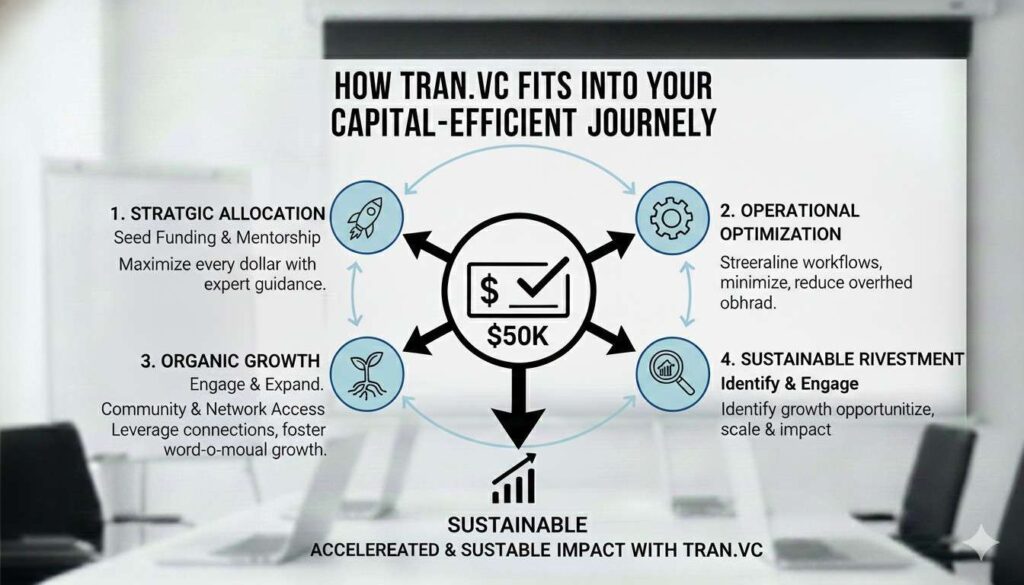
Most seed money comes as cash.You then must decide how much of that cash to spend on IP, on product, on hiring, and on sales. In-kind IP support flips this a bit. You get up to $50,000 worth of patent and IP services from people who know both law and startups.You do not have to carve this out of a tiny budget.
This lets you use your limited cash on build and learning. At the same time, your IP base grows with expert care.
You get the effect of a much larger seed round, but without giving up more equity just to pay legal bills.
For deep tech, AI, and robotics startups, this is a big deal. Your company is your inventions. Getting those right and safe early can change every future round you raise.
You can start that work with us by applying here: https://www.tran.vc/apply-now-form/
Working With People Who Have Been in the Trenches
Theory is cheap. You do not need more blog posts telling you to “move fast” or “iterate.” What you need are partners who understand what it is like to build hard tech with limited time and money. People who know how it feels to juggle code, labs, pilots, and patent drafts all at once.
Tran.vc was started by operators and engineers who have lived that mix. We have built and sold companies. We have filed patents ourselves. We have worked with serious firms and know what matters and what is fluff. This matters for you because advice then comes from real scars, not from slides. We know where founders tend to waste money. We know where they should spend a bit more. We bring that view into every call and every filing.
Building a Company That Grows on Your Terms
At the end of the day, capital efficiency is about freedom. It is about the freedom to choose your own pace, your own path, and your own partners.
You still raise money, but you do it from a place of strength. You still grow fast, but you do not grow blind. You still dream big, but you base that dream on solid assets. A company built this way is much harder to shake. It can handle market shifts, new rivals, and hard years. It has a strong core: real IP, real users, real value.
That is the kind of company Tran.vc wants to back. We are not here to push you into a round you are not ready for. We are here to help you build the kind of foundation that makes every future round easier and smarter.
Conclusion: Your Next Step Toward Capital-Efficient Building
Bringing It All Together
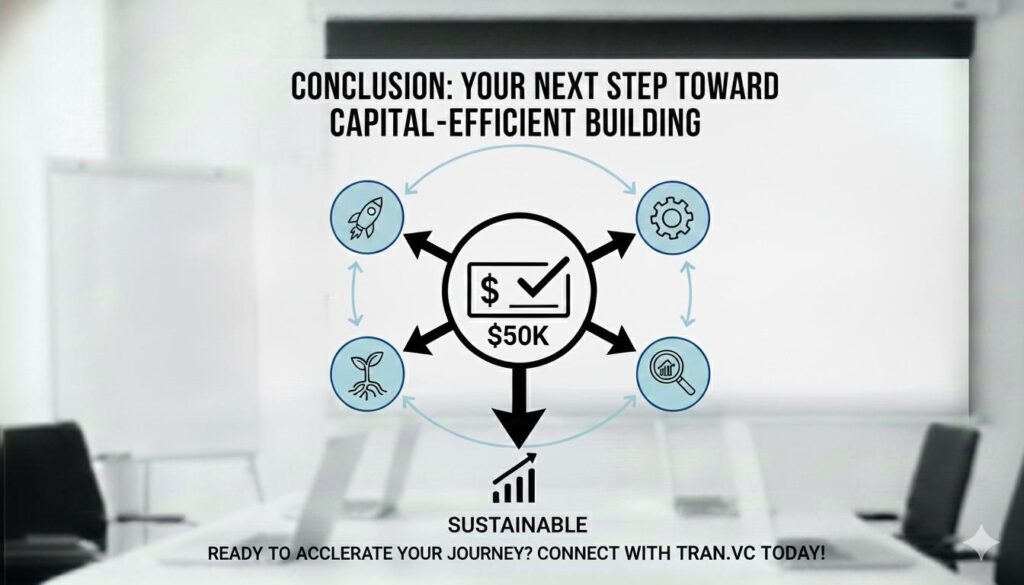
We have covered a lot. We talked about why capital efficiency is really about control.We looked at how to build moats before markets, how to grow without chasing hype, and how to turn your work into a fundable story.
The thread through all of this is simple. Use your time and money to build assets, not just activity.
Protect what makes you special.Move with focus, not panic.If you are a technical founder in AI, robotics, or deep tech, this is not just “nice to have.” It is the difference between being a short-lived project and a lasting company. Your ideas deserve that chance to last.
A Simple, Clear Call to Action
If this vision matches how you want to build, you do not have to do it alone. Tran.vc is here to be your partner in this kind of careful, strong, capital-efficient journey.
We invest up to $50,000 in kind toward your patent and IP work. We help you shape your moat while you are still early.We stand beside you as you turn raw code, models, and hardware into a real, fundable company.Your next step can be very small. Share your story with us, even if it is still messy. Let us see where your ideas can turn into real assets.
You can apply any time at: https://www.tran.vc/apply-now-form/