
Most founders think fundraising is the job. It is not. The job is building something real, protecting what makes it hard to copy, and earning the right kind of money—money that helps you win, not money that pulls you off track.
Lean fundraising is a simple idea: you raise less, later, and with more control. You spend less time pitching and more time building. You pick partners who bring real help, not pressure. You treat every investor “yes” as a trade, because it is. You trade a piece of your company for speed, safety, and support. If that trade is not clean, you should not take it.
This matters even more in AI, robotics, and deep tech. These teams can get trapped early. A shiny demo gets attention, but the hard work comes next: data, edge cases, safety, reliability, manufacturing, integration, hiring, and long sales cycles. If you raise too early from the wrong people, you can end up chasing growth numbers that do not match the truth of your market. You burn out your team. You burn cash. You lose leverage. And you still have to solve the real problems.
“Smart capital” is different. Smart capital is patient. It understands technical risk. It respects focus. It wants a strong plan, but it does not demand theater. It does not force you to sell a story you cannot prove yet. It helps you build value that lasts.
But here is the part most people miss: smart capital is not attracted by a perfect pitch deck. It is attracted by clear progress, clean structure, and strong assets.
One of the strongest assets a technical startup can build early is intellectual property. Not because a patent is a magic shield. It is not. But because good IP makes your company easier to trust. It shows you know what is truly new in your work. It helps you draw sharp lines around your advantage. It gives investors a reason to believe you can hold your ground when bigger teams show up. It also helps you negotiate from a stronger place, because you are not just “a team with code.” You are building protected value.
This is where Tran.vc comes in. Tran.vc helps AI, robotics, and other technical founders build that protected value early—without pushing them to raise a big round too soon. Tran.vc invests up to $50,000 as in-kind patent and IP services, working hands-on with founders to shape a smart IP plan and execute it with experienced patent attorneys and operators. That way, when you do choose to raise, you are not begging. You are choosing.
If you want to build leverage before you pitch, you can apply anytime here: https://www.tran.vc/apply-now-form/
In this article, we will talk about how lean fundraising really works in the real world. Not the social media version. We will cover how to decide if you should raise at all, what “traction” means when you are building hard tech, how to shape your company so the right investors lean in, and how to avoid money that looks helpful but costs you later.
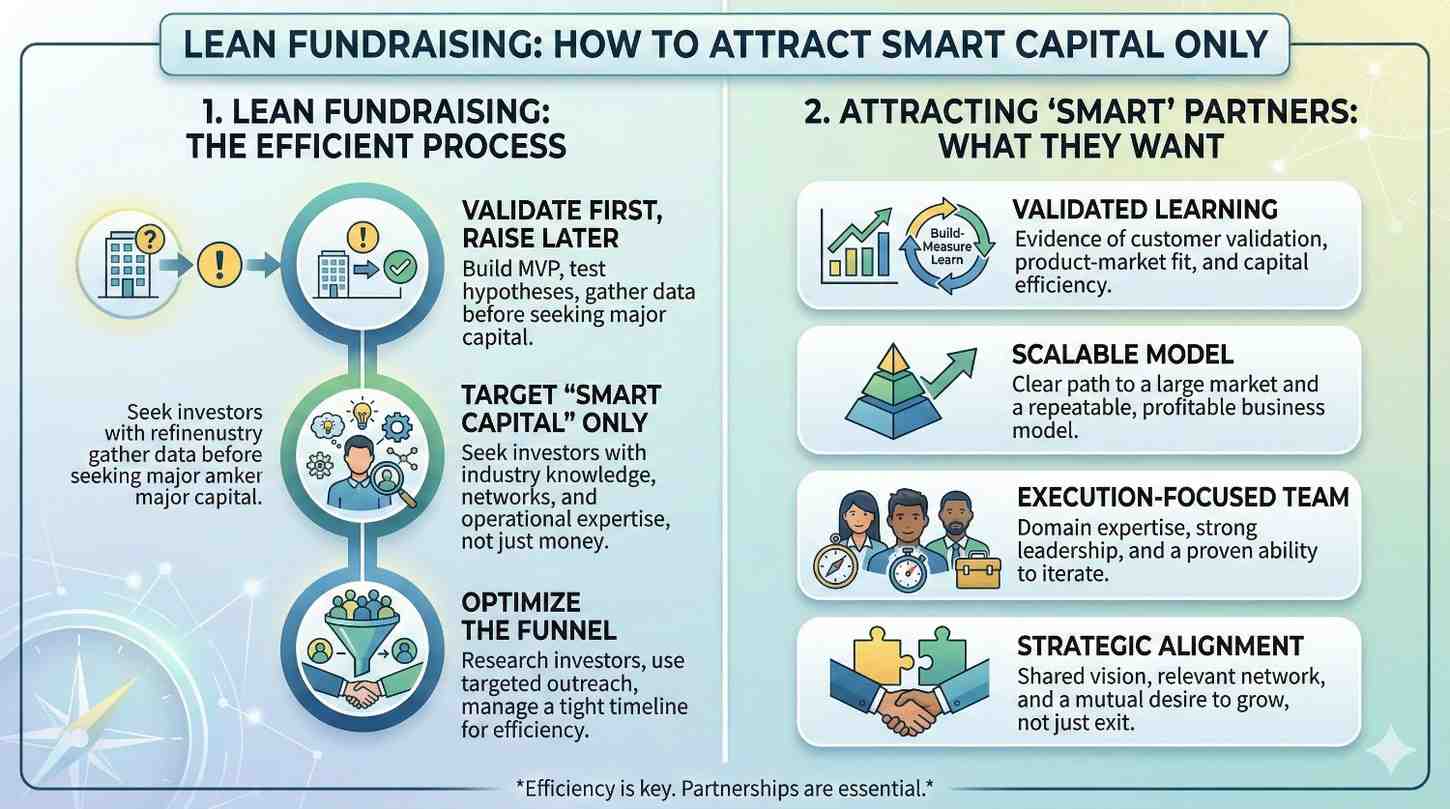
Lean Fundraising: How to Attract Smart Capital Only
What lean fundraising really means
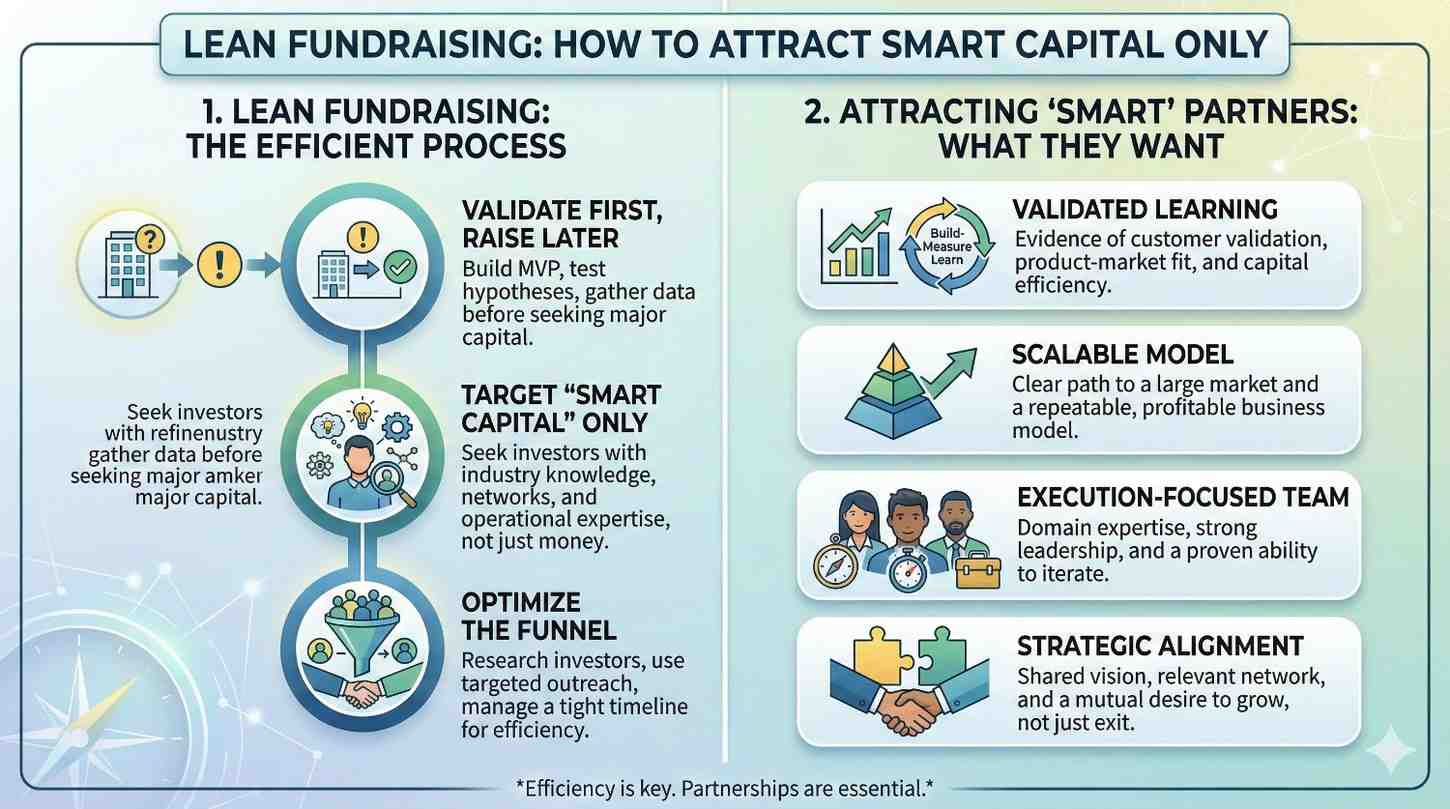
Lean fundraising means you raise money with care, not with fear. You do not chase a round because other founders are doing it. You do not raise just to “buy time.” You raise when the money will clearly turn into progress that makes your company worth much more later.
In practice, lean fundraising is about keeping your options open. It is about staying focused on the work that creates value, and cutting everything else. It is also about protecting your ownership early, because control is easiest to lose at the start.
Lean fundraising is not “anti-investor.” It is “pro-founder.” It assumes your company is not a lottery ticket. It is a long build, and you need partners who respect the pace of real engineering and real customers.
Why “smart capital” is not the same as “available capital”
Available capital is money you can get today if you say the right things. Smart capital is money that fits your business, your timing, and your constraints. It comes with clear thinking, honest feedback, and the kind of support that saves you months of mistakes.
Smart capital also tends to be calmer. These investors do not rush you into a story you cannot support. They do not push you to hire too fast or sell to the wrong market just to show fast revenue.
When founders say, “We raised from a top fund, but it still feels hard,” it is often because the fit was wrong. The investor may be great at fast-moving software plays, but your robotics product needs testing cycles, supply chain planning, and slow trust-building with buyers.
Why lean fundraising matters more in AI, robotics, and deep tech
Deep tech is not built in straight lines. You get breakthroughs, then you hit walls. You improve performance, then a real-world edge case breaks everything. You sign a pilot, then procurement delays the full contract for months.
If you raise too much, too early, your burn rate rises to match the round. That means you must keep raising, even if your product is not ready. It becomes hard to pause and fix the core issues, because the company is now built around spending.
Lean fundraising protects you from that trap. It helps you grow at a pace that matches the truth of your technology and your market, not the pace of a funding calendar.
A quick note on Tran.vc and why this approach fits lean fundraising
Tran.vc supports technical founders by investing up to $50,000 as in-kind patent and IP services. That means you get real help from patent attorneys and operators without taking on the pressure that often comes with early cash rounds.
This is powerful in lean fundraising because it helps you build assets that investors can respect. It also helps you speak clearly about what you have that others cannot copy, which matters a lot when the product is still early.
If you want to build leverage before you raise, you can apply anytime here: https://www.tran.vc/apply-now-form/
The first rule: do not raise until the money has a clear job
The “job” test that removes most bad rounds
Before you speak to investors, decide what the money must do. Not the vague answer like “grow the team” or “go to market.” The real answer should sound like a plan you can track week by week.
For example, the money might be for completing a safety standard, finishing a key integration, or reaching a specific reliability target in the field. It might be for turning a pilot into a repeatable rollout. It might be for locking down a supply chain path that makes your unit economics workable.
When the job is clear, fundraising becomes simpler. You can explain exactly why the round exists and what success looks like. Smart investors like this because it signals discipline and respect for their money.
What happens when the job is not clear
When the job is fuzzy, founders often raise to reduce stress. It feels good at first, but then the new money creates new pressure. You hire people without a tight plan. You build features that do not matter. You do marketing before the product holds up.
That kind of spending does not create real leverage. It creates noise. The next round gets harder because you have more costs, but you do not have stronger proof.
Lean fundraising is not about suffering. It is about avoiding chaos. It is about spending only on steps that reduce risk in a way investors and customers can see.
The simplest way to define your job in one paragraph
Write one paragraph that starts with: “This round exists to…” Then list three outcomes you will deliver. Each outcome should be measurable. Each outcome should tie to a business reason, not just a technical milestone.
If you cannot write that paragraph, you are not ready to raise. That is not a failure. It is a gift. It means you should keep building and keep your focus tight.
Build leverage first: the quiet work that attracts the right investors
The real reason most pitches fail
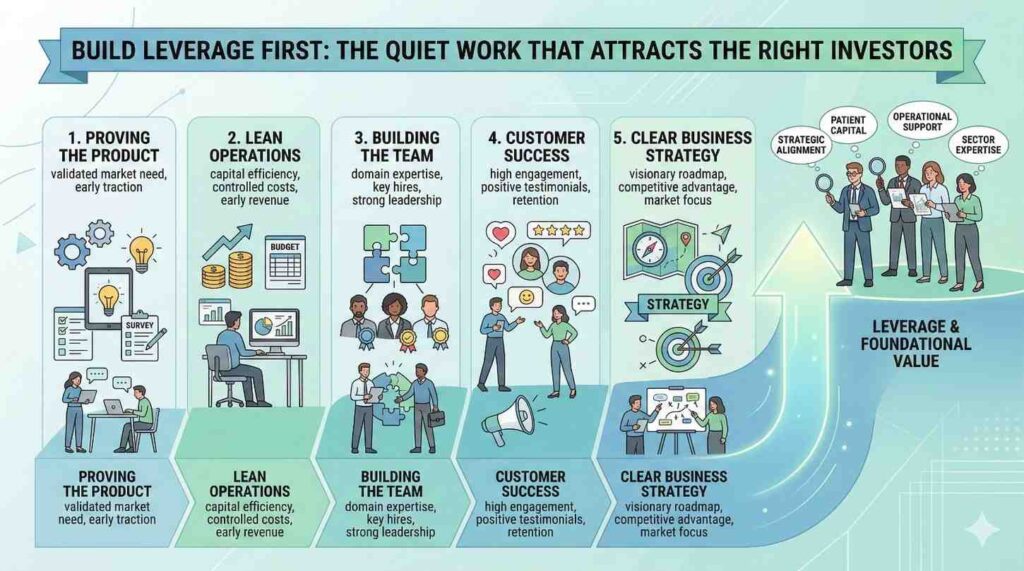
Most pitches fail because the founder is asking for belief without showing proof. Investors hear the story, but they cannot see the path. The details are missing, or the plan depends on too many “we will figure it out” steps.
Smart capital does not want hype. It wants clarity. It wants to understand what you know, what you do not know, and how you will learn fast without blowing up the company.
When you build leverage first, you do not need to “sell” as much. The work speaks. The investor can feel the weight of progress.
Leverage is built from assets, not opinions
An opinion is “we think this market is huge.” An asset is a signed pilot, a strong technical result, or a system that keeps working in the field. An asset can also be a clear IP position that shows you are not just copying what everyone else can do.
Investors may smile at opinions, but they fund assets. They fund the things that reduce risk. Lean fundraising is a process of building assets before you ask for money.
Why IP helps you raise smarter, not just raise faster
For deep tech, IP can make your story clean. It helps you name what is new in your invention. It helps you show that you understand your own edge, not just your demo.
It also helps when investors ask the questions they always ask: “What stops a bigger team from doing this?” and “What happens when a well-funded competitor enters?” If you can answer those questions with a strong IP plan and smart filings, the conversation changes.
Tran.vc is built around this idea. Instead of pushing founders to chase a big round early, Tran.vc helps them create IP-backed leverage first. If that fits what you want, apply here: https://www.tran.vc/apply-now-form/
What “traction” looks like when your product is hard to build
Traction is proof that risk is going down
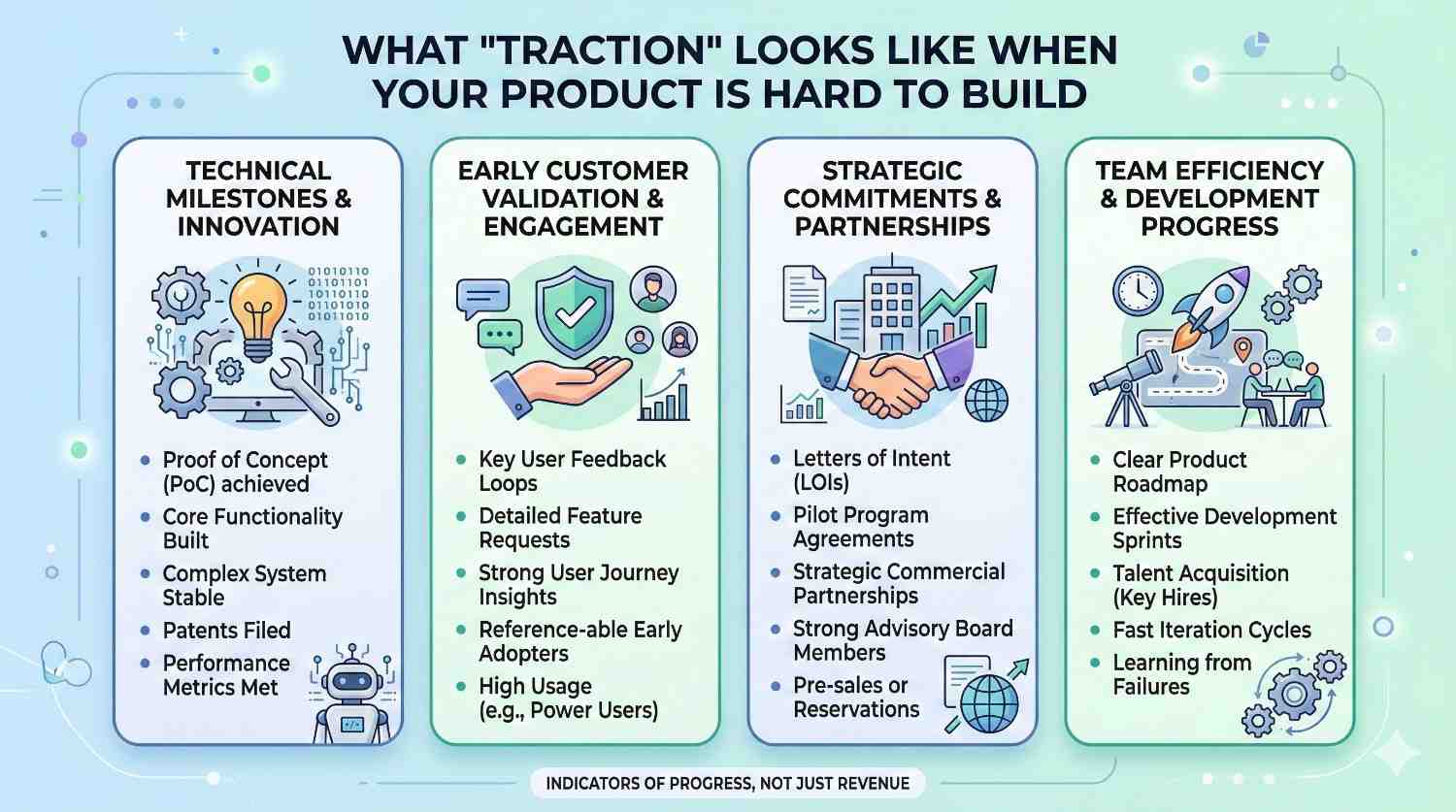
In many deep tech startups, early traction is not revenue. It is evidence. It is proof that you can build the thing, deliver it, and make it work in the real world.
Traction can be a stable technical result that holds across conditions. It can be a repeatable test process. It can be an integration with a partner system. It can be a customer who keeps showing up and pulling the product forward.
The key idea is simple: traction is not applause. It is reduced risk.
Technical traction that investors actually respect
If you are building AI, traction might be model performance on real data, not a curated dataset. It might be latency and cost at scale, not a notebook result. It might be safety and reliability, not a best-case demo.
If you are building robotics, traction might be uptime, failure recovery, and operation in messy environments. It might be deployment time. It might be proof that a non-expert can use the system without calling your team every day.
This kind of traction is boring in a pitch deck, but it is powerful in diligence. Smart investors lean in when they see it because they know how rare it is.
Market traction that fits long sales cycles
Many robotics and enterprise AI sales cycles are slow. That does not mean you have no traction. It means you must show forward motion in different ways.
A signed pilot with clear success terms matters. A letter of intent from a serious buyer can matter, if it is tied to a real budget path. A partner who is willing to integrate and co-sell can matter, if they will commit resources.
The investor’s real question is: “Is this moving forward in a way that becomes repeatable?” Your job is to show that progress without pretending the cycle is shorter than it is.
The story that attracts smart capital without overselling
The three parts of a lean fundraising story
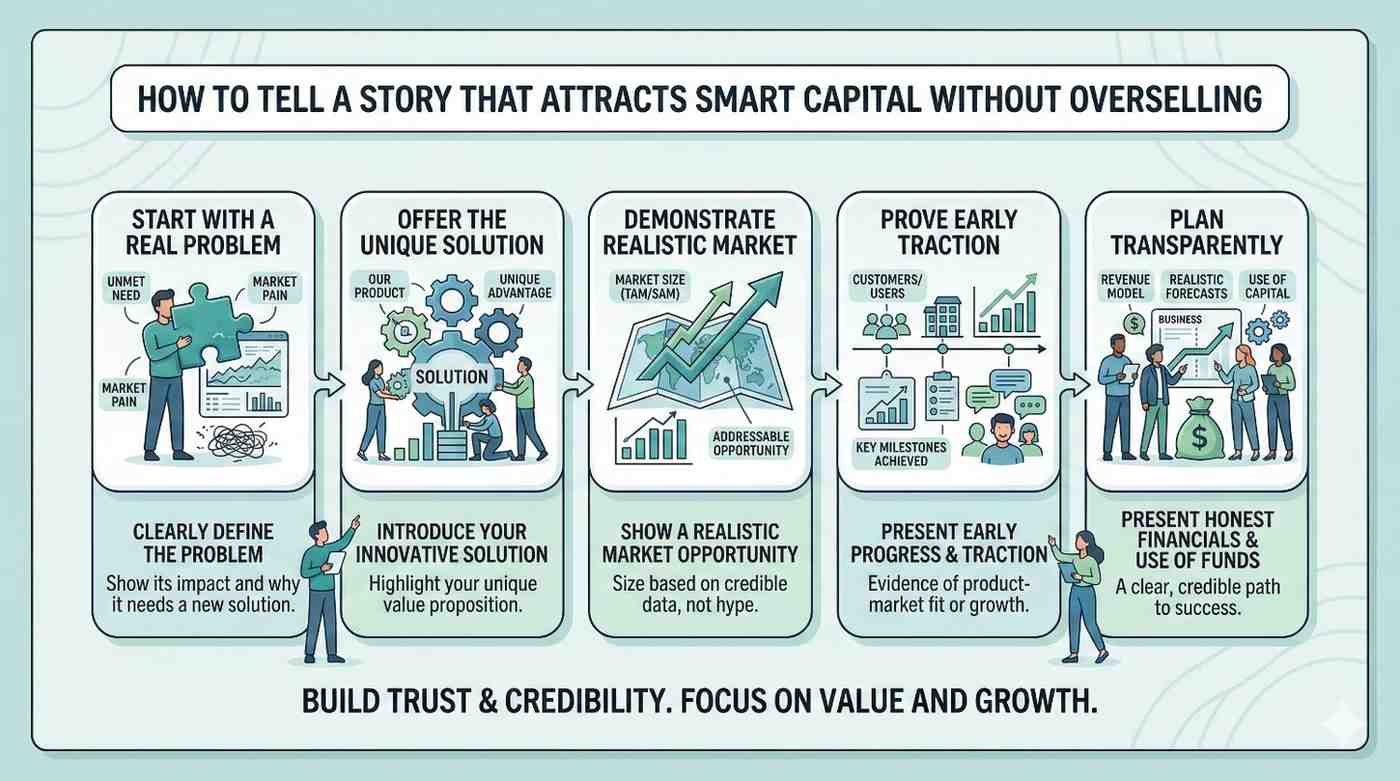
A lean fundraising story has three parts: the problem, the proof, and the plan. The problem must be real and painful. The proof must show you are already solving it. The plan must show how money turns into more proof.
This is different from the “big vision” pitch. Big vision is fine, but it cannot be the whole meal. Smart investors want a grounded story that is tied to what you can deliver next.
When your story is built this way, you do not need dramatic claims. You need clean facts and a clear direction.
How to talk about competition without sounding scared
Competition is normal. In AI and robotics, it is almost guaranteed. Smart investors do not punish you for having competitors. They punish you for not understanding them.
The goal is to show that you know the landscape and you have a plan to win. That plan might be a better technical approach, better data access, better integration, or better unit economics. It might also be a defensible IP position that matches your core invention.
If you hand-wave competition, you look inexperienced. If you obsess over it, you look weak. The calm middle is best: clear, factual, and confident.
How to explain your moat in plain words
A moat is just the reason you keep winning after the first deal. In plain words, it is what makes you hard to copy and hard to replace.
If your moat is IP, say what is protected and why it matters. If your moat is data, explain how you get it and why others cannot. If your moat is workflow, explain why switching away from you would hurt the buyer.
A moat is not a claim. It is a chain of reasons. You want that chain to be easy to follow.
Lean outreach: how to get meetings without living in your inbox
Why warm paths beat cold messages
Smart investors get cold emails all day. Most are ignored. Warm paths are not about privilege. They are about trust.
A warm intro from someone the investor respects is a signal. It says, “This founder is worth attention.” Your job is to earn that signal by building real progress and building real relationships.
If you do not have warm paths today, you can build them. You do it by showing up in the right places, sharing useful updates, and helping others without asking for anything right away.
The one-page update that gets replies
When you reach out, keep it simple. Share what you are building, what changed in the last 60 days, and what is coming next. Make the progress easy to see. The point is not to impress. The point is to be clear.
Investors respond to momentum they can understand quickly. They also respond to founders who do not waste time.
If you want, I can write a lean outreach message template later in the article that fits AI and robotics, without sounding salesy.
When to start outreach if you are not raising yet
You can talk to investors before you raise. In fact, you should. But the goal is different. The goal is to learn what they care about, and to build trust over time.
This also helps you find smart capital. The best partners are often the ones who watched you execute over several months. When they finally invest, it feels obvious.
If you want to build this kind of long trust, Tran.vc can help you strengthen the “assets” side of your story early through IP strategy and filings. Apply anytime here: https://www.tran.vc/apply-now-form/
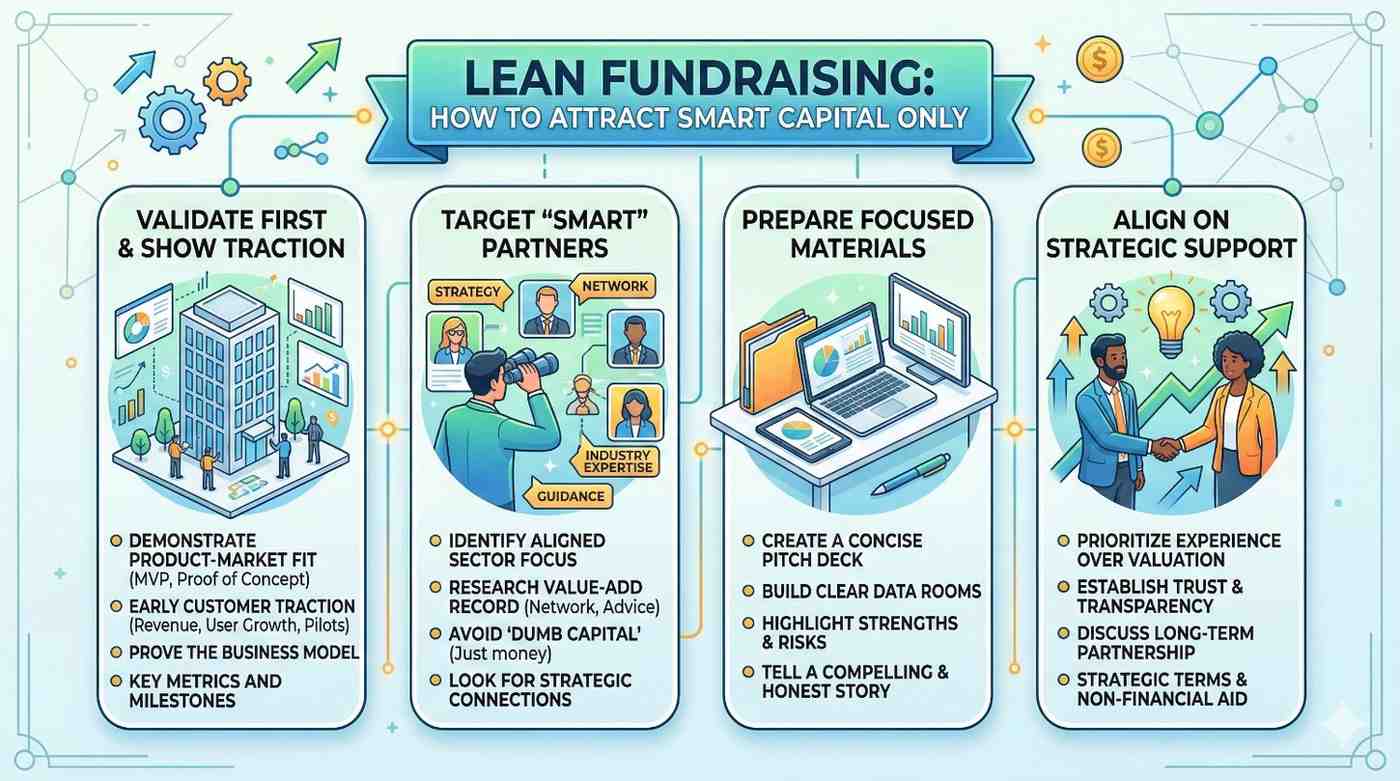
Lean Fundraising: How to Attract Smart Capital Only
How to structure your round so you keep control
A lean round is not just a smaller number. It is a cleaner deal. The goal is to raise enough to hit the next proof points, while keeping the cap table simple and your decision power intact.
Control is not only about voting rights. It is also about pace. If you bring in investors who expect fast growth at any cost, you can lose control of the calendar. Suddenly, the team is building for the next pitch, not for the customer. A lean round protects your ability to say, “We will do this the right way,” even if it takes a bit longer.
A simple rule helps here. If you cannot explain your round in two minutes to a smart friend, it is probably too complex. Smart capital likes clean structure because clean structure lowers future friction.
Why valuation is not the main goal in lean fundraising
Many founders treat valuation like a scoreboard. But a high valuation can be expensive. It can force you into bigger promises than the company can safely deliver. It can make the next round harder, because the bar rises even if your market moves slowly.
In lean fundraising, the main goal is not “highest price.” The main goal is “best partner and best path.” A fair valuation with the right investor can beat a flashy valuation with the wrong one. This is especially true in robotics and deep tech, where timelines can shift and early assumptions often need correction.
If you focus on partner fit and realistic milestones, the valuation often takes care of itself. You win by building real value, not by winning one negotiation.
The dilution math most founders avoid until it is too late
Dilution is not evil. It is a tool. But when you raise too much, too early, dilution stacks fast. It can also create a messy ownership structure that scares off later investors.
The hidden problem is not only the percentage you give up. It is what happens to your leverage. If you sell too much before you have strong assets, you may still need to raise again, but now you own less and you have fewer options.
Lean fundraising aims to delay the “big dilution” until the company has proven something hard. That way, when you do give up equity, you get a better trade because the business is stronger.
Choosing investors who make you better, not louder
The difference between brand money and builder money
Brand money can open doors. It can also create pressure. Some brand investors are excellent builders. Others mostly provide status and a network, and they expect you to run fast.
Builder money is quieter. These investors ask sharper questions. They care about your system, your process, and your ability to learn. They help you avoid mistakes. They often understand that deep tech progress can look slow from the outside, even when the team is moving fast on the inside.
Lean fundraising favors builder money because it aligns with the way real engineering works. You want investors who respect the work, not just the headline.
Questions that reveal whether an investor is smart capital
You can learn a lot by listening to what an investor asks in the first conversation. Smart capital tends to ask about risk in a calm, specific way. They want to know what must be true for this to work, and how you will prove it.
They also care about focus. They will ask what you are not doing. They will ask how you decide priorities. They will ask how you measure progress when revenue is not yet the main metric.
If the questions are only about speed, hype, and “going viral,” that is a warning sign. It does not always mean “bad investor,” but it may mean “bad fit for your stage.”
The red flags that cost founders years
Some red flags are subtle. A big one is when an investor pushes you to raise more than you need. It sounds helpful, but it often comes from their own model, not from what your company needs.
Another red flag is when an investor wants control early, or tries to shape your team and product before they understand your constraints. In deep tech, early control moves can break a company’s ability to explore and iterate.
A final red flag is the investor who keeps you in “maybe land” for too long. They ask for endless updates, but they do not commit. That kind of attention can drain your time and distract you from building.
Smart capital is clear. Even when the answer is no, it is a clean no.
The lean pitch: how to explain hard tech in simple words
Why simple words build more trust than fancy words
In AI and robotics, it is easy to hide behind complex terms. But smart investors do not trust complexity. They trust clarity.
If you can explain your system in plain words, it signals that you truly understand it. It also helps the investor retell your story to partners in their firm. That retelling matters, because most investments are decided in group meetings, not in the first call with you.
Your goal is not to sound smart. Your goal is to be understood.
How to present your tech without turning the pitch into a lecture
A lean pitch is not a class. It is a decision tool. You want to show the key idea, why it works, and why it is hard for others to copy.
Instead of giving every detail, pick one or two “proof points” that show your approach is real. Then connect that proof to customer value. For example, you might show that your model reduces false alarms in a high-cost setting, or that your robot can operate longer without human help.
When you link tech proof to business value, the pitch becomes easy to follow. You also avoid the common trap of presenting raw features without explaining why they matter.
How to talk about IP in a way investors respect
Many founders either ignore IP or talk about it in a vague way. Smart investors tend to prefer the middle path: a clear plan that matches what you are building.
The strongest way to talk about IP is to explain what is truly novel, what parts are easy for others to copy, and what parts you are actively protecting. You do not need to share sensitive details. You need to show that you have thought it through.
When IP is handled well, it becomes part of your risk story. It tells the investor that you are building a company with real assets, not only a demo.
Tran.vc is designed for founders who want to do this early and correctly. If you want help turning your technical work into defensible IP, apply here: https://www.tran.vc/apply-now-form/
Building proof points that make fundraising easier
The proof point mindset: reduce one big risk at a time
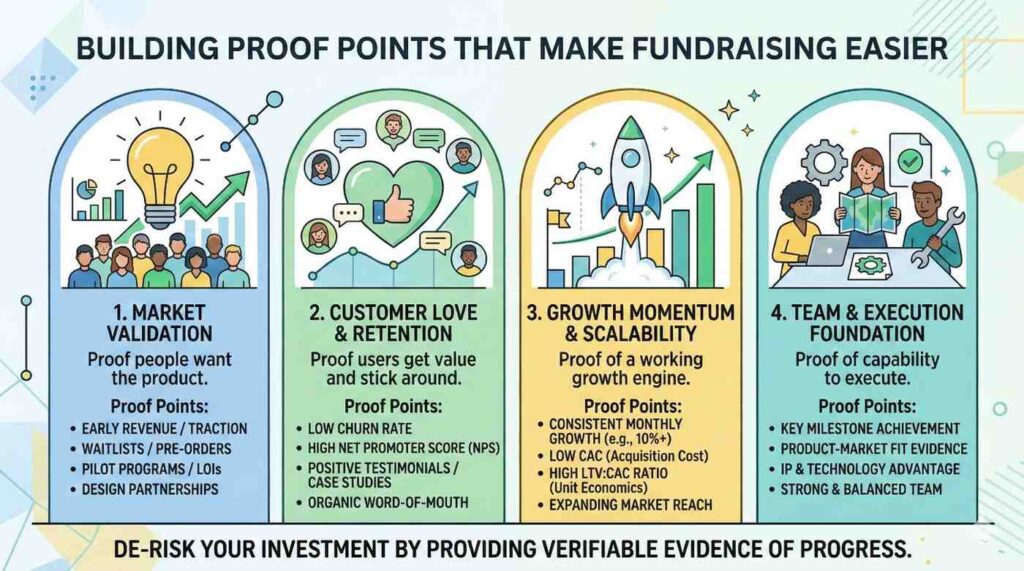
Founders often try to solve everything at once. That leads to scattered progress and weak proof. Lean fundraising works better when you focus on reducing the biggest risk first.
In deep tech, the biggest risk might be technical feasibility, or it might be deployment, or it might be the buyer’s willingness to pay. You choose the risk that blocks everything else, then you build a clear test that reduces it.
This mindset makes your company easier to fund because investors can see the path. They can say, “If they hit this, the next step makes sense.”
Proof points for AI that go beyond accuracy charts
Accuracy alone is rarely enough. Smart investors want to know what happens in real operations. They want to see robustness, cost, latency, and how the system behaves when data shifts.
A strong proof point might be a live test with a real customer workflow. It might be a reduction in manual work. It might be stable performance across locations, devices, or lighting conditions. It might be a clear plan for monitoring and retraining that does not require a large research team.
When you show these proof points, you are showing that the company can scale, not just that the model can score well.
Proof points for robotics that show readiness for the field
Robotics buyers care about reliability and safety. They care about downtime. They care about who fixes the system when something breaks.
So strong proof points often relate to uptime, error recovery, ease of setup, and training time for operators. They also relate to how the robot handles the messy parts of reality: dust, glare, uneven floors, unexpected objects, and human behavior.
If you can show that your system keeps working in real conditions, your fundraising becomes much easier. You are no longer selling a dream. You are selling a track record.