
Every AI and machine learning startup has a moment where the team realizes something important: the model is not the moat.
Your edge is usually a mix of things—how you collect data, how you clean it, how you train, how you ship, how you loop feedback back into the system, and how you make the results useful in the real world. That is where the real value lives. And that is also where strong IP can be built, early, with intention.
If you wait until you “raise later,” you often miss the best window. Early is when your work is most original, your choices are most unique, and your story is easiest to defend. Investors also notice when you treat IP like a product asset, not a legal chore.
That is the core idea behind Tran.vc. Tran.vc invests up to $50,000 in in-kind patent and IP services for AI, robotics, and other technical startups, so you can protect what matters before you are forced to trade control for cash. If you want help turning your technical work into real defensible assets, you can apply anytime here: https://www.tran.vc/apply-now-form/
What an IP strategy means for an AI startup

An IP strategy is simply your plan to protect the parts of your work that make you hard to copy. It is not “filing patents for the sake of it.” It is a clear map that says what you will protect, why it matters, and when you will do it. The goal is to turn your technical choices into business leverage.
For AI and machine learning teams, this matters because many people can train models now. Tools are easy to access. Talent moves around. If your edge is not protected, a larger team can copy your approach faster than you think. A good IP plan helps you stay in control of your story.
Your strategy should connect to your product roadmap. It should follow your real build steps, not a made-up list of “innovations.” The best plans are built around what you ship, what you measure, and what your users cannot live without once they try it.
If you want expert help building that plan from day one, Tran.vc invests up to $50,000 in in-kind patent and IP services for AI, robotics, and deep tech startups. You can apply anytime at https://www.tran.vc/apply-now-form/
The simple promise of IP strategy
IP is not just about stopping others. It is also about helping others believe you. When you can point to clear protected claims, it becomes easier to show that you built something real, not a thin demo. That changes how investors, partners, and buyers treat you.
A strong IP plan also keeps your team focused. It forces you to write down what is special about your system, and why you built it that way. That clarity helps in product decisions, hiring, and even sales calls.
Why AI startups need a different approach than other software
Many software patents fail because they are too broad, too vague, or too close to “do it on a computer.” AI makes this harder if you are not careful. If you say, “We use a neural network to predict X,” that is not enough. It sounds like everyone else.
AI IP works best when it ties the model to a specific system design. The strength usually comes from how the model is trained, how it is used, how it adapts, how it is made safe, or how it handles messy real data. That is where your “how” lives, and that is what can be protected.
What investors want to see when they ask about IP
Most investors are not asking because they love legal work. They ask because they want to know if you can keep your edge long enough to win. They want to see that you understand risk, and that you are not building on sand.
When your IP work is done well, your answers become calm and clear. You can explain what is protected, what is still pending, and what you plan to file next. You can also explain what you will keep as a trade secret, and why that choice is smart.
What to protect first in an AI and ML product
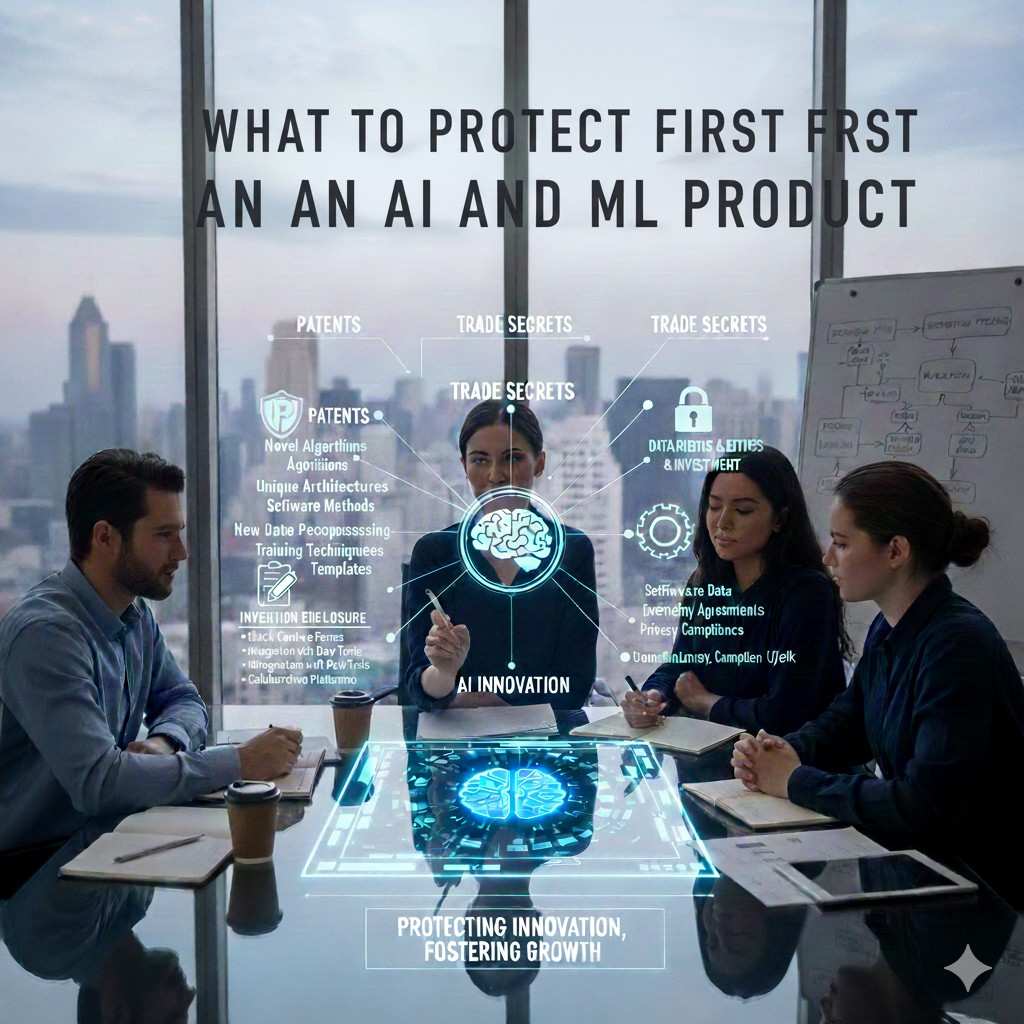
Most founders try to protect the model first. That is normal, but it often misses the point. The model is only one piece. In many cases, the model can be replaced, copied, or rebuilt. The durable value is usually the system around it.
A better first step is to identify the “hard parts” you solved that others will struggle to solve again. These are the parts that took you weeks or months of real work. These are also the parts that, if removed, would make your product feel ordinary.
Think about what makes your output better, faster, cheaper, safer, or more useful. Then trace that advantage back to the design choices that created it. That is usually where the best patent material is hiding.
If you want a team to help you spot these protectable edges quickly, Tran.vc’s in-kind IP support is built for this exact early stage moment. Apply anytime at https://www.tran.vc/apply-now-form/
The data pipeline that makes your model good
For many ML products, the real magic is not training. It is the data work. How you collect signals, how you label, how you clean, how you handle noise, and how you keep the pipeline stable over time often matters more than model type.
If your pipeline includes a unique method of labeling, quality scoring, weak supervision, synthetic data creation, or safe data merging, that can be highly valuable. These methods are often specific, technical, and defensible.
When you write this down for IP purposes, do not describe it as “pre-processing.” That word is too soft. Explain what inputs you take, what steps you apply, what you output, and why it improves results. The detail is the strength.
Training methods that are not just “we fine-tuned a model”
Fine-tuning is not a moat by itself. But your fine-tuning approach can be. If you built a way to train with fewer labels, to reduce drift, to avoid bias, or to keep performance stable across changing environments, that is meaningful.
Many strong filings in AI are not about a new architecture. They are about a training loop. They describe how the system chooses data, trains, tests, and updates. They explain how the loop reacts to failure cases, edge cases, and user feedback.
If you have a training approach that saves cost or improves safety, do not treat it like a private hack. Treat it like a core asset. Your competitors will try to build it once they see your results.
Inference systems and real-time use in the wild
A lot of ML startups win because they can run the model in a way others cannot. Maybe you reduce latency. Maybe you run on edge devices. Maybe you handle unreliable networks. Maybe your system picks the right model per case, or switches modes based on risk.
These deployment choices can be protectable when they are specific. If you built a smart way to route requests, cache outputs, compress models, or detect when results are unsafe, that can form the backbone of an IP plan.
This is especially true in robotics and physical systems, where AI meets sensors, motion, and real constraints. The “how it runs” often matters more than “what it predicts.”
Human-in-the-loop workflows that make quality repeatable
In many B2B AI products, human review is not a weakness. It is a design choice. The best teams build review steps that are fast, cheap, and consistent, so quality improves over time. If you built a unique review workflow, it can be an IP advantage.
This includes how you choose what cases to send to humans, how you display context, how you capture corrections, and how you feed that back into training. It also includes how you measure reviewer agreement and how you keep bad labels from poisoning the system.
When written well, these systems are not “a dashboard.” They are a method to improve model performance and reduce risk. That framing matters for defensibility.
Choosing the right kind of protection

Not everything should be patented. Some things should be kept secret. Some things should be protected through contracts. Some things should be protected by speed and distribution. The key is to choose on purpose, not by habit.
Patents are powerful when they describe a specific method that can be proven and enforced. Trade secrets are powerful when the secret is hard to discover from the outside. Trademarks help when your brand becomes the reason people trust the product.
A strong IP strategy uses more than one tool. It also aligns with how your product is sold and delivered. A cloud API product has different risks than an on-device model. A regulated healthcare product has different needs than a marketing tool.
If you want a practical plan that fits your business model, Tran.vc can help shape it and execute it with real patent support as part of their in-kind investment. Apply anytime at https://www.tran.vc/apply-now-form/
When patents make sense for AI and machine learning
Patents make sense when your method has clear steps that can be described. They also make sense when a competitor would need to copy those steps to match your outcome. The “copy path” is important. If someone can take a different path and still compete, the patent may not help much.
In AI, patents often work well for system methods. For example, methods for training, monitoring, data processing, safe deployment, or combining models with other components. They can also work well for robotics pipelines where sensors, control, and learning are integrated.
When trade secrets are the smarter choice
Trade secrets work best when the key asset stays inside your walls. If your system runs on your servers and the outside world cannot see how it works, trade secrets can be a strong option. This is often true for labeling rules, internal tooling, and some parts of data processing.
But trade secrets require discipline. You need access control, clean policies, and clear agreements with staff and contractors. If secrets leak, you cannot “un-leak” them. So the choice should be made carefully.
How contracts and policies support your IP
Even if you file patents, you still need good paperwork. Your contractor agreements must assign IP to the company. Your employment agreements should clarify invention rights. Your data agreements should define what you can use, store, and learn from.
Many startups discover problems later when they try to raise money or get acquired. Someone built core code as a contractor, and there is no assignment. Or data rights are unclear. These issues slow down deals and can kill them.
Good IP strategy includes “boring” steps that prevent expensive surprises. The best time to fix them is before you are under pressure.
The biggest IP mistakes AI startups make early

Most early mistakes are not about missing a filing date. They are about not seeing what is valuable. Teams focus on the obvious thing—the model—and ignore the deeper system that makes the model work.
Another common mistake is waiting too long. Once you start marketing, demoing, or posting details publicly, your options can narrow. Some founders also publish papers or open source parts of the pipeline without thinking about what that does to patent rights.
A third mistake is writing IP in a way that is too broad or too thin. Broad claims that are not supported get rejected. Thin claims that only cover a tiny detail do not scare competitors. The sweet spot is specific, technical, and tied to real performance.
This is why having guidance early can save months. Tran.vc is built to give that guidance and execution as an in-kind investment for technical founders. If you want that support, apply anytime at https://www.tran.vc/apply-now-form/
Treating a model choice like a protectable invention
Many founders say, “We use a transformer,” or “We use a graph model,” and assume that is the invention. In most cases, it is not. That is a tool. What matters is what you did with it.
If your invention is real, you can explain it without naming the model type at all. You can describe the problem, the constraints, the steps, and the effect. If you cannot, the “invention” may be more like a normal implementation.
Sharing too much too soon
Demos, pitch decks, blog posts, and conference talks are part of growth. But they can also expose details that should be protected first. The risk is not just a competitor. It is also your future legal position.
A smart approach is to build a simple rule inside the company: do not share the “how” until you have captured it properly. That does not mean you hide everything. It means you share benefits and results, while keeping key method details protected.
No clear ownership of code, data, and inventions
If your early work was built by contractors, research partners, or advisors, you need clear assignment language. If you used third-party data, you need to know what rights you have. If you trained on customer data, you need to know what you promised.
These details are not fun, but they become very real during diligence. Fixing them early is cheaper and calmer. Fixing them later is costly and stressful.
How to find patent-worthy ideas inside your ML stack

Most AI teams already have patent-worthy work. They just do not label it as “an invention.” They see it as a workaround, a shortcut, a safety fix, or a way to make messy data usable. That is exactly the kind of thing that often becomes strong IP, because it is practical and tied to real results.
A useful way to think about this is simple. If a new hire joined tomorrow, could they rebuild your best results in one week by reading your code? If the answer is no, the reason why is often where your protectable edge lives. The hard part may be hidden in small choices your team made along the way.
Patent-worthy does not mean “never seen before on Earth.” It usually means a clear technical method that solves a real problem in a new way, or in a better way. You are not trying to win an award. You are trying to make copying expensive and slow.
Tran.vc helps technical founders turn these hidden edges into clear patent plans, and backs that work with up to $50,000 in in-kind IP and patent services. If that sounds like what you need, you can apply anytime at https://www.tran.vc/apply-now-form/
Look for places where you made a tradeoff on purpose
Every ML system is full of tradeoffs. You trade speed for accuracy. You trade cost for coverage. You trade recall for safety. When you make these tradeoffs on purpose, with a method that can be repeated, you may have something worth protecting.
For example, you might have built a way to detect when the model is unsure and then take a safer path. Or you might have built a way to choose a smaller model for easy cases and a bigger model for hard cases. These are not just “settings.” They are system methods that can be described and claimed.
When you search for patent ideas, do not only look at the model. Look at the decisions around the model. Look at when you run it, how you route to it, how you watch it, and how you correct it.
Track “failure stories” because they reveal the real invention
A lot of real inventions show up after something breaks. The model works in a clean test set, then fails in the real world. Your team then designs a fix that makes the product stable. That fix is often the part competitors struggle with later.
Keep a simple habit: when a failure happens, write down what caused it, what you tried, what did not work, and what finally worked. Even if the final solution feels “obvious” later, it was not obvious at the start. That journey contains the technical substance.
Many patents are born from these stories. Not from a perfect plan, but from an ugly real-world problem that required a real-world method.
Pay attention to the “data work” that no one wants to do
In AI, data work is where many teams quietly win. If your pipeline includes smart labeling, automated cleaning, anomaly detection, domain adaptation, synthetic data, or privacy-safe learning, you may have a valuable system.
One easy signal is this: if your team built internal tools to keep data quality high, you likely have protectable material. Tools do not have to be polished. The point is the method behind them.
Also, if your product depends on data from sensors, devices, or user behavior, you may have unique ways to turn raw signals into features. Feature creation and signal fusion can be very defensible when described with care.
Notice what you had to build because “off-the-shelf” was not enough
If you tried common tools and they were not good enough, your changes can be important. Maybe you added guardrails to an LLM. Maybe you built a retrieval step that cuts hallucinations. Maybe you built a verification layer that checks outputs against rules or trusted sources.
These add-ons often become the real moat, because they make the system reliable. Reliability is what buyers pay for. If you created a method to make the output dependable, and you can describe that method clearly, it may belong in your IP plan.
A simple way to document inventions without slowing the team

Many founders avoid IP work because they fear it will slow shipping. That fear makes sense. But the best approach is lightweight. You do not need long meetings or heavy process. You need a repeatable way to capture “what we built” while it is fresh.
Think of invention capture like writing good engineering notes. You are not writing a legal document. You are writing a clear technical story that another engineer could follow. Later, a patent team can shape it into the right format.
The earlier you capture details, the better the quality. When months pass, everyone forgets what was tried, what failed, and what choices mattered. That lost detail is often what would have made the IP stronger.
If you want a team that can do this with you, and keep it founder-friendly, Tran.vc’s in-kind patent support is designed to fit early product pace. Apply anytime at https://www.tran.vc/apply-now-form/
Use a weekly “invention note” instead of random brainstorming
Random brainstorming sessions can be fun, but they often produce weak ideas. A better way is to write a short invention note each week, tied to what you actually shipped or tested.
This note should explain the problem you faced, why normal approaches did not work, what you changed, and what improvement you saw. It should include any key thresholds, checks, routing logic, or training loop steps. It should also include diagrams if that is easier than text.
Over time, these notes become a library. When it is time to file, you are not starting from zero. You are simply picking the strongest notes and expanding them.
Capture the “before and after” in plain language
Patent material is stronger when it shows contrast. What was the old way? What was the pain? What does your method do differently? What changed in results, cost, or safety?
You do not need fancy charts. Even simple measurements help. For example, “reduced false positives in a noisy sensor stream” or “cut labeling time by half” or “reduced response latency under peak load.” These are practical signals that your method matters.
Also, describe the environment. Was it on-device? Was it real-time? Was the data messy? These details help show that your method solves a real technical problem, not a made-up one.
Keep a clean timeline of public sharing
One part of documentation is not about the invention itself. It is about when you shared it publicly. That includes demos, talks, posts, papers, customer decks, and open source releases.
Keeping a simple log protects you. It helps you make smart filing choices before you share too much. It also helps your patent team understand what must be filed fast.
Even if you do not feel “ready” for a patent, capturing the timeline is a low-effort habit that can prevent costly mistakes.
Make sure IP ownership is captured at the same time
When you document inventions, also document who worked on them. If an advisor or contractor contributed, make sure the company has proper assignment. If a research partner was involved, make sure agreements are clear.
This is not about being paranoid. It is about avoiding a future mess. A great invention is less valuable if ownership is unclear. Clean ownership makes fundraising and partnerships smoother.
How to align IP filings with product milestones

A common early-stage trap is filing either too early or too late. Too early can mean you file a thin idea before you know the best version. Too late can mean you share or ship and lose the chance to protect, or you allow competitors to get ahead.
The best middle path is to align filings with real product milestones. Not with arbitrary dates. This way, your patents track the product as it becomes real, and the claims can be grounded in what you actually built.
You also want your filings to match how your story will be told to investors. If your company has a clear wedge, your first filings should protect that wedge. If your first customers use a specific workflow, protect that workflow.
Tran.vc helps founders build this timeline so you do not waste filings or miss windows. If you want help mapping this out, apply anytime at https://www.tran.vc/apply-now-form/
File around the moment the method becomes stable
In most AI products, the first version changes fast. But there is a point where the method becomes stable enough that your team stops changing the core loop every week. That is often a good time to file, because you now know what really works.
This does not mean you stop improving later. It means you now have a core method that is unlikely to disappear. Filing at this moment captures your real invention, not your early guess.
If you are unsure whether you reached that point, look at your last few iterations. If changes were mostly tuning and polish, the method may be stable. If changes were still fundamental, you may want to capture notes but wait a bit before filing.
Use multiple filings that follow the product as it expands
Many strong IP portfolios are not one big patent. They are a set of related filings that protect different layers. One might cover data processing. Another might cover training. Another might cover monitoring and safety. Another might cover deployment.
This is useful because AI products often evolve into platforms. As you add use cases, you add new defensible methods. Those new methods can be protected without rewriting your entire story.
The point is not volume. The point is coverage. You want to protect the core loop and then protect key expansions that investors will care about later.
Protect the “system” not just the “math”
It is tempting to write patents that sound like research papers. But buyers and investors care about systems that work. Strong filings often describe a full system with clear steps, inputs, outputs, and decision points.
If your method depends on model confidence, explain how confidence is computed and how it changes the workflow. If your method uses retrieval, explain how sources are chosen and how conflicts are handled. If your method uses sensors, explain how sensor data is fused and validated.
This level of clarity makes it harder to design around you. It also makes it easier to explain why your product is different.