
If you are building an AI tool using open datasets, you are not alone. Most great AI products start that way. Open data is fast, cheap, and rich. But it also creates a real worry: “Can I even patent this if the data is public?” The answer is often yes—if you focus on the right parts of the invention and you tell the story the right way.
This article will show you how to do that in a clear, practical way. You will learn what matters in a patent for an AI tool, what does not, and how to avoid the most common mistakes founders make when the dataset is open. You will also learn how to shape your work into strong patent claims, even if your model uses public benchmarks, public images, public text, or public code.
At Tran.vc, we see this pattern every week: a technical team builds something real, then pauses because they think open data means “no moat.” That belief is costly. Your edge is rarely “the data.” Your edge is how you turn raw data into a system that works better, faster, cheaper, safer, or more reliably than others. That is the part you can often protect.
If you want help turning your AI work into an IP plan that investors respect, you can apply any time here: https://www.tran.vc/apply-now-form/
How to Patent AI Tools Built on Open Datasets
Why open datasets do not kill patent chances

A lot of founders hear “open dataset” and assume the door is closed. They think patents are only for secret data or private data. That is not how patent offices look at it. Patent law is not a prize for owning data. It is about owning a new and useful way of doing something.
Open datasets can even help you. They give you a clear baseline and a public reference point. That makes it easier to show what you changed and why it matters. If you can explain your system clearly, and show a real technical lift, the fact that the raw data was public often does not stop you.
The key is simple. You do not try to patent “an AI trained on Dataset X.” That is weak and usually dead on arrival. You patent the method, the system, and the steps that make your tool work in a way others are not doing.
If you want a team to help you map your tool into patent-ready pieces, you can apply any time at https://www.tran.vc/apply-now-form/
What you can actually patent in an AI tool
Most AI tools have many layers. There is the input, the cleaning, the labels, the model, the training loop, the checks, the output, and the way users interact with it. The patent value is usually in the parts you designed, not the parts you copied from a blog post.
Your patent “center” is often one of these: a new way to prepare the data, a new way to train, a new way to reduce errors, a new way to make results more stable, or a new way to deploy under real limits like cost or speed. It can also be a new way to connect the model to a product workflow so it solves a real problem with fewer steps.
Also, patents do not require that every part is brand new. You can use known model types and still patent a new method that makes them work better in a real setting. Many strong patents combine known pieces in a new way that creates a useful result.
What usually cannot be patented in this space
Some things are hard to protect. If your only difference is “we used an open dataset and trained a model,” that is not enough. If the only change is a small tweak to a known loss function with no clear technical outcome, that is also risky.
A pure idea with no clear steps is another weak spot. “We use AI to detect fraud” is not an invention. It is a goal. Patents reward the “how,” not the “what.”
Also be careful with claims that sound like a human task done by a computer. Patent examiners push back when the invention looks like “just math” or “just a business rule.” The safer path is to show a technical problem and a technical fix, in a way that reads like engineering.
The simple mindset shift that makes patents work
Here is the shift: stop talking like a demo. Start talking like a builder. A demo says, “Look, it predicts.” A builder says, “Here is the pipeline, here is the bottleneck, here is the failure mode, and here is the step we created to fix it.”
When you write patents, you want to sound like the second person. You want to make it clear that the invention is not “AI.” The invention is the set of steps that turns messy real input into stable output, with less compute, fewer labels, fewer errors, or better safety.
This is why many AI patents are really about data flow, system design, and control steps. The model can be one part, but it is rarely the whole story.
If you want Tran.vc to help you turn your engineering story into a patent plan, apply here: https://www.tran.vc/apply-now-form/
Step One: Separate open data from your real invention
Open data is “prior art,” not your invention
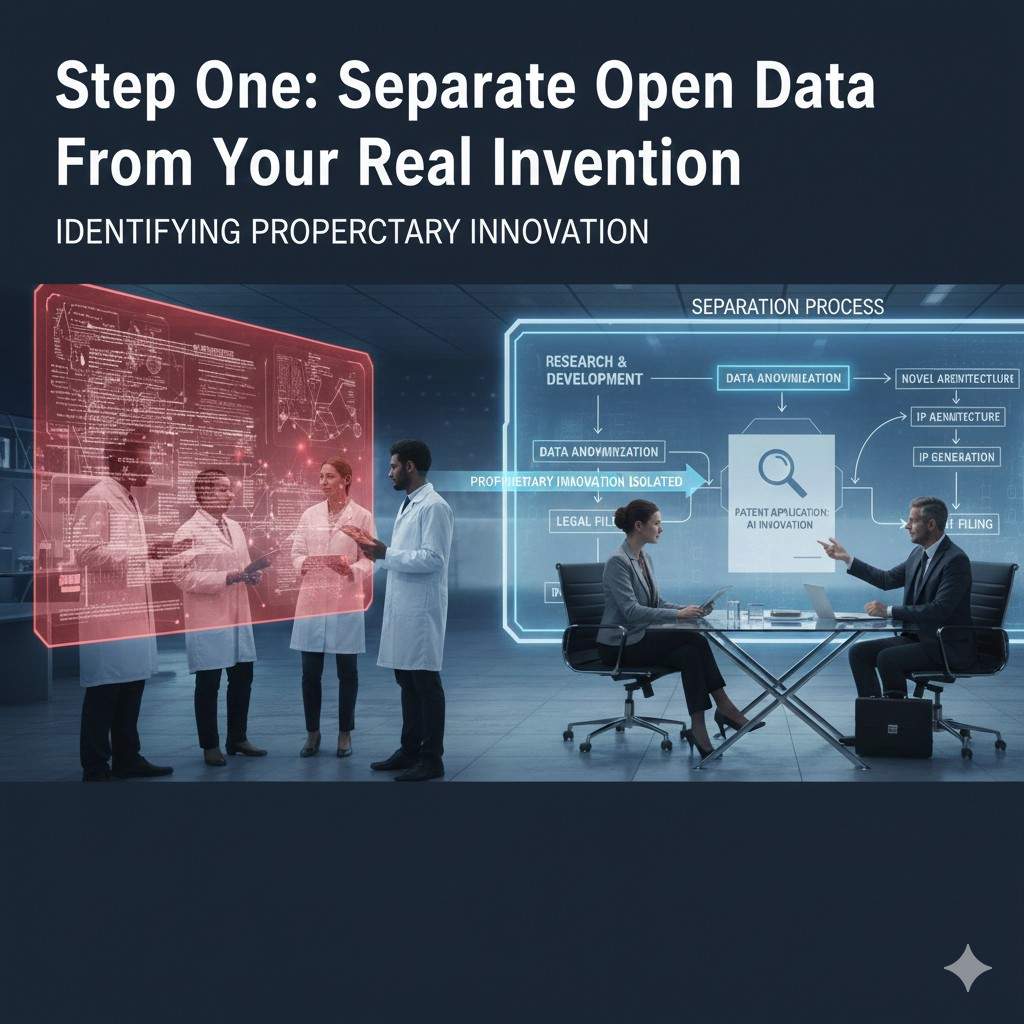
When a dataset is open, it becomes part of the public record. That means an examiner can treat it like prior art. Prior art is anything that shows what was already known. If your patent looks like it depends on owning that dataset, it will not go well.
But that does not mean you are stuck. It simply means you must draw a clean line. The dataset is the raw material. Your invention is what you do with it. Think of open data like lumber. You do not patent wood. You patent the structure you built.
This is also why your patent should never hinge on “we trained on dataset X.” If dataset X is public, it is not a differentiator. Your claims must stand even if dataset X is swapped for another dataset with the same type of content.
Find the hidden “hard part” in your workflow
Most teams underestimate what they built. They focus on the model and ignore the work that made it usable. In real products, the hard part is often upstream and downstream from the model.
Upstream, it is how you choose samples, how you correct labels, how you handle missing fields, or how you reduce noise. Downstream, it is how you detect bad outputs, how you explain results, or how you route uncertain cases to a safe path.
These “hard parts” are usually where the patent lives. They are also where copycats struggle, because they are not obvious from a screenshot of your UI or a high-level blog post.
We solved a technical constraint
Turn “we used public data” into “we solved a technical constraint”
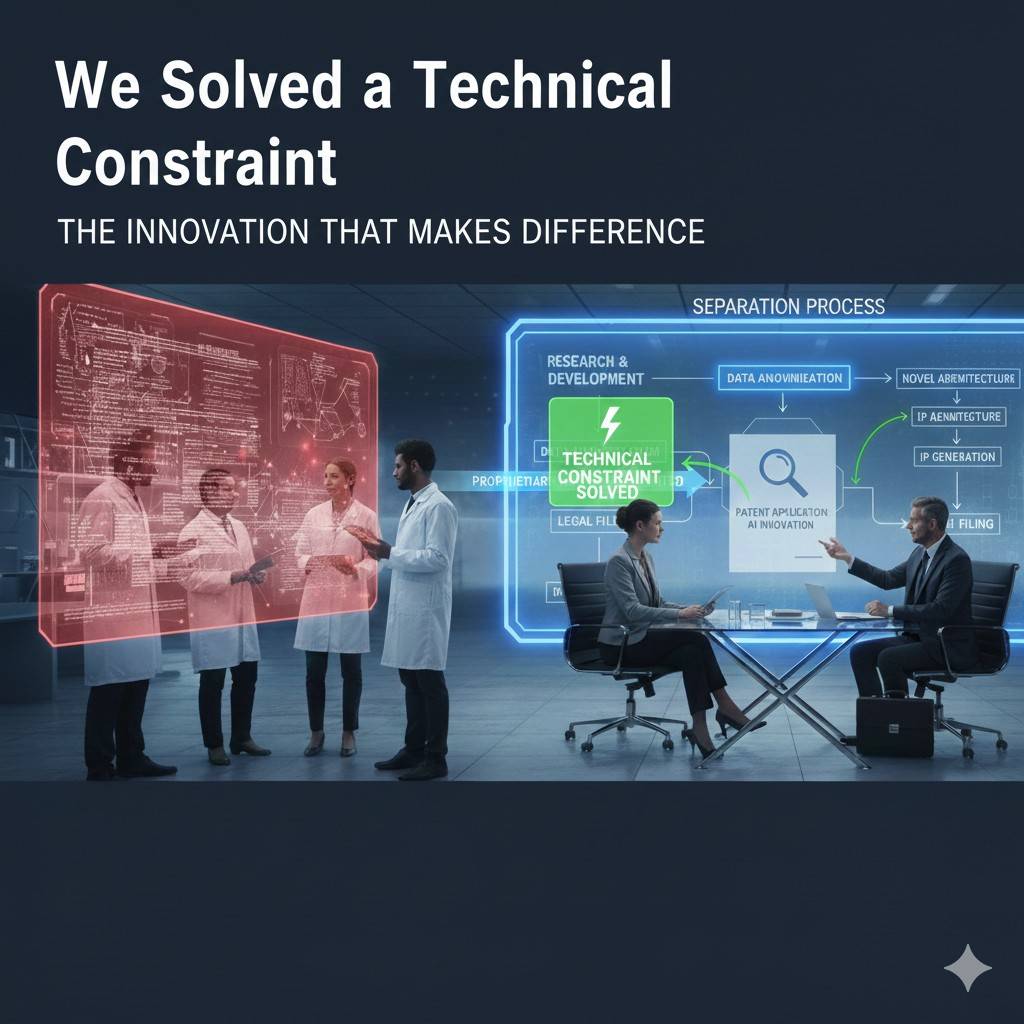
A strong patent story frames a constraint. For example, “We needed to train with limited labels,” or “We needed fast inference on edge devices,” or “We needed to avoid leaking sensitive text.” These are technical constraints with real pain.
Then you show the mechanism that solves the constraint. That mechanism might include a special sampling rule, a privacy step, a model compression step, or a real-time monitoring loop. The dataset being open becomes almost irrelevant, because the invention is about the mechanism.
This is the single best way to patent AI built on open data. You anchor the patent in the technical problem your product solves, not in the public inputs you started with.
If you want a clear plan to do this for your product, Tran.vc can help. Apply any time at https://www.tran.vc/apply-now-form/
Step Two: Prove novelty without getting trapped by the dataset
Novelty is about your steps, not your training source

Novelty means “new.” In patents, that does not mean “nobody has ever trained a model before.” It means nobody has disclosed your exact combination of steps in the same way, for the same technical purpose.
So you should describe your system as a sequence of actions that produces a technical result. The more you can describe the actions in a clear, testable way, the easier it becomes to argue novelty.
A common mistake is to write the invention like a paper abstract. Papers often highlight results and skip details. A patent needs the details. It needs to show what you do, in what order, with what checks, and why that order matters.
Do not claim the whole field; claim the engine
Founders often try to claim too much. They write claims that sound like, “Any AI that does X.” That tends to fail, because examiners can find something close and say you are not new.
A smarter move is to claim the engine that makes your approach work. This is the step or set of steps that you would hate to give away, because it is what makes your tool reliable. When you focus there, your claims become narrower but stronger.
Strong patents are not always broad. They are enforceable. They cover the part competitors cannot avoid without losing performance.
Use measurable outcomes tied to technical actions
Examiners like to see a link between an action and an outcome. It is not enough to say, “This improves accuracy.” You want to connect the dots: “This step reduces a specific error mode,” or “This step lowers compute cost by reducing the number of model calls,” or “This step increases stability across shifts in data.”
You do not need to put every number in the patent, but you should show that the outcome is not magic. It is caused by a concrete technical change.
When you do this well, the dataset fades into the background. The patent is no longer about the open dataset. It is about a system that produces a better result under real constraints.
A note on investors and why this matters early
Investors have seen a lot of “AI on public data.” Many assume it is easy to copy. A clean patent story changes that. It shows you have a defensible method, not just a nice demo.
Even if you do not enforce the patent right away, having filed early gives you leverage. It signals you are building assets, not just features. It also makes later rounds and partnerships smoother, because diligence goes faster when your IP is organized.
If you want help building that leverage, Tran.vc invests up to $50,000 in in-kind patent and IP services for technical teams. Apply any time at https://www.tran.vc/apply-now-form/
Step Three: Choose claim angles that still work when the dataset is public
Start from the product promise, then walk backward to the mechanism

If you begin with the dataset, you will usually end with a weak patent. A better start is your product promise. What do users pay for? What outcome do they trust you to deliver? What is the one thing your tool does that saves time, lowers risk, or makes a hard job possible?
Now walk backward from that promise. Ask what has to be true for the promise to hold. Then ask what you built to make those things true. That path almost always leads you to the patentable core.
For example, if your promise is “fast answers with high trust,” your invention might be a way to detect uncertain outputs and trigger a second pass only when needed. If your promise is “works on edge devices,” your invention might be a specific compression and scheduling method that keeps latency low without losing key signals. If your promise is “safe use in regulated work,” your invention might be a guardrail layer that blocks risky outputs and logs proof.
None of those depend on owning the dataset. They depend on your method.
Claim angle: a better way to prepare and shape open data
Open datasets are rarely ready for product use. They can be messy, biased, incomplete, and full of duplicates. Many teams build clever shaping steps that quietly do most of the work.
A strong patent angle is a pipeline that turns raw open data into training-ready sets in a way that reduces a specific failure mode. This could be a method to detect near-duplicates that cause leakage, or a method to cluster samples and rebalance them so rare cases get enough weight. It could also be a way to create weak labels that are later corrected using a feedback loop.
The key is to avoid writing, “we cleaned the data.” That is too vague. You want to describe the exact checks and the exact transforms, and why they happen in that order. You also want to tie them to a clear technical reason, like reducing overfitting, reducing label noise, or improving stability across shifts.
When the steps are clear, your claims can cover the shaping method, the system that performs it, and the trained model that results from it.
Claim angle: training methods that reduce labels, cost, or drift
Many modern AI tools are limited by one of three things: labels, compute, or drift. If you built a training method that reduces any of these, that is often strong ground.
If you cut label needs, the invention may be in active learning, weak supervision, human-in-the-loop selection, or a method that chooses what to label next based on measured uncertainty. If you cut compute, the invention may be in staged training, caching, mixed precision scheduling, or selective re-training when data changes. If you handle drift, the invention may be in monitoring and controlled updates, or in a method that detects data shifts and triggers a safe response.
With open datasets, this angle is powerful because it clearly separates you from “anyone can train a model.” You are claiming a process that makes training realistic for real products, not just a one-time lab run.
Claim angle: inference pipelines that act like a system, not a single model
A lot of founders think patents must describe a single model. That is not required. Many strong patents describe a system that uses one or more models, plus checks, plus routing, plus memory, plus rules.
This system-level view is often where the defensible value lives. For example, your AI tool may use a fast model first, then a slower model only when needed. Or it may use retrieval to pull in context, then score sources, then generate, then run a verifier. Or it may run an on-device model and a cloud model in a way that keeps data private while still meeting accuracy targets.
When you patent the pipeline, you can protect the choreography. Competitors can copy your model type, but they cannot copy your exact workflow without stepping on your claims.
Claim angle: safety and reliability layers that prevent bad outputs
If you are in robotics, health, finance, legal, or any domain where errors hurt, safety is not a “nice to have.” It is the product. Safety steps can be very patentable if they are technical, specific, and tied to a real failure mode.
A common example is a method that scores output risk using signals from the model, the input, and the environment, then blocks or routes risky cases. Another example is a method that produces a confidence measure that is stable across data shifts, then uses it to decide when to ask for human review.
What matters is that the safety layer is not just a policy sentence. It is a mechanism. It uses measurable inputs, runs concrete steps, and changes system behavior.
If your AI tool is built on open datasets, a safety or reliability layer can be the cleanest way to show real invention.
Claim angle: domain adaptation that makes open data usable in the real world
Open datasets often come from neat settings. Real user data is not neat. If you built a method that adapts a model trained on public data to the messy reality of production, that is often a strong patent angle.
This could be a way to normalize inputs from different sensors, or a method to map user behavior into a stable feature space, or a technique that aligns training data and real data without needing full labels. It could also be a continuous calibration loop that updates thresholds while keeping the model stable.
The patent story here is simple: the open dataset is a starting point, but your method makes it work in the real world where others fail.
If you want to pressure-test your claim angles with people who do this every week, Tran.vc can help. Apply any time at https://www.tran.vc/apply-now-form/
Step Four: Write your invention so it survives “this is just an abstract idea”
Why “abstract idea” shows up in AI patents

One of the biggest reasons AI patents get rejected is not the dataset. It is that the invention is described like an idea instead of an engineered system.
Patent examiners often push back when a claim sounds like math in the air, or a human task done faster, or a generic computer doing generic steps. AI can trigger this because it can sound like “we run a model and get an answer,” which is not enough on its own.
You do not avoid this by using fancy words. You avoid it by describing a technical problem, a technical environment, and a technical fix that changes how the system runs.
How to frame the technical problem in plain words
You want to name the real technical pain. For example, “The model fails on rare cases.” Or “Inference is too slow on the device.” Or “Training leaks test samples due to duplicates.” Or “Outputs are unstable when inputs shift.”
Then you describe why the usual solutions do not work. Maybe they are too costly, too slow, or they need labels you do not have. This sets the stage for your method as a necessary fix, not a random feature.
This is important for open datasets because it keeps the story anchored in engineering, not in “we used public data.” Your method becomes the hero.
Describe the system as parts that talk to each other
A helpful mental model is to describe your AI tool as a set of modules that exchange signals. You do not need to make it complicated. You simply show that this is a system with structure.
For example, you might have an input module, a preprocessing module, a feature module, a model module, a confidence module, and an action module. You explain what each does and what it outputs. You describe the data that moves between them. You explain how decisions are made.
When you do this, your invention looks less like “math” and more like “a machine that runs a process.” That helps a lot in AI patents.
Make sure there is at least one “non-obvious” step with a clear reason
In almost every strong AI patent, there is a step that is not what a normal engineer would do by default. It might be an unusual sampling method, a special way to set thresholds, a two-stage verification step, or a specific way to cache results.
What makes it non-obvious is not that it is weird. It is that it solves a problem in a way that is not suggested by common practice, and it produces a useful outcome. You want to make that connection easy to see.
This is where many drafts fail. They include the step, but they do not explain why it exists, so it looks arbitrary. In a patent, the “why” is part of the power.
Model type
Do not over-focus on the model type

If your patent draft spends most of its time naming model types, it often becomes fragile. Model names change fast. Also, many model types are already known, so naming them does not help novelty.
A safer approach is to keep the model description broad enough to cover variants, while being very specific about the steps around it that create your advantage. You can describe the model as a neural network, a transformer, a classifier, a ranking model, or a policy network, but do not let the patent depend on one brand-name architecture.
The goal is to protect your method, even as your internal model evolves.
If you want Tran.vc to help you draft this in a way that reads like real engineering and stands up in review, apply any time at https://www.tran.vc/apply-now-form/