
Licensing can feel like the “safe” way to earn money from your invention without building everything yourself. But licensing has a hidden trap: you can sign a deal that brings in short-term revenue while quietly giving away the very power that makes your company valuable.
This happens all the time in AI, robotics, and deep tech. A big partner wants access. They offer reach, brand, and “distribution.” You want the validation and the cash. And then the paperwork shows up. It is long. It is dense. It is full of friendly words that mask permanent tradeoffs.
The goal is not to avoid licensing. Licensing can be smart. Licensing can be the difference between slow growth and fast scale. Licensing can also make investors take you more seriously because it proves market pull. The goal is to structure it so you get paid and you keep your edge.
When you do this right, you stay in control of four things that matter most: who can use your IP, where they can use it, how long they can use it, and what they can do with what they learn. If you keep those four levers tight, licensing becomes a growth tool instead of a leak.
At Tran.vc, we see licensing as part business move, part IP move. The business side is about pricing, delivery, and partner fit. The IP side is about keeping your moat intact while you let someone borrow a piece of it. That is why strong patent planning early matters so much. If your IP is clearly mapped and filed the right way, you can license from a position of calm strength, not fear. If you want help building that foundation, you can apply anytime here: https://www.tran.vc/apply-now-form/
Now, before we go deeper, let’s set a simple frame.
A licensing deal is not “one yes.” It is a bundle of smaller yeses. Each yes has a cost.
You may be saying yes to a field of use. You may be saying yes to a region. You may be saying yes to a certain product line. You may be saying yes to improvements they create. You may be saying yes to exclusivity. You may be saying yes to audit limits. You may be saying yes to a broad definition of “derivative works.” You may be saying yes to letting them keep using your IP even after termination. Some of these yeses are fine if priced and boxed in well. Many are dangerous if they are vague or forever.
So the first move is to stop treating “license” like one door. It is a hallway with many doors. Your job is to decide which doors stay locked.
You can think of licensing in two buckets.
One bucket is about letting someone sell something you already built. This is closer to distribution. The other bucket is about letting someone build on top of your tech, sometimes inside their own systems. This second bucket is where IP gets weak fast, because the partner touches your source, your data flow, your training loop, your robot stack, your firmware logic, your control models, or your process steps. Once a partner “learns” your system, the boundary between your IP and their know-how can blur unless you set it clearly from day one.
That is why, even in a friendly deal, you must act like you are designing a fence. A good fence does not stop all movement. It controls it.
Here is the most common mistake founders make: they negotiate money first and IP second.
It feels normal to start with royalty rates, minimums, and milestones. But if the IP scope is sloppy, the money terms do not matter. You can end up with a decent royalty rate on paper and still lose the future, because you handed them rights that block you from selling into your best market later, or you allowed them to patent improvements that sit right on top of your core, or you agreed they can keep using the tech even if they stop paying.
In licensing, the money terms are often the easy part. The hard part is the “shape” of the rights.
So in the rest of this piece, we are going to talk about how to shape rights so you can grow revenue without shrinking your moat. We will keep it simple, direct, and practical.
How to Structure Licensing Deals Without Weakening IP
Why licensing feels safe, and why it can still hurt you
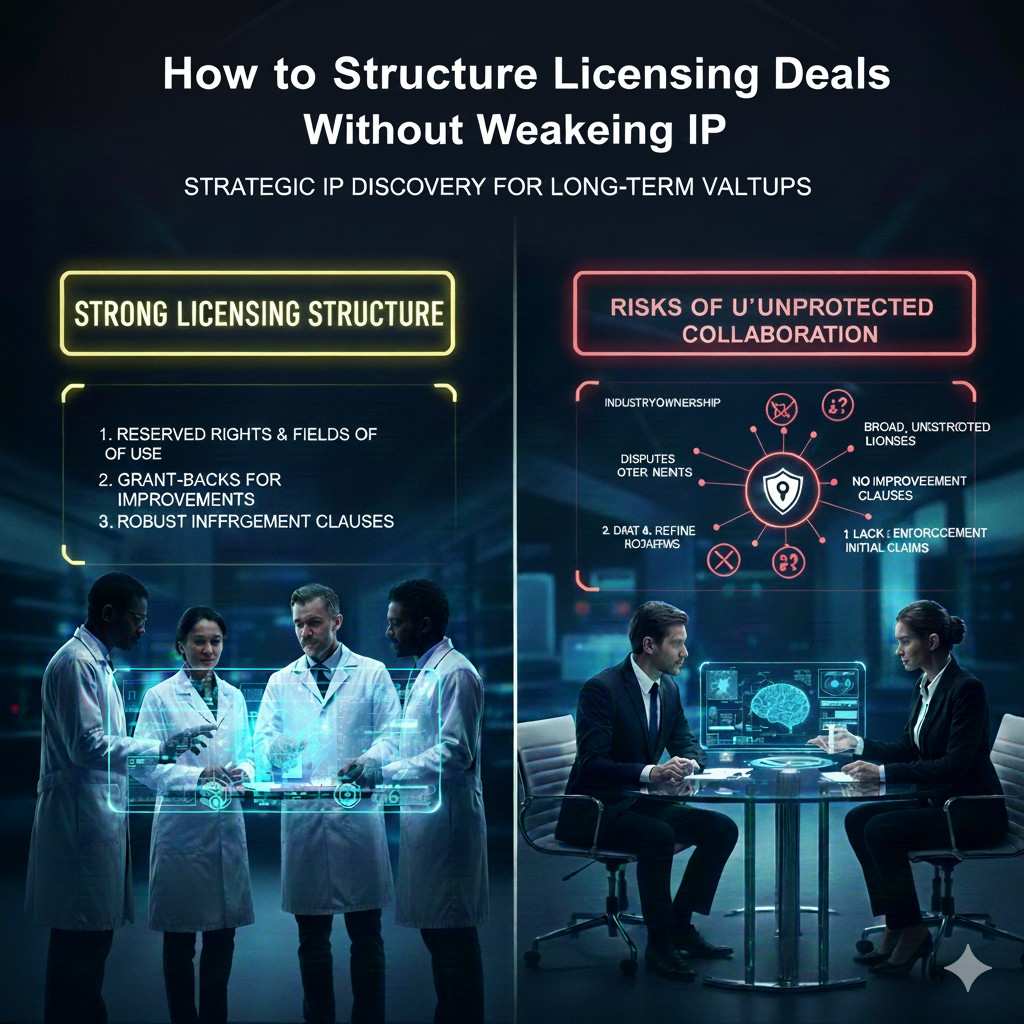
Licensing looks simple from the outside. You let a larger company use your technology, they pay you, and you move on. For many technical founders, it feels like the cleanest path because it does not force you to build a full sales engine right away. It can also bring fast proof that real buyers want what you made.
The risk is not the idea of licensing. The risk is the shape of the deal. A license can quietly change who controls your future markets, your future products, and your future pricing power. You can keep “ownership” on paper and still lose control in practice if the rights you grant are too wide, too long, or too hard to undo.
If you want to build a company that stays valuable, you must treat licensing like architecture. You are not selling access. You are designing boundaries. When the boundaries are clear, you can earn money and still keep your moat strong.
If you want help setting up that moat early, Tran.vc helps founders build patent and IP strategy from day one. You can apply anytime here: https://www.tran.vc/apply-now-form/
The four levers that decide whether you keep your power
Most licensing problems can be traced back to four levers that were not controlled well. First is who can use your IP. Second is where they can use it. Third is how long they can use it. Fourth is what they can do with what they learn while using it.
When those levers are tight, your license is a controlled channel. When those levers are loose, your license becomes an open door. Open doors do not only let revenue in. They let your advantage leak out.
Founders often focus on the royalty rate first because it feels like the main number. But rates do not matter if the rights are sloppy. You can negotiate a “good” rate and still sign away a market forever. A smart structure keeps the market options in your hands.
Your IP is bigger than patents, and that matters in licensing
Patents are critical in AI and robotics because they can protect systems, methods, workflows, control logic, and even key steps in how the product works. They also give you clean proof of what belongs to you. That clarity is very helpful when the other side has big legal teams.
But licensing usually touches more than patents. It touches trade secrets, know-how, training methods, data pipelines, model weights, manufacturing steps, and the small decisions that make your tech actually work. Many companies lose value through licensing because trade secrets slip out through “support” or “integration help.”
A well-structured license protects both the registered IP and the quiet IP. Quiet IP is often the real edge. It is the “how,” not just the “what.” Your deal must prevent the partner from learning your how and then rebuilding it without you.
Step One: Define What Is Being Licensed
“Our technology” is not a licensing scope
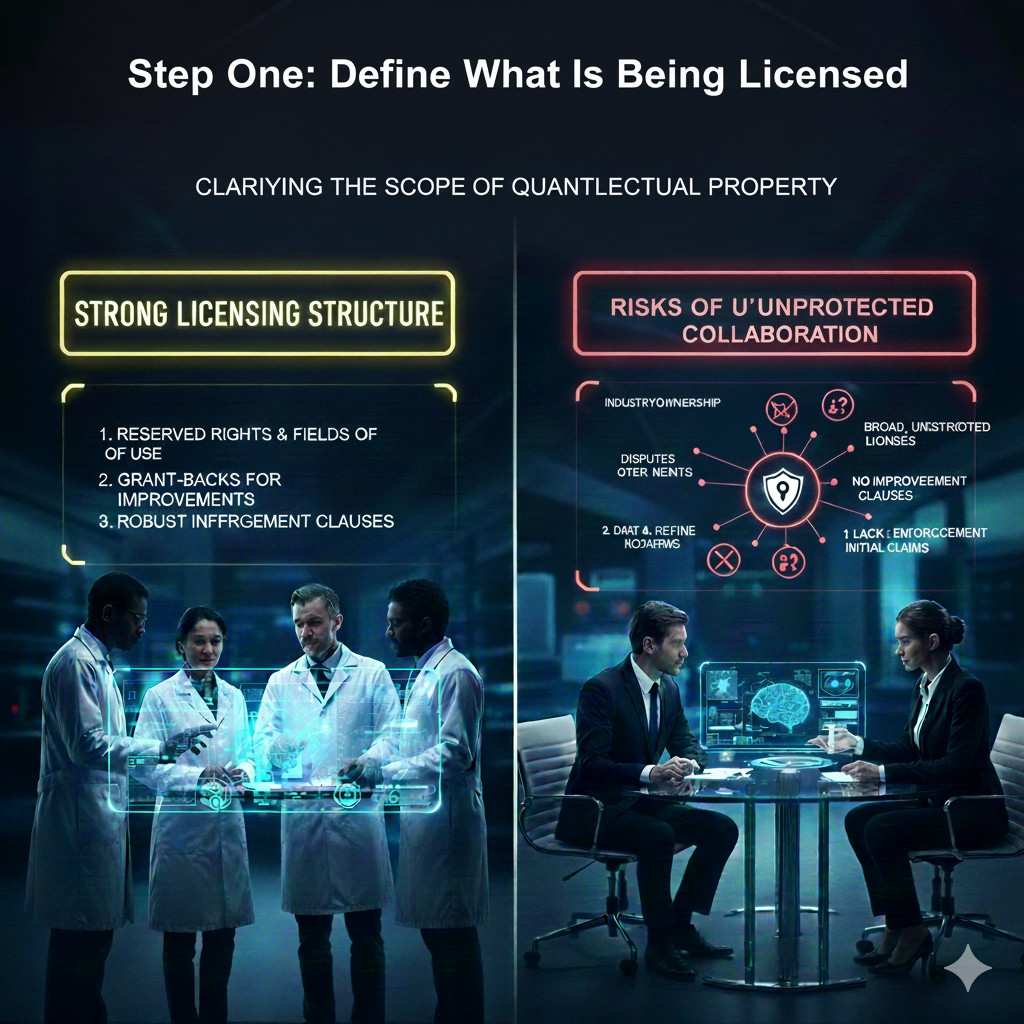
A contract cannot protect you if the licensed item is vague. Words like “our technology,” “our platform,” or “our system” feel normal in conversation, but they are dangerous in legal scope. Vague scope invites the other side to interpret the deal in the way that benefits them most, especially years later when people change jobs and memories fade.
A safer approach is to license a defined package. That package should be named, versioned, and described in a way that can be checked. If it is software, define modules, builds, and interfaces. If it is robotics hardware, define drawings, BOMs, and firmware versions. If it is an AI model, define model version, inference wrapper, and allowed deployment path.
When the licensed package is clear, everything else becomes easier. Support becomes easier. Compliance becomes easier. Enforcement becomes easier. Most importantly, you can still build new versions without automatically giving them away.
Use inclusions and exclusions like a fence, not a suggestion
Many founders list what is included but forget to list what is excluded. That is a common way to lose control later. A partner’s legal team can treat anything not excluded as “part of the package,” especially if the contract includes broad phrases like “related materials” or “associated know-how.”
Exclusions should be real and specific. You can exclude internal training methods, internal tooling, test rigs, manufacturing process details, and future platform components. You can also exclude any part of your stack that you plan to reuse across markets, so you do not lock yourself into one partner’s success.
The goal is not to be difficult. The goal is to keep the license narrow enough that it solves their problem without turning your core into a shared asset.
Separate “delivery” from “rights” so you do not give away support as IP
Another hidden leak is when support becomes a backdoor transfer of know-how. A partner may ask for deep integration help, architecture review, tuning, or “best practices.” Those requests can be fine, but you should treat them as a service with limits, not as part of the rights.
In a clean structure, the license grants defined rights. Support is a separate workstream with a defined scope, limited access, clear deliverables, and clear fees. This keeps your team from being trapped in endless partner demands and reduces the chance you teach them how to replace you.
If you want Tran.vc’s help mapping what should be licensed and what should stay protected, you can apply anytime here: https://www.tran.vc/apply-now-form/
Step Two: Control the Field of Use
Field of use is how you license today without losing tomorrow
Field of use means the partner can use your IP only for a defined purpose. It is one of the strongest tools you have to protect your future markets. It lets you say yes to a deal that brings near-term revenue while still keeping other markets open for you, or for other partners later.
In robotics, field of use might be limited to a single type of facility or workflow, like “parcel sorting in urban hubs.” In AI, it might be limited to a specific use case, like “defect detection for a defined category of parts.” The narrower the field, the safer your long-term optionality.
Partners will often ask for a broad field because it sounds simpler. Broad fields are rarely simple. They often become silent exclusivity. If the field is too wide, you may find you cannot sell into your best market later because it “touches” the partner’s field.
Use “what it is used for” and “what it is not used for”
A good field of use has both a positive and a negative definition. The positive part states exactly what they may do. The negative part states what is out of bounds. This reduces arguments later, especially in AI where the same model can be applied to many tasks.
For example, you can allow use for “in-plant quality inspection for Product Class A” and clearly exclude “inspection for Product Class B” or “any medical or safety-critical use.” You can also exclude the use of your technology for training competing models, building generalized platforms, or enabling external services.
This kind of clarity feels strict, but it prevents the partner from “stretching” the license as their business changes.
Add a mechanism for expansion so you can price growth fairly
Partners may truly start in one field and later want more. That is normal. The deal should not force you to say no forever. It should give a clean path for expansion that you control.
A practical approach is to define an expansion process: new fields require a written amendment, updated pricing, and updated compliance terms. This reduces pressure later when the partner says, “We already have it integrated, so just let us use it in this new product too.” Integration should not be your enemy. Structure should protect you from being cornered.
Step Three: Choose Exclusivity With Extreme Care
Exclusivity is not a “badge,” it is a trade
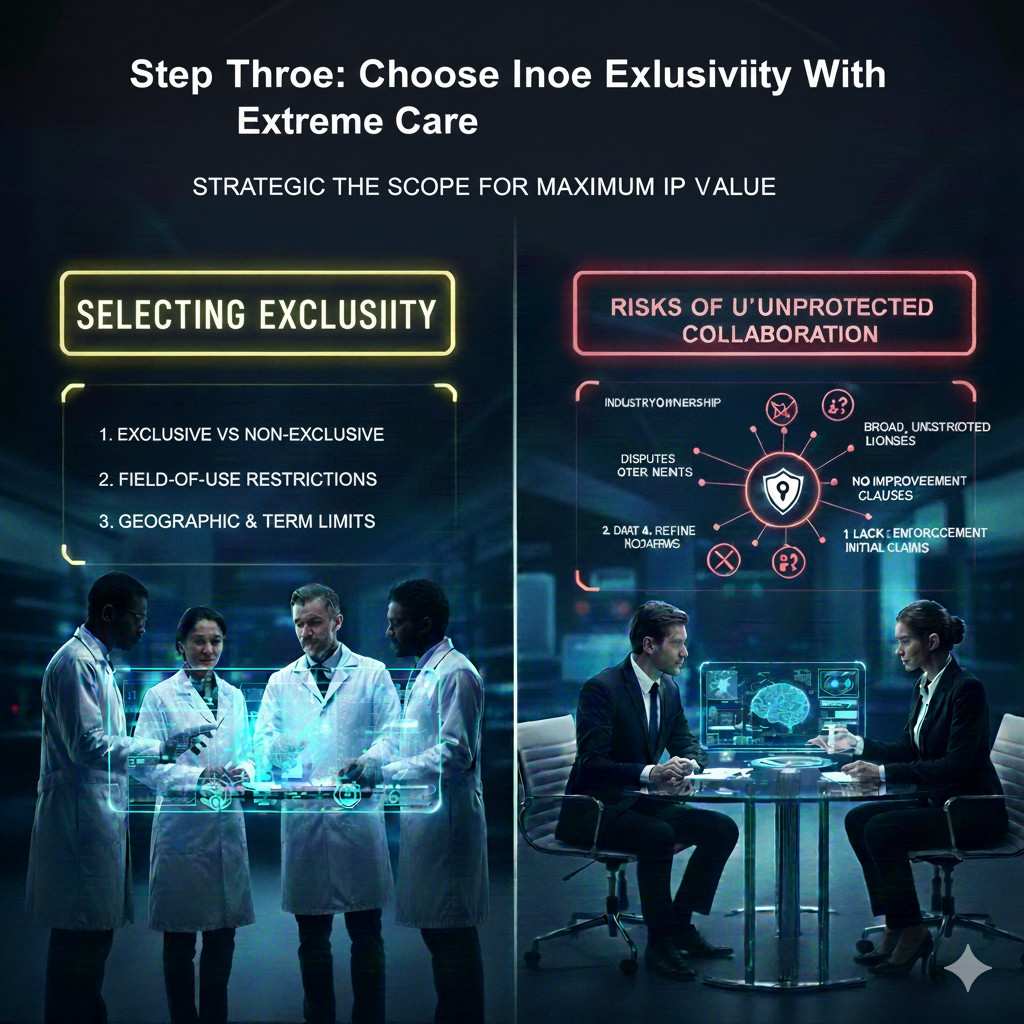
Exclusivity sounds flattering. It can also feel like a signal that the partner believes in you. But exclusivity has a cost: it removes your ability to sell to other buyers in the same space, even if the exclusive partner moves slowly or changes priorities.
If you grant exclusivity too early, you can freeze your growth. You also weaken your fundraising story because investors dislike deals that limit your market. In deep tech, the biggest danger is giving an exclusive license in a space where you have not yet proven adoption speed.
If you do grant exclusivity, it should be earned. It should be narrow. It should be tied to performance.
“Exclusive where it matters, non-exclusive everywhere else”
A safer pattern is limited exclusivity. That could mean exclusivity only for a narrow field of use, only in one region, or only for a specific product line. You can also grant exclusivity for a short period, like a launch window, while keeping the rest open.
This lets the partner feel protected without you surrendering the entire market. It also gives you leverage. If they want more exclusivity, they can pay more and commit to stronger obligations.
Exclusivity should never be free. If the partner wants to block your other paths, they should compensate you for that opportunity cost.
Always tie exclusivity to measurable performance
If exclusivity is granted, it should not depend on “best efforts.” It should depend on real numbers and real dates. Think minimum royalties, minimum unit sales, minimum deployment milestones, or minimum revenue thresholds.
The purpose is simple: if they do not perform, you get your freedom back. Without performance triggers, exclusivity becomes a one-way door. With triggers, it becomes a conditional privilege.
Also, make sure the consequences are clear. If they miss the threshold, exclusivity converts to non-exclusive automatically, without a long fight. That single detail can save you years later.
Step Four: Set Strong Limits on Territory and Channels
Territory can quietly become global control
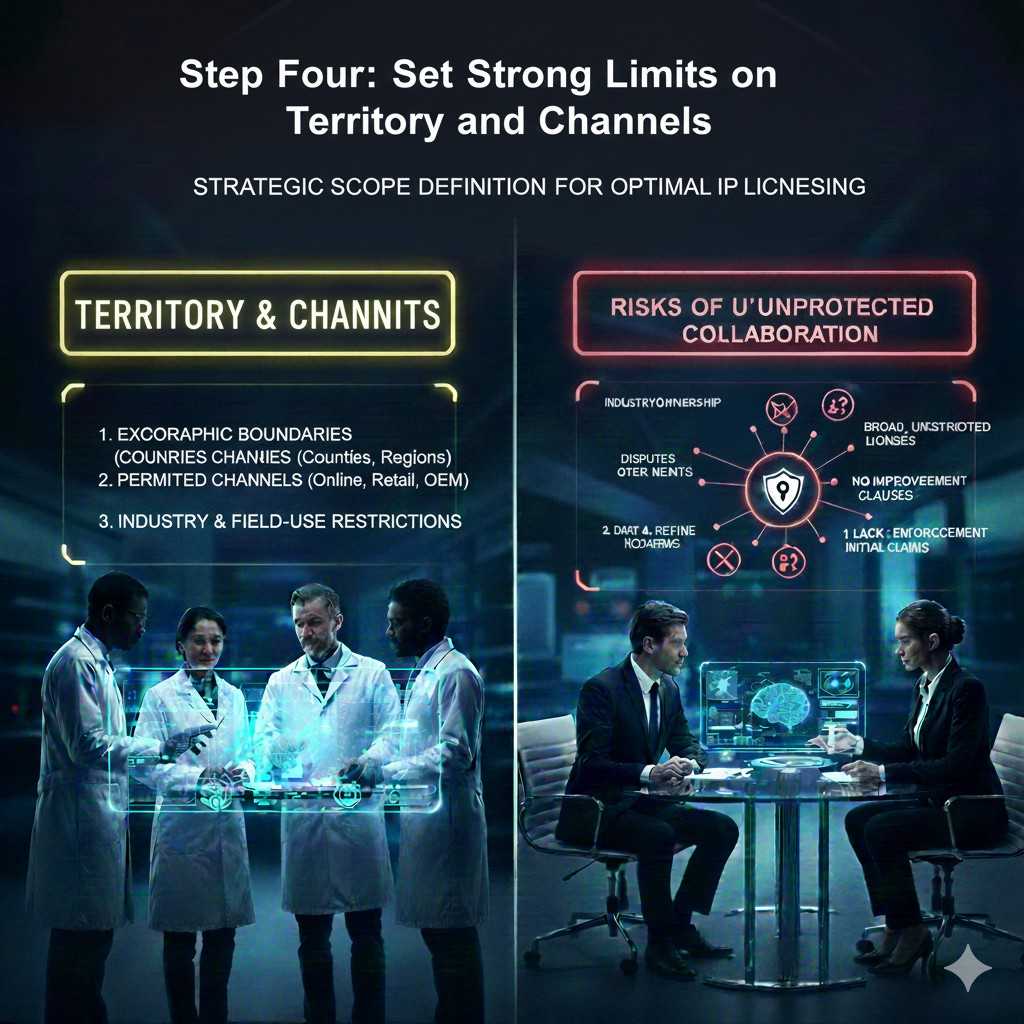
Many licensing agreements default to “worldwide” because it feels normal. In some cases, worldwide may be fine, but only if field of use is tight and your pricing reflects the scale. If scope is broad and territory is worldwide, you have basically handed over a big chunk of your future.
A smarter approach is to license by region where the partner truly has strength. If they are strongest in North America, start there. If they later want Europe or Asia, that becomes an expansion step with new pricing and new obligations.
This protects you from being blocked in regions you could serve through other partners or direct sales.
Define sales channels, not just geography
In B2B tech, channels matter as much as territory. A partner may sell into OEM channels, enterprise channels, government channels, or embedded channels. If you do not define channels, they can claim rights in places you did not expect.
Channel control matters a lot in robotics and AI because deployments are often tied to system integration partners. If your license lets one partner sell into all channels, you may lose access to the integrators who could have scaled you faster.
A good structure names the allowed channels and excludes the rest. It also prevents sublicensing into unknown hands unless you approve it.
Sublicensing is where control often breaks
Partners may ask to sublicense your technology to affiliates, integrators, or customers. Sometimes this is needed for deployment. But sublicensing is risky because it spreads your IP into many places where tracking and enforcement are harder.
If sublicensing is allowed, it should be controlled. Require your written consent. Require that sublicenses match your terms, including limits on use and confidentiality. Require reporting so you can see where your IP ends up. Require that the partner remains responsible for the sublicensee’s behavior.
This is not about distrust. It is about knowing where your crown jewels are.
Step Five: Protect Improvements, Derivatives, and “Learning”
Improvements are the most common way founders lose the future
A partner will often say, “If we improve it, we should own the improvements.” That sounds fair until you see what “improvements” can mean. In practice, an improvement may sit directly on top of your core invention and block you from using your own next version.
The key is to separate improvements that are specific to the partner’s product from improvements that touch the core platform. You can let them own partner-specific improvements, but you should keep rights to core improvements, or at least ensure you have a broad license back.
Even better, define improvements carefully. Do not let “improvement” include any change that relates to the field broadly. Keep it tied to a specific deliverable and a specific integration context.
“Derivative works” language can swallow your entire codebase
In software and AI licensing, “derivative works” can become a black hole. If the contract says the partner owns derivative works or has broad rights to them, you may be giving them rights to anything you build next that looks similar.
A safer approach is to state that you own your background IP and all enhancements to it. The partner gets only a limited right to use what is needed inside the license scope. If they need a custom module, define it as a “deliverable” with clear ownership terms.
Also, avoid any clause that lets them claim ownership simply because their engineers touched the system. Touching is not inventing. Collaboration must not become capture.
Protect against “training on your tech” without permission
In AI deals, a partner may want to use your models, outputs, logs, or user data to train their own models. This is a major IP and competitive risk. They can use your deployment to build a replacement, then renegotiate from a stronger position later.
Your license should clearly state what data may be collected, who owns it, and how it can be used. If the partner wants training rights, treat it as a separate negotiation with separate pricing and separate safeguards.
Most founders should default to “no training rights” unless the deal is structured so you benefit and your moat stays intact.
Step Six: Keep Your Trade Secrets From Leaking Through Implementation
Implementation is where the real leak happens

You can draft a perfect license and still lose your edge during delivery. This is because the partner’s team learns how your system works while integrating it. They ask questions. They request code access. They request detailed docs. They request debugging sessions. Over time, your knowledge becomes their capability.
To prevent this, decide early what you will share and what you will not. Then build a delivery method that supports their success without handing over the blueprint.
APIs, binaries, secure deployment environments, and “black box” modules can help you limit exposure. The right choice depends on your product, but the principle is constant: share what they need to use it, not what they need to rebuild it.
Support scope should be written like a project plan
Support should not be open-ended. Define hours, response times, roles, and boundaries. Define what counts as a change request. Define what is included and what is paid extra.
When support is structured, you protect your team’s time. You also protect your secrets because your engineers are not pushed into over-explaining just to end a meeting faster.
A clean support plan also makes you look stronger. Strong companies have structure. Weak companies “wing it.”
Confidentiality must be practical, not poetic
Almost every contract has a confidentiality section. Many are useless because they are not tied to real behavior. Practical confidentiality includes rules about who can access the materials, how they are stored, how long they are kept, and what happens at the end.
In deep tech, pay attention to “residuals” clauses. Residuals language can allow a partner to use what their employees remember, even if it came from your confidential info. This is a quiet way to weaken trade secret protection. You should push back hard on any residuals clause that applies to your core know-how.
If you want Tran.vc’s help spotting these issues before they become expensive, you can apply anytime here: https://www.tran.vc/apply-now-form/
Step Seven: Build a Royalty Model That Matches IP Risk
Pricing should reflect what you are giving up, not only what they gain today
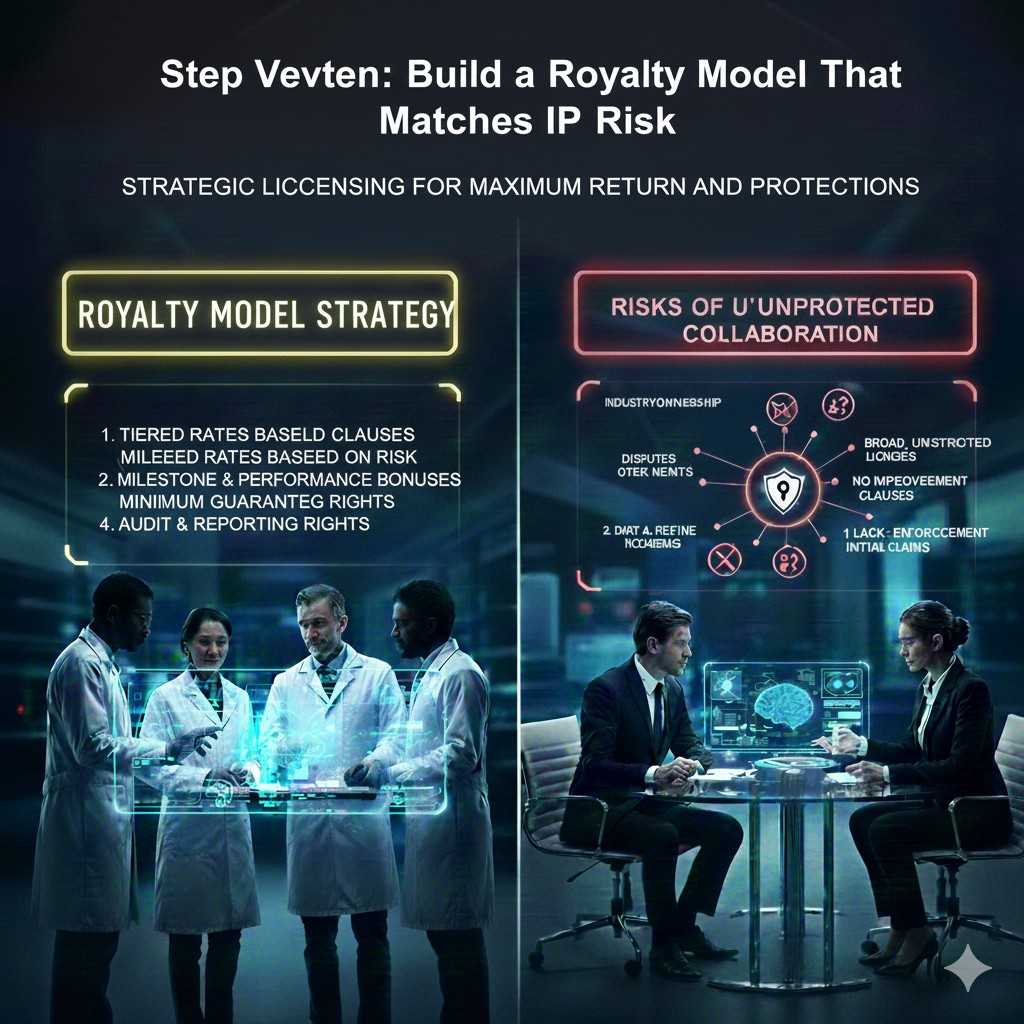
Royalty rates are often negotiated like a market benchmark. That is fine as a starting point, but your real pricing should reflect risk. If the license is narrow, time-limited, and controlled, the risk is lower. If it is broad, exclusive, and long-term, the risk is higher and price should rise sharply.
You should also price based on how close the partner gets to your core. If they need deep access to your code or model internals, the IP risk is higher than if they only call an API.
You are not only selling usage. You are taking on the risk of becoming a teacher.
Minimums prevent you from being parked on a shelf
A common failure mode is the “shelf deal.” The partner signs the license, announces it, then does little. They may have bought time. They may have blocked competitors. They may have used your brand for signaling.
Minimum royalties, minimum orders, or minimum deployment commitments protect you from this. They also help your planning because you know the deal has real weight.
Minimums should be tied to clear time windows, with clear remedies if missed. Remedies should include loss of exclusivity, reduction of territory, or termination rights.
Audit rights keep reporting honest without starting wars
Licenses often rely on the partner’s reporting for royalties. If reporting is wrong, you lose money and you may not even know it. Strong audit rights are normal in mature licensing. They should not be seen as aggressive.
Define reporting format, frequency, and detail. Define your right to audit through an independent auditor. Define who pays for the audit depending on whether there is a meaningful underpayment.
This keeps the relationship clean. It reduces the chance that small issues become big fights.
Step Eight: Design Term, Renewal, and Exit Like a Safety System
Term length is a control lever, not a footnote
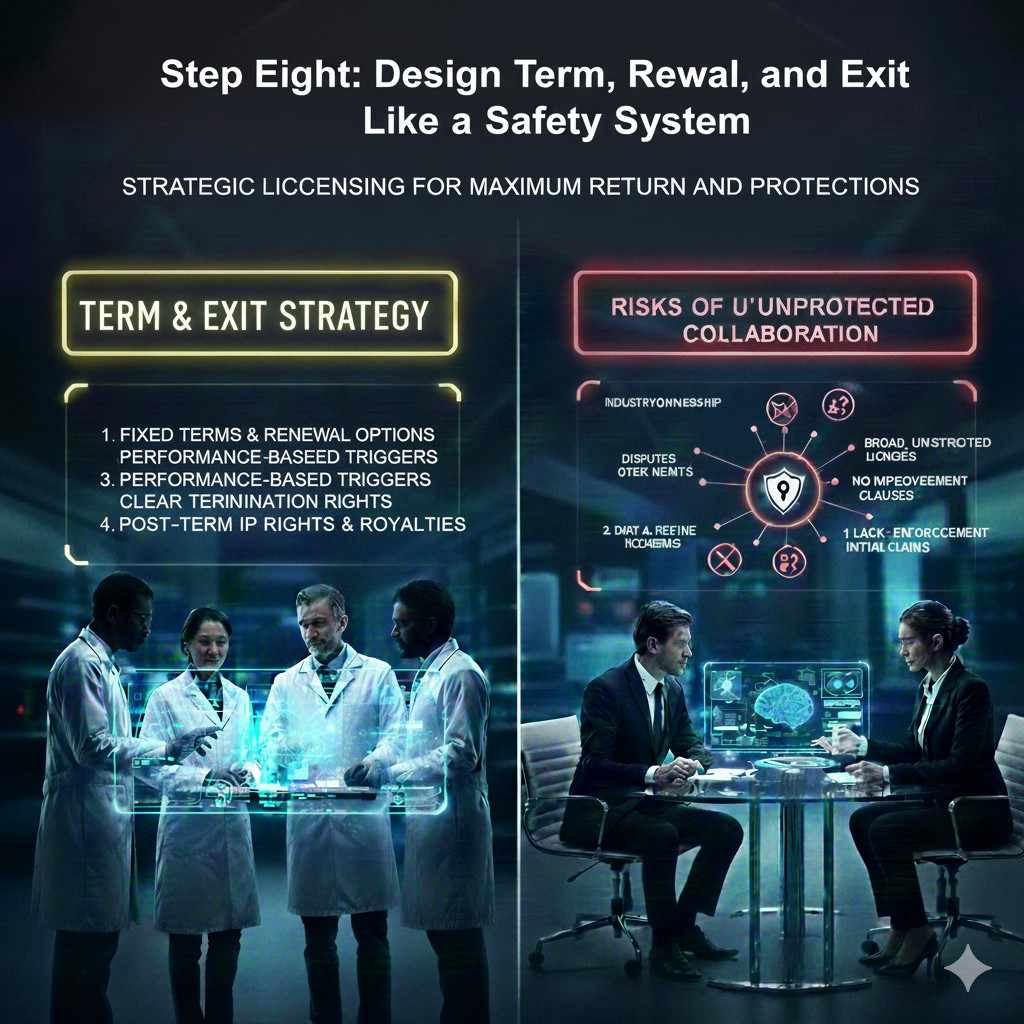
Long terms feel stable, but they can lock you into a bad structure. In fast-moving AI and robotics, a deal that looked fine today may look outdated in two years.
A safer approach is shorter terms with renewal options. Renewal should depend on performance and compliance. This gives you a chance to reset pricing and scope as the market changes.
Be careful with “evergreen” renewals that auto-renew unless you act. You do not want to miss a window and be stuck for another cycle.
Termination rights should match real risks
If the partner breaches confidentiality, misuses your IP, or fails to pay, you need the ability to act fast. Long cure periods can be dangerous when misuse is happening. Your contract should allow immediate action for serious breaches, especially around IP and confidentiality.
Also, make sure termination is not the end of the story in a way that hurts you. Many contracts include “post-termination” rights that let the partner keep using your tech for a long time. Some even allow perpetual use for “existing products.” These clauses can turn termination into a hollow threat.
A good structure limits post-termination use to a short wind-down period, tightly defined, and only if they are fully paid and compliant.
“Return or destroy” must cover real assets, not just documents
At the end of a license, you want your materials back or destroyed. But you should define what “materials” means. It should include code, model weights, documentation, test data you provided, and any copies in backups where practical.
Also consider verification. In some deals, you can require a written certification of destruction and, for higher-risk cases, a process audit. The point is not to police. The point is to prevent your IP from living forever inside someone else’s system after the relationship ends.