
Edge devices are where the real work happens.
They sit in cars, factories, hospitals, farms, stores, drones, robots, cameras, wearables, and tiny boxes bolted to walls. They take in messy real-world signals, make fast choices, and keep working even when the cloud is slow, expensive, or not allowed.
And now they are getting smart.
Embedded AI is no longer a “nice add-on.” It is the core of the product. The model, the firmware, the sensor pipeline, the power tricks, the on-device updates, the safety logic, the custom chips, the memory layout, the timing rules. All of it.
That is also why patents matter so much here.
If you are building embedded AI, you are almost always inventing something. Even if you do not call it an invention. You are solving hard limits: heat, battery, latency, bandwidth, cost, compute, and safety. Those solutions are your moat. They are also easy to copy once your device ships, gets bought, and gets taken apart.
A patent is not a trophy. It is a tool.
It can stop fast followers. It can give you leverage in a deal. It can unlock partnerships. It can make your seed round easier because investors can point to something that is hard to replicate. It can also help you avoid a painful fight later, because you filed early and wrote it the right way.
But edge patents are different from “app patents.”
On the edge, the value is often in the system. Not one screen. Not one API call. It is the way data moves from sensor to signal to feature to model to output to actuator. It is the way you keep the model accurate without blowing battery. It is the way you update safely in the field. It is the way you keep privacy while still learning. It is the way you hit a strict time deadline without a big GPU.
That means your patent plan has to match the way your product is actually built.
If you try to patent “AI on a device” in a generic way, you will get weak coverage, or a rejection, or both. If you describe only the model math, you might miss the real advantage, which is how you made the model run inside tight limits. If you focus only on hardware, you might miss the clever software flow that makes the hardware useful.
So the first step is not filing. The first step is seeing what is truly special in your system, then turning it into a clean patent story that a patent office can grant and a competitor cannot step around.
That is exactly what Tran.vc helps founders do. Tran.vc invests up to $50,000 in in-kind patenting and IP services for robotics, AI, and other technical startups, so you can build a real moat early without giving up control or rushing into a priced round. If you want to see if your edge device work is patent-ready, you can apply anytime here: https://www.tran.vc/apply-now-form/
Before we go deeper, let’s set a simple frame for the rest of this article.
When you say “edge device,” you are usually talking about three layers working together:
The physical layer: sensors and actuators, and sometimes custom boards, radios, and power systems.
The compute layer: MCU, CPU, GPU, NPU, FPGA, or a mix. Memory. Storage. Buses. Timing.
The intelligence layer: the model, the features, the training and update method, the guardrails, and the decision logic.
Most strong patents for embedded AI are not only about one layer. They are about the way two or three layers work together to solve a hard limit.
That is your sweet spot.
A few examples, just to make this feel real:
You found a way to run a vision model on a cheap chip by changing the order of steps in the pipeline and using a tiny cache pattern that reduces memory reads.
You built a sensor fusion flow that keeps accuracy high even when one sensor drops out, and it does it without a big compute hit.
You created a safe update method that can swap models in the field while meeting strict safety rules, with rollback, and with proof the new model will not break timing.
You built a privacy-first on-device learning loop that never ships raw data but still adapts per user.
All of those can be patentable. And each one can be written in a way that covers more than one product version, more than one chip, and more than one model type.
Now, one more truth that most teams learn the hard way.
Edge companies often wait too long to file.
Why? Because they are busy building hardware. They are dealing with supply chain. They are getting boards spun. They are chasing noise in a sensor. They are rewriting firmware. They are trying to hit a demo date. Patents feel like “later.”
But in edge, “later” can be risky.
Hardware gets shown. Devices go to pilots. Partners get access. People see the board. People measure the signals. People can infer what you are doing. Sometimes you publish benchmarks. Sometimes you give a talk. Sometimes you ship a dev kit. Any of that can narrow your options if you have not filed.
Filing early does not mean filing sloppy.
It means capturing what matters while it is still fresh, and before you accidentally give away the story.
A practical mindset is this: treat patents like you treat source control. You do not wait until the product is done to commit your work. You commit as you go, in a clean way, with good notes.
That is why many strong edge teams use a simple routine:
When you solve a hard limit, you write it down.
When you change the system design to meet a constraint, you log it.
When you make a trade that others would not think of, you capture it.
Those notes become the raw fuel for a strong filing.
And no, you do not need to write patent language. You just need to record the problem, the old way, your way, and why your way works under real limits.
Tran.vc’s process is built around that reality. You keep building. Their patent team helps you pull out the patent-worthy parts, shape them into filings, and build a plan that matches your product roadmap. If you want that support, apply anytime here: https://www.tran.vc/apply-now-form/
This article will walk you through how to think about patents for edge devices and embedded AI in a way that is practical. Not abstract. Not legal-heavy. It will help you spot what to protect, when to file, and how to avoid the common traps that make edge patents weak.
What “Patentable” Really Means for Embedded AI
It is not “AI on a device”
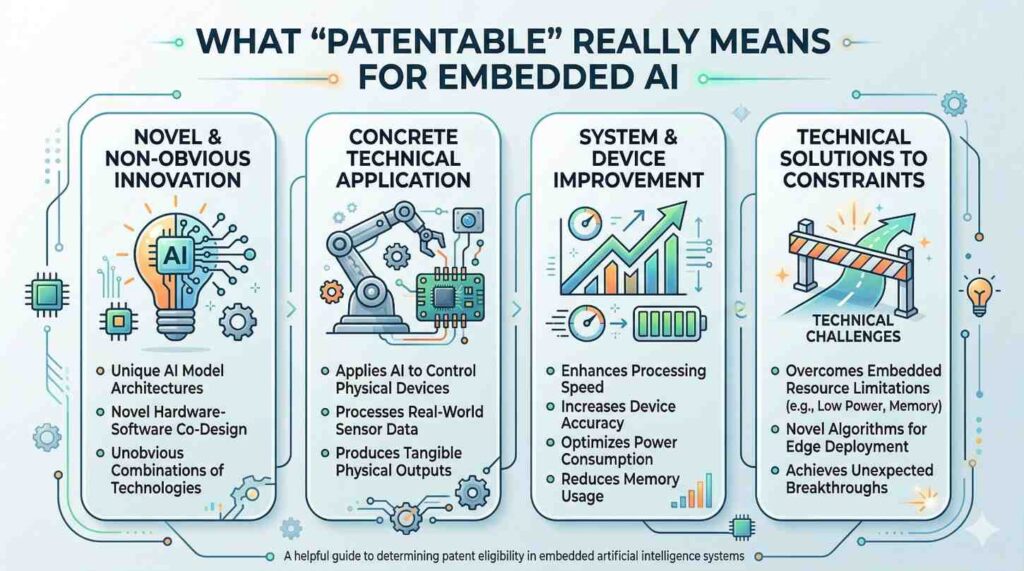
Many teams start with a sentence like, “We run AI on the edge.” That line is true, but it is not a strong patent story. It is too broad, and it sounds like something many others do.
Patent examiners and competitors both react the same way to broad claims. They look for the part that is actually new, and they try to show it is already known. Your job is to point to the real, specific leap you made, and explain it in a way that stands up.
For embedded AI, the “new” part is often not the model type. It is the system you built around the model so it can work in tight limits.
The real inventions live in constraints
Edge devices force trade-offs that cloud systems can ignore. You have power limits, heat limits, memory limits, and strict timing needs. You also have real sensors, messy signals, and safety risk.
When you solve those limits in a clean way, you usually create something patentable. Your “invention” is often the design choice that makes the whole thing possible.
A good mental test is simple. If a smart engineer at a large company tried to copy you, what part would they struggle with first? That struggle is usually the patentable core.
Patents reward “how,” not “what”
A strong embedded AI patent explains how you do the thing, not just what the thing is. The patent should teach a skilled person enough to recreate it, while still covering a wide range of versions.
This is why “We detect defects with a neural network” is weak. But “We detect defects by running a staged pipeline that reduces memory reads, adapts sampling based on confidence, and guarantees a decision within X milliseconds” is much stronger.
The second version has moving parts. It has structure. It has levers you can claim in different ways.
Where the Moat Often Hides in Edge Products
The pipeline from sensor to decision
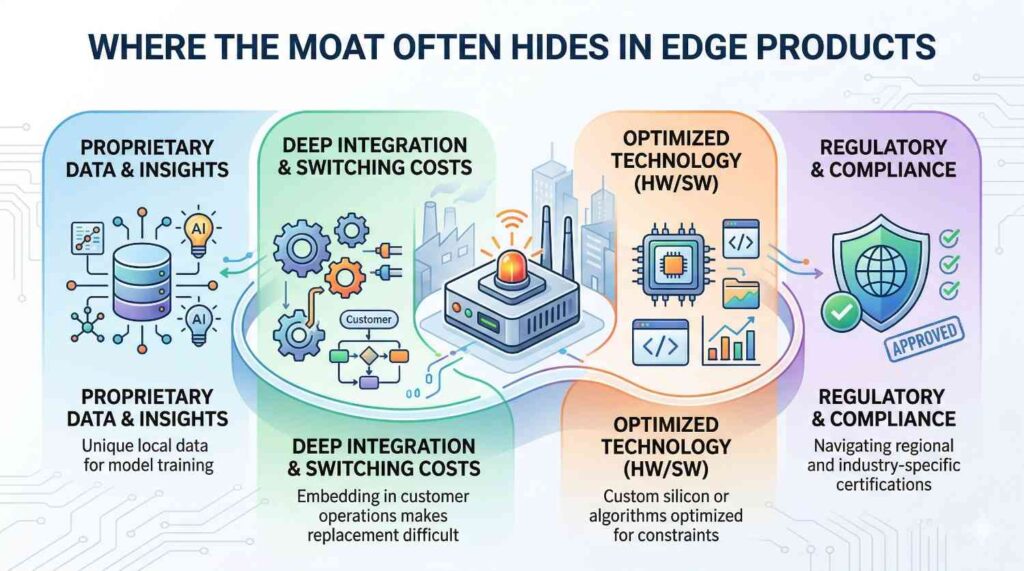
Most embedded AI products are not just a model. They are a chain of steps. The chain begins at a sensor and ends in a decision, an alert, or an action.
The unique part is often the order of the steps, the way data is filtered, the way features are built, or the way the model output is checked before it triggers something real. Even small changes here can create large gains in speed or accuracy.
If your pipeline is custom because the “normal” pipeline fails on-device, you likely have patent material.
The “tricks” that make the model fit
Edge models must fit in small memory and run on small compute. So teams compress, quantize, prune, distill, or split models. Many teams also use early exit logic or dynamic compute, so the device works harder only when it needs to.
The patentable part is rarely “we quantize a model.” The patentable part is how you quantize for your specific signals, and how you preserve accuracy while meeting strict limits.
If you have a method that keeps performance high in the real world while shrinking cost, you should treat it as IP.
The way you manage time, power, and heat
A cloud model can be slow. Many edge devices cannot.
A robot cannot wait for a late decision. A medical device cannot drift. A car system cannot miss a deadline. That pushes you into timing design, scheduling, and power control.
If you built a method that guarantees a result within a fixed time window, that can be a strong invention. The same is true for power-aware inference that changes behavior based on battery state or thermal state.
These are the kinds of details that look boring from the outside, but they are hard to reproduce without your know-how.
The field update and safety layer
Embedded AI products live in the world for years. You ship them, then they face new lighting, new noise, new users, new failure cases, and new rules.
If you have a safe way to update models on-device, roll back, validate performance, and avoid bricking devices, that is often patent-worthy. A strong update system is also a strong buyer and investor signal.
Competitors can copy a model. They struggle to copy a full update and safety pipeline that is proven and robust.
How to Capture Patent Ideas While You Build
Use engineering artifacts as raw input
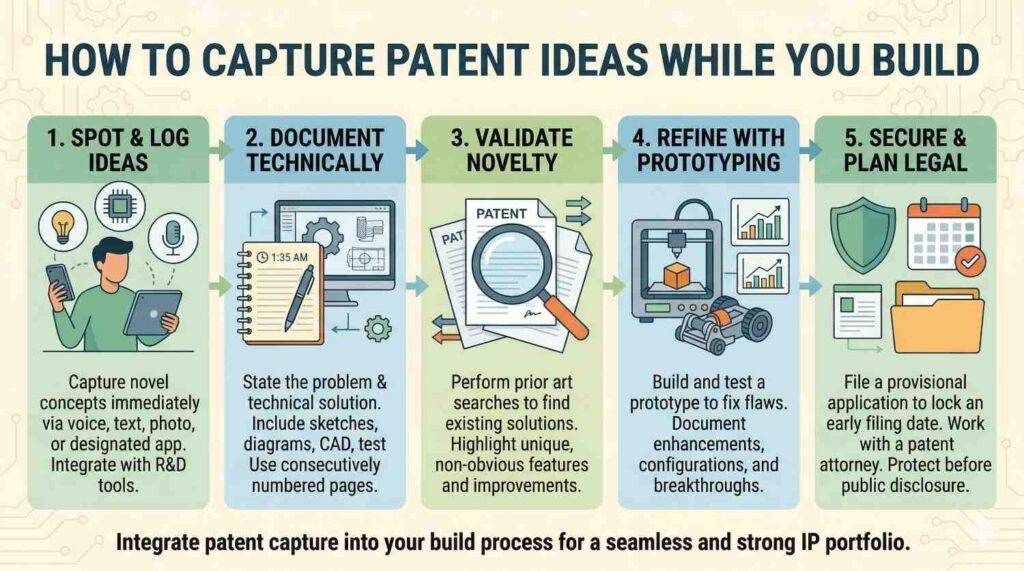
You do not need a special “IP day” to find inventions. Most inventions are already written down in your work.
They are inside design docs, commit messages, bug notes, test results, lab notebooks, and performance graphs. They show up when you write, “We tried A and B, both failed, so we did C, and it finally met the deadline.”
That story is exactly what a patent needs. It explains the problem, the failed approaches, and your solution that works under constraints.
Document the before-and-after
The easiest way to capture a patentable moment is to write a clean before-and-after story.
Before: what was the standard method, and why did it fail in your case? After: what did you change, and what did that unlock? Then: what measurements prove it?
This is not busywork. This makes you a better company. It also makes your patents much stronger because you can support the claims with real evidence.
When Tran.vc supports founders, this is one of the first habits they install. It keeps teams moving fast while still building a defensible moat. If you want help setting this up, apply anytime here: https://www.tran.vc/apply-now-form/
Keep the “invention log” lightweight
The most common reason teams skip IP capture is that it feels heavy. The fix is to keep it small.
A simple habit is to write down one paragraph when a hard issue is solved. Include what was tried, what changed, and why it worked. Add any numbers you have, like latency, memory size, error rate, or power draw.
Over a few months, this becomes a gold mine. When it is time to file, you are not digging through old messages and trying to remember details.
Turning a Technical Win Into a Patent Story
Start with the user pain in the real world
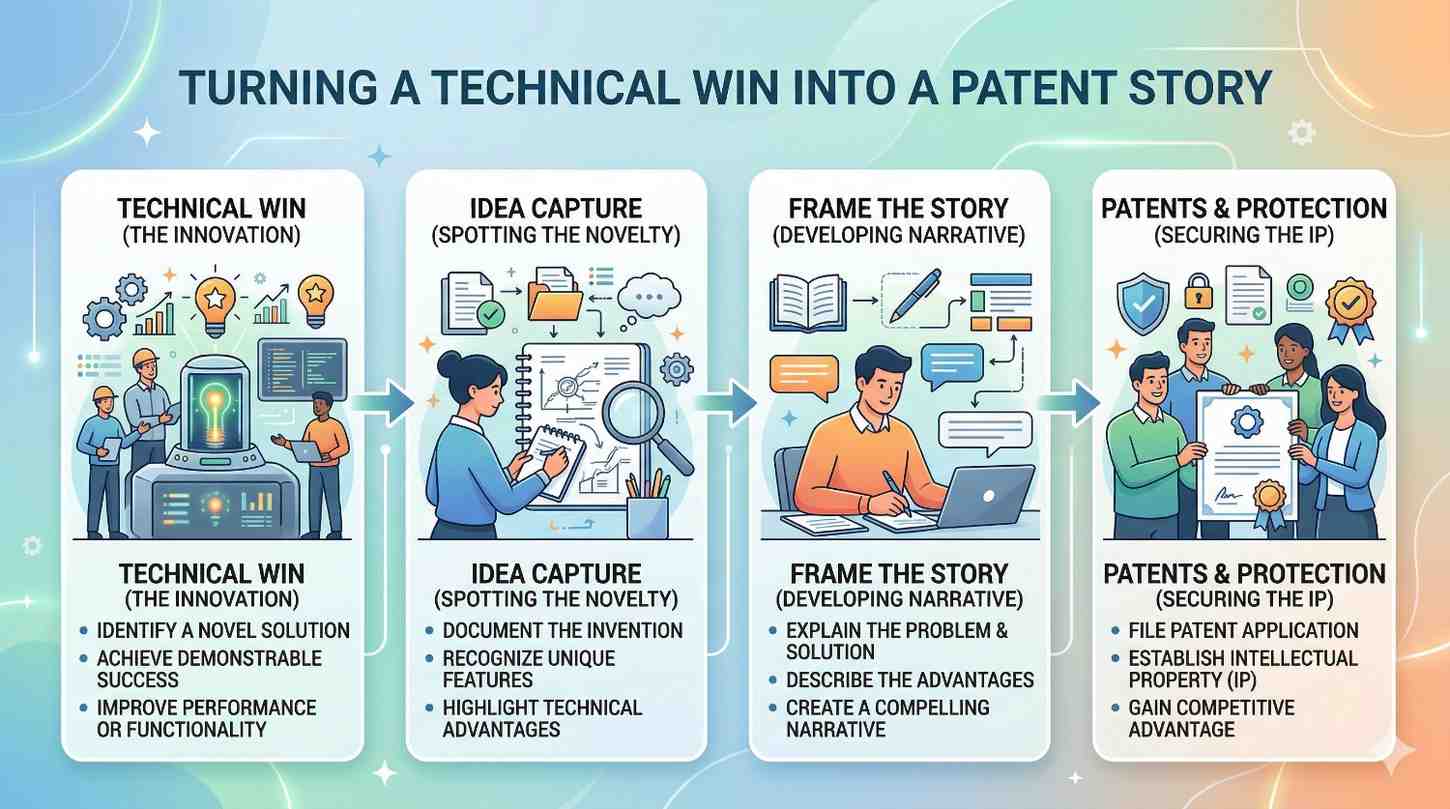
Edge inventions are easiest to explain when you anchor them in the real situation.
For example, “The device must detect a fault in under 30 milliseconds because a motor can be damaged.” Or, “The camera must run for a year on a small battery, so inference must stay below a certain energy budget.”
This kind of framing matters. It shows why your system exists, and it helps the examiner understand the need for your design choices.
It also helps you later, because you can tie your patent coverage directly to the product value.
Break the invention into a system of parts
A good embedded AI patent reads like a system description. It shows the components and how they interact.
You might have a sensor interface, a preprocessing module, a feature generator, a model runner, a confidence checker, and an action policy. You might also have a scheduler, a memory manager, and a power controller.
Each part can become a claim angle. That matters because you want more than one way to protect your idea. If a competitor avoids one part, you still want coverage through another part.
Claim the behavior, not only the code
Code changes fast. Products evolve. Your patent should still fit when you ship version two.
This is why strong patents describe functional steps and system behavior in a broad way. They explain what the system does and how the parts work together, not just a single implementation.
You can still include key implementation examples. But the coverage should not be trapped inside one exact code path.
This is one of the biggest differences between weak filings and strong filings in embedded AI.
Common Mistakes That Make Edge Patents Weak
Filing too narrowly around one chip or one model
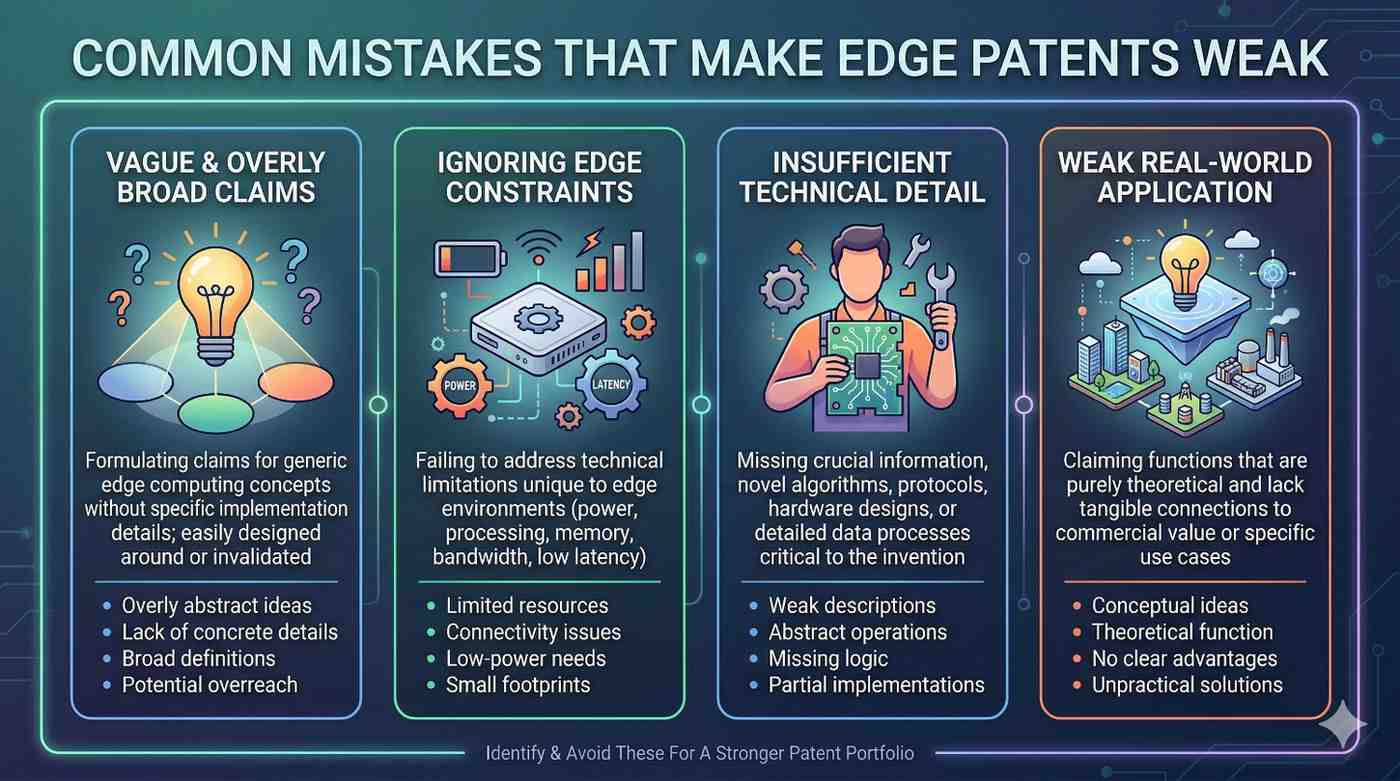
Many founders describe their system in a way that is too tied to today’s hardware.
But your product may move from one chip to another, or from one model family to another. If the patent is written as if it only works on a specific board, you lose long-term value.
A better approach is to describe the compute resources in a flexible way, then show multiple examples. That keeps the patent useful even as you upgrade.
Hiding the best detail because it feels “too specific”
Teams sometimes fear that a patent will give away secrets. So they write vague descriptions.
That usually backfires. Patents must be enabling, and the best patents include enough detail to prove the invention is real. If you remove the key detail, you weaken the filing and make it easier to reject or design around.
A good strategy is to include the key mechanism and its variations. You can still keep certain tuning values as trade secrets. But the core “why it works” should be in the patent.
Waiting until after demos and pilots
Edge products often get shown early because hardware needs partners.
The risk is that a public demo, a talk, a paper, or a partner deck can count as disclosure. Rules vary by country, and some places are less forgiving than others.
The practical move is to file before you show. Even a strong early filing can protect you while you keep building the deeper portfolio.
Tran.vc is built for this stage. The goal is to protect the real invention early, without slowing engineering, so you can demo and sell with less risk. If you want to explore that, apply anytime here: https://www.tran.vc/apply-now-form/
A Practical Example: How a Single Edge Feature Becomes Multiple Patent Angles
Start with one feature you already built
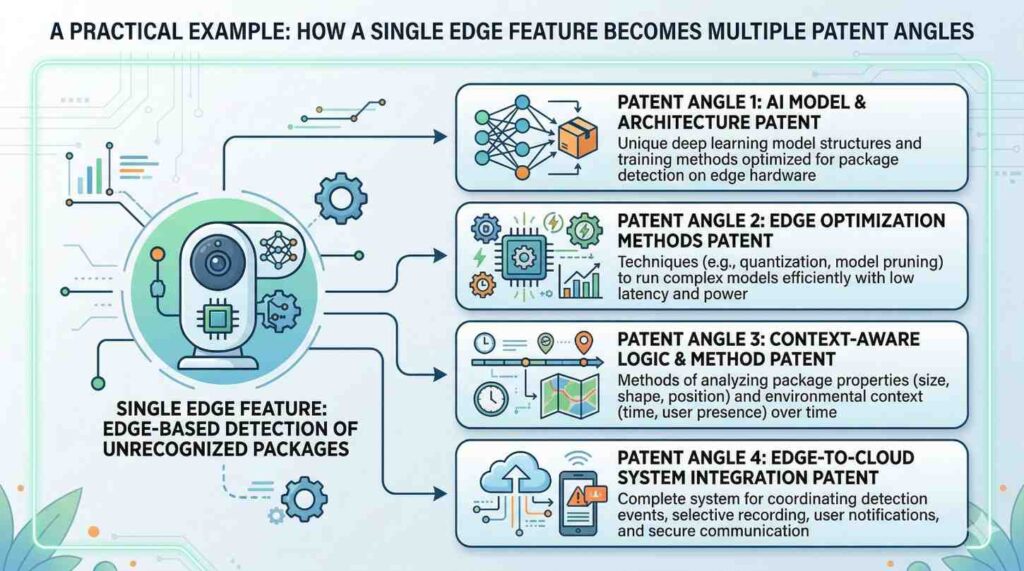
Let’s say your device does on-device anomaly detection for industrial machines.
At first glance, you might think, “That is common.” But your version likely has a unique method to deal with noise, drift, and strict power limits. That is where your IP lives.
When you map the full flow, you often discover several inventions hiding inside one feature.
One idea can produce a small portfolio
You might have a new sampling method that adapts based on confidence and motor speed. You might have a compact feature set that is robust to sensor drift. You might have a fallback mode when the model confidence is low. You might have a way to update thresholds on-device without sending raw data.
Each of these can be protected. Some can be in one filing as different claim sets. Others can be separate filings if they are strong enough.
This is how serious embedded AI companies build patent walls instead of patent pins.
Why this matters for fundraising
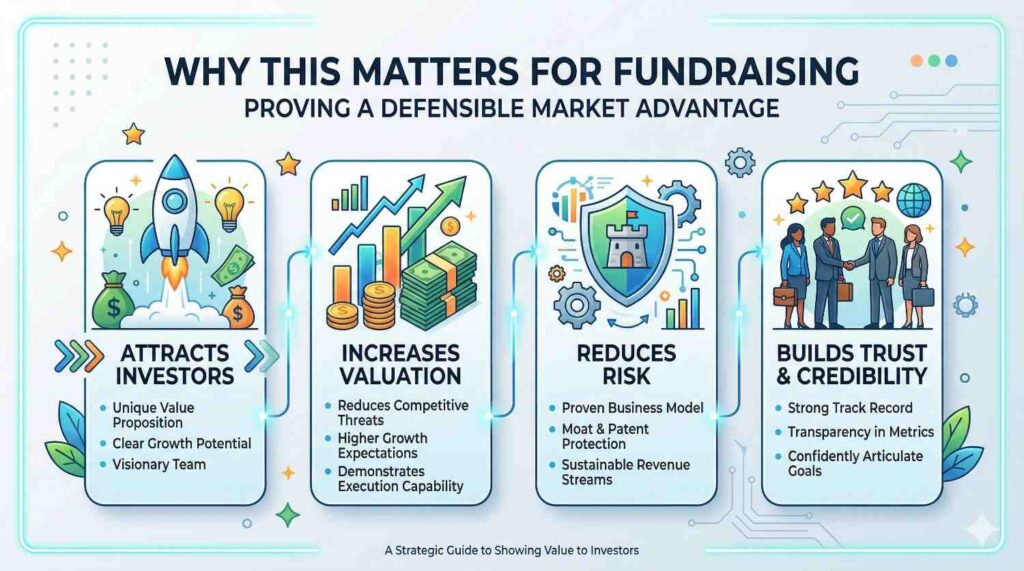
Seed investors back risk. They also look for signals that you can defend value.
A clean edge patent story shows you can build something that is hard to copy. It also signals maturity, because you are thinking about long-term leverage and not only short-term demos.
When Tran.vc works with founders, the goal is not “a patent.” The goal is a portfolio that matches product milestones and business value. If you want help shaping that plan, apply anytime here: https://www.tran.vc/apply-now-form/