
Most founders think patents are “paper.” Investors see something else.
A well-built patent is proof that you can turn a hard idea into a real asset. It shows you can think ahead, protect what matters, and create a clear edge that others can’t copy. And when you use it the right way, it stops being a legal file and starts becoming leverage in a fundraise.
Leverage means you walk into meetings with more control. You don’t beg. You don’t rush. You don’t accept weak terms just because you need money. You can say, calmly, “Here is what we own. Here is why it matters. Here is why you want in early.”
At Tran.vc, we see this pattern over and over. The founders who treat IP like a strategy tool raise with more confidence. They also make better product choices, because they’re building around what they can defend. Tran.vc invests up to $50,000 in in-kind patenting and IP services for AI, robotics, and other deep tec
teams, so you can build that leverage before you’re forced to raise. If you want help shaping your patent into a fundable story, you can apply anytime at https://www.tran.vc/apply-now-form/.
Now, here’s the truth most people won’t say out loud.
A patent does not automatically create leverage.
A patent can be weak. It can be too broad and easy to reject. It can be too narrow and easy to work around. It can describe the wrong thing. It can miss the real value in your system. It can be filed too late, after you’ve already shown the key idea in a talk or a paper or a demo. It can even be “granted” and still not help you raise, because it doesn’t map to a real business advantage.
Leverage comes from how you choose the invention, how you write it, how it connects to your product, and how you present it in the room.
So in this article, I’m going to show you how investors actually think about patents, and how you can turn yours into a tool that improves your terms, increases your valuation, and reduces investor doubt.
Let’s start with the investor’s mindset, because this is where most founders guess wrong.
When an investor backs a startup, they are betting on a future where you win. Not a small win. A big win. That future is risky, and investors know it. They are not just checking if your tech works. They are checking if you can keep others from copying it once the market proves you are right.
Because the moment you prove demand, copycats show up. If you’re in AI, people can copy fast. If you’re in robotics, people can copy parts of your system and sell a “good enough” version. If you’re in infra, someone can bundle features and undercut you. The stronger your moat, the safer the investor’s bet.
Your patent becomes leverage when it reduces that fear.
How Investors Read a Patent
They are not judging legal style

Most investors will not read your patent like a lawyer. They read it like a risk filter. They want to know if your edge is real, and if it can hold up once you get traction.
If your patent looks like a science paper, they may nod politely, but it won’t change the deal. If your patent clearly protects the path that creates your results, their posture changes. They start to see you as harder to copy. That is where leverage begins.
They care about “copy cost,” not “novelty”
Founders often try to impress investors with how new the idea is. Investors care more about how expensive it is to copy the outcome.
If someone can recreate your result with a small tweak and a weekend sprint, a patent won’t save you. But if your claims cover the method that makes your system work in the real world, the copy cost becomes high. That makes investors more confident you can hold the market.
They want to see a moat tied to revenue
A patent is not leverage if it sits outside the buying path. Investors look for a link between IP and money.
If your patent protects a feature customers pay for, it matters. If it protects a method that reduces your cost, it matters. If it protects a process that makes your deployments reliable, it matters. When the IP supports margin, retention, or speed, it becomes a real business asset.
If you want help shaping your patent around what investors truly reward, you can apply anytime at https://www.tran.vc/apply-now-form/. Tran.vc invests up to $50,000 in in-kind patenting and IP services so you can build this foundation early.
Choose the Right Thing to Patent
Patent the “why we win,” not the “what we built”
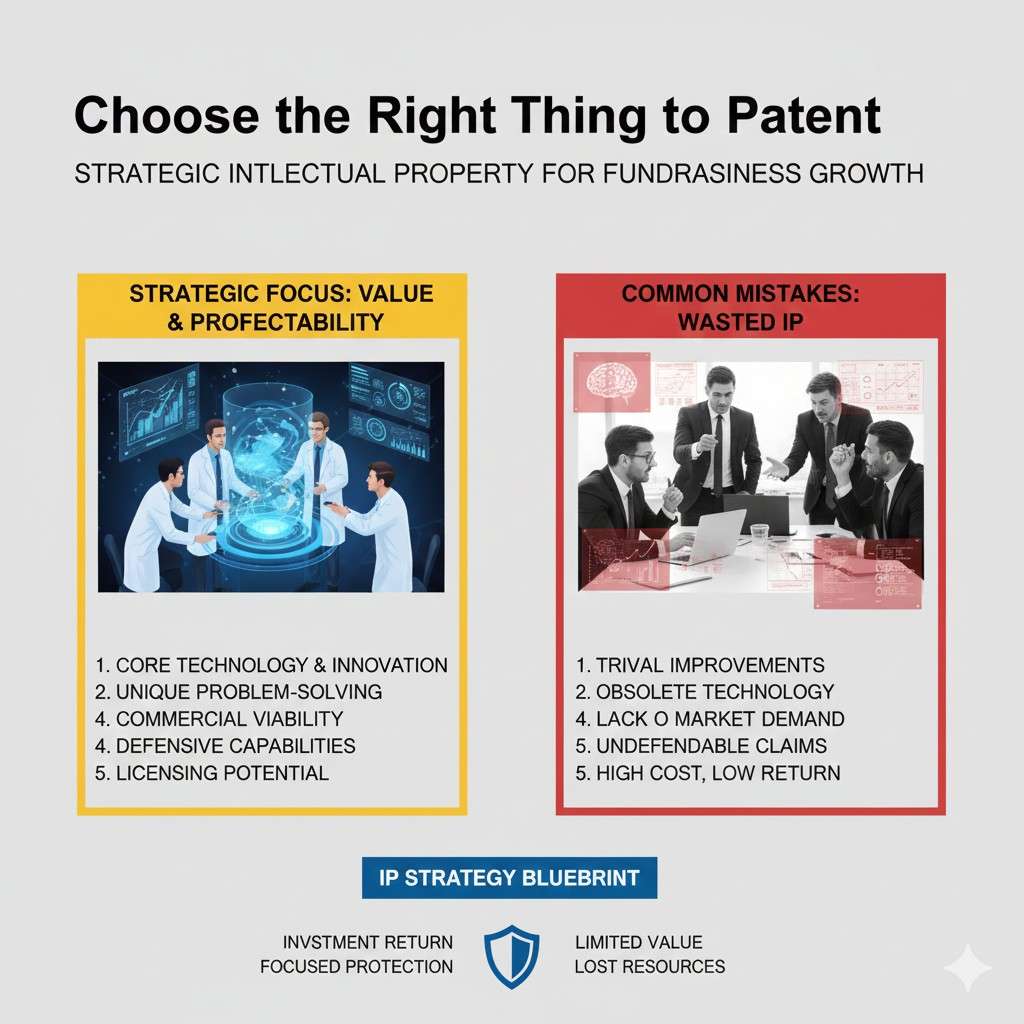
Many founders patent the most visible part of the product, because it is easy to describe. But visible parts are often easy to copy around.
Instead, you want to protect the hidden parts that make your product hard to replicate. That might be the training loop, the control loop, the data capture method, the calibration flow, the safety logic, or the system design that makes performance scale.
When your IP wraps around the real engine, competitors can’t match you without stepping on it. That is the kind of patent that changes how investors price risk.
Look for “must-use” steps in your system
A strong patent often covers steps that a competitor must use to get the same result. This is a very practical way to think about leverage.
Ask yourself what parts of your system cannot be removed without breaking performance. If a competitor tried to recreate your key metric, what steps would they still need? The closer your claims are to those must-use steps, the harder it is to work around.
Avoid patenting the wrong layer
If you patent too high, the claims can become vague and easy to challenge. If you patent too low, the claims can become narrow and easy to dodge.
The sweet spot is usually the layer where the system turns messy real-world inputs into stable outputs. In robotics and AI, that is often where the real value is. It’s also where investors worry about defensibility the most.
If you are not sure which layer is best, that is exactly the kind of problem Tran.vc helps founders solve. You can apply anytime at https://www.tran.vc/apply-now-form/ and get guidance from people who have built and filed in deep tech before.
Turn Your Patent Into a Fundraising Story
Start with a simple problem sentence
Investors remember clarity. If you start with a long technical setup, you lose them early.
A good story begins with the real constraint that blocks the industry. Not the market size. Not the trend. The hard bottleneck that makes other solutions fail.
When you can name that bottleneck in plain words, your patent starts to feel like an answer to a real business wall.
Then explain the “special move” in one breath
After the problem sentence, you need one short explanation of your unique approach. This is not the time for full detail.
You are aiming for a clean sentence that shows what you do differently, and why it matters. If the investor can repeat it back to someone else, you win.
When that “special move” is also the core of your patent claims, you’ve now tied IP to the product story.
Finally connect it to a win metric
A patent becomes leverage when it protects a measurable advantage. That could be speed, accuracy, cost, reliability, energy use, safety, or uptime.
Investors don’t need every internal metric, but they need to see that the patent protects the reason customers choose you. If you can say, in plain words, “This method is why we get this result,” your patent becomes a deal asset, not just a legal artifact.
Make Your Claims Match Your Business
Claims are the product in legal form

Many founders treat the claims like an afterthought, because the language looks intimidating. But claims are what matter.
Think of claims as the part of the patent that defines what you own. If your claims do not cover the core behavior that makes your system valuable, then your patent will not create leverage.
This is why drafting strategy matters. A solid draft is not about sounding smart. It is about covering the actions and system pieces a competitor would need in order to compete.
Cover the critical path, not the full universe
A common mistake is trying to cover everything your company might ever do. That usually makes the patent weaker, because it becomes less precise and easier to reject.
A stronger approach is to protect the critical path that creates your best outcome. The path that, if copied, would damage your ability to win deals and keep margins.
When investors see this focus, they read it as maturity. It signals that you understand what drives your business. That alone can raise trust in the room.
Build a “fence,” not a single stake
One patent can help, but the best leverage comes when your IP forms a fence around your core.
That does not mean filing dozens of random patents. It means shaping filings so that key methods, key system designs, and key variations are protected in a way that makes workarounds painful.
This is one of the main reasons Tran.vc exists. We invest up to $50,000 in in-kind patenting and IP services so founders can build that fence early, before competitors notice. Apply anytime at https://www.tran.vc/apply-now-form/.
Use Timing to Your Advantage
File before you talk too much
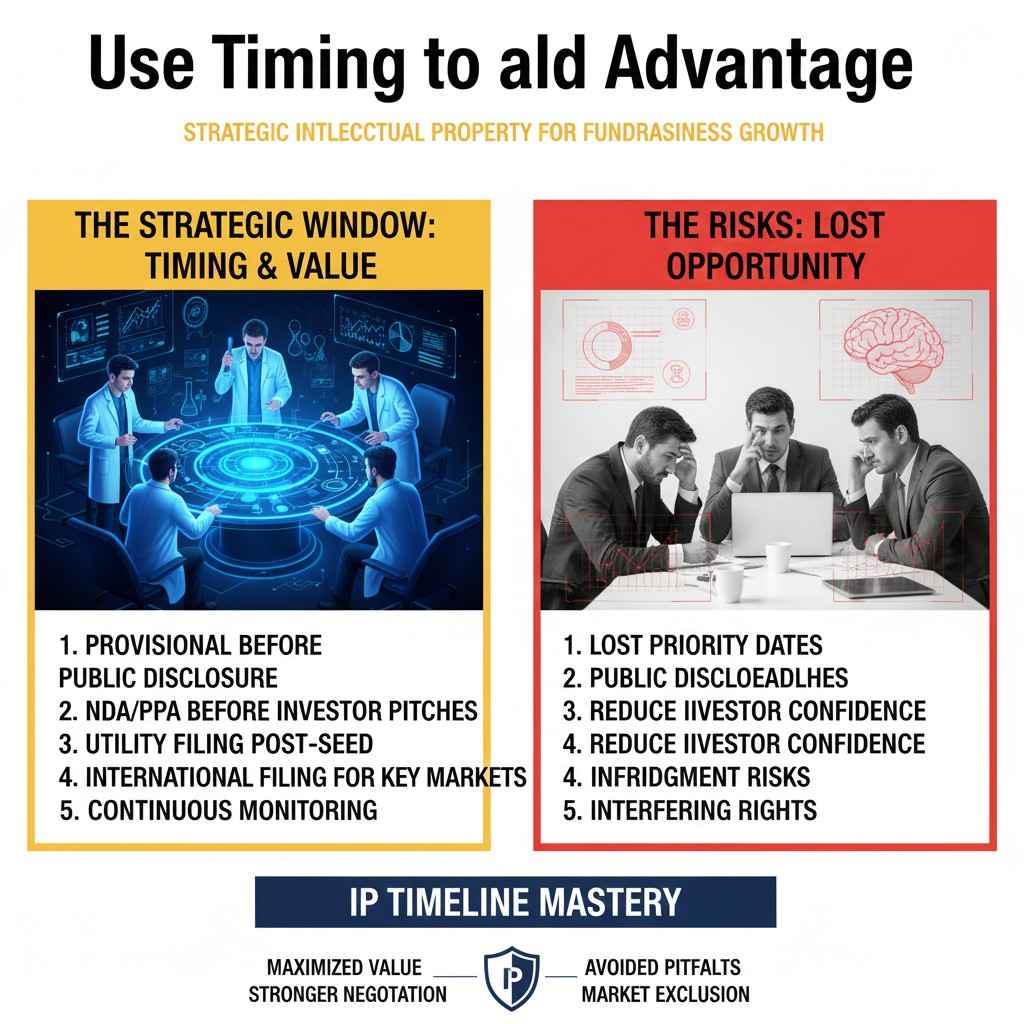
Founders often share details too early. A demo day talk, a blog post, a conference abstract, even a sales deck can create risk if it reveals the core invention before filing.
If you want your patent to become leverage, you need it in motion early. You don’t need everything perfected, but you do need a plan that protects the key ideas before they are widely shown.
Use “patent pending” the right way
“Patent pending” is not magic, but it can be useful when used with care. The value is not the label itself. The value is the signal that you are serious about defense, and that your edge is being captured as an asset.
In investor conversations, you do not need to overplay it. You simply place it in the right spot in the story, and you show what it covers at a high level. That is enough to change the tone of diligence.
Don’t wait for revenue to start
Some founders delay IP until they have revenue, thinking it is “too early.” But in deep tech, the best time is often before the market fully sees what you can do.
If you wait until the space is crowded, you may find that similar ideas have already been filed by others, even if they have not built a real product. Early filing can protect your future options and reduce risk for investors.
Show Your Patent Without Boring People
Do not “read the patent” in a pitch
This is where many technical founders lose the room. They show screenshots of dense pages and start explaining legal wording.
Instead, translate the patent into a simple picture: what problem it solves, what unique method it protects, and why a competitor would struggle to copy you without stepping on it.
This keeps the pitch human, while still making the patent feel powerful.
Build one clean slide that ties it all together
Even though we are keeping lists to a minimum, one structured slide is worth it in a pitch. The slide should not be crowded.
It should show the bottleneck, your method, the outcome, and a short note that the method is protected through filed IP. When the logic is clean, investors do not need legal detail to feel the strength.
Offer depth only when asked
Strong leverage is calm. If you rush to prove the patent is real, it can sound defensive.
A better approach is to show the headline and then offer the backup if the investor wants it. Many investors will ask for more detail when they see the IP is tied to business outcomes.
If you want to build this kind of pitch-ready IP narrative, Tran.vc can help you do it early, without burning months and cash. Apply anytime at https://www.tran.vc/apply-now-form/.
Turn IP Into Better Terms
Use IP to reduce investor fear
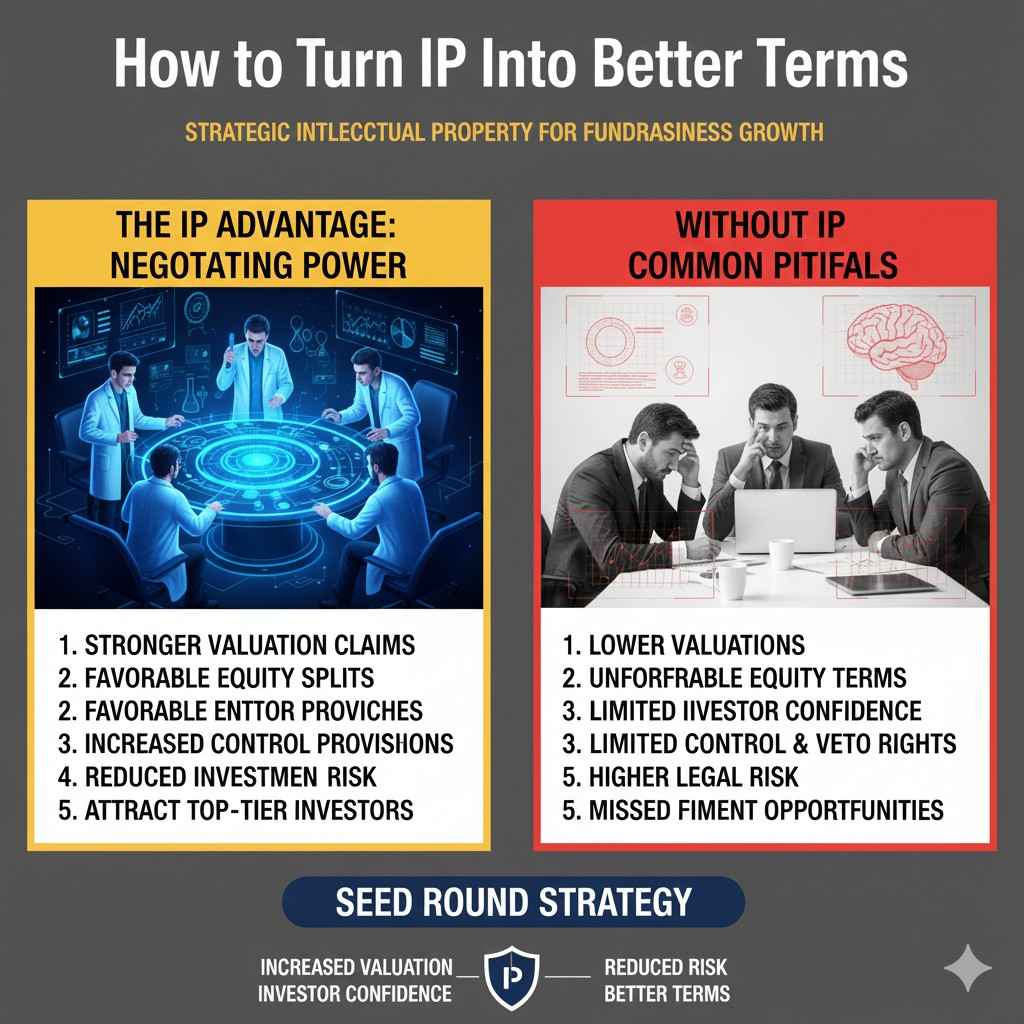
Valuation and terms often come down to perceived risk. If investors believe your advantage can vanish, they push for more control, lower price, or heavier protections.
When your patent clearly protects the advantage, you reduce that fear. Less fear often means cleaner terms. Not always, but often enough that it becomes a meaningful lever.
Use IP to justify focused traction goals
Another quiet way patents create leverage is by letting you raise on a clearer plan.
Instead of trying to prove everything at once, you can propose a tight milestone path and show that the core method is protected while you execute. Investors are more willing to fund a focused plan when they believe the upside can be defended.
Use IP to hold your ground in negotiations
When a round gets competitive, patents can increase urgency. But even when a round is not competitive, IP can still help you hold your ground.
You can say, in a measured way, that you are building protected technology in a space where fast followers are common. You can explain that your approach is not easily copied, and that you are investing early in defense. That posture supports stronger pricing and less pressure to concede control.
Build a Patent Portfolio That Feels “Inevitable”
Think in systems, not single inventions
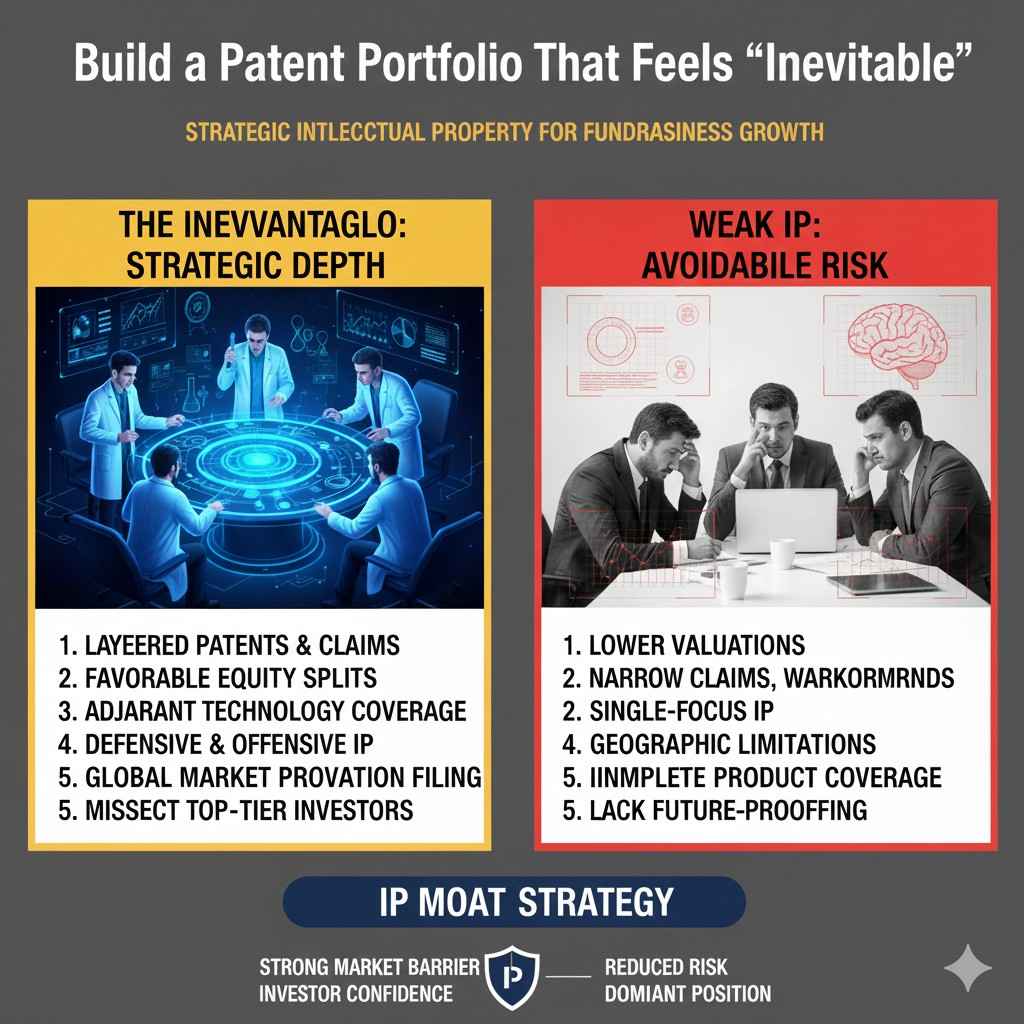
A single patent can help, but investors get much more comfortable when they see a pattern. They want to believe your company is building a protected system, not a one-time trick.
In AI and robotics, your advantage often comes from how parts work together. Sensors, models, control, data loops, safety checks, and deployment methods all stack. When your IP plan follows that stack, it signals that you understand where defensibility lives.
This does not mean filing many patents for the sake of it. It means choosing a few strong filings that lock down the parts that make the whole system hard to reproduce.
Separate “core” from “support” inventions
Your core invention is the one that, if copied, would erase your edge. That is the first thing to protect.
Support inventions are the ones that make your core invention practical, reliable, and scalable. These can be just as valuable because competitors often try to work around a main claim by changing small steps. If your support inventions cover those steps, the workaround becomes costly.
When investors see this, they stop asking, “What if they get around it?” because your IP plan shows you already thought about that problem.
Use a simple map to show coverage
You do not need complex diagrams. You can create a simple map that shows where your IP sits inside your product flow.
For example, if your robot’s edge is stable operation in messy settings, show where that stability comes from. Point to the method that drives it. Then show that your filings cover the core method and the key variations.
This kind of map is not for legal review. It is for investor trust. It helps them see that you are building a real moat on purpose.
If you want to build this kind of IP map with experienced help, Tran.vc invests up to $50,000 in in-kind patenting and IP services. You can apply anytime at https://www.tran.vc/apply-now-form/.
Turn Your Patent Into a “Category Claim”
Own a clear sentence that investors repeat
The best leverage is a story that travels. If an investor cannot repeat what you own, it won’t help you after the meeting.
Your patent can support a simple “category claim.” That means a short sentence that says what new capability you enable, and why you are hard to copy.
An example in plain form looks like: “We make robots stay stable on uneven ground by using a feedback method that corrects drift in real time, and we’ve filed IP around that method.”
The exact words will be different for your company. The structure is what matters. It makes your IP easy to remember, and it makes your defensibility easy to explain.
Link the claim to a painful buyer need
A category claim is not about sounding big. It is about connecting your protected method to a pain buyers already feel.
When your claim matches a real cost, a real failure mode, or a real safety risk, it becomes believable. Investors can then picture a market pulling you forward, instead of you pushing a nice demo into the world.
This matters because many deep tech startups fail at the story level. They build something smart, but they do not frame it as a must-have. Your patent can help you frame it as a must-have, because it proves you are not just “doing what everyone does.”
Make the claim hard to contest
Investors get skeptical when claims sound like marketing. You reduce that skepticism by tying the claim to one concrete result.
You do not need to share every number. But you should have one anchor metric that shows why your method matters. It could be fewer failures, lower cost, higher uptime, faster training, safer operation, or better accuracy under noise.
When your claim, your metric, and your patent align, you sound like a company that has momentum and control. That is leverage.
Use Patents to Unlock Enterprise Deals
Enterprise buyers ask different questions
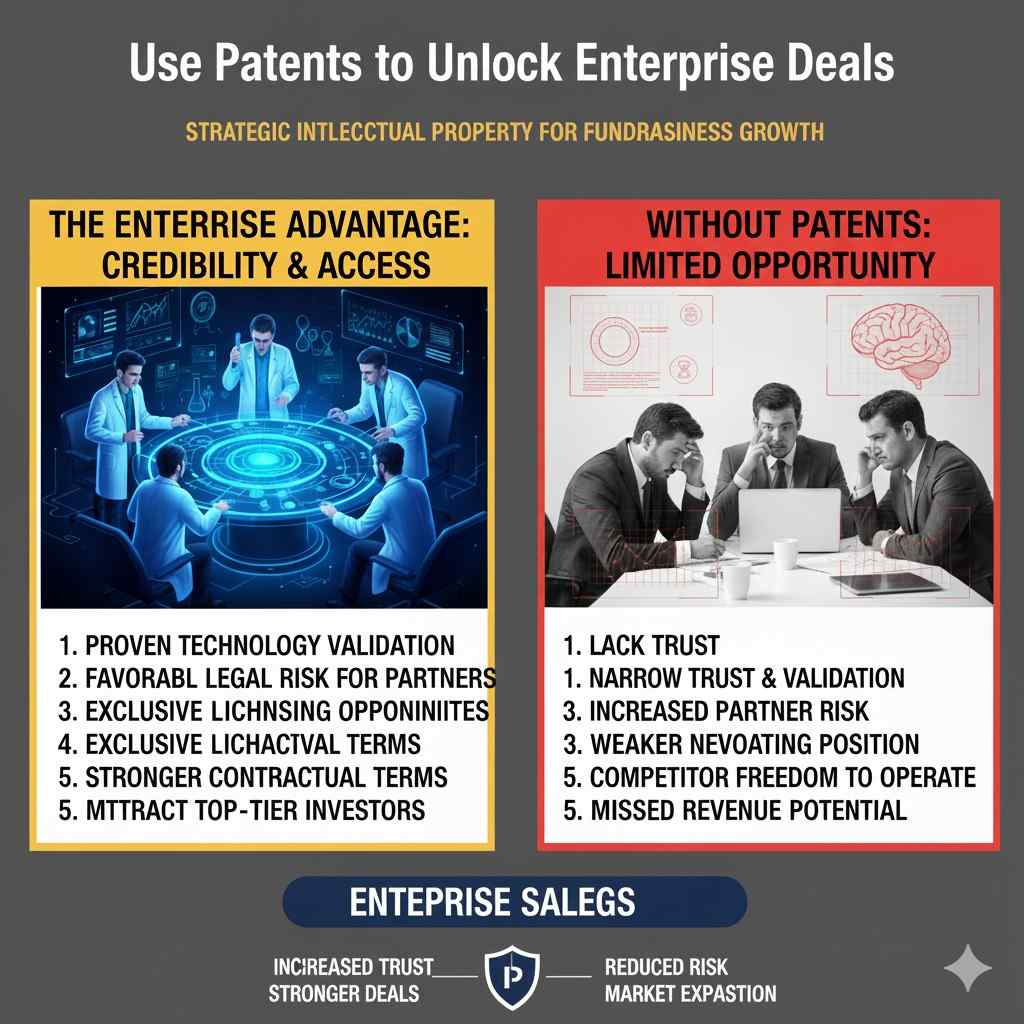
Early buyers can be forgiving. Enterprise buyers are often not. They may love your product, but they still ask, “Do you own this?”
They ask because they fear vendor risk. They fear being stuck with a tool that gets sued, copied, or shut down. They fear depending on a supplier who has no defensible position.
Even if your patent is not granted yet, having a clear filing strategy can reduce friction in these conversations. It signals seriousness.
A patent can shorten security and procurement cycles
In many enterprise settings, risk reviews slow things down. IP is not the only risk, but it is part of the broader picture of vendor maturity.
When you can clearly explain what you protect and why it is unique, you help the buyer justify the decision internally. You give them language they can use with their legal team and leadership team.
This is not about threatening anyone. It is about making your company feel safe to bet on.
Use “IP posture” as a sales tool
Even if a buyer never reads your filing, your IP posture can still support your sales motion.
An IP posture means you can show that you have identified the valuable inventions, filed around them, and built the product to match those inventions. It’s the difference between “we might file someday” and “we already protect the engine.”
That difference often shows up in pricing power. When buyers believe your advantage is protected, they are less likely to treat you like a replaceable vendor.
If you want help building an IP posture that supports fundraising and sales, you can apply anytime at https://www.tran.vc/apply-now-form/.
Avoid the Patent Mistakes That Kill Leverage
Mistake one: filing after you overshare
Founders love to talk about what they are building. Talks, podcasts, blogs, conferences, even casual demos can spread key details.
If those details describe the inventive part before you file, you can create real IP risk. It can narrow your options and weaken future claims.
The safer path is to file early around the core idea, then speak freely about the parts that do not expose the key steps. This does not mean you hide everything. It means you protect the engine first.
Mistake two: writing the patent like a research paper
A research paper tries to explain and prove. A patent needs to define and cover.
When patents read like papers, they often miss the practical variations and alternate forms that competitors can use to work around. Investors can sense this when they look closely, especially if they have seen many deep tech deals.
A strong filing anticipates how others might copy and change the idea. It describes those variations so your protection is not fragile.
Mistake three: treating patent strategy as a one-day task
Many teams rush a filing to check a box. Then they do not revisit the strategy as the product evolves.
But your product will change. Your customers will reveal what they truly value. Your system will mature. New inventions will appear as you scale.
If you do not update your IP plan, you can end up protecting the wrong parts while leaving the valuable parts exposed. Investors do not like that surprise.
Mistake four: not connecting the patent to the roadmap
A patent helps most when it supports your future roadmap, not only what you shipped this month.
If you file on a method that will not matter in the product you sell next year, you may end up with “dead IP.” Investors see that as wasted effort.
A better approach is to file on what will stay true as you grow. The core loops, core methods, and core system structures that will still matter at scale.
This is exactly why Tran.vc works hands-on with founders. We help you choose what to protect so the IP stays aligned with the business as it grows. You can apply anytime at https://www.tran.vc/apply-now-form/.
Use Your Patent in the Room Without Sounding Defensive
Bring it up at the right moment
If you lead with your patent too early, you can sound like you are hiding behind legal paperwork. If you bring it up too late, you miss the chance to reduce risk while the investor forms their first impression.
A good timing pattern is simple. First you show the problem, then the solution, then the proof, and then you briefly show what you protect.
When the investor already believes the problem is real and the approach is strong, the patent lands as a confidence booster instead of a distraction.
Speak like a founder, not like counsel
You do not need to say “claims” and “embodiments” in a pitch. That language can create distance.
Instead, speak plainly. Explain what you protect in human terms, and why it matters. Then offer to share more detail in diligence if needed.
This keeps you in control. It also keeps the conversation focused on business value, which is where leverage is created.
Prepare for the two common questions
Most investor questions around patents fall into two buckets.
The first is about strength: “How hard is it to work around?” That is where you explain, calmly, that your filing covers the must-use steps and key variations. You do not overpromise. You show you have thought about real competitive behavior.
The second is about timeline: “Is it granted?” Here you explain that early-stage companies often operate with filings in progress, and what matters is that the core methods are captured early and being prosecuted with a strategy that fits the product.
If you can answer these two questions without getting tense, your patent becomes a stabilizer in the meeting.