
Grant reviewers and SBIR panels do not just fund “cool tech.” They fund teams that can prove three things at the same time: the idea is real, the risk is managed, and the upside belongs to the company that is asking for money.
That last part—ownership and protection—is where patents quietly move from “legal paperwork” to “funding strategy.”
A smart patent plan can make your proposal feel safer without making it feel slower. It can help you explain what is truly new, why it matters, and why a competitor cannot simply copy it the moment your results look promising. It also helps you talk about your work in a clear, structured way, because patent thinking forces you to define the invention, the problem it solves, and what exactly makes it different.
This guide will show you, in plain words, how to use patents the right way when you are applying for grants and SBIRs—without wasting time, without over-sharing, and without filing the wrong thing too early.
And if you want hands-on help building that plan, Tran.vc invests up to $50,000 in in-kind patent and IP services for AI, robotics, and deep tech startups—so you can build protection early while keeping control. You can apply anytime here: https://www.tran.vc/apply-now-form/
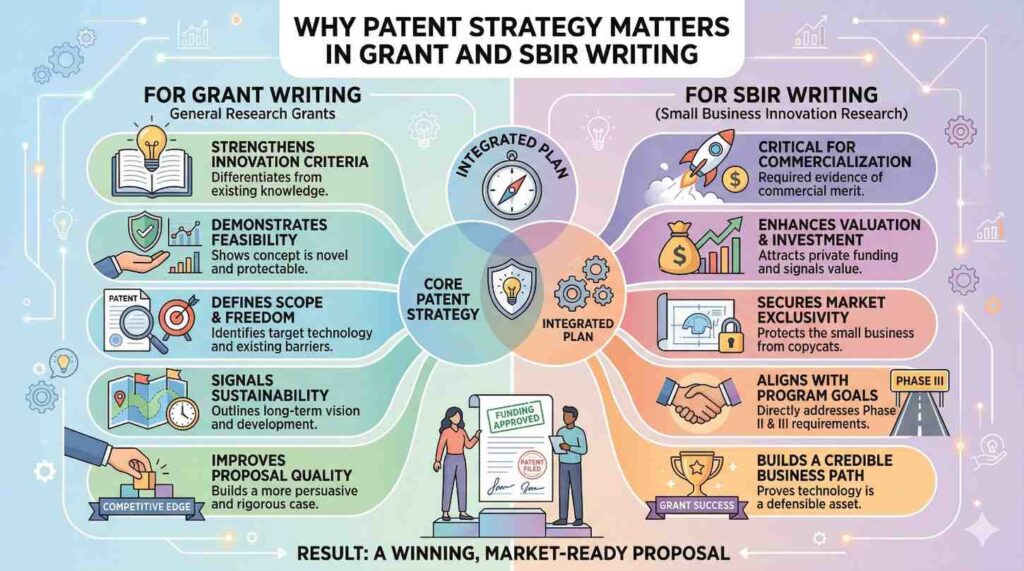
Why patent strategy matters in grant and SBIR writing
Reviewers fund “ownable” outcomes, not just experiments
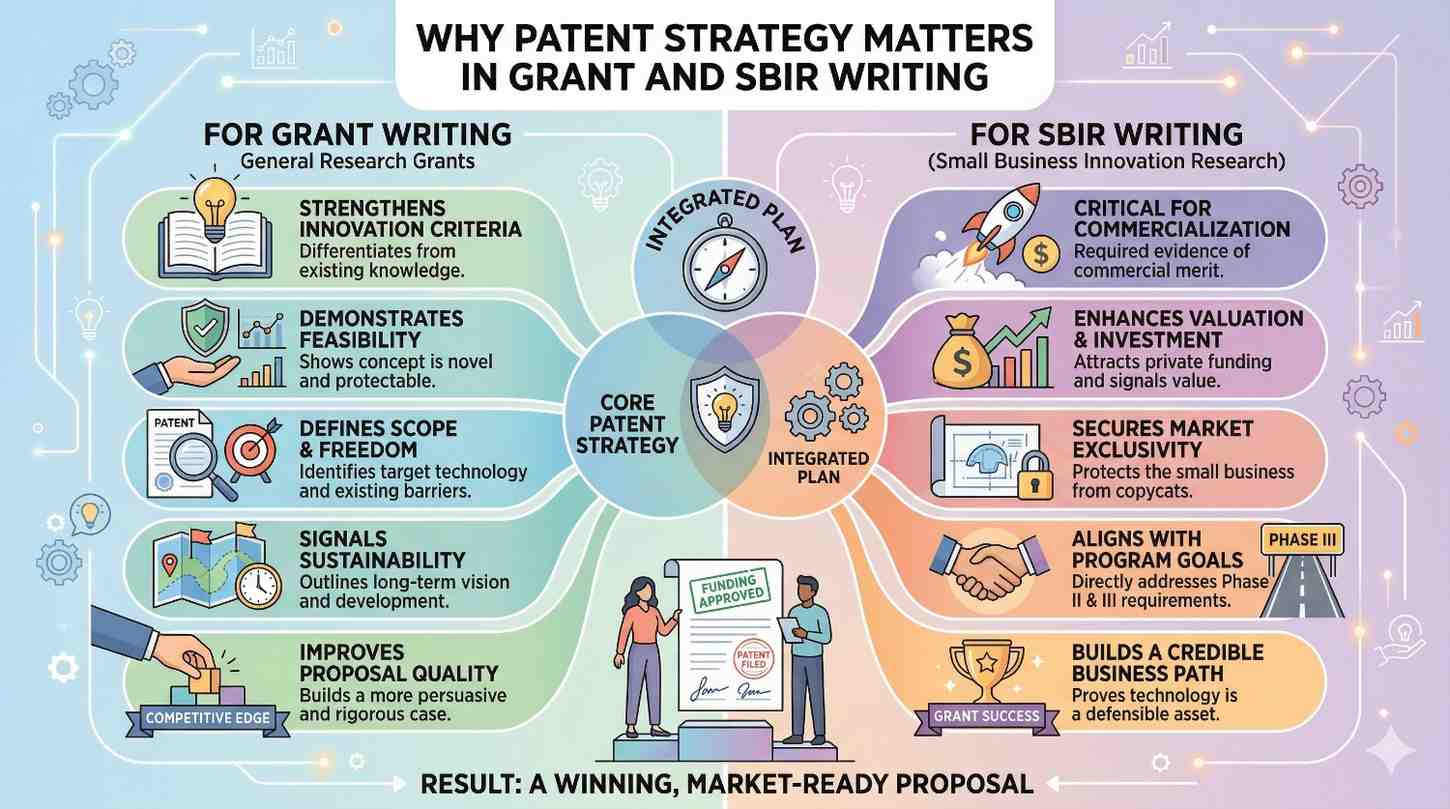
When a panel reads your grant or SBIR, they are judging more than your science. They are judging whether the results will turn into something that a real company can build, sell, and defend. If your work can be copied the moment it shows promise, the funding feels risky, even if the tech is strong.
A good patent strategy lowers that risk in a quiet but powerful way. It tells the reviewer that your progress will not leak value to competitors. It also tells them you have thought about real-world use, because patents force you to define what you are making and why it is different.
This is why IP shows up again and again in strong proposals. Not as legal talk. As a clear story: “Here is what is new, here is what we will protect, and here is how protection supports impact.”
IP is part of commercialization, even in early-stage research
Many technical founders treat IP like a later task, something you do after the prototype works. In grant and SBIR work, that mindset can hurt you. These programs are built to move ideas out of the lab and into the world, and commercialization is not a “Phase II problem.” It starts the day you ask for money.
A patent plan helps you explain the path from research to product in a way that feels grounded. It connects the technical aims to a market outcome. It shows that the company will have leverage when it talks to partners, customers, and future investors.
If you are building in AI or robotics, this matters even more. In these fields, it is common for others to copy quickly, improve slightly, and compete on speed or distribution. Patents are not the only defense, but they are a strong signal that you are building something that lasts.
Tran.vc’s angle: protect what matters before you raise
Tran.vc invests up to $50,000 in in-kind patent and IP services for deep tech founders. That means real support from patent experts, shaped around the invention and the funding path, not generic templates. The goal is simple: help you build an IP-backed foundation early so you raise from strength, not pressure.
If you want to build your patent plan alongside your grant strategy, you can apply anytime here: https://www.tran.vc/apply-now-form/
How grants and SBIRs treat “public disclosure” and why it can hurt you
A proposal can become a disclosure if you are not careful
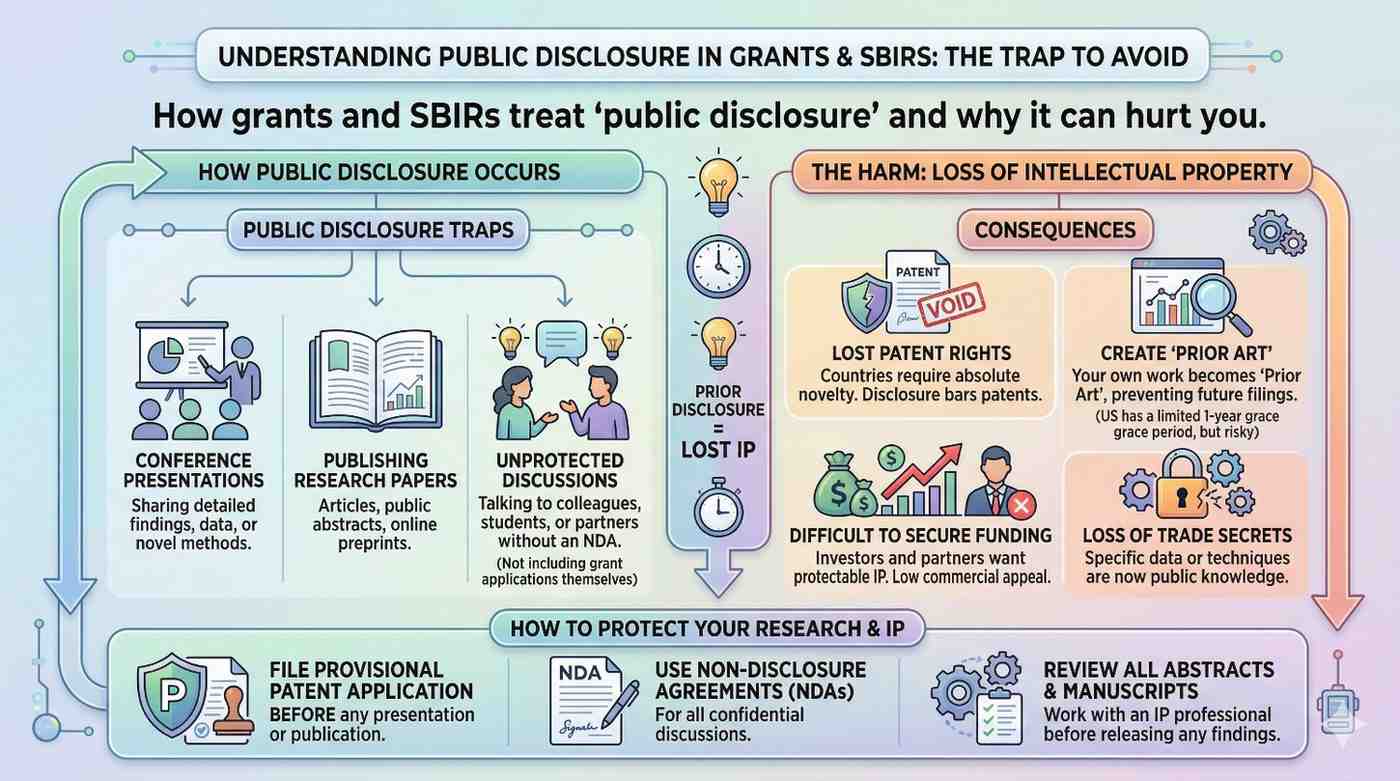
One of the easiest ways to damage patent options is to share too much too soon. Grant writing pushes you to be detailed. SBIR writing pushes you to show you know what you are doing. That combination can lead founders to describe the secret sauce in plain words, with diagrams and results, and then send it into systems they do not fully control.
In the United States, you often have some room after disclosure to file, but that room is not universal. Many countries do not forgive early disclosure the same way. Even in the U.S., relying on “we can file later” can backfire if timelines slip, if a team member publishes, or if a partner talks.
A practical rule is to treat any document that may leave your direct control as if it could become public. That mindset does not make you paranoid. It makes you professional.
You can explain novelty without giving away the crown jewels
There is a difference between describing what your system achieves and describing exactly how it achieves it. Reviewers need to understand what is new, but they do not need a full blueprint. They want to see that you have a defensible insight, not that you have typed the full implementation into the appendix.
A smart patent plan helps you decide what to reveal and what to hold. You can talk about performance gains, system-level design choices, safety constraints, and the problem structure you solve, without handing over the precise steps that make your method hard to copy.
This is where many founders slip. They think more detail always equals more credibility. In reality, clear structure equals credibility. You can be clear without being exposed.
Timing is not a legal detail, it is a funding tactic
Grant cycles have fixed windows. SBIR has deadlines. Review periods take time. If you wait until “after we submit” to think about IP, you may end up filing in a rushed way, or not filing at all, or filing something that does not match what you actually built.
The best timing is usually to connect filing to milestones. If the next milestone is a key experiment or a field demo that you must describe in detail, that is often a good moment to file at least a provisional patent first. This gives you breathing room to write freely in the application, while still protecting core claims.
If you want help mapping your timeline so your filings support your submissions, Tran.vc does this kind of planning with founders. You can apply anytime at: https://www.tran.vc/apply-now-form/
What reviewers actually want to see in the IP section
They want a plan, not a pile of patents
Some founders think the goal is to show a big number. “We filed three provisionals” sounds impressive, but reviewers often care more about fit than count. A single well-aimed filing that matches the product path can be stronger than five filings that chase minor ideas.
Reviewers want to see that you know what you are protecting and why. They want to see you can build a business, not just collect paperwork. That means your IP story should connect to your market story, your technical aims, and your team’s ability to execute.
When your IP section feels like it belongs in your proposal, reviewers relax. When it feels like a copy-paste paragraph, they notice.
They want freedom to operate thinking, even if it is early
A full freedom-to-operate study is not always required at the earliest stage, but reviewers like to see that you have at least looked around. They want to know you are not building inside someone else’s fence. A short, honest statement that you have done a prior art and patent landscape scan, and that you have a plan to manage risks, can go a long way.
This is especially important in robotics and AI, where patents can cover sensors, control loops, training pipelines, data handling, and system integration. Even if your core idea is novel, a subpart might collide with existing claims. Showing awareness makes you look mature.
You do not need to pretend you have solved every legal risk. You need to show you see the risks and have a process.
They want clarity on who owns the work
Ownership problems kill deals and weaken grants. If an invention was created at a university, under a lab, or with a prior employer’s tools, ownership may not be clean. Reviewers and program officers may not investigate deeply at first, but commercialization reviewers often catch these issues.
You should be able to state, in plain words, that the company owns the key inventions or has the rights it needs. If there are joint inventors, sponsored research terms, or background IP, you should have a clean plan for licenses or assignments.
This is not about oversharing. It is about removing doubt.
Building a patent strategy that matches SBIR phases
Phase I: protect the core insight before you prove everything
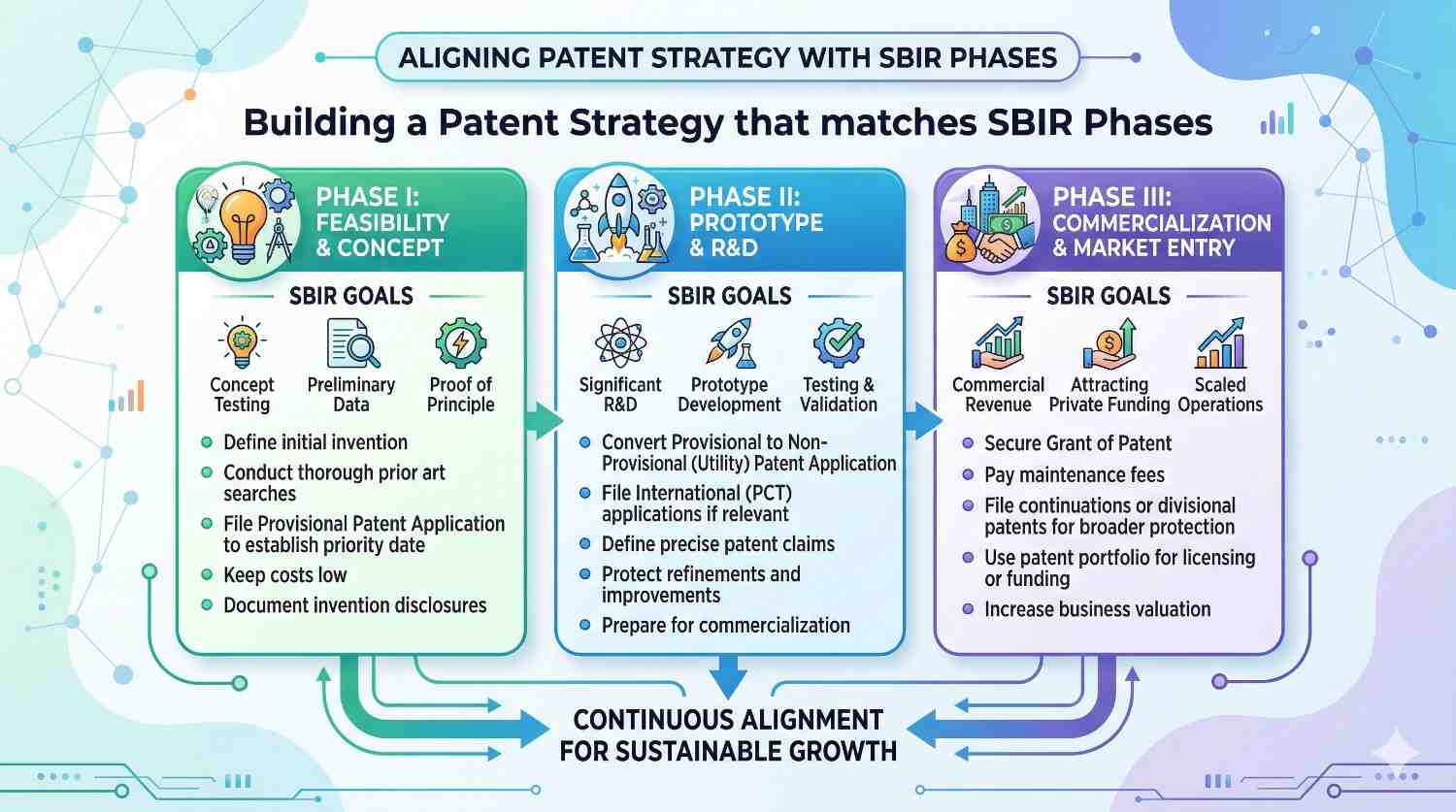
Phase I is usually about showing feasibility. That means you may not have full performance results yet, but you often do have the key insight. The key insight is what patents are built around. If you wait until the end of Phase I to file, you may have already disclosed key details in your proposal or in discussions with partners.
A good Phase I patent strategy usually focuses on the main inventive concept and a few strong variations. You do not need to claim every feature. You need to claim the heart of what makes your approach different and useful.
In robotics, this might be the control method under uncertainty, the sensing fusion logic, or the safety envelope. In AI, this might be the training method, the data pipeline that improves reliability, or the way you enforce constraints.
Phase II: expand the coverage around the system and the use cases
Phase II is where you push toward a product. Your patent strategy should widen with that push. By this stage, you often know more about the real constraints: cost, compute, power, latency, deployment environment, and customer needs.
This is the stage where you often file more than one application, not because more is always better, but because different parts of the system may deserve their own protection. A system claim can protect the whole pipeline. A method claim can protect the steps. A device claim can protect a physical integration. The right mix depends on what competitors would copy first.
Your goal is not to build a wall of paper. Your goal is to make copying expensive and uncertain.
Phase III: use IP to support partnerships, pilots, and scale
Phase III is about market traction and scale, even if the program does not fund it directly. Here, patents become leverage in partner talks. They also become a tool to defend pricing and to reduce fear in buyers who worry about vendor lock-in or future lawsuits.
At this stage, you also care about where you file. If your market is global, you may need to think beyond U.S. coverage. This is where planning early saves you money later, because deadlines for foreign filings come fast.
If you want a team that can help you make these choices with clear tradeoffs, Tran.vc’s in-kind IP support is designed for exactly this stage of growth. Apply anytime: https://www.tran.vc/apply-now-form/
Translating your invention into “claim-ready” language without getting lost
Start with the problem you remove, not the feature you built
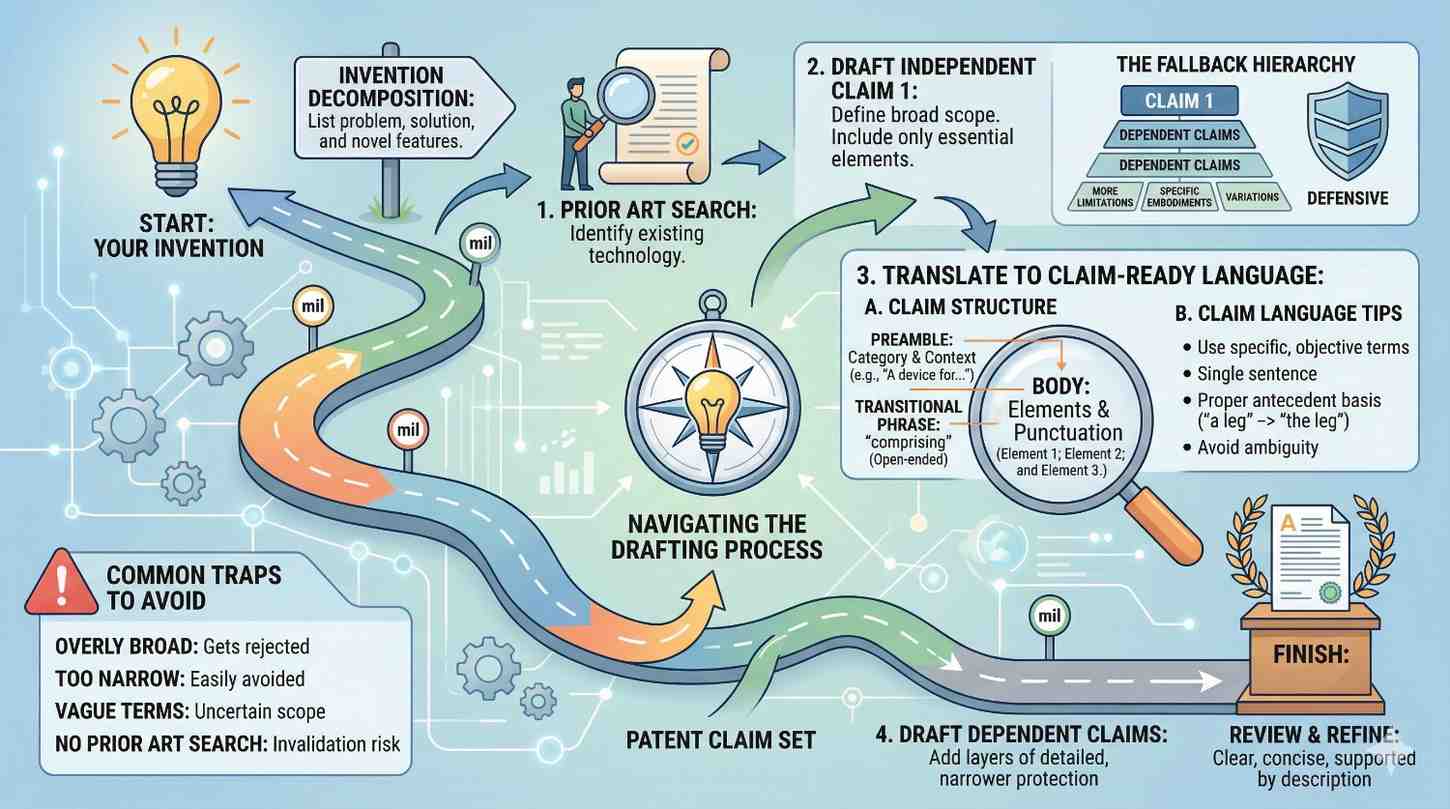
Founders often describe inventions as features. Reviewers and patent examiners care more about problems and constraints. When you anchor your story in the problem, you create a cleaner link between your technical aims and your protection plan.
For example, “we built a perception module” is vague. “We reduce false positives in low-light motion detection while keeping latency under a fixed limit” is clearer. The second statement helps you explain novelty, helps you define test plans, and helps you shape claims later.
This way of thinking also improves your proposal writing. Your aims become sharper. Your metrics become more meaningful. Your path to impact becomes easier to believe.
Define the smallest “must-have” of the invention
Every invention has a core that cannot be removed without breaking the value. Your job is to name that core in simple words. If you cannot explain it to a smart person outside your domain, you will struggle to protect it and struggle to pitch it.
This core is what you file first. It is also what you protect most aggressively. Everything else can become a dependent layer later. When you do this well, you avoid filing a patent on a nice-to-have detail, and you avoid missing the true invention.
A fast test is to ask: if a competitor copied only one thing from us, what is the one thing that would hurt the most? That is usually where your first claims should point.
Build variation early so competitors cannot “design around” you
A common patent mistake is to describe only the exact version you built. Competitors do not copy exactly. They copy the shape of the idea and change just enough to dodge you. Good patents anticipate those changes.
You do not need a long list of variations in your proposal. But in your patent planning, you should name several ways the system could be implemented and still deliver the same outcome. Different sensors, different model types, different deployment settings, different thresholds, different order of steps.
This is not legal games. This is strategy. It turns your invention from a narrow lane into a wider protected space.
Using patents to strengthen the core grant story
Novelty becomes more believable when it has structure
Grant reviewers see a lot of “new” ideas. When you present novelty as a structured invention, it lands better. You can describe the prior approach, the gap, and the new mechanism in a way that feels like engineering, not marketing.
Patents train you to do this. They require you to name the parts, the steps, and the interactions. That structure helps reviewers follow your logic quickly. It reduces the mental work they must do to understand why you win.
When reviewers understand quickly, they trust faster. Trust is what wins funding.
Risk feels smaller when protection is planned
SBIR and grant work is always about risk. Technical risk, market risk, execution risk. A patent plan does not remove those risks, but it removes a specific fear: that success will be stolen.
If you can say, in a calm and concrete way, that you have filed on the core idea, and that you have a plan for follow-on filings as milestones are met, you help the reviewer picture a stable outcome. That stability makes it easier for them to recommend your project.
You do not need to be dramatic. You need to be clear.
Commercialization feels real when IP matches the go-to-market
The strongest IP sections do not float separately. They match the customer and the product path. If your first customer is a hospital, your claims should reflect the workflow and safety constraints that matter in that setting. If your first customer is a factory, your protection should reflect deployment and uptime constraints.
This alignment shows you are not building in a vacuum. It shows your work will land somewhere specific, with a buyer who has a clear pain. That is exactly what commercialization reviewers want to see.
If you want help making your patent plan match your market entry plan, Tran.vc is built for this kind of founder-led strategy. Apply anytime: https://www.tran.vc/apply-now-form/
Patent Strategy for Grant Applications and SBIRs
What to file before you submit
Provisional patents and why they fit grant timelines
A provisional patent is often the best first move when you are preparing a grant or SBIR. It is not because it is “cheap” or “fast,” though those can be true. It is because a provisional lets you lock in a filing date while you keep building. That matters when your application forces you to explain the work in detail.
Think of a provisional as a snapshot of your invention on a specific day. If it is written well, that snapshot becomes the foundation you can build on later. It gives you room to speak more openly in the grant because you have already filed.
Many founders treat a provisional like a placeholder. They write a few pages, add a diagram, and assume it will protect them. In practice, a weak provisional can be worse than none. It can create false confidence. It can also lead to a later non-provisional that does not truly claim what you thought you had protected, because the early document did not describe the invention deeply enough.
A strong provisional is not about legal style. It is about technical completeness. It should read like a careful internal design note that explains the method, the system, and the variations, in a way that a skilled person could reproduce.
Non-provisional patents and when they make sense early
A non-provisional patent application is the formal filing that can mature into an issued patent. It is more structured, more expensive, and tied to more deadlines. For many early SBIR and grant applicants, it is not the first step, but it can be the right step when the invention is already stable and central to the company.
If you already have a working prototype, strong test results, and a clear product direction, filing a non-provisional earlier can sometimes save you time later. It can also strengthen your story if you are in a very crowded space where reviewers expect serious protection plans.
The risk is filing too soon on an invention that is still changing. If your approach is evolving week to week, you may end up filing something that misses the version you later sell. That does not mean you wait. It means you plan the filing around the part that is stable, and you keep room for follow-on filings as the product sharpens.
How to decide, using simple signals
If your grant or SBIR application will describe a key mechanism in detail, and you have not filed anything yet, a strong provisional is often the safest move. It lets you submit without fear that you just gave away the core in a government document.
If you are already in customer talks, or you are moving toward a pilot where a partner will see deep system details, filing before those discussions can be wise. Even with NDAs, people learn. People move jobs. People remember ideas. A filing makes the relationship cleaner.
If you are close to a public demo, a conference talk, a paper, or even a detailed blog post, you should treat that as a deadline. Public sharing and patent timing do not mix well unless you file first.
Tran.vc often helps founders map this timing in a way that fits real startup life. You can apply anytime here: https://www.tran.vc/apply-now-form/
How to write a provisional that is not weak
Describe the invention like you are teaching a new engineer
The best provisional patents read like clear technical writing. Not marketing. Not vague claims like “we use AI to improve performance.” The goal is to describe what the system does, how it does it, and what parts are required.
Imagine a new engineer joins your team and you need to explain the invention so they can build it without guessing. That level of clarity is what gives the provisional strength later. If your provisional is thin, your later claims may not be supported by the first filing. That can cost you your early date, which was the whole point.
You do not need perfect legal language. You need complete technical language. Clear steps. Clear components. Clear data flow. Clear conditions where the method changes its behavior.
Include variations that still deliver the same value
A patent is not only about what you built. It is about the idea space around what you built. This is why variations matter. If your system can work with two sensor types, describe both. If your model can be trained in two ways, describe both. If your method has alternate steps that still create the same result, describe them.
This is not stuffing the document. It is protecting your future. Startups pivot. Hardware sources change. Regulations shift. You may need to swap components and still keep the same product promise. If your provisional only covers the first version, you can end up unprotected when you move to the better version.
Variations also make it harder for a competitor to copy you and dodge your claims with a small change. You want them to feel trapped in a maze of options, not able to walk around your work with one simple adjustment.
Capture what makes the invention work, not just what it looks like
A common mistake is to focus on structure, like a block diagram, but ignore the true reason the system works. For example, a robotics invention may look like “sensor → model → controller,” but the real invention may be how uncertainty is handled, how safety constraints are enforced, or how decisions are made under latency limits.
The patent should highlight that “why.” It should explain the key rules, thresholds, feedback loops, and constraint logic that create the benefit. If you only describe the outer shape, you risk protecting something generic that many systems already resemble.
Reviewers do not read your patent, but the discipline of writing it this way improves how you talk about novelty in your grant. It helps you say, “this is the mechanism,” not “this is our system.”
Aligning patent content with your SBIR technical aims
Each aim should point to a protectable output
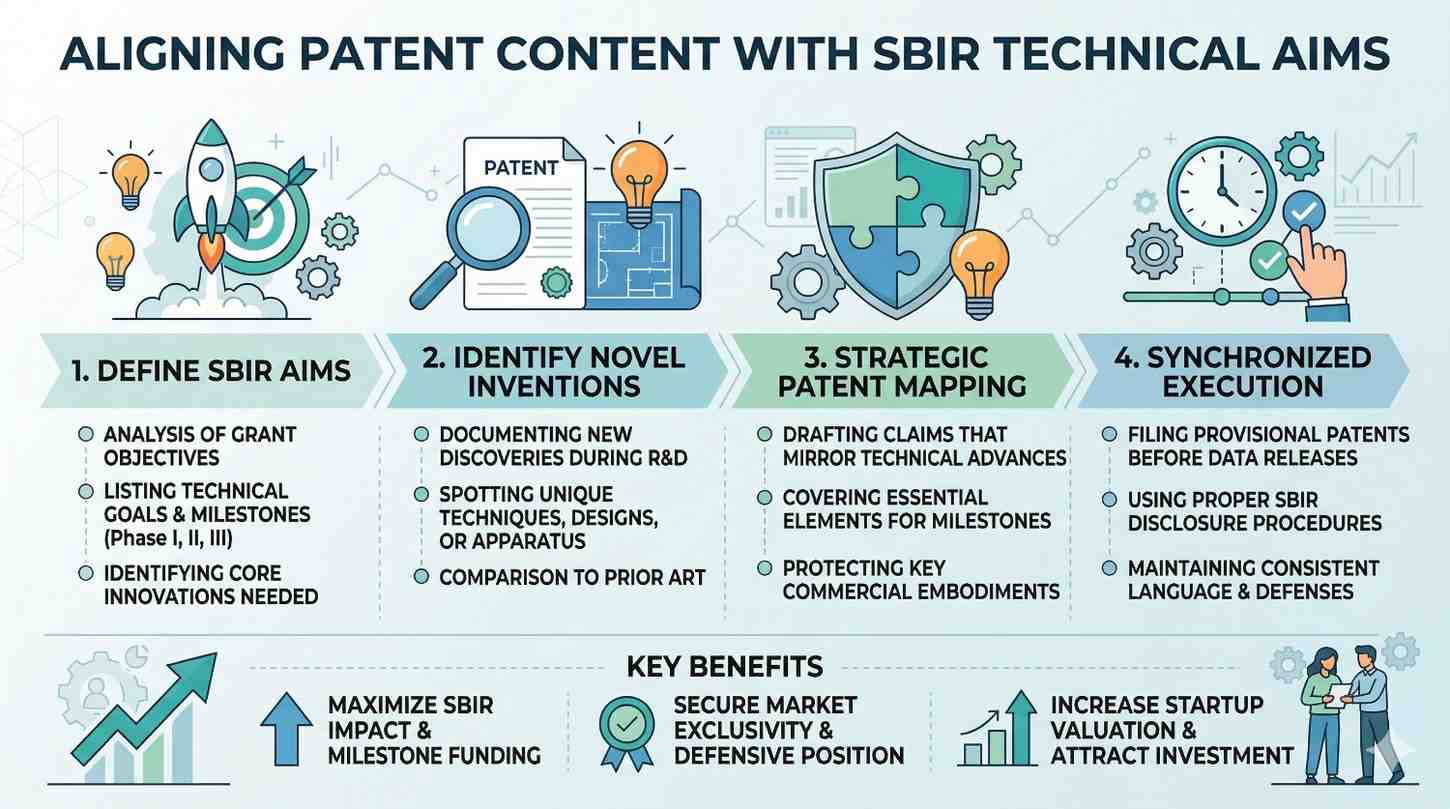
A strong SBIR proposal has technical aims that lead to measurable outcomes. The patent strategy should match those outcomes. If Aim 1 is “prove feasibility,” it likely produces a new method, a new pipeline, or a new system configuration that can be described and protected.
If Aim 2 is “build a prototype,” it may produce device integration, calibration methods, or deployment improvements that also deserve coverage. The biggest mistake is treating patents as separate from the aims, because then your proposal feels like two disconnected documents.
When the aims and IP align, your plan reads like a road map. Reviewers can see that each step increases value and reduces risk. That increases trust, and trust is a real scoring factor even when it is not written that way.
Choose one or two core claims to anchor the story
You do not need to list claims in your SBIR, and you should not try to “sound like a lawyer.” But internally, you should know the core claim idea you are protecting. That core claim idea should match the main promise of the project.
If your project promise is “reduce failure in edge conditions,” the core claim should protect the mechanism that achieves that. If your promise is “cut compute cost while maintaining accuracy,” the core claim should protect the specific way you do that, not just the goal.
This mental anchor helps you write the proposal with focus. It also helps you avoid adding attractive side tasks that are interesting but not central. SBIR reviewers can sense drift. A clear core makes the whole application tighter.
Keep room for follow-on filings after Phase I results
A smart plan accepts that Phase I will teach you something. You might discover a better method. You might find a new use case. You might identify a failure mode and create a fix that becomes more valuable than the original idea.
That is why your first filing should cover the core and the obvious variations, but you should expect to file again once results arrive. In grant language, you can describe this as “building an IP portfolio tied to milestones,” which reads as thoughtful, not aggressive.
Founders often fear that filing again means the first filing was wrong. That is not true. Follow-on filings are normal in serious companies. They are how you keep coverage matched to the real product.
If you want a partner to help you decide what to file first and what to hold for later, Tran.vc’s in-kind IP support is built for this. Apply anytime: https://www.tran.vc/apply-now-form/
Protecting yourself while still writing a strong proposal
Say enough to prove you can do it, not enough to make copying easy
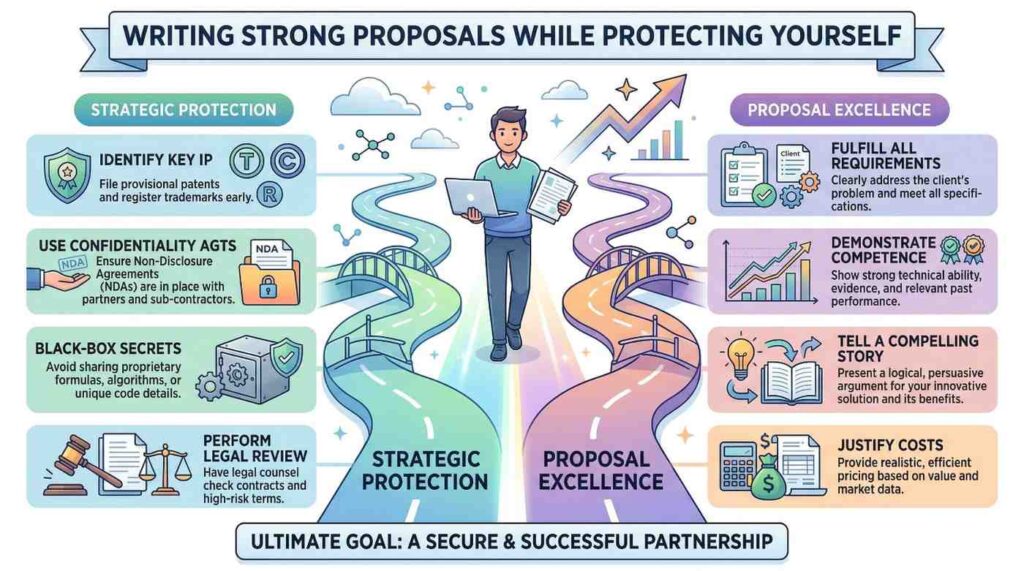
The goal of a proposal is to show capability. The risk is turning the proposal into an instruction manual. You can prevent this by writing at the right level of detail.
You can explain your approach by focusing on inputs, outputs, constraints, and evaluation methods. You can describe the system architecture at a high level. You can show you have identified risks and have mitigation plans. You can share results that prove feasibility. None of that requires giving away every parameter choice and every implementation trick.
If you have filed first, you can write more freely. If you have not filed, you should be more careful, especially in sections that describe novelty. This is where timing again becomes strategy, not paperwork.
Use consistent language between your patent and your proposal
One quiet benefit of filing early is that it gives you a vocabulary. Your patent description forces you to name the components and steps in a consistent way. When you use the same language in your proposal, the writing becomes clearer.
Clarity matters because reviewers are often reading fast. If your terms change from section to section, they lose confidence. If your system is described with stable names and stable boundaries, they can follow you without effort.
This also helps later when you raise money. Investors also read fast. Consistent language makes you sound more real, because you sound like you truly know what you are building.
Avoid statements that weaken your future patent position
Some founders include lines like “we will open-source the core method” or “we will publish full details immediately.” That may be a valid mission choice, but it should be a deliberate choice, not a casual line in a proposal. If your business needs protection to survive, you do not want to promise away the thing you need.
You can still be a good citizen. You can still publish results. But you should decide what is published, when it is published, and what is protected first. A patent-first strategy can still allow openness; it just prevents the company from losing its footing.
This is another place where an experienced partner can help you balance science goals with company survival.