
Most founders feel IP work is “something we’ll do later.” Then a customer asks for proof you own the tech. A big company starts building a similar feature. Or an investor asks, “What’s protected here?” And suddenly, you’re trying to make a smart legal move while your product is moving fast.
This is where the real question shows up:
Do you hire an in-house IP counsel, or do you use an external IP firm?
There is no one right answer. But there is a right answer for your stage, your speed, your budget, and your risk. In this article, I’ll walk you through how to make that call in a practical way—especially if you are building in AI, robotics, or deep tech, where the “idea” is rarely the value. The value is in the details: the method, the workflow, the data setup, the control loop, the edge case handling, the system design.
And if you want the fastest path to a strong IP base without hiring too early, Tran.vc can help. Tran.vc puts up to $50,000 in in-kind IP and patent services to help you lock down your moat early, while you stay focused on shipping. You can apply any time here: https://www.tran.vc/apply-now-form/
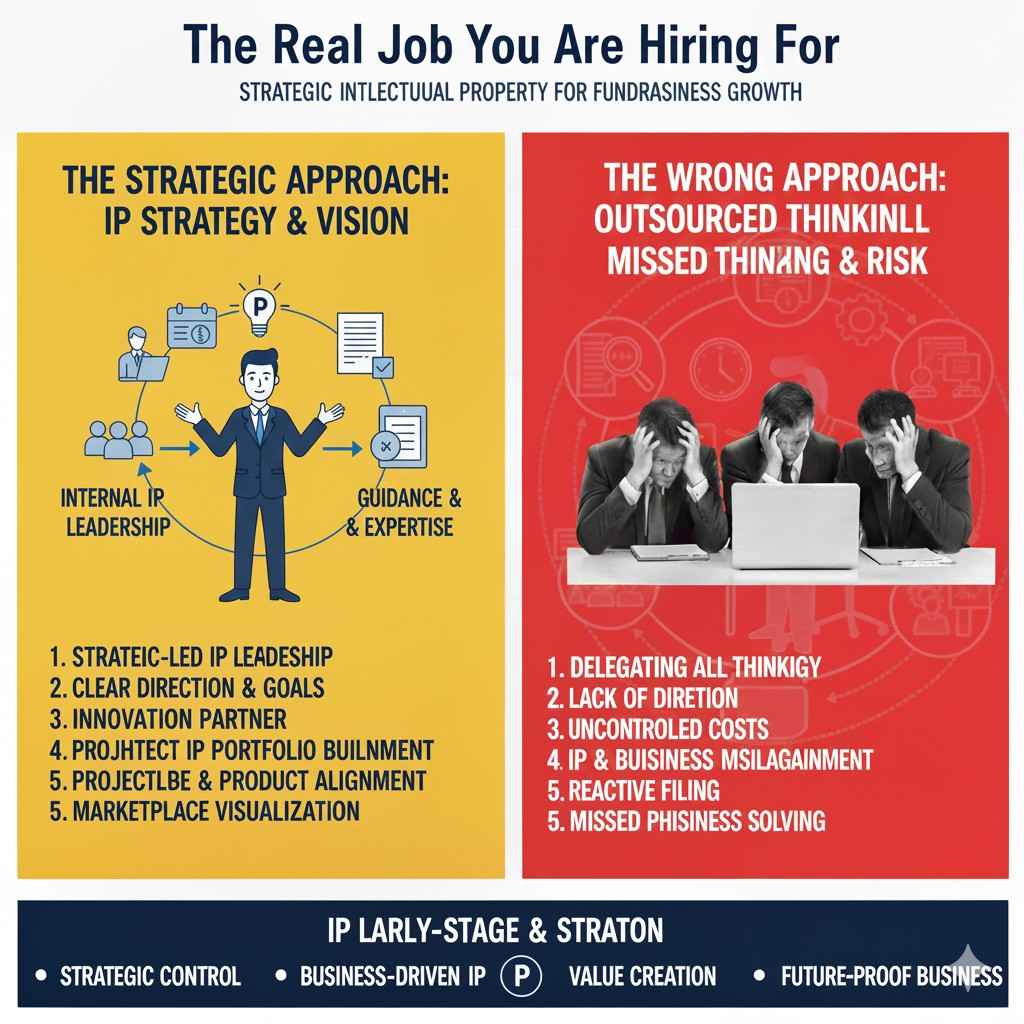
The real job you are hiring for (and why this choice matters)
Before we compare “counsel vs firm,” let’s name the job.
In early-stage startups, IP work is not just “write a patent.” The real job is:
- finding what is truly new in your system
- shaping it into something protectable
- deciding when to file and what to keep as a trade secret
- making sure the claims match your product plan
- building a story investors understand
- avoiding traps that quietly kill your rights
That last one matters more than most founders think.
A single rushed public demo can block your ability to patent in many countries. A sloppy contractor agreement can make ownership unclear. A “helpful” blog post can reveal your secret sauce. Even your pitch deck can create problems if you share it in the wrong way.
So the question is not just “who can file.” It is:
Who can help you build IP as a business asset while you move fast?
That is what you are hiring for.
What in-house IP counsel is great at (when it’s the right time)
When founders say “I want in-house counsel,” what they usually mean is: “I want someone on my side, all the time.”
That’s a fair instinct.
An in-house IP counsel, when you hire the right person, can become the steady hand inside your company who:
- learns your tech deeply
- sits in product meetings early
- catches inventions as they happen
- helps engineers document ideas in a clean way
- guides what to share and what not to share
- builds an IP plan that fits your roadmap
- works with outside counsel like a quarterback
They can also help you make decisions that are not about patents at all, like:
What should be a trade secret?
What should be open sourced?
What should be licensed?
What should be blocked from leaving the building?
That kind of thinking is hard to buy by the hour.
But there is a catch.
In-house counsel is expensive, and the value is highest when you have enough “volume” to keep them busy. In simple terms: you need a steady flow of inventions, deals, and IP decisions.
If you don’t, you might pay a lot for someone who is under-used.
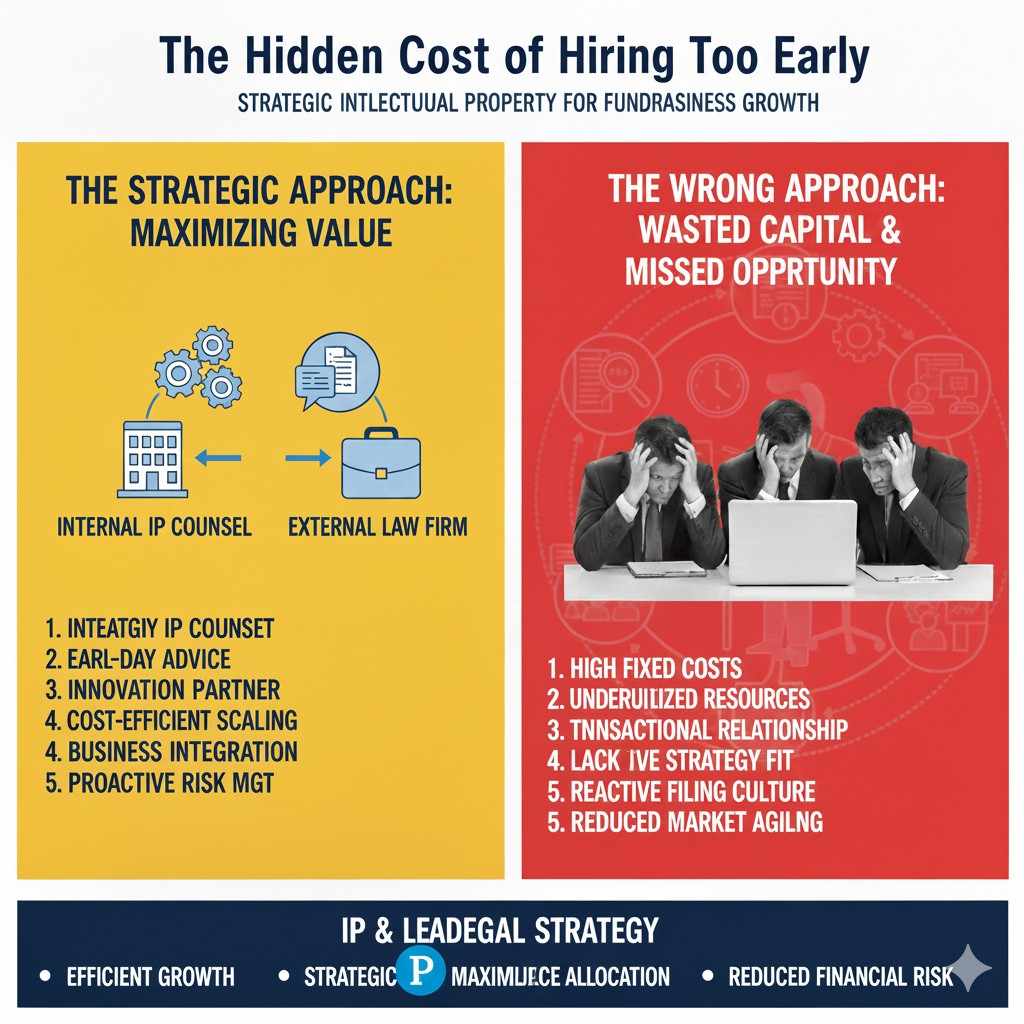
The hidden cost of hiring too early
This is the part people rarely talk about.
Hiring in-house IP counsel too early can create three quiet problems:
First, you may hire for the wrong shape of work.
In the earliest stage, you often need someone who can move between strategy and drafting support, and who can build an IP map from messy early work. Many in-house counsel are excellent, but they may not be the best “early chaos” fit. Some are strongest when the machine is already running.
Second, your burn goes up in a way that is hard to undo.
If you hire a senior counsel, you are not just paying salary. You are paying the whole package: benefits, tools, time, management load, and the “this person must always have work” pressure.
Third, you might still need a firm anyway.
Even with in-house counsel, many startups still use external firms for filings, foreign work, special cases, and extra drafting capacity. So you can end up with both costs at once.
This is why the timing matters.
What external IP firms are great at (when used correctly)
External IP firms are built for execution.
If you know what you want, and you want it done in a clean, proven way, a good firm can be a strong partner. They typically bring:
- trained patent attorneys who draft and prosecute patents for a living
- process and templates that reduce mistakes
- support staff that keeps filings moving
- experience across many inventions and industries
- fast throughput when you need volume
A good firm can also help you avoid basic traps, like filing too late, or drafting claims that don’t match the product reality.
But here is the part founders learn the hard way:
Many firms are not built to “think with you” unless you pay for that time.
They are built to draft what you give them.
So if you walk in with a vague idea, you may walk out with a patent application that is vague too. It might look official, but it may not protect what matters.
External firms can be amazing. But they are not mind readers. And many founders do not have the time—or the pattern knowledge—to feed them the right inputs.
That is why the best outcomes come when someone plays the “IP product manager” role. Sometimes that is in-house counsel. Sometimes that is a venture partner like Tran.vc who does this work with you early, before you hire.
If you want that kind of hands-on support without a full-time hire, apply here: https://www.tran.vc/apply-now-form/
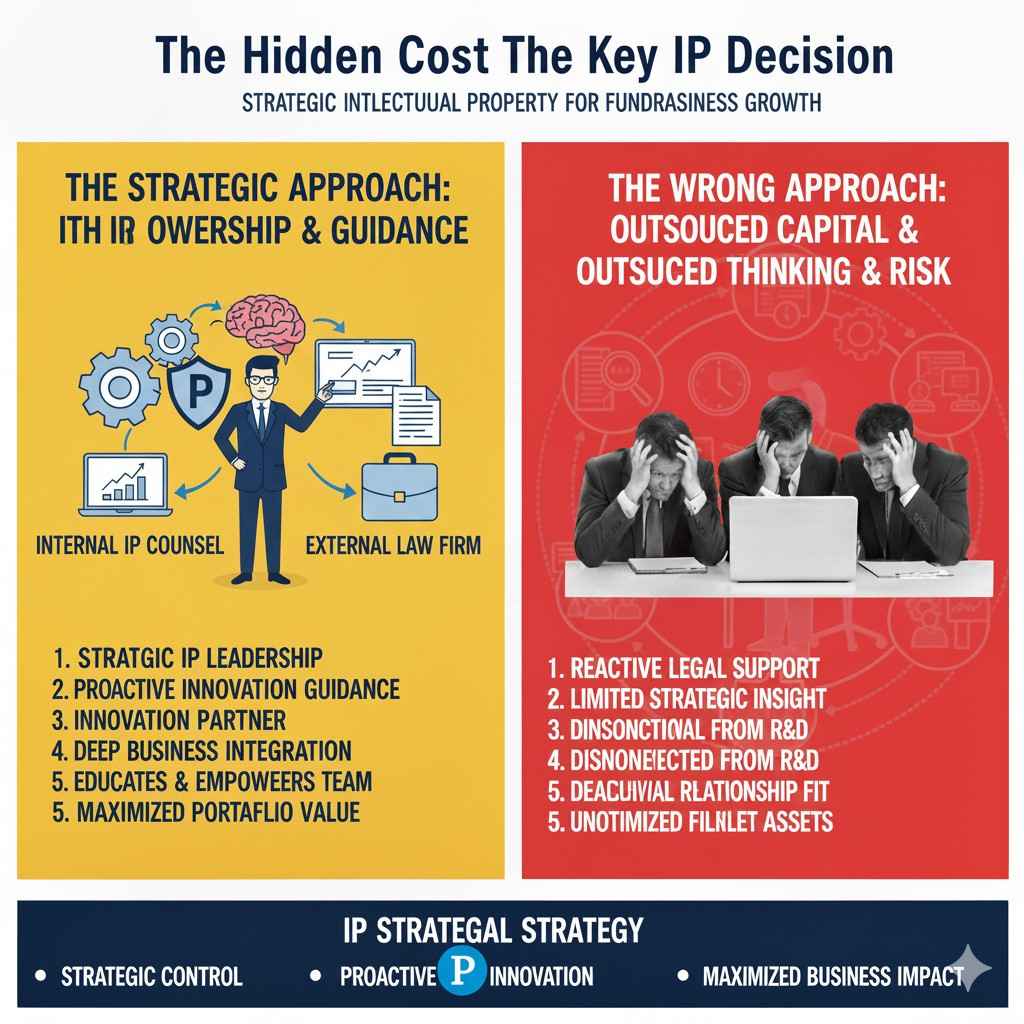
The key decision is not “inside vs outside.” It’s “ownership of the thinking.”
Here is a simple way to see it:
- If you hire in-house counsel, you are paying for continuous thinking plus coordination.
- If you hire an external firm, you are mostly paying for execution plus limited thinking.
Both can be strategic. But the default settings are different.
So you should decide who owns:
- spotting inventions early
- deciding what to file
- shaping the claims around the roadmap
- building an IP story that matches your market
- creating rules for the team so you don’t leak value
If nobody owns that thinking, you get random filings that look good on a slide but don’t help when it counts.
A practical way to decide: look at your next 12 months
Let’s make this very real.
Ask yourself what your next year looks like:
Are you going to ship 3 major system upgrades?
Are you hiring a bigger engineering team?
Are you closing deals that involve licensing, joint development, or customer IP terms?
Are you going to publish papers, give talks, or open source parts of the stack?
Are you going to raise a seed round and get heavy investor questions on defensibility?
If your answer is “yes” to many of those, you are entering an IP-heavy year. You need a tighter system.
Now ask: do you have someone inside who can run that system?
If not, you either need in-house counsel, or you need an external setup that includes strategy, not just drafting.
Early-stage reality: most startups don’t need full-time in-house counsel yet
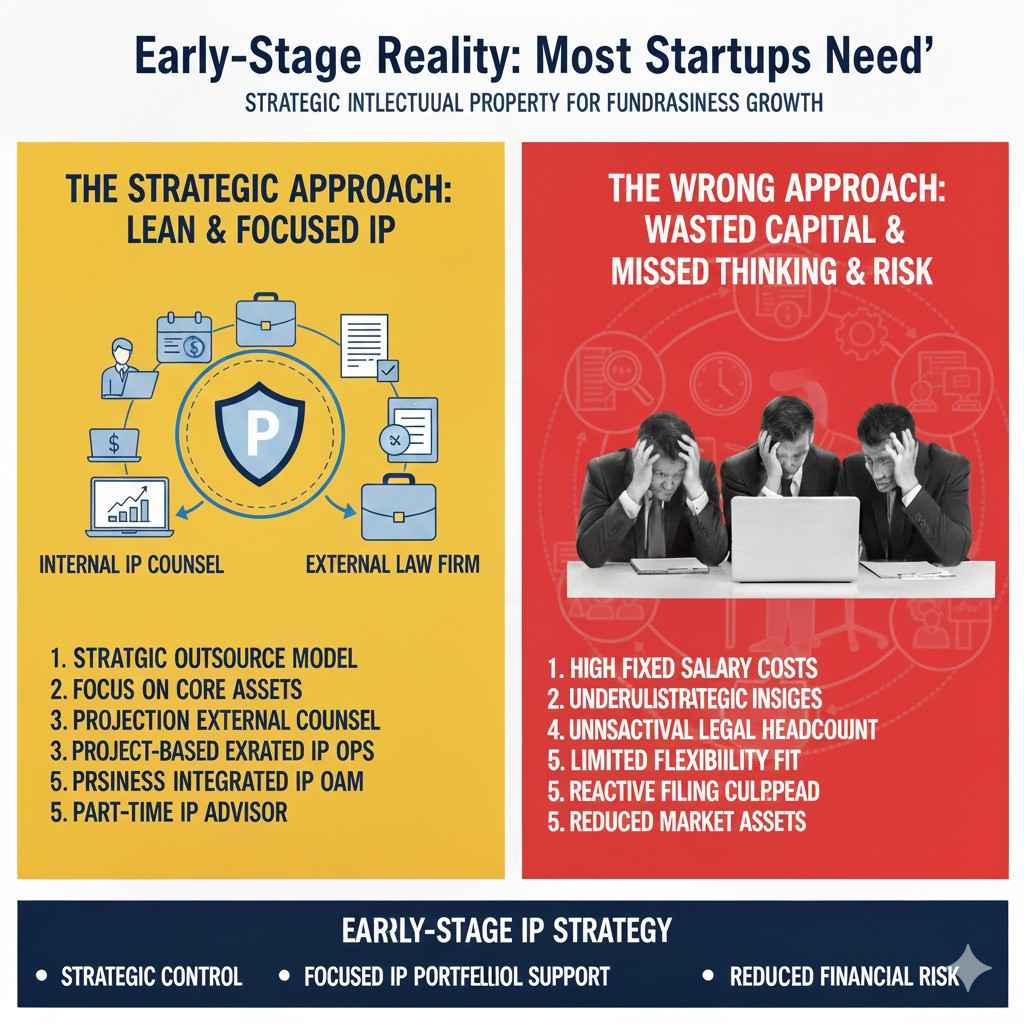
This may surprise you, but for most pre-seed and seed startups, full-time in-house IP counsel is usually not the best first move.
Not because IP is not important. It’s because:
- you can build a strong IP base with the right external help
- you need flexibility while the product is still changing
- you want to keep burn low until revenue or funding supports it
What you do need is a clean plan.
And that plan usually includes:
- a clear invention capture habit (so you don’t miss key ideas)
- a filing strategy tied to milestones (not random dates)
- smart choices on what to patent vs keep secret
- tight assignment paperwork (so you own what you think you own)
That is exactly the gap Tran.vc is built to fill for technical founders—helping you create an IP-backed foundation early, without giving up control or hiring too soon. Apply here: https://www.tran.vc/apply-now-form/
The “too early” and “too late” warning signs
If you want a simple gut check, watch for these signs.
You are likely too early for in-house counsel if:
You have only a couple of core inventions so far, and the rest is still changing.
Most IP work would be a few filings, plus basic agreements.
You are still proving the use case and don’t know the final product shape.
You don’t have ongoing IP negotiations or complex customer terms.
You are likely too late for in-house counsel if:
Your team is shipping new technical methods every month and nobody is capturing them.
You have multiple outside collaborations and unclear ownership lines.
You are sharing details in sales calls and demos without a sharing policy.
You are filing reactively, only when an investor asks.
You are spending a lot on a firm but still feel “blind” on what your IP covers.
If the second set feels familiar, the cost is already showing up. It might not be on the balance sheet yet, but it shows up as risk, delays, and missed protection.
The biggest mistake founders make with external firms
Let’s talk plainly.
The most common failure mode with external IP firms is not “bad lawyers.”
It’s this: founders treat the firm like a vendor, not a partner.
They send an invention disclosure that is too thin, then they approve drafts quickly, then they file. Six months later, they realize the claims don’t match what they built, or the application protects the wrong piece, or it’s too narrow.
A patent is only as good as:
- the invention you chose
- the way it was described
- the claim coverage
- and how it maps to your product and competitors
If you don’t own that mapping, you can spend a lot and still end up with weak coverage.
That is why, if you use an external firm, you need a repeatable process to feed them the right inputs and to review the outputs with care.
And you need someone who understands both the tech and the business goal.
Where Tran.vc fits in this decision (and why it’s different)
Tran.vc is not a normal fund that wires cash and disappears.
Tran.vc invests up to $50,000 in in-kind IP and patent services so you can build real assets early—before your seed round—without adding a full-time hire too soon.
This can be a strong middle path if you are thinking:
“We need strong patents, but we are not ready to hire in-house counsel.”
“We want an IP plan, not random filings.”
“We need help translating our robotics/AI work into defensible claims.”
“We want to raise with leverage, not hope.”
If that sounds like you, you can apply any time: https://www.tran.vc/apply-now-form/
The real job you are hiring for
IP is not paperwork, it is leverage
Most founders think IP work means one thing: filing a patent. In real life, the filing is only the last step. The real work is finding what is truly new in your system, shaping it into clear language, and deciding what to lock down now versus later. This is business work, not just legal work, because the outcome changes how safe your market position feels to buyers and investors.
When you hire for IP, you are hiring for judgment. You want someone who can look at your product and say, “This piece is the moat,” and then build protection around it. That includes patents, yes, but also trade secrets, clean ownership, and simple rules your team can follow. If the “thinking” is missing, you can spend money and still end up with weak protection.
Why the counsel vs. firm choice keeps coming up
In-house IP counsel and external firms can both do good work. The difference is not “good versus bad.” The difference is what each model is built for. In-house counsel is built for continuous decisions inside your company. A firm is built for throughput and delivery, with strategy added only when you ask and pay for it.
So the real question becomes: who will own the thinking day to day? Who will notice inventions as they happen? Who will connect the filing plan to your product plan? When nobody owns that role, filings become random, and randomness is costly in IP.
What most technical founders overlook
Your best ideas do not arrive in neat “patent-shaped” packages. They arrive during debugging, while tuning a model, while fixing a control loop, or while making a system run on cheaper hardware. Those breakthroughs are easy to miss because the team is focused on shipping.
This is where a strong IP setup earns its keep. It helps you catch the moments that matter. It turns them into assets that can be explained, defended, and used to build trust in the company.
If you want that support without hiring too early, Tran.vc helps technical teams build a real IP base as an in-kind investment. You can apply any time at https://www.tran.vc/apply-now-form/
What in-house IP counsel is great at
Constant access to your real work
The biggest advantage of in-house counsel is proximity. They can sit close to the engineers, product leads, and founders. They can hear what is changing, what is hard, what is new, and what is likely to become core to the product. That kind of context is difficult to recreate in a one-hour call with an outside firm.
When counsel is internal, they can build simple habits that catch inventions early. They can ask the right questions in the right meetings. They can turn “we solved it” moments into documented invention records before the memory fades. This is how strong portfolios start: not with one big filing, but with repeatable capture.
A single brain for strategy, risk, and timing
In-house counsel can also act as your steady decision-maker on timing. They can tell you when to file, when to wait, and when to keep something as a trade secret. They can connect filing choices to business events, like a pilot launch, a public demo, a paper submission, or a big partner meeting.
They can also reduce risk that does not show up until it is too late. Many startups accidentally harm their IP position through public sharing, sloppy contractor agreements, or unclear ownership between co-founders. In-house counsel can set guardrails early, in plain language, without slowing the team down.
Strong alignment with your long-term roadmap
A good patent is not only about what you built today. It also needs to support what you will build next. In-house counsel can align protection with the roadmap because they are in it every week. They can help you file in ways that leave room to grow, instead of locking you into narrow claims that stop fitting once you iterate.
They can also shape how you talk about your tech. This matters more than founders expect. When your messaging is aligned with your IP, your pitch becomes clearer and your story becomes easier to believe. That is not hype. It is consistency.
Where in-house IP counsel becomes a risk
The cost is more than the salary
Founders often calculate cost as a salary number. But the real cost of in-house counsel includes benefits, management time, and the fact that you now have a permanent expense that is hard to unwind. That can be fine when you have stable revenue or strong funding. It is harder to justify when you are still searching for product-market fit.
There is also an opportunity cost. Every full-time hire takes attention and energy. If the company is small, adding a senior role can shift how decisions get made. That can be helpful, but it can also slow down a team that is still learning what the product truly is.
Not all in-house counsel are built for early chaos
Some in-house counsel are excellent in structured environments where the product is known and the machine is running. Early-stage startups are the opposite. The product changes quickly. The invention is messy. The “real value” might be hiding in a weird edge case you fixed at midnight.
If you hire counsel who expects a clean process before the process exists, you can get friction. That friction shows up as longer cycles, heavier documentation, and a sense that IP is a blocker instead of a lever. The best early-stage counsel can work with uncertainty and still make progress. But that is a specific skill set, and it is not universal.
You still may need a firm anyway
Even with in-house counsel, many startups still use external firms for drafting, prosecution, foreign filings, and overflow work. That means you may end up paying for both models at once. If you are not ready for that combined cost, you may feel trapped between “we should have help” and “we cannot afford the full setup.”
This is why timing matters. In-house can be a powerful move, but it is best when the company has enough invention volume and enough complexity to keep counsel’s time fully used.
What external IP firms are great at
High-quality execution when inputs are clear
A strong external firm can draft well, file on time, and run the prosecution process with discipline. They have systems for deadlines, formats, and compliance. They can also staff cases with people who do this work daily, which often means fewer technical mistakes in the filing itself.
If you already know what you want protected, a firm can be the fastest route to “get it on file.” That can matter when you are about to launch, publish, present, or enter a competitive market window. Execution speed is a real advantage.
Flexible capacity without a full-time hire
Firms are also flexible. You can ramp up when you need to file multiple inventions, and ramp down when you do not. For many early-stage startups, this flexibility is the difference between having any IP plan at all versus postponing it. A firm can meet you where you are, without forcing a permanent internal expense.
This also helps when your tech spans multiple areas. For example, robotics can involve mechanical systems, sensors, controls, embedded software, and AI. A firm can pull in attorneys with different strengths for different pieces, instead of expecting one internal person to cover everything.
Useful external perspective
A good firm sees many companies and many patterns. They may spot common claim structures and common mistakes. They may also know how examiners tend to react in certain categories. That perspective can reduce trial-and-error, especially if your team has never filed patents before.
However, that value only shows up when the relationship is handled as a partnership. If you treat the firm as a form-filling service, you will get form-filling outcomes.
Where external firms often fail startups
The strategy gap is real
The biggest problem founders face with external firms is not bad intent. It is a missing bridge between your messy real-world invention and the clean legal document. Many firms will draft based on what you provide. If you provide vague inputs, you often get vague coverage.
This is why founders end up with patents that look official but do not protect what matters. The claims may be too narrow. They may focus on an implementation detail that later changes. Or they may miss the true inventive step, which might be the workflow, the system architecture, or the training method, not a single code snippet.
Review quality depends on your time and skill
A patent draft is not something you can approve on a quick skim. You need to check if the core idea is captured, if the variations are included, and if the language matches what you actually built. Many founders are too busy to do that well. Many do not know what to look for, even if they try.
So the risk is predictable. The firm drafts, the founder approves quickly, the application gets filed, and months later the company realizes it filed the wrong thing. Fixing that later is hard. In many cases, it is impossible without new filings.
Billing can steer behavior
Most firms bill by the hour. That model is not evil, but it affects behavior. If you want deep strategy, you need to pay for deep time. Some founders avoid those conversations to save money. Then they spend more later when the filings do not match the business.
This is why it can feel like IP is always expensive. The cost often comes from doing it twice, or from filing without clear direction. The solution is not “spend less.” The solution is “spend with focus.”
If you want a more guided path early, Tran.vc’s model is built to reduce these mistakes. You get up to $50,000 in in-kind IP services to help you build a strong foundation without hiring too early. Apply here: https://www.tran.vc/apply-now-form/
The clearest way to choose: who owns the thinking
The difference in one sentence
In-house counsel gives you a person inside the company who owns the ongoing IP thinking. External firms give you skilled execution that depends heavily on the quality of inputs and oversight. Both can be strategic. But without someone driving strategy, a firm will rarely invent it for you.
This matters because IP is not only a legal asset. It is a business asset. It should match your roadmap and your market threats. If your filing plan is not connected to those two things, it is not doing its job.
What “owning the thinking” looks like in practice
Owning the thinking means someone is tracking what is novel, what is defensible, and what is at risk of being copied. They are watching what the team is building and what competitors are likely to do next. They are also shaping inventions into filing-ready forms before the company shares too much publicly.
This person also owns simple education. They teach engineers what to write down. They teach sales what not to promise. They teach founders how to talk about the tech in a way that is truthful but not careless.
Why this gets harder in AI and robotics
AI and robotics inventions are often system inventions. They are not “a new bolt” or “a new app screen.” They are workflows, training pipelines, control loops, data strategies, sensor fusion choices, safety logic, and compute tradeoffs. The inventive step can be in how parts work together.
This is why many generic filings miss the point. A patent that only describes a surface feature can be easy to design around. Strong protection in these areas usually requires careful framing of the system, the variations, and the real reason your approach works.