
Burnout is not a badge. It is a leak.
And when you are running an IP-first plan—where you are building, documenting, and protecting your core invention while still shipping product—burnout can sneak in faster than you expect. Not because you are weak. Because the work is heavy in a special way. It demands deep focus, careful thinking, and steady follow-through, week after week.
At Tran.vc, we work with technical founders who are doing hard things: robotics, AI, and deep tech that takes real time to build. We also see the pattern: the founders who win are not the ones who push the hardest for a month. They are the ones who can keep going for a year without breaking.
So this article is about one thing: how to avoid burnout while you execute an IP-first plan.
Not theory. Not fluffy “self-care.” Real actions you can take this week to keep your mind clear and your body steady—while you still move fast and file strong.
If you want help building an IP-first plan without drowning in it, you can apply anytime here: https://www.tran.vc/apply-now-form/
Why an IP-first plan can burn you out faster than product work

Most founders expect product work to be hard. You write code, debug, test, ship, repeat. The loop is painful, but it is clear.
IP work is different.
It is still technical, but it is also emotional. Because when you write a patent draft or create invention notes, you are doing something that feels like it should be “final.” You are turning messy thinking into clean language. You are trying to describe the heart of what you built in a way that will stand up later.
That pressure can create a quiet strain. You start to think:
- “If I miss this detail, we lose the moat.”
- “If I say it wrong, it won’t count.”
- “If I share too much, someone copies us.”
- “If I share too little, the patent is weak.”
Those thoughts can trap you in a loop where you never feel done. And when you never feel done, you never rest.
An IP-first plan also creates extra work at the same time you are trying to find product-market fit. You are doing:
- deep work to invent and build
- fast work to ship and learn
- careful work to document and protect
Each one uses a different part of your brain. Switching between them all day is a huge energy tax.
If you do not design your work, your days turn into constant switching. That is one of the fastest paths to burnout.
The first rule: protect your energy, not your time

Most founders try to fix burnout by “managing time.”
They buy a new calendar app. They set more reminders. They stack meetings. They squeeze.
That rarely works.
Burnout is not a time problem. It is an energy problem.
You can have ten free hours on your calendar and still feel dead inside if those hours are broken into tiny pieces, filled with stress, and loaded with unclear tasks.
So the goal is not “more hours.”
The goal is higher-quality hours.
If you can protect your best energy, you can do the hardest IP work with less pain, fewer mistakes, and less rework.
This is what that looks like in real life:
You stop asking, “How do I fit patents into my week?”
You start asking, “When is my brain sharp enough to do patent-level thinking?”
For many technical founders, that window is early. For others, it is late night. It does not matter when. It matters that you defend it.
If you only take one thing from this article, take this:
IP work needs your cleanest brain. Give it your cleanest brain.
What “IP-first” really means (and what it does not mean)
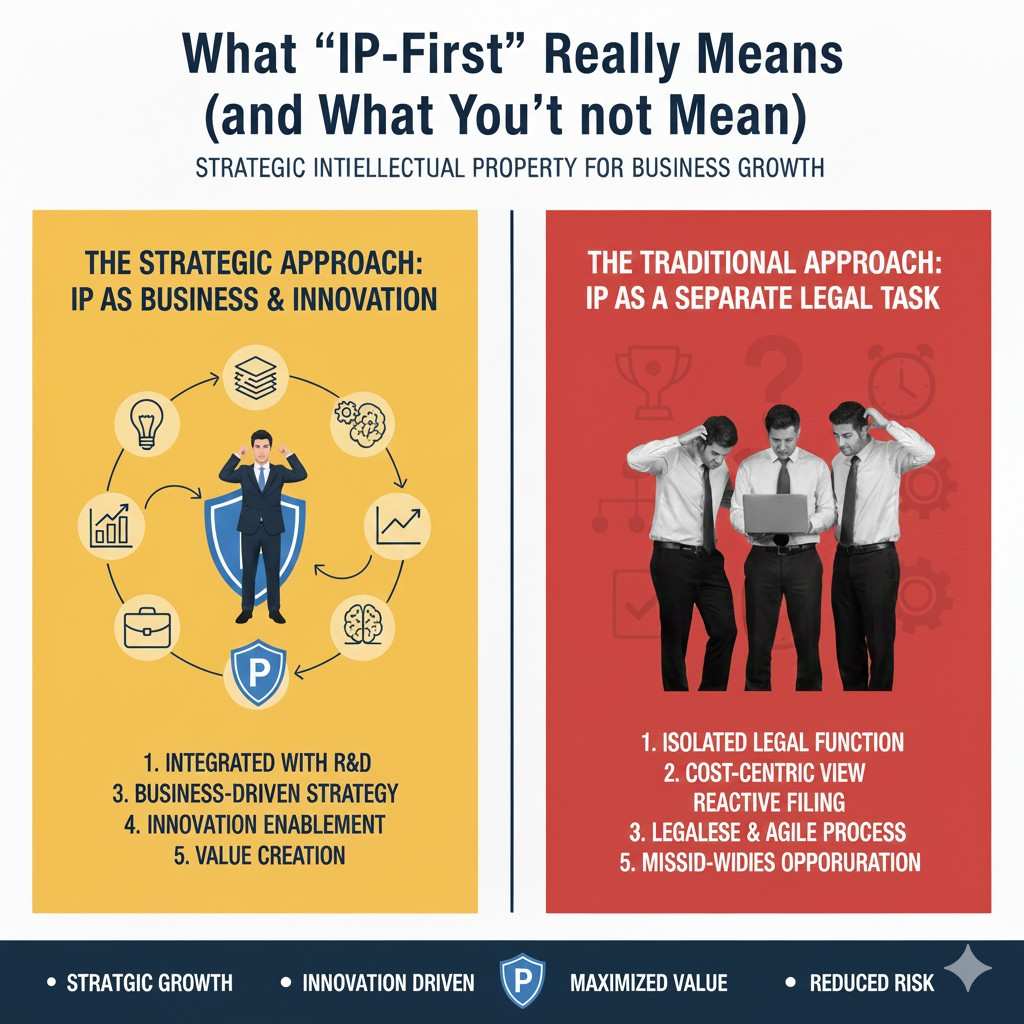
Let’s clear up a big misunderstanding.
IP-first does not mean you stop shipping product until you file patents.
It also does not mean you spend all day talking to lawyers.
It means you build your company like a person building a house on strong ground. Before you paint the walls, you make sure the foundation is solid.
In practice, IP-first means:
You identify what is truly novel in what you are building.
You capture it early, before the details fade.
You file smart, on the right parts, at the right time.
You do this in a way that supports your product work, not blocks it.
The founders who burn out are often the ones who treat IP like a second full-time job. They try to add it on top of everything else, with no system.
The founders who do well treat IP like a steady rhythm. Like brushing your teeth. You do it often. You do it lightly. You do it consistently.
That rhythm is what we are going to build.
If you want Tran.vc to help you set that rhythm—with real patent strategy and filings as in-kind support up to $50,000—you can apply anytime at: https://www.tran.vc/apply-now-form/
Your burnout risk is highest in three moments
There are three common points where IP-first founders crash.
1) Right after a big technical breakthrough
You solve something hard. The model finally works. The robot stops failing. The data pipeline becomes stable.
You feel a rush.
Then someone says: “We should capture this for IP.”
And now you are expected to do careful writing and clean thinking right after a long sprint.
This is when founders force themselves through IP work with an empty tank. They push anyway. They do it late at night. They end up creating messy notes they cannot use later. Then they feel guilty. Then they avoid it next time.
The fix is simple: do not do deep IP work when you are fried.
Capture raw notes quickly. Then schedule the clean write-up when your brain is fresh.
2) During investor pressure
Even if you are not “chasing VC money too soon,” you still feel the pressure. A demo day. A warm intro. A big customer call. A pitch deck request.
Suddenly you want to look sharp. You want to say, “We have strong IP.” You want to look defensible.
So you rush.
Rushed IP work is a burnout engine. It creates long nights and poor decisions. It also creates weak filings, because you cannot think straight when you are stressed.
The fix is to treat IP like a long game. If you want to raise with leverage later, you build the IP base now, calmly.
3) When the team grows and your day fragments
Early on, you can get long quiet blocks. Later, you cannot. People need answers. Bugs need triage. Customers need replies.
Now your day is chopped up. That makes IP work harder, because it needs long focus.
The fix is to create a protected “deep work window” that the team respects, like it is a meeting with a key customer.
Build a simple IP rhythm that does not drain you
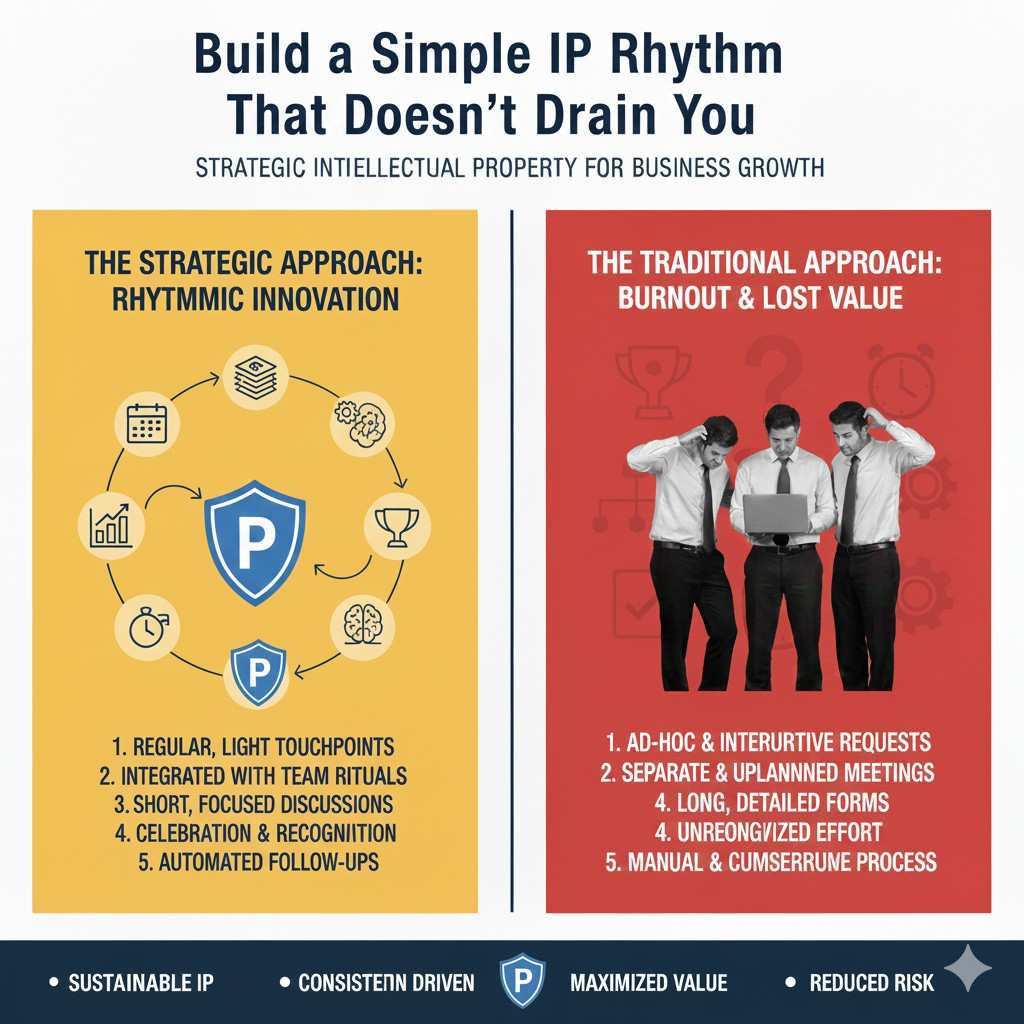
Most founders fail at IP documentation because they think it must be perfect.
It does not.
You need a system that is:
- fast
- repeatable
- “good enough” in the moment
- easy to hand to a patent attorney later
Here is a rhythm that works without making you hate your life.
Step one: capture “invention moments” in under five minutes
An invention moment is when you do something that feels like:
- “No one else is doing this like this.”
- “This is the trick.”
- “This is why it works.”
- “This is the part that took us three weeks to figure out.”
When that happens, do not open a blank document and try to write a full description. That is where you will spiral.
Instead, do a quick capture. A few lines. Short. Rough.
The goal is not beauty. The goal is to prevent loss.
Use a single place for this. One doc. One folder. One tool. Not five.
Write:
- what problem you were solving
- what your first approach was
- why it failed
- what you changed
- why the change worked
- what makes it different from the normal way
If you do this in under five minutes, you will actually do it. If it takes thirty minutes, you will skip it when you are tired.
Step two: once a week, do a “clean pass” for 45 minutes
This is the core habit.
Pick one time each week where you are fresh. Put it on the calendar. Treat it like a real meeting.
During that time, you take your rough invention notes and turn them into a clean page that someone else can understand.
Not ten pages. One page.
When you try to write too much, you burn out. When you write one page a week, you build a powerful archive without pain.
This clean page should answer:
- what it is
- why it matters
- how it works at a high level
- what is new about it
- what the variants could be
Variants matter because patents are not about one exact build. They are about the space around it. So your clean page should include a few “also could be done like this” ideas, even if you do not plan to build them right now.
Step three: once a month, pick the top one or two for filing plans
Not every invention moment becomes a patent filing. If you try to file everything, you will burn out and waste money.
Once a month, look at the pages you wrote. Ask:
- which one is most tied to the moat?
- which one would hurt the most if copied?
- which one is most likely to be used in your core product?
Pick one or two.
That is enough.
This rhythm creates a steady pipeline. It also reduces panic. You stop feeling like you are “behind on IP,” because you have a system that keeps moving.
The mental shift that stops IP burnout
Here is the shift:
IP work is not extra work. It is part of building the product.
If you treat IP as “admin,” you will hate it.
If you treat it as “product design,” it becomes lighter.
Because when you document invention details, you also clarify your own thinking. You see patterns. You notice weak points. You spot new angles. You make the tech cleaner.
In many cases, the act of writing the invention makes the invention better.
That is why the best founders do not delegate all IP thinking. They collaborate with attorneys, but they stay close to the core.
At Tran.vc, this is exactly where we help: we work with you to turn what you built into a clear IP story, without turning your week into chaos. If that sounds useful, apply here: https://www.tran.vc/apply-now-form/
Burnout prevention is mostly about boundaries (even if you hate that word)
Technical founders often dislike the idea of “boundaries.” It sounds soft. It sounds like something for other people.
But boundaries are just rules that protect your best work.
Without boundaries, your day becomes a mix of shallow tasks. And shallow tasks are sneaky. They feel easy, but they drain you because they never end.
Here are boundaries that protect an IP-first plan.
Do not do IP work in the “cracks” of the day
Do not try to write invention notes between calls. Do not try to polish a claim idea after a stressful meeting. Your brain will resist.
Instead, set a real block. Even 45 minutes.
Do not let IP become a daily guilt weight
If you wake up every day thinking, “I should be doing IP,” you will burn out.
You need a schedule that makes you feel safe. That weekly block does that. It tells your brain: “We are handling this. Not today. On Friday morning.”
Do not argue with your body
If you are exhausted, you will not produce good patent-level thinking. You will produce words that you later hate, which creates more work later.
So give yourself permission to stop.
Capture rough notes. Sleep. Clean it later.
This is not laziness. It is efficiency.
The practical reason founders burn out: they try to hold the invention in their head
There is a special kind of stress that comes from trying to remember complex ideas.
Founders often do this:
They build something novel. They do not document it. They tell themselves they will remember.
Then weeks pass.
Now they have a new sprint, new bugs, new customer needs.
The invention fades. They feel panic. They feel like they are losing something valuable. That panic turns into late-night writing sessions and messy “catch-up” work.
This is a direct path to burnout.
The fix is to offload memory quickly.
Your brain is not a hard drive. It is a processor.
Let it process. Put storage somewhere else.
That is why the under-five-minute capture habit is so powerful. It turns the invention from “a thing I must remember” into “a thing I have safely stored.”
Instant relief.
A founder-friendly way to document inventions without hating it
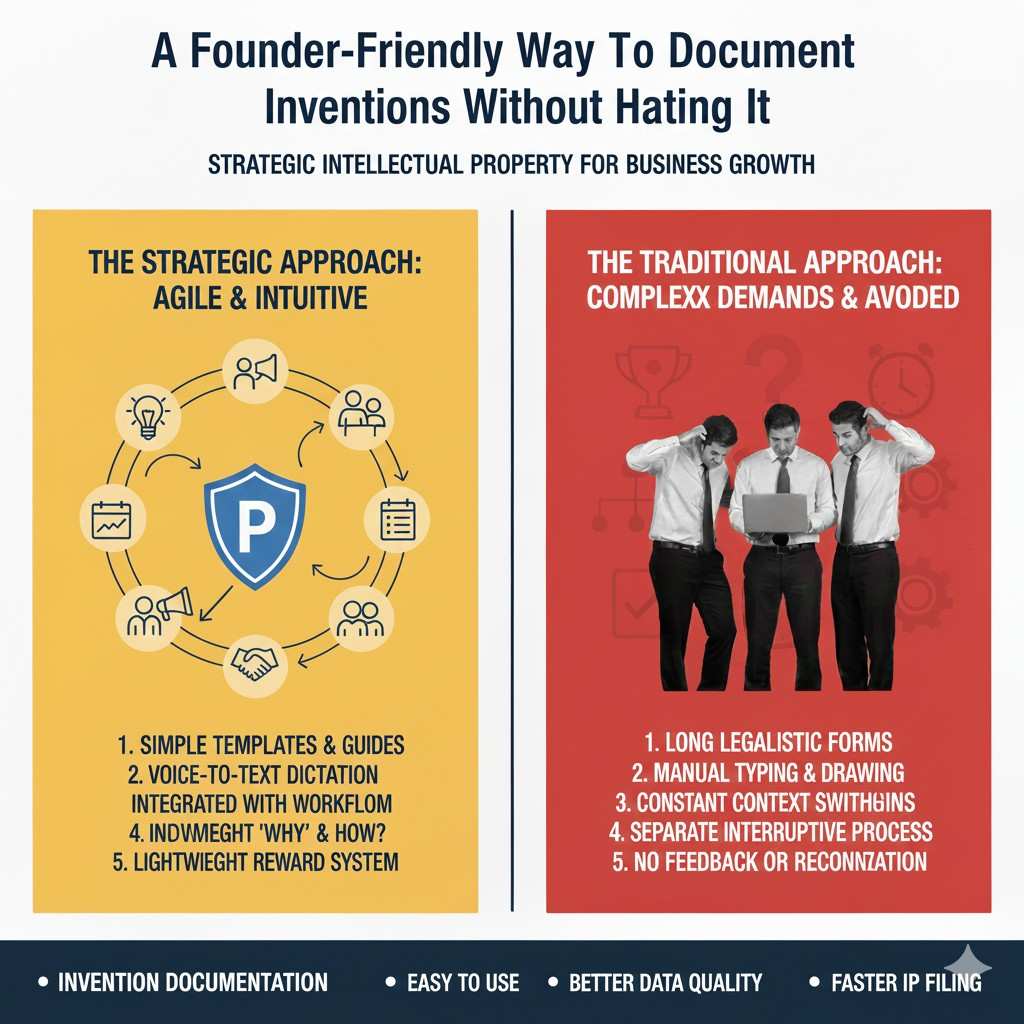
Here is a simple method that works well for AI, robotics, and deep tech. It keeps you focused and stops you from writing useless fluff.
Write your invention note like a short story:
Start with the problem. Not the solution.
Then talk about the failed attempt.
Then the “aha.”
Then the result.
This format is natural. It is easy. It also maps well to what patent attorneys need, because it shows context and contrast.
You do not need fancy words. You do not need legal terms. You do not need to sound like a textbook.
Clear beats clever.
Also: include one picture if you can. A rough sketch. A block diagram. A flow chart. A screenshot of a pipeline. Even a photo of a whiteboard.
Pictures reduce writing load. They also reduce misunderstanding later.
The hidden burnout trap: perfection
Perfection is a smart founder’s enemy.
Because you are used to correctness. Your code must compile. Your robot must not crash. Your model must hit metrics.
So you bring that mindset into IP writing.
You try to make the invention note perfect.
You try to cover every edge case.
You try to write like a lawyer.
That is when you stall.
Here is the truth:
Your job is not to write a perfect patent draft.
Your job is to capture the technical truth clearly enough that your patent team can turn it into strong filings.
If you try to do the attorney’s job, you will burn out.
This is also why Tran.vc’s model matters. We bring real patent strategy and execution support so you do not carry that full load alone. If you want that kind of help, apply here: https://www.tran.vc/apply-now-form/
How to keep IP work from taking over your whole week
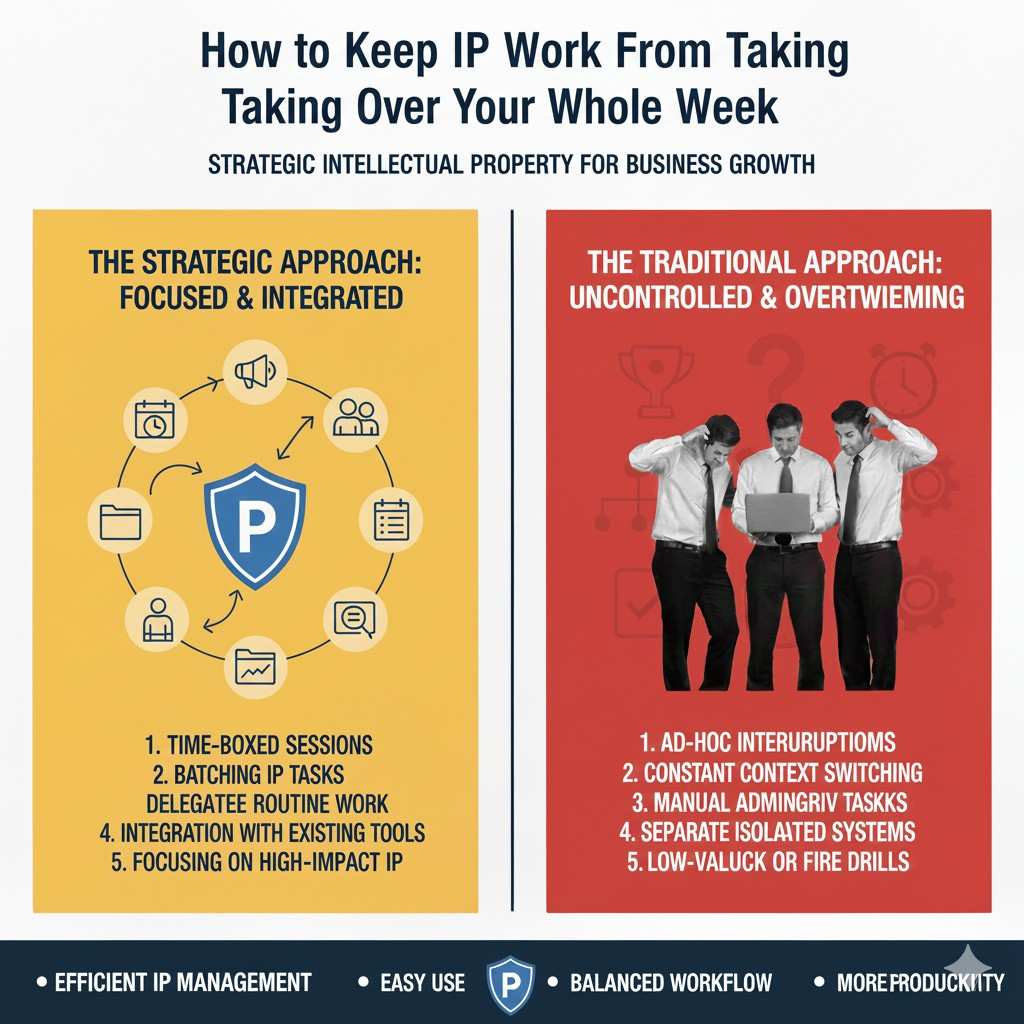
This is where founders need tactical rules.
You need a “stop point.”
Otherwise IP work expands forever, because there is always more you could add.
A simple rule:
When your invention note answers: “what, why, how, what’s new,” you stop.
You can always add later. But you must stop today.
Another rule:
You do not open your invention note more than two times in a week unless it is being filed right now.
Because repeated re-reading and editing is a form of procrastination. It feels productive, but it drains you.
You want forward motion, not constant polishing.
The best burnout defense: a calm IP pipeline
When your IP work is chaotic, you feel like you are always behind.
When your IP work is steady, you feel in control.
Control reduces stress.
And reduced stress reduces burnout.
Your calm pipeline looks like:
- quick captures as you invent
- one weekly clean pass
- one monthly selection for filing plans
That is enough to build a serious IP base over time. It also keeps your head clear.
You do not need hero weeks. You need steady weeks.
Avoiding Burnout While Executing an IP-First Plan
Why burnout shows up fast in deep tech
Burnout is not a sudden crash. It builds in small ways, day after day, until your mind starts to feel heavy and your work feels slow. In AI, robotics, and deep tech, the load is even bigger because you are solving problems that do not have easy answers.
You are not only writing code or building hardware. You are also making choices that shape the future of the company. That mix of pressure and unclear paths can drain you faster than normal startup work.
What an IP-first plan adds to your brain
An IP-first plan asks you to do more than build. It asks you to notice what is truly new, capture it while it is fresh, and protect it before it leaks out into the world. That is smart business, but it is also extra mental weight.
The hard part is that IP work often feels “unfinished” even when you did good work. If you do not create a clear rhythm, you start carrying invention ideas in your head like fragile glass. That constant holding is a quiet stress that never ends.
How Tran.vc reduces the load for founders
Many technical founders burn out because they try to do product work, IP strategy, and legal-level writing alone. That is a heavy mix to carry, especially when you are also hiring, selling, and shipping.
Tran.vc invests up to $50,000 in in-kind IP and patent services so you do not have to guess your way through early filings. If you want help building a strong IP base without losing your health, you can apply anytime at https://www.tran.vc/apply-now-form/
Why an IP-First Plan Can Feel Like a Second Job
The hidden pressure of “getting it right”
Product work is hard, but the feedback loop is clear. You run tests, you see results, you fix, you ship. With IP work, the feedback loop is slower, and that can make you overthink every word.
Founders often feel like a patent document must be perfect from day one. That belief creates stress. Stress creates delay. Delay creates panic. And panic is one of the biggest drivers of burnout.
Context switching is the real energy killer
In a normal day you might jump from debugging, to a customer call, to hiring, to investor updates. Then you try to switch into careful invention writing. Your brain cannot snap into that mode without cost.
Each switch is like taking money out of your energy bank. When you do it all day, you end up tired even if you worked “only” eight hours. That is why burnout can show up even when your calendar looks reasonable.
Why burnout creates weaker IP, not stronger IP
When you are tired, you write vague notes. You skip key details. You forget the “why” behind the design choice. Later, when you try to create a real filing, you end up redoing work you thought you already finished.
This creates a painful loop where IP becomes a source of guilt. The guilt makes you avoid it. The avoidance makes it pile up. And the pile becomes stress that follows you into sleep.
Energy First, Not Time First
Why time management alone does not solve it
Many founders try to fix burnout with tighter schedules. They add more tools, more reminders, more strict plans. That can help a little, but it does not address the real issue.
Burnout is often about the quality of your energy, not the number of hours you have. If your best thinking time gets eaten by small tasks, you will struggle even with an open calendar.
Find your sharpest thinking window
Most people have one part of the day when their mind is clean and calm. For some founders it is early morning. For others it is late evening. The time does not matter as much as the consistency.
That window is where your best IP work should live. When you protect it, invention writing becomes simpler and faster. When you ignore it, IP work feels like pushing a car uphill.
A simple rule that prevents most IP burnout
Do not try to do deep IP thinking when you are drained. If you only have low energy, do a quick capture and stop. The goal is not to force yourself through hard writing while tired.
When you follow this rule, you reduce rework and you stop building a habit of suffering. Over time, your brain starts to trust the process, and that alone reduces stress.
What “IP-First” Really Means in Daily Work
It does not mean you stop shipping
Some founders fear that IP-first means slowing down product. That is not the point. The point is to build protection while you move, not to pause your startup until paperwork is done.
You can ship quickly and still capture inventions in a clean way. The key is to make IP part of the build rhythm, not a separate mountain you climb once a quarter.
It means you treat invention capture as a core habit
When you build something new, you do not want to rely on memory. Memory fades, especially in high-pressure weeks. Capturing the idea is like saving your work before the laptop dies.
A strong IP-first plan is simply a habit of saving what matters, often enough that you never feel behind.
It means you choose what to protect with care
Not every feature is worth filing. Not every clever trick is a moat. IP-first means you learn to spot the few technical ideas that would truly hurt if a competitor copied them.
When you focus on the right pieces, you avoid the burnout that comes from trying to protect everything. You also end up with stronger filings, because you are writing about what actually matters.
The Three Moments When Founders Crash
After a big breakthrough
Right after a breakthrough, founders often feel both relief and exhaustion. They push hard to finish the sprint, and once it works, they are running on fumes. That is the worst time to force yourself into deep writing.
Instead of trying to draft a perfect description, capture rough notes quickly. Then schedule a clean write-up when your mind is fresh. This small change prevents late-night work that hurts your health.
During investor or customer pressure
When you are about to pitch, you may feel a need to show strong defensibility right away. That can lead to rushed writing and rushed decisions. Rushed IP work is not only stressful, it is often lower quality.
A better path is to build a calm pipeline long before you need it. When you do that, you can walk into investor talks with quiet confidence, not panic.
When your day becomes chopped into tiny pieces
As your team grows, people need you more. You end up answering questions, fixing problems, making calls, and jumping between tasks. That is normal, but it harms deep thinking.
If you do not protect a focus block, IP work gets pushed into the cracks of the day. The cracks are where energy goes to die. Deep work needs a real block, even if it is short.
A Sustainable IP Rhythm That Does Not Drain You
The goal is a pipeline, not a sprint
Most burnout comes from treating IP work like a one-time rush. You put it off, then try to do everything at once, then feel crushed. A pipeline avoids that cycle.
A pipeline keeps you moving with small steps. Small steps are easier to repeat. Repeated steps become habits, and habits reduce mental strain.
Capture invention moments in under five minutes
An invention moment is when you do something that feels clearly different from the usual path. Maybe your robot control loop became stable in a new way. Maybe your model became accurate because of a new training method. Maybe you found a system trick that cut cost by half.
When it happens, write a quick note. Use simple words. Capture the problem, what failed, what changed, and why it worked. If you keep it under five minutes, you will do it even in busy weeks.
Do one weekly “clean pass” when you are fresh
Pick one time each week when your mind is clear. Put it on your calendar. Treat it like a meeting that matters. In that time, take the rough notes and turn them into a clean page.
One page is enough. You are not writing a patent. You are creating a strong seed that your patent team can grow into filings. This keeps the work light and prevents the perfection trap.
Do a monthly “top picks” review
Once a month, look at what you captured and choose the top one or two items that matter most. Ask which invention is closest to the core moat, and which would hurt most if copied.
This is where founders often feel relief, because you stop trying to protect everything. You focus on what matters, and your energy returns.
If you want Tran.vc to help you choose the right inventions and turn them into strong filings with real patent support, you can apply anytime at https://www.tran.vc/apply-now-form/