
If you are building a startup in India but aiming to sell to the world, your patent plan cannot be “we’ll do it later.” Global-first companies move fast, copycats move faster, and investors notice who protected the core early. A smart India-first patent move can become your launchpad for the US, Europe, and beyond—without burning time, money, or control.
This guide will show you how to think about patents like a founder: what to protect, when to file, how to use India’s system to your advantage, and how to keep your options open for global filings. And if you want hands-on help, you can apply anytime at https://www.tran.vc/apply-now-form/
The global-first reality: India is your base, not your border
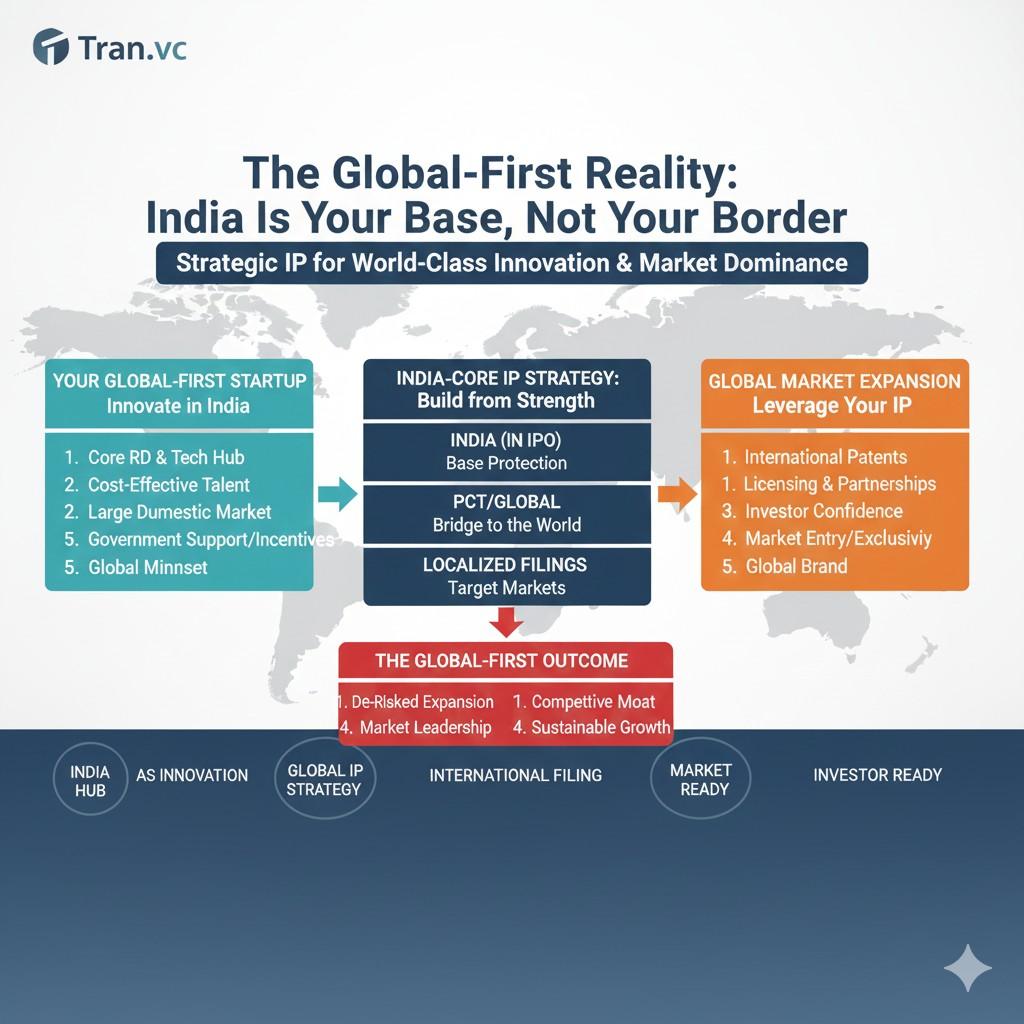
When people say “global-first,” they usually mean three things:
You want customers outside India early.
You want partners outside India early.
You want funding that expects global scale.
Now here is the uncomfortable truth: many startups try to “go global” with a weak IP story. They might have great code, strong demos, even paying pilots. But their moat is thin. A bigger player can rebuild the same thing, brand it better, and crush them with distribution.
Patents are not magic. They do not replace speed, execution, or sales. But for deep tech, AI, robotics, chips, new materials, medical devices, energy, and industrial tech, patents often decide who gets taken seriously. They also decide who gets copied.
A global-first patent strategy is not “file in the US.” It is a sequence of steps, timed well, where each step buys you options.
India gives you a strong starting point if you use it right. India can be your priority date, your technical proof, your cost-friendly base, and your leverage in conversations. But only if you plan early and document cleanly.
This is where most founders struggle: they do not know what is patentable, what is not, and what to file first.
Let’s make this simple.
A patent is about an invention, not a product.
A product is what users buy.
An invention is the “new way” behind it.
If your startup is global-first, your patent plan needs to focus on the invention that will still matter when you have competition in 18 months.
That is the heart of the game.
If you want a team that helps you do this without wasting months, Tran.vc supports technical founders with up to $50,000 worth of in-kind patent and IP services. You can apply anytime at https://www.tran.vc/apply-now-form/
Start here: decide what you are really protecting
Most startups think they are protecting “the idea.” That is too broad. Patents do not protect vague ideas. They protect specific methods, systems, and designs.
A better way is to answer one question:
If a smart competitor watched your demo, what would they copy first?
That “first thing” is usually one of these:
A core method that makes the system work better
A novel way of using sensors or data
A special training or inference pipeline
A control loop that makes robotics stable
A hardware layout that improves reliability
A workflow that cuts cost by 10x
A model architecture that solves a hard case
A safety or monitoring layer that prevents failure
A human-in-the-loop method that improves outcomes
A deployment trick that makes it usable in the real world
You are looking for the part that is hard to discover unless you built it, tested it, and failed many times.
That is the part you want to protect first.
A strong patent strategy is not about filing many patents. It is about filing the right first patent. The first filing sets your priority date. Everything later can build on that.
Think of it like staking a claim. If you stake it early, you can improve the land later.
But there is a catch: you only get that early stake if you do not publicly disclose your invention before filing.
Founders lose patent rights all the time because they show too much too early.
They post a technical deep dive on LinkedIn.
They publish a paper.
They open source a repo.
They pitch with detailed architecture slides.
They do a webinar that reveals the method.
They submit to an accelerator with full details.
Then they say: “We’ll patent later.”
Later is too late.
So the first rule is simple: if it is core, file before you reveal.
You can still market. You can still sell. But you do it with the right level of detail.
If you want a simple way to apply this: separate your story into two layers.
Layer 1 is what customers need to understand.
Layer 2 is what engineers need to rebuild it.
You can share Layer 1 freely.
Layer 2 should be shared only under NDA, and ideally after filing.
This one habit alone prevents most early IP mistakes.
And yes, Tran.vc helps founders build this habit and the paperwork around it. Apply anytime at https://www.tran.vc/apply-now-form/
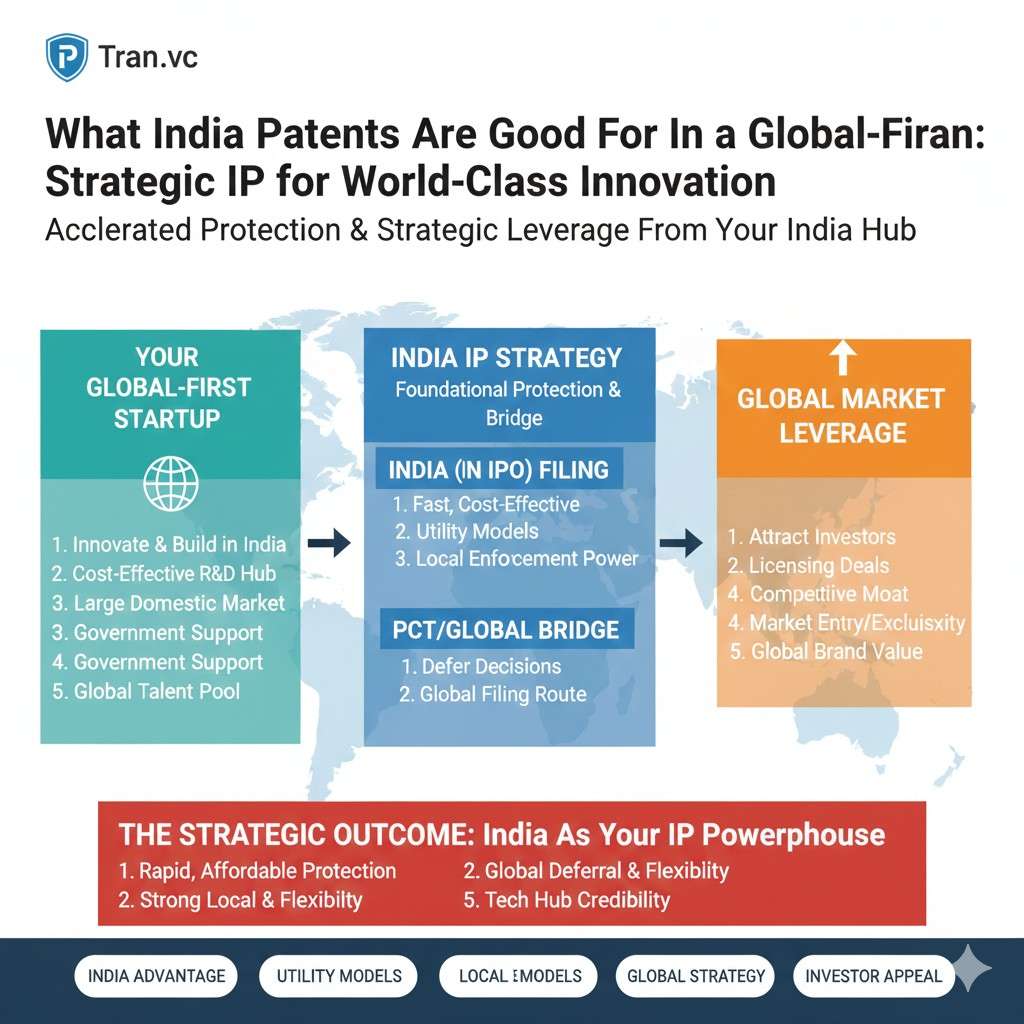
What India patents are good for in a global-first plan
Some founders think India patents are “not worth it” because they want the US market.
That thinking is incomplete.
An India filing is often the most efficient way to secure your first priority date. It can be the anchor for global filings later. It can also be valuable on its own because:
Many global companies manufacture in India or sell in India.
Enforcement is improving, and courts are more active than many assume.
Investors like seeing a clear filing and a clean story.
A granted India patent can be a real asset for partnerships.
But the biggest benefit is timing and cost.
You can file in India early, then use global pathways to expand later.
Most global-first startups use one of these routes:
File in India first, then file PCT within 12 months.
File in India first, then file directly in the US within 12 months.
File in India first, then file in a few key countries within 12 months.
The “12 months” number matters because of the priority system. Your first filing date is your priority date. If you file in other countries within that window, you can claim that earlier date.
That gives you protection against later filings by others and can block competitors who try to patent the same thing after seeing your product.
So India can be your low-cost, fast move that buys you time.
But only if your India filing is well written.
A weak first filing can trap you. If it is too narrow, you cannot later claim the bigger invention. If it is too vague, it can get rejected or become hard to enforce.
So the real goal is not “file in India.” The goal is “file a strong first application that supports global expansion.”
That is the difference between check-the-box IP and real IP.
Know this before you file: India has strict rules for software and algorithms
If you are building AI, ML, or software-heavy robotics, you must understand one thing early: India has limits on patenting “computer programs per se.”
In plain words, you cannot patent a pure algorithm in India as a bare idea.
So how do real startups patent in India?
They frame the invention as a technical solution to a technical problem, often tied to a system, device, method, or improved performance. They show how it changes the working of a machine or a technical process.
This matters a lot for AI and robotics.
If your invention is “a model that predicts failure,” that sounds like software.
If your invention is “a method in a robotics system that reduces failure by controlling X based on Y and improves stability,” that is more technical.
Same underlying work, different framing.
The right framing starts from engineering truth, not legal tricks. You ask:
What real-world system changes because of this method?
What measurable technical effect happens?
What constraints are solved? Latency, compute, power, safety, drift, noise, accuracy, reliability, wear, heat, bandwidth?
The more you can tie your invention to a technical effect, the stronger it becomes in India and also in many other regions.
This is why founders should not write patent drafts alone from scratch. Not because founders are not smart. Because a patent is a special kind of writing. The best patents read like a clean engineering spec, but also like a legal boundary fence.
When you do it right, it supports global filings and gives you multiple claim angles later.
Tran.vc’s model is built for this exact gap: technical founders with real inventions who need strong, strategic patents without the usual chaos. Apply anytime at https://www.tran.vc/apply-now-form/
The first filing: provisional or complete? Make it a business decision
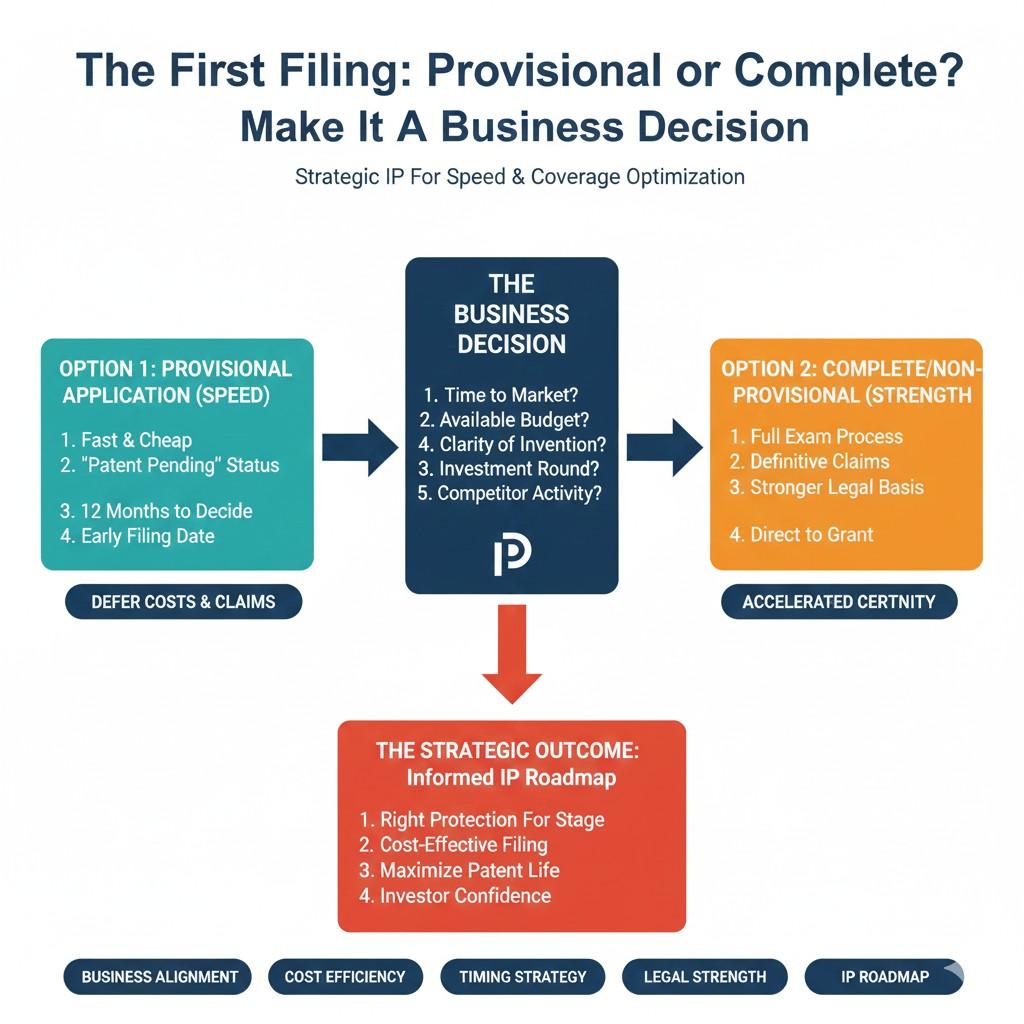
You will often hear: “File a provisional first.”
That can be right. But not always.
A provisional filing is useful when:
You need to lock a date quickly.
Your invention is still evolving.
You need time to test, collect data, refine.
You want to file more improvements in the next few months.
But a provisional can be risky when:
It is too thin and does not describe the invention well.
It misses key variants and fallback options.
It is written like a blog post, not a patent.
It leaves out details that you later want to claim.
A complete specification is stronger and more formal, but it takes more work.
Here is a simple way to decide:
If your core invention is stable enough that you can explain it clearly with examples and options, aim for a strong first filing that reads like a complete technical story, even if it is filed as a provisional-like draft.
If your invention is still changing every week, file a fast first filing, but make it rich in detail. Do not file a two-page sketch and call it a day.
The mistake is not choosing provisional. The mistake is filing something weak just to feel safe.
You want your first filing to do three jobs:
Prove novelty and usefulness.
Support broad claims later.
Support global filings later.
That means it needs depth: system diagrams, method steps, variants, edge cases, and measurable effects.
You do not need fancy words. You need clear engineering.
The “invention capture” habit: the easiest way to create strong patents
Most patents fail at the start because founders try to remember everything at filing time.
Do this instead.
Every time you solve a hard technical problem, capture it.
Write down:
What was failing before
What you changed
Why that change worked
What trade-off you accepted
What numbers improved
What hardware or data you used
What alternative versions could also work
This does not have to be long. It can be a simple internal doc or a short note. The key is consistency.
When you do this for 4–6 weeks, you suddenly have a backlog of real inventions. You can pick the best one to patent first, and you can build a pipeline.
Investors love this because it signals depth and discipline.
Also, when you later file in the US or Europe, that detail becomes gold. It helps the patent attorney draft stronger claims and avoid avoidable rejections.
This habit also protects you in another way: it reduces “inventor disputes” later. If your startup grows and people change, you have records of what was built, when, and by whom.
That is part of IP hygiene. It sounds boring, but boring is what wins in legal fights.
What to patent first if you are building AI or robotics in India
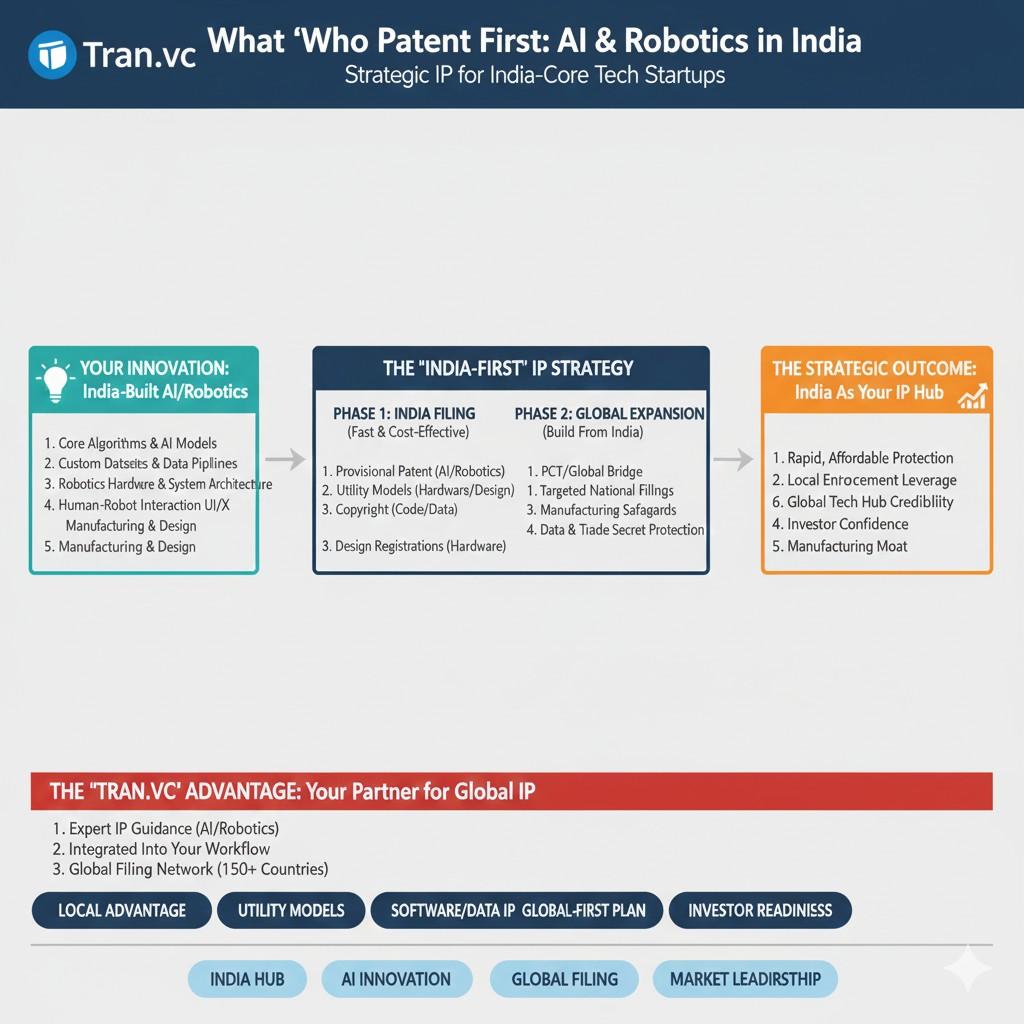
Let’s make this tactical.
If you are building robotics, your best first patents often relate to:
Control and stability methods
Sensor fusion and calibration
Safety systems and failure detection
Edge compute optimizations
Actuation and mechanism improvements
Navigation or planning methods tied to hardware limits
Low-cost manufacturing improvements that keep precision
Testing and monitoring methods that reduce downtime
If you are building AI, strong first patents often relate to:
Data pipeline methods that improve performance
Training methods that reduce compute or labels
Inference methods that reduce latency or memory
Techniques that handle drift, noise, and messy real-world data
System-level ways the model interacts with devices or workflows
Methods that produce reliable outputs under constraints
If you are building something in the middle, like an AI robot system, your strongest patents are often “system patents” that connect the full loop: sensor → model → decision → action → feedback, with a measurable technical effect.
India examiners often respond better when the invention is tied to a real system effect, not abstract math.
So, when you are deciding “what first,” do not start from what sounds cool. Start from what is hardest to copy and most tied to real-world performance.
The global timeline: use the India filing to create calm
A global-first startup has a lot going on: product, pilots, hires, fundraising, partnerships. Patents can feel like extra weight.
But if you file early and plan your next 12 months, patents create calm.
Because now you can:
Pitch with confidence
Share under NDA with less fear
Publish marketing content safely
Show investors a real barrier
Negotiate partnerships with leverage
A practical global-first timeline often looks like this:
Month 0: invention capture and decision on first filing
Month 1: file first India application
Month 2–6: build, test, collect results, capture improvements
Month 6–10: decide global markets and product direction
Month 11–12: file PCT or direct foreign filings
That is not rigid. But the 12-month window is real. You should plan around it.
If you do nothing until month 11, you will rush. And rushed IP is expensive and weak.
If you plan early, you can choose calmly. Calm is a competitive advantage.
India Patent Strategy for Global-First Startups
Why “global-first” changes how you file
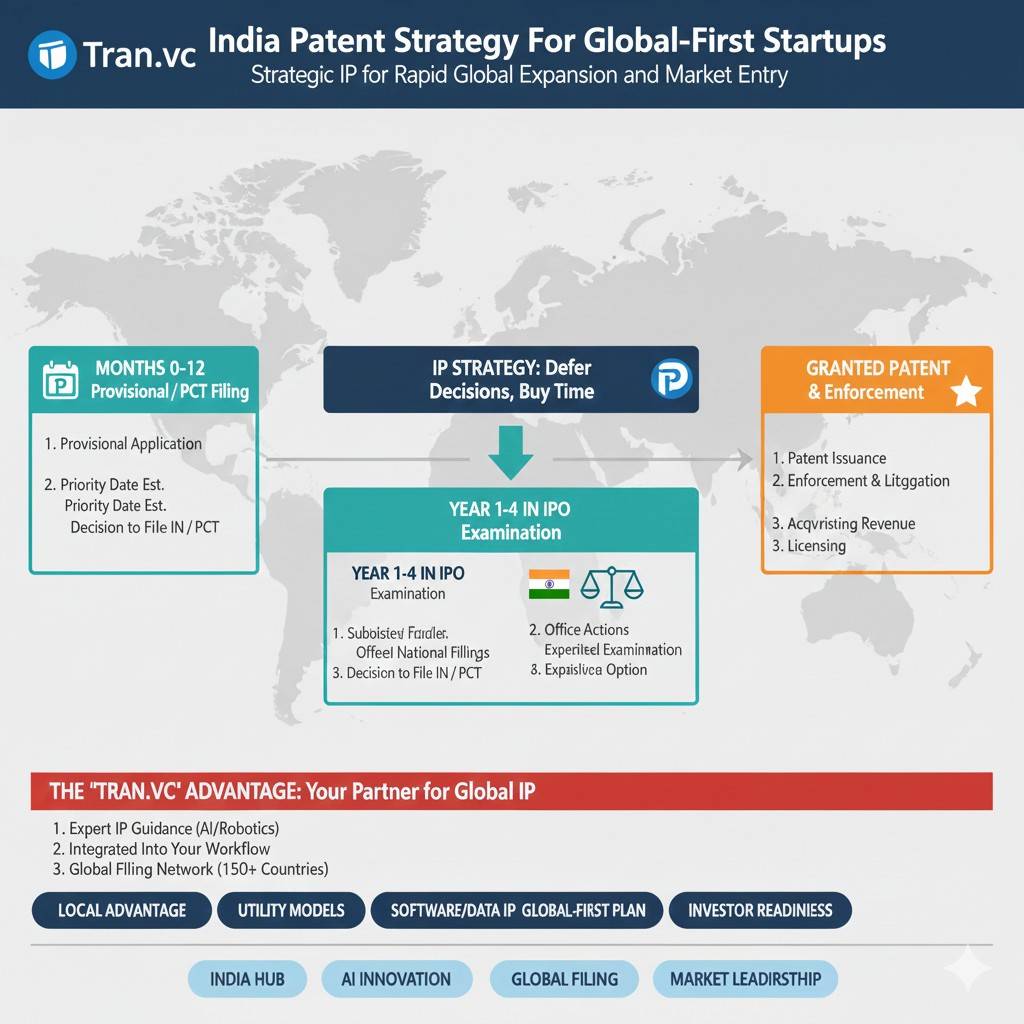
If your first real market is outside India, your patent choices must support that plan from day one. You are not filing just to say “we have a patent pending.” You are filing to protect the part of your tech that gives you an edge when you enter tougher markets.
Global-first also means your timeline is tighter. You will share more, pitch more, and partner more. Each time you share, you risk giving away details. A good strategy lets you keep moving fast without leaking the core.
The real goal: options, not paperwork
A strong patent plan is mainly about keeping options open. You want the freedom to file in the US or Europe later, to expand claim scope, and to build a patent family that grows with your product.
Many startups file one weak application and then feel stuck. The right first filing is like a solid foundation. It supports future filings and makes later decisions easier, not harder.
Where Tran.vc fits in this picture
Tran.vc helps founders turn real technical work into real IP assets early. The support is up to $50,000 in in-kind patent and IP services, built for AI, robotics, and deep tech teams that want to go global. You can apply anytime at https://www.tran.vc/apply-now-form/
India as your launchpad, not your finish line
What an India filing can do for a global company
India can be a smart first move because it gives you a priority date you can build on. That priority date can later support filings in other countries if you act within the right window. It can also help you speak with investors and partners from a position of strength.
India is also a real market for many sectors. If you sell, build, or manufacture here, an India patent can carry direct value. For some startups, it becomes part of their negotiation power in partnerships.
What India cannot fix later
An early filing only helps if it is written with enough depth. If the first application is thin, you cannot magically expand it later while keeping the same priority date. This is where many founders lose leverage without realizing it.
A rushed draft often misses key variants, edge cases, and system details. Later, when you try to file globally, you find that the best parts were never described properly. That creates gaps that competitors can exploit.
The 12-month window you must respect
Once you file your first application, you typically have a 12-month window to file in other countries and still claim that first date. This is a key reason India works well as a starting point. It buys you time to learn your market, refine your product, and still keep your global path open.
But time only helps when you use it well. The goal is to plan your next steps early, so you are not scrambling at month eleven with a half-ready story.
What to protect first: stop thinking “idea,” start thinking “engine”
Find the part competitors would copy first
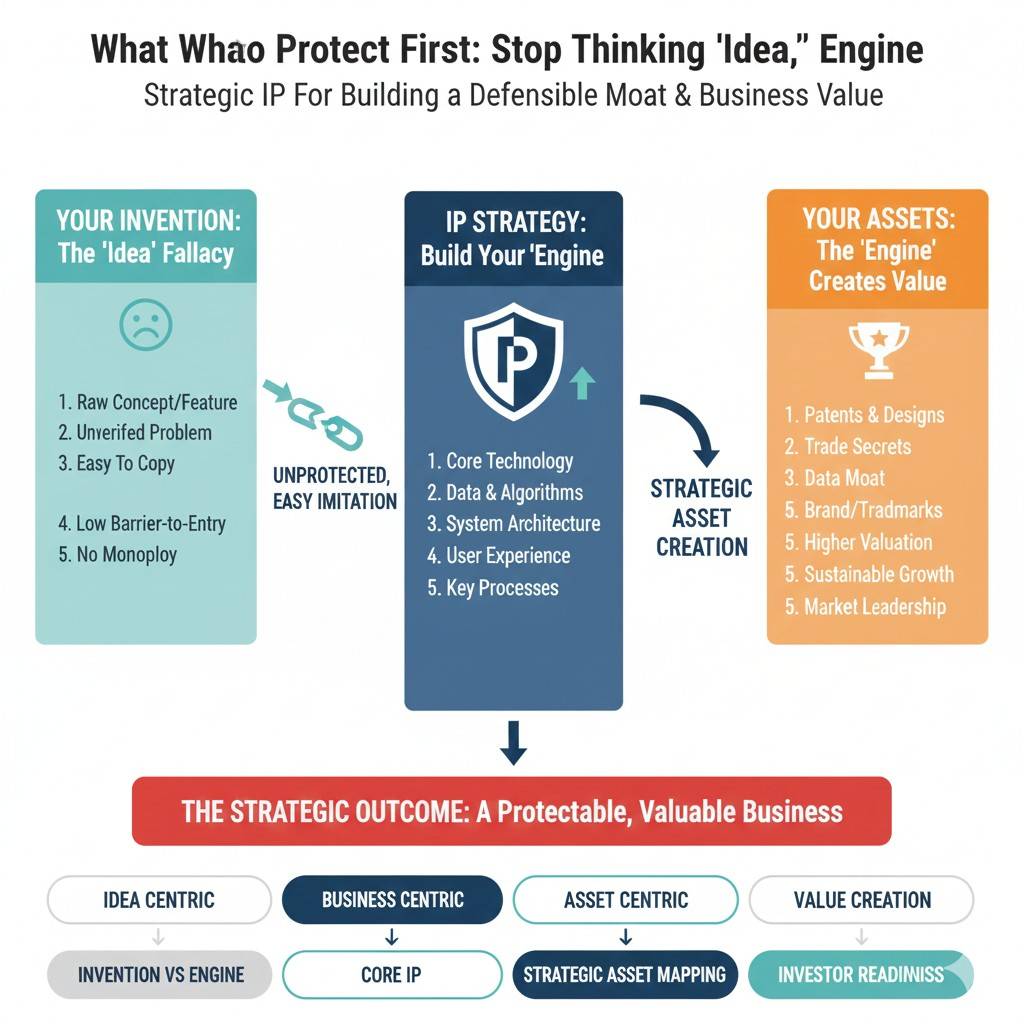
Patents do not protect a vague idea. They protect a specific invention. A simple way to find your first invention is to ask what a strong competitor would rebuild if they saw your demo and wanted to catch up fast.
In many AI and robotics startups, that “copy target” is not the UI, the dashboard, or the branding. It is the method that makes the system work in the real world, under real limits. That method is often hidden behind engineering decisions that took months of testing.
Protect what stays valuable in 18 months
Your first patent should not be tied to a feature that may change next quarter. It should be tied to something that stays important when you scale. Think of the core loop, the core pipeline, the core control method, or the core system behavior that makes your performance hard to match.
If your invention is truly central, it will still matter when you have ten customers, not just one pilot. That is what investors are looking for when they ask about defensibility.
The “two-layer story” that prevents IP leaks
A practical habit is to separate your story into two layers. The first layer is what customers need to understand to buy. The second layer is what an engineer needs to rebuild your solution.
You can share the first layer widely. You should protect the second layer with NDAs and careful sharing, and ideally file before you reveal it. This simple separation reduces accidental disclosures that can damage your patent position.
India’s software limits: how AI startups avoid dead ends
Why pure software claims struggle in India
India has rules that make it harder to patent a pure “computer program” as an abstract idea. This matters for AI startups because many inventions are expressed as models, code, or algorithms. When framed the wrong way, you can face rejection even if the work is meaningful.
This is not the end of the road. It just means your patent must show a technical solution, not only math on paper. The way you describe the invention matters as much as the invention itself.
How to frame AI inventions as technical solutions
Strong AI patents in India often focus on a measurable technical effect. This can include better speed, lower compute, lower memory, lower power use, better safety, better reliability, or better performance under real constraints.
The invention becomes stronger when tied to a system or process that changes how something works in the real world. In robotics, this connection is often natural because the output drives action. In software-only products, you need to be clearer about what technical problem is solved and what technical result is achieved.
What “technical effect” looks like in simple terms
A technical effect is a change you can point to and explain without hype. It can be “we reduced inference time on edge devices by X%,” or “we improved stability under sensor noise,” or “we cut false alarms in a safety system while keeping recall high.”
The best part is that this is not only good for patents. It is also good for sales and fundraising. Clear technical outcomes make your story sharper and more believable.
Provisional vs complete: choose based on risk and speed
When a fast first filing is the right move
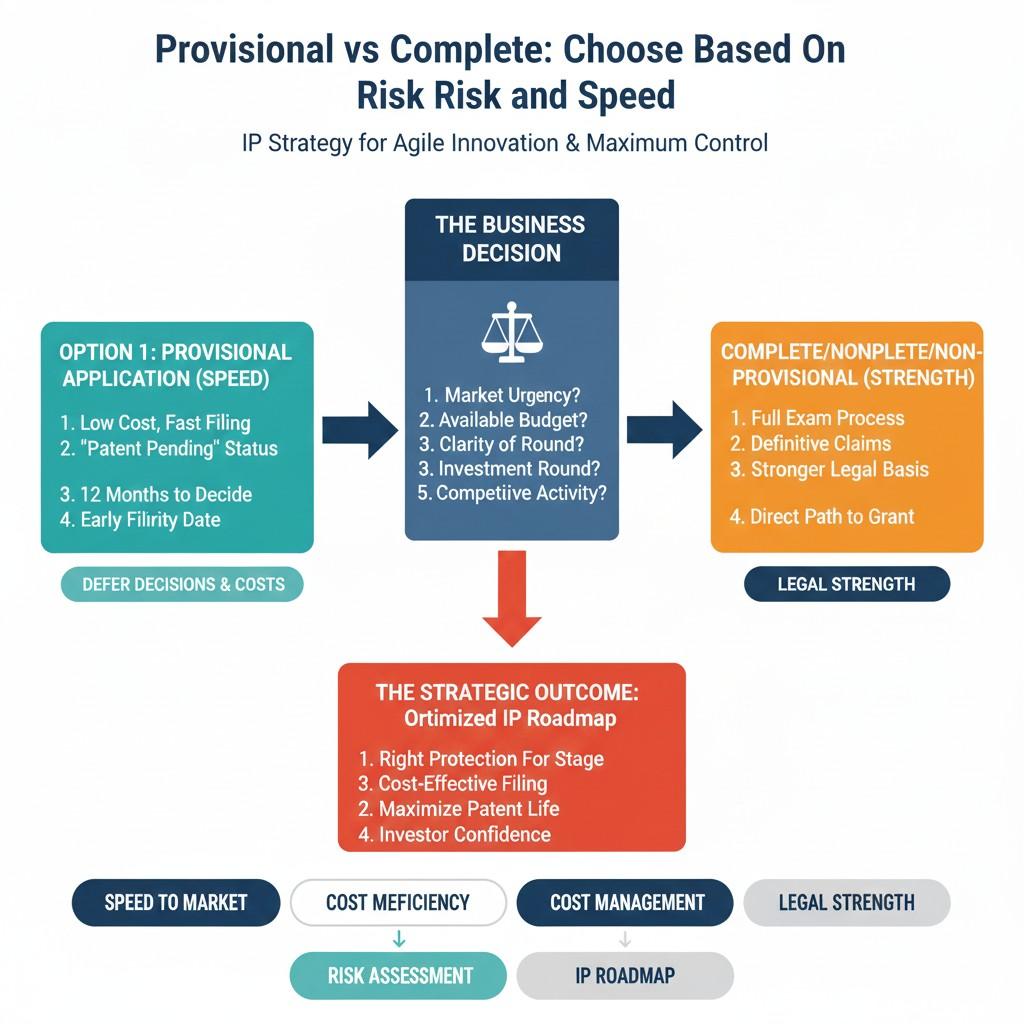
A fast filing can be smart when you need to lock a date before a demo, launch, or major pitch. It is also useful when the invention is still evolving and you want time to refine before filing globally.
But a fast filing should still be detailed. A short sketch can become a trap later. You want enough description to support broad claims and multiple variants, even if the product is still in motion.
When a complete filing is the better option
If your core method is stable and you can describe it clearly, a complete filing can reduce uncertainty. It can also help later during examination because it shows a more finished invention story with stronger support.
For global-first teams, the key factor is not the label. The key factor is whether the document contains enough engineering detail to back your future claims in the US and Europe.
The “thin filing” problem founders underestimate
A thin filing feels safe because it creates “patent pending.” But later, when you face investors or competition, thin filings do not help much. They can also limit what you can claim later, because you cannot add new matter while keeping the original priority date.
This is why drafting quality is not a luxury. It is a strategy choice. The first filing sets the ceiling for what you can build later.
The invention capture habit: build patents from real work, not memory
Treat inventions like sprint outputs
Every time your team solves a hard problem, capture it while it is fresh. Write what failed before, what you changed, why the change worked, and what improved. This is not busy work. It is how you build a patent pipeline without stress.
If you do this regularly, you stop fearing the blank page. You can choose which inventions are worth patenting, rather than hunting for something to file when a deadline hits.
How this helps you file stronger, faster
When you have captured notes, diagrams, test results, and variants, your patent draft becomes easier and more accurate. You do not rely on vague memory. You rely on real engineering detail.
This also helps you avoid inventor disputes later. Clear records reduce confusion about who contributed what and when, which matters as your team grows.
Why investors notice this discipline
Investors can tell when a startup has real depth. A clean invention process signals that you build original work, not only glue code. It also shows that you can defend your edge, which reduces risk in their eyes.
If you want this handled with a founder-friendly process, Tran.vc supports this end-to-end. Apply anytime at https://www.tran.vc/apply-now-form/
What to patent first in AI and robotics: practical targets
Robotics: protect control, safety, and real-world reliability
Robotics inventions often live in the messy zone between theory and reality. That is where patents are strongest. If your work improves stability, reduces failure, handles sensor noise, or enables safer operation, you likely have patentable material.
A good robotics patent often describes the full loop: sensing, decision, actuation, and feedback. It explains how the loop behaves under real conditions and why the method is better than common approaches.
AI: protect system-level methods, not only model names
For AI, the strongest patents often focus on how data flows, how training is done under constraints, how inference is made efficient, and how outputs become reliable in the real world. Many of these inventions can be described as methods and systems that create a technical improvement.
If your advantage is “we trained a better model,” that is often too weak. If your advantage is “we achieve X reliability under Y constraint using Z method,” that becomes a stronger invention story.
Hybrid systems: the best patents link software to outcomes
If your AI drives a device, workflow, or real process, your patent should show how the invention changes the system outcome. This helps in India and also helps globally, because it anchors the invention in technical results.
This is also where startups can build a patent family. One filing can anchor the core system, then later filings can cover improvements, variants, and specific deployments.
The global timeline: using India to create calm and leverage
A timeline that reduces panic filing
Global-first teams benefit when they plan around the first filing date. The first filing gives you a starting point, then you use the next months to test, improve, and capture more inventions. By the time the global filing decision arrives, you are choosing thoughtfully, not rushing.
This calm matters because rushed filings cost more and deliver less. Calm filings are usually better written, better scoped, and more aligned with the business.
PCT vs direct filings: why the choice matters
Many startups use the PCT route because it can delay the biggest country-specific costs while keeping options open. Others file directly into a key market like the US when they already know where they will sell first.
The right choice depends on your sales plan, budget plan, and investor plan. It also depends on what your product will look like in 12 to 18 months, because that affects what claims you want to pursue.
How to align patents with fundraising without giving up control
Patents can help you raise with better terms because they reduce the “copy risk.” They also help you show that your tech is not easy to replace. This can matter even more when you are seed-strapping, where you grow without chasing big VC money too early.
Tran.vc’s approach is built around that kind of leverage. If you want to build defensible IP while keeping control, you can apply anytime at https://www.tran.vc/apply-now-form/