
Canada and Australia don’t get talked about the way the U.S., China, or Europe do. They don’t dominate patent headlines. They don’t show up in every “top 5 jurisdictions” chart founders pass around in pitch decks.
And that is exactly why they can be so valuable.
If you’re building real tech—AI, robotics, core software, sensing, compute, new hardware—these two countries can give you something founders often miss in the noisy markets: strong protection, clean pathways, and smart leverage for later raises. Not because they are “cheap” or “easy.” But because they are often overlooked. And in patents, being overlooked can be an advantage.
At Tran.vc, we work with early technical teams who want to build a moat before they are famous. Before they have a big round. Before competitors copy the best parts of the product. Our whole model is built around that idea: we invest up to $50,000 in-kind through patent and IP services so you can build defensible assets early—without giving up control too soon. If you want help mapping a practical patent plan for your stack, you can apply anytime here: https://www.tran.vc/apply-now-form/
Now, why focus on Canada and Australia?
Because each one offers a quiet kind of leverage.
Canada is deeply tied to the U.S. economy, investor base, and supply chain world, yet it has its own legal system and its own patent office behavior. Australia is a gateway into Asia-Pacific business and enforcement realities, and it has a patent system that can be surprisingly founder-friendly when you use it well.
In both markets, the “big company playbook” often doesn’t show up at the pre-seed level. That means founders can make smart moves that cost less effort than the same moves would cost in the U.S.—and still create real investor-grade value.
Let’s make this simple and useful.
A patent market becomes “quietly valuable” when four things are true.
First, it gives you protection that actually matters in court or in deals, not just a certificate you frame. Second, it helps you tell a stronger story to buyers, partners, and investors. Third, it can fit into a broader global plan without forcing you to burn cash early. Fourth, it can help you move faster than the teams who only think about patents when a VC tells them to.
Canada and Australia meet these conditions more often than people think.
The founder mistake: thinking patents are only “U.S. first”
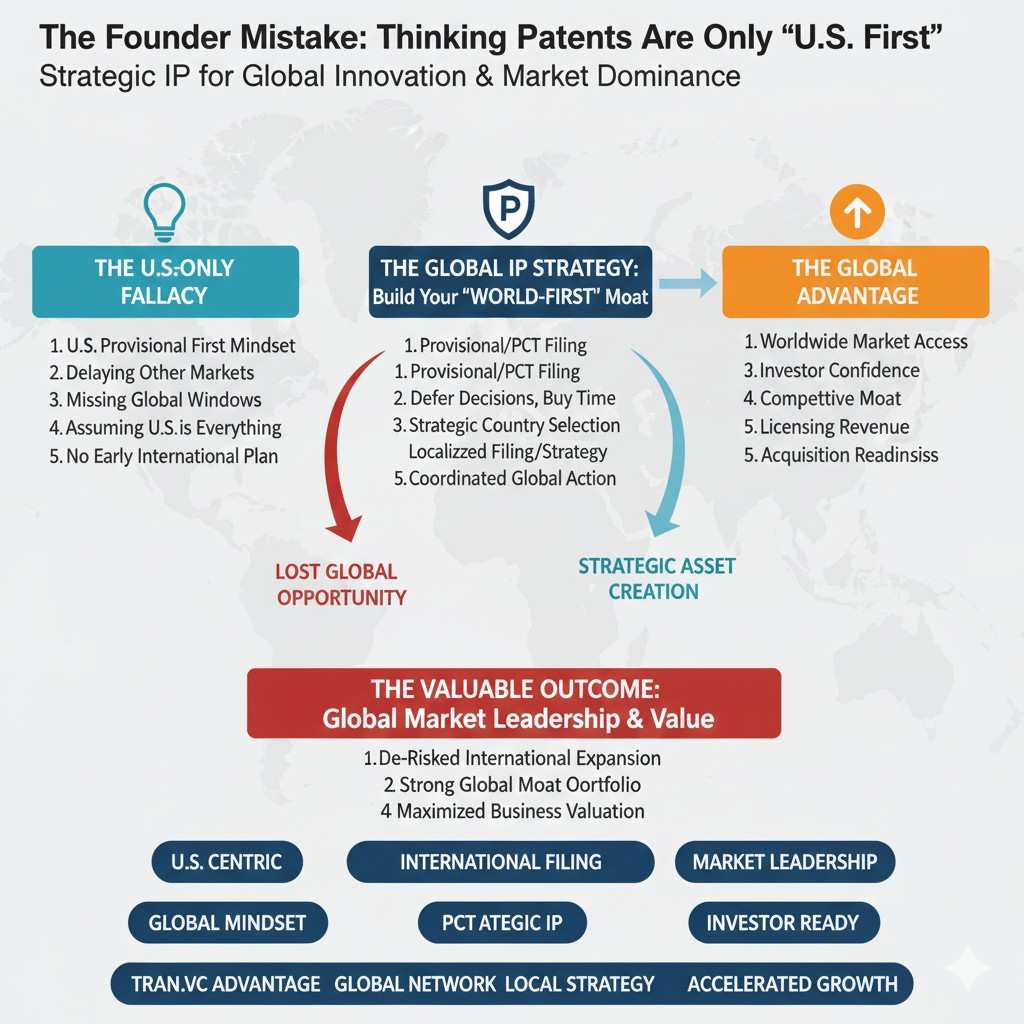
Many technical founders start with a default setting: “We’ll file in the U.S. first, then we’ll see.”
Sometimes that is correct. But the hidden risk is what comes next. The team keeps shipping. They keep improving. They keep posting demos. They keep hiring. And they assume they can “add patents later.”
Patents do not work like that. Your best technical edge often shows up early, before you even know what the final product will be. The routing choice. The learning loop. The data pipeline trick. The way your robot calibrates itself. The method your model adapts with less data. The way you reduce latency without losing accuracy.
These are the things that turn into defensible claims.
And these are the things competitors will copy first.
So the better question is not “Where do we file first?” The better question is “How do we build a patent plan that keeps options open, builds proof for investors, and does not slow the team down?”
That’s where Canada and Australia become tools, not just destinations.
Canada: the close neighbor that investors take seriously
Canada sits right next to the U.S., but it plays its own game. This is good news if you know how to play it.
When a U.S. investor looks at Canada, they don’t see a random overseas filing. They see a country with strong rule of law, stable courts, and a business environment they understand. Even if your company is not Canadian, a Canada filing can signal that you think beyond “one market,” without looking like you’re wasting money on far-off places that don’t match your go-to-market.
But the bigger value is more tactical.
Canada is a great place to do three things:
One, create credible “global intent” early without committing to the most expensive full global build-out. Two, reduce risk around copycats who operate across North America. Three, shape your claim strategy with another examiner culture in mind, which can help you later.
Here’s what that means in plain founder terms.
If you only file in the U.S., you are betting that your competitors will only care about the U.S. That is not how modern tech competition works. Many teams build in one country, sell into another, and manufacture somewhere else. Canada is tightly connected to U.S. supply chains, research networks, and buyer systems. Filing there can stop “nearby” copying and can strengthen your position in negotiation, especially when customers or partners have a Canada footprint.
And there’s another quiet upside. A Canada patent can help with deal leverage.
When you are in early talks with a strategic partner, they may not care about your entire roadmap. They care about risk. If they integrate your tech, can a rival replicate it quickly? If they bet on you, can they protect that bet? Having protection in more than one serious jurisdiction signals that you are not building on sand.
This matters even more for robotics and AI. These products often land in regulated, safety-sensitive, or long sales-cycle spaces. Buyers do not just want performance. They want reduced vendor risk. Strong IP helps.
Australia: the Asia-Pacific lever founders ignore
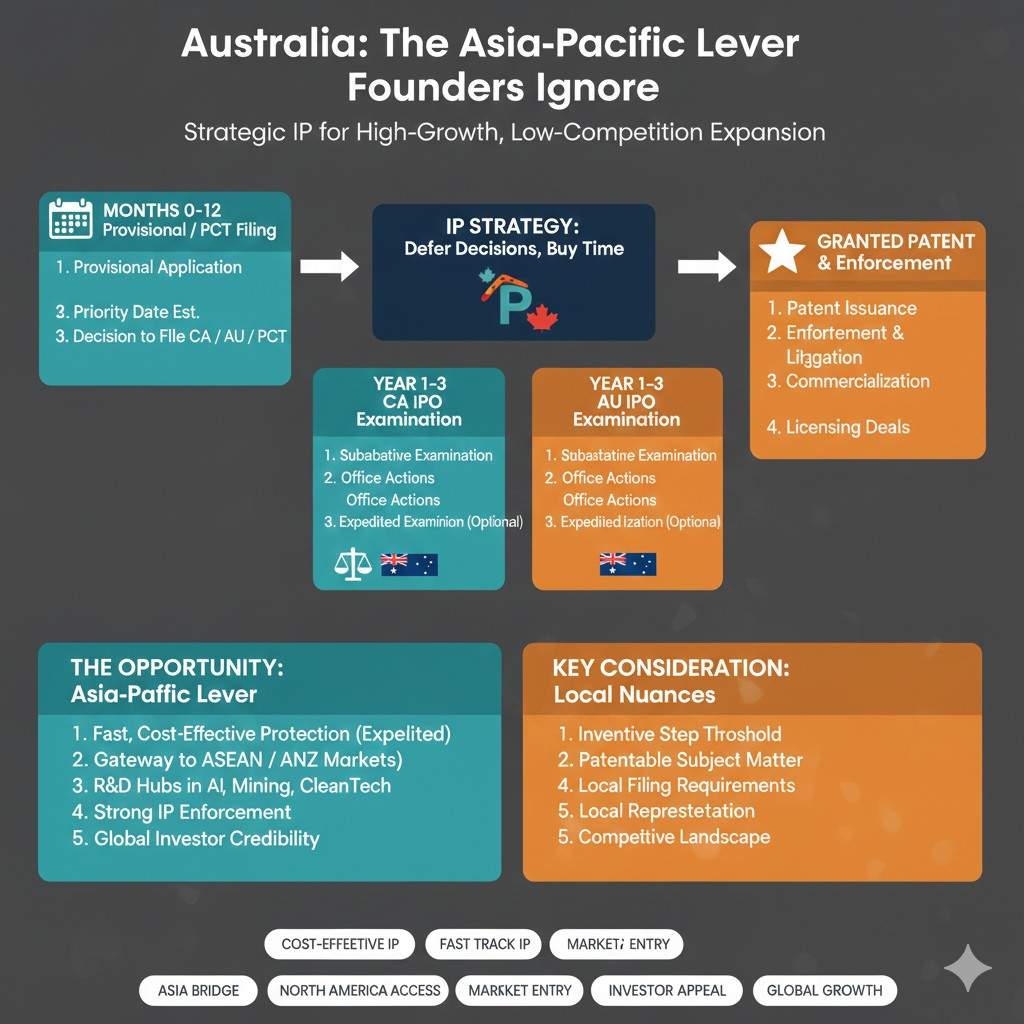
Australia is often treated like a “nice to have” market, or a place you file only if you sell there.
That mindset leaves value on the table.
Australia is a highly respected legal system, and it is strategically placed in a region where a lot of tech business flows. It also has an IP system that, when used thoughtfully, can fit a pre-seed company’s reality. Not because it’s lax, but because it can be navigated in a way that lines up with how founders build.
For founders, Australia is quietly useful for:
Creating an enforcement and licensing footprint in Asia-Pacific discussions, even when your HQ is elsewhere. Strengthening the perceived seriousness of your IP portfolio for global investors. Building a “second anchor” outside North America and Europe, without the cost and complexity of filing everywhere at once.
If you’re building robotics, Australia can matter because of mining, logistics, agriculture, and industrial automation use cases. If you’re building AI, it can matter because of enterprise adoption patterns and regional partnerships. And even if you never sell a unit there, it can matter in negotiation. Patents are not only about where you sell today. They are also about where competitors operate, where manufacturing happens, and where the next partner wants certainty.
The main reason these markets are “quietly valuable”: they reward disciplined planning
Let’s talk about what “disciplined planning” actually looks like.
It does not mean filing ten patents because you want a big number.
It means starting with a clear map of your technical edge.
A real map, not a marketing list.
For robotics, this might include: how your system senses the world, how it fuses signals, how it plans, how it acts, how it learns, how it handles failures, how it calibrates, how it updates, how it stays safe.
For AI, it might include: how you collect data, how you clean it, how you label it, how you train, how you fine-tune, how you compress, how you serve, how you monitor drift, how you keep privacy, how you prevent model theft, how you align outputs, how you reduce compute.
Each of those areas can hold patentable methods. The trick is choosing the ones that create a moat, not the ones that sound impressive.
Canada and Australia are useful because they let you extend and reinforce that moat in places where competition often does not expect you to show up. That surprise can change negotiation dynamics later.
A practical founder scenario (this is common)
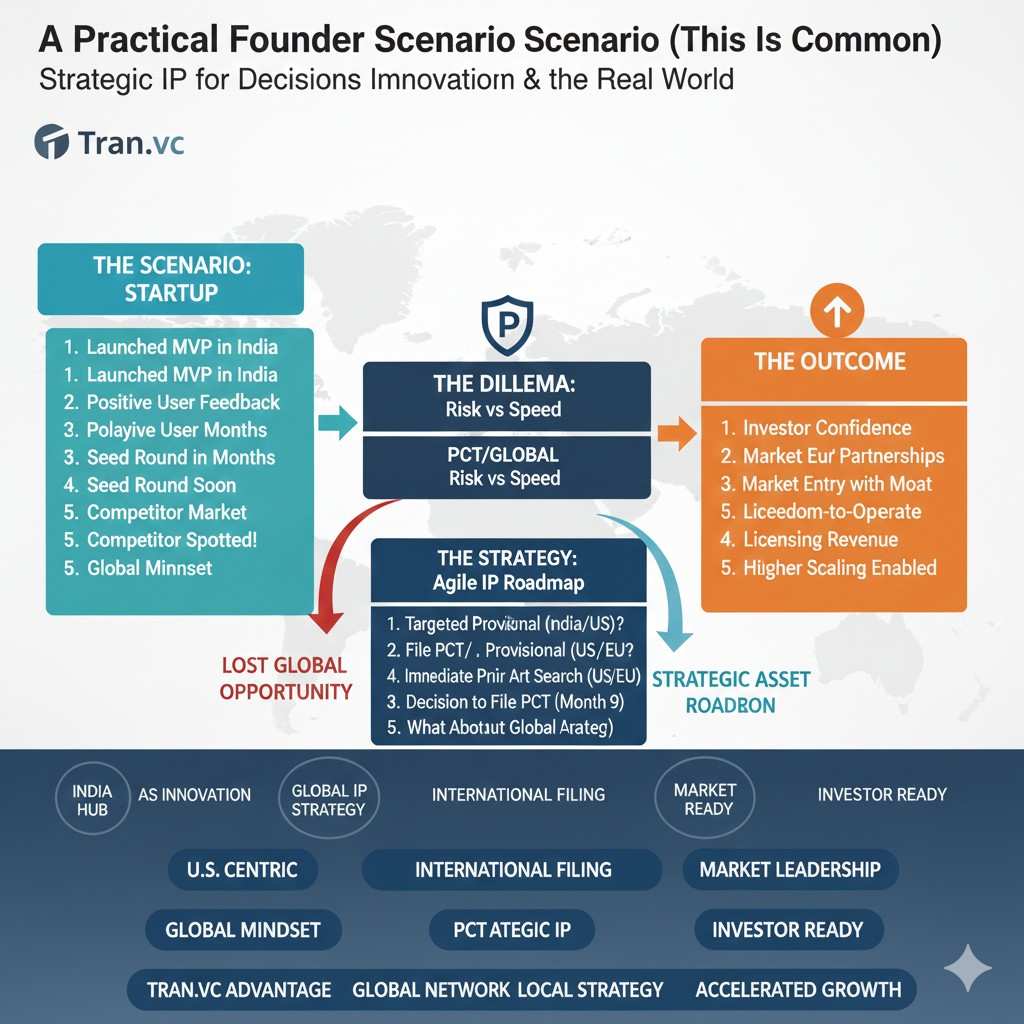
Imagine you are building a robotics platform for warehouse picking.
You have one big edge: a method that adapts grasp strategy in real time using a small on-device model plus a fast feedback loop from force sensors. It cuts error rates and avoids damage.
Now imagine two competitor types:
The first competitor is a well-funded team in the U.S. They build something similar. They are not sure if you have patents. They assume you don’t, because most pre-seed teams don’t.
The second competitor is a team overseas. They do contract manufacturing, they sell into different markets, and they move fast.
If you only file in the U.S., you are protected in one place. If you file in the U.S. plus Canada, you now have coverage in a connected North American market. If you add Australia as a planned part of your portfolio (even if you do it in phases), you can signal a broader defensive posture without pretending you can afford “worldwide” filings.
The result is not just legal protection. It is business leverage.
When investors ask, “What stops a bigger team from copying you?” you can answer with more than “speed.” You can show that you protected the core method across multiple serious markets. That changes the tone of the conversation.
If you want to build that kind of leverage without wasting time, this is exactly what Tran.vc helps with. We help you choose what to protect, how to write it so it holds up, and how to time filings so you don’t burn cash at the wrong time. Apply here if you want to talk through your plan: https://www.tran.vc/apply-now-form/
What founders should do before thinking about any country
Before we go deeper into Canada vs. Australia, you need one thing: a clean “claim story.”
This is not a patent document yet. It’s a simple narrative that answers:
What is the method?
What problem does it solve?
Why is it different from standard practice?
What parts must be present for it to work?
What parts are optional improvements?
How would a competitor try to copy it?
Where would they cut corners?
Where would they still infringe?
If you can’t tell this story, you will waste money in every country. If you can tell it, Canada and Australia become extra tools to tighten your moat.
A simple way to build that story is to take one feature and force yourself to explain it like you’re teaching a smart engineer from another domain. No marketing language. No “platform.” No “end-to-end.” Just steps.
If the explanation naturally becomes a method with clear steps and clear technical inputs and outputs, you are close to something patentable.
If it stays vague, it’s either not ready or not a real edge.
Why Canada can be easier to “fit” into early-stage budgets
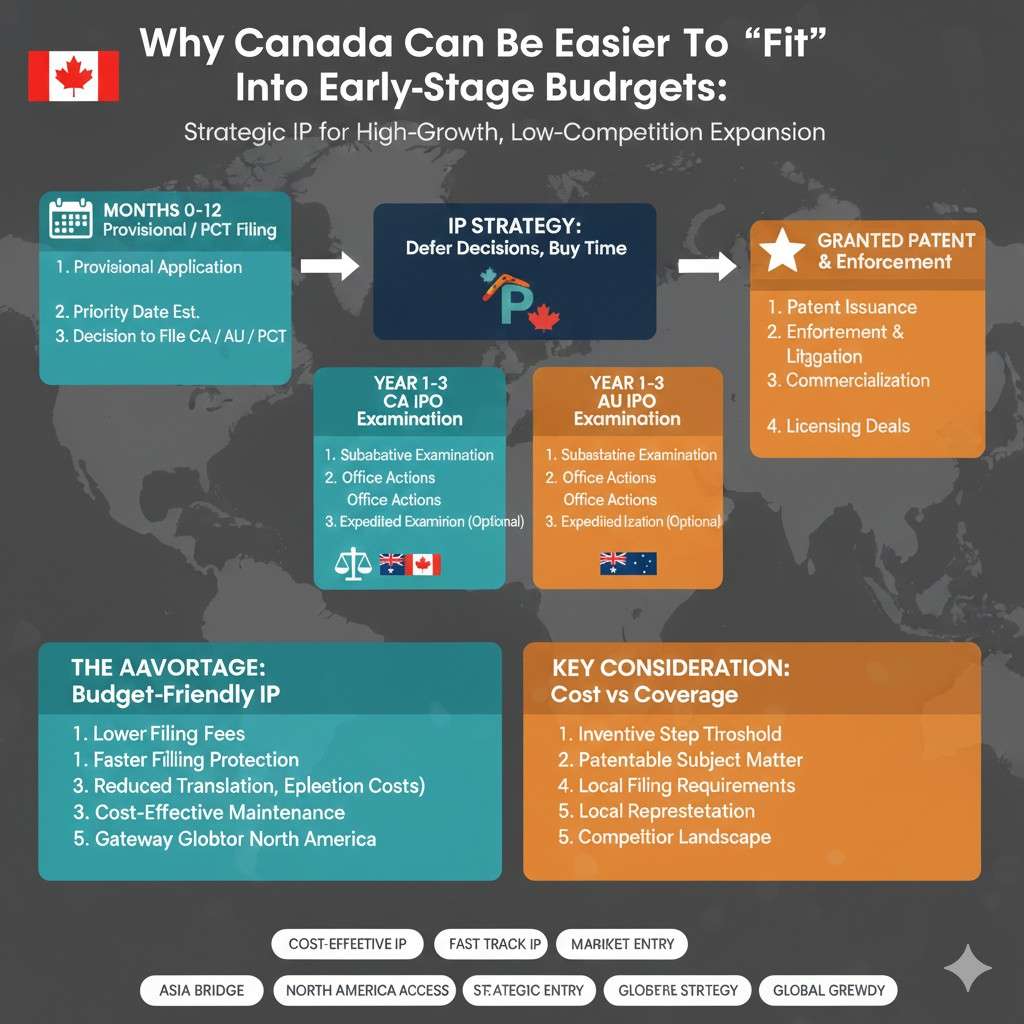
Founders often ask about cost, but the better way to think about it is timing.
You don’t need to do everything at once.
A strong early plan often follows a path like this:
You file once, early, with a well-built core disclosure.
Then you keep improving the invention while you learn from the market.
Then you file follow-ons that capture the improvements, before you publicly reveal them.
Then you choose where to enter national phases based on where you sell, where you partner, where competitors operate, and where enforcement would matter.
Canada is often a sensible part of that later stage, because it is close enough to the U.S. story that it feels like a natural extension rather than a wild expansion. That psychological factor matters when you are explaining strategy to investors. It makes your plan look focused.
Australia can play the same role for teams who want an Asia-Pacific anchor, but don’t want to spray filings across many countries.
The key is that you’re building optionality.
Optionality is what pre-seed teams need most. Not a huge spend. Not a vanity portfolio. Options you can exercise when you see traction.
That’s the whole seed-strapping mindset Tran.vc supports. Build assets early. Keep control. Raise with leverage later. If you want help building that option-rich IP plan, apply anytime: https://www.tran.vc/apply-now-form/
Canada: The North America “Moat Extender”
Why Canada matters even if you do not sell there yet
Canada is not just a smaller version of the U.S. It is a market with its own patent office habits, its own court system, and its own deal culture. But it is closely tied to the same North American business lanes that most startups end up using anyway. That mix is rare, and it is why Canada can quietly increase the value of your IP story.
If you are building AI or robotics, you are often selling into buyers who operate across borders. Large logistics firms, industrial groups, health systems, and energy companies do not think in one-country maps. When you show that your core invention is protected in both the U.S. and Canada, it can make you look more prepared and less risky.
For early-stage teams, this is not about filing everywhere. It is about picking a second jurisdiction that feels logical, serious, and close to your main commercial story. Canada checks those boxes more often than founders expect.
The hidden advantage: predictable seriousness
A patent only helps if it holds weight when it matters. Canada is a stable rule-of-law country where business disputes are handled through systems that sophisticated companies respect. That means your patent is more likely to be treated as a real asset in a negotiation, not as a decorative paper.
This matters in two common moments: partnerships and fundraising. In partnerships, a large company wants comfort that they are not building their future product on a vendor that can be copied overnight. In fundraising, a strong portfolio can move your story from “cool demo” to “defensible business.”
Canada’s value is not loud. It is steady. It is the kind of steady that makes diligence calls simpler and buyer conversations smoother.
When Canada fits best for AI and robotics founders
Canada fits best when your business touches North America in any meaningful way. That could mean customers, partners, manufacturing, talent, or even data relationships. If your team is in the U.S., Canada still fits because competitors often operate in both markets, and because many buyers have operations in Canada even if their HQ is elsewhere.
It also fits when your invention sits in a domain where trust and compliance matter. Robotics in warehouses, labs, and factories tends to face safety questions. AI used in enterprise settings tends to face privacy and accountability questions. Strong IP does not solve these, but it signals maturity and long-term thinking.
If you have even one credible path to enterprise buyers, Canada can strengthen your posture without forcing you into an overly complex global plan.
What types of inventions tend to “show well” in Canada
For robotics, inventions that describe a clear technical method often do well. If your work improves sensing, calibration, control loops, motion planning, grasping, or failure recovery in a way that can be written as steps, you likely have something protectable. The trick is not the field. The trick is the clarity of the method and the proof that it is not the standard approach.
For AI, the strongest candidates are often the practical system inventions. This includes training methods that reduce data needs, serving methods that reduce latency, techniques that make models more robust, methods that detect drift, privacy-preserving pipelines, model compression that keeps accuracy, or defenses against model theft. If your innovation changes how the system behaves, not just what the user sees, it is a better candidate.
Canada is especially useful when your invention can be described in a way that looks like an engineering process rather than a marketing claim. Investors love that too, because it reads as real technology, not just branding.
The mistake founders make: writing patents like a feature list
A common early-stage mistake is to describe the product as a collection of features. “We do X, Y, and Z.” That reads well on a website, but it usually becomes weak in a patent because it does not define the inventive method clearly. It also makes it easier for a competitor to copy the core idea while changing surface details.
A stronger approach is to pick one technical advantage and write it as a process with steps. What inputs come in, what transforms happen, and what output comes out. Then you add variations that are still part of the same underlying method. This is how you create claims that are harder to avoid.
If your patent attorney has to guess what the invention is, you will get a document that looks formal but does not protect the heart of your system. At Tran.vc, our job is to prevent that outcome by shaping the claim story early, before filing turns into expensive guesswork. If you want to build that foundation, you can apply here anytime: https://www.tran.vc/apply-now-form/
A tactical method to decide if Canada should be on your list
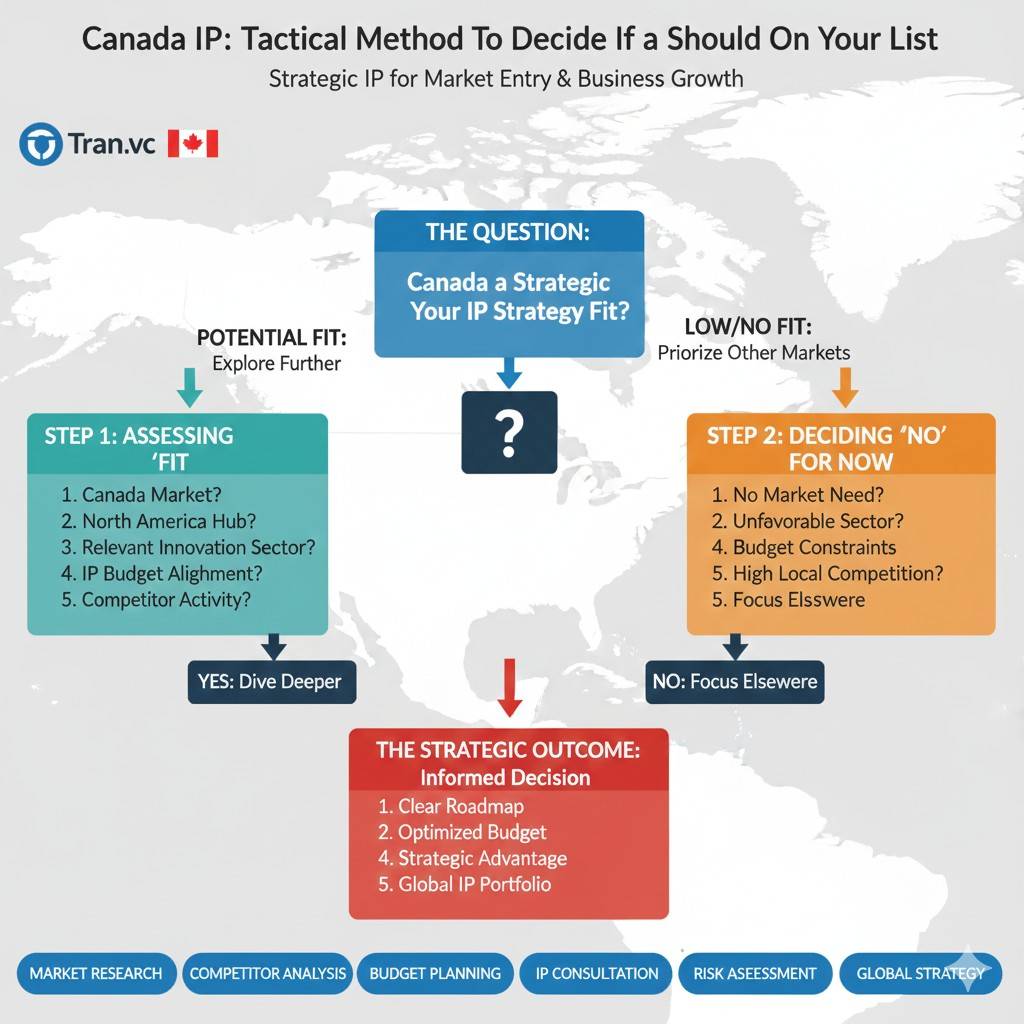
Here is a simple test founders can run without spreadsheets or long meetings. Ask yourself where copying would hurt the most in the next two years. Not in theory, but in your real path. If a competitor copies you in North America, do you lose deals, partners, or pricing power? If the answer is yes, Canada becomes a strong second-market choice.
Next, ask where your first “real” customers are likely to be. Many robotics and AI startups start with pilot projects. Pilots tend to be with larger operators, and those operators often have facilities in Canada. If your pilot customer has Canadian operations, even if you never sell there first, Canadian coverage can strengthen your negotiation leverage.
Finally, ask if your story benefits from looking global without looking scattered. Investors can get suspicious when a pre-seed team files in many countries without clear reason. Canada rarely triggers that suspicion, because it sits right next to the U.S. story and feels like a logical extension.
How Canada supports a smart “phased” filing plan
Most founders assume global patent planning means huge checks and huge commitments. In reality, good early planning is often phased, where you keep options open and only spend big when you have traction. Canada can sit naturally inside that kind of plan.
The core idea is to build a strong first filing that captures the invention deeply. Then, as your product evolves, you add follow-on filings that protect the improvements. Then, when your commercial path is clearer, you choose where to convert that early filing into full protection.
Canada is often chosen at that stage because it aligns with the North American customer and competitor landscape. It can also help when you are discussing licensing, partnerships, or strategic interest, because it shows you are thinking beyond a single jurisdiction.
This is why we often tell technical founders to stop thinking in terms of “where do we file first” and start thinking in terms of “what do we want to protect first, and how do we keep our options alive.” If you want a team to help you build that plan without slowing your product work, apply anytime: https://www.tran.vc/apply-now-form/
A founder-grade checklist for what to capture in the first Canada-relevant filing
When you prepare a first filing that could later extend into Canada, your focus should be depth, not breadth. You want to describe the invention so clearly that someone else could implement it, yet broad enough that they cannot dodge it by trivial changes.
In robotics, that often means describing the full loop: sensing, interpretation, decision, action, and feedback. In AI, it often means describing the full pipeline: data inputs, transformations, model steps, serving mechanics, monitoring, and protective measures. The more your invention is tied to measurable system behavior, the easier it is to defend.
It also helps to include real variations. Not random alternatives, but realistic versions you might ship. When you include those variations, you reduce the risk that your own future roadmap escapes your patent coverage.
How to use Canada to strengthen the investor story
Investors do not only ask “do you have patents.” They ask “do the patents matter.” A Canada strategy can make your answer stronger if you connect it to business logic.
Instead of saying, “We filed in Canada,” you say, “Our core method is protected across North America, because our buyers and competitors operate across these borders.” That makes your filing look like a strategic decision, not a vanity move.
Then you connect it to timing. “We filed early to protect the core method, and we are adding follow-ons as we ship major improvements.” This shows discipline. Discipline is what investors want from technical founders, because it reduces execution risk.
If you want help building a patent narrative that feels credible in diligence, that is exactly what Tran.vc does. We help you translate real engineering into defensible IP that supports fundraising, not just legal paperwork. Apply here: https://www.tran.vc/apply-now-form/