
Patents feel like a “later” problem. Until a customer asks, “Do you own this?” Or an investor says, “What stops the next team from copying you?” Or a big company starts circling your space. Then the question becomes simple and urgent: how much is global patenting going to cost us, really?
This guide will walk you through the real cost of patenting across countries, broken down by stage—starting from the moment you have an invention worth protecting, all the way to owning patents in the places that matter.
And if you want help building a clear patent plan without burning cash early, you can apply anytime at https://www.tran.vc/apply-now-form/.
The truth nobody tells you upfront
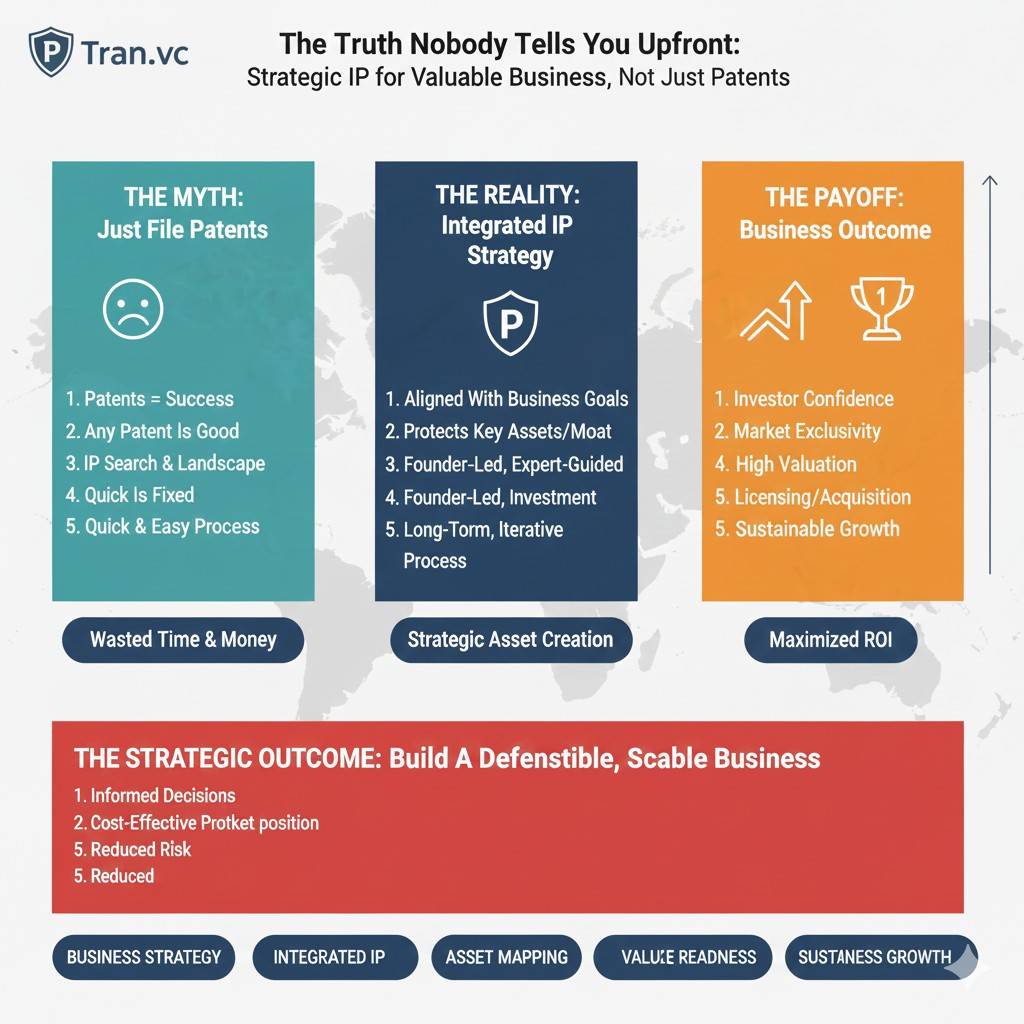
Most founders hear a number like “$15,000 for a patent” and think they now understand the budget. That number is usually for one filing, in one country, with no serious back-and-forth, and it often skips the costs that hit later.
Global patenting is not one bill. It is a chain of bills.
You pay to explore. Then you pay to file. Then you pay to keep your options open. Then you pay to enter countries. Then you pay again to fight examiners. Then you pay to maintain it year after year.
So instead of one giant scary number, you need a stage view. Because the best way to manage patent spend is not “spend less.” It is spend at the right time, on the right thing, for the right reason.
First, what “global patenting” really means
There is no such thing as “a worldwide patent.” You get patents country by country (or through regional routes that still end in country rights).
So when founders say “we want global coverage,” what they usually mean is:
- We want the right to stop copycats in the markets we sell into.
- We want leverage in the markets where big competitors operate.
- We want strong IP that investors respect.
- We want options, without spending too early.
That is the real goal: options with control.
This is exactly why smart teams use a staged approach. You do not pay for the whole world on day one. You buy time, learn what matters, then pay for the countries that match your plan.
The cost drivers that decide your budget
Before we talk stages, you need to know what actually moves the number up or down. Most patent cost shock comes from these five things:
One: how complex your invention is.
A simple mechanical change is often cheaper to write and argue. Deep AI systems, robotics stacks, sensors, edge compute, and training methods usually take more time to describe well. More time means more cost.
Two: how much work it takes to write a good application.
A patent that gets allowed fast is often one that was written with care. If the first draft is weak, you may “save” money early and then pay for it later in rejections, rewrites, and narrow claims.
Three: how many times you argue with the examiner.
Most good patents go through back-and-forth. Each round costs money. Some inventions get allowed with one round. Others take three or four rounds. That swing can change the total cost a lot.
Four: what countries you choose.
The US, Europe, Japan, China, and Korea are major markets with strong value, but each has its own filing and legal costs. Translation alone can be a big line item.
Five: your timing.
Patenting done too early wastes money on ideas that change. Patenting too late risks losing rights. The sweet spot is when the core is stable enough to describe, but early enough that you still own novelty.
Tran.vc helps founders find that timing and build a plan that fits the company stage. If you want that kind of guidance without handing away equity early, apply anytime at https://www.tran.vc/apply-now-form/.
Stage 0: The “Should we even file?” stage (idea → first proof)
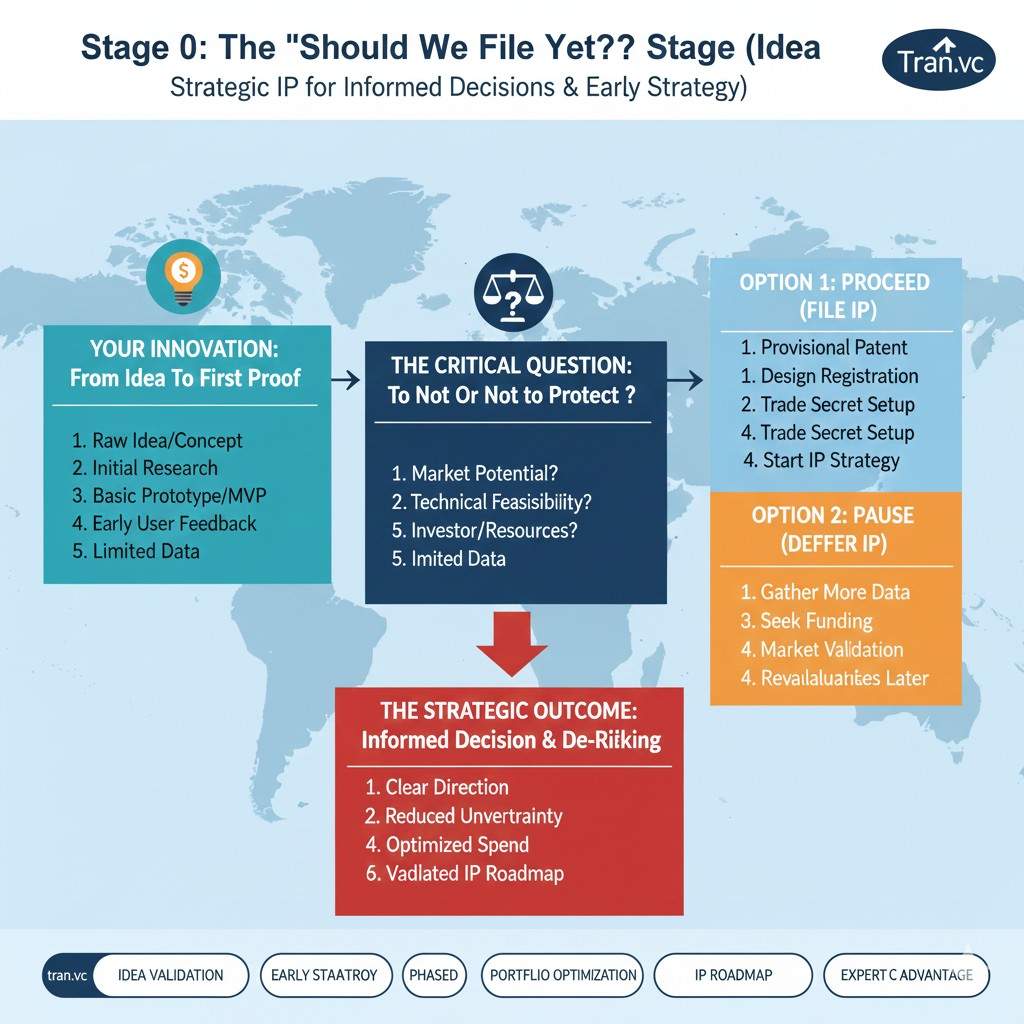
This is the stage where your invention exists in a notebook, a repo, a lab setup, or a prototype. You have something real, but you may still be changing it fast.
At this stage, the biggest risk is paying for patent work before you know what matters.
What you should pay for here is not “a patent.” You should pay for clarity.
That usually means two things:
First, a fast prior art check.
This is not a perfect search of the universe. It is a targeted scan to see if you are about to file something that already exists.
A decent search often costs a few hundred dollars to a couple thousand, depending on who does it and how deep they go. Some law firms do a quick check. Some do a full search report. Some founders use cheaper search tools first and then have a pro review the results.
The point is not to get a “yes or no.” The point is to learn:
- what others already claimed,
- what language examiners use in your space,
- and how to frame your idea in a way that is still new.
Second, a short strategy session.
This is where you decide what you are truly trying to protect. Many founders think the product is the invention. Often, the protectable part is the method, the system design, the training flow, the control loop, the sensing logic, the safety layer, or the way data moves.
If you skip this, you often end up patenting the wrong thing.
So the cost at Stage 0 is usually modest if done right. Think: small spend to avoid big mistakes later.
But there is a hidden cost here: talking too much, too early.
If you present the invention publicly before filing in many countries, you can lose rights. The US has some grace rules, but many countries do not forgive a public disclosure. So founders sometimes pay nothing in legal fees and then lose the ability to patent later. That is the most expensive outcome of all.
So in Stage 0, the question is not “how do we file cheap?” It is “how do we avoid getting trapped?”
If you are heading into demos, pitch events, press, or public docs, it may be time to move to Stage 1.
Stage 1: Provisional filing (buy time, lock a date)
A provisional application (mainly a US tool) is like planting a flag. It sets a filing date and gives you 12 months to file a full application.
Founders love provisionals because they sound like a discount patent. But a provisional is only powerful if it is written well.
A weak provisional can be worse than none. Why? Because later, when you file the full version, you only get the early date for what was clearly described in the provisional. If the important parts were missing, your “early date” may not protect what matters.
So the real question is not “should we file a provisional?” It is “can we file a strong provisional that matches the real invention?”
What you are paying for in Stage 1:
- capturing the invention clearly,
- showing examples and variations,
- and describing the parts that might become your strongest claims later.
Typical cost range (very rough, varies a lot):
A strong provisional often costs somewhere in the low thousands to mid thousands if done with care. It can be cheaper if you do a lot of the drafting yourself and have a patent attorney shape it. It can be much higher for complex deep tech if the writing work is heavy.
Why this stage is worth it:
Because it buys you time. And time has value.
That 12-month window is when you can:
- build the product,
- get early traction,
- learn what customers want,
- decide which markets matter,
- and raise money with a real filing date behind you.
This is also the stage where you should start thinking like a chess player. Not “how do we file?” but “what does our first moat look like?”
A good patent plan at this stage usually includes more than one idea. It might include:
- the core system,
- the data pipeline,
- the safety method,
- the training or calibration flow,
- and the deployment setup.
Not all need filings now. But you want to map them.
This is where Tran.vc is most useful to technical teams. Instead of guessing, you build a plan that matches the business and the tech. And Tran.vc invests up to $50,000 in in-kind IP and patent services so you can build that base early without draining the bank account. If you want that support, apply anytime at https://www.tran.vc/apply-now-form/.
Stage 2: PCT filing (keep the world open)
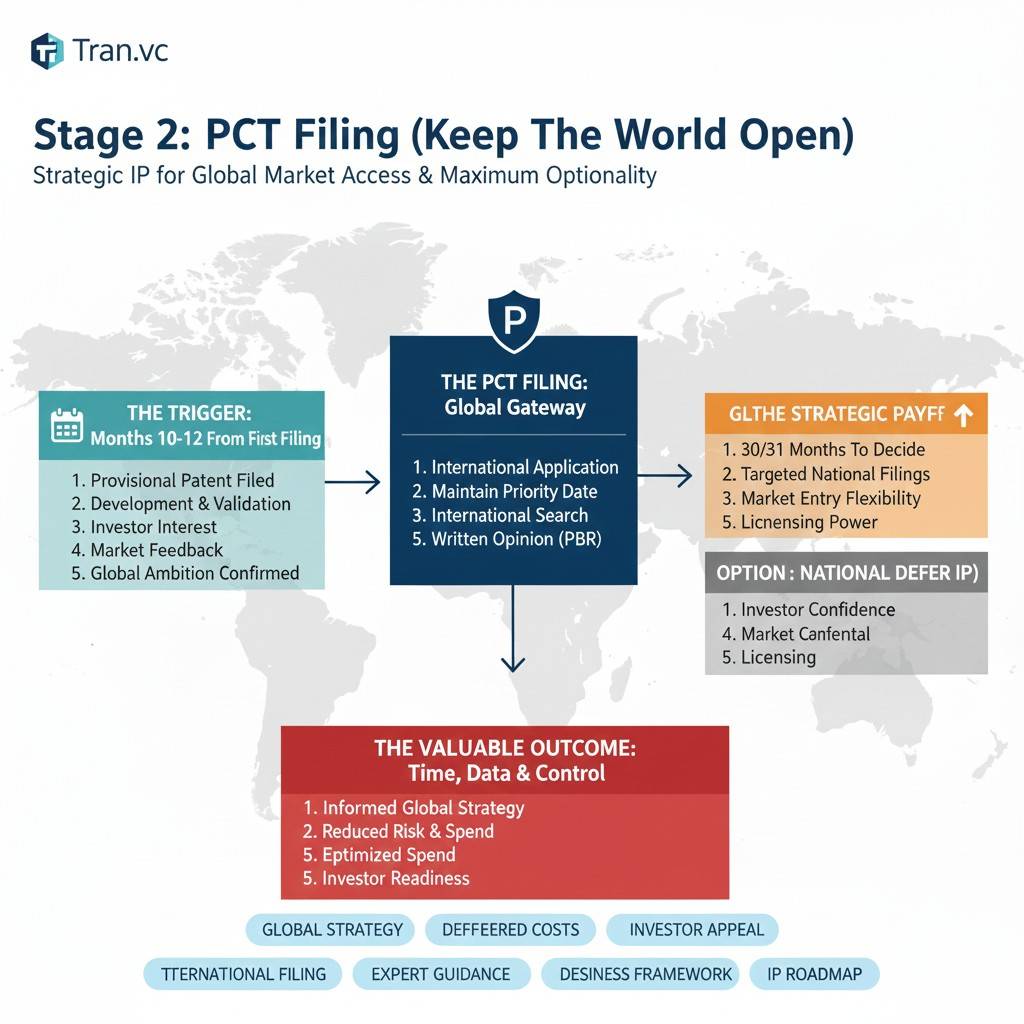
After the provisional, many founders hear about the PCT and assume it is “the international patent.” It is not. It is a global placeholder system.
A PCT application buys you more time—usually up to about 30 months from your earliest filing date in many places—to decide which countries you want to enter.
That extra time is huge. It lets you avoid paying for ten countries before you even know where the business will land.
What you pay for in Stage 2:
- preparing and filing the PCT application,
- official fees,
- and often an “international search” done by an office that issues a report.
That report is not final, but it is useful. It gives you a signal about how novel your invention looks, and what prior art the system thinks is closest.
Cost reality:
Stage 2 is where the bill starts to feel real, because you are now moving from a provisional into a full patent-style document, with real claims.
But it is still cheaper than jumping straight into many countries, because you are mostly paying once for the core application, not repeating work across many local filings.
The smart way to think about Stage 2 is: you are paying to keep doors open, while learning which doors are worth walking through.
Stage 3: National phase entry (the “this is where it gets expensive” stage)
This is the stage where you pick countries and actually enter them. This is where global patenting starts to feel like a serious budget line.
Why? Because now costs multiply.
You will often pay:
- local filing fees,
- local attorney fees,
- translation fees for some places,
- and early steps that each patent office requires.
If you enter the US, Europe, Japan, China, Korea, and maybe India, that is not one process. That is several processes running in parallel.
This is also where founders mess up budgeting most often.
They think, “We have a PCT, we’re covered.” Then the 30-month deadline hits, and they learn national entry can cost a lot right away. If you do not plan for it, you may be forced to drop key countries.
This is why staged planning matters. You do not want to choose countries based on fear. You want to choose based on:
- where you will sell,
- where your competitors build,
- where manufacturing might happen,
- where investors care most,
- and where enforcement has real power.
At Tran.vc, this is one of the biggest value points: helping founders pick a country plan that fits their business, not someone else’s template. If you want help with that, apply anytime at https://www.tran.vc/apply-now-form/.
Stage 4: Prosecution (arguing, narrowing, winning)
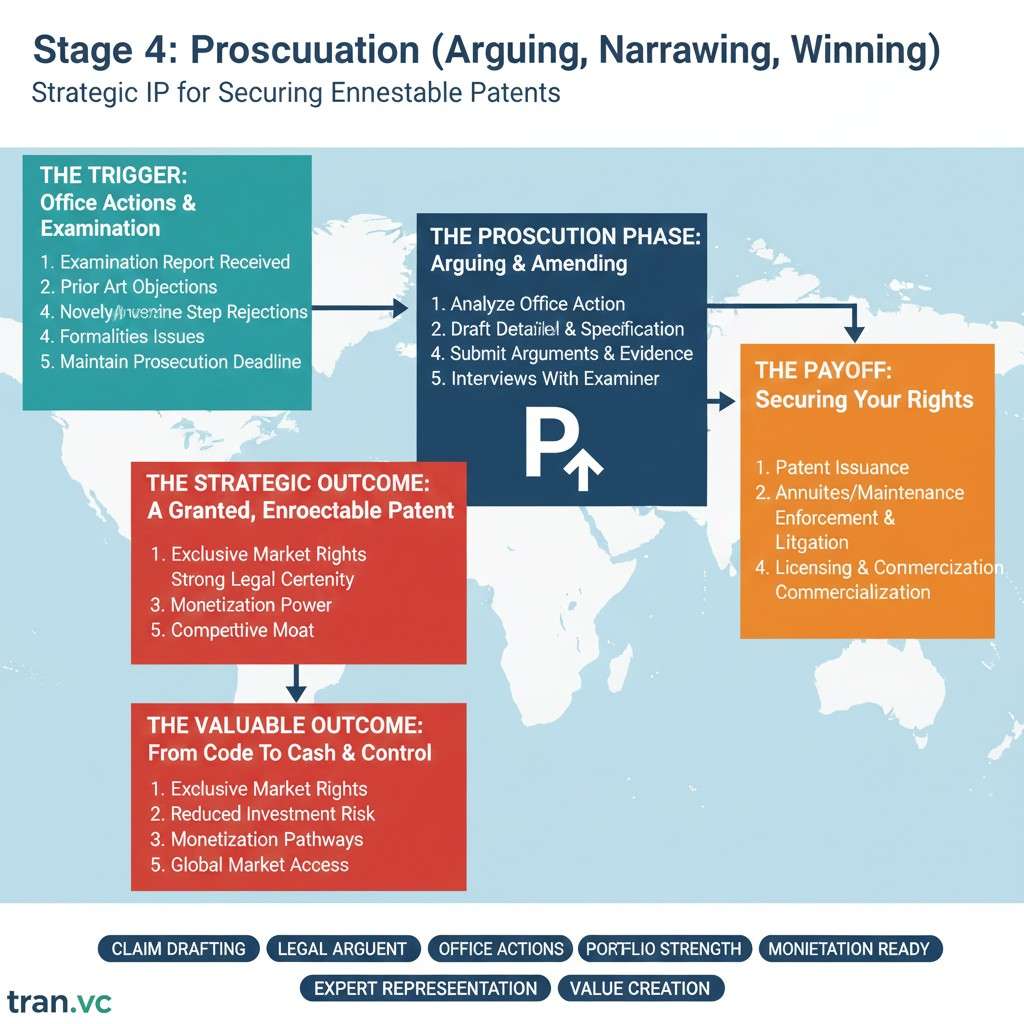
“Prosecution” sounds scary, but it just means working with the patent office while they review your case.
This is often the longest stage. It can take years.
It is also where the final cost swings the most.
Some patents get allowed quickly. Many do not.
Each time the office rejects or questions your claims, your attorney responds. That response costs money. Sometimes you amend claims. Sometimes you argue. Sometimes you add new angles. Sometimes you split the case into more filings to cover different claim sets.
This is why you cannot budget global patenting as “filing cost only.” The life of the patent includes this back-and-forth.
A well-written early application reduces pain here. A messy early application can create years of expensive fixes.
Stage 5: Maintenance (keeping the patent alive)
Once a patent is granted, you often pay ongoing fees to keep it alive. These vary by country and time. Miss them and the patent can lapse.
Maintenance costs are usually not huge in year one, but over 10–20 years they add up, especially across many countries.
This is also where smart teams prune. Not every country stays strategic forever. If a market is not real, you can stop paying there.
The point is to treat patents like assets. You keep paying for the assets that serve the business.
How to use this stage view to avoid overspending
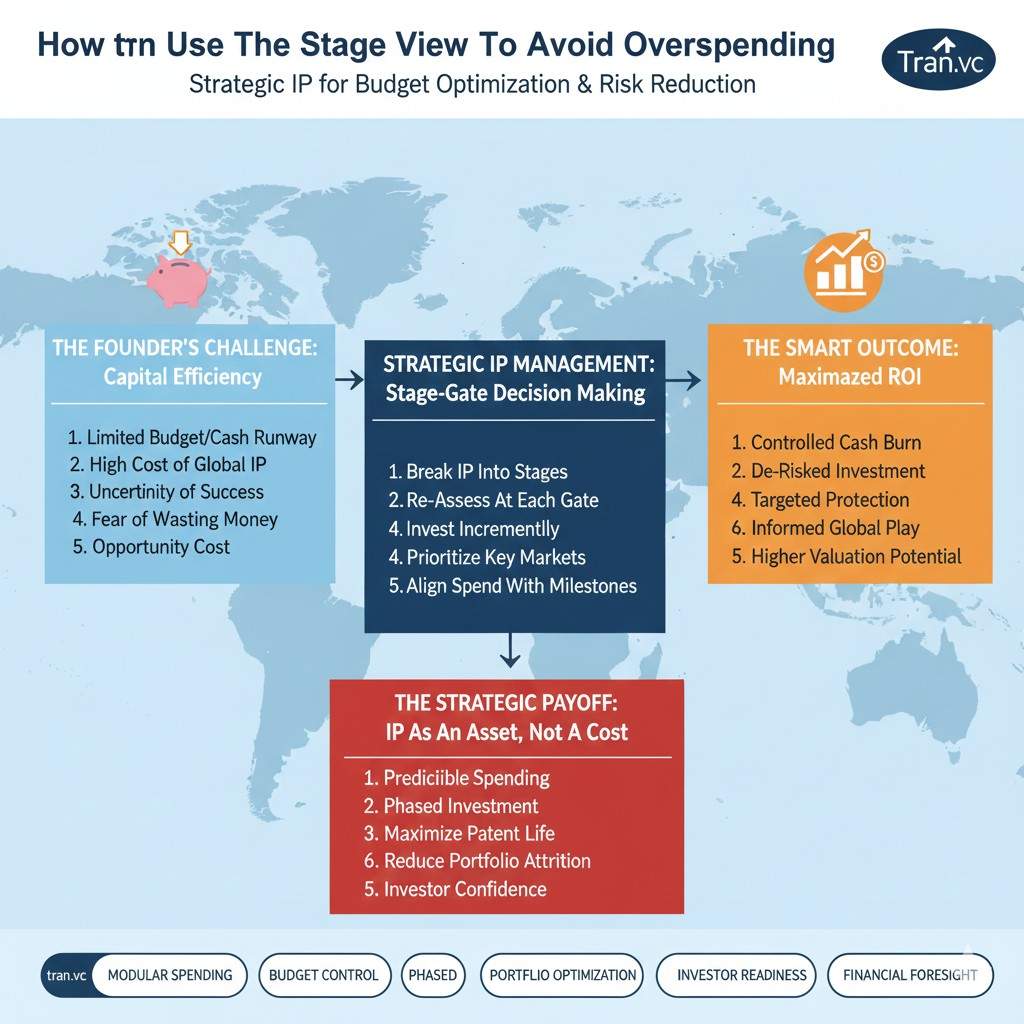
Here is the simple rule: pay for learning early, pay for scale later.
At the start, you need enough IP to:
- protect novelty,
- show seriousness,
- and build leverage.
You do not need to buy the world.
As traction grows, then you expand coverage where it matters.
This is the heart of “seed-strapping.” You build the moat before the hype, but you do it with control. If you want to do that with Tran.vc’s in-kind patent and IP support, you can apply anytime at https://www.tran.vc/apply-now-form/.
How Much Global Patenting Really Costs (By Stage)
A quick note before we get into numbers
Global patenting costs are real, but they are also manageable when you treat them like a plan, not a panic.
You will spend in waves. Each wave has a purpose. If you know what the wave is for, you can choose the right move at the right time.
In this section, I will go stage by stage and show what usually gets paid, why it gets paid, and where founders often get surprised.
The cost ranges in this guide
Every patent budget depends on the tech, the writing quality, the countries, and how much back-and-forth happens with examiners.
So instead of pretending there is one “correct” number, I will give practical ranges and explain what pushes a cost toward the low end or the high end.
If you want a plan made for your exact product and market path, you can apply anytime at https://www.tran.vc/apply-now-form/.
Stage 0: The “Should we file yet?” stage
What you are really paying for at this stage
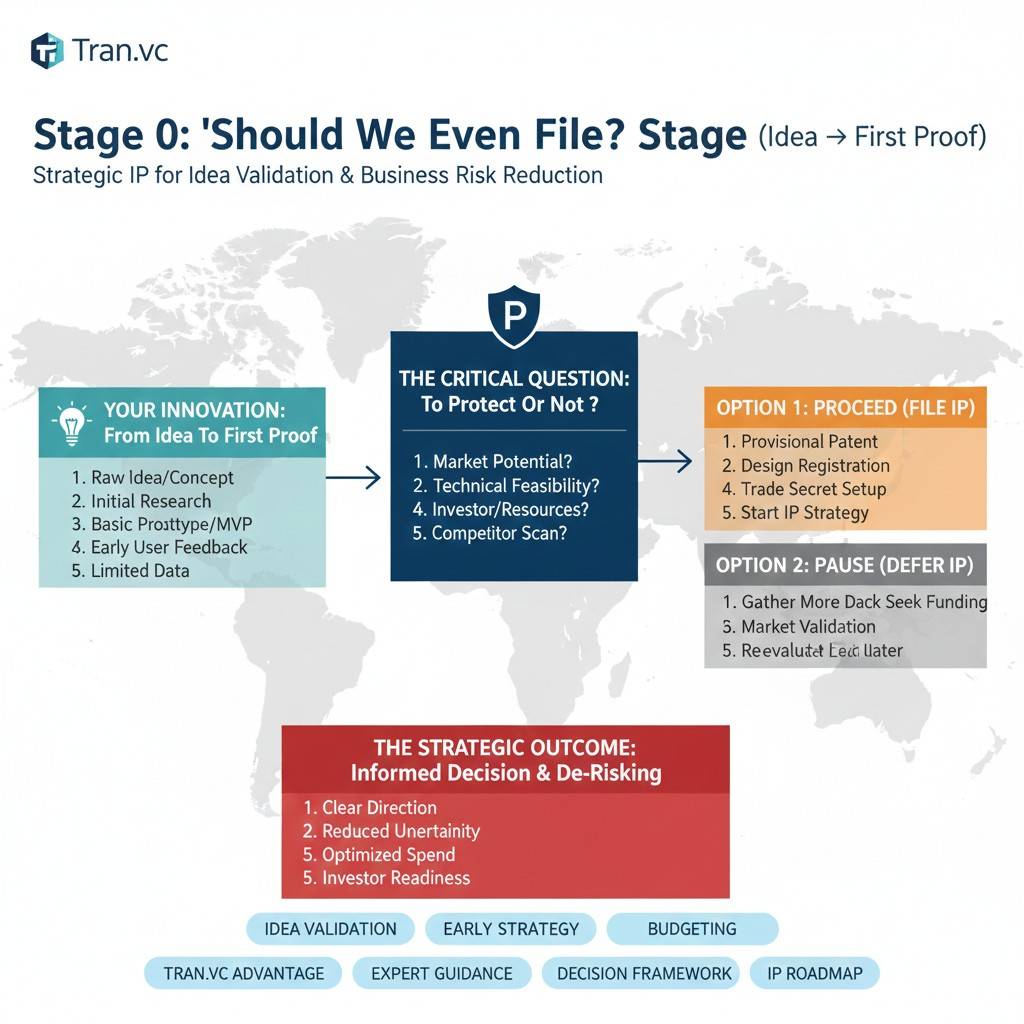
At the start, the goal is not to “buy patents.” The goal is to avoid wasting money and avoid losing rights.
Many teams either file too early, when the invention is still moving fast, or they wait too long and share too much in public. Both choices can be costly in different ways.
The best spend here is small and focused. It is meant to reduce risk, not to produce a perfect document.
Typical cost range
For a careful early review and planning step, many founders spend roughly a few hundred dollars up to a couple thousand dollars.
That range depends on whether you do a quick search only, or you also pay for an attorney-led strategy session that maps what you should protect and how.
If the invention is very complex, some firms will quote higher because they need more time to understand the system well enough to give advice.
What makes costs jump unexpectedly
A common surprise is that “free” choices can be expensive later. If you publish a paper, post a detailed blog, ship open docs, or demo publicly before filing, you can lose patent rights in many countries.
Another surprise is paying for a deep search when you are not ready to act on it. Searches are useful, but only when they lead to a decision and a plan.
This is why early-stage teams benefit from tight guidance. Tran.vc helps founders decide what matters, what can wait, and what should be protected now. Apply anytime at https://www.tran.vc/apply-now-form/.
The practical outcome you want before moving on
Before you leave Stage 0, you should be able to say what your invention is in plain words, what the “new” part is, and what proof you have that it works.
You should also know if you are about to disclose anything publicly. If the answer is yes, you may need to file sooner than you planned.
Stage 1: Provisional filing
What a provisional really does
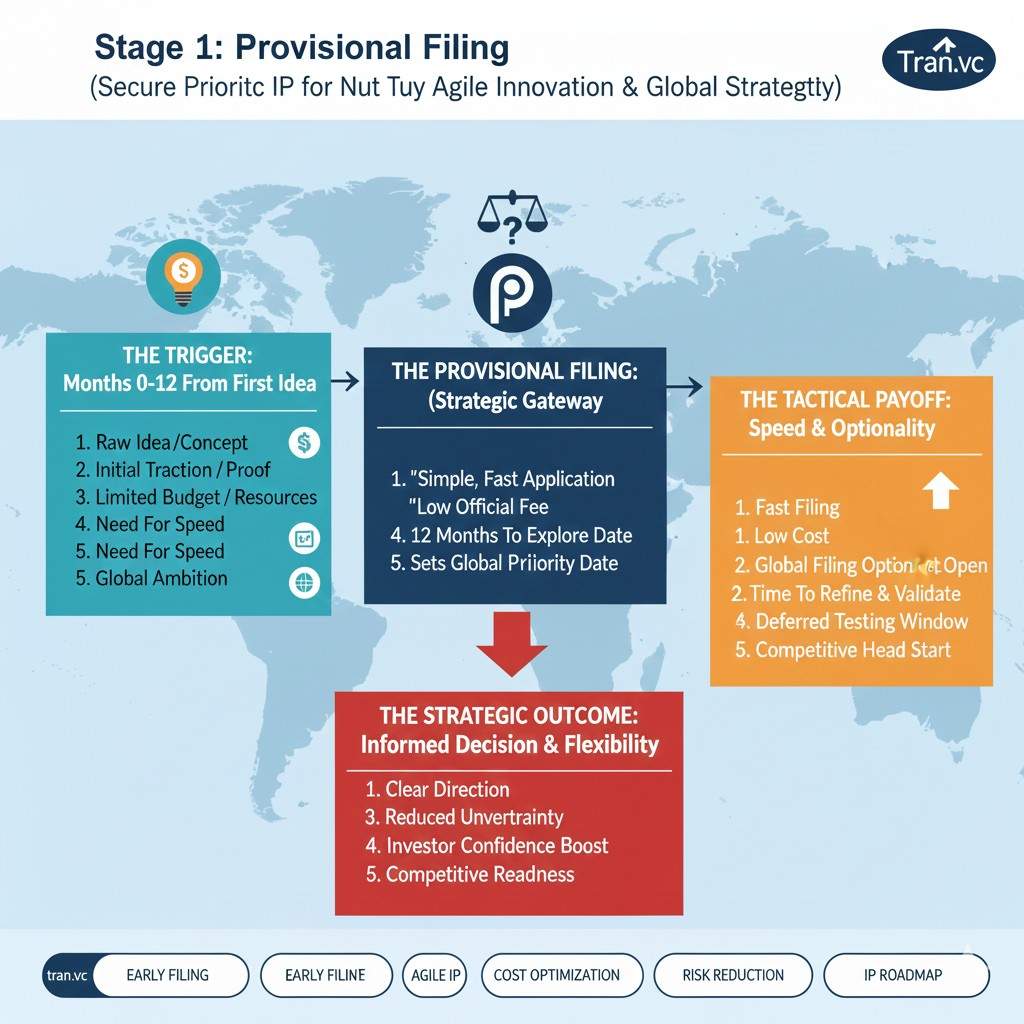
A provisional filing is often used to lock a date and buy twelve months of time. It can be a smart move when you are about to share the invention with investors, customers, partners, or the public.
But a provisional is not a shortcut to quality. If it is thin or vague, it may not protect the parts that matter later.
A strong provisional is written as if you truly care about the future patent, because that is what it becomes.
Typical cost range
A well-prepared provisional often lands in the low-thousands to mid-thousands of dollars. The range shifts based on how much work goes into capturing details, examples, and variations.
Very complex robotics or AI systems can cost more because the writing needs to cover the system clearly, including what happens in edge cases and how the parts interact.
If a founder writes a solid draft and a patent attorney refines it, costs may stay lower without sacrificing quality.
What you are paying for inside that number
You are paying for someone to turn your idea into a clear technical story that a patent office can understand. That story needs enough detail that you can later claim the core method, not just the surface-level product.
You are also paying for breadth. A good filing does not describe only one narrow version of your system. It shows multiple ways to implement it, so competitors cannot sidestep it with small changes.
This is the part founders underestimate. They assume “we already know what we built.” The office does not know. The paper must do that work.
The biggest mistakes founders make here
The first mistake is treating a provisional like a “cheap placeholder.” That leads to thin filings that do not support strong claims later.
The second mistake is filing a provisional that describes the product, but not the invention. Products change fast. The invention should be described in a way that still holds when your UI, packaging, or deployment shifts.
The third mistake is filing and then forgetting. The twelve-month clock moves fast, and the best teams use that window to plan the next filing step early.
The practical outcome you want
By the end of Stage 1, you want a dated filing that covers your core invention in a way you are proud of.
You also want a short plan for what you will build and learn in the next twelve months, because that learning should shape the next stage.
Stage 2: PCT filing
What the PCT actually buys you
A PCT filing is not a global patent. It is a system that lets you delay expensive country-by-country filings while keeping your options open.
This matters because founders rarely know, in year one, which markets will become the true revenue markets. The PCT gives you time to learn that without losing your early filing date.
In simple terms, you are paying for breathing room, so you can make smarter decisions later.
Typical cost range
A PCT filing often costs more than a provisional because it is a full application with claims and formal structure. In many cases, teams see costs in the high-thousands to low tens of thousands of dollars, depending on complexity and legal support.
You may also pay official fees tied to the PCT system, plus a search step that produces an early report.
The biggest driver is still attorney time, because writing strong claims and a clean specification takes real work.
What is included, and what is not
The PCT stage usually covers the core application preparation and the act of filing it in the PCT system. It often includes handling forms, deadlines, and basic formal steps.
It does not include the major country-by-country costs that come later when you “enter” specific places. Many founders misunderstand this and feel shocked later.
Think of the PCT as a bridge. It is valuable, but it is not the destination.
How the PCT search report helps you
The search report can give you a signal about the closest known work in your space. It can also help you see how examiners might read your claims.
But it is not a final verdict. A “good” report does not guarantee allowance, and a “tough” report does not mean the idea is dead.
The real value is that it helps you adjust strategy before you spend the big money on national filings.
The practical outcome you want
By the end of Stage 2, you want a strong application that you can confidently carry into top markets.
You also want an early view of prior art risks, and a clear shortlist of countries you are likely to enter later, based on business logic.
If you want help building that country plan without wasting money, Tran.vc can support you with in-kind patent and IP services. Apply anytime at https://www.tran.vc/apply-now-form/.
Stage 3: National phase entry
Why this is the expensive moment
National phase entry is when global patenting becomes real. This is when you stop saying “we might file in these places” and you start paying to actually file there.
Costs rise because each country has its own rules, fees, and local attorney needs. If translation is required, costs rise again.
This stage is the biggest budgeting cliff in global patenting, and the one that surprises founders most.
Typical cost range
For one country, national entry can range from a few thousand dollars to much more, depending on the country and the work involved.
For a multi-country plan, founders can see total entry costs reach tens of thousands of dollars quickly, especially if they enter several major markets at once.
The more countries you choose, the more you should expect the budget to scale, not linearly, but in a way that adds extra overhead each time.
The hidden cost that makes the bill feel bigger
The hidden cost is coordination. Each country may need local counsel. Each office may need formal papers, signatures, and deadlines managed carefully.
Even when the technical content is shared, the process work multiplies. That process work costs money because legal teams spend time making sure filings are correct and on time.
This is why a clean plan matters. A messy plan increases coordination cost and increases risk.
How to choose countries without guessing
Country choice should not be based on ego, fear, or “we want global.” It should be based on where the business will win and where threats will come from.
If your biggest customers are in the US and Europe, those markets might matter most. If manufacturing is likely in Asia, that may change the list. If a major competitor operates heavily in one region, that region may become strategic.
You want a map that matches your go-to-market plan, not a random list pulled from a blog.
The practical outcome you want
By the end of Stage 3, you should have entered only the countries that truly support your next two to five years of growth.
You should also have a forecast for the next stage, because prosecution costs come next and they can stack up if you do not plan for them.
Tran.vc helps founders build this staged country plan, so you do not overspend early while still building a real moat. Apply anytime at https://www.tran.vc/apply-now-form/.
Stage 4: Prosecution
What prosecution really means
Prosecution is the back-and-forth with patent offices after you file. Examiners review your claims, compare them to known prior art, and often reject or limit them at first.
Your attorney then responds. They may argue, amend claims, add clarity, and try to keep your coverage strong without giving away too much.
This stage is normal. It is not a sign you did something wrong. But it is a stage you must budget for.
Typical cost range
The cost here depends on how many rounds happen and how hard the examiner pushes back. A simple case might need one or two responses. A harder case might need several, and may also lead to filings that split claim sets to protect different angles.
Because of that, prosecution costs can range from a few thousand dollars spread over time to much larger totals for complex inventions or broad strategies.
The key point is timing. These costs show up later, which is why founders forget to plan for them early.
How early writing quality changes this stage
A strong application helps because it gives your attorney room to adjust claims without losing support. If the original filing has many examples and variations, you can defend your invention from more angles.
A weak filing forces narrow moves. Narrow moves can reduce business value. They can also lead to more rounds because you keep trying to fix the story with limited raw material.
So the cheapest prosecution is often the one you earned by writing well earlier.
The practical outcome you want
By the end of Stage 4, you want claims that match what competitors would actually copy. You do not want a patent that protects something nobody would steal.
You also want a clean record that future investors can read and respect, because diligence teams often look closely at this stage.
Stage 5: Maintenance
Why maintenance is often ignored
After grant, the patent becomes an asset you must keep alive. Many countries require periodic fees. If you miss them, you can lose the patent.
Founders ignore this because it feels small compared to filing and prosecution. But across many countries and many years, maintenance adds up.
It is also where smart companies prune and focus.
Typical cost range
Maintenance fees vary by country and by age of the patent. Early years may be modest, and later years can rise.
If you hold patents across several major markets, the combined maintenance across the full life can become meaningful.
The best approach is to review your portfolio regularly and decide which assets still support your business goals.
The practical outcome you want
By the end of Stage 5 planning, you want a simple calendar and a clear owner inside the company who tracks deadlines.
You also want a yearly “keep or drop” review, because dropping a non-strategic country can free budget for new filings that matter more today.