
Most founders do not lose because their tech is weak. They lose because they ship into a market they cannot legally sell into.
That is what “freedom to operate” (FTO) is about. It is the simple question: Can we make, use, sell, and ship this product in this country without stepping on someone else’s patent?
If you plan to sell worldwide, you need a starting point that is clear, practical, and not built for big-company budgets. This is that starting point.
And if you want help doing this the right way from day one, you can apply to Tran.vc anytime: https://www.tran.vc/apply-now-form/
What “freedom to operate” really means (in plain words)
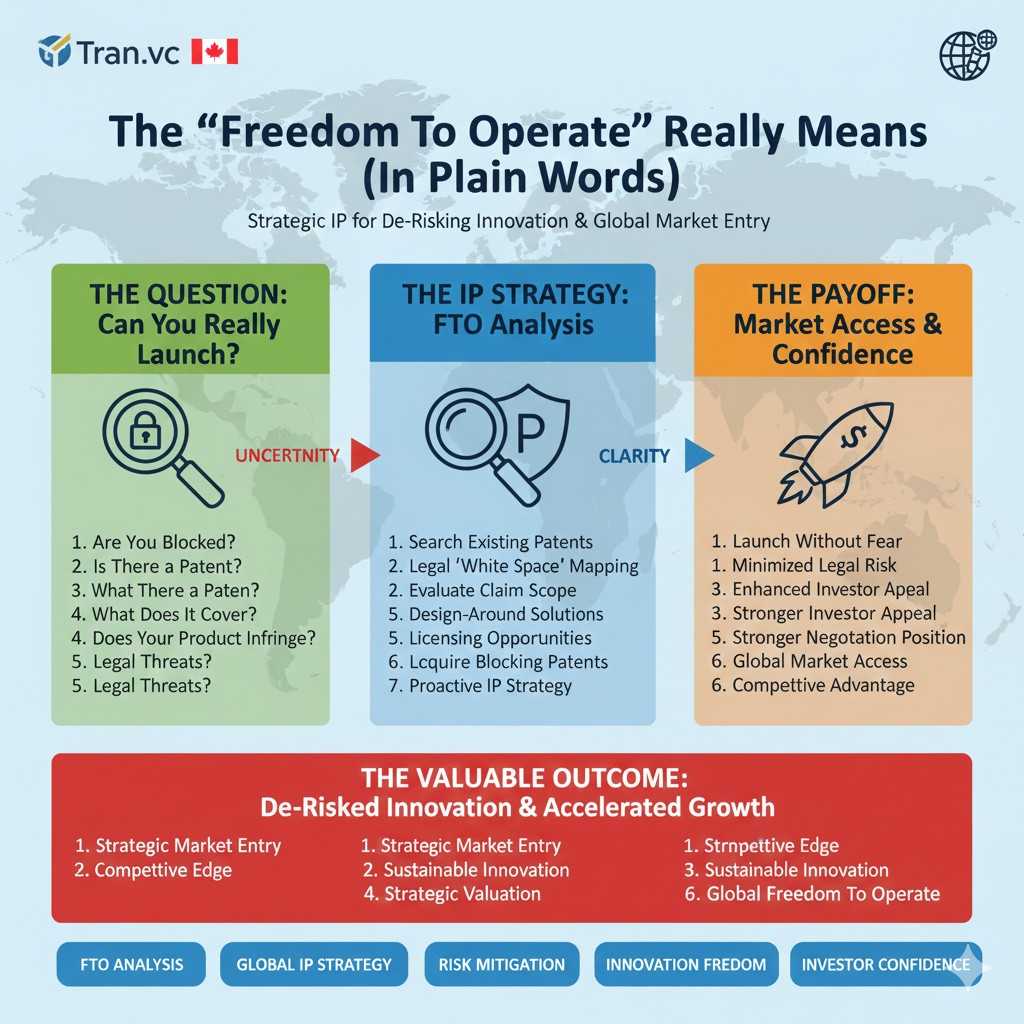
Many founders think patents are only about owning ideas. That is only half the story.
A patent can do two important things:
- It can protect what you made (your “moat”).
- It can block you from selling, even if you invented it yourself.
This second part surprises people. You can build something from scratch and still infringe a patent, because patents are not about who invented first in your garage. They are about what the claims cover.
So FTO is not “Do we have patents?”
FTO is “Are we safe to ship?”
Now here is the part most teams miss: FTO is always tied to a place.
Patents are territorial. A patent in the US blocks you in the US, not automatically in Germany. A patent in Japan blocks you in Japan, not automatically in India. That is why the phrase “worldwide FTO” is tricky. You do not get one global yes-or-no answer.
What you get is a smart plan that answers:
- Where do we plan to sell first?
- Where do we plan to manufacture?
- Where do we plan to ship from and into?
- What parts of our product create the most legal risk?
That plan is your real starting line.
If you want Tran.vc to help you build this plan with real patent experts, apply here: https://www.tran.vc/apply-now-form/
Why early-stage teams should care (even before PMF)
I know what you are thinking.
“We are early. We are still finding our market. We do not have time for legal stuff.”
That is normal. But FTO is not “legal stuff” in the slow, paperwork sense. It is a product risk issue. It is like security, safety, and uptime. If you ignore it, you might still move fast—right into a wall.
Here are a few ways FTO problems show up in real life:
A pilot becomes a deal, then procurement asks if you have clearance to sell. You freeze.
A big customer asks you to sign an indemnity clause. They want you to pay if they get sued. You cannot sign. Deal dies.
A competitor sends a letter saying you infringe. You panic and change the design. The new design takes months. You lose the market window.
An investor asks about IP risk during due diligence. You have no answer. They pass or cut your valuation.
This is why the best time to start is not “later.” The best time is when your design is still flexible.
Because once you ship hardware, deploy robots, or lock your model architecture into a product, changes get expensive fast.
Tran.vc exists for this exact gap: early technical founders who need real IP help without burning cash on big-firm retainers. If you are building AI, robotics, or deep tech, you can apply here: https://www.tran.vc/apply-now-form/
The biggest misunderstanding: “We’ll just file our own patents”
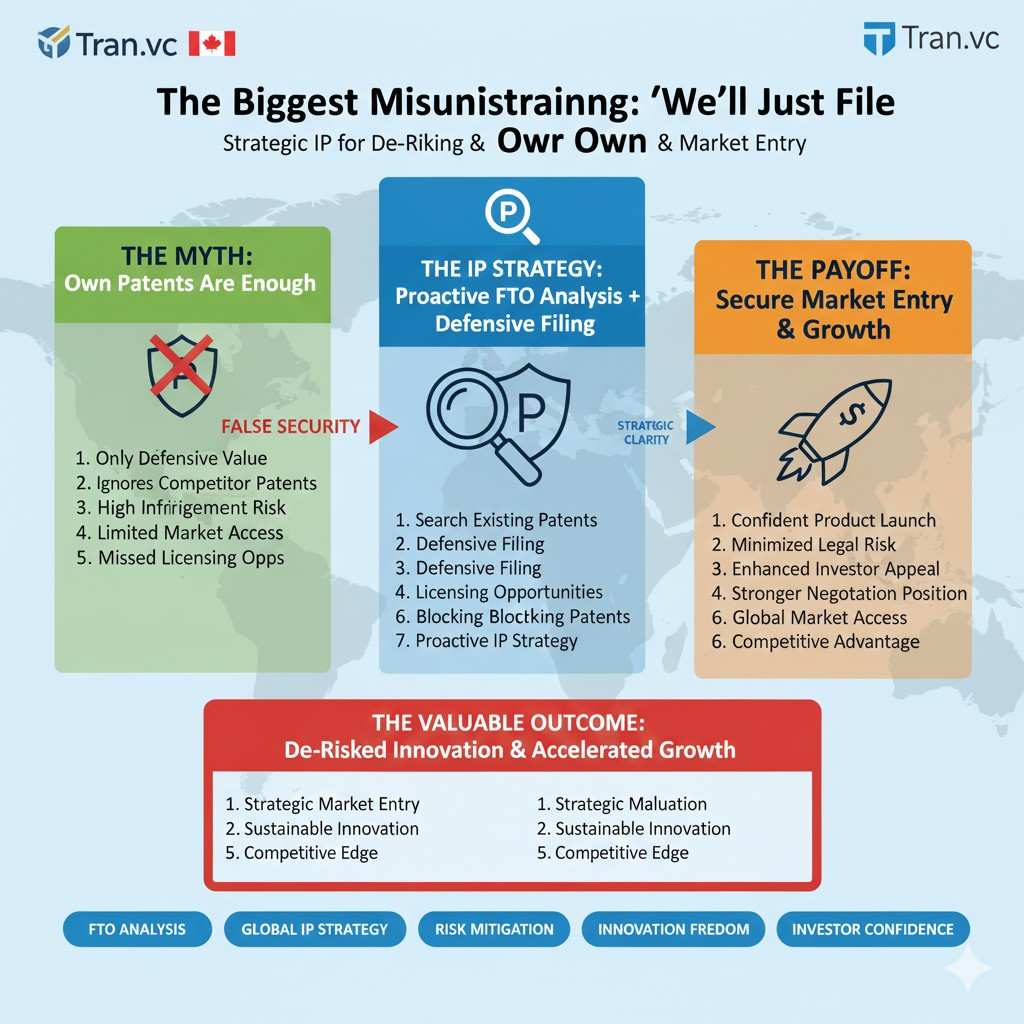
Filing your own patents can be smart. But it does not solve FTO by itself.
Here is why.
Your patent is a sword. It helps you stop others.
FTO is a shield. It helps you avoid getting hit.
You can own patents and still infringe someone else’s patents.
So the starting question is not “How do we patent our tech?”
The starting question is “Where are we exposed?”
This is a mindset shift. Once you make it, your whole product planning becomes cleaner.
Start with the product map, not the patent search
Founders often start with the wrong thing. They start by searching patent databases with broad terms like “robot arm” or “LLM agent” and then drown in thousands of results.
A good FTO starting point begins inside your own product.
You want a simple product map that answers:
What are the few parts of our system that are truly unique, and what are the few parts that are common and likely patented by others?
For robotics, common risk zones often include:
- Grippers, end effectors, and how they sense contact
- Motion planning and collision avoidance
- Sensor fusion (camera + lidar + IMU)
- Calibration methods
- Safety systems, e-stops, compliance control
- Docking and charging
- Mapping, localization, and navigation
- Specific mechanical linkages or actuation setups
For AI products, common risk zones often include:
- The pipeline around data processing
- Model training methods, especially if specialized
- Inference speed tricks and compression
- Retrieval and ranking logic
- Guardrails and safety filters
- Workflow automation steps that look “obvious” but are often patented
- UI flows tied to unique backend behavior
Notice something: the risk is not “AI” or “robotics.” The risk lives in specific features and specific steps.
So your first real action is to write down your product in a way that a patent person can use.
Not a pitch deck. Not a high-level diagram.
A practical map. In simple words. Like:
- “We use two cameras and one depth sensor.”
- “We align frames using this math step.”
- “We decide where to move using this rule.”
- “We detect error and correct using this loop.”
- “We choose what to store and retrieve using this scoring method.”
This is not busy work. This is how you avoid wasting weeks searching the wrong things.
If you want, Tran.vc can help you turn your system into an “IP-ready” map quickly, and then use it for both patent filings and FTO review. Apply here: https://www.tran.vc/apply-now-form/
Pick your first countries using business truth, not wishful thinking
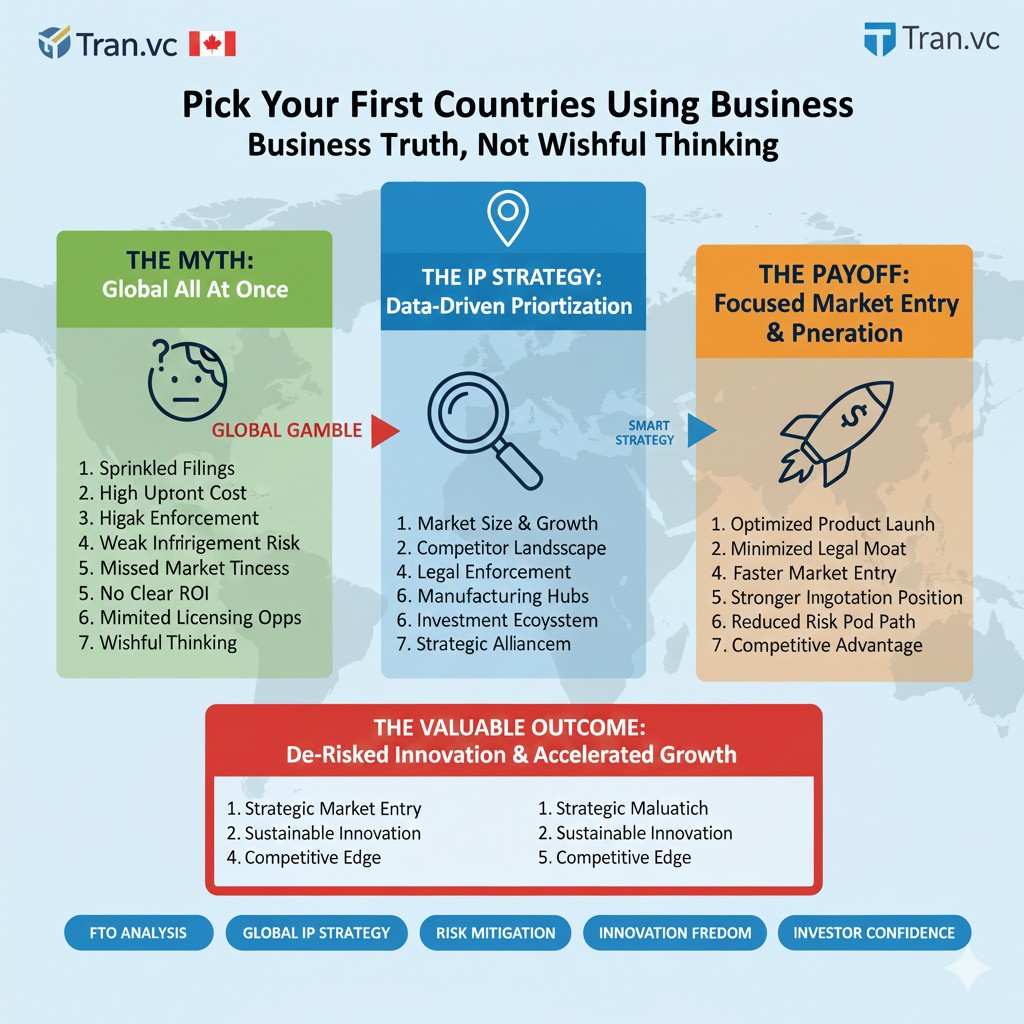
“Worldwide” is a big word. But you do not start everywhere.
You start where you will actually touch the market.
There are three country sets that matter first:
Where you will sell.
If customers are in the US and EU, those markets matter now.
Where you will make the product.
If you manufacture in China, Mexico, or Eastern Europe, that matters too, because making can be infringement even before selling.
Where you will ship through or store inventory.
Sometimes patents can create import issues. Even if your first customer is small, your shipping path can matter.
Most early teams pick 2–4 priority regions to start, such as:
- United States
- Europe (often focused on Germany, France, UK, and sometimes a wider EU lens)
- Japan or South Korea for robotics and sensors
- China for manufacturing-heavy strategies
You do not need to treat the entire world equally. You need to treat your first path to revenue seriously.
A useful way to choose is to ask: “If we get blocked in one place, which place kills the company fastest?” Start there.
Learn the difference between “quick risk scan” and “real FTO”
This part saves money.
People use “FTO” to mean different things. That leads to mismatched expectations.
A quick risk scan is early-stage friendly. It aims to find obvious red flags and guide design choices. It is not perfect. It is a decision tool.
A real FTO opinion is deeper. It often includes a formal written analysis of specific patent claims against your exact product design in specific countries. It can be expensive, and it takes time.
Early-stage teams usually should not jump straight to the most formal version unless a major deal or funding round demands it.
What you want first is an approach like this:
Start with a focused risk scan on the features that are most likely to be patented and most likely to cause harm if blocked.
Then, when you get closer to a major commercial contract, expand into a deeper FTO opinion for the exact configuration you will ship.
This staged approach is how you stay fast and smart.
Tran.vc’s model is built for that staged reality. They support patent strategy and filings as in-kind services, up to $50,000 in value, so you can build a real IP foundation without draining runway. Apply anytime: https://www.tran.vc/apply-now-form/
What you are actually looking for in an FTO search
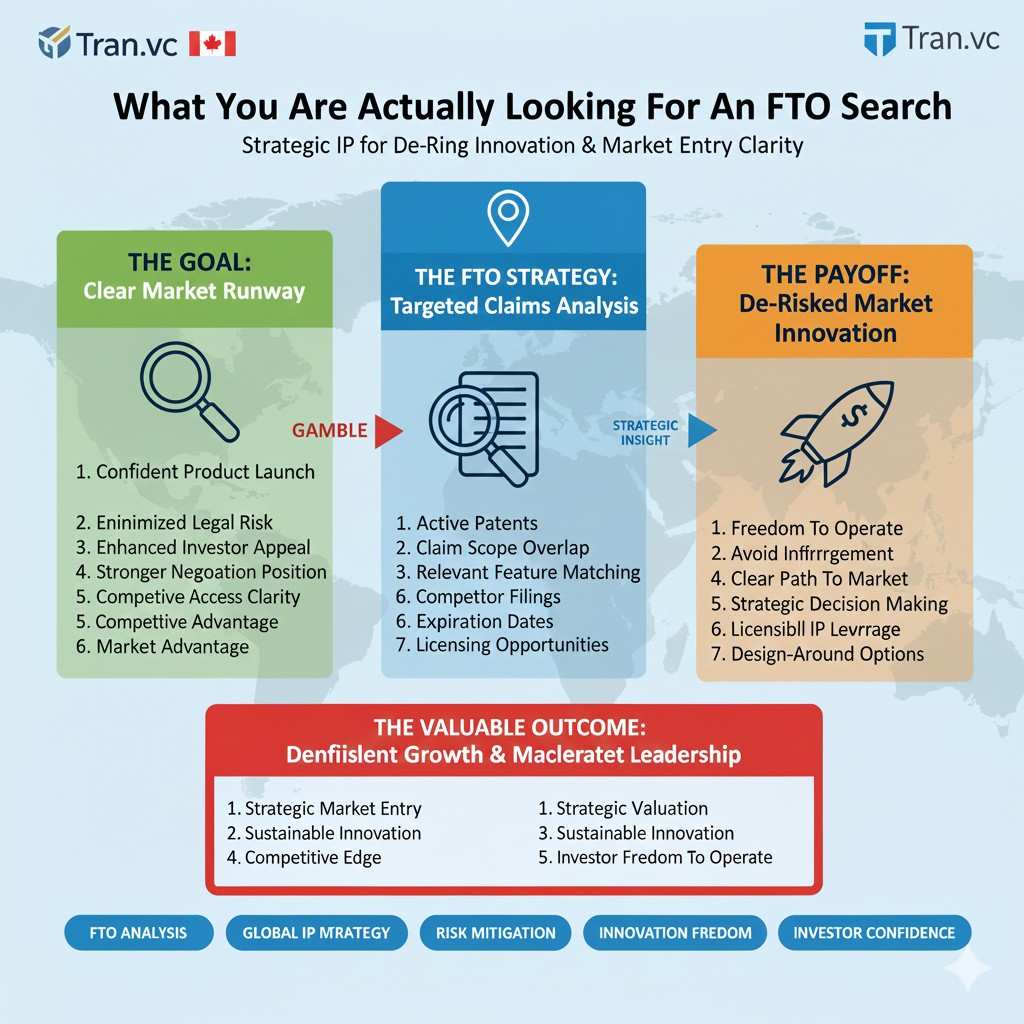
Let’s make this concrete.
A founder often asks: “Can you search patents for me?”
But a good FTO search is not about keyword hunting. It is about finding blocking claims tied to:
- your core steps
- your core components
- your core system interactions
You are looking for patents that are:
- Active (not expired, not abandoned)
- In the countries you care about
- Claiming something close to what you do
- Owned by someone who might enforce (this matters more than people admit)
That last point is not about fear. It is about reality. Many patents exist. Only some owners enforce.
Big operating companies enforce to protect market share.
Some patent owners enforce to generate licensing revenue.
So when you find relevant patents, you also want to note: Who owns this? Do they litigate? Do they license?
This helps you decide what to do next.
The “features first” method: the best starting method for small teams
If I had to give one practical method you can use next week, it is this:
Pick 3–5 features that create the most value in the product.
Then pick 3–5 features that create the most risk.
Sometimes they overlap. Sometimes they do not.
Value features are what customers pay for.
Risk features are what big companies patented heavily.
For example, in warehouse robotics, “navigation in dynamic environments” is both value and risk.
In an AI workflow tool, “automated routing of tasks based on inferred intent” might be value and risk.
Once you have those features, you write them as short, testable statements.
Not “smart navigation.”
Instead: “Robot builds a map, updates it in real time, predicts moving objects, and chooses a path while staying within safety limits.”
Not “secure LLM.”
Instead: “System filters prompts, detects sensitive data, blocks certain outputs, and logs the reason.”
Now your search terms become better because they match steps and behavior.
And your analysis becomes sharper because you can compare “what we do” with “what the patent claims.”
The hidden trap: open source does not mean safe
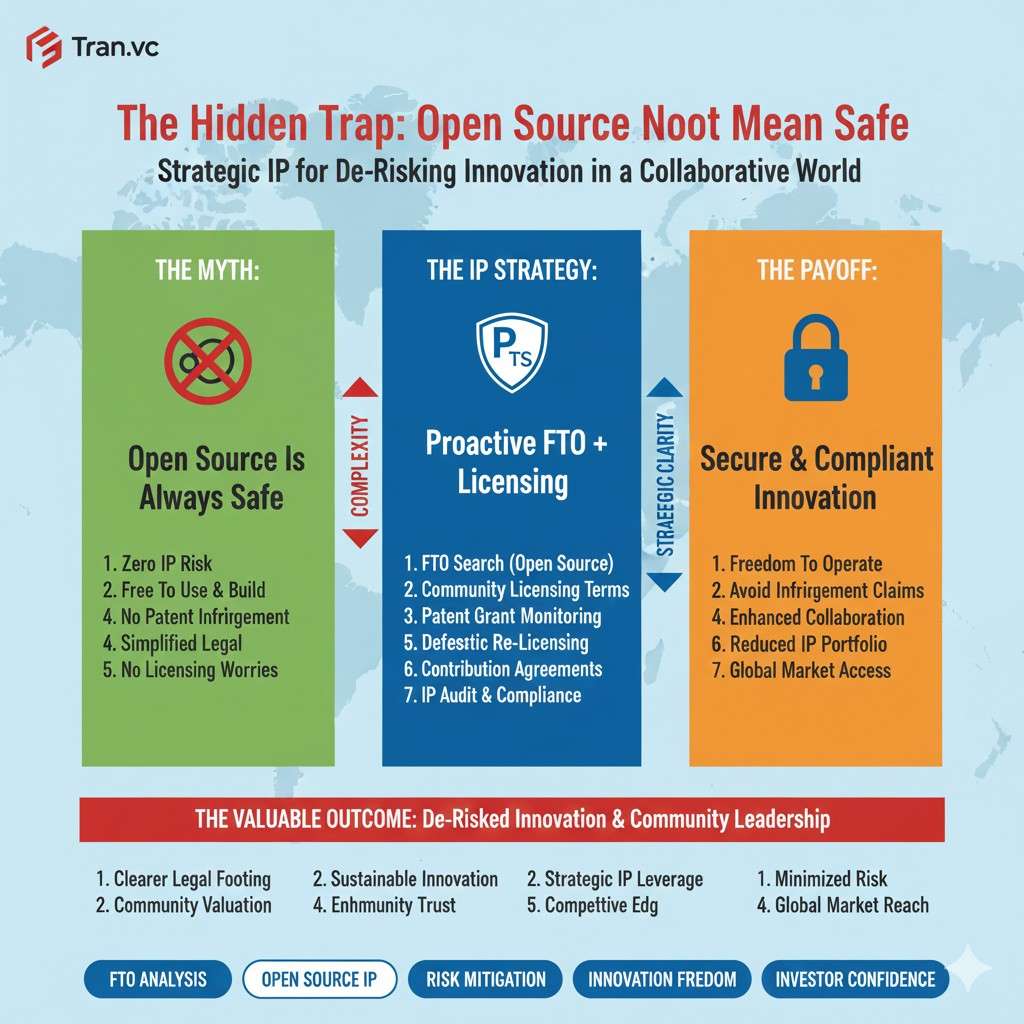
One more early-stage trap: “We used an open-source library, so we are fine.”
Open source licenses deal with copyright and usage rights for the code. They do not magically remove patent risk.
Some projects include patent grants. Some do not. Some have contributors who grant rights under certain terms. Some are unclear.
Also, even if the library is safe, your product behavior can still overlap with someone else’s patent claims.
So yes, use open source. Just do not treat it as a legal shield for patents.
What you can do right now in 60 minutes
If you only have an hour, do this.
Write a one-page “FTO starter brief”:
- What the product does in one paragraph
- The top five product features in simple step form
- Where you plan to sell in the next 12 months
- Where you plan to manufacture or assemble
- The names of the top three competitors you see in the market
This single page makes every next step faster.
It helps your patent team search better.
It helps you avoid vague conversations.
It helps you make smart design calls earlier.
This is also the kind of thing Tran.vc uses to get moving quickly with founders—so you get real progress, not endless meetings. Apply here: https://www.tran.vc/apply-now-form/
Build a simple FTO plan before you search anything
Start with your “ship path” instead of “worldwide”
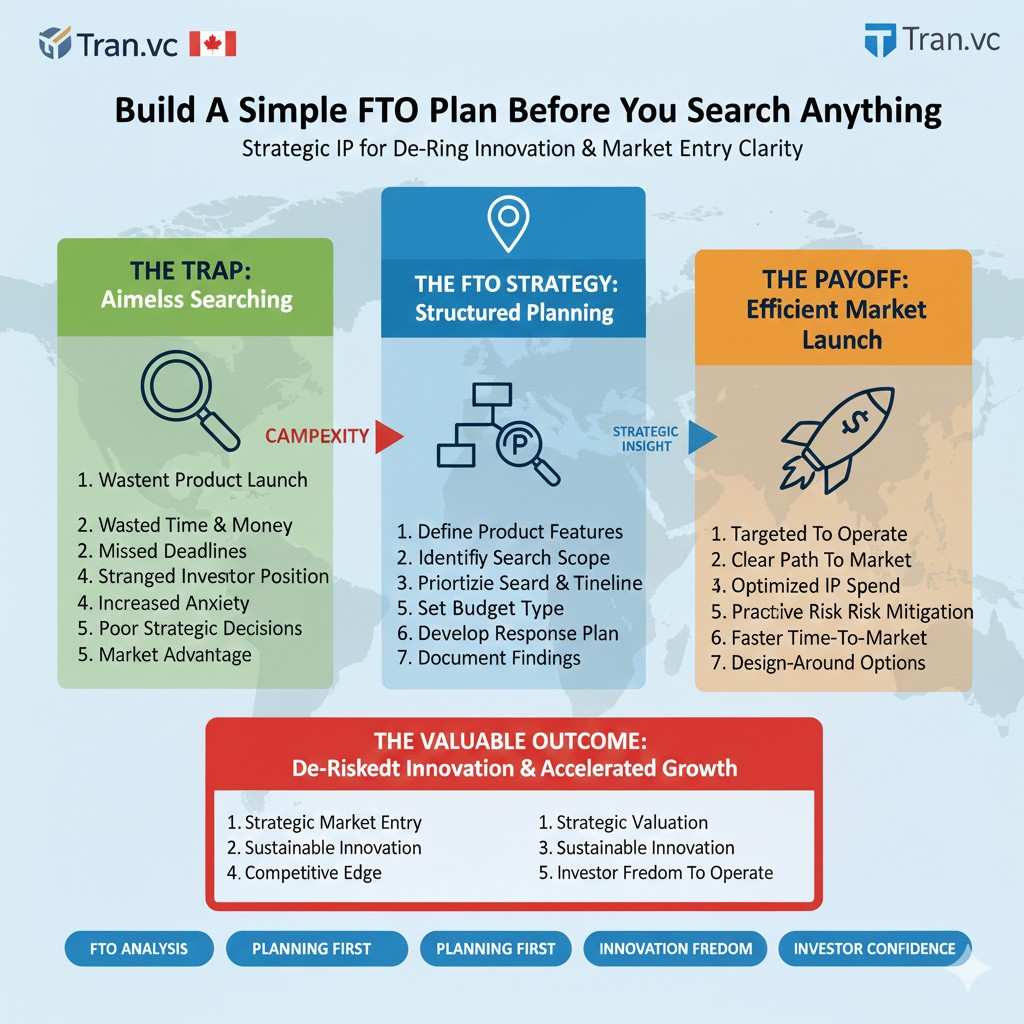
“Worldwide” sounds bold, but it is not a plan. A plan starts with where the product will touch real life first. That means the first countries where you will sell, the first place you will build or assemble, and the first place you will ship through or store stock.
When you write those locations down, you reduce noise fast. Your search becomes smaller, and the results become useful. You also stop wasting time on patents that cannot affect you this year.
Separate selling risk from making risk
Many founders only think about selling. But patent rules can hit you at the “making” stage too. If you manufacture in one country and sell in another, you can face risk in both places, even before you have big revenue.
This is why your plan must name both sets: the market countries and the build countries. It is also why contract manufacturing decisions can quietly change your legal risk profile.
Choose the first 2–4 regions with honesty
The right first regions are not the ones that feel impressive. They are the ones that would hurt the most if you got blocked. For many deep tech teams, the first set often includes the United States and one key part of Europe, plus the country where manufacturing happens.
If you are in robotics, Japan and South Korea can matter sooner than you think because of strong incumbents. If you are building enterprise AI, the US and EU often dominate early procurement and compliance questions.
Understand the difference between a quick scan and a formal FTO opinion
Why language causes problems in FTO work
Many teams ask for “an FTO” like it is one fixed deliverable. In real life, FTO work comes in levels. The right level depends on your stage, your deal size, and how final your product design is.
When you match the level to the moment, you save both money and time. When you choose the wrong level, you either overpay early or under-protect later.
What a quick risk scan is meant to do
A quick scan is meant to find obvious danger zones. It helps you spot the areas where patent owners have been active, and where your product overlaps with well-known approaches.
The goal is not perfection. The goal is direction. You want to know where to dig deeper, what to redesign early, and which features might need a licensing conversation later.
What a formal FTO opinion is meant to do
A formal FTO opinion is closer to a legal work product. It is tied to a specific product configuration and specific countries. It often includes detailed mapping between patent claims and how your product works, with a clear explanation of why a claim is or is not likely to cover your product.
Teams usually move toward this when a large customer, a partner, or an investor asks for deeper comfort. It can also be needed when you are about to scale distribution and cannot afford surprises.
How to stage this in a founder-friendly way
A practical approach is to start with a focused scan on your highest-risk features and your first target countries. Then, as your design stabilizes and your contracts get larger, you expand into a deeper opinion for the exact product you will ship.
This staged approach fits how startups actually work. You keep speed early, and you add formality only when the business needs it.
Turn your product into an FTO-ready “feature map”
Why keyword searching fails for technical products
If you search patents using broad keywords like “robot navigation” or “AI assistant,” you will drown in results. Patent language is wide and often written in ways that do not match how founders talk. A raw keyword approach wastes time and still misses key patents.
A better starting point is a feature map that describes what your system does as steps. This gives your search structure and makes comparisons possible.
Write features as actions, not labels
Do not write “smart planning” or “adaptive control.” Those are labels, and labels are slippery. Instead, write what the system actually does, using simple action words and clear steps.
For example, instead of “sensor fusion,” describe how signals are collected, aligned, weighted, and used to decide movement. Instead of “LLM guardrails,” describe how prompts are checked, how content is blocked, and how the system explains decisions.
Focus on the points where systems interact
Many patent claims live in the “in-between” parts of a system. They cover how modules talk to each other, how inputs are transformed, and how outputs trigger action. The interaction points are often more legally risky than a single component on its own.
This is why your feature map should include data flow, decision points, and control loops. These are the parts that can look “obvious” to engineers but are often heavily patented in real markets.
Keep it short, but specific enough to test
Your feature map does not need to be long. It needs to be testable. If a patent person reads it, they should be able to say, “I can search for this step,” and later, “I can compare this step to a claim.”
A good rule is that each feature should be explainable in a paragraph that includes what triggers it, what it consumes, what it outputs, and why it matters to your product.
Run an FTO search the right way without overloading your team
Start with competitor families, not the whole database
A fast path is to start from the companies most likely to sue or most likely to have patents in your space. Look at their patent families and the areas they file in most.
This approach is focused and realistic. It also teaches you how incumbents think. You will start to see patterns in what they consider valuable, and which parts of the stack they try to control.
Use “problem statements” as your search engine
Patents are often written around problems, not around your product name. So instead of searching for your brand terms, search for the problems you solve and the constraints you handle.
For robotics, this might be phrases tied to “collision avoidance,” “dynamic obstacle prediction,” “compliant grasping,” or “calibration with limited sensors.” For AI workflows, it might be “routing tasks,” “ranking retrieved items,” “detecting unsafe content,” or “privacy filtering.”
When you search for problems, you find more relevant claims and fewer random results.
Filter aggressively before you read deeply
Before you spend time reading, filter for what can actually hurt you. If a patent is expired, it is not a blocker. If it is not granted in your target countries, it may not matter right now. If it is about a different use case, it may not be worth deep time.
This step is where many teams save the most effort. You are not trying to read everything. You are trying to identify the few documents that deserve serious analysis.
Track results in a simple format you will actually use
Do not build a complex spreadsheet that no one updates. Use a simple tracker that notes the patent number, owner, country coverage, key claim topic, and a quick risk note. Add a link and a short “why we care” explanation.
The value is not the format. The value is that you can look back in six months and still understand what you found and why it mattered.
Learn claim basics so you do not get fooled by long patent documents
Why the “claims” matter more than the description
A patent can be twenty pages long and still not be a risk to you. The legal power lives in the claims. The claims are the boundaries of what the patent covers.
The rest of the document can help explain the idea, but it does not define the legal fence. If you learn to focus on claims, you avoid panic over irrelevant patents.
Think of claims as a checklist of required parts
A simple way to understand a claim is to treat it like a checklist. If a claim requires certain steps or components, then those steps or components must be present for infringement to be likely.
This does not mean you should do “checkbox law” on your own for high-stakes decisions. But it does mean you can read with structure and stop treating every patent as a threat.
Independent claims versus dependent claims
An independent claim stands on its own. Dependent claims add extra details on top of an earlier claim. Often, the independent claim is broader, and dependent claims narrow things down.
In practical terms, you often start by reading the independent claims first. If you are clearly outside the independent claim, many dependent claims stop being relevant. If you are close to the independent claim, the dependent claims show the “tightened” versions you must also consider.
Compare a claim to your product using “plain mapping,” then refine
Start with a clean, plain-language comparison
When you find a patent that seems close, do not jump to conclusions. First, write a plain mapping: claim step on one side, your product behavior on the other, in simple words.
This forces clarity. It also reveals gaps fast. Many times, you will see that the patent requires something you do not do, or you do it in a different way.
Watch for hidden words that change everything
Patent claims often hinge on a few small words. Words like “configured to,” “based on,” “wherein,” and “at least one” can make a claim broader than it first appears.
The goal is not to become a lawyer. The goal is to notice that small language can change meaning. When a claim is close, that is the moment to bring in expert help and not rely on guesswork.
Treat “close” as a design signal, not a crisis
If a claim looks close, you have options. Sometimes the best move is to redesign a small step. Sometimes it is to document why your approach is different. Sometimes it is to avoid a market until you are ready. Sometimes it is to plan a license.
When you treat closeness as a signal, you stay calm and strategic. Panic leads to rushed changes that can harm the product.
Use design-around thinking without breaking your product
Design-around is not “change everything”
A good design-around is usually small. It changes a step, a sequence, a threshold, a data path, or a component choice in a way that moves you away from a risky claim while keeping your customer value intact.
The key is to target the claim elements that create the overlap. You do not redesign the whole system. You adjust the pieces that matter.
Keep customer value as the anchor
When teams redesign only to avoid risk, they sometimes lose the feature that customers loved. That is why you must keep the customer outcome as the anchor and redesign the internal method, not the promise.
A good patent strategy protects the business goal. It does not turn legal fear into product compromise.
Document the reasoning while you build
When you make a design change due to patent risk, document it. Capture what you changed, why you changed it, and how it works now. This record helps later during diligence, and it also supports your own patent filings by showing intentional invention steps.
This is one of the easiest habits that creates long-term leverage with very little effort.
Plan country-by-country without turning it into a heavy project
Why the same product can be safe in one place and risky in another
Because patents are territorial, a patent family might be granted in the US but not in Europe, or it might have different claim scope across countries. This means your risk can vary by market.
That is why “we are safe” is not a global statement. You need “safe where we will sell and make.”
Build a priority ladder that matches your go-to-market plan
Start with the country where you will sell first, and the country where you will build first. Then add the next market you will enter. This keeps your work aligned with revenue timing.
As your business grows, you can expand the ladder. This is how small teams manage global goals without global overload.
Know when trade-offs are acceptable
Sometimes a patent risk in a smaller market is acceptable early if it does not affect your main path to revenue. Other times, it is not acceptable because that smaller market is where your manufacturing happens or where your biggest customer sits.
The point is not to avoid all risk. The point is to choose risk with open eyes and a clear plan.