
Most founders hear the words “prior art search” and think: legal pain, slow timelines, and a bill they do not want.
But a global prior art search is not a “lawyer thing.” It is a founder tool. If you treat it like a product decision—clear goal, clear scope, fast learning loops—it becomes one of the highest leverage moves you can make before you spend months building (or filing) the wrong thing.
At Tran.vc, we work with technical teams in AI, robotics, and deep tech. Many are early. Some are pre-revenue. Almost all have something valuable that can be protected—if they do the basics right. And the first basic is this: know what already exists, worldwide, before you lock in your patent plan.
This article is called “Global Prior Art Search: A Founder-Friendly Approach.” I will keep the words simple, the tone professional, and the steps practical. No fluff. No long lists. Just a clear path you can follow.
If you want to move faster with real support, you can apply anytime here: https://www.tran.vc/apply-now-form/
What “global prior art” really means (in founder terms)
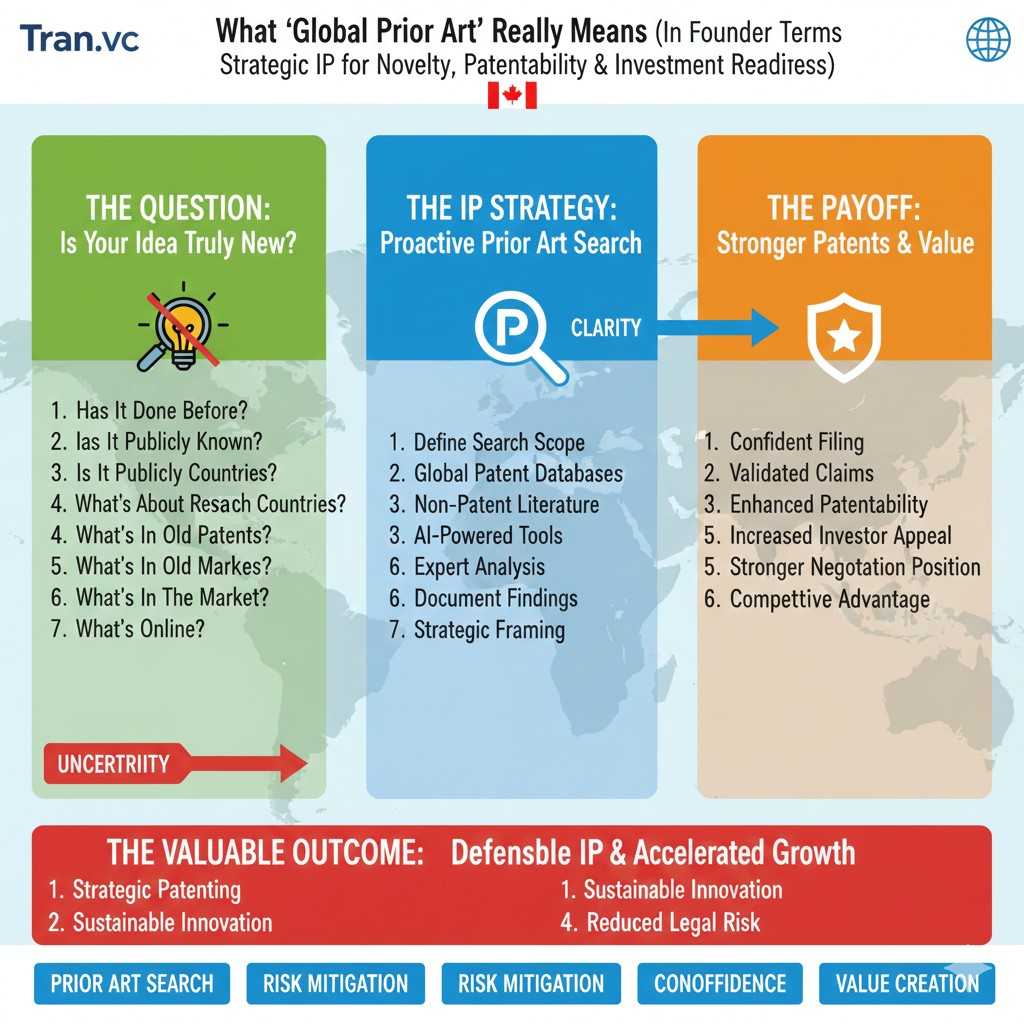
Prior art is any public proof that your idea, or something very close to it, was already known before your filing date. It can be a patent. It can be a paper. It can be a blog post. It can be a product manual. It can even be a talk deck uploaded online.
“Global” matters because patents are not local in how they judge newness. Patent offices look at public info from anywhere in the world. A robotics lab demo in Japan, a thesis from Germany, a Chinese patent publication—if it is public, it can be used against your patent.
Founders often make a quiet mistake here. They search only in Google, find nothing obvious, and assume they are first. Then they file. Then later, an examiner cites a prior patent that was published years ago in a place they never checked. Now the claims get cut down. Or the patent dies. Or the startup pays again to rework the whole plan.
A global search does not mean you must search every database on earth perfectly. It means you must search like a founder who understands risk. You want enough coverage to answer three questions:
- Is this truly new, or is it already out there?
- If parts already exist, where is the real gap we can own?
- How should we write and file so the patent is strong, not “pretty”?
If you can answer those three in a calm way, you are already ahead of most teams.
Why founders should care before they file (even if you plan to “file fast”)
Many startups file patents because investors ask, customers ask, or competitors scare them. That is normal. But filing without a good search is like shipping without testing. You might get lucky. But you also might build your company story on sand.
A strong search helps you:
Avoid wasting money. Patent work costs real dollars and real time. If you file on something that is already known, you pay twice: once to file, and again to fix, narrow, or restart.
Write better claims. Most founders focus on the “cool feature.” Prior art forces you to explain the real invention in a sharper way. You learn what is common and what is rare. That makes your claims stronger.
Find your moat. In AI and robotics, many pieces are known: sensors, control loops, model training steps, inference tricks. The moat is often in the exact way you combine them, or the exact constraint you solve, or the exact data pipeline you created. Prior art helps you see that clearly.
Prepare for investor questions. A good seed investor will ask, “How do you defend this?” You do not need a long legal speech. You just need a clean answer: “We searched globally. Here is what exists. Here is what is missing. Here is what we are filing on.” That calm confidence matters.
If you want Tran.vc to help you do this the right way—without burning months—we invest up to $50,000 in-kind in patent and IP services for deep tech founders. Apply anytime: https://www.tran.vc/apply-now-form/
The founder-friendly mindset: treat this like discovery, not like homework
A prior art search is not a school assignment where you must “find everything.” If you try to do that, you will get stuck, you will hate it, and you will stop.
Instead, treat it like product discovery:
You start with a clear hypothesis about what is new.
You test it against reality.
You adjust your story based on what you learn.
You repeat until the invention is clean and defensible.
That mindset changes how you search. You stop chasing perfect coverage. You start chasing useful truth.
And here is the good news: you do not need to be a patent expert to do the first pass well. You just need a method.
Step one: define the invention in one page (before you search)
If you skip this step, your search becomes random. You will type vague words, open 30 tabs, and still not know what you learned.
Before you search, write a single page that answers these points in plain words:
What problem are you solving?
Who has this problem?
What is the system, end to end?
What is the “secret sauce” step where the result changes?
What inputs do you use?
What outputs do you produce?
What constraints do you handle that others do not?
What is the minimum version of the invention that still works?
Notice what is missing: fancy words. You do not need them. In fact, fancy words make searching worse because the world does not use your internal naming.
Example in robotics: instead of writing “adaptive multi-modal proprioceptive fusion,” write “we combine force sensor readings and motor current to detect slip in real time.”
Example in AI: instead of writing “self-supervised latent alignment,” write “we train a model to match two views of the same item without labels.”
This one-page invention note becomes your map. Every good search begins with a map.
Step two: break your invention into “must-have” parts
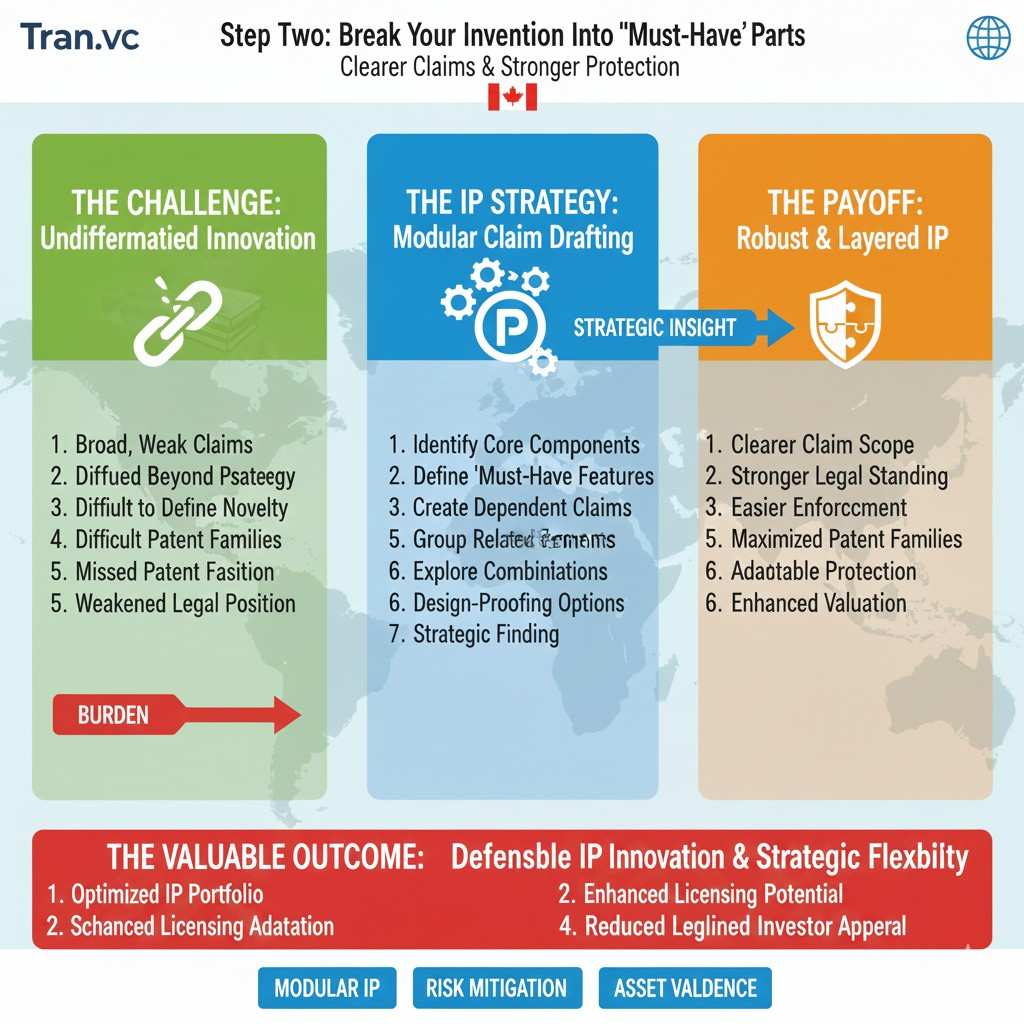
Most inventions are not one thing. They are a chain.
A typical chain might be:
A sensor or data source.
A processing step.
A model or controller.
A decision rule.
A specific deployment setup.
You want to separate what is common from what is special.
Founders often do the opposite. They describe the whole system as one blob. But prior art searches work best when you test each part, then test the combination, then test the edge cases.
Here is a simple way to do this without making it feel like a checklist.
Write your invention as three layers:
Layer A: the goal (what outcome you get)
Layer B: the method (how you get it)
Layer C: the constraints (what makes it hard in the real world)
In robotics, a constraint might be “works with cheap sensors” or “runs on-device with low power” or “handles dust and vibration.”
In AI, a constraint might be “learns from tiny data” or “explains decisions” or “works under privacy limits.”
Constraints are often where the patent value is. Because constraints are where others fail.
Step three: start your global search with the right tools (and the right order)
Founders usually start with Google. That is fine for quick context. But a global prior art search needs at least two worlds:
The patent world (published patent documents).
The non-patent world (papers, theses, blogs, open source, manuals).
You do not need to search every database in the beginning. But you do need to hit the main sources that examiners and competitors use.
A simple founder order is:
Start broad in patents to see the landscape.
Then go deep in the non-patent world to catch papers and code.
Then return to patents with better keywords you learned.
This back-and-forth is important. Patents use strange language on purpose. Papers use technical language. Product docs use practical language. You want all three.
Also, “global” means you should not limit yourself to one country’s patent office search. Many strong references show up first in international databases.
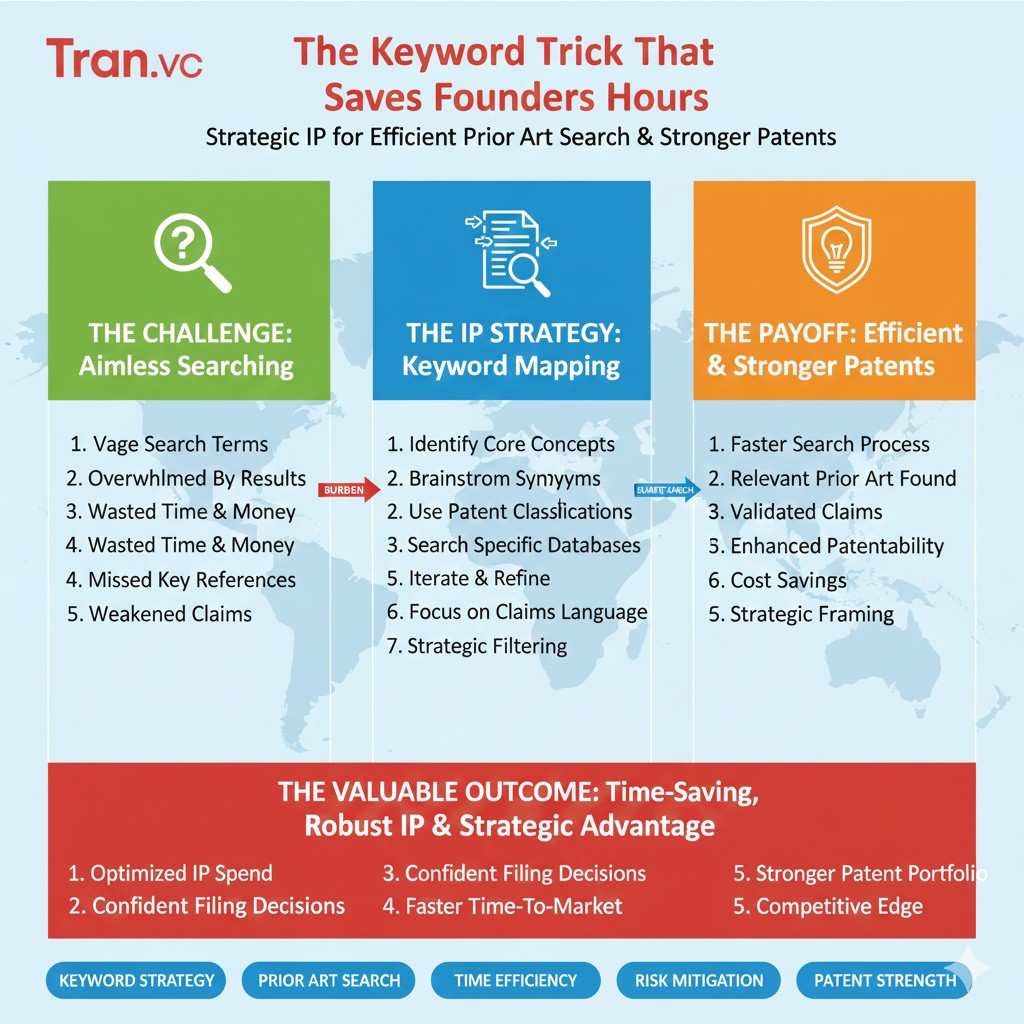
The keyword trick that saves founders hours
Here is a truth that feels small but changes everything:
The best prior art search is not about your words. It is about their words.
Your internal project name does not exist in public. Your feature names do not exist. Your “cool term” is not what the world uses.
So how do you find “their words”?
You start with plain words and synonyms, and you let the documents teach you better terms.
For each key concept in your one-page note, write three versions:
A plain version a customer would say.
A technical version an engineer would say.
A patent-ish version that sounds general.
Example: “robot picks fragile items without crushing them”
Plain: “gentle grip,” “don’t crush,” “handle fragile items”
Technical: “force control,” “grip force estimation,” “tactile sensing”
Patent-ish: “end effector,” “contact force,” “object manipulation,” “compliance”
Now here is the move: when you find one good document, do not just read it. Mine it. Pull out 10–20 phrases from it and reuse them in your next searches. That is how you stop guessing.
This is why searching feels hard for founders. They keep using their own words. The world does not respond. But once you borrow the world’s words, you get signal fast.
A warning: do not confuse “I found something similar” with “I cannot patent”
Founders sometimes panic when they find a similar idea.
They should not.
Most good patents are built in a world where related work exists. Patents are not about inventing from zero. They are about a new and non-obvious advance over what is already known.
So the goal is not to find a clean empty space. The goal is to find:
What is known.
What is missing.
What your specific advance is.
That is why a search is not just a risk check. It is a design tool. It shapes what you claim, how broad you go, and what fallback options you keep.
If you want to do this with experienced guidance, Tran.vc does exactly that: we help you turn your technical edge into a clean IP plan that fits your stage. Apply anytime: https://www.tran.vc/apply-now-form/
The founder’s “good enough” standard for the first pass
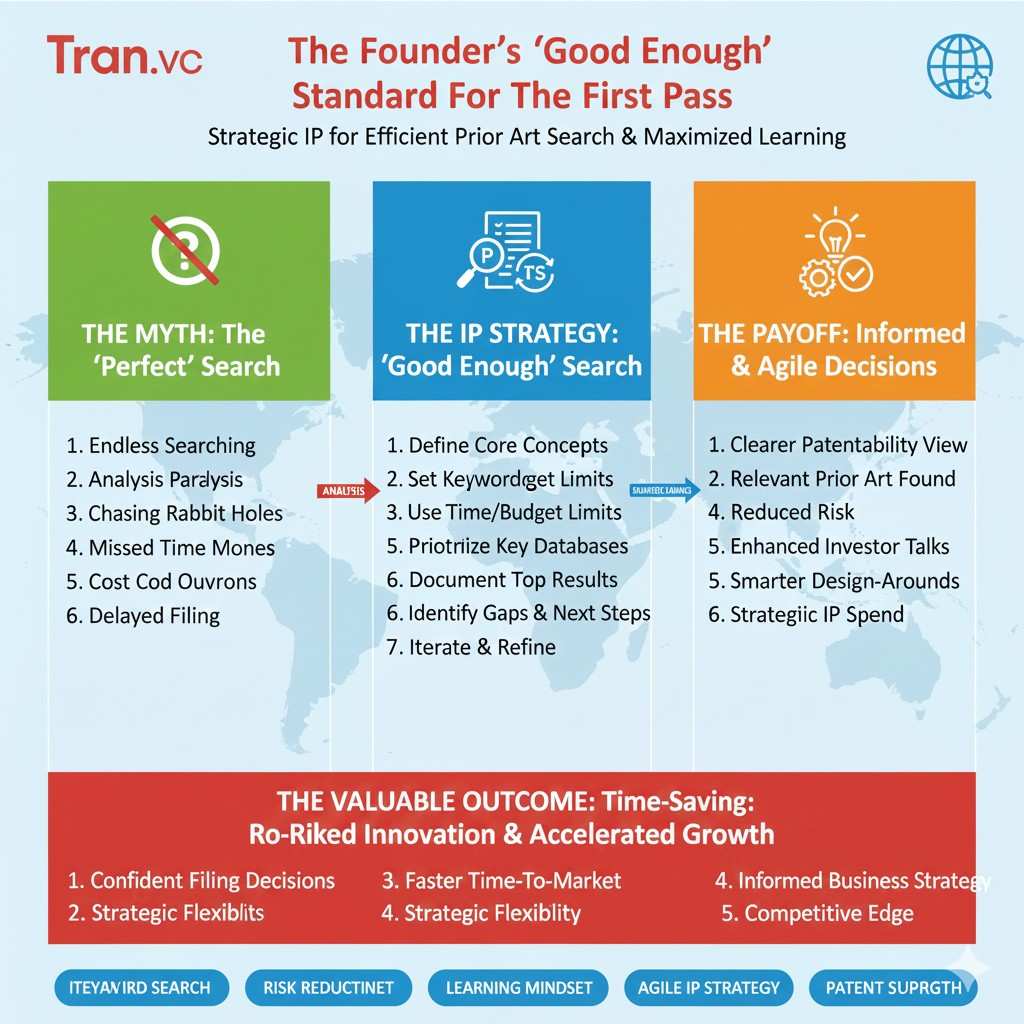
A first-pass global prior art search is “good enough” when you can say:
“I found the top clusters of related work.”
“I can name the main players and approaches.”
“I can describe what is common across them.”
“I can point to the gap we fill.”
“I can explain why our path is different.”
If you cannot say those, your search is still too shallow. If you can say those, you are ready for a more serious search and for claim drafting strategy.
That is the founder-friendly way: get to clarity first, then go deeper with experts.
Where founders usually go wrong (and how to avoid it)
They search only for the full system description.
But prior art is often hidden in parts. Search the parts first, then the combo.
They search only in English.
But many global patent docs appear first in other languages with English translations later. The international databases help here.
They stop after one night of searching.
But a good search is two or three rounds, because each round improves the words you use.
They treat search results as “yes or no.”
But the value is in learning how to position your claims: what to include, what to avoid, what to emphasize.
They wait until after they talk to investors.
But your IP story is part of the investor story. The earlier you sharpen it, the easier fundraising becomes.
Global Prior Art Search: A Founder-Friendly Approach
Why this matters sooner than most founders think
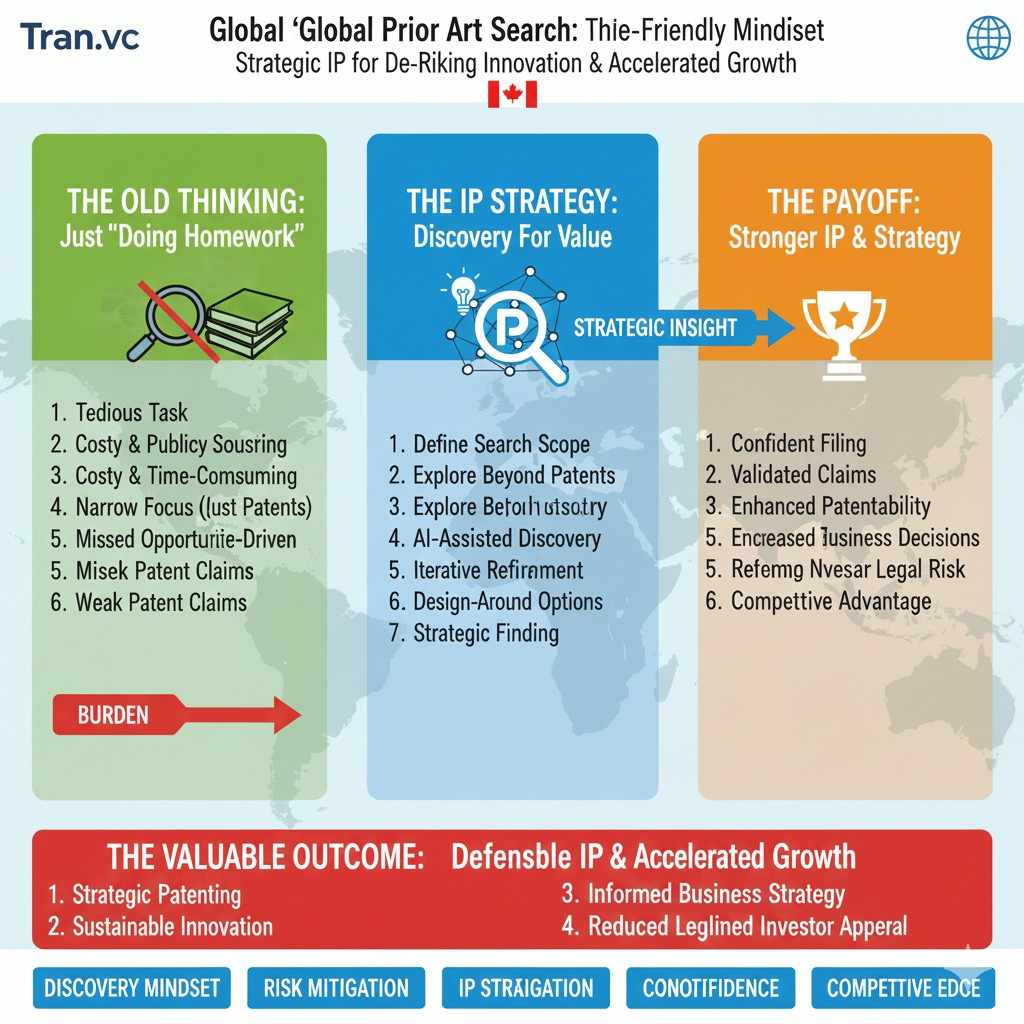
A prior art search sounds like a legal task, but it is really a business safety check. If you file a patent without knowing what is already public, you can end up paying for work that cannot hold up later. That risk is not just about money. It can also weaken your story when an investor asks what is truly new.
A global search matters because patent offices do not care where a public idea came from. A paper in Europe, a product manual in Korea, or a patent publication in China can all block you. If it is public before your filing date, it counts.
If you want expert help doing this correctly from the start, Tran.vc can support founders with up to $50,000 in-kind patent and IP services. You can apply anytime at https://www.tran.vc/apply-now-form/
What “prior art” includes in the real world
Founders often assume prior art means only patents. That is a common trap. Prior art can be almost anything that was shared publicly, even if it was not written for patent work.
It can be a research paper, a thesis, a conference talk slide deck, a public GitHub repo, a blog post, or a product datasheet. If someone can access it without signing a strict private agreement, it may count.
This is why your search has to go beyond a quick Google check. The goal is not to collect random links. The goal is to understand what a patent examiner or a competitor could point to later.
The founder-friendly way to think about “global”
“Global” does not mean you must search every database perfectly. It means you must search in a way that covers the most likely sources worldwide. You are trying to reduce surprise.
A founder-friendly global search is a learning loop. You search, you find patterns, you change your wording, and you search again. Each round becomes faster because your keywords get sharper.
Done well, you end up with a clear map of the landscape. That map helps you file smarter, not just faster.
The mindset shift: treat search like product discovery
Search is not homework, it is risk control
If you treat search like a school assignment, you will either delay it or do it half-way. But if you treat it like product discovery, it becomes useful. Product discovery is about testing what you believe against what is true.
Your first belief is simple: “This is new.” The search is how you check that belief in public reality. If the belief holds, you move forward with more confidence. If it does not hold, you adjust early when it is still cheap.
That is a founder advantage. You do not need to be perfect. You need to be early and honest with what you find.
What “success” looks like for a founder
A good search gives you three practical outcomes. You learn what already exists, you find the real gap you can own, and you get better at describing your invention in plain and defensible terms.
This makes your patent plan stronger because you can draft claims that avoid known work. It also makes your fundraising story stronger because you can explain your edge without sounding vague.
You are not searching to “prove you are a genius.” You are searching to make sure you are building on solid ground.
Why this is extra important in AI and robotics
In AI and robotics, many building blocks are shared widely. Sensors, standard control methods, model architectures, training tricks, data cleaning steps, and deployment patterns often have public references.
Your value is usually in a specific combination, a specific constraint you solve, or a specific method that works when others fail. Those details are easy to miss if you do not search well.
A good search helps you spot what is truly rare in your approach. That rare part is often the best place to file.
If you want Tran.vc to help you find and protect that rare part, you can apply anytime at https://www.tran.vc/apply-now-form/
Step 1: Define the invention in one page before you search
Why you need a one-page invention note
Many founders jump into searching before they can explain their invention clearly. That creates a messy search where you open too many tabs and still feel unsure. A one-page note turns your search into a guided process.
This note is not marketing copy. It is not investor pitch language. It is a plain description of what the system does and what makes it different.
You will reuse this note later when you speak with patent counsel. You will also reuse it when you explain your moat to investors.
What the one-page note should actually say
Start with the problem in simple words. Then describe the full system from input to output. Keep the words plain enough that a smart person outside your field can follow the logic.
Then add the turning point, meaning the step where your approach creates a result others do not get. This is often where your real invention lives, even if your demo looks like the whole system.
Finally, write down what makes it hard in the real world. Real constraints are gold in patent strategy because they show practical value, not just theory.
A simple example of “plain words” that work
If you write “adaptive multi-modal fusion,” your search will be weak because you will only find papers that use that phrase. But if you write “we combine motor current and force sensor signals to detect slip,” you will find broader and more useful prior work.
The goal is not to sound smart. The goal is to sound searchable. Prior art search rewards clarity more than fancy naming.
This is also where many founders discover a helpful truth. If you cannot explain it simply, it is hard to protect because it is hard to define.
Step 2: Break the invention into layers so you can search faster
Why searching “the whole system” fails
When you search for the entire system at once, you often miss key references. Public documents may describe parts of your approach without describing the complete product. Patent examiners often combine references, so you must expect the same.
This is why you should search in parts first. You want to see what exists for each major piece, and then test whether the combination is still new.
This method feels slower at first, but it becomes much faster after the first round because you stop guessing.
The three layers that make searching easier
A practical way to break the invention is to separate the goal, the method, and the constraints. The goal is the outcome. The method is how you get it. The constraints are the real-world limits you handle.
In robotics, constraints might include cheap sensors, low power, heat, vibration, dust, or safety requirements. In AI, constraints might include small data, privacy limits, on-device inference, or speed requirements.
Constraints often lead you to the best patent angle because they show why your method matters. Many people can build a demo. Fewer can make it work under hard limits.
How to turn layers into search angles
Once you have the layers, you create search angles. You search the method without your product name. You search the constraint without your preferred term. You search the goal using words a customer might say.
Then you combine them in pairs. Goal plus method. Method plus constraint. Goal plus constraint. This approach helps you uncover documents that describe the same thing in a different style.
When you do this, you usually find strong references within the first few hours. That is enough to make smart decisions early.
Step 3: Use the right sources in the right order for global coverage
Two worlds you must search: patents and non-patents
Global prior art lives in two main worlds. One is published patent documents. The other is non-patent literature, which includes papers, theses, blogs, manuals, standards, and open source.
If you search only patents, you miss papers and code that can still block your novelty. If you search only papers, you miss patent language that examiners rely on heavily.
A founder-friendly approach uses both. The goal is not to drown in results. The goal is to collect the few most relevant references that shape your claim strategy.
A simple order that reduces wasted time
Start with patent databases to see the landscape and common claim language. Then switch to papers and technical sources to catch the research side. After that, go back to patents using the better keywords you learned.
This back-and-forth is powerful because patents often use broad terms, while papers use precise technical terms. Each teaches you vocabulary you can reuse.
By the third round, your searches tend to become much sharper, and the results become far more relevant.
What “global” changes about the way you search
Global means you should avoid limiting yourself to one country’s database. Many inventions show up first in international patent systems. Many countries publish early, and those publications become searchable worldwide.
It also means you must be open to translation. You might find a patent family that started in a non-English jurisdiction but has an English abstract or machine translation.
You do not need to read everything word-for-word. You need enough to understand the concept, the claims direction, and the key drawings.
Step 4: Use better keywords by borrowing “their words,” not yours
Why founder-made terms hide results
Founders love naming things. Internal names help teams move fast. But they hurt search because public documents rarely use your names.
If you search using only your own terms, you will get a false sense of novelty. The search will look empty, not because you are first, but because you asked the wrong question.
The fastest way to fix this is to learn the language the public uses. Your job is to match how others describe similar ideas.
How to create keyword sets that actually work
For each key concept, write a plain version, a technical version, and a general version. The plain version sounds like a customer. The technical version sounds like an engineer. The general version sounds like a patent document.
This gives you three doors into the same room. Some databases respond better to technical terms. Others respond better to broad terms. If one door is blocked, you use another.
As you search, you will notice repeat phrases in strong documents. Those phrases are a gift. They are proof that the world uses them, and you should too.
The “one good document” method
When you find one highly relevant document, do not just skim and move on. Mine it. Look for repeated nouns, verbs, and system descriptions. Pull out the phrases and reuse them as new search terms.
This makes your next searches smarter and faster. It also keeps you from drifting into random browsing.
Over time, you build a small dictionary of the field. That dictionary becomes useful far beyond patents. It helps with positioning, messaging, and even hiring.
Step 5: Read prior art fast without missing the important parts
How to avoid getting trapped in long documents
Patent documents can be long and exhausting. Papers can be dense. Manuals can be boring. If you try to read everything in full, you will stop.
Instead, you should read for structure. You want the concept, the boundary, and the claims direction. You are looking for what it does, how it does it, and what it tries to own.
This approach saves time while still giving you what you need for decisions.
What to look at first in a patent document
Start with the abstract to understand the promise. Then look at the drawings, because drawings often reveal the real system faster than text. After that, read the main independent claim if it is available, because it shows what the inventor is trying to protect.
Only then should you scan the detailed description. You do not need every detail. You need the parts that overlap with your method and constraints.
If a document seems close, save it and label it as a “high risk” reference. Those are the ones your patent strategy must address directly.
What to look at first in papers and open source
For papers, read the title, abstract, and figures first. Then check the method section and what data they used. Often the novelty is in the setup or the training pipeline, not the headline.
For open source, read the README, key config files, and any examples that show intended use. Pay attention to whether the work was public and when it was posted.
Dates matter because prior art depends on what was public before your filing date. That is why saving the source and timestamp is important.
Step 6: Turn search results into a clear “gap story” you can file on
The real output is not links, it is clarity
A founder does not win by collecting 80 bookmarks. A founder wins by being able to explain, in plain words, what exists and what is missing.
This is the heart of the gap story. “Here is the common approach. Here is where it breaks. Here is what we do instead. Here is why it works under a real constraint.”
This gap story becomes the spine of your patent drafting. It also becomes the spine of your investor narrative.
How to find the gap when everything looks similar
In AI and robotics, many documents will feel close. That is normal. When that happens, look for the difference that changes the outcome.
It might be a specific data flow, a specific sensor arrangement, a specific training objective, a specific control rule, or a specific deployment constraint. Small changes can be patentable when they create a real technical effect.
Your job is to describe that effect clearly. Not “it is better,” but “it reduces failure in this case,” or “it works without this expensive component,” or “it achieves this performance with lower compute.”
How this shapes what you file first
A good search often changes the order of filings. Instead of filing on the entire product, you might file first on the narrow but defensible core. Then you can add broader follow-on filings as you build.
This approach fits early-stage reality. You protect what is real today, and you keep room for future claims as the product matures.
It also matches how strong IP portfolios are built over time, not in one perfect shot.
If you want help building that filing path with experienced patent attorneys and startup operators, you can apply to Tran.vc anytime at https://www.tran.vc/apply-now-form/