
Most founders think VCs only care about revenue, growth, and the deck.
But in the first real diligence call, many investors quietly look for one thing that tells them whether your company truly owns what it is selling.
That thing is IP assignment.
It’s not flashy. It’s not fun. But it is one of the fastest ways for a deal to slow down, get repriced, or die.
At Tran.vc, we spend a lot of time helping technical founders lock this down early, because we’ve seen the pattern: amazing tech, strong team, real traction… and then a messy ownership gap that scares investors. If you want to build a company that can raise clean money later, this is one of the first documents you should treat like a core product asset.
And yes—if you want hands-on help building a clean IP foundation from day one, you can apply anytime here: https://www.tran.vc/apply-now-form/
What “IP assignment” really means (in plain words)
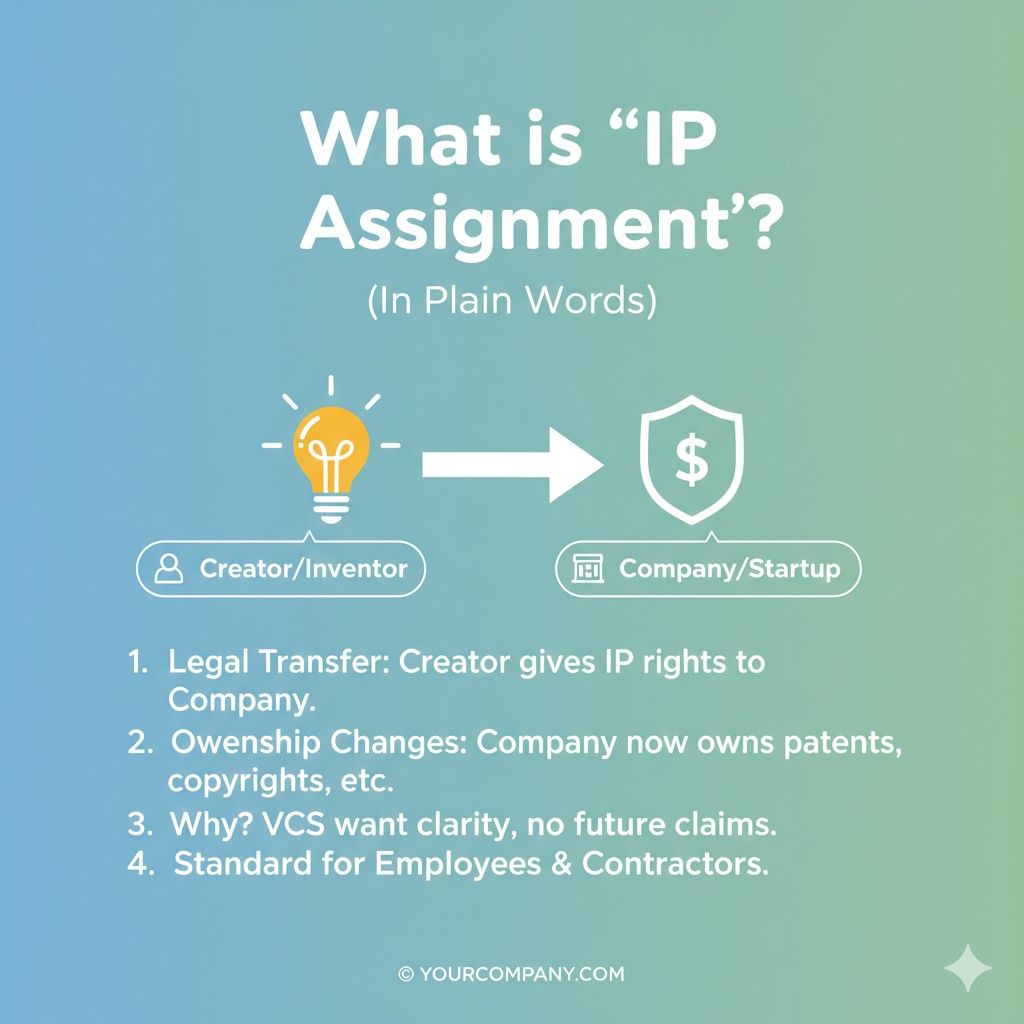
An IP assignment is a document that says, clearly and legally:
“This person created this invention or this code, and now the company owns it.”
That’s it.
No drama. No mystery.
It is different from an NDA. It is different from a patent filing. It is different from “we talked about it and agreed.”
It is a transfer of ownership.
If the company does not own the key IP, then the company is not fully real. It might still operate. It might still sell. But investors see a risk that can blow up later.
Here’s the simplest way to understand why.
A company is a box. Inside the box is supposed to be your product, your code, your models, your designs, your data work, your inventions, your know-how. When a VC invests, they are buying a piece of that box.
If the key tech was created by people who never assigned it to the box, then part of the product is sitting outside the box.
VCs don’t like buying boxes with missing parts.
That is why they check.
And they check early.
The moment this becomes a problem (and it’s usually earlier than you think)
A lot of founders assume IP assignment matters “later,” like after they raise a seed round.
But it starts being relevant the moment any of these are true:
You wrote code before the company existed.
A co-founder built an early prototype on weekends.
A contractor helped you design the system.
A friend from your lab contributed a key part.
A student helped you train a model.
A previous employer might claim the work overlaps.
You used open-source in ways that might create obligations.
You moved fast, because you had to, and paperwork came last.
All normal.
But here is the hard truth: if you don’t fix ownership early, the problem does not stay the same size. It grows. It gets tangled with hiring, fundraising, and patents.
And the worst time to clean it up is when you are already in diligence and someone is waiting for a clear answer.
When VCs ask questions like “Who owns the code?” they are not doing it to be annoying.
They are checking whether you have a clean chain of title.
That means a clean line of ownership from the person who created the IP to the company that claims it owns it.
If there is a break in that line, it creates leverage for someone else. And investors hate leverage they do not control.
What VCs are really trying to avoid
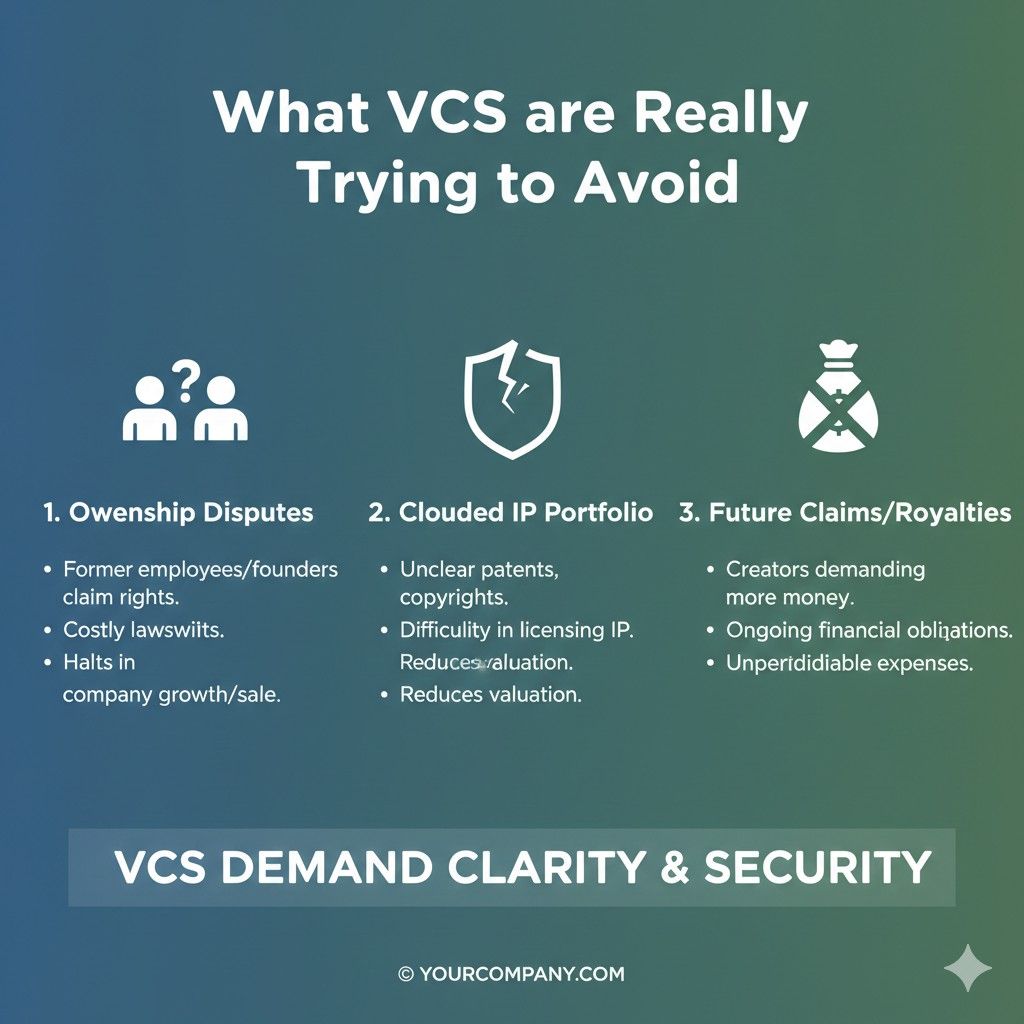
When investors dig into IP assignment, they are trying to avoid a few scary outcomes.
One is the simple one: a former co-founder shows up later and says, “That’s my code,” or “That’s my invention,” or “Pay me or I block this.”
Another is a contractor dispute. Many founders assume paying an invoice means the company owns the work. In many places, it does not work that way. Payment is not the same as assignment. You can pay for work and still not own the IP unless the contract says it transfers.
Another is the employment overlap issue. A founder builds something while employed elsewhere, using company time, company tools, or even just “related to the company’s business.” Some employers have broad invention assignment clauses. Investors know this. They will ask. If the answer is fuzzy, they get cautious.
Another is patent trouble. If you file patents but do not have the right assignment documents from inventors, you can create headaches later. Sometimes those headaches can be fixed. Sometimes they get expensive. Sometimes they reduce the value of the patent.
Another is an acquisition deal dying. Buyers also check ownership. If you ever want to sell, this paperwork will come back again.
So when VCs check IP assignment, they are checking whether the company is safe to invest in, safe to grow, and safe to exit.
Why this matters even more for AI, robotics, and deep tech
In software-only startups, investors can sometimes accept a bit of mess early, because the value may be in market position or brand or sales motion.
In deep tech, AI, and robotics, your tech is often the core reason you exist.
Your algorithms. Your data pipeline. Your system design. Your control stack. Your model training method. Your hardware integration. Your sensor fusion work. Your mechanical design.
If your moat is technical, then your ownership must be tight.
That is why Tran.vc focuses on IP from the start. We invest up to $50,000 in-kind in patent and IP services to help founders turn technical work into owned assets, not just demos. If you are building in AI, robotics, or other hard tech, and you want to lock your foundation early, apply here: https://www.tran.vc/apply-now-form/
The biggest myth: “We’ll just fix it later”
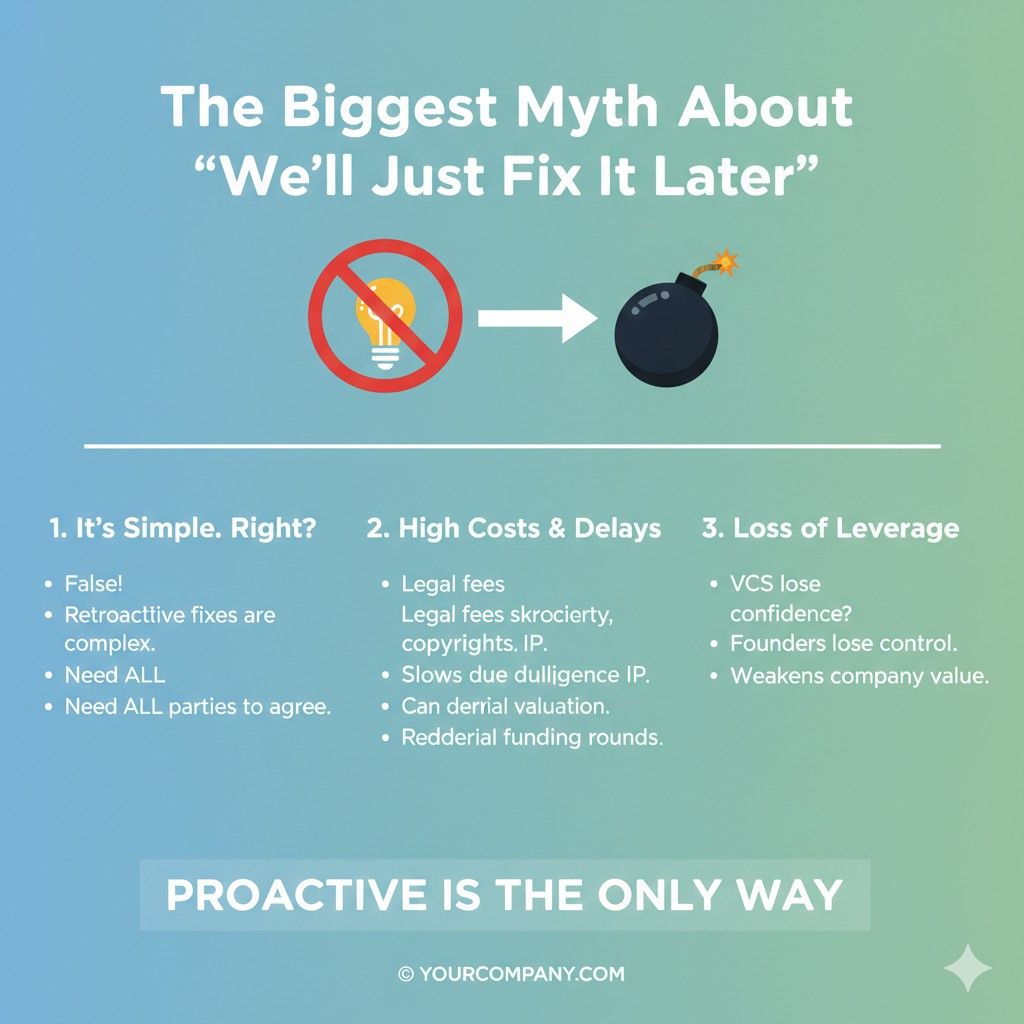
Founders often say this with good intent. They are not lazy. They are busy. They are shipping.
But “later” creates three problems.
First, people disappear. A contractor moves on. A co-founder leaves. Someone gets upset. Someone asks for more money. Someone stops replying.
Second, the story gets unclear. What was created when? Who contributed what? Was it before or after incorporation? Was it done under another job? Was it done using company resources? If you wait, the facts get fuzzy.
Third, you lose negotiation power. When you need someone’s signature urgently because a VC is waiting, you are negotiating from a weak position.
That is why the best time to handle assignment is when everyone is still excited, still aligned, and still close to the work.
What an IP assignment document usually covers (without getting legal-heavy)
Even though we are keeping this simple, you should know what the document is trying to accomplish.
At a high level, it does four jobs.
It identifies the person transferring IP.
It identifies the company receiving it.
It describes what is being transferred.
It makes the transfer official, permanent, and enforceable.
Sometimes it also includes extra language that helps the company file patents, sign paperwork later, and confirm that the person is not keeping hidden rights.
The exact wording matters, and it should be drafted carefully. But the goal is simple: no confusion about ownership.
The three places assignment often breaks (and how to spot them early)
A clean chain of title is like a clean wiring job. You only notice it when it is missing.
In early startups, assignment usually breaks in three places.
1) Before incorporation work
You and your co-founder hack together a prototype. You test a model. You train on a dataset. You build a hardware rig.
Then you incorporate.
Then you assume the company owns the work because you are the founders.
But legally, that early work was created by you as individuals. Unless you assign it to the company, the company may not own it.
This is one of the most common diligence questions: “Was any core tech created before the company was formed? If yes, do you have assignment into the company?”
The fix is usually straightforward if done early. It becomes awkward if done after someone leaves.
2) Contractors and advisors
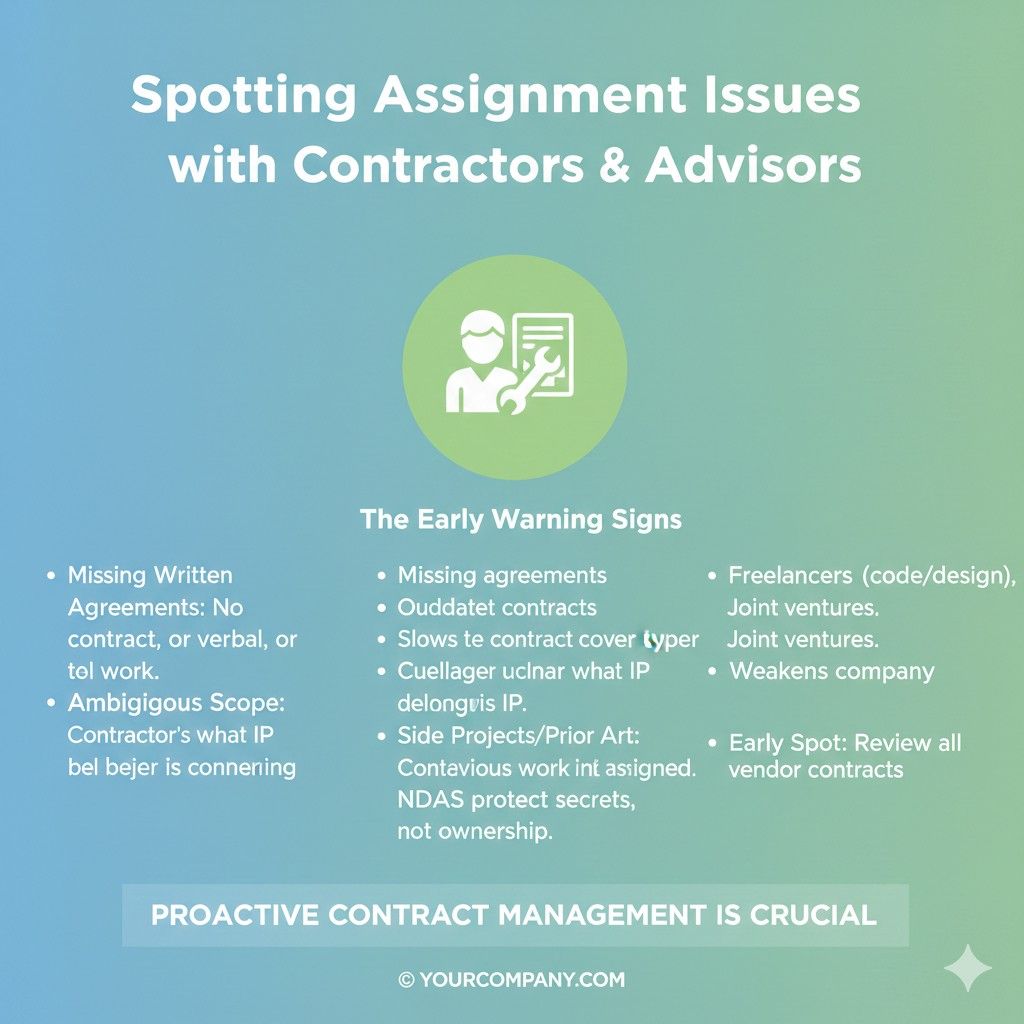
If a contractor wrote code, designed a PCB, created CAD files, built a dataset, labeled data, or even helped design the architecture, you need to be sure the contract includes assignment.
Many contractor templates do not transfer ownership by default. Some say “license” instead of “assignment.” Some are silent. Silence is not your friend.
Also, advisors sometimes contribute ideas that become real IP later. Not always, but enough that VCs will look at advisor agreements too, especially if the advisor was hands-on.
3) Founders with another job or university ties
This one is sensitive, and it is common in deep tech.
If you built the tech while employed, your employer may claim rights.
If you built the tech in a university lab, the university may claim rights.
Even if you believe they do not, investors will want evidence, not belief.
This does not mean you are stuck. It means you need to handle it carefully and cleanly.
And if you want help thinking through this the right way—without panic, without guessing—this is exactly the kind of early foundation work Tran.vc supports. Apply here if you want a serious IP-first path: https://www.tran.vc/apply-now-form/
What VCs actually ask for (and how they think when they ask)
Founders sometimes get nervous when investors ask for “IP assignment docs.” It can feel like an accusation.
It’s not.
It’s a basic checklist item.
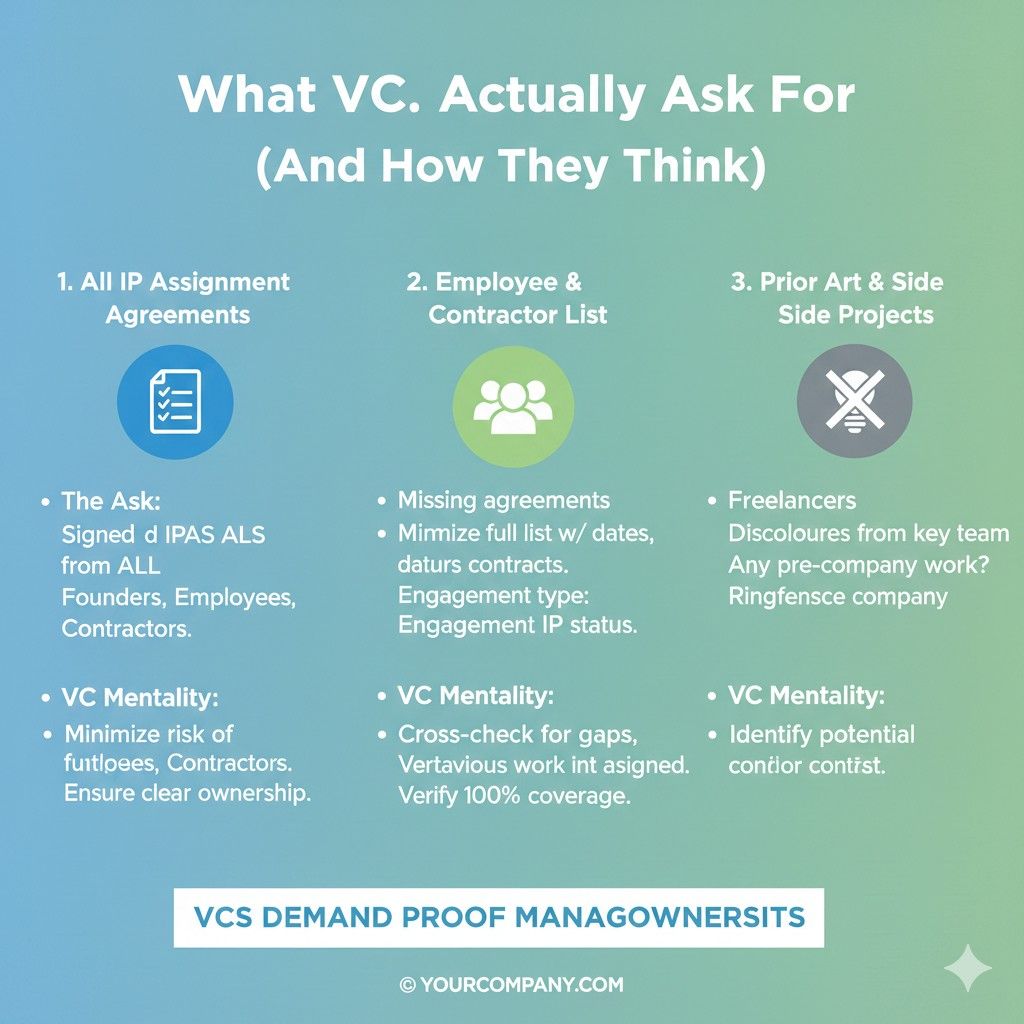
A typical investor, or their counsel, may ask for:
Proof that each founder assigned inventions to the company.
Proof that employees are under invention assignment agreements.
Proof that contractors assigned work product.
Any patent assignments, if patents were filed.
Any invention disclosures, if relevant.
A cap table and incorporation docs, because ownership must line up across everything.
Sometimes they also ask for your open-source policy, because licensing risk can look like ownership risk.
They are trying to answer one question: “If this company wins, can someone else take the core asset away?”
If the answer is clearly “no,” the deal moves faster.
If the answer is “maybe,” even if you are probably fine, the deal slows down.
In fundraising, speed matters. Clean documents create speed.
The practical playbook: how to get IP assignment right without overcomplicating your life
The goal is not to become a lawyer.
The goal is to be a founder who runs a clean company.
Here’s the mindset that works: treat ownership paperwork like version control. Small, regular updates. No giant cleanups right before a launch.
Start with founders.
If you are incorporated, each founder should have a signed agreement that includes invention assignment language, or a separate assignment.
If you are not incorporated yet, keep a clear record of what exists now, and plan the assignment into the company as soon as it is formed.
Then cover every person who touches the product.
If someone writes code, designs hardware, creates training pipelines, builds data tools, labels data, or produces technical diagrams that you will rely on, you need assignment.
Then store it in one place.
A shared folder with clear naming: “Founder IP Assignment – Name – Date.pdf” and similar.
When diligence starts, you do not want to hunt through email threads.
You want to send a clean set of documents in minutes.
That creates confidence.
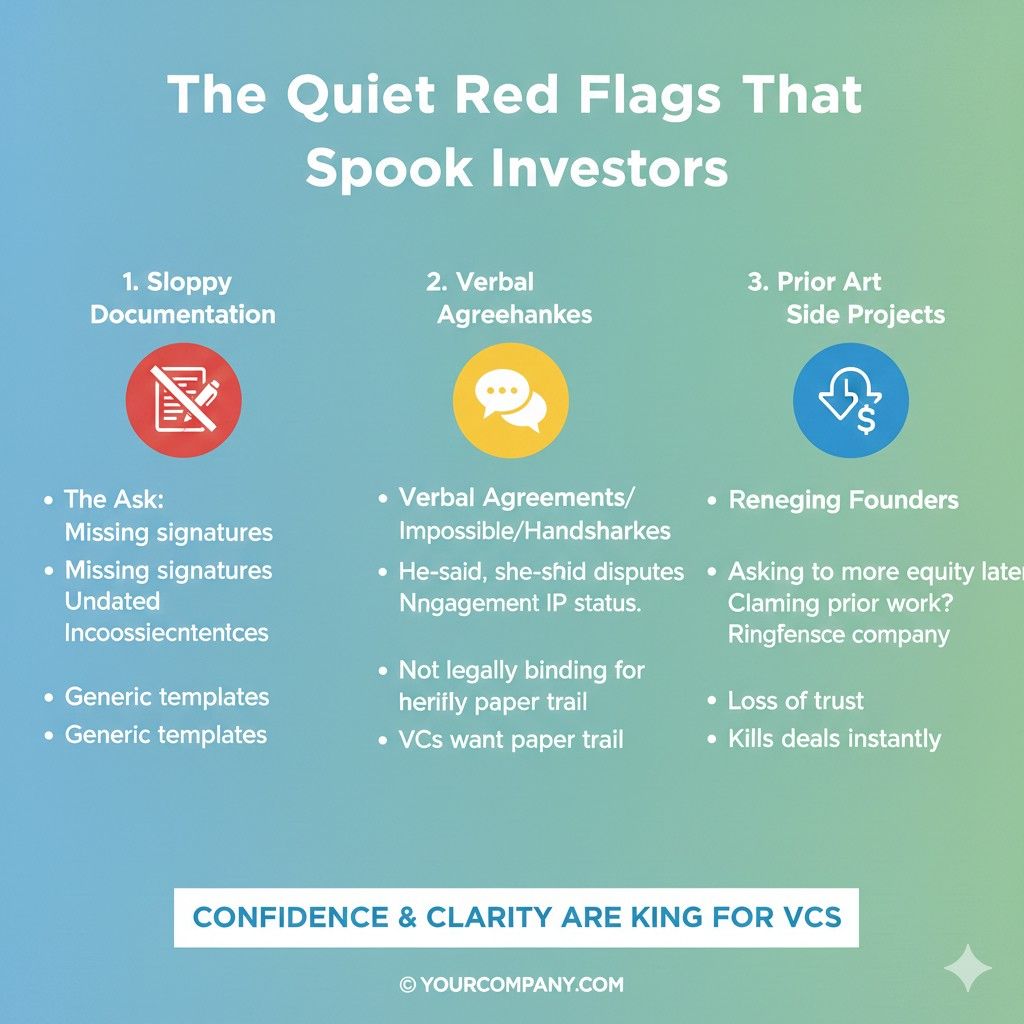
The quiet red flags that spook investors
Most founders don’t realize which answers sound dangerous to an investor.
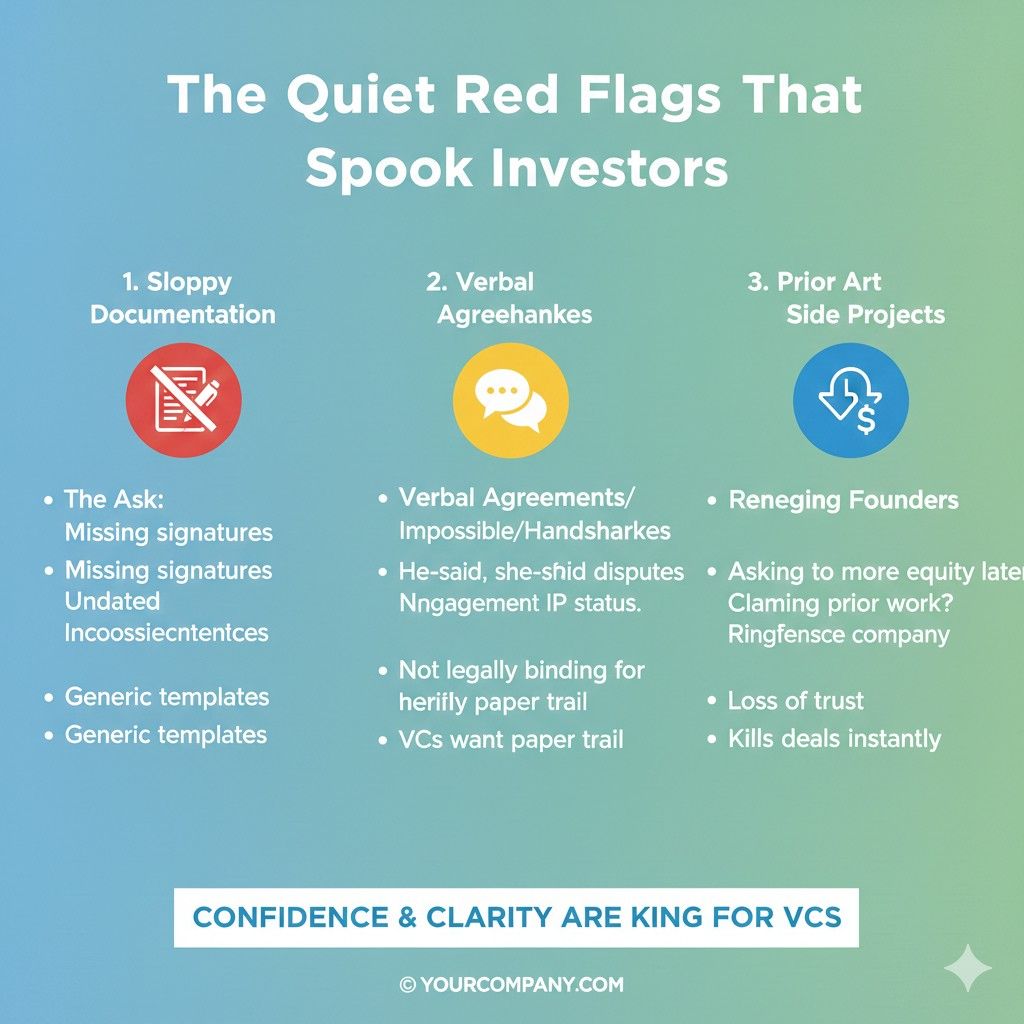
Here are a few examples of what not to say in diligence:
“We didn’t sign anything yet, but we trust each other.”
“Our contractor is a friend, it’s fine.”
“We paid them, so we own it.”
“The code was written before we incorporated, but it’s basically the same team.”
“We used to work at X, but this is different.”
None of these are proof.
None of these are malicious, either. They are just not investment-grade answers.
An investment-grade answer sounds like:
“Yes, all founders assigned IP to the company.”
“Yes, all employees and contractors sign invention assignment agreements before starting work.”
“Yes, we have a clean record of pre-incorporation work and assignment into the company.”
Even if you are early, you can still be clean.
And if you want help building this kind of clean foundation, Tran.vc is designed for exactly that. Apply anytime: https://www.tran.vc/apply-now-form/
A simple story that shows why this matters
Imagine you are a VC.
Two startups look similar. Same market. Similar traction. Both teams are smart.
Startup A sends diligence documents fast. Founder agreements are signed. Contractor assignments are clean. Everything is organized. The story is consistent.
Startup B says they are still collecting signatures. A contractor is slow to respond. One founder built the first version while employed elsewhere. Nobody is sure what the old employment agreement said. They think it is fine.
Who feels safer?
Who feels easier?
Who feels like less hidden risk?
Most VCs will choose the cleaner company, even if Startup B’s tech is slightly better.
Not because they don’t like risk. They invest in risk all day.
But they want market risk, product risk, execution risk.
They do not want preventable legal risk.
Where founders usually slip up when leaving a company or changing roles
This comes up more than people admit.
A co-founder leaves after six months. They contributed meaningful code. They helped shape the system. They wrote early training scripts.
If they already assigned IP to the company, the situation is still painful emotionally, but the company can keep building.
If they did not, you now have a business problem.
You might need them to sign later. They might ask for more equity. They might refuse. They might threaten.
Investors know this pattern. That’s why they check assignment.
The best time to sign these documents is when someone joins and when someone leaves.
Not later.
Not “when it matters.”
It matters now.
One more point founders miss: IP assignment and patents are linked
A lot of technical founders care about patents, but they treat assignment as separate admin work.
In reality, clean assignment makes patents cleaner.
When you file, you need to name the real inventors. Then the company usually needs assignment from those inventors so the company owns the patent rights.
If you don’t do this cleanly, you can still sometimes fix it. But fixing it later can be expensive and stressful, and it can raise questions in diligence.
Tran.vc’s whole model is built around helping you do this early and correctly. We invest up to $50,000 in-kind in patenting and IP services so you can build a real moat without burning cash. If you’re building deep tech, AI, or robotics, apply here: https://www.tran.vc/apply-now-form/
The founder-friendly way to read this article
What you are about to get
You’ll get a clear, practical explanation of IP assignment in plain language, with enough detail to help you act fast without guessing.
You’ll also see how investors think about this document, what they look for, and how to fix gaps before they become deal problems.
If you want Tran.vc to help you build a clean, defensible IP base from day one, you can apply anytime at https://www.tran.vc/apply-now-form/
How to use it
Read it once for understanding, then come back and use it like a checklist in your next hiring, contractor, and fundraising steps.
This is not legal advice, but it is the same kind of playbook thinking experienced teams use to stay clean.
What an IP assignment really is
The plain meaning
An IP assignment is a legal transfer. It moves ownership of inventions, code, designs, and other creative work from a person to a company.
When it is done right, it makes the company the owner of the work. That makes the company stronger, easier to fund, and safer to scale.
When it is missing or unclear, the company may still operate, but investors see a hole in the foundation.
Why “we all agree” does not count
Founders often feel that a handshake or shared understanding is enough. In day-to-day building, it might feel that way.
But investors do not fund feelings. They fund documents, because documents survive stress, conflict, and time.
When a deal gets serious, the question becomes simple: can the company prove ownership without debate.
Why this is not the same as an NDA
An NDA is about secrecy. It says someone should not share private information.
An IP assignment is about ownership. It says the company owns the work, even if the person leaves.
You often need both. But if you only have an NDA, you may still not own the thing you are protecting.