
Picture this: you finally get a meeting with the exact buyer you want. They’re curious. They’re leaning in. And right when the talk starts to feel real, you say the words that can freeze the room:
“Before I share anything, I need you to sign an NDA.”
Sometimes that’s the right move. Many times, it quietly kills the deal.
Not because the buyer is shady. Not because they hate you. But because you just added work, risk, and legal time to what they thought was a simple first chat. Most sales calls are meant to answer one question: “Is this worth a second meeting?” An NDA too early can make the answer “no,” even if your product is strong.
Here’s the uncomfortable truth: most early sales talks do not need an NDA. And when you ask for one too soon, you often signal the wrong thing. You signal you don’t know what must be protected. You signal you may be hard to work with. You signal fear.
Yet founders in AI, robotics, and deep tech have a real problem: you do have valuable ideas. You do have models, designs, data flows, and methods that matter. And you do need a smart way to protect what you’re building—without scaring off the people who could pay you, partner with you, or invest in you.
That’s what this article is about: using NDAs in a way that protects you and keeps the sales talk moving.
At Tran.vc, we help technical founders do exactly this. We invest up to $50,000 in-kind in patent and IP services so you can protect the real value early, build a moat, and still talk to customers with confidence. If you want help building an IP plan that fits your product and your sales cycle, you can apply anytime here: https://www.tran.vc/apply-now-form/
Now, let’s start with the simple reason NDAs often break sales conversations.
A buyer has a job. Their job is to reduce risk. Legal reviews add risk. An NDA can pull them into their internal process: legal team, vendor onboarding steps, security reviews, contract redlines. That process can take weeks. And most buyers will not spend weeks just to learn what you do.
So the key is timing and scope. You want to protect what truly needs protecting, but you do not want to force legal work before trust exists.
The biggest mistake founders make is thinking an NDA is a “polite safety belt.” In practice, it’s a gate. Gates are fine when you are about to enter the private area. Gates are terrible when you’re still at the front door saying hello.
So what should you do instead in the first call?
You learn to sell without revealing your secret sauce.
The first call: protect your IP without asking for an NDA
What the buyer is really trying to do in meeting one
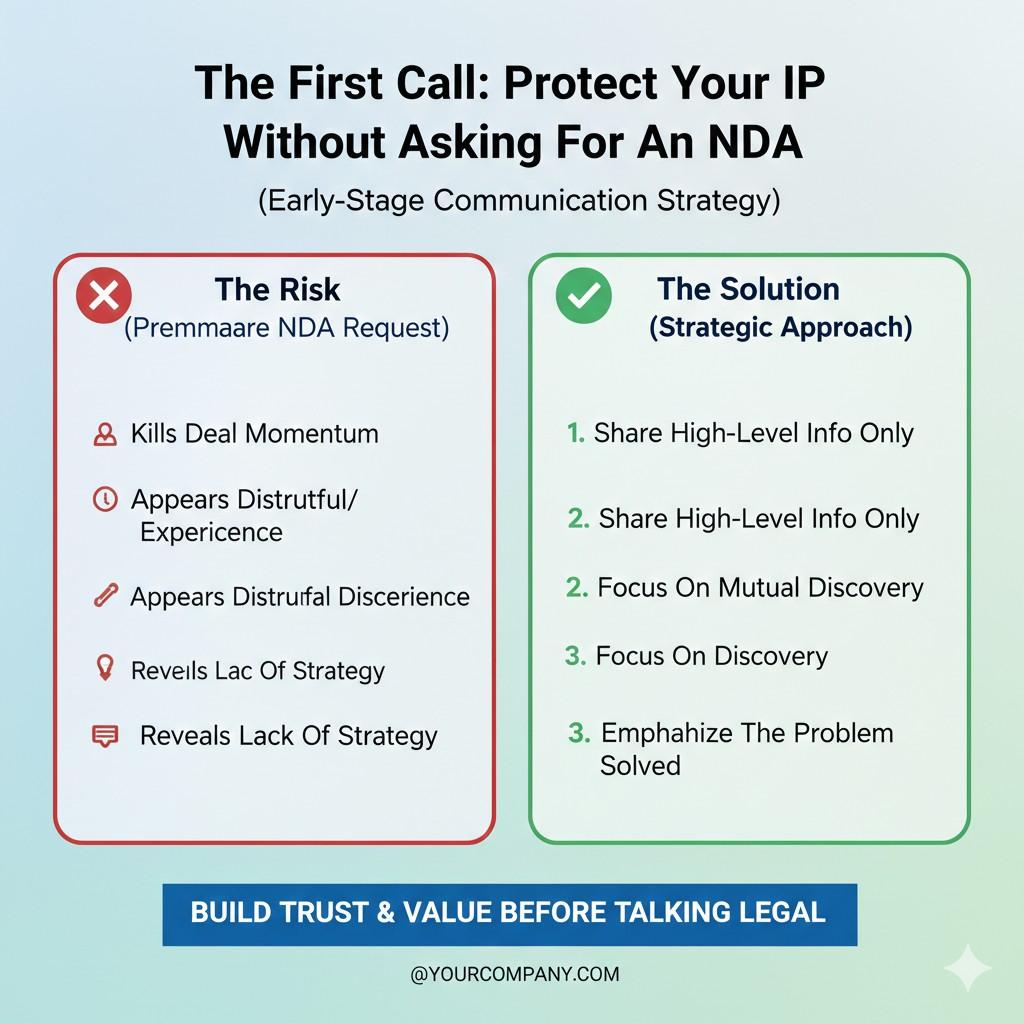
On the first call, most buyers are not trying to steal anything. They are trying to decide if you are worth their time. They want to know if you understand their world, if your product fits their needs, and if the next step feels safe and simple.
An early NDA request often changes the mood. It turns a light “learn more” chat into a legal task. Even if the buyer likes you, they may pause because they do not want to pull in legal for a call that might go nowhere.
So your job in meeting one is to keep the talk useful, clear, and easy. You do that by focusing on outcomes and fit, not deep mechanics.
The simple rule: share the “what” and “proof,” hold back the “how”
Founders often feel like they must explain how the engine works to prove it is real. In most B2B sales, that is not true. The buyer cares about whether the car gets them to work on time, not how the engine is built.
You can describe what you do, who it is for, and what changes after your tool is in place. You can show results, examples, pilot steps, and timelines. You can even describe your system at a high level without giving away the part that makes it hard to copy.
This keeps momentum. It also keeps you from handing over the blueprint before anyone has earned it.
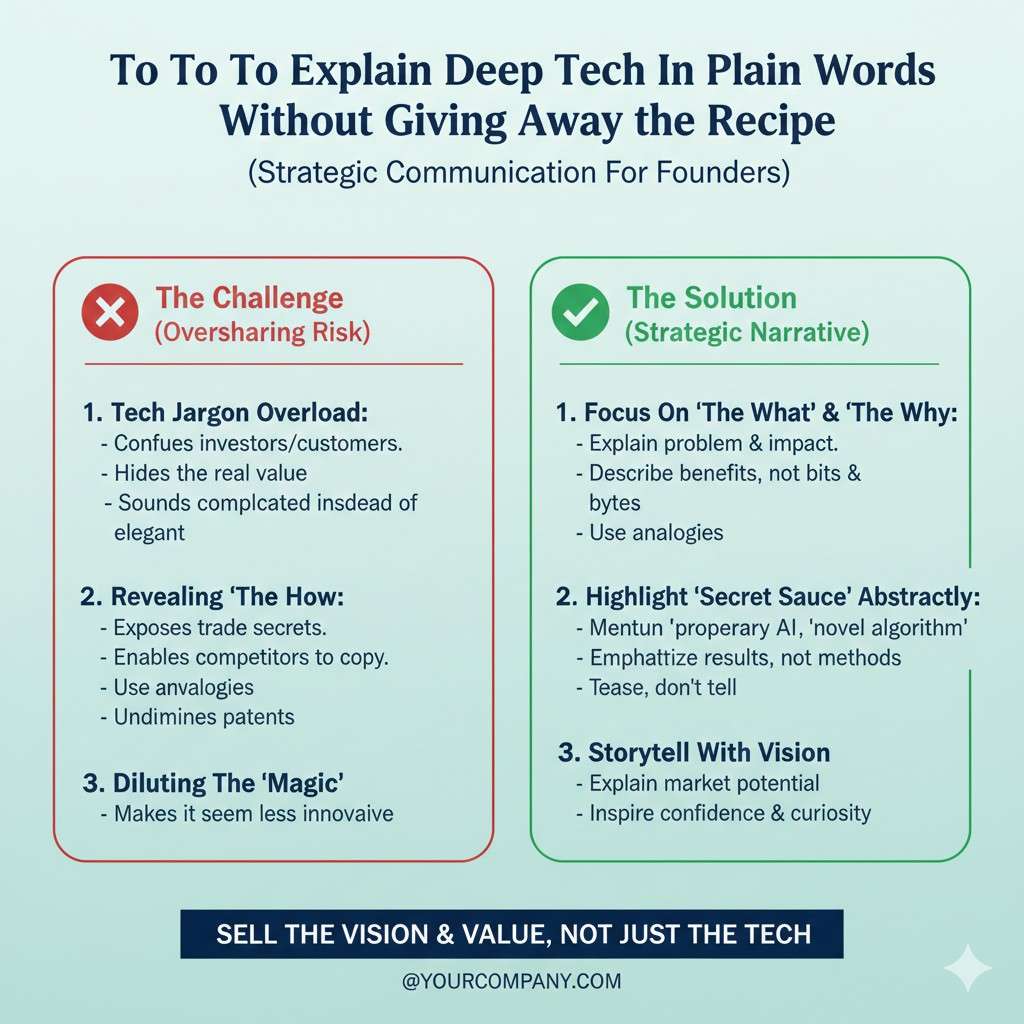
How to explain deep tech in plain words without giving away the recipe
In AI and robotics, the “how” can be very tempting to share because it is interesting. But the more detail you give, the more you risk turning a sales call into a free design review.
A safer way is to speak in layers. Start with the problem and the outcome. Then share a simple view of the process. Then share evidence that it works. If they push for details, you can offer the next step under a mutual NDA.
This approach feels confident, not defensive. It signals that your work is real and protected, while still being easy to engage with.
What to say when someone asks, “How do you do it?”
This is the moment where many deals stall. The buyer asks a fair question. The founder either over-shares out of fear of sounding vague, or blocks the question with “sign an NDA first.”
A stronger response is to give a clear, high-level answer and then guide them toward validation. You can say you combine their signals with a planning and control layer that adapts in real time, and that you deploy it in a way that fits their environment. Then you pivot to what they can measure, like speed, error rate, uptime, or time to deploy.
This keeps trust intact. It also makes the next step feel like progress rather than friction.
Decide what you protect before you ever get on the call
Separate “public,” “business,” and “core IP” in your own mind
If you treat every detail like a secret, you will either freeze or overshare. A better approach is to sort what you know into clear buckets before you talk to anyone.
Public info is the problem you solve and the general approach the market already knows. Business info is what helps the buyer plan: ranges, timelines, deployment needs, and what success looks like. Core IP is the small set of details that would let a strong team rebuild what you built.
Once you see the difference, you stop feeling like every question is dangerous. You also start to sound more steady, which makes buyers more willing to take next steps.
Build a short “safe talk track” you can use every time
You do not need a script that sounds rehearsed. You need a simple track you can return to when the talk goes into risky areas.
You can describe the workflow in plain steps, without naming the exact method behind each step. You can share what inputs you need, what outputs you produce, and what the buyer will see in a pilot. You can share what common failures look like and how you handle them, without exposing the unique fix you built.
This helps you sell the value, not the secret. It also makes every call smoother because you are not deciding in the moment what is safe.
Why “proof” is your best protection in early sales
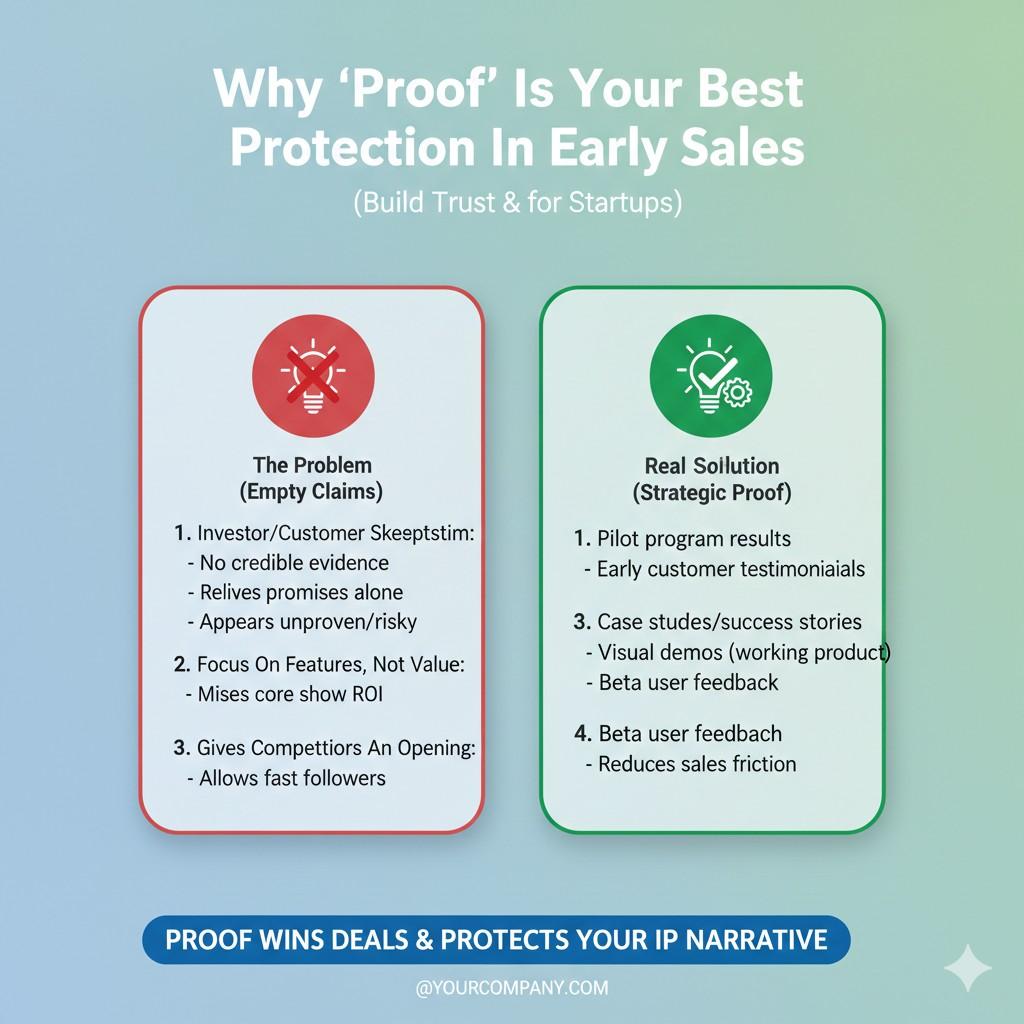
Buyers do not pay for hidden tricks. They pay for reduced risk. If you can show proof, the buyer needs fewer details of your internal work.
Proof can be a controlled demo, a pilot plan, a test result, or a clear before-and-after story. It can also be a simple set of metrics you measure the same way every time. When proof is strong, the buyer stops asking for the recipe and starts asking how soon they can try it.
This is one reason founders should put effort into measurable outcomes early. It makes sales easier and protects your core work at the same time.
When an NDA helps and when it hurts
The best timing for an NDA: when the next step truly needs it
An NDA makes sense when you are moving into a real working step. That is usually after the buyer has shown intent, such as agreeing to a pilot, asking for integration steps, or sharing internal data.
At that point, the NDA is not a barrier. It is a safety tool that supports a serious phase. The buyer is more willing to sign because they now see why it matters.
If you ask for an NDA before that, many buyers feel they are being forced into paperwork without clear value.
The most common moments an NDA is reasonable
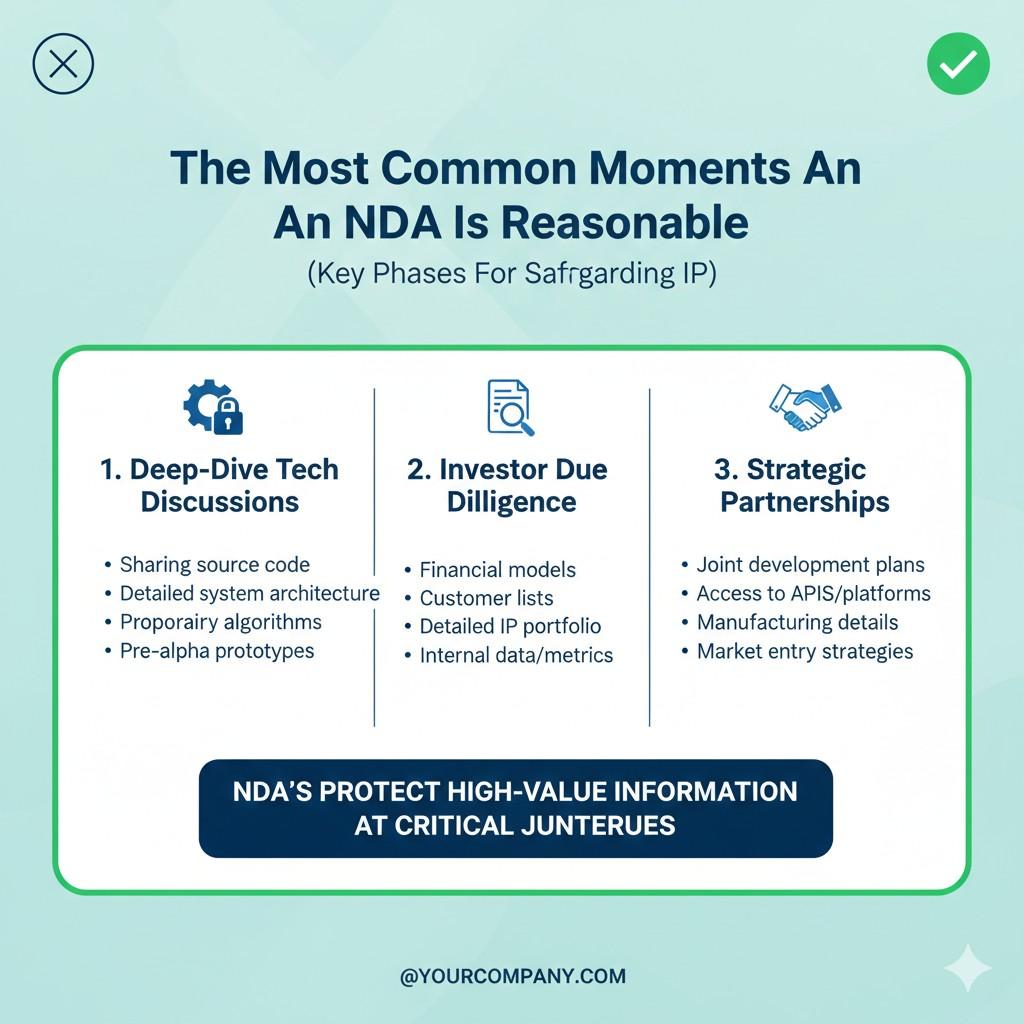
If you need their private data, you should use an NDA. If you need to see details of their factory process, you should use an NDA. If you are about to share detailed design docs or a roadmap that reveals your next moves, you should use an NDA.
In these moments, the NDA is easy to justify because the buyer can see the reason. The key is to link the NDA to a specific next step, not to your general fear of sharing.
Why an NDA is not a full shield by itself
Many founders think an NDA means they are safe. In real life, an NDA is only useful if you can prove a breach and enforce it. That can be hard, especially against a large company.
So the goal is not to rely only on NDAs. The goal is to combine good conversation boundaries, good sales process, and real IP protection that gives you leverage.
That is why patent strategy matters early. It can give you room to speak and sell without living in fear.
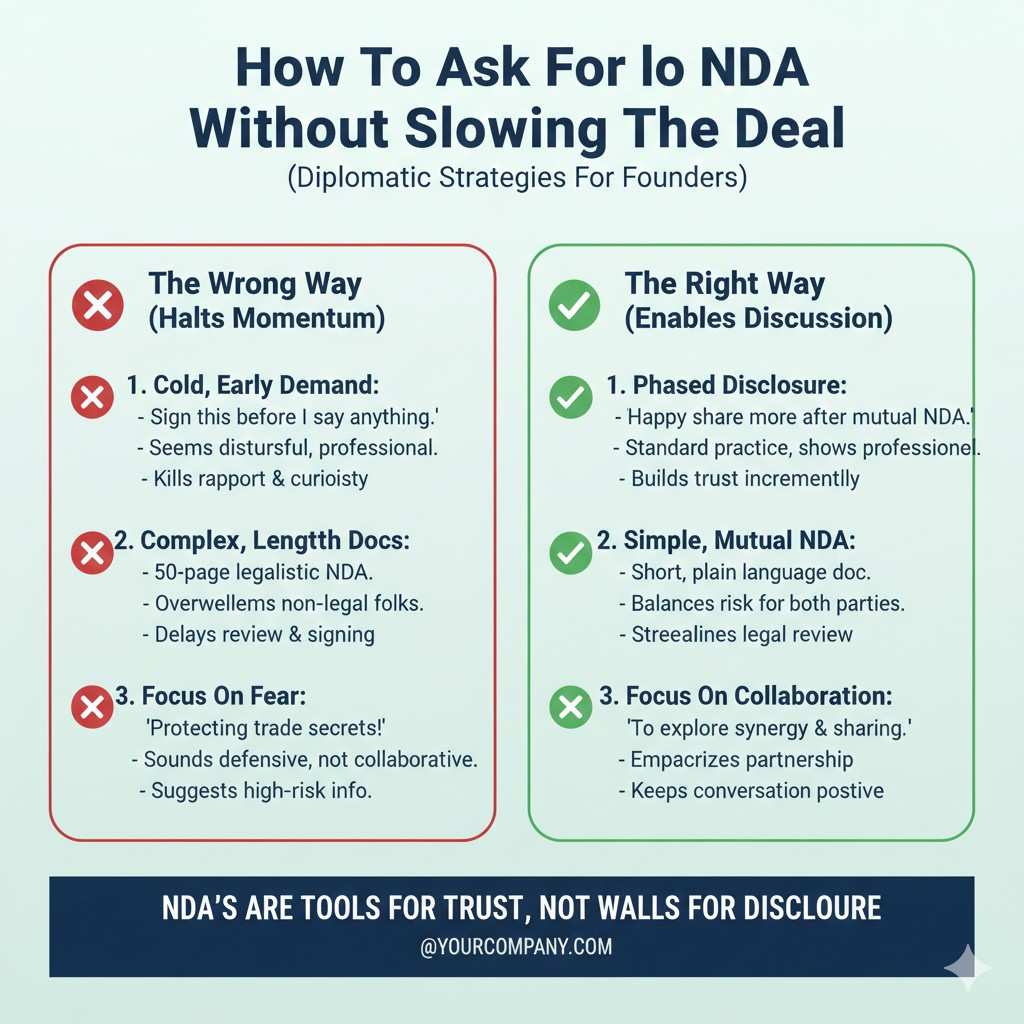
How to ask for an NDA without slowing the deal
Tie the NDA to a clear reason that the buyer understands
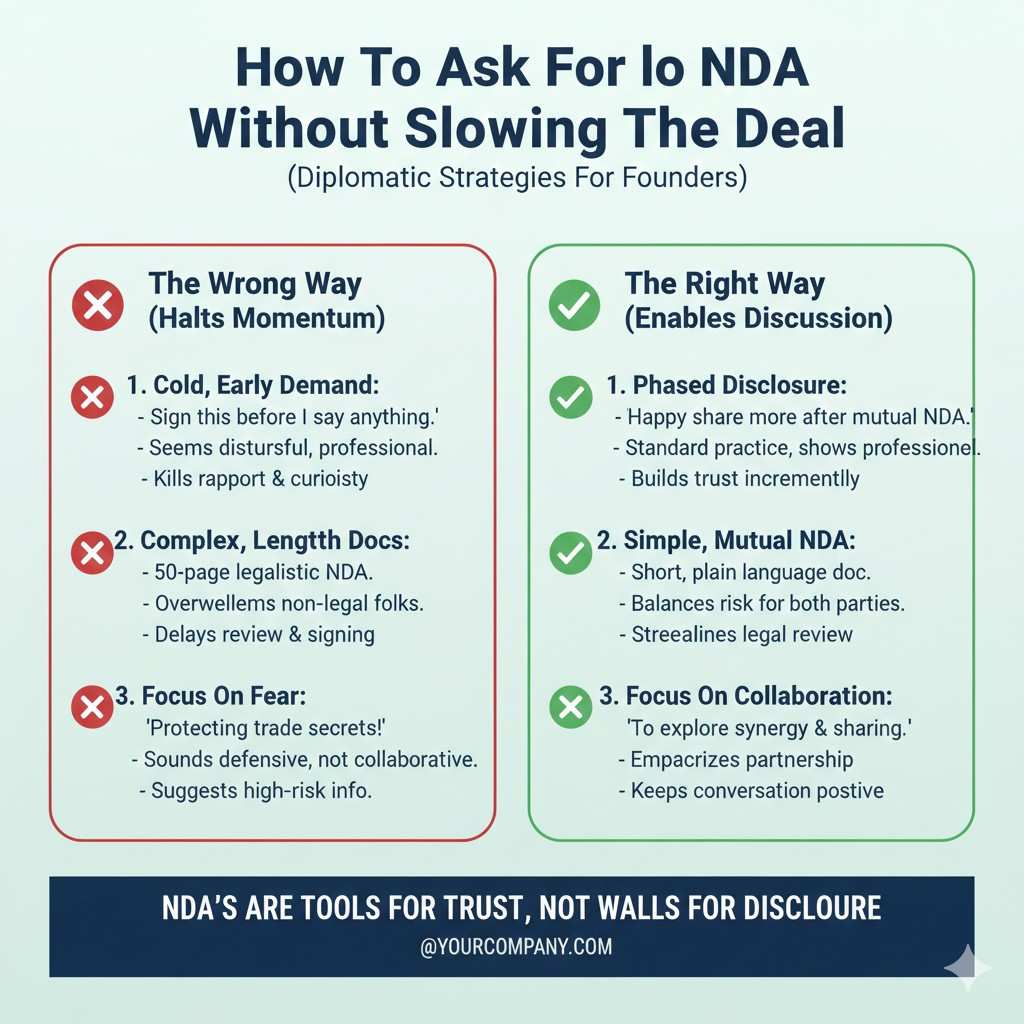
The buyer does not want “legal for legal’s sake.” They want a reason. When you connect the NDA to the next step, it feels normal.
You can say you are happy to keep the first call open, but the next session will include private data and deeper technical detail. Then you propose a standard mutual NDA to protect both sides.
That framing is important. It makes the NDA feel like a sign of progress rather than a sign of distrust.
Use “mutual” language so it feels fair
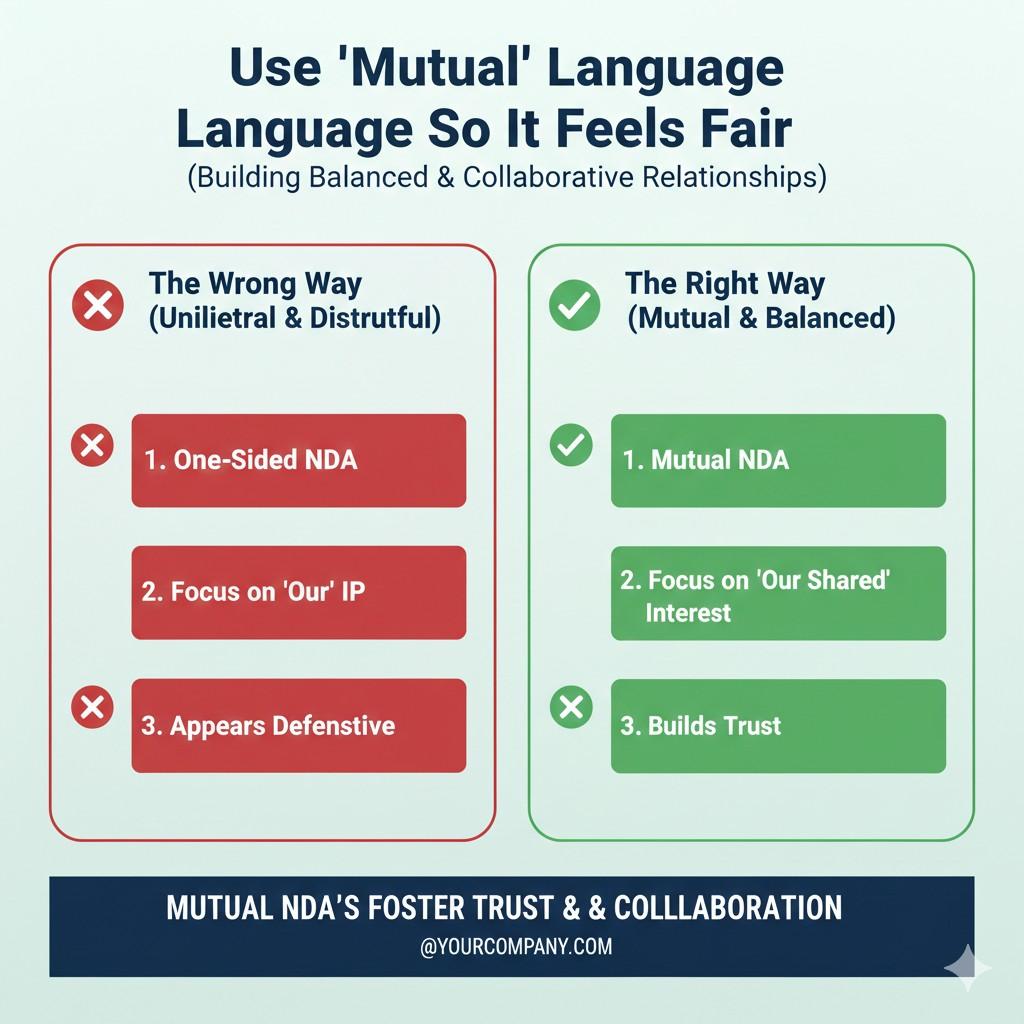
A one-way NDA can feel like you are trying to control the buyer. A mutual NDA feels balanced, because both sides are sharing something valuable.
You can say you want to protect their data and your non-public technical details. This tells them you are thoughtful and professional, not paranoid.
That tone matters a lot in enterprise deals, where trust is part of the product.
Reduce friction by offering to start with their template
Many buyers have their own NDA form. If you insist on your own document, you may add days of delay for no reason.
A smoother approach is to say you can start with their standard mutual NDA and keep terms reasonable. This makes it easier for them to say yes because it fits their normal process.
If they still want to use yours, you can send it, but you will already have shown that you are easy to work with.
Use a two-lane process so sales stays fast
Lane one: open discovery that never needs an NDA
Lane one is where you qualify each other. You discuss the problem, outcomes, constraints, and how you measure success. You show a demo that proves value without revealing the deep mechanics.
You also set expectations for what a pilot looks like, how long it takes, and what resources are needed. This gives the buyer a clear picture of effort and payoff.
Because lane one stays high-level and proof-driven, you do not need legal work to begin.
Lane two: protected deep dive that earns the NDA
Lane two starts when both sides agree the deal is worth real time. That is when you exchange sensitive data, design documents, or deeper technical detail.
Here, the NDA supports the work. It helps you speak more freely, and it helps the buyer share what you need to succeed. It is not about fear. It is about professional boundaries.
When you present it this way, most serious buyers are fine with it.
Why patents make lane one easier
When you have patents filed or a clear filing plan, you can speak with more calm. You stop acting like every detail is fragile.
Patents are not just a legal tool. They are a sales tool because they reduce fear. They also signal maturity to buyers and investors, especially in AI and robotics where copying is fast.
This is exactly where Tran.vc supports founders. Tran.vc invests up to $50,000 in-kind in patent and IP services so you can protect what matters early and sell with confidence. If you want help building your IP plan while keeping your sales moving, apply here: https://www.tran.vc/apply-now-form/
Handling legal and procurement without losing momentum
Why legal delays feel bigger than they really are
Many founders panic the moment a deal touches legal or procurement. They imagine months of silence and endless redlines. In reality, most delays come from confusion, not rejection.
Legal teams move slowly when the reason for the contract is unclear. Procurement teams stall when they do not understand scope, cost, or risk. When you guide the process with clarity, things usually move faster than expected.
Your role is not to fight legal. Your role is to make their job easy.
Set expectations before legal ever gets involved
Before an NDA or any contract is sent, explain what comes next in simple words. Tell the buyer what information will be shared, why it matters, and what decision it supports.
When legal understands that the NDA unlocks a defined technical review or pilot step, they treat it as a task with purpose. When they see it as vague or open-ended, it sinks to the bottom of the pile.
This is why you should never send an NDA “just in case.” Always tie it to a clear outcome.
Keep scope tight so contracts stay light
One common mistake is trying to protect everything in one document. This makes the NDA long, strict, and slow to approve.
A better approach is to limit the NDA to non-public technical details and shared data. Leave pricing talks, general product info, and public material outside the scope.
When contracts are narrow, legal teams move faster. Buyers also feel safer because they know exactly what they are agreeing to.
Stay present during the legal step
Do not disappear once the NDA is sent. A short follow-up note that restates the purpose and next step keeps momentum alive.
You can say you are looking forward to the deeper session once the NDA is in place and that you have time blocked for it. This signals that the deal is active, not stalled.
Small signals like this often shave weeks off the process.
What to do when a buyer refuses to sign an NDA
Understand the reason before reacting
When a buyer says they cannot sign an NDA, it is rarely personal. Often, they have internal rules about early vendor talks or exploratory meetings.
Instead of pushing back, ask what they are comfortable sharing and learning at this stage. Many times, you can still move forward in lane one without issue.
The goal is to keep the relationship warm, not to “win” the argument.
How to continue the conversation safely without an NDA
If there is no NDA, stay firmly in high-level territory. Focus on outcomes, integration effort, timelines, and success criteria. Use proof, not secrets.
You can also propose a structured pilot or paid evaluation that limits exposure. When money is involved, buyers are often more willing to revisit legal protections.
This approach keeps progress alive without forcing a hard stop.
When “no NDA” is a real red flag
Sometimes, a refusal is a signal. If a buyer asks for deep technical detail, private data, or design docs but refuses any protection, you should pause.
That is the moment to hold your boundary. You can explain that you are happy to continue at a high level, but deeper work requires basic safeguards.
Serious buyers usually understand this. If they do not, it may not be the right deal.
Using pilots to replace fear with structure
Why pilots are safer than long explanations
A well-designed pilot answers the buyer’s real question: “Will this work for us?” It does that better than long technical talks ever could.
Pilots shift the focus from how your system works to what it produces. They also limit what you need to share because the value is shown, not explained.
This makes pilots a powerful tool for selling without oversharing.
Design pilots that protect your core work
Your pilot should show results without exposing internals. You control the setup, the metrics, and the outputs the buyer sees.
For example, you can deliver performance improvements, reports, or live demos without giving access to raw models or training methods. You can also time-box the pilot so it does not drift into free consulting.
This structure protects you while still delivering real value.