
Data Security Basics for VC Readiness
If you want serious investors to take you seriously, your data security cannot be a “later” problem. It must be a “now” habit. The good news is you do not need a giant security team to look ready. You need clear choices, clean systems, and proof you can protect what matters.
And if you are building deep tech, AI, or robotics, security is not only about trust. It is also about value. Your models, training data, source code, and invention notes are part of your moat. The same way Tran.vc helps you turn your invention into real IP assets, solid security helps you show investors you can defend those assets in the real world. If you want support building an IP-backed foundation that investors respect, you can apply anytime at https://www.tran.vc/apply-now-form/
Most founders think “VC readiness” is a pitch deck, a demo, and some growth. That is only half true. The other half is risk. Investors ask one silent question in every deal:
“Can this team keep the company safe enough to scale?”
They may not say it directly. But it shows up as diligence questions, delays, and suddenly “we need to talk to your CTO.” Security is one of the fastest ways to lose momentum during a raise, because once doubt enters the room, it is hard to remove.
So let’s make this simple, practical, and real. We will focus on the basics that make you look credible. Not perfect. Credible. Because early-stage investors do not need a Fortune 500 security program. They need evidence of maturity. They need to see that you are not careless with customer data, trade secrets, or your own internal keys.
What “data security” really means at seed stage
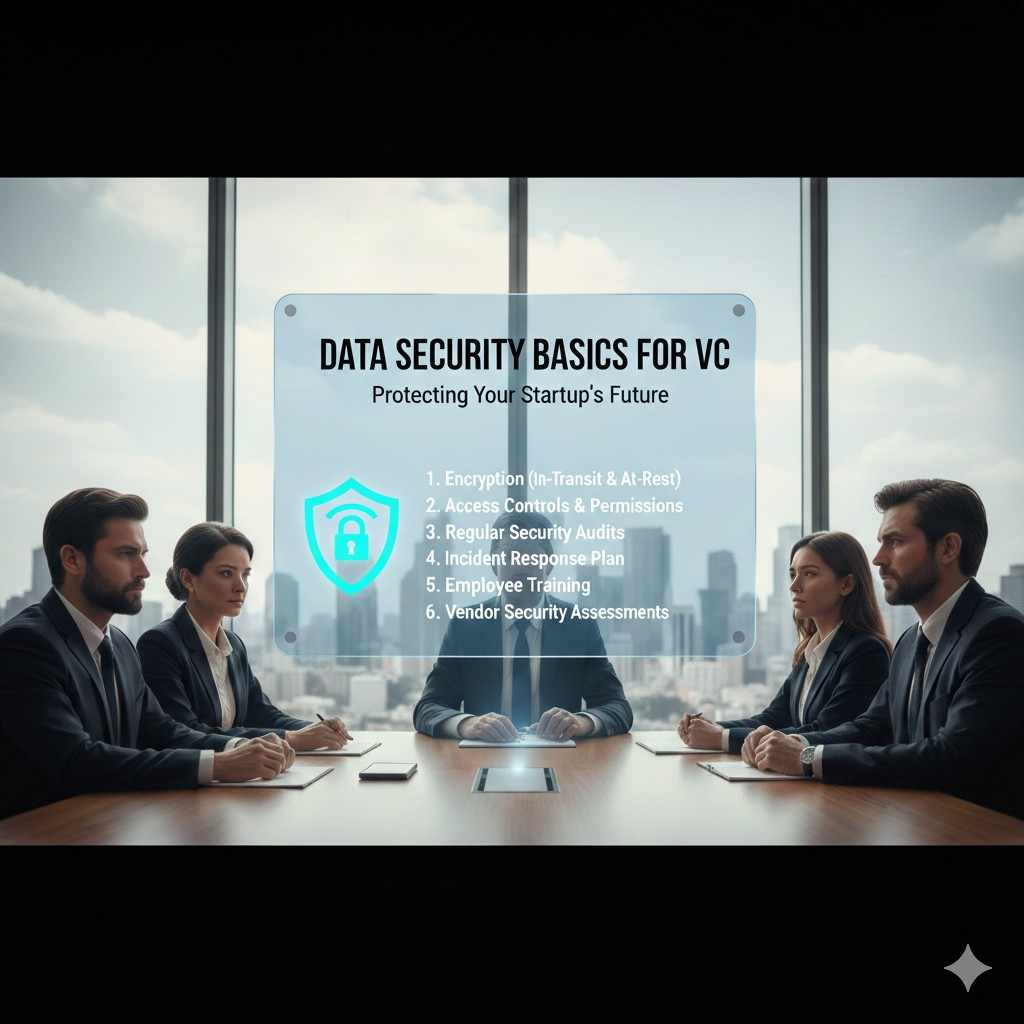
At seed stage, “data security” is not a big document. It is a set of daily controls that prevent your company from making a small mistake that becomes a big incident.
In plain terms, data security is:
- Knowing what data you have
- Knowing where it lives
- Limiting who can touch it
- Keeping a record of what happened
- Being able to recover when something breaks
That’s it. If you can do those five things with discipline, you will clear most early diligence hurdles. And you will sleep better.
But first, you need to understand what investors mean by “data.” They do not only mean customer names and emails. For deep tech teams, investors also care about:
- Your code and build pipeline
- Your model weights and model checkpoints
- Your training sets, labels, prompts, and fine-tuning files
- Your robotics telemetry and sensor logs
- Your product specs, test results, and lab notes
- Your patentable invention details (the stuff you do not want on the internet)
That last one is important. If invention details leak before you file, it can hurt patent strategy. That is a real reason Tran.vc pushes founders to treat IP like an asset from day one. If you want help turning your inventions into protected IP, apply anytime at https://www.tran.vc/apply-now-form/
The most common reason startups fail security diligence
It is not “they got hacked.” Most early-stage teams have never been hacked in a dramatic way. The common reason is simpler: they cannot answer basic questions quickly.
An investor, or a security person working for the investor, asks:
- Where is customer data stored?
- Who has admin access?
- Do you encrypt data at rest and in transit?
- What happens when an employee leaves?
- Do you have logs? For how long?
- Do you have backups? Have you tested restore?
- Do you use SSO? Do you enforce MFA?
If you say “I think so” too many times, your deal slows down.
So VC readiness is about being able to answer with clarity. If you do not know, that is fine. But you must have a plan, and you must show you are actively improving.
The mindset shift is this: security is not a feature. It is a way of operating.
Start with an honest map of your data

Before you buy tools, you need a clear map. A simple map wins more diligence points than a pile of software nobody uses.
Here is what “map” means in practice.
Open a doc. Title it: “Data Map v1.” Then write down, in plain words:
- What data do we collect?
- Where does it come from?
- Where do we store it?
- Who can access it?
- How do we delete it?
- How do we back it up?
Do not overthink it. You are not writing a compliance manual. You are building shared truth inside your team.
For many startups, the answers look like this:
You collect product usage data from your app. You store it in a cloud database. You send some events to an analytics tool. You store logs in a logging platform. You use a customer support tool that contains user emails and chat transcripts. You use a payment provider. You store internal docs in Google Drive or Notion. You store code in GitHub. You store training data in cloud buckets.
That is already a lot. And that is exactly why mapping matters. Most early incidents happen in the gaps, like “we forgot that bucket existed,” or “we forgot that old contractor still has access.”
When investors see a startup with a clear data map, it signals leadership. It says: this team knows what it is doing.
Classify data in a way your team will actually follow
Security frameworks love complex labels. Startups do not have time for that.
Instead, pick three simple buckets:
- Public: fine if shared
- Internal: only for the team
- Sensitive: would hurt us or customers if leaked
Now apply those buckets to the data map.
Your marketing site content is Public. Your internal roadmap is Internal. Your customer list is Sensitive. Your private keys are Sensitive. Your patent drafts are Sensitive. Your model weights may be Sensitive, depending on your business.
This tiny step changes behavior. It makes decisions clearer. It reduces “should we put this in a shared doc?” debates.
Also, it helps IP work. Sensitive invention details should not float around in random chats. If you are building something novel, tighten the flow. If you want help building an IP plan that matches how you build, Tran.vc can help. Apply anytime at https://www.tran.vc/apply-now-form/
Access control: the simplest way to look mature fast

If I had to pick one area that gives the biggest VC-readiness boost per hour, it is access control. This is where a lot of startups look sloppy without realizing it.
Here is the goal: the right people have the right access for the right time, and nothing more.
Investors like to see these habits:
You use one central identity system, and you turn on MFA for everyone. You do not share accounts. You remove access quickly when someone leaves. You avoid “everyone is admin” in cloud tools. You separate personal and work accounts.
Let’s make this concrete.
1) Enforce MFA everywhere
MFA is not optional anymore. Not for email. Not for GitHub. Not for your cloud provider. Not for your password manager.
If a single account gets compromised, the attacker often moves sideways. They look for credentials in old docs. They search Slack for “key.” They look for cloud console access. MFA blocks most of the easy attacks.
This is not theory. This is what happens.
Make it a rule: no MFA, no access.
2) Use SSO when it makes sense

Single sign-on sounds “enterprise.” But for startups, it is a control lever.
If you use Google Workspace, you already have a core identity provider. Many tools let you sign in with Google. Use it.
Why? Because when an employee leaves, you disable one account, and access drops everywhere. That is a strong signal in diligence. It also prevents the awkward situation where a former contractor still has access to your customer support tool six months later.
3) Remove access the same day someone leaves
This is one of the most common diligence gaps: offboarding is slow or informal.
Make a simple offboarding routine. Not a long checklist. Just a rule:
The same day someone leaves, you do three things:
- Disable their main email and SSO
- Remove them from GitHub and cloud accounts
- Transfer ownership of any key assets (repos, docs, dashboards)
If you do only that, you are ahead of many startups.
4) Stop using shared passwords

Shared logins are a trap. They feel fast. They create blind spots.
If you need shared access, use role-based access, or a password manager with shared vaults and audit logs.
This also matters for fundraising. When an investor asks “who has access to production?” and you say “we all use the same login,” that is a red flag.
Encrypt the right things in the right way
Encryption can get technical, but the core idea is simple: make data hard to read if it gets stolen.
Two places matter:
Data in transit: when data moves between systems. This should be protected with HTTPS/TLS. Most modern platforms do this by default. Your job is to not break it. Do not allow plain HTTP. Do not allow old insecure ciphers if you can help it.
Data at rest: when data sits in a database, disk, or storage bucket. Many cloud services encrypt by default. Still, you must confirm it. And you must handle keys with care.
Here is how investors often think about it:
If your database was copied tomorrow, could someone read it easily?
If your storage bucket leaked, could someone download sensitive files without detection?
If your backups were exposed, would they be protected?
You do not need to implement your own crypto. Please do not. Use managed services. Use cloud defaults. But verify, document, and enforce.
A simple move that helps: in your “Data Map v1” doc, add one line for each store: “Encrypted at rest? Yes/No.” and “Encrypted in transit? Yes/No.” If you do not know, write “Unknown” and assign it to someone.
That is what maturity looks like: you see the gap, you track it, you close it.
Secrets: where startups quietly lose control

If you want to find the highest risk area in a typical early-stage startup, it is secrets.
Secrets include API keys, private keys, tokens, database passwords, service account credentials, signing certificates, and webhook secrets. It also includes your OpenAI keys, cloud credentials, and anything that can be used to access infrastructure.
Startups leak secrets in three ways:
- They put keys in code
- They paste keys in Slack or email
- They store keys in docs that are shared too widely
The fix is not complicated, but it must be consistent.
You want three outcomes:
- Secrets never live in source code
- Secrets are stored in one secure place
- Secrets can be rotated without pain
If you use AWS, GCP, or Azure, use their secret tools or environment variable systems. If you do not, use a dedicated secrets manager. At minimum, use a password manager for early-stage.
Also, set a habit: whenever a key is pasted anywhere, treat it as burned. Rotate it. Assume it is exposed.
This is also where a lot of AI startups get caught. They ship with a single API key that has wide permissions. That is risky. A stolen key can run up cost, leak data, or access model endpoints.
Logging: the proof that you are not blind
Diligence teams love logs because logs prove control.
Without logs, you cannot answer questions like:
- Who accessed this record?
- When did this setting change?
- Did anyone download a full dataset?
- Did we have unusual login activity?
At seed stage, you do not need perfect logs. You need enough to detect basic issues and show you can investigate.
Start here:
Make sure you have logs for:
- Cloud account access (admin actions)
- Production database access (at least at the system level)
- Application errors and auth events
- Changes to IAM and permissions
Then, set retention. Many startups keep logs for a week because the default is cheap. Investors often want longer. A common simple target is 30 days to start, then 90 days as you scale. Choose what you can afford, but do not leave it as a mystery.
Most important: make sure someone on the team knows how to find the logs during an incident. Tools do not matter if nobody can use them under stress.
Backups: the part everyone assumes they have

Many teams say “we have backups.” Fewer have tested restore.
For VC readiness, the key is not the backup itself. It is the ability to recover.
Ask yourself:
If our production database was deleted today, could we restore it? How long would it take?
You want an answer you can say out loud.
Also, make sure backups are protected. A backup that an attacker can delete is not a backup. A backup stored in the same system with the same credentials is fragile.
You do not need to build a complex disaster recovery program. But you should do one restore test, even if it is into a staging environment. Write down the steps. That alone makes you look far more serious.
“Least privilege” without making your team slow
Security advice often sounds like “lock everything down.” That can kill speed if done badly.
The better approach is “least privilege” in layers.
For example:
- Most people do not need production database access.
- Many people do not need admin access to cloud accounts.
- Contractors should not have access to core IP docs unless required.
- A dev environment should not contain real customer data.
You can still move fast with clear boundaries.
A simple pattern:
Keep production access small. Keep everyone else in staging. When someone needs access, grant it for a reason, and review it later.
In diligence, investors do not expect zero production access across the team. But they do expect you to have thought about it.
Secure development: the minimum that signals maturity
You do not need to turn into a compliance company. But investors will look at how you build.
These are the basics that help:
You use private repos. You require code review for core services. You protect the main branch. You have some form of dependency scanning (even basic). You patch critical issues when you learn about them. You do not ship secrets in code.
Also, treat your CI/CD pipeline as production. If someone gets access to your build system, they can ship malicious code.
So lock down:
- Who can change build configs
- Who can approve deploys
- Where build secrets are stored
Even if you are only three people, this matters.
Customer data: reduce what you collect
One of the simplest ways to improve security is to collect less.
If you do not need a field, do not collect it. If you do not need to keep raw logs forever, set a deletion window. If you can store hashed or tokenized values instead of raw values, do it.
Investors like this because it reduces risk. It also helps compliance later.
This is especially true for AI systems. Training data is a magnet for risk. If you are collecting user content, you must be clear about:
- what you store
- how long you keep it
- who can use it
- whether it can be used for training
Even if you are not ready for formal certifications, your internal clarity matters.
The “security story” you will tell in diligence
Investors do not only want controls. They want a coherent story.
You want to be able to say:
“We know what data we have and where it lives. We classify it. We limit access. We use MFA and SSO. We log key actions. We back up and test restore. We rotate secrets. We review access when roles change.”
That is the story. It is calm. It is credible. It reduces fear.
And it pairs well with an IP story. If you can say: “We also protect invention details and file patents early to build a moat,” that shows you understand defense from both sides: legal defense and operational defense.
That is exactly the approach Tran.vc is built around: helping technical founders build defensible companies early, with $50,000 of in-kind patent and IP services so your core work becomes an asset investors respect. If you want that support, apply anytime at https://www.tran.vc/apply-now-form/
Build a Simple Security Policy That People Will Follow
Make the policy match how you work
A policy only helps if it fits your real day. If your team ships fast, your policy must support that speed, not fight it. Think of it as “how we do things here,” written down in clear words.
Investors do not expect a long handbook at seed stage. They do expect consistency. They want to see that your team has a shared way to handle access, data, and incidents.
Write it like you are explaining it to a new hire on their first day. Simple words. Clear rules. No legal tone.
Start with five rules that cover most risk
Your first version can be short and still be strong. What matters is that it covers the places where startups usually slip. This is often enough to make diligence feel smooth.
One rule should cover accounts and logins. One should cover devices. One should cover data handling. One should cover code and deployments. One should cover what to do when something looks wrong.
When you keep the rules tight, people remember them. And when people remember them, they follow them.