
You are about to build something hard. That means you will bring in co-founders, early hires, maybe advisors, and later, investors. At some point, you will offer equity. And the moment you do, one quiet detail will shape your company more than most people expect: vesting.
Vesting is not “legal paperwork.” It is a fairness system. It is a safety belt. It is also a way to avoid ugly founder breakups that can freeze a company at the worst possible time.
If you are building in AI, robotics, or deep tech, vesting matters even more. These companies take time. Progress can look slow at first, even when the work is real. You need a structure that keeps everyone aligned for the long haul, without trapping anyone in a bad situation.
And while we are here: if you are building real tech that could be copied, you should protect it early. Tran.vc helps founders do that by investing up to $50,000 in in-kind patent and IP services so your hard work turns into assets. You can apply anytime at https://www.tran.vc/apply-now-form/.
Now let’s make vesting simple.
What vesting really means (in plain words)

When someone gets equity in a startup, vesting means they do not fully own it on day one. They earn it over time.
Think of it like this: you are not paying for time already spent. You are paying for the future work that still needs to happen.
That future work is the hard part. Shipping the first version. Fixing the first big failure. Hearing “no” from customers. Hiring your first team. Surviving the first real cash crunch. These are the moments where a company either grows up or falls apart.
Vesting is how you make sure the people who stay and do the work get the reward.
Without vesting, equity can end up in the hands of someone who leaves early. Then you have a problem that does not go away. That equity stays out there. It can block funding. It can hurt morale. And it can make the rest of the team feel like they are carrying someone who walked away.
That is why vesting is normal. It is not a sign of distrust. It is a sign of being serious.
The most common vesting schedule founders use
Most startups use a four-year vesting schedule with a one-year cliff.
Those words sound heavy. They are not.
“Four-year vesting” means the equity is earned over four years.
“A one-year cliff” means nothing is earned until the person completes one full year. After that first year, a chunk vests all at once. Then it vests in small pieces over the remaining three years, often monthly.
So in a very typical setup, if someone is granted 4% equity:
- At 12 months, they might earn 1% all at once.
- Then they earn the remaining 3% slowly over the next 36 months.
If they leave at 10 months, they keep 0%. If they leave at 18 months, they keep what vested at month 12 plus the extra that vested from months 13–18.
This is designed to solve a common startup problem: people join with strong hope, then reality hits. The cliff gives both sides a real trial period. If it is not working, the company is not stuck giving away equity for a short attempt.
Why vesting is especially important for co-founders
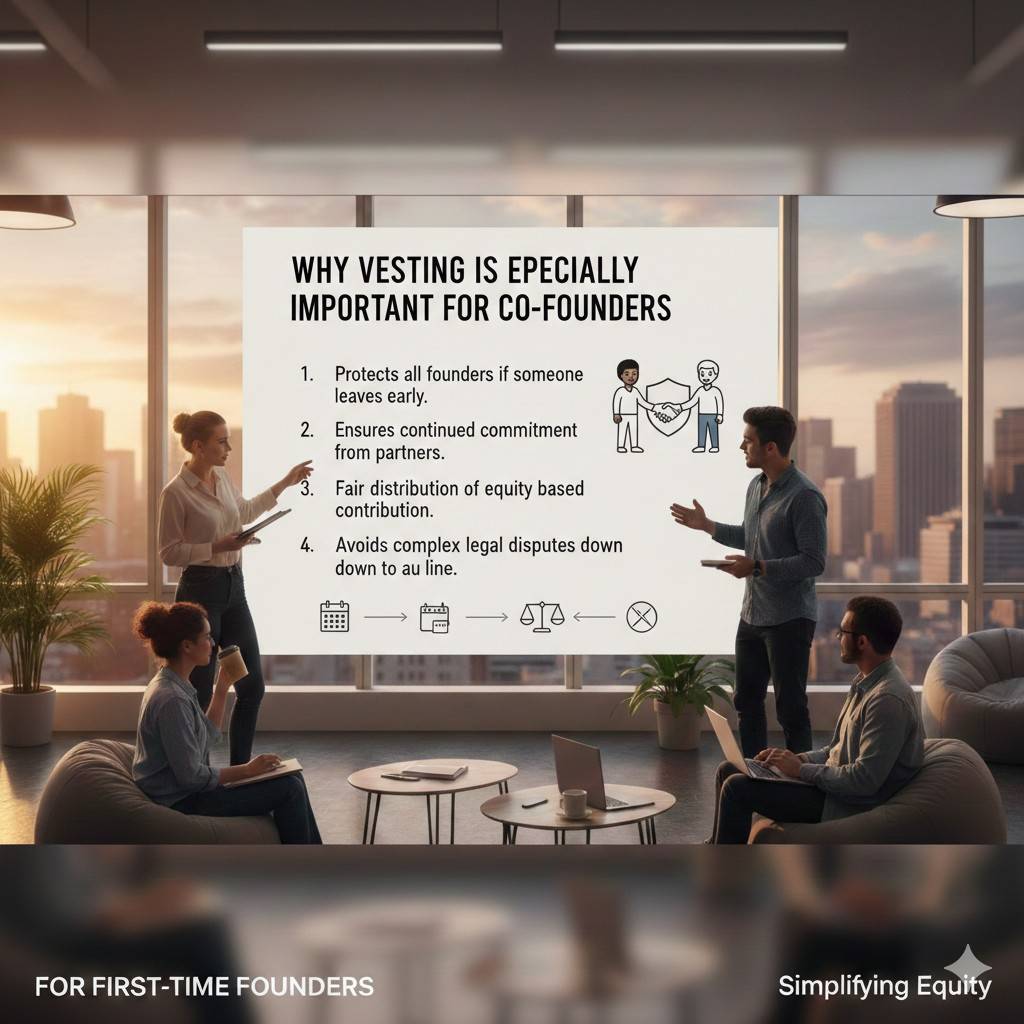
First-time founders often think vesting is only for employees. It is not. It is critical for founders too.
Founders are humans. Life happens. Burnout happens. Big disagreements happen. Sometimes one founder wants to keep going and the other does not. Sometimes a founder is doing less than promised. Sometimes someone needs to step away for personal reasons. You can be kind and still protect the company.
Founder vesting is how you do both.
If two founders split the company 50/50 on day one with no vesting, and one leaves after six months, the company is now trapped. The remaining founder is trying to build the whole thing while the person who left owns half. Investors hate that. Future hires hate that. It is hard to fix later without conflict.
With founder vesting, the company can buy back the unvested shares when someone leaves. That lets the cap table stay healthy. It also gives the remaining team room to hire and reward people who actually stay.
So if you are a founder reading this and you do not have vesting, it is worth treating as urgent.
How vesting works with “buyback” and why that word matters
Here is the part many founders misunderstand.
When a company grants shares to a founder or early employee, often those shares are issued up front. The person signs an agreement that says: the company has the right to buy back the unvested shares if the person leaves.
That is vesting in real life. It is not just a calendar. It is a legal right.
This is why founders often file an “83(b)” election in the U.S. when they receive restricted stock. It can help with taxes, because you are choosing to be taxed as if you received the shares now rather than later. This is a big topic, and you should talk to a tax pro, but the key point is: vesting shows up in your documents, not just your spreadsheet.
And if you are building deep tech, remember: equity is only one side of your foundation. The other side is your IP. If you are creating new algorithms, robotics systems, or novel models, you want to protect those inventions early while the story is clean and the founders are still in sync. Tran.vc was built for that stage, and you can apply anytime at https://www.tran.vc/apply-now-form/.
The cliff: why one year is common and when it should change
A one-year cliff is common because it matches how long it takes to know if someone is truly committed and effective.
In many startups, the first year is where the “idea energy” turns into “execution energy.” It is where the work becomes less fun. You learn whether someone can operate under stress, take feedback, and keep going when things are unclear.
But the cliff is not sacred. It is a tool.
Sometimes a shorter cliff makes sense. If you are hiring a very senior person to fix a very specific problem in six months, a one-year cliff may feel unfair. In that case you might use a shorter cliff, or even a different structure like milestone vesting. That said, be careful: milestone vesting can cause fights about whether a milestone was truly met. Time-based vesting is simple and avoids arguments.
Sometimes a longer cliff is used for advisors or part-time roles, because the relationship is less intense and takes longer to evaluate.
What matters is that the cliff matches the reality of the role. The more you expect someone to be in the trenches, the more a standard cliff makes sense.
Monthly vesting: why it feels boring and why that is good
After the cliff, most vesting happens monthly. Some older plans used quarterly. Monthly is now common because it is smooth.
Smooth vesting reduces drama. It avoids big jumps. It makes it easier to model dilution and ownership. It also makes it easier for someone to leave without feeling like they must stay an extra few months just to hit a large vesting event.
Boring is good here. You want vesting to be a quiet background system. Not something that creates constant pressure.
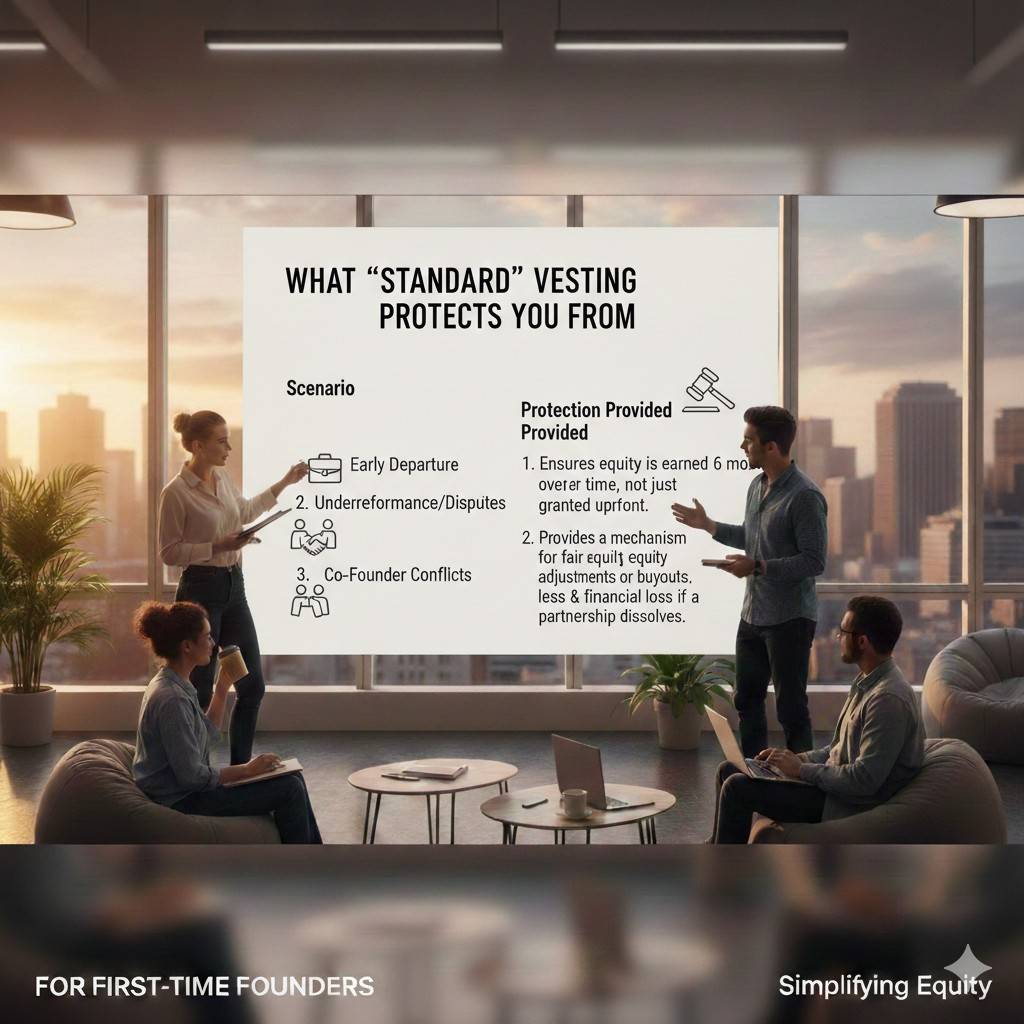
What “standard” vesting protects you from

Let’s get very practical. Vesting protects you from four painful situations that happen all the time.
The first is the early exit. Someone leaves right after you give them a meaningful equity slice. Without vesting, the company loses a piece of itself for little return.
The second is the slow fade. A person does not quit, but stops producing. They still “own” a large chunk even though the team is doing the work without them. Vesting does not fully solve this, but it gives you a window early on. If performance is off, you can address it before most equity vests.
The third is the messy founder breakup. This one can destroy companies. Vesting makes it easier to separate while keeping the company alive.
The fourth is fundraising friction. Investors want to see that key people are still earning their equity. It signals commitment. It also keeps more equity available for future hiring, which investors care about because talent is expensive.
How vesting connects to hiring, morale, and your ability to raise
Founders often treat vesting as a legal step and then never revisit it. But vesting is part of your talent strategy.
If your company gives equity with no vesting or weird vesting, strong candidates will notice. Serious early employees want to join companies that operate like real startups. They want to know the cap table is not broken. They want to know a former founder is not sitting on 40% while doing nothing.
Also, vesting creates a shared timeline. In the early years, when you do not have big salaries, the equity promise is part of the pay. Vesting sets the expectation: we are building together, over time.
This is also where your IP story matters. For AI and robotics, a strong IP foundation can make hiring easier too. Great engineers like working on real invention, not commodity features. If you show that you protect inventions and treat them as assets, you attract a different kind of builder. Tran.vc exists to help with that foundation, and you can apply anytime at https://www.tran.vc/apply-now-form/.
“But I already earned this”: the mindset shift founders need
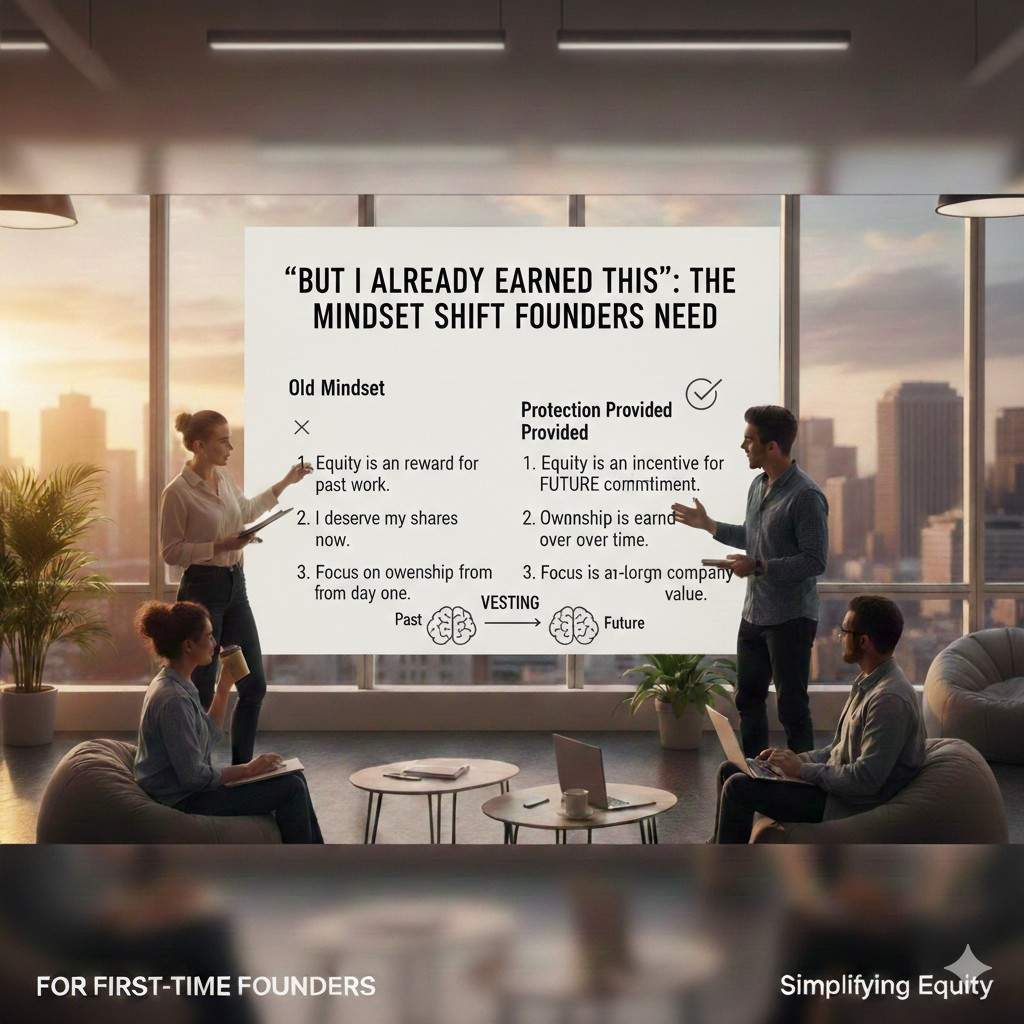
A common emotional reaction to vesting is: “I put in months already. Why should I vest over time?”
That is a normal feeling, especially if you are the one who started the work first.
But equity is not a back-pay bonus. It is a claim on the future value of the company. And that future value only exists if you keep building.
Vesting is simply making the deal match the truth: you get rewarded if you stay long enough to create the value.
This is also why many startups include “reverse vesting” for founders. The shares are issued now, but the company can buy back what is not earned if you leave. You still feel like a real owner. But the company is protected.
How vesting interacts with options vs. stock
This part confuses many first-time founders, so let’s keep it simple.
Founders often receive stock (common shares) early.
Employees often receive options (the right to buy shares later at a set price).
Both can vest. The schedule is the same idea: ownership is earned over time.
Options have extra details like the “exercise price” and a window after leaving the company to exercise. Those details matter a lot, but they are separate from vesting itself.
The key point: do not assume vesting only applies to one type of equity. It applies to both.
A simple way to sanity-check your vesting setup

If you do not know whether your vesting schedule makes sense, run one mental test:
Imagine your co-founder leaves in 9 months. Are you okay with what they keep?
Now imagine they leave in 18 months. Are you okay with what they keep?
Now imagine they leave in 3 years. Are you okay with what they keep?
If the answer feels wrong at any of those points, your schedule needs work.
This test is powerful because it forces you to see the future, not just today.
The biggest vesting mistakes first-time founders make
One big mistake is skipping founder vesting because it feels awkward. Many founders fear the conversation. They think it signals distrust.
In reality, the opposite is true. Having the vesting talk early signals maturity. It prevents resentment later because expectations are clear.
Another mistake is giving out equity promises in casual conversations. A founder says, “We’ll give you 2%,” without defining vesting, cliffs, or what happens if the person leaves. Later, when the paperwork shows a cliff and four-year vesting, the person feels tricked. That creates distrust.
A third mistake is over-granting too early. Equity is a limited resource. Deep tech teams often need more key hires over time than they expect. If you give away too much in the first six months, you may have nothing left to attract the people you need in year two.
And a fourth mistake is ignoring IP ownership. This is not vesting, but it is tied to equity in a painful way. If a co-founder leaves and they also claim they own parts of the code or inventions, the company can become uninvestable. This is why clean invention assignment agreements and early patent strategy matter. Tran.vc helps solve this early by investing in patent and IP services, so the company is not fragile later. Apply anytime at https://www.tran.vc/apply-now-form/.
Setting up vesting for real life
Start with what you are trying to protect

Vesting is not there to make anyone feel small. It is there to protect the company from the moments you cannot predict today.
A startup is fragile in the early days. One person leaving can change everything. One fight can stop progress. One messy equity story can scare away a great hire or a serious investor.
So your first job is to be clear on the risk. You are protecting the team that stays. You are protecting future hiring. You are protecting the ability to raise money when the timing is right.
The simplest vesting setup that works for most founders
If you do not want to overthink it, the standard setup still works for most startups.
Four years with a one-year cliff is common because it matches how long the company needs to become real. The first year shows who can do the hard work. The next three years reward staying and building through change.
This setup is also familiar to investors and lawyers. Familiar is helpful. It reduces “extra questions” at the exact time you do not want extra friction.
When “standard” is not the best fit
Sometimes the standard schedule does not match your situation. That is fine, but the reason needs to be clear.
If a person is joining for a short, high-impact mission, time-based vesting can feel too slow. If a person is joining in a part-time role, a one-year cliff can feel too fast or too harsh.
The goal is not to be clever. The goal is to create a fair trade between ownership and long-term contribution, without building a system that becomes an argument later.
Founder vesting without awkwardness
Why founder vesting is a sign of trust, not doubt
Many first-time founders avoid the founder vesting conversation because they fear it will offend the other person.
In practice, strong co-founders expect it. They want to know the company will not get trapped if life changes. They want to know the cap table will stay clean so the company can hire and raise later.
When you frame it as protection for both sides, the tone changes. It becomes a shared safety plan, not a test of loyalty.
How to talk about it with a co-founder
The best time to talk about vesting is when everything still feels friendly. That is when you can be calm and fair.
You can explain it as a simple promise: “If we both stay and build, we both earn what we agreed. If one of us leaves early, the company has a way to move forward without bitterness.”
When people understand that vesting prevents a future crisis, they usually support it.
Reverse vesting in plain language
Founders often use a setup called reverse vesting. The name sounds odd, but the idea is simple.
The shares may be issued to the founder upfront. At the same time, the company keeps the right to buy back the unearned portion if the founder leaves. Over time, that buyback right fades as the shares vest.
This matters because founders often need to show ownership right away, but the company still needs protection if someone steps away early.
The core terms you will see in vesting documents
Cliff
A cliff is the “first checkpoint.” Before the cliff date, nothing vests.
In most cases, the cliff is one year. If someone leaves before that year is complete, they keep none of the equity tied to that vesting schedule.
The cliff reduces early mistakes. It protects the company from giving away ownership to a relationship that was never truly tested under real startup pressure.
Vesting frequency
After the cliff, vesting usually happens monthly. This means the person earns a small portion each month.
Monthly vesting is popular because it is smooth and predictable. It also reduces gamesmanship, like someone trying to stay just long enough to hit a large quarterly vest.
The goal is to avoid sharp emotional moments. Equity should feel steady, not like a cliffhanger.
Repurchase right
This is the legal engine behind vesting, especially for founders with restricted stock.
A repurchase right means the company can buy back the unvested shares if the person leaves. It is how the schedule becomes enforceable.
Without this, vesting can become a spreadsheet idea that does not hold up when things get tense.
What happens when someone leaves
In a normal setup, the person keeps what vested and gives up what did not. That is the entire logic.
If a founder or employee leaves early, the company does not lose the ability to reward the people who stay. The unused equity can be put back into the pool for future hires or retained for future fundraising needs.
This is one reason investors like vesting. It shows you have planned for the messy parts of reality.
Acceleration and why it can be helpful
What acceleration means
Acceleration changes the vesting timeline if a specific event happens.
The most common event is a company sale. If the company gets acquired, acceleration can allow some or all unvested equity to vest early.
This is meant to protect people who helped build the company but would otherwise lose future vesting because the job changes after an acquisition.
Single-trigger acceleration
Single-trigger means vesting accelerates just because the company is sold.
This can sound fair, but it can also make acquirers nervous. An acquirer often wants the key team to stay after the deal. If everything vests immediately at the sale, the retention hook is gone.
That does not mean single-trigger is always wrong. It means you should understand the trade before you agree to it.
Double-trigger acceleration
Double-trigger means two things must happen for acceleration to kick in.
The company is sold, and the person is also terminated or their role is reduced in a meaningful way within a set time window.
Double-trigger is common because it balances fairness and retention. The team is protected if they lose their role, but the acquirer still has a reason to keep the team engaged.
This structure tends to feel more reasonable to investors and buyers because it is tied to real harm, not just the sale itself.
“Good leaver” and “bad leaver” ideas
Why these labels exist
Some agreements try to define different outcomes based on why someone left.
A “good leaver” might be someone who left due to health issues, family emergencies, or other approved reasons. A “bad leaver” might be someone who was fired for cause, harmed the company, or violated key agreements.
The intent is to protect the company from someone acting in bad faith, while still being humane to someone who had a real life event.
Why you should be cautious with this
These labels can create conflict if the definition is vague.
If the company and the person disagree about what happened, you now have a fight about labels, not a clean process. That is why many early startups keep it simple and rely on standard vesting and standard termination terms.
If you do use these ideas, clarity matters more than cleverness. A simple and clear agreement is usually safer than a detailed one that invites argument.
How to set vesting for early employees
Why early hires are different from later hires
In the earliest stage, you are not only hiring skills. You are hiring belief.
Early employees take more risk. They join before the company has proof. They may accept a lower salary. They may work through chaos.
Because of that, equity is often a key part of the deal. Vesting makes sure the equity goes to people who stay through the messy years, not just the exciting first months.
How to avoid the most common employee equity mistake
The most common mistake is promising a number without defining the terms.
If you say “we will give you 1%,” the person hears “I will own 1%.” If you later present “1% subject to four-year vesting with a one-year cliff,” they may feel misled.
A better approach is to speak in full terms from the start. Explain that equity vests over time, and that this is normal. When you do this early, the relationship starts with clarity, not confusion.
Post-termination exercise windows
This is not vesting, but it often shows up in the same conversations.
If employees receive options, they usually have a limited time after leaving the company to exercise those options. Many plans use a short window, like 90 days. Some startups extend it, but that can affect taxes and plan design.
This area can become emotional because people can lose the chance to exercise if they do not have cash. It is worth thinking about early, especially if you want to be founder-friendly and employee-friendly at the same time.
Advisor vesting and why it needs its own logic
Advisors should not vest like full-time builders
Advisors often meet you once a month or once a quarter. They are not in the trenches.
That does not mean they are not valuable. A strong advisor can change your hiring, your strategy, and your fundraising path. But the time and risk are different, so the equity logic should be different too.
Many startups use shorter schedules for advisors, sometimes with cliffs that match the expected trial period. The key is that the agreement should reflect real involvement, not a hopeful title.
Avoid “big equity for a famous name” deals
First-time founders sometimes give away too much for a brand name advisor.
A famous name can look good on a slide, but it does not build product, close customers, or ship hardware. If the person is not actively helping, the equity becomes dead weight.
A cleaner approach is to start small and expand only if the advisor proves real value over time.
Vesting and fundraising: what investors look for
Investors want to see commitment and flexibility
When investors review your cap table, they are scanning for two things.
They want to see that the key builders are tied to the company long enough to execute the next stage. Vesting helps show that.
They also want to see that you have enough equity available to hire the team you will need. If early grants were too large or not structured well, your hiring options get smaller, and that can weaken your story.
Founder equity that is fully vested too early can be a red flag
If a founder owns a very large stake that is fully earned very early, investors may worry.
They may wonder if the founder can walk away with a big share while the rest of the team does the work. Even if you would never do that, investors think in risk terms.
A vesting schedule is a simple way to remove that worry before it ever becomes a question.
Vesting ties into your moat and your leverage
Equity is one lever. IP is another lever.
If you are building in AI or robotics, your moat is often tied to technical inventions that can be protected. When you combine clean vesting with strong IP ownership, your company looks more serious and more durable.
Tran.vc helps founders build that foundation early by investing up to $50,000 in in-kind patenting and IP services. If you want to build real protection around what you are creating, you can apply anytime at https://www.tran.vc/apply-now-form/.