
Most founders hit this question right when things start to feel real.
You have an idea that won’t leave you alone. Maybe you already built a rough demo. Maybe a few people said, “I need this.” Maybe you are about to pull in your first advisor, first contractor, or first pilot customer.
And then it shows up:
“Should I incorporate now… or wait until I validate?”
This is not a legal trivia question. It changes how fast you can move, how safe you are, how clean your ownership is, and how strong your future fundraise looks.
This post will help you make the call with clear thinking and simple steps, without fear, without hype, and without wasting months on the wrong move.
Also, one quick note before we begin: if you are building in AI, robotics, or deep tech, your IP matters early. Tran.vc helps technical founders turn what they are building into real, defensible assets through up to $50,000 in in-kind patent and IP services. If you want to build a moat while you build the product, you can apply anytime here: https://www.tran.vc/apply-now-form/
Now let’s get into it.
What “validation” really means (and why people get stuck)
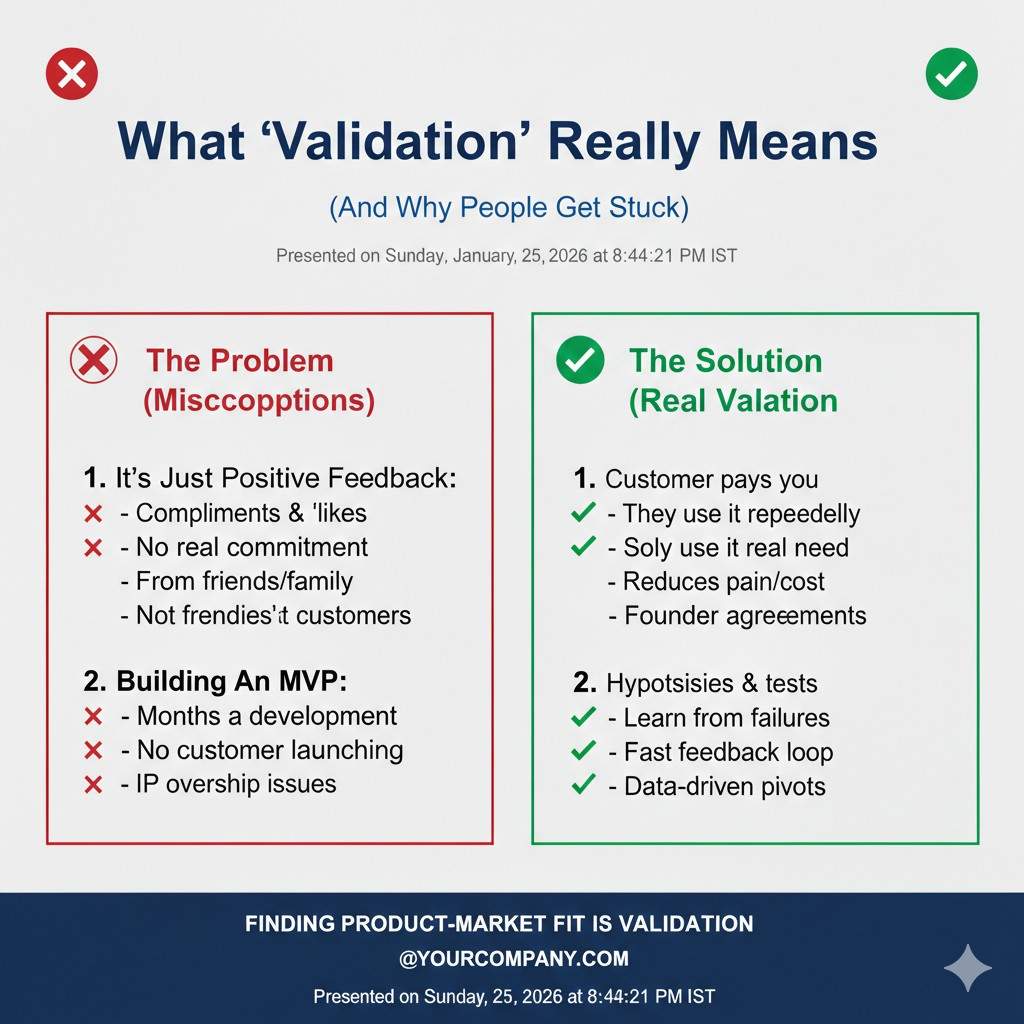
Founders say “I’ll incorporate after validation” all the time. But many do not define validation, so they end up waiting forever.
Validation is not when strangers say, “Cool idea.”
Validation is not a bunch of likes on a post.
Validation is not a friend saying they would use it.
Validation is when risk gets removed.
And there are two kinds of risk you are trying to remove:
Product risk: Are you solving a real problem people will pay to fix?
Company risk: Can you build and deliver it without breaking everything around you?
Most founders only look at product risk. They forget the company risk is also real. And that is where the incorporation choice becomes important.
Because the “company” part shows up earlier than people think.
The moment you do any of these, you are already acting like a company:
You take money, even a small amount.
You sign a pilot.
You hire a contractor.
You bring on a co-founder.
You share code, models, designs, or drawings with anyone outside.
You start building something that could be patented.
So the better question is not “before or after validation?”
The better question is:
“What actions am I about to take, and what could go wrong if I am not incorporated yet?”
Once you ask it like that, the answer becomes clearer.
The real job of incorporation (it is not what most people think)
A lot of founders think incorporation is mostly about looking serious.
It is not.
Incorporation is a tool that does four big jobs:
It sets ownership clearly.
It creates a clean box to hold IP.
It reduces personal risk.
It makes it easier to do deals.
That’s it. That is the core value.
Incorporation does not make your product better.
It does not guarantee investors will care.
It does not create traction.
But it prevents a whole set of painful problems that show up later, right when you are trying to raise money or sign bigger deals.
If you want a simple way to think about it:
Incorporation is not a trophy. It is plumbing.
Good plumbing is boring. But bad plumbing ruins the house.
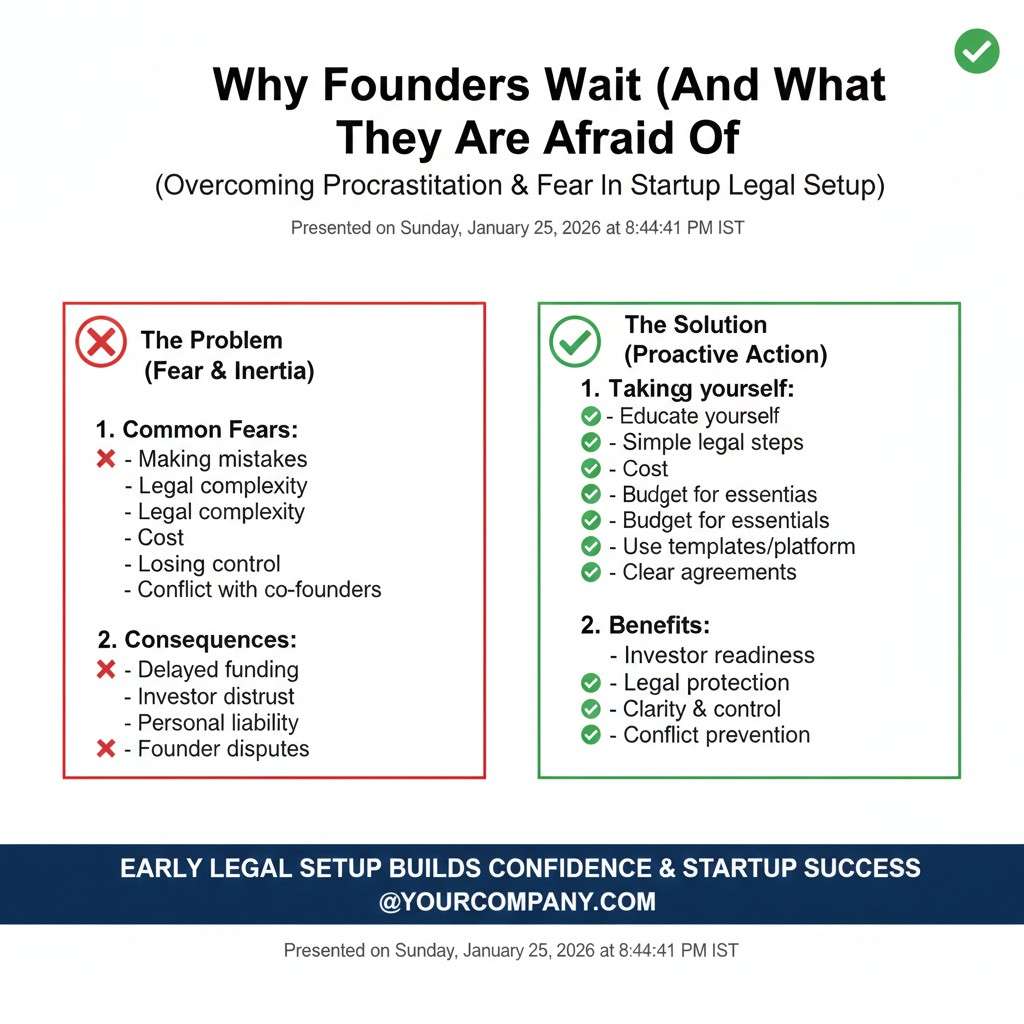
Why founders wait (and what they are afraid of)
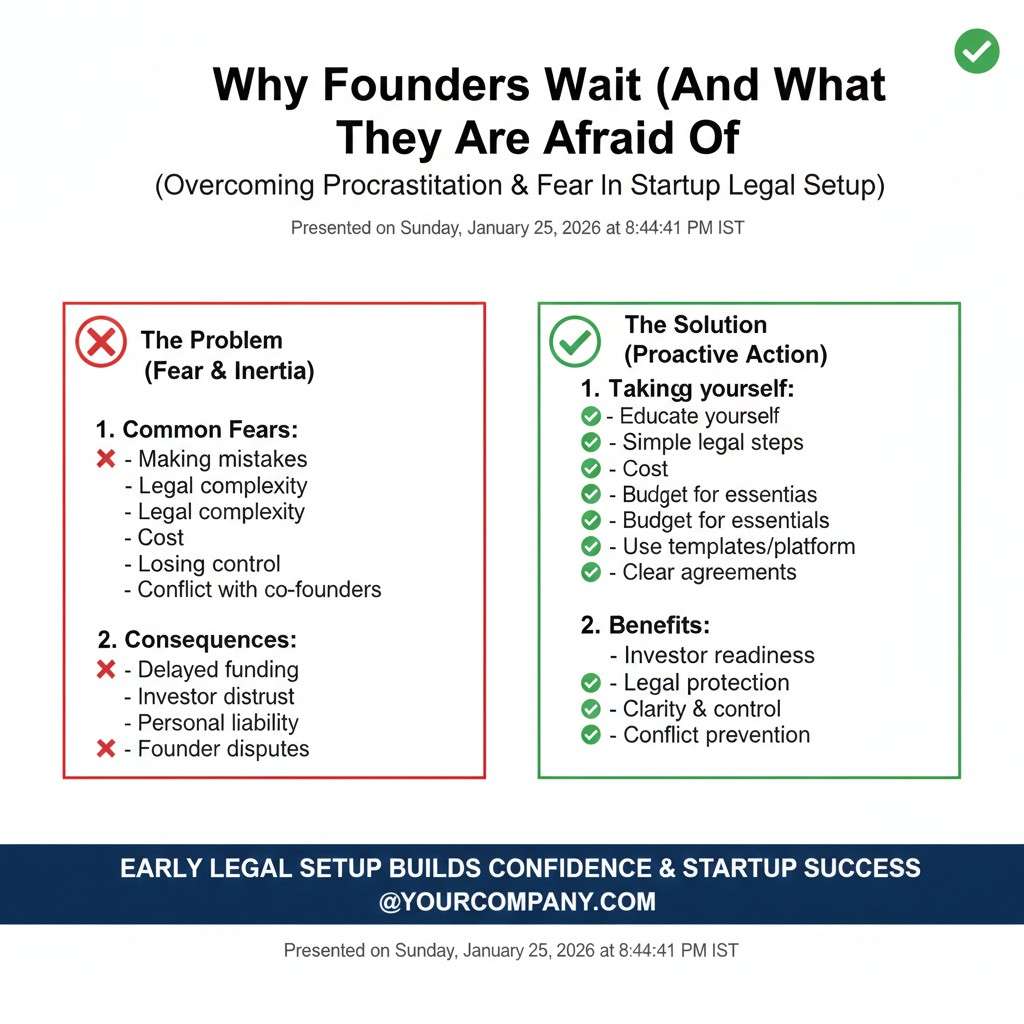
Many technical founders delay incorporation for three reasons.
First, they think it is expensive or complex.
Second, they worry they will pick the wrong structure or state and regret it.
Third, they think incorporating “too early” will create busywork and slow them down.
Those fears are understandable. Some are even true in certain cases.
But there is another reason people do not say out loud:
Incorporation feels like commitment.
Once you incorporate, it can feel like you are telling the world, “I am doing this for real.”
That can be scary.
But the truth is, you can commit without trapping yourself. A company can be formed cleanly and still stay lightweight.
The goal is not to rush. The goal is to avoid avoidable mess.
The hidden cost of “waiting”
Here is the trade most founders miss:
Waiting feels simple today, but it can create cleanup later.
Cleanup later is always harder.
If you delay incorporation while doing real work, you may end up with:
Messy ownership between co-founders.
Contractors who own part of your code.
An advisor who thinks they were promised equity.
A customer who wants to pay you, but cannot because you are not set up.
Personal liability because you signed something in your own name.
IP that is not clearly assigned to the company.
And if you are building AI or robotics, there is one more: early inventions that could have been protected, but were shared too widely too soon.
This is not rare. This is common. It happens to smart people.
And it often shows up right when you want to move fast: a seed round, an accelerator, a big pilot, a strategic partner.
That is the worst time to discover your foundation is shaky.
So the point is not “incorporate early no matter what.”
The point is: if you are doing activities that create lasting risk, waiting is not simpler. It is just pushing the cost forward.
The simple framework: incorporate when you cross one of these lines
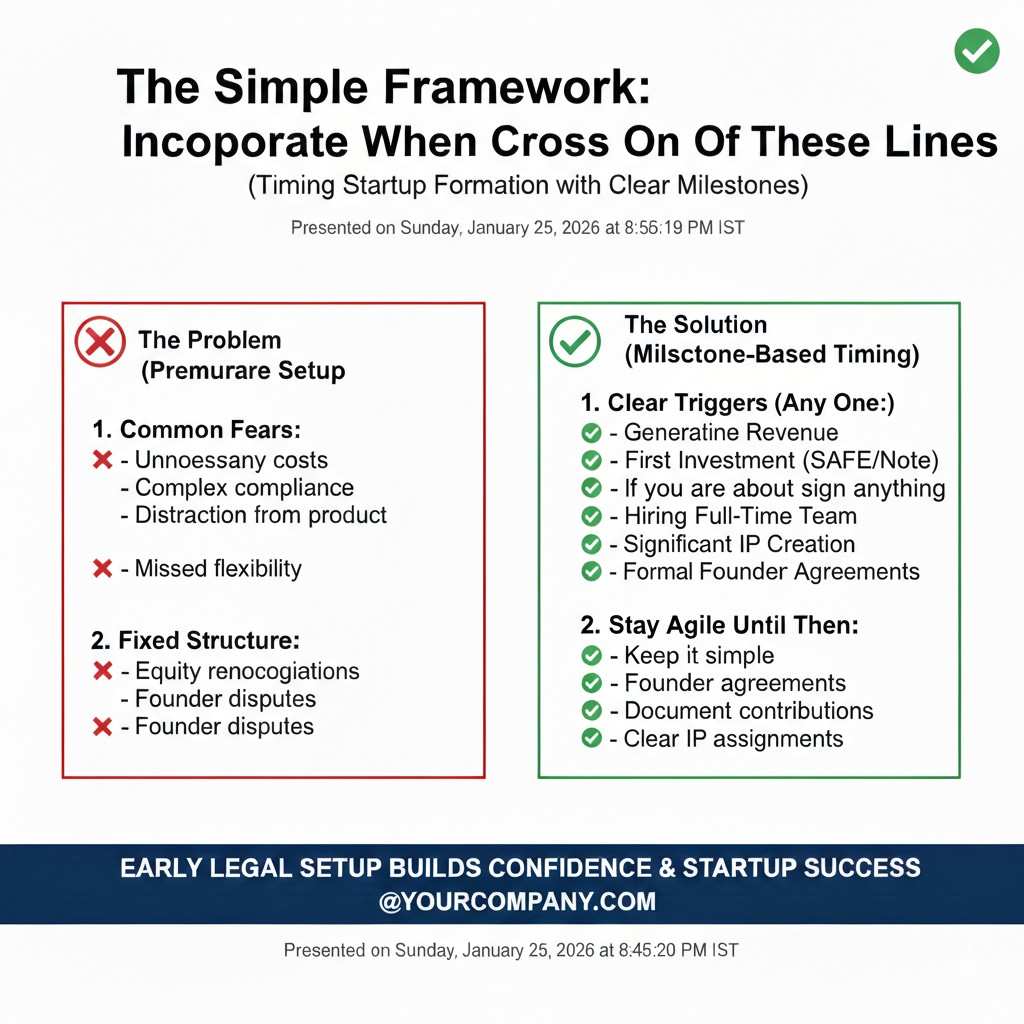
Think of your startup life in two zones.
In the first zone, you are exploring. You are learning. You are trying to find a real problem. You are talking to people. You are sketching, maybe building tiny tests.
In the second zone, you are building the machine. You are making commitments, spending money, signing things, and creating IP.
Incorporation becomes valuable when you enter the second zone.
So here are the lines that matter. If you cross even one, incorporation starts to make sense.
If you have a co-founder (or you are about to)
This is the biggest one.
When two people build together without clear paperwork, they assume they “share it.”
But the world does not run on assumptions.
If you and a co-founder are writing code, designing hardware, training models, or creating data pipelines, you are creating assets.
If you wait too long, you get into awkward questions later:
Who owns what work?
What happened before the company existed?
What if one person leaves?
What if you split the company unevenly later?
The earlier you define ownership, the less painful it is.
Incorporation is not the only way to define ownership, but it is the cleanest way for an actual startup path.
Even if you are still validating, if you are building seriously with a co-founder, you are already beyond “just exploring.”
If you are paying anyone to help you build
Contractors are a common trap.
A contractor can write code for you. They can design circuits. They can help you label data. They can build your UI. They can draft CAD.
If you do not have proper agreements, the contractor may own what they made.
This surprises founders all the time.
They think “I paid, so I own it.”
That is not how it works by default in many places.
A company with clear contractor agreements makes assignment of work much easier and cleaner.
If you are about to pay anyone, especially for core product work, incorporate before the first invoice.
If you are about to take money of any kind
If someone wants to invest, even a small amount, you will need a legal entity.
If someone wants to give you a grant, many programs require an entity.
If a customer wants to prepay, they may require a company.
Money is a line because money creates expectations. Expectations create disputes. Disputes are expensive.
If money is about to move, incorporate.
If you are about to sign anything
Pilots, NDAs, data agreements, software terms, hardware test agreements, joint development notes, supplier deals, leases, even some accelerator forms.
When you sign as a person, you take the risk as a person.
Sometimes that risk is small. Sometimes it is not.
Incorporation helps you sign as a company, and keeps your personal life separate from business risk.
If any contract is coming, incorporate.
If you are building something that is patentable
This is where deep tech founders need to pay extra attention.
Patents are time sensitive in ways most people do not realize.
Public disclosure can hurt your ability to patent, depending on where you file and how you disclose.
Also, patents want clean ownership. If you file a patent and then later move the invention into a company, it can be done, but it can add steps and cost and risk.
If your work is truly novel, and especially if you are building in AI, robotics, sensors, edge compute, autonomy, or new model methods, you should treat IP as part of the product, not a task for later.
This is exactly where Tran.vc helps. They invest up to $50,000 in in-kind patenting and IP services, so you can build your moat early without burning cash. If that sounds like what you need, apply anytime: https://www.tran.vc/apply-now-form/
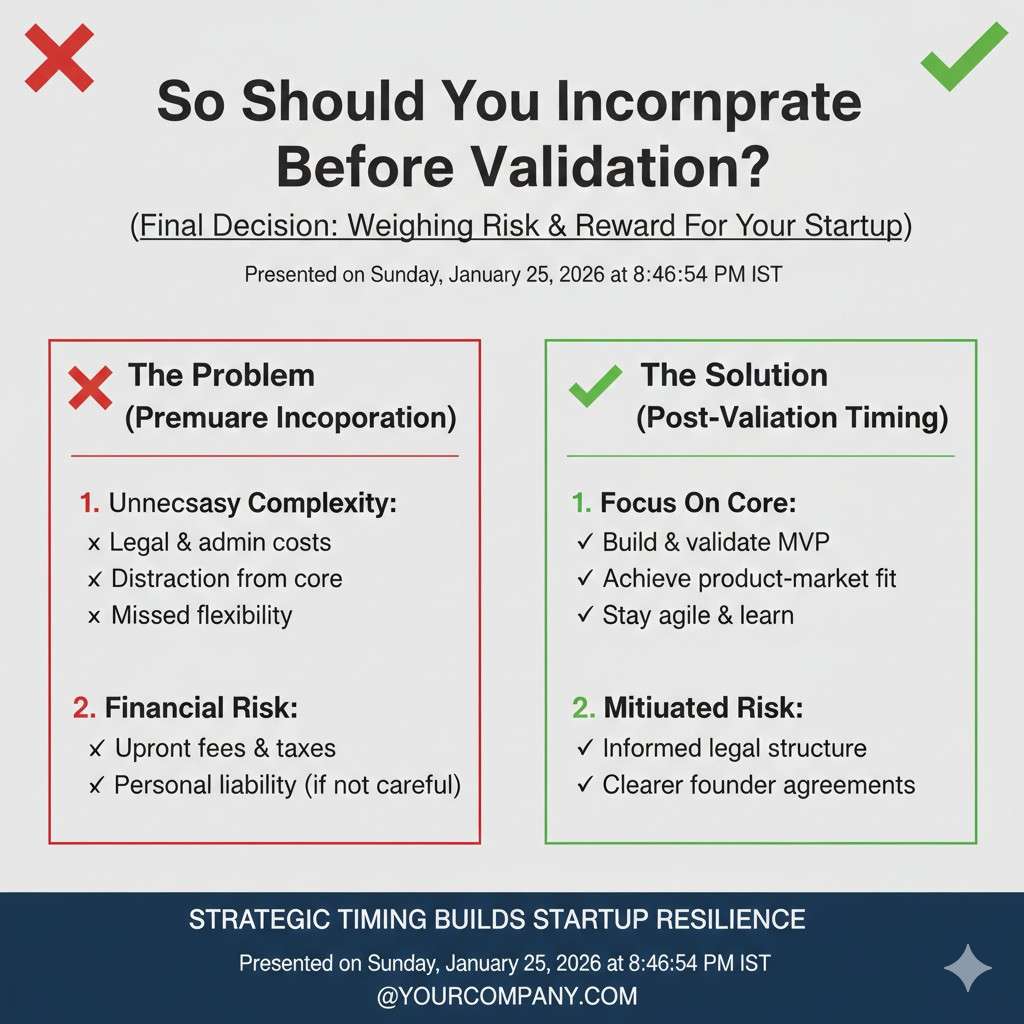
So should you incorporate before validation?
Sometimes yes.
But not for the reason people say.
You incorporate before validation if your validation path requires you to act like a real business.
Many deep tech startups need real-world testing, pilots, and partnerships to validate. That means contracts. It means insurance questions. It means data access. It means paying for components. It means shipping prototypes. It means hiring help.
In those cases, “waiting until validation” is not even possible, because validation itself needs the structure.
There is another reason to incorporate early:
If you are building a platform that will raise money soon, and you already have real momentum, you want a clean cap table and clean IP from day one.
Investors do not pay you more because you incorporated early.
But investors do walk away or slow down when the foundation is messy.
A clean foundation reduces friction. Reduced friction is speed.
Speed matters.
But can incorporating too early be a mistake?
Yes. It can.
Here are the two common “too early” problems.
First, founders incorporate, then do nothing for a year.
That creates taxes, filings, fees, and mental load for no benefit.
Second, founders incorporate before they have clarity on who the team is, and then they guess at equity splits.
Then they later find out the team changed, or the work split was not equal, or one person carried most of the load, and now the cap table is unfair and hard to fix.
So “too early” is not about a calendar date.
It is about incorporating before you have any real action that needs it, and before you have enough clarity to set ownership fairly.
If you are only doing customer calls and drawing diagrams, you can wait.
If you are writing meaningful code with a co-founder and paying people and signing pilots, you should not wait.
A tactical way to decide in one hour
Here is a practical exercise. You can do it today.
Imagine it is 90 days from now.
Picture the best case.
You ran fast. You learned a lot. You have something working.
Now ask: what happened in those 90 days?
Did you ship a prototype to a pilot?
Did you collect real data from a user?
Did you pay for help?
Did you accept money?
Did you sign an agreement?
Did you create something truly new?
If your honest answer includes any of those, incorporation should happen before you do them.
Because the point is to protect what you are about to create, not what you already created.
“Validation first” can still be smart, if you validate the right way
Some founders hear “incorporate early” and think they must stop everything and do paperwork.
No.
You can validate hard without incorporating, if you keep your validation lightweight.
This works well when:
You are still picking the problem.
You are testing demand with interviews.
You are building tiny demos that are not production code.
You are not sharing core designs broadly.
You are not paying people or taking money.
You are not signing contracts.
In that zone, your job is to learn quickly. A company can wait.
But be honest with yourself: many founders say they are “just validating” while they are quietly doing real building work that creates long-term value.
That is where trouble starts.
A note for AI and robotics founders: your “validation” often creates IP
In AI and robotics, validation is not always a landing page.
It is often:
A new control method.
A novel data pipeline.
A model training trick.
A sensor fusion approach.
A safer motion plan.
A hardware-software loop that is hard to copy.
That is IP. Even if it feels like “just a test.”
So if you are in these areas, you want to think about incorporation and IP early, not as a formality, but as strategy.
You do not need a mountain of patents.
You need the right protection around the right core.
This is one of the main reasons Tran.vc exists. They help founders build an IP plan that matches the product, then file what matters, so your work becomes an asset investors can respect and competitors cannot easily copy.
If you want help thinking this through in a founder-friendly way, apply here: https://www.tran.vc/apply-now-form/
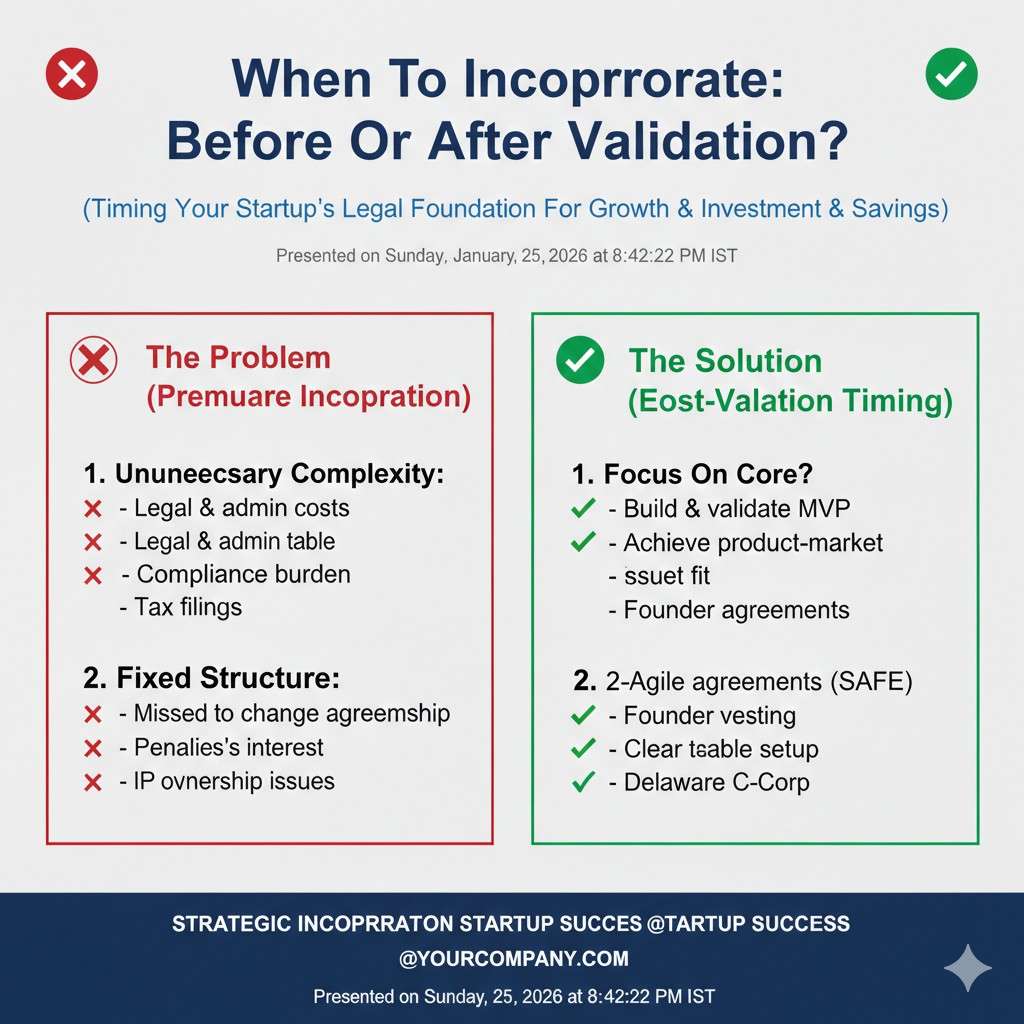
When to Incorporate: Before or After Validation?
Why this question shows up so early
Most founders meet this decision right when the work starts to feel serious. You may still be testing the problem, but you are also writing code, building prototypes, or talking to your first real customers. That mix creates confusion because part of you feels like you are still “just exploring,” while another part of you is already behaving like a business.
The truth is simple. Incorporation is not a prize you earn after you “make it.” It is a tool that can protect you while you build. The right time depends less on your confidence and more on what you are about to do next.
What Tran.vc does in this moment
If you are building AI, robotics, or deep tech, the early stage is often when your most valuable ideas are born. Tran.vc supports founders with up to $50,000 in in-kind patent and IP services, so you can turn early inventions into defensible assets while you move forward. If you want to build leverage early, you can apply anytime at https://www.tran.vc/apply-now-form/
What “validation” really means
Validation is not applause
Many people treat validation like a popularity test. They look for likes, excitement, and compliments. That kind of feedback can feel good, but it does not remove real risk. It can also trick you into building something that sounds interesting but does not solve a painful problem.
Real validation reduces uncertainty. It helps you see that a real customer has a real problem, and that they will take a real step to fix it. That step could be giving you data, agreeing to a pilot, introducing you to the buyer, or paying even a small amount.
Two kinds of risk you are trying to remove
Most founders think only about product risk. That is the question of whether people want what you are making. It matters, and you should take it seriously, because it saves you from wasting months on the wrong thing.
But there is also company risk. That is the risk that you create confusion around ownership, contracts, payments, and IP. Company risk is quieter at first, then suddenly loud when you try to raise money or sign a real deal. Incorporation is mostly about reducing company risk.
The trap of undefined validation
Founders often say, “I will incorporate after validation,” but they never define what that means. Then validation becomes a moving target, and months pass while the founder keeps doing work that creates value. By the time they finally incorporate, they have to untangle who owns what, what was built when, and what was promised to whom.
A better approach is to define validation in actions. Ask what you plan to do in the next eight to twelve weeks, and whether those actions create legal, financial, or IP risk. When you focus on actions, the decision becomes practical instead of emotional.